CarMax Auto Finance: How CarMax Financing Works, From Its Filings
CarMax’s own lender sees your application first, then outside lenders CarMax is paid by or pays. What its SEC filings print about rates, the 3-day payoff, paying a CAF loan and loan losses.
The short version
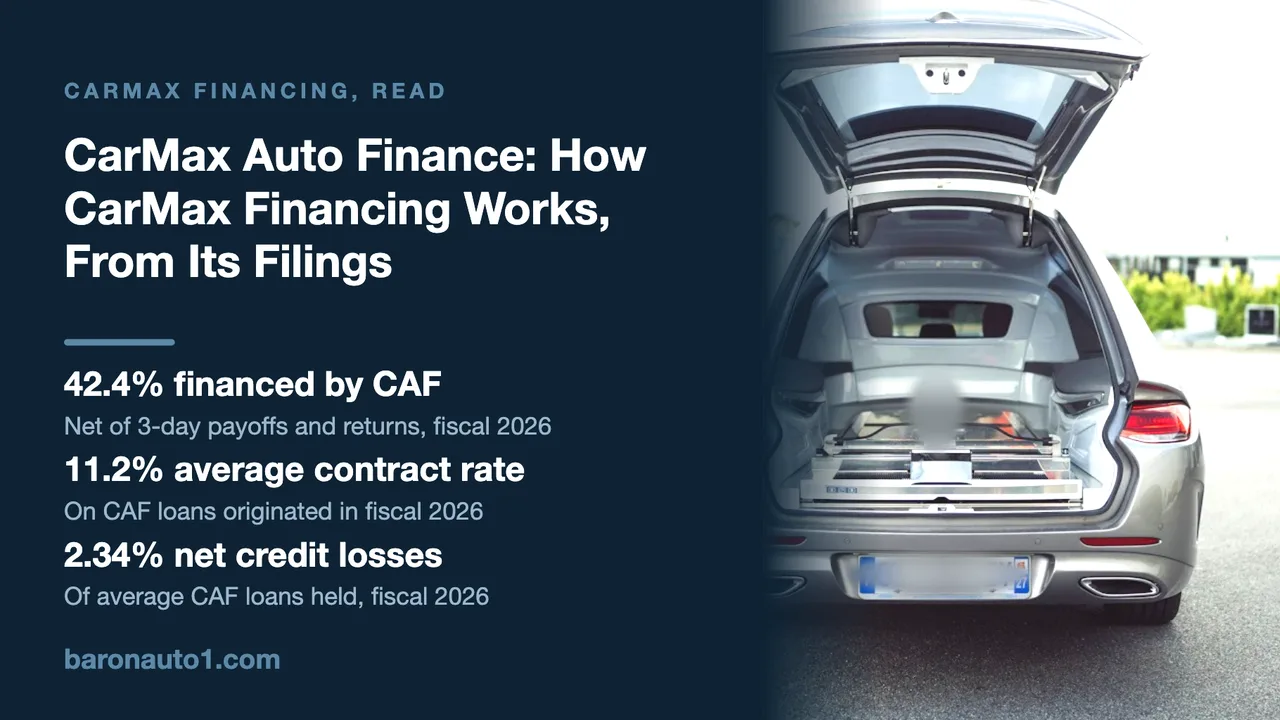
- CarMax financing is one application with three possible lenders. CarMax’s annual report says its own lender, CarMax Auto Finance (CAF), generally reviews it first; what CAF declines or approves with conditions generally goes to outside lenders CarMax calls Tier 2 and Tier 3. In fiscal 2026, before 3-day payoffs, CAF financed 44.9% of the used cars CarMax sold, Tier 2 lenders 16.7% and Tier 3 lenders 8.3%; the other 30.1% of buyers brought their own loan or needed none.
- CarMax says pre-qualifying is a soft credit inquiry with no effect on your score, and the terms last 30 days. The application you file to buy is a hard inquiry, and pre-qualified terms are “estimated”.
- CarMax publishes no rate range. Its 10-K prints an average: CAF’s weighted average contract rate was 11.2% on loans made in fiscal 2026, up from 8.5% in fiscal 2022, with a weighted average credit score of 723 and a term of 68.5 months.
- Every offer, from CAF or an outside lender, carries a 3-day payoff: CarMax’s filings say you can refinance “within three business days at no charge.” CAF itself “does not currently offer refinancing”, but there is no penalty for paying early.
- A CAF loan is simple interest, so a late payment costs more. Extra money goes to future payments and can move your next due date unless you call and ask otherwise.
- CAF’s net credit losses rose from 0.80% of average loans in fiscal 2022 to 2.34% in fiscal 2026. In February 2026 CarMax settled Justice Department allegations that it repossessed the vehicles of at least 28 servicemembers without court orders, neither admitting nor denying them.
CarMax Auto Finance is CarMax’s own lending arm, and CarMax financing is the process that decides whether CAF or an outside lender writes your loan. CarMax’s filings describe a fixed order: CAF reviews the application first, outside lenders see what CAF turns down, and every offer carries a three-business-day window to replace it. On 6 October 2026 we read CarMax, Inc.’s annual report for the year ended 28 February 2026, its reports for fiscal 2024 and 2025, its quarterly report to 31 August 2026, CarMax’s financing page and CarMax Auto Finance FAQ, a Justice Department settlement and the CFPB complaint file. We filed no application, so this page has no personal rates, and this site has no commercial relationship with CarMax or any lender.
How CarMax financing works: one application, three kinds of lender
CAF is not a bank you can walk into. CarMax’s 10-K says “CAF provides financing solely to customers buying retail vehicles from CarMax,” and its Help Center calls it “a division of CarMax.” CarMax’s fiscal year ends in February, so fiscal 2026 ran from March 2025 to February 2026; every year on this page is a CarMax fiscal year.
The annual report sets out the order: “Generally, credit applications submitted by customers to CarMax are initially reviewed by CAF using our proprietary underwriting standards.” Then “Applications that CAF declines or approves with conditions are generally evaluated by other third-party finance providers.” As of 28 February 2026 those were Ally Financial, American Credit Acceptance, Bank of America, Capital One Auto Finance, Exeter Finance Corp., Santander Consumer USA and Westlake Financial Services (our reviews of Ally, American Credit Acceptance, Bank of America, Capital One Auto Finance, Exeter Finance and Westlake Financial read each lender’s own terms).
CarMax’s financing article says “CarMax will share every offer that you receive,” and “At CarMax, we don’t have finance managers.” That article dates from 29 September 2022. Whatever the lender, the 10-K says cars “are financed using retail installment contracts secured by the vehicle.”
The third route is your own lender: the FAQ says you’ll “need to provide a voucher, check, or other proof of financing.” Our guide to car loan pre-approval covers getting one.
Pre-qualification: what the soft pull does and does not do
CarMax’s pre-qualification article, published on 12 August 2026, is plain: “A pre-qualification request is a soft credit inquiry, meaning it won’t impact your credit score.” The terms “are available for 30 days.” The annual report says customers can “request pre-qualification online with no impact to credit scores and receive their decisions and terms within minutes,” and that “Approximately 80% of our customers use our online finance-based shopping tool as they begin the credit process.”
A soft pull still asks for a lot: name, address, date of birth and Social Security number; housing status and monthly housing payment; employment status and income. A co-buyer “may help you receive more favorable terms,” and the FAQ warns that if your credit reports “are locked or frozen, our finance sources might not be able to complete a review,” so lift a freeze first.
Three limits are in CarMax’s own words. To buy, “you’ll submit a credit application, which includes a hard credit inquiry, to get your final offer terms on that vehicle.” The article’s comparison table answers “Final terms guaranteed?” with “No, credit application required for final terms.” And the small print says “Pre-qualification terms are estimated.”
| CarMax document | How many qualify | How fast |
|---|---|---|
| Financing page | “Over 97% get pre-qualified”; “97% approval rate” | “Results in just 4 minutes” |
| Pre-qualification article (12 August 2026) | “over 95% get pre-qualified”; “no minimum credit score needed” | “as little as 5 minutes”; most “in less than 3 minutes” |
| FAQ: Does CarMax offer financing? | Not stated | “5 minutes or less” for most decisions |
| Form 10-K, fiscal 2026 | Not stated | “within minutes” |
None of these figures gives a period or a base, and they disagree by a couple of points. They agree there is no published minimum score; our guide to the credit score you need to buy a car explains why lenders work in tiers rather than cut-offs.
CAF, Tier 2 and Tier 3: who pays whom
The Tier labels are CarMax’s, defined by which way a fee flows: “We refer to the providers who generally pay us a fee or to whom no fee is paid as Tier 2 providers, and we refer to providers to whom we pay a fee as Tier 3 providers.” CarMax pays Tier 3 lenders “because we believe their participation provides us with incremental sales by enabling customers to secure financing that they may not otherwise be able to obtain.” In fiscal 2026 the fees netted to a cost: third-party finance fees were minus $8.7 million, after minus $1.5 million in fiscal 2025 and minus $5.8 million in fiscal 2024.
For a borrower, one sentence matters most: “All fees either received or paid are pre-negotiated at a fixed amount and do not vary based on the amount financed, the interest rate, the term of the loan or the loan-to-value ratio.” On CarMax’s account, its fee is the same whether your rate is high or low, unlike the pattern in our guide to how a dealer-arranged rate is built. The 10-K does not say how each outside lender sets its own rate, so compare the APR on every offer.
Once you sign with an outside lender, the loan is theirs. CarMax says it has “no recourse liability for credit losses on retail installment contracts arranged and held by third-party providers.” Payments, extensions and any repossession then follow that lender’s terms, not CAF’s.
CAF is moving into Tier 2
“CAF also provides financing for customers who would typically be financed by a Tier 2 or Tier 3 provider,” the 10-K says, and those loans “have higher loss and delinquency rates than the remainder of the CAF portfolio, as well as higher contract rates.” In fiscal 2026 CAF kept below 15% of total Tier 2 loan volume and 5% of Tier 3. For fiscal 2027 CarMax intends to raise the Tier 2 target to “approximately 30% of the total volume across the Tier 2 spectrum,” and says “We do not plan to increase our target originations for Tier 3.” In the six months to 31 August 2026, CAF financed “approximately 23% of the total Tier 2 volume,” and 10% of the loans CAF made in that half were Tier 2. Tier 2 and Tier 3 loans grew from 3.4% of CAF’s book on 28 February 2026 to 4.7% on 31 August 2026.
How many buyers each lender finances
CarMax prints the split as used units financed by each channel “as a percentage of total used units sold,” before 3-day payoffs. “Other” “Represents customers arranging their own financing and customers that do not require financing.”
| Period | CAF | Tier 2 | Tier 3 | Other (own loan or no loan) |
|---|---|---|---|---|
| Fiscal 2022 | 46.1% | 22.5% | 7.8% | 23.6% |
| Fiscal 2023 | 45.4% | 22.0% | 6.5% | 26.1% |
| Fiscal 2024 | 45.8% | 18.9% | 7.0% | 28.3% |
| Fiscal 2025 | 45.0% | 18.0% | 7.1% | 29.9% |
| Fiscal 2026 | 44.9% | 16.7% | 8.3% | 30.1% |
| Six months to 31 August 2026 | 44.5% | 15.8% | 8.3% | 31.4% |
Tier 2’s share fell from 22.5% to 16.7% while Tier 3’s rose to 8.3%; together the outside lenders went from 30.3% of used units to 25%, by our arithmetic. “Other” climbed from 23.6% to 30.1%, and to 33.2% in the quarter to 31 August 2026, which the 10-Q puts down to “lower Tier 1 penetration as customers use alternate funding in response to increased rates.”
After payoffs and returns, “CAF financed 42.4% of our retail used vehicle unit sales in fiscal 2026,” after 42.7% in fiscal 2025 and 42.9% in fiscal 2024. The gap between 44.9% and 42.4% is 2.5 percentage points, by our arithmetic; CarMax does not split it between borrowers who refinanced away and cars that came back.
CarMax wants the CAF share higher, toward “our initial goal of increasing CAF penetration to 50%.” It says “We believe CAF enables us to capture additional profits, cash flows and sales,” and values each extra percentage point at “$10 million to $12 million in lifetime pre-tax income per year of origination.” That is CarMax’s interest in a CAF loan, in its own words. A CAF offer may still be your cheapest; only a comparison of APRs will tell you.
What CAF’s loans look like: rate, score, term and loan-to-value
No CarMax page read on 6 October 2026 prints an APR range or a rate sheet, and the only term range we found is in the 2022 article: CAF “offers term lengths between 36 and 72 months.” The payment calculator’s sample rate is an illustration and is not used here. The 10-K prints weighted averages for the loans CAF made, after 3-day payoffs:
| Period | Loans financed | Contract rate | Credit score | Loan-to-value | Term (months) |
|---|---|---|---|---|---|
| Fiscal 2022 | 393,681 | 8.5% | 703 | 88.7% | 66.6 |
| Fiscal 2023 | 340,077 | 9.7% | 708 | 88.3% | 66.0 |
| Fiscal 2024 | 328,704 | 11.2% | 719 | 88.7% | 65.4 |
| Fiscal 2025 | 336,595 | 11.3% | 723 | 89.6% | 67.6 |
| Fiscal 2026 | 331,380 | 11.2% | 723 | 89.7% | 68.5 |
| Six months to 31 August 2026 | 192,600 | 11.6% | 721 | 89.1% | 68.9 |
From fiscal 2022 to fiscal 2026 the average rate rose 2.7 percentage points while the average credit score rose 20 points, by our arithmetic. In the latest quarter the rate reached 11.8%, which the 10-Q attributes to “shifts in customer mix as a result of our continued Tier 2 expansion.” An average is not your rate: the 10-K says a borrower’s credit grade “influences the terms of the agreement, such as the required loan-to-value ratio and interest rate.”
The score column needs a caution. CarMax says “FICO® scores are not a significant factor in our primary scoring model,” which uses bureau data and application information that “includes income, collateral value and down payment.” Customers “with the highest probability of repayment are A-grade customers,” and A-grade loans were 58.2% of CAF’s book on 28 February 2026.
Loan-to-value sits near 90% because CarMax measures it against “the vehicle selling price plus applicable taxes, title and fees.” Net loans originated divided by loans financed comes to $24,119 per CAF loan in fiscal 2026, by our arithmetic, against an average used-car price of $26,121. Long terms at that loan-to-value build equity slowly, which is how negative equity starts. Compare these averages with our guides to used car loan rates and credit union rates.
Loss provisions and charge-offs: what the filings show
The provision for loan losses is CarMax’s estimate of what CAF’s loans will lose over their life; net credit losses are what was written off, less recoveries. The fiscal 2024 and 2025 reports measure them against “total average managed receivables”; the fiscal 2026 report uses “average auto loans held for investment” and reprints fiscal 2025’s loss rate at the same 2.03%.
| Period | Provision for loan losses | Net credit losses | Net credit losses, % of average loans | Past due, % of loans | Average recovery rate |
|---|---|---|---|---|---|
| Fiscal 2022 | $141.7 | $119.8 | 0.80% | 4.02% | 70.8% |
| Fiscal 2023 | $317.0 | $242.8 | 1.49% | 5.00% | 64.2% |
| Fiscal 2024 | $310.5 | $334.9 | 1.93% | 5.44% | 53.0% |
| Fiscal 2025 | $334.7 | $358.8 | 2.03% | 4.85% | 47.2% |
| Fiscal 2026 | $391.2 | $396.9 | 2.34% | 5.11% | 45.5% |
| Six months to 31 August 2026 | $209.0 | $164.7 | 2.03% | 5.10% | 46.3% |
The fiscal 2026 loss rate was 2.9 times the fiscal 2022 rate, by our arithmetic. CarMax blames loans “originated in 2022 and 2023, when average selling prices were elevated and these customers were later challenged by the inflationary environment,” and says that after it tightened CAF’s underwriting, “loans originated after April 2024 are performing in line with expectations.” The newest move runs the other way: CAF’s allowance for future losses rose to 3.07% of loans on 31 August 2026, from 2.78% in February, “primarily driven by our continued expansion in the Tier 2 credit space.”

The recovery rate matters if a car is repossessed. CarMax defines it as “the average percentage of the outstanding principal balance we receive when a vehicle is repossessed and liquidated, generally at our wholesale auctions.” It fell from 70.8% to 45.5% over the five years, near the bottom of the 45% to 71% range the 10-K gives for the past 10 fiscal years. The less a sale recovers, the more the borrower can still owe; our guide to what survives a repossession covers deficiency balances.
The 3-day payoff, and refinancing later
The annual report’s wording: “All finance offers, whether from CAF or our third-party providers, are backed by a 3-day payoff option, which allows customers to refinance their loan with another finance provider within three business days at no charge.” CarMax watches how often buyers use it, “as the percentage of customers exercising this option can be an indication of the competitiveness of our offer.”
CarMax’s customer page on the program sits under a path its robots.txt disallows, so we did not read it. Two other statements frame the window. The FAQ says you can “refinance your vehicle at any time after purchase,” but “refinancing often cannot be completed until the title and registration are processed.” And “CarMax Auto Finance does not currently offer refinancing,” though “there’s no penalty for paying off your account early.”
Read together, three business days suit a loan you have already lined up, not one you start shopping for after signing. Bring a bank or credit union approval, compare it at the desk, and if you take CarMax’s offer anyway, the window lets you switch without a charge. Later refinancing works as for any car loan; see when to refinance a car loan.
The payoff window is three business days; the return policy is separate. CarMax’s return policy, read by this site on 30 September 2026, is a 10-day money-back guarantee, and if your financing included negative equity from a trade-in, CarMax says “you can either repay the negative equity or finance it with a different vehicle, subject to financing approval.” Our CarMax warranty guide covers the return terms.
Paying a CAF loan: simple interest and how payments are applied
CAF does its own servicing: the 10-K says it handles “billing statements, collecting payments, maintaining contact with delinquent customers, and arranging for the repossession of vehicles securing defaulted loans.” On 31 August 2026 that meant “approximately 1.0 million customer accounts,” including “$1.20 billion of auto loans that have previously been sold.” A sold loan does not change who you pay.
Interest builds every day
The CAF FAQ calls the contract “a ‘simple interest’ contract,” with finance charges that “accrue daily, beginning on the date of your contract.” Its formula is principal balance times APR divided by 365, and its example is $10,000 at 10% APR accruing $2.74 a day. Pay five days late on that balance and about $13.70 more interest has built up, by our arithmetic. CarMax’s own summary: “your payment history will determine whether your final payment amount is more or less than originally scheduled.” Our guide to how loan interest accrues explains the mechanics.
Extra payments move the due date
Money paid above what is due “will be applied to future scheduled payments, which may advance your next due date,” the FAQ says. Its example: pay $500 against a $100 payment and the remaining $400 goes to principal and future payments, “pushing out your next due date.” Interest keeps running: “even if you are paid-ahead, finance charges will continue to accrue daily on your account.” CarMax recommends paying monthly anyway, and says to call if you do not want extra money applied to future payments; principal-only payments are also arranged by phone.
CarMax’s pages list two payment orders. The CAF FAQ says payments go “first to finance charges, then to any late charges, then to principal balance, and finally to any fees”; the separate finance-charge answer lists past-due balance, finance charges, principal, then future payments and fees. Your retail installment contract governs, so check its payment clause.
- Partial payments are allowed “as long as the FULL amount of the monthly payment is received by the monthly due date.”
- Grace periods “vary based on applicable law.” CarMax suggests mailing payments 7 to 10 days early, and says a late charge on a payment received near the end of the grace period “will automatically be removed” once it is processed.
- Statements are generated 18 days before each due date and stay online for 13 months.
- Online access may be restricted at 75 or more days past due, in bankruptcy, or after multiple returned payments.
- The final payment can be larger after late payments, an extension or fees; CarMax says it will warn you 12 payments and 6 payments before maturity.
Title, insurance and credit reporting
Title paperwork uses a different name from the brand: if you move states, the FAQ says to have the new DMV send a letter to “CARMAX BUSINESS SERVICES LLC” and to allow 30 to 60 days. After payoff, the title can take up to 60 days in electronic-title states and 2 to 3 weeks in paper-title states. A co-buyer “cannot be removed from the title.” Maximum insurance deductibles are $1,000 for collision and $1,000 for comprehensive. CAF reports to Experian, Equifax and TransUnion.
Falling behind: extensions, charge-off and repossession
An account is delinquent when the customer “fails to make a substantial portion of a scheduled payment on or before the due date,” the 10-K says. CAF’s FAQ says extensions “may be requested over the phone,” with an estimated new final payment. Accounts are generally charged off when “the loan is 120 days or more delinquent as of the last business day of the month, the related vehicle is repossessed and liquidated, or the loan is otherwise deemed uncollectable.” At the end of fiscal 2026, 5.11% of CAF’s loans were past due. Most repossessions need no court order, as our guide to how repossession works explains; servicemembers are the exception.
The Justice Department’s SCRA settlement
On 23 February 2026 the Justice Department announced a settlement with CarMax, Inc. under the Servicemembers Civil Relief Act (press release 26-178). The agreement resolves allegations that CarMax repossessed, “without court orders, the vehicles of at least twenty-eight (28) servicemembers,” “from March 1, 2018, through at least October 24, 2023,” including some after owners said they were in military service. It states: “Defendant neither admits nor denies any of the allegations made by the United States.”
CarMax will pay at least $420,000 to servicemembers, $15,000 per violating repossession plus lost equity and interest, and a $79,380 civil penalty. It must check the Defense Department’s military-status database no more than 2 business days before referring a vehicle for repossession, and again before selling it, and ask the credit bureaus to delete the affected accounts. The agreement runs for 4 years. The release states the rule: no repossession of a servicemember’s vehicle without a court order if at least one payment was made before entering service. CarMax’s FAQ says CAF borrowers can request SCRA benefits by phone, email, fax or mail. Neither the fiscal 2026 annual report nor the August 2026 quarterly report mentions the settlement.
What the CFPB complaint file and the courts show
On 6 October 2026 we pulled complaint counts for CarMax, Inc. from the CFPB database. Under “Vehicle loan or lease” it holds 1,195 complaints received between 26 June 2017 and 23 September 2026, 1,135 about loans and 59 about leases: the 22nd-largest count among 1,152 companies named in the category. Yearly counts rose from 174 in 2024 to 297 in 2025, with 237 more by 23 September 2026. The CFPB warns its database “is not a statistical sample of consumers’ experiences in the marketplace.” Complaints are unverified, counts grow with a lender’s size, and CAF services about 1.0 million accounts. A loan CarMax arranged with an outside lender is complained about to that lender.
| Issue | Complaints | Share | Largest sub-issue |
|---|---|---|---|
| Managing the loan or lease | 307 | 25.7% | Billing problem (164) |
| Getting a loan or lease | 216 | 18.1% | Fraudulent loan (77) |
| Repossession | 194 | 16.2% | Loan balance remaining after the vehicle is repossessed and sold (49) |
| Incorrect information on your report | 141 | 11.8% | Account information incorrect (56) |
| Problems at the end of the loan or lease | 133 | 11.1% | Unable to receive car title or other problem after the loan is paid off (74) |
| Struggling to pay your loan | 104 | 8.7% | Denied request to lower payments (54) |
The shares are our arithmetic. CarMax closed 1,164 with an explanation, 18 with non-monetary relief and 13 with monetary relief, and responded on time to 1,192. The issues match the terms above: billing, balances left after repossession, and title delays after payoff. Of the 1,195, 124 carry the CFPB’s Servicemember tag and 10 more carry it with Older American.
The other public record is an investor case, not a borrower case. CarMax’s 10-K reports that Jason Cap v. CarMax, Inc., et al. was filed on 3 November 2025 for investors who bought CarMax securities between 20 June and 5 November 2025, under the Securities Exchange Act of 1934. The August 2026 10-Q says it was transferred to the Eastern District of Virginia on 23 September 2026 and that CarMax has moved to dismiss; CarMax says the claims are without merit. We have not read the complaint. A web search of the CFPB and FTC sites on 6 October 2026 found no CFPB enforcement action naming CarMax, a search result rather than a clearance; the 10-K says CarMax’s financing is subject to the CFPB’s supervisory authority.
Before you finance at CarMax
- Get an outside approval first. It gives CarMax’s offers something to beat and makes the 3-day payoff usable.
- Unfreeze your credit reports before applying. CarMax says frozen reports can stop a review.
- Treat pre-qualified terms as estimates. The purchase application is a hard inquiry and sets the final terms.
- Ask which lender each offer comes from. An outside lender’s loan is serviced on that lender’s terms.
- Compare APRs and total cost, not payments. CAF’s average term was 68.5 months in fiscal 2026.
- Decide on add-ons separately. See our CarMax warranty and GAP insurance guides, and the out-the-door price before financing is discussed.
- Mark the date your 3-day payoff window closes. It counts business days.
- If you pay extra, decide where it goes. Call CAF to put it on principal rather than future payments.
If a trade-in is part of the deal, our guide to the CarMax appraisal reads that offer from CarMax’s filings, and Carvana vs CarMax compares the two retailers.
Common questions
Is it good to finance with CarMax?
It depends on the rate you are offered against what your own bank or credit union offers. CarMax’s lender network includes CAF and seven outside lenders, pre-qualifying is a soft pull, and every offer carries a 3-day payoff at no charge. CarMax’s 10-K also says CAF lets it “capture additional profits,” so compare APRs before choosing.
What is CarMax’s financing interest rate?
CarMax does not publish one. Its annual report prints the weighted average contract rate on loans CAF made: 11.2% in fiscal 2026 and 11.6% in the six months to 31 August 2026. Your rate depends on your credit grade, down payment and the car.
Does CarMax pre-qualification hurt your credit?
CarMax says no: it “is a soft credit inquiry, meaning it won’t impact your credit score,” and the terms last 30 days. The credit application you submit to buy is a hard inquiry.
Who are CarMax’s lenders?
CarMax Auto Finance first, then, as of 28 February 2026, Ally Financial, American Credit Acceptance, Bank of America, Capital One Auto Finance, Exeter Finance Corp., Santander Consumer USA and Westlake Financial Services, split into Tier 2 and Tier 3 by whether CarMax is paid or pays a fee.
Can I refinance a CarMax Auto Finance loan?
Yes, with another lender. CAF “does not currently offer refinancing,” but there is no penalty for paying it off early. Within three business days of purchase CarMax’s filings say you can replace the financing at no charge; after that, refinancing often waits for title and registration.
Who services a CarMax Auto Finance loan?
CAF does, including loans it has sold. Payments can be made online, in the CarMax app, by phone, by mail, or through Western Union or MoneyGram, which may charge a fee.
Sources and further reading
- SEC EDGAR filings: CarMax, Inc.
- CFPB consumer complaint database
- CFPB auto loan resources
- CFPB: what is the difference between dealer-arranged and bank financing?
- CFPB: how does a lender decide what interest rate to offer me on an auto loan?
- CFPB: what is a credit score?
- FTC vehicle repossession
Recall, complaint and safety-rating figures on this page were retrieved from the federal databases above on August 19, 2026. Federal data changes — re-check any VIN before you rely on it.
Published October 6, 2026 · last updated October 6, 2026. Found something out of date or wrong? Tell us and we will correct it.