Lexus Financial Services Review: Pay, Payoff, Lease End, Who Holds It
Lexus Financial Services is a service mark of Toyota Motor Credit Corporation, with leases owned by Toyota Lease Trust. What LFS’s own pages say about paying, payoff and title, the $500 wear waiver and $7,500 Excess Wear & Use cap, the disposition-fee waiver, how they differ from Toyota’s, and where LFS’s documents contradict each other.
The short version
- Lexus Financial Services (LFS) is a service mark used by Toyota Motor Credit Corporation (TMCC), the company behind Toyota Financial Services. TMCC services every LFS loan and lease, and Toyota Lease Trust owns the leases.
- Newer Lexus contracts do not appear to come from Toyota Financial Savings Bank. TMCC’s 10-K moved only new Mazda contracts to that bank, and no LFS page ties it to Lexus.
- Paying from a bank account is free. LFS “can’t process cash, credit, or debit card payments,” and its current online terms put the same-day cut-off at 6 p.m. Central.
- A payoff quote is good for 10 days. A paper title should arrive 25 to 40 business days after the payoff posts; an electronic one within 7.5 to 9.5 weeks.
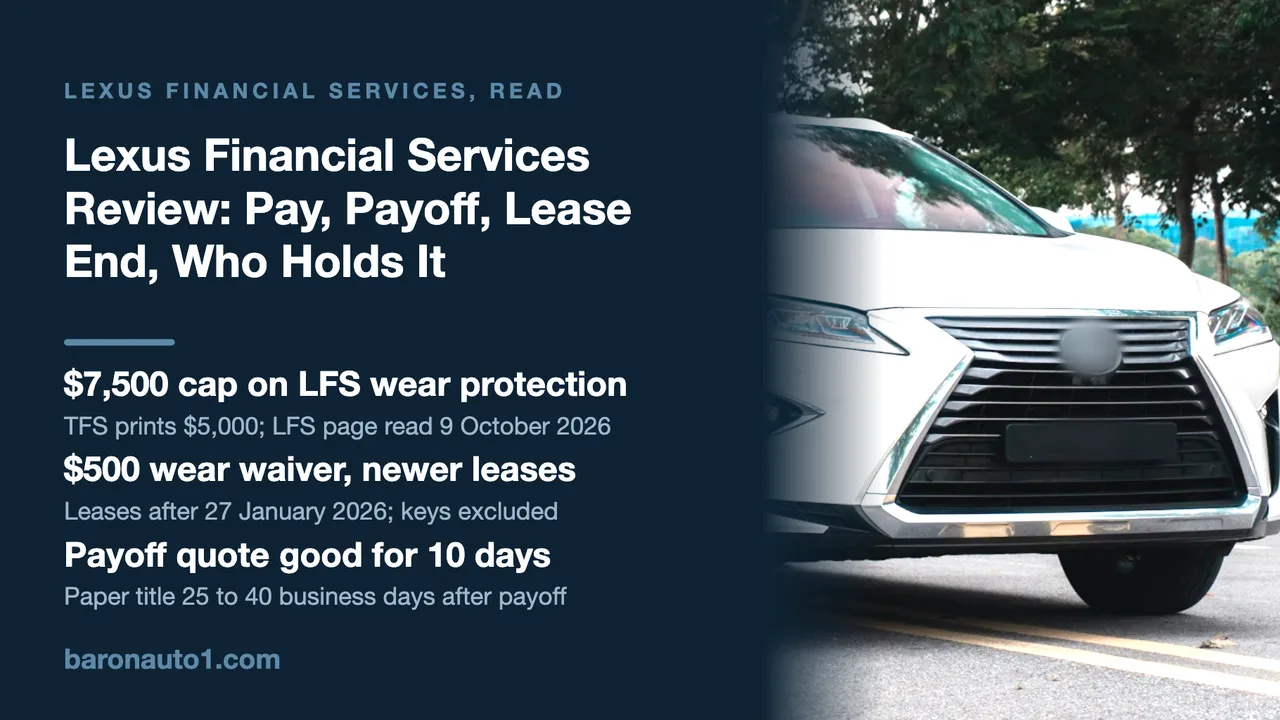
- Return a lease only to a Lexus or Toyota dealer. Leases signed after 27 January 2026 get up to $500 of wear waived, LFS’s Excess Wear & Use Protection covers up to $7,500 against Toyota’s $5,000, and returning customers can have the disposition fee waived up to $350.
- The CFPB’s 2016 and 2023 consent orders were issued against TMCC, the company that services every Lexus account. Lexus complaints are filed under TMCC; a separate “LEXUS FINANCIAL SERVICES” name holds 1.
Most people who search “Lexus Financial Services” want to pay, pay off a loan, end a lease or find out who holds the contract. On 9 October 2026 we read what LFS publishes on those questions: its payment, payoff, title and lease-end pages and FAQs, its glossary, two editions of its Lease-End Guide, its lease-programs and wear PDFs, and the Online Policies and Agreements on its site. We also read the passages of TMCC’s 10-K for the year to 31 March 2026 and 10-Q to 30 June 2026 that say who holds Lexus contracts. TMCC’s regulator record is shared with Toyota, so we summarise it from our Toyota Financial Services review, read on 6 October 2026. We entered no login or credit application, and this site has no commercial relationship with Lexus, TMCC or any lender.
Who Lexus Financial Services is, and who holds your contract
The footer of every LFS page answers it: “Lexus Financial Services is a service mark used by Toyota Motor Credit Corporation (TMCC) and Toyota Motor Insurance Services, Inc. (TMIS) and its subsidiaries.” Loans “may be owned by TMCC or its securitization affiliates,” leases by Toyota Lease Trust (TLT), and “TMCC is the servicer for accounts owned by TMCC, TLT, and their securitization affiliates.” TMCC’s 10-K agrees: “TMCC is marketed under the brands of Toyota Financial Services, Lexus Financial Services, and Bass Pro Shops Financial Services.” It adds that Toyota Lease Trust “acts as lessor and holds title to leased vehicles in the U.S.” Even the terms you accept online are TMCC’s: in the Online Policies and Agreements, effective October 10, 2025, “we” means Toyota Motor Credit Corporation.
| Company | Role on an LFS account |
|---|---|
| Toyota Motor Credit Corporation (TMCC) | Buys contracts from Lexus dealers, may own the loans, services every account |
| Toyota Lease Trust (TLT) | Owns leases and holds title to the leased car |
| Toyota Motor Insurance Services (TMIS) | Shares the LFS name; administers GAP and other protection products |
| Toyota Motor Sales, U.S.A. | Offers the college-graduate and military rewards, says the 2021 lease-programs brochure |
| Toyota Financial Savings Bank | Named on LFS’s site only as an affiliate; TMCC’s 10-K ties it to Mazda, not Lexus |
The Toyota plumbing shows in ordinary tasks. Pay a Lexus account through Western Union and LFS tells you to give the company name “based on account type”: “Retail Toyota Motor Credit” or “Lease Toyota Lease.” Move state with a leased Lexus and “Lexus Financial Services (LFS) or Toyota Lease Trust (TLT) must be listed as the legal owner or lessor on all title and registration documentation.” LFS’s documents describe the link four ways: a “service mark used by” TMCC and TMIS (footer), “a service mark of both TMCC and TMIS” (FAQ), “Toyota Motor Credit Corporation d/b/a Lexus Financial Services” (December 2025 Lease-End Guide) and “a division of Toyota Motor Credit Corporation” (2021 brochure). All four put TMCC behind the money.
Does Toyota Financial Savings Bank now write Lexus contracts? Our Mazda Financial Services review found that new Mazda contracts come from that bank. We found no such shift at Lexus. TMCC’s 10-K says “In fiscal 2025, TMCC transitioned the origination and financing of new automotive finance and lease contracts under the Mazda Financial Services (“MFS”) Agreement to Toyota Financial Savings Bank (“TFSB”).” Every other passage naming the bank concerns contracts “originated under the MFS Agreement by TFSB” or shared services; none mentions Lexus, and the 10-Q to 30 June 2026 does not mention the bank at all. On lexusfinancial.com it appears once, in TMCC’s privacy policy (revised May 8, 2025), as an example of the “other financial service companies” that may receive shared information. Your contract’s assignment section and your title name the holder for certain.
The dealer writes the contract and sets the rate. LFS’s glossary says the contract “is later assigned to a secondary finance source, such as LFS,” and its FAQ says “Your Annual Percentage Rate (APR) is agreed upon by you and your dealer.” TMCC never reports Lexus on its own: its volume was “approximately 97 percent Toyota/Lexus and 3 percent private label/non-Toyota/Lexus.” A preapproval from another lender gives you a rate to hold the dealer to; our guide to the buy rate explains the dealer’s margin.
How to pay Lexus Financial Services, and what each way costs
LFS’s Ways to Pay page and payments FAQ list these routes. Every route LFS runs itself draws on a bank account.
| Method | What LFS says it needs | Fee, as LFS prints it |
|---|---|---|
| Pay Online (website) | Bank account and routing number; one-time or recurring | “Right now, we will not charge you any monthly or payment transaction fees” |
| myLFS app or Lexus App | The Lexus App needs a web-registered account, a matching VIN and affiliate sharing on | None printed |
| AutoCheque (automatic debit) | A paper form; “generally completed within 14 business days” | None printed |
| Phone or mail | A checking account, or a check to the address on your statement | None printed |
| Western Union Quick Collect | Cash or debit card; company name Toyota Motor Credit or Toyota Lease | “Western Union will collect a fee”; no amount |
| CheckFreePay | Cash at a retail location | “CheckFreePay collects a fee”; no amount |
The payments FAQ says “Unfortunately, we can’t process cash, credit, or debit card payments,” and LFS may “return the cash to the sender by regular mail.” Western Union and CheckFreePay take cash or a debit card and pass the payment on, for a fee LFS does not print. The Lexus App carries a privacy condition: to link your account you must “Have affiliate sharing enabled for LFS privacy choices,” and if you turned it off, “they will need to re-select and enable affiliate sharing in order to link LFS account on Lexus App.” If you would rather keep that sharing off, pay on the website or in the myLFS app.
Timing matters more than method. The Online Policies and Agreements, effective October 10, 2025, say that “if you enter a payment post date after our cut off hour of 6 p.m. Central Time, we may change the payment post date of our payment to the date of our next business day.” That is 7 p.m. Eastern or 4 p.m. Pacific, by our arithmetic. Our Toyota review quoted TMCC’s older terms PDF, effective July 1, 2020, which said 5 p.m. Pacific, an hour later. The glossary adds “There are two days from the submit date to the credit date,” and once a payment is “in process” on its post date you cannot change or revoke it online. Pay a couple of days early.
Recurring payments cover the scheduled amount only: “late fees, tolls, and parking tickets” are not debited with them. Weekly and bi-weekly schedules are “only available for Other Fixed Amount.” LFS cancels recurring payments itself after the final lease payment and “If your bank has returned NSF payments four or more times within the last 12 months.” Extra money is applied to principal but “will be applied towards your next scheduled payment,” so choose “Make A Principal Only Payment” if you want the balance cut; “Your account must be current.” LFS prints no late fee: “Late fees are subject to state laws.” Refunds come by check; “allow approximately 7-10 business days from the date the refund check is mailed.”
You can ask to move your due date, but not if the account is past due, a lease is “near maturity,” or you have not made the first payment. A lease change requested “within 17 days” of the current due date waits a month, the total move over the contract is “no more than 29 days,” and loans cannot move to the 31st or leases to the 29th, 30th or 31st.
Extensions, deferrals and falling behind
LFS offers loan extensions and lease deferrals. An extension moves a payment to the end of the loan, but “your interest will still be calculated daily in accordance with the terms of your loan agreement and may result in additional finance charges.” Deferrals “require evaluation and approval on a case-by-case basis and could result in additional charges.” Get the new maturity date and extra charge in writing. If a car is repossessed, LFS says you can get it back “by either redeeming or reinstating your contract” and that it will send “a notice of intent to sell.” After a sale you owe any shortfall, and “if the proceeds are more than the amount owed, we will send you the excess.” Our Toyota review sets out TMCC’s collection timeline, and our repossession guide the state rules. TMCC’s privacy policy adds that it “may direct Toyota Motor North America (TMNA) to find your vehicle” for alleged fraud or a breach of your contract.
Keep insurance current. A loan needs physical damage cover for the car’s full value, with “no deductible limitations”; on a lease, “Physical damage insurance is required for the full value of the vehicle, with a maximum deductible of $1,000.”
Payoff quotes and getting your title
The payoff quote sits under Remaining Balance in your account. LFS says “A Payoff Quote is good for 10 days from the date it is provided,” though the amount can change if “returned payments or other charges or fees post to the account.” To send the title to a dealer or new lender, “Written or verbal authorization is required for the title/lien release to be sent to a third party.”
| Title type | What LFS does | Then | Total LFS expects | When to chase |
|---|---|---|---|---|
| Paper title or lien release | Sends it within 10 business days | 15 to 30 business days in the post | 25 to 40 business days | After 40 business days, contact LFS |
| Electronic title | Notifies the state within 10 business days | The state takes 6 to 8 weeks | 7.5 to 9.5 weeks | After 9.5 weeks, contact your state titling agency |
These are the same figures Toyota prints, with the same exception: “Florida and Arizona generally require the title to remain electronic unless the owner requests a paper title.” Title problems after payoff are a recurring complaint about TMCC, as the counts below show, so diary the chase date the day you pay.
Ending a Lexus lease: returning it, buying it or leaving early
LFS gives three roads at lease end: turn the car in and buy or lease a new Lexus, buy the car you have, or hand it back. The return has one firm rule: “Ensure you return your vehicle back to a Toyota or Lexus dealer by lease-end.” “Your originating Dealer is required to process the vehicle return”; other Toyota and Lexus dealers usually will, “while not required,” so book the turn-in “approximately 30 days prior to your lease maturity date.”
Do not drop a Lexus lease at an independent dealer or car buyer. LFS’s Return Your Vehicle page calls that “an unauthorized third-party vehicle return.” If you assign your purchase option to such a dealer, “you remain responsible for all obligations under the lease agreement” until LFS has the payoff and paperwork, and if you leave the car there, “we deem the vehicle to remain in your possession until the vehicle is delivered to us.”
Bring “Your LFS Odometer Disclosure Statement,” the tool kit and spare, every key and remote, the manuals and any original equipment; missing items can bring “additional charges.” Sign the odometer statement and keep a copy, tell LFS the car is back through your account or app, and cancel automatic payments (“Yes, and this is one people forget”). TMCC’s privacy policy says it will have Toyota Motor North America locate a returned lease car “To ensure that your lease return is accurately recorded.” That matters: as the 2023 order below shows, late-logged returns once got lessees reported as delinquent.
The Lease End Invoice may list unpaid payments, late fees, “property taxes and parking/traffic citations,” wear, mileage and the disposition fee, and “These items may be taxable.” The December 2025 Lease-End Guide says it comes “60 to 120 days after your vehicle is returned.” A security deposit comes back by check but “will be used to first pay any Lease End Invoice charges.”
Buying the car. Get a payoff quote in your LFS account; for a loan, “you can head straight to your dealer for help,” and “Some states require that you purchase your lease vehicle through your dealer.” TMCC’s 10-K says the lessee may buy “at the contractual residual value”; if you return the car, the dealer may buy it at that price or “a market-based price.” See our lease buyout guide.
Leaving early. “You can return your vehicle at any time. However, early termination charges may apply, which can be substantial.” LFS prints no formula. For a return 31 days or more early, the Early Lease Return page says “TFS will calculate your early return balance” using “the lowest calculation of this balance based on your lease agreement,” with the invoice “60-120 days after return.” It lists four exits that may cost less: the Servicemembers’ Civil Relief Act, under which eligible service members may end a lease “without early lease termination charges”; a Gold Star Military Program; a Deceased Customer Transfer of Lease; and Probate Lease Cancellation when all parties on the lease have died. “Cancellation or forgiveness of lease obligations may be taxable as income.” Our lease takeover guide compares other lessors.
Mileage, wear and Lexus’s protection limits
Your allowance is in your lease. LFS’s formula is the term in months, divided by 12, times “15,000 (standard lease) or 12,000 (low mileage lease)”, so 45,000 miles on a standard 36-month lease. Low-mileage leases come at “5,000 miles (33- to 60-month terms only), 7,500 miles, 10,000 miles or 12,000 miles”; on a hypothetical 36-month lease at 5,000 miles, that is 15,000 miles, 30,000 fewer than standard, by our arithmetic. What going over costs is not on LFS’s FAQs: “you will be charged for the additional mileage,” so call your dealer. Only the glossary gives a figure, as an example: “(e.g., $0.15 per mile).” Toyota’s FAQ says “typically $0.15 per mile.” Our lease-or-buy guide covers allowances.

Can you buy miles up front? The FAQ: “Unfortunately, we’re not currently offering that as an option.” The glossary: you “can add the anticipated excess mileage (at $.10 per mile) to your lease.” The 2021 brochure: “Purchase additional miles up front (standard lease only).” On a hypothetical 1,000 extra miles, that is $150 at the example overage against $100 bought up front, $50 apart, by our arithmetic. Ask the dealer before you sign.
Wear rules changed this year. LFS’s Wear & Use page says that “FOR LEASES AFTER JANUARY 27, 2026” it will “waive excess wear and use charges (excluding missing equipment, parts, and accessories, like missing keys and remote entry devices) up to a maximum of $500.” For earlier leases, charges “may be waived if the customer has an EWU product.” Neither heading covers a lease signed on 27 January itself.
That product, Excess Wear & Use Protection, is optional, and Lexus’s version has higher limits than Toyota’s: “Each eligible event valued at $2,000 or less Each eligible missing part or equipment valued at $250 or less Up to $7,500 in excess wear and use charges.” Toyota prints $1,000, $200 and $5,000, so Lexus allows $1,000 more per event, $50 more per part and a $2,500 higher total, by our arithmetic. LFS prints no price.
| Area | Excess, as LFS describes it |
|---|---|
| Paint and body | A single dent greater than a credit card; poor or missing collision repairs; holes in panels |
| Glass and lights | Windshield cracks, stars or bullseye; damaged or non-factory tinted glass; broken or missing lights and mirrors |
| Tires and wheels | Exposed cords or sidewall damage; missing or damaged wheel covers; wheel damage greater than a credit card |
| Seats and trim | A single cut, tear, burn or stain greater than a credit card |
| Equipment | Missing keys, remotes or parts; broken equipment; modifications not on the car at lease inception |
For the free courtesy pre-inspection, by your originating or any Lexus dealer, LFS recommends “completing 60 days before your return”; it is not offered to lessees in Hawaii or with leases from New Hampshire or Wisconsin. “Detailed condition reports, itemizing any estimated excess wear and use fees, are available immediately after your inspection.” Repair before turn-in, keep the receipts, and remember “All charges may be subject to sales tax.”
The disposition fee, returning-customer waivers and lease programs
LFS says the disposition fee is applied “to help cover the costs to sell or dispose of your vehicle,” and prints no amount; your lease has it. The Return page says “we will waive the Disposition Fee (up to $350)” if you replace the car with a new or certified Lexus or Toyota through LFS or TFS “within 30 days before or after return,” or “have had three or more Toyota Financial Services or Lexus Financial Services accounts.” Delays “may prevent LFS/TFS from applying the waiver prior to billing,” and “customers who originated in NJ may receive a bill for a disposition fee prior to the application of the waiver.” The December 2025 guide’s footnote is wider: from “31 days prior to” until “90 days following” maturity or return. If the fee appears and you qualify, ask for the credit in writing.
The Repeat Customers page is narrower: a “New or qualifying L/Certified Lexus” through LFS, and “For every new qualifying leased or financed vehicle, Lexus Financial Services will waive the disposition fee on one terminating lease.” The offer is “subject to change without notice.”
LFS also runs standing lease programs, described here without offer amounts: lease terms of 24 to 60 months on new and qualified L/Certified cars (see our Lexus Certified Pre-Owned guide); the 1Pay Lease, which prepays the lease “in a single payment at lease signing”; the Multiple Security Deposit Program, “up to nine additional security deposits,” “not available in New York”; and College Rebate and Military Rebate programs whose amounts LFS leaves to “Lexus.com/offers.” GAP is sold only “in the dealership when you purchase or lease your vehicle” and administered by Toyota Motor Insurance Services; LFS’s GAP brochure says “GAP not available for lease customers with a deficiency balance waiver.” Our GAP guide and Lexus extended warranty review cover the add-ons.
Lexus Financial Services versus Toyota Financial Services: what differs
The two brands share a servicer, online terms and most page wording. Comparing each brand’s own pages (LFS’s read on 9 October 2026, TFS’s as our Toyota review read them on 6 October 2026), the differences are in lease protection and in what each FAQ prints.
| Item | Lexus Financial Services | Toyota Financial Services |
|---|---|---|
| Excess Wear & Use Protection | $2,000 per event, $250 per missing part, up to $7,500 | $1,000 per event, $200 per missing part, up to $5,000 |
| Per-mile overage on the FAQs | No rate printed; glossary example $0.15 | “typically $0.15 per mile” |
| Low-mileage lease | 5,000 (33 to 60 months only), 7,500, 10,000 or 12,000 miles a year | “less than 10,000 miles per year” on 33 to 60-month terms |
| Payment refunds | A check, about 7 to 10 business days after mailing | “typically process it within a week” once approved |
| Final lease bill | 60 to 120 days (guide and Early Lease Return page) | 30-90 days (FAQ) or 60 to 120 days (guide) |
| Wear waiver after 27 January 2026, disposition-fee waiver, payoff quote, title timing, due-date rules, where to return | The same terms on both brands’ pages | |
Lexus lessees get the higher protection limits and a bill timeline that does not contradict itself. Toyota lessees get a typical overage rate on the FAQ; Lexus lessees must find theirs in the lease. The disposition-fee waiver crosses brands: on the Return page’s wording, a Lexus lessee moving to a new or certified Toyota through TFS qualifies.
Where LFS’s own documents disagree
Where it matters to you, get the answer in writing.
- Buying extra miles: “not currently offering that” (FAQ), “at $.10 per mile” (glossary), “Purchase additional miles up front (standard lease only)” (2021 brochure).
- Low-mileage allowance: the Lease a Lexus page computes it at 12,000 miles a year, then offers low-mileage leases from 5,000 miles up.
- The disposition waiver: a new or certified Lexus or Toyota through LFS or TFS (Return page) or a “New or qualifying L/Certified Lexus” through LFS (Repeat Customers page); “within 30 days before or after” on both, “within 30 days of lease return” in a Lease a Lexus footnote, and 31 days before to 90 days after in the guide, a 121-day span by our arithmetic.
- Where to return: “an authorized Toyota or Lexus Dealer” on the end-of-lease pages, “your originating Lexus dealer” in one FAQ answer. The end-of-lease FAQs page says “bring your vehicle back to your Toyota dealer” to get a new Lexus; the stand-alone answer says “your Lexus dealer.”
- Toyota’s name on Lexus pages: “TFS will calculate your early return balance”; “log into Toyota Financial Services website” to find your title type.
- Two lease-end guides: the end-of-lease FAQs page links the March 2025 edition, with no section on the $500 wear waiver; other pages link the December 2025 edition, which has it.
- Security deposits: “up to nine additional” on the Lease a Lexus page, “maximum 9 security deposits allowed” in the brochure.
- Phone lines: LFS’s pages give two different numbers for the same lease-end questions; use the one on your statement.
The lender behind both brands: TMCC’s record in brief
What TMCC’s filings and regulators say about the lender applies to Lexus accounts too. Our Toyota review read those documents on 6 October 2026:
- Who it lends to. An average origination FICO score of 753 in the year to 31 March 2026, net charge-offs of 0.80%, and 53.3% of new Toyota and Lexus sales financed (52.5% in the quarter to 30 June 2026). None of it is split by brand.
- The 2016 dealer-markup orders. On February 2, 2016 the CFPB (2016-CFPB-0002) and the Justice Department resolved a fair-lending case over dealer markups on TMCC’s rates. Caps fell from 250, 200 and 175 basis points, by term, to 125 and 100, and TMCC paid up to $21.9 million to affected borrowers (details).
- The 2023 order. On November 20, 2023 the CFPB (2023-CFPB-0015) found TMCC made add-ons hard to cancel, failed to make sure unearned GAP and credit-life premiums were refunded after early payoffs, and reported customers who had returned leased cars as delinquent, affecting at least 27,507 accounts. It ordered $48 million in redress and a $12 million penalty, and terminated the order on May 12, 2025 (details).
Both orders were issued against TMCC, which consented “without admitting or denying” the findings; we did not re-read them, so we do not say whether either names Lexus. The lessons carry over: get add-on refunds in writing, and check your credit report after a lease return.
On 9 October 2026 a CFPB company-name search for “lexus” returned one name, LEXUS FINANCIAL SERVICES, holding 1 complaint from 2017 about managing a loan or lease. Lexus complaints are otherwise filed under TOYOTA MOTOR CREDIT CORPORATION, which held 9,411 when our Toyota review counted on 6 October 2026, 3,659 (38.9%) about vehicle loans or leases, including 223 about getting a title after payoff (6.1%), 90 about mileage, damage or wear fees and 64 about early-termination fees. Complaints are unverified consumer reports and grow with a lender’s size; the CFPB has published no narratives since 30 September 2026. See the Toyota review for the breakdown.
If you have a Lexus Financial Services loan or lease
- Pay from a bank account before 6 p.m. Central, a couple of days before the due date.
- Use “Make A Principal Only Payment” for extra money you want off the balance.
- Pay off within the quote’s 10 days, and authorize LFS in writing if the title should go elsewhere.
- Chase a missing title after 40 business days (paper, ask LFS) or 9.5 weeks (electronic, ask your state).
- Check your lease date against 27 January 2026 for the $500 wear waiver, and whether you bought Excess Wear & Use Protection.
- Book the free pre-inspection about 60 days out and keep repair receipts.
- Return the car only to a Lexus or Toyota dealer, keep the signed odometer statement, notify LFS and cancel automatic payments.
- Time your next car inside the waiver window and ask for the disposition-fee credit in writing if it appears.
Common questions
Is Lexus Financial Services the same as Toyota Financial Services?
Both are names Toyota Motor Credit Corporation uses, and TMCC’s 10-K lists both as its brands. They share a servicer, online terms and most page wording; the differences are in lease protection limits and what each FAQ prints.
Who owns my Lexus lease?
Toyota Lease Trust or one of its securitization affiliates, according to LFS’s footer, with TMCC as servicer. That is why Western Union lease payments go to “Toyota Lease.” Nothing LFS or TMCC publishes puts Toyota Financial Savings Bank behind Lexus contracts.
Can I pay Lexus Financial Services with a credit card?
No. LFS says it “can’t process cash, credit, or debit card payments.” Western Union takes cash or a debit card and CheckFreePay takes cash, each for its own fee. Bank-account payments carry no LFS fee.
How long does Lexus Financial Services take to send the title after payoff?
A paper title or lien release should arrive within 25 to 40 business days after the payoff posts. With an electronic title, LFS notifies the state within 10 business days and expects the title in 7.5 to 9.5 weeks.
Does Lexus waive the disposition fee?
Often, if you come back. LFS waives it, up to $350, if your next new or certified Lexus or Toyota goes through LFS or TFS within 30 days before or after the return, or if you have had three or more LFS or TFS accounts. The fee itself is in your lease, not on LFS’s site.
What does Lexus Financial Services charge for extra miles?
Whatever your lease says; LFS’s FAQs print no rate and its glossary gives “$0.15 per mile” as an example. The charge comes on the Lease End Invoice; to keep the car instead, see our lease buyout guide and refinancing guide. Our reviews of Acura Financial Services, Audi Financial Services, Genesis Finance and Porsche Financial Services read other luxury lenders the same way.
Sources and further reading
- CFPB auto loan resources
- CFPB consumer complaint database
- CFPB: what is the difference between dealer-arranged and bank financing?
- CFPB: what is Guaranteed Asset Protection (GAP)?
- 12 CFR Part 1013 — Consumer Leasing (Regulation M)
- FTC vehicle repossession
Recall, complaint and safety-rating figures on this page were retrieved from the federal databases above on August 19, 2026. Federal data changes — re-check any VIN before you rely on it.
Published October 9, 2026 · last updated October 9, 2026. Found something out of date or wrong? Tell us and we will correct it.