Gerber Collision & Glass: Lifetime Guarantee, Owner and Insurers
Gerber Collision & Glass is Boyd Group’s company-run collision and glass chain. What its Lifetime Guarantee covers and excludes, whether it survives a sale, how it works with insurers, your right to choose a shop, rentals, towing and glass.
The short version
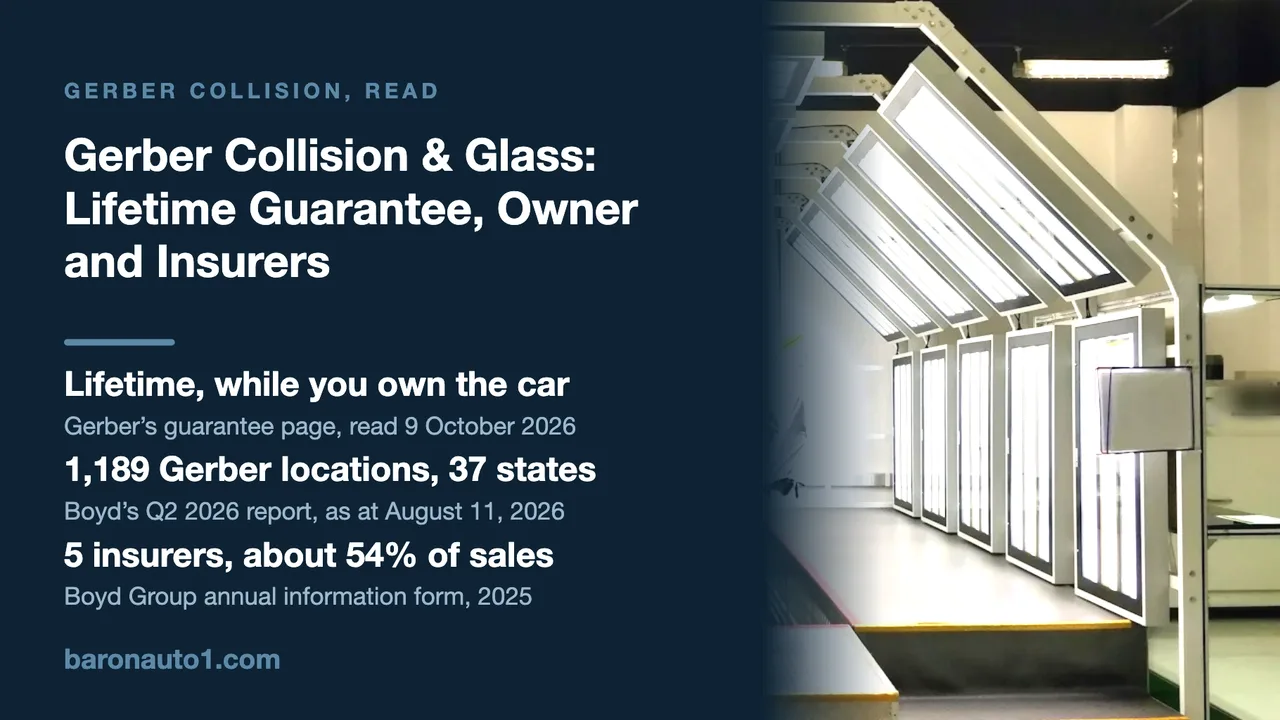
- Gerber Collision & Glass is the U.S. brand of Boyd Group Services, a Canadian company listed in Toronto and, since November 2025, New York. Boyd says its shops are “non-franchised”: Gerber runs them itself.
- Gerber’s Lifetime Guarantee covers “defects of workmanship” in the repairs listed on your final estimate “for as long as you own your vehicle.” Rust, stone chips, scratches, abuse, a later collision or theft, and improper care are excluded by name.
- No page we read says a later owner can use the guarantee, gives a deadline for reporting a defect, or explains how to claim at another shop. The guarantee page ends: “Please see in store for additional details.”
- Glass work is guaranteed too: a replaced windshield against leaks and defects while you own the car; a failed chip repair earns a credit toward a new windshield, not a free one.
- Gerber is built around insurance work. Boyd’s 2025 filing says five insurers accounted for about 54% of its sales, yet owners “still have the freedom of choice of repair provider.”
- Boyd bought Joe Hudson’s Collision Center (258 shops) in January 2026 and converted them to Gerber by mid-year. Its filings count 1,189 Gerber locations in 37 states as at August 11, 2026.
If you searched for Gerber Collision, you probably need a body shop or a windshield after a crash, a hailstorm or a rock on the highway. Gerber is one company, not a franchise network: its shops belong to Boyd Group Services, which files with the U.S. Securities and Exchange Commission. Its main written promise is a Lifetime Guarantee; the useful questions are what it covers, what it leaves out and whether it outlasts a sale of the car. On 9 October 2026 we read Gerber’s guarantee page, its FAQ, its insurance claims page, its glass, financing and About pages and five of its articles, plus Boyd’s 2025 annual filing (Form 40-F, with its Annual Information Form and management’s discussion) and its second-quarter 2026 report on EDGAR. This site has no commercial relationship with Gerber, Boyd or any repair shop.
Who owns Gerber Collision & Glass
Gerber started as one shop. Its About page says it was “Founded in 1937 by Phil Gerber” and began as “a single auto glass and trim shop in Chicago.” That makes the name 89 years old in 2026, by our arithmetic. Gerber’s pages say “more than 80 years”; one of its own articles still says “more than seventy years.”
The owner is Boyd Group Services Inc. (BGSI), which Boyd’s Annual Information Form, dated March 17, 2026, describes as “a Canadian federal corporation.” Through its operating company, The Boyd Group Inc., it runs collision shops in Canada as Boyd Autobody & Glass and Assured Automotive, “as well as in the U.S. under the trade name Gerber Collision & Glass.” Gerber’s own footer names the same family: “The Boyd Group | Boyd Autobody & Glass | Gerber Collision & Glass.” Most of the money is American: the U.S. accounted for 92.2% of Boyd’s sales in 2025.
Boyd is a recent SEC filer. On November 4, 2025 it completed what it calls its “initial public offering in the United States,” and its shares now trade on the New York Stock Exchange as BGSI as well as in Toronto. As a Canadian company it files a yearly Form 40-F, prepared “in accordance with Canadian disclosure requirements,” and quarterly reports on Form 6-K.
The ownership fact that matters most for a customer is that Gerber is not franchised. Boyd calls itself “one of the largest operators of non-franchised collision repair centers in North America in terms of number of locations and sales.” The company that fixes your car, writes the estimate and issues the guarantee is the same company that owns the brand. That is the opposite of CARSTAR, whose shops are independently owned franchises (see our CARSTAR page).
Gerber grows partly by buying shops: “Part of our growth is attributed to acquiring existing repair facilities that meet our criteria,” its acquisitions page says. On October 29, 2025, BGSI agreed to buy Joe Hudson’s Collision Center from TSG Consumer Partners LP for “US$1.3 billion in cash,” a deal that “expanded BGSI’s footprint by 258 locations” in the Southeast. It closed on January 9, 2026, after Boyd announced on January 7 that “the regulatory requirements have been satisfied.” Boyd’s August 12, 2026 results release says it “completed the conversion of Joe Hudson’s 258 locations” during the second quarter. By our arithmetic, about 21.7% of Gerber’s August 2026 locations came from that one deal.
The Lifetime Guarantee: what it covers
Gerber’s headline promise sits in the footer of every page we read: “We proudly stand behind our repair work for as long as you own your vehicle.” The full wording is on its guarantee page, under the heading “Collision Repair Lifetime Guarantee.” Gerber says it “guarantees the repairs made to your vehicle, as reflected in your final estimate, against any defects of workmanship for as long as you own your vehicle.”
Each piece of that sentence limits the promise:
- “the repairs made to your vehicle, as reflected in your final estimate”: the guarantee follows the paperwork. Work that is not on the final estimate is not described as covered, so the final estimate is the document to keep.
- “defects of workmanship”: the promise is about how the work was done. Another Gerber page puts the remedy this way: if the car “has not been properly repaired, Gerber will replace any faulty parts and make appropriate repairs.”
- “for as long as you own your vehicle”: the length is your ownership, not a number of years.
The next sentence lists what is left out: “Our warranty does not cover defects or damages related to rust, abuse, a subsequent collision or theft, stone chips, scratches, or improper care and/or maintenance.” That is six exclusions, printed on the page itself. Two are worth reading closely: stone chips and scratches are excluded however they arose, and “rust” is not limited on the page to rust the repair did not cause.
Other pages describe the same guarantee more broadly. The guarantee page opens by offering “a Lifetime Guarantee on all of our work,” and the auto body page says “Everything we offer, from dent and scratch repair to automotive painting to fender and bumper repair, is covered by our guarantee.” Gerber calls it a “written National Lifetime Guarantee” there, and its insurance page calls it a “Nationwide Lifetime Guarantee.” The guarantee page itself closes with “Please see in store for additional details,” so the store may hand you more terms than the website shows.
| Page | What it says | Scope stated |
|---|---|---|
| Guarantee page (collision) | “as reflected in your final estimate, against any defects of workmanship”; six exclusions | Repairs on the final estimate, while you own the car |
| Guarantee page (opening) | “a Lifetime Guarantee on all of our work” | All work |
| Auto body repair page | “a written National Lifetime Guarantee on all of our collision auto body repair services” | All body work |
| Gerber for Collision Repair | Gerber “will replace any faulty parts and make appropriate repairs” | Improperly repaired cars |
| Guarantee page (glass) | Windshield replacement covered against “air and water leaks, defective materials and/or workmanship” | While you own the car |
| Footer of every page read | “for as long as you own your vehicle” | Repair work |
The FTC’s advertising guides address the word “lifetime.” Its guide at 16 CFR 239.4, as this site read it for its Safelite page, says an ad that calls a guarantee “lifetime” “should disclose, with such clarity and prominence as will be noticed and understood by prospective purchasers, the life to which the representation refers.” Gerber’s guarantee page and footer do that: they name the life as your ownership of the car. The section’s own example is a battery guarantee that is “Good for as long as you own the car!” Federal law defines a written warranty as a written promise about “material or workmanship” (15 U.S.C. 2301(6)); whether a body repair falls under that law is a question for a lawyer.
If you sell the car, move, or need to claim
Three questions a buyer would ask are not answered on Gerber’s site.
Does it pass to the next owner? No page we read uses the word “transfer.” Every version that states a length is worded to the current owner: “for as long as you own your vehicle,” or, on the page written for insurers, “For as long as your client owns the vehicle.” Read as written, the guarantee ends when you sell. Safelite, by contrast, says outright that its glass warranty “is not transferrable to another owner/lessor”; Gerber simply does not say. If you are buying a used car that Gerber repaired, do not count on the seller’s guarantee.
Is it honored at any Gerber? The names “National” and “Nationwide” suggest so, and every shop belongs to the same company. But no page we read says in so many words that another location will take the claim. The FAQ’s answer to “Who do I contact for a warranty issue?” is to call customer service or use the online contact form. Gerber also has a Customer Care page with a contact form for complaints.
Is there a deadline or an inspection? Gerber prints none. Safelite’s glass warranty requires notice “within 30 days of discovering the defect”; Gerber’s pages set no such limit, but “see in store” leaves room for one. Report a problem as soon as you see it and keep a copy of what you sent.
Keep the final estimate and invoice for as long as you own the car. Gerber’s guarantee covers the repairs “as reflected in your final estimate,” so that document defines what is covered. Before you authorize the work, ask the shop for the in-store guarantee terms its page refers to, and ask whether they add a claim deadline, an inspection step or anything on transfer. If your shop used to be a Joe Hudson’s and did work on your car before the 2026 conversion, ask in writing whether Gerber honors that earlier warranty; nothing we read says.
Here is how Gerber’s printed terms line up with two chains this site has already read. This is a comparison of wording only, not of price or quality.
| Term | Gerber Collision & Glass | CARSTAR (collision) | Safelite (glass) |
|---|---|---|---|
| How long | “for as long as you own your vehicle” | Web pages: five years on “qualifying repairs”; franchise document: “Limited Lifetime” | “for as long as you own or lease the vehicle” |
| Passes to a buyer | Not stated; worded to your ownership | Not stated | “not transferrable to another owner/lessor” |
| Exclusions printed | Yes, six on the guarantee page | Only in a document handed over “if provided” | Yes, on its warranty page |
| Deadline to report | None printed | None printed | Within 30 days of discovering the defect |
| Failed chip repair | Chip repair’s cost credited toward a new windshield | Not applicable | Repair’s cost credited toward a Safelite replacement |
| Who stands behind it | Gerber itself (company-operated) | The franchisee; other shops honor claims after written authorization | Safelite itself |
Our CARSTAR page and Safelite page quote those terms in full, and another collision chain, Crash Champions, has its own page.
Windshields and other glass
The “Glass” in the name is a real second business. Gerber says it offers “same-day / next-day windshield auto glass repair and replacement service - including free on-site mobile service, direct billing to insurance, and a National Lifetime Guarantee.” Mobile service “is offered within a 30-mile radius of our locations,” and the FAQ says “There is no charge for mobile / onsite auto glass service.” Boyd’s filing calls the company “a major retail auto glass operator in the U.S.” under the Gerber name and four other glass brands.
The glass guarantee has two parts, and they are not alike:
- Replacement. “Your windshield replacement is warranted against air and water leaks, defective materials and/or workmanship for as long as you own your vehicle.” That is a true lifetime-of-ownership promise on the installation and the glass.
- Chip repair. Gerber says it “guarantees windshield chip repairs for as long as you own your vehicle,” but the remedy is specific: if you are not satisfied, or “the chip repair fails to stop the break,” Gerber “will credit the cost of the chip repair towards a new windshield and we will install it for you.” The repair page adds that “sometimes the repair process will cause a crack to spread necessitating a full windshield replacement,” and the FAQ says that in that case, too, you get the credit. In plain terms, a failed chip repair gets you a discount on a new windshield, not a free one.
Which damage can be repaired? The FAQ says a chip “smaller than a quarter in diameter” may be, and so may a crack under 6 inches long, “the size of a dollar bill.” A quote, it says, covers “labor (installation) and the cost of the glass chosen,” with sales tax and any extra materials on top. Technicians follow the National Glass Association and AGRSS installation standards, according to the FAQ.
Two things to ask about. First, the glass itself: asked “Do you use OEM quality glass?”, the FAQ answers that Gerber uses “only the highest quality glass and adhesives.” “OEM quality” is not the same claim as glass made for the carmaker; our windshield page explains the difference. Second, the camera: none of Gerber’s glass pages mentions recalibrating the driver-assistance camera behind the windshield. Boyd’s MD&A does: scanning and calibration made up 6% of its revenue in 2025, and 75% of that work in the U.S. was done in-house in the fourth quarter of 2025, up from 53% a year earlier. Ask whether your car needs recalibration after the job and who will do it; our windshield replacement guide covers why it matters.
On paying, Gerber’s FAQ says glass work “is covered under your automobile’s comprehensive policy,” that the deductible is “collected at the time of service,” and that “Many insurers will waive your deductible for a windshield repair.” Your policy decides, not the shop. One more Boyd business sits behind some glass claims: Gerber National Claims Services, a third-party administrator that Boyd says “offers glass, emergency roadside and first notice of loss services.” Boyd does not say which insurers use it. If a claims line steers you to a shop, say which shop you want and ask whether your policy limits that; our Safelite page covers how glass claims are routed.
How Gerber works with insurance companies
Gerber’s pages put insurance first. It says it will “process your insurance claim in-house,” bill the insurer directly and work “with your insurance company on your behalf, managing the claim and direct billing process.” It says its shops are DRP (Direct Repair Program) partners, part of what Boyd calls insurers’ “customer referral arrangements.” How many insurers that covers depends on the page: “many well-known insurance companies” on the insurance and glass pages, “most insurance companies” on the collision page, and “all major insurance companies” on the windshield replacement page. The insurance page’s practical advice: “contact any Gerber Collision & Glass to verify” whether it is in your insurer’s program.
Insurers get their own service menu, Gerber Platinum Solutions, which lists a “Dedicated Toll-Free Number,” “Centralized Scheduling of Repair or Estimate,” “Vehicle Rental & Tow Coordination” and customer-satisfaction measurement for its “insurance partners.”
Boyd’s filings show how much of the business that is. The Annual Information Form says “the highest percentage of the Company’s revenue is derived from insurance-paid collision repair services,” and that the top five insurers it deals with accounted for “approximately 54%” of total sales in 2025 (51% in 2024), with the largest at about 19% and the second at about 12%. By our arithmetic, two insurance companies accounted for roughly 31% of Boyd’s 2025 sales. The same document warns that DRP agreements are “usually cancellable upon short notice,” and that insurers choose shops on criteria including “average cost of repair, cycle time, customer service, high quality repair and integrity in every interaction.”
Two lines in Boyd’s MD&A are worth knowing before you sign an estimate. In 2025 Boyd aligned “regional and field management compensation” with “each carrier’s performance expectations.” And among the initiatives it says lower repair costs for its customers is a “focus on the use of cost effective alternative parts.” Neither line says anything about repair quality. Both are reasons to read the estimate closely: ask which parts are new original-equipment parts and which are alternatives, and which items your insurer will and will not pay for.
Your right to choose the shop
Gerber’s FAQ and insurance page do not raise the question; one of its articles does. Under the heading “Choosing a Collision Repair Shop Is up to You,” it says insurers “usually recommend several vehicle repair shops,” that those shops “often have contracts or agreements with the insurance companies to carry out the repair work at a lower cost to the insurance company,” and that “it is up to the owner to decide which shop should work on their vehicle.” Gerber is itself one of those contracted shops for many insurers, so the advice cuts both ways: you may pick a Gerber your insurer did not suggest, or go elsewhere when it did.
Boyd’s Annual Information Form says the same thing from the company’s side: “Although automobile owners still have the freedom of choice of repair provider, insurance companies may educate the owner on the benefits of choosing a repairer in their DRP network.” Another Gerber article advises getting “at least three written estimates” with “a detailed breakdown of the repairs included.”
The right itself comes from state law. This site read one state’s statute in full for its CARSTAR page on 9 October 2026: Minnesota Statutes section 72A.201, subdivision 6, which governs insurers handling claims in Minnesota, where Gerber had 16 locations as at August 11, 2026. It makes it an unfair settlement practice for an insurer to require, as a condition of paying a claim, that repairs be made “by a particular contractor or repair shop,” or that parts, “other than window glass, must be replaced with parts other than original equipment parts.” When you report a claim, a Minnesota insurer must tell you: “You have the legal right to choose a repair shop to fix your vehicle.” Once you say you have chosen, it “must cease all efforts to influence” your choice. Gerber operates in 37 states, and we did not read any other state’s rules; your state insurance department can tell you yours. Our CARSTAR page reads the Minnesota text more closely.
Rental cars, towing and updates
On rentals, Gerber is direct: “When you bring your vehicle for repair, we’ll arrange for a rental vehicle.” Another page says it will “coordinate a rental vehicle,” and the insurance page says it will “help arrange alternate transportation while your vehicle is undergoing repairs.” Arranging is not paying. Gerber’s own article on rental fees puts it plainly: “if your insurance doesn’t cover car rentals, you may be responsible for the rental car bill.” Whether you pay depends on your policy’s rental coverage or, if another driver caused the crash, on that driver’s insurer. Its menu for insurers lists “Schedule Rental Delivery w/ ERAC,” an abbreviation the page does not spell out, so ask which rental company you will be sent to.
Minnesota’s statute again spells out the customer’s side. An insurer that recommends a rental company must say: “Minnesota law gives you the right to choose any rental vehicle company, and prohibits me from requiring you to choose a particular vendor.” In a claim against another driver’s insurer where liability is reasonably clear, it must tell you that you “may have a claim for loss of use of the vehicle.”
Towing gets less space. No Gerber page for customers says it will arrange or pay for a tow; the phrase “Vehicle Rental & Tow Coordination” appears on the page written for insurers. Gerber’s article on when to tow advises that if “body panels or mechanical parts” are “hanging loose, then you should not attempt to drive the vehicle.” Ask your insurer who arranges the tow and who pays before the truck arrives. Among the ways Minnesota’s statute lets an insurer settle a damage claim is “to assume all costs, including reasonable towing costs, for the satisfactory repair of the motor vehicle.”
While the car is in the shop, Gerber promises “twice-weekly update phone calls or text messages.” If the other driver’s insurer is paying, ask about the value your car loses from now having an accident history; our diminished value guide explains who owes it.
The estimate, the deductible and paying for it
Gerber prints no repair prices. Its collision page says “We’ll review the damages and provide you with an accurate written repair estimate,” and the FAQ says it will help you file the insurance claim: “We will assist you every step of the way.”
For payment, the FAQ lists “debit cards and most major credit cards (select locations may accept checks).” The glass page lists Visa, MasterCard, Amex, debit and cash for mobile service. The site also posts glass offers; the conditions we read limited one to “Non-Insurance Repairs only.”
For a deductible or a bill your insurer will not pay, Gerber advertises interest-free financing. The financing page says “Up to 6 Months Interest FREE Financing,” available at “*select Gerber Collision & Glass locations,” and “Once approved you can arrange for repairs and have up to 6 months to pay.” An article says “0% financing for up to six months at select locations.” The insurance page says financing is “available at most locations.” None of these pages names the lender or says what happens to a balance still owed after six months. Before you sign, ask the shop for the credit agreement and read the part about the end of the interest-free period.
If the insurer decides the car is not worth fixing, Gerber’s pages say nothing about total losses. Our total loss page explains what the title record will show, and our gap insurance page covers a payout that falls short of the loan.
How many Gerber shops there are
Gerber’s own pages give older or rounder numbers than its parent’s filings. The FAQ and the Locations page say “over 1,000 repair center locations”; the insurance page still says “over 600 locations” and “Hundreds of Convenient Locations.” Boyd’s filings count by brand and by state.
| Count | What it counts | Source and date |
|---|---|---|
| over 600 | “over 600 locations” | Gerber insurance page, read 9 October 2026 |
| over 1,000 | “over 1,000 repair center locations” | Gerber FAQ and Locations page, read 9 October 2026 |
| 1,000th | Boyd’s 1,000th location, all brands, at a Gerber shop in Murfreesboro, Tennessee | Boyd 2025 MD&A, milestone of August 28, 2025 |
| 1,174 | Gerber locations in 37 states | Boyd 2025 MD&A table, as at March 17, 2026 |
| 1,189 | Gerber locations in 37 states, including three intake and two fleet locations | Boyd second-quarter report, as at August 11, 2026 |
| 1,321 | Boyd collision locations, all brands | Boyd results release, at June 30, 2026 |
| 1,323 | Boyd collision locations, all brands (Gerber, Boyd Autobody & Glass 46, Assured 88) | Boyd second-quarter report, as at August 11, 2026 |
By our arithmetic, Gerber made up 89.9% of Boyd’s collision locations in August 2026 and added 15 locations between the March and August tables. The largest state counts in August were Florida (123), Texas (98), Michigan (78) and Illinois (73). Boyd’s MD&A calls the company “the second largest independent collision repair operator” after the Joe Hudson’s purchase.
What regulators and courts have recorded
Web searches on 9 October 2026 found no state attorney-general, FTC or court action against Gerber Collision & Glass or Boyd over repairs, warranties or advertising. Boyd’s Annual Information Form, under “Legal Proceedings and Regulatory Actions,” says: “Neither BGSI, Boyd nor any of its subsidiaries are involved in any legal proceedings which are material in any respect.”
The one regulatory step in the filings concerns the Joe Hudson’s deal: on January 7, 2026, Boyd announced “that the regulatory requirements have been satisfied” and closed two days later. The Better Business Bureau’s site blocked our request and this site does not use review sites, so this page gives no rating.
Where Gerber’s own documents disagree, and what to ask
We recorded 7 places where Gerber’s pages disagree with each other or with Boyd’s filings. Those that matter to a customer:
- How much of the work the guarantee covers. “a Lifetime Guarantee on all of our work” in one place; the repairs “as reflected in your final estimate,” against “defects of workmanship,” with six exclusions, in the guarantee’s actual terms.
- What a chip-repair guarantee pays. “All repairs are covered by our lifetime guarantee,” says the glass page; the guarantee page’s remedy for a failed chip repair is a credit toward a new windshield.
- Where financing is offered. “available at most locations” on the insurance page; “*select” locations on the financing page and in an article.
- Which insurers Gerber works with. DRP partner for “many well-known insurance companies,” for “most insurance companies,” or “Approved by all major insurance companies,” depending on the page.
- Size. “America’s leading collision repairer” on one page, against Boyd’s “second largest independent collision repair operator”; “over 600” and “over 1,000” locations against 1,189 in the filings.
Your own paperwork outranks all of it: the estimate, the final invoice and any guarantee terms the store gives you.
- At the estimate, ask for the in-store guarantee terms (“Please see in store for additional details”) and check them for a claim deadline, an inspection step and anything on selling the car.
- Read the parts lines. Ask which parts are new original-equipment parts and which are alternatives, and which items your insurer will not pay for.
- If your insurer steers you, remember Gerber’s own article: “it is up to the owner to decide which shop should work on their vehicle.” Ask your insurer what your state’s law says.
- Before the rental and the tow, ask who is paying and which rental company you will be sent to.
- Before financing, ask who the lender is and what happens if the balance is not paid within six months.
- After a windshield, ask whether the camera needs recalibration and who did it.
- At pickup, check the work, then keep the final estimate and invoice for as long as you own the car. If you sell, tell the buyer the guarantee is worded to you.
Common questions
Who owns Gerber Collision & Glass?
Boyd Group Services Inc., a Canadian company whose shares trade in Toronto and, since its U.S. offering on November 4, 2025, on the New York Stock Exchange as BGSI. Boyd runs Gerber’s shops itself; they are not franchises.
Does Gerber Collision have a lifetime warranty?
Yes. Gerber calls it a Lifetime Guarantee: the repairs on your final estimate are guaranteed “against any defects of workmanship for as long as you own your vehicle.” Rust, abuse, a later collision or theft, stone chips, scratches and improper care are excluded.
Does the Gerber guarantee transfer if I sell the car?
Gerber’s pages do not say it does. Every version that states a length is worded “for as long as you own” the vehicle, and none mentions a transfer. Ask the shop for its in-store terms if a sale is coming.
Do I have to use the body shop my insurance company recommends?
Gerber’s own article says no: “it is up to the owner to decide which shop should work on their vehicle.” Boyd’s filing agrees that owners “still have the freedom of choice of repair provider.” The legal right comes from state law; Minnesota’s, for example, requires insurers to tell you so.
Does Gerber give you a rental car?
It arranges one: “When you bring your vehicle for repair, we’ll arrange for a rental vehicle.” Who pays is up to your policy or the other driver’s insurer; Gerber’s own article warns that without rental coverage “you may be responsible for the rental car bill.”
Is Joe Hudson’s Collision Center now Gerber?
Yes. Boyd bought Joe Hudson’s 258 locations for US$1.3 billion, closed on January 9, 2026, and says it completed their conversion during the second quarter of 2026. Nothing we read says how warranties issued before the conversion are handled; ask the shop in writing.
Sources and further reading
Recall, complaint and safety-rating figures on this page were retrieved from the federal databases above on August 19, 2026. Federal data changes — re-check any VIN before you rely on it.
Published October 9, 2026 · last updated October 9, 2026. Found something out of date or wrong? Tell us and we will correct it.