Audi Extended Warranty: Who Backs Pure Protection and What It Covers
Audi sells its own service contract as Pure Protection. VWFS Protection Services owes the repairs, terms reach 10 years or 120,000 miles counted from delivery, the electric plan excludes the battery, and Audi Care maintenance is a different product.
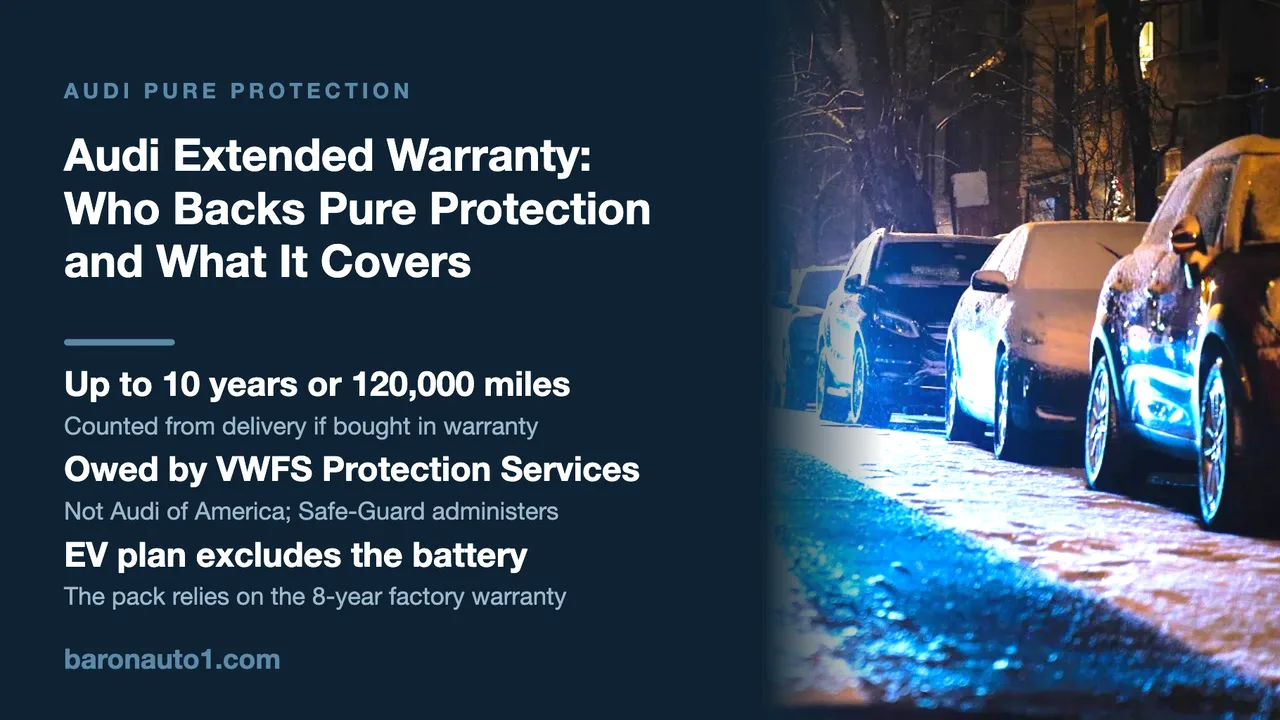
The short version
- Audi’s own extended warranty is Audi Pure Protection Vehicle Service Protection, a service contract sold through Audi dealers under the Audi Financial Services name. The company that owes you the repair is VWFS Protection Services, Inc., not Audi of America.
- There are three plans, Powertrain, Gold and Platinum, with terms up to 10 years or 120,000 miles. Electric Audis get one plan, Platinum, up to 8 years or 100,000 miles. The Pure Protection pages print no price, deductible amount or fee amount.
- A plan bought while the 4-year, 50,000-mile factory warranty is still running is measured from the car’s original in-service date at zero miles. Buying it in year three doesn’t move the end date.
- The electric plan excludes repair or replacement of the high-voltage battery, which is left with Audi’s factory battery warranty of 8 years or 100,000 miles.
- Audi Care and Audi Signature Care are scheduled maintenance, not repair cover. Audi’s Audi Care terms list mechanical breakdown repairs among the things they don’t cover.
- VW Credit, the lender behind the Audi Financial Services name, has 1,072 vehicle loan or lease complaints at the CFPB. The 46 about add-on products closed with relief 23.9% of the time, against 29.2% for the rest.
Audi’s extended warranty is a vehicle service contract called Audi Pure Protection Vehicle Service Protection. It is sold through Audi dealers, presented on audiusa.com under Audi Financial Services, and owed by VWFS Protection Services, Inc. It isn’t the factory warranty, which Audi of America issues with every new car and whose 2026 booklet doesn’t mention Pure Protection at all. This page is built from the seller’s and the carmaker’s own documents, all read on 30 September 2026: the Pure Protection pages on audiusa.com, Audi’s 2026 and 2025 Warranty & Maintenance booklets, Audi’s Audi Care page, price brochure and contract terms, and two older Pure Protection brochures from 2017 and 2018. It also uses the CFPB complaint file of VW Credit.
Audi Pure Protection, and who actually owes you the repair
Audi Pure Protection is the family name. The Pure Protection hub calls it “a collection of financial coverage plans for your vehicle” and lists nine products. Three pay for mechanical repairs or worn parts: Vehicle Service Protection, the certified pre-owned version of it, and Term Protection. The other six are Multi-Coverage, Tire & Wheel, Key Protection, Theft Protection, Lease-End Protection and GAP. The Multi-Coverage page says its tire and wheel, dent and windshield products can be bought only when you buy or lease the car, and its key product only when you buy it.
No Audi page we read uses any other name; “Audi Extended Vehicle Protection” doesn’t appear on any of them. The address printed on the 2017 and 2018 brochures, AudiPureProtection.com, now redirects to the hub. Audi’s own warranty page is headed “Get peace of mind with Audi extended warranties”, but it describes only the new-car and certified pre-owned warranties and doesn’t mention Pure Protection.
Who owes you the repair is printed in the legal footer of every Pure Protection page. The obligor, the company contractually bound to pay a covered claim, is VWFS Protection Services, Inc., at an address in Reston, Virginia. The administrator is Safe-Guard Products International, LLC, of Atlanta, Georgia. In Florida they are VWFS Protection Services FL, Inc. and Safe-Guard Warranty Corporation. Our guide to who actually owes you the repair explains each role.
So three different companies stand behind an Audi bought on finance with a plan. Audi of America, Inc. issues the new-car warranty. VWFS Protection Services owes the Pure Protection repairs. The loan or lease sits with VW Credit, Inc.: Audi’s 2018 brochure says “Audi Financial Services” is a service mark of VW Credit, Inc. The footer adds that Pure Protection “is optional and is not insurance”, that it “is not required for you to obtain financing for the purchase or lease of a vehicle”, and that coverage may vary by state.
The Customer Agreement is the only document that binds anyone. Every Pure Protection page says all transactions “are governed solely by the provisions of the Audi Pure Protection Contract (‘Customer Agreement’)”, and none links a sample. We found no published copy on any Audi, VWFS or VW Credit site. Ask the dealer for the full agreement for your VIN before you sign, check that the obligor line reads VWFS Protection Services, Inc., and read the exclusions and the cancellation section first.
Powertrain, Gold and Platinum: what each plan covers
The Vehicle Service Protection page offers “coverage options for mechanical repairs that include parts and labor up to 10 years or up to 120,000 miles”, and says you “pay nothing on covered repairs other than the deductible you select.” The table sets its one-sentence description of each plan beside the component grid from Audi’s 2017 brochure, the most recent Pure Protection document we found that prints one.
| Plan | What the current page says it covers | Component groups ticked in the 2017 grid |
|---|---|---|
| Powertrain | The engine, transmission, transaxle or transfer case, drive axles, and certain hybrid and electric components | 4: engine, transmission, drive axle, hybrid/electric |
| Gold | Powertrain coverage, plus front and rear suspension, climate control, fuel, electrical, and certain additional hybrid and electric components | 10: adds climate control, shocks, front and rear suspension, fuel system and electrical system |
| Platinum | All mechanical parts in the event of a mechanical breakdown, unless listed as “not covered” in the Customer Agreement, such as maintenance and cosmetic items | All 16: adds steering, brakes, CV boots, navigation, audio and high-tech |
| Platinum, all-electric | All mechanical parts unless listed in the agreement’s exclusions, up to 8 years or 100,000 miles; the high-voltage battery is excluded | Not in the 2017 brochure |
The gap between Gold and Platinum is the part to read twice. On the 2017 grid, Gold stops short of steering, brakes, CV boots, navigation, audio and a group Audi labelled high-tech, and today’s Gold sentence doesn’t name any of them either. If those are the repairs you want covered, check the Gold component list in the agreement before choosing it. Platinum works the other way round: everything mechanical is covered unless the agreement lists it as not covered. The 2017 brochure’s examples of that list were “maintenance items such as spark plugs and wiper blades, as well as items such as trim pieces, upholstery, and body panels.”
All three plans carry the same printed benefits, each tied to a covered mechanical breakdown:
- Towing: up to $100 to the nearest authorized Audi dealer or authorized service provider.
- Rental car: up to $35 a day for up to 10 days, $350 at most for one breakdown (our multiplication).
- Trip interruption: up to $200 a day for a maximum of five days, $1,000 in all (our multiplication, and the total the 2017 brochure printed). Not available to New York residents.
- Roadside assistance: 24-hour help with batteries, flat tires, lockouts and emergency fuel, limited to three gallons up to three times per calendar year.
- Repairs: OEM or OEM-approved parts, at any authorized Audi dealer or authorized service provider nationwide.
The factory warranty itself excludes “out of pocket expenses for substitute transportation or lodging”, and Audi’s separate roadside program, with its own towing and trip interruption benefits, ends 4 years from the in-service date. After that, the plan’s benefits are the ones left.
The certified pre-owned plan
Certified pre-owned Audis have their own version, CPO Vehicle Service Protection, which “delivers mechanical coverage beyond your manufacturer CPO warranty.” It describes two plans, Powertrain and Platinum, where the 2017 brochure listed three, with the same towing, rental and trip benefits and roadside help up to $100 per occurrence. It prints no term, mileage limit or deductible; the 2017 brochure printed terms up to 8 years or 120,000 miles and an $85 deductible per visit. The plan sits on top of Audi of America’s 1-year, 20,000-mile Certified pre-owned Limited Warranty, which begins only when any remaining new-car warranty expires; our Audi certified pre-owned guide works through that timing. Audi’s documents describe the inspection behind a certified car three ways: the CPO plan page says “125-plus-point”, the certified program page says technicians inspect “more than 125 components”, and the 2017 brochure said “300+ point”.
When the clock starts, and why buying later doesn’t buy more time
The most important sentence on the Vehicle Service Protection page is a footnote: “Vehicle Service Protection coverage runs concurrently with any applicable manufacturer’s warranties. In-warranty plan expiration is measured in time/miles from the Manufacturer’s Original In-Service Date and zero (0) miles. Out-of-warranty plan expiration is measured in time/miles from the Agreement Purchase Date and the Current Odometer Reading.” The electric and certified plans use the same two start points.
The page doesn’t define “in-warranty”; the electric plan’s footnote says the terms mean what the Customer Agreement says they mean. Read plainly, a plan bought while the factory warranty still runs is counted from the day the car was first delivered, at zero miles, however long after that you buy it. One bought after it has run out is counted from the day you buy it and that day’s odometer reading. Your registration page should say which you have.
| Car’s age when you buy | Plan ends | Plan time left, at most | Plan time after the factory warranty, at most |
|---|---|---|---|
| New, on delivery day | 10 years from in-service | 10 years | 6 years |
| 1 year | 10 years from in-service | 9 years | 6 years |
| 2 years | 10 years from in-service | 8 years | 6 years |
| 3 years | 10 years from in-service | 7 years | 6 years |
Buying later in the warranty years doesn’t cost you any time after the factory warranty ends. It only shortens the overlap, and the overlap is thin by design: the plans exclude “mechanical breakdowns covered by your vehicle’s manufacturer’s warranty”, so for the first 4 years or 50,000 miles Audi’s warranty pays for defects first. In those years the plan’s clearest additions are its rental, towing and trip benefits.
Measured by end points, the 10-year, 120,000-mile ceiling runs 6 years and 70,000 miles past the end of the factory warranty. That subtraction is ours, not Audi’s, and it isn’t what every car gets, because each limit ends at whichever comes first. A car that reaches its fourth birthday on low mileage keeps up to 6 more years. One that reaches 50,000 miles early keeps up to 70,000 more miles, which a high-mileage driver can cover in far less than 6 years.
An out-of-warranty plan starts a fresh clock, but the pages print no term, age limit or mileage limit for it. Whichever kind you are offered, ask the dealer to print the plan’s end date and end mileage on the quote.
The all-electric plan, and the battery it leaves out
Electric Audis get a separate product on the same page, All-electric Vehicle Service Protection. It has one plan, Platinum, covering “all mechanical parts of your vehicle unless specifically listed in the exclusions section of your Customer Agreement” for up to 8 years or 100,000 miles. Towing is up to $200 and can go to the “nearest compatible charging station”, and roadside help covers the 12-volt battery. The exclusions add one line the page doesn’t print for the other plans: “Repair or replacement of hybrid high-voltage batteries and high-voltage electric batteries.” The most expensive part of an electric Audi isn’t in the plan.
What covers it is Audi’s factory High-Voltage System Limited Warranty. The 2026 electric booklet says the battery is warranted for 8 years or 100,000 miles, and that the warranty pays for a repair of a defect or “when the remaining energy content of the battery SOH (State of Health) is below 70% compared to the condition at the time of delivery.” A replacement battery supplied under it will have a state of health of at least 70% and may not be “as new”. The booklet calls gradual capacity loss “a normal characteristic of the battery similar to wear and tear”.
Set side by side, the plan’s longest term ends at exactly the battery warranty’s end points, 8 years or 100,000 miles (our comparison). What the electric plan buys is cover for everything except the battery, for up to 4 years and 50,000 miles past the new-car warranty, measured by end points (our subtraction). Plug-in hybrids follow the gasoline booklet, whose high-voltage battery and battery module warranty is also 8 years or 100,000 miles.
Don’t buy the electric plan for the battery. It excludes battery repair and replacement in so many words. If battery health is your worry, the factory warranty is the cover that matters: get the car’s in-service date, which sets when it ends, and ask what state-of-health reading the dealer can give you.
What a new Audi already has: the 2026 warranty booklet
The 2026 Warranty & Maintenance booklet for gasoline and hybrid models (form 8V1012723TT, marked 01.2026) and its electric edition (8V1012723TQ) are served through Volkswagen Group of America’s owners-literature service, the source behind maintenance.audiusa.com. The warranty section holds four warranties: the New Vehicle Limited Warranty, the corrosion perforation warranty, the emissions warranties and a Kansas seat-belt warranty. There is no separate, longer powertrain warranty. The engine and transmission share the same 4-year, 50,000-mile term as everything else.
| Coverage | Term | What the booklet says |
|---|---|---|
| New Vehicle Limited Warranty | 4 years or 50,000 miles | Any repair or replacement to correct a defect in material and workmanship, from delivery to the first buyer or lessee |
| Items subject to normal wear | 12 months or 12,000 miles | Defects only, in items such as wiper blades, filters, belts, paint finish, upholstery and trim |
| Plug-in hybrid battery and module | 8 years or 100,000 miles | Work must be done by a certified technician at an Audi plug-in hybrid dealer |
| Electric high-voltage battery | 8 years or 100,000 miles | Defects, or a state of health below 70% |
| Corrosion perforation | 12 years, no mileage limit | Rust perforation of the body caused by a defect; surface corrosion excluded |
| Federal emissions defect | 2 years or 24,000 miles | Defects that make the car fail to conform with EPA emissions rules |
| Major emission components | 8 years or 80,000 miles | A listed set, including the catalytic converter, engine control module and transmission control unit |
| 24-Hour Roadside Assistance | 4 years, regardless of mileage | A program listed apart from the warranties, including towing and trip interruption benefits |
After 4 years or 50,000 miles, whichever comes first, the Audi warranties still running are corrosion, the emissions warranty on listed parts, the high-voltage battery on hybrids and electric cars, and in Kansas the seat belts, for 10 years. The emissions list is worth reading before you price a Powertrain plan. For gasoline models it includes the catalytic converter, the engine electronic control module and the “Transmission Control Unit / Mechatronic with Software (TCM)”, covered to 8 years or 80,000 miles. That cover is narrower than the new-car warranty, though: the booklet limits it to defects that cause the car to fail to conform with EPA emissions rules.
The factory warranty follows the car: it is “transferred, without cost, if ownership of the vehicle changes within the warranty period.” Audi may also on occasion “adjust its policy to pay for specific repairs that are no longer covered by warranty” and tell owners by mail, so a secondhand buyer should report the ownership to Audi, as the booklet asks. The 2026 booklet adds one thing the 2025 booklet doesn’t have, Audi Signature Care, covered below. Neither mentions Audi Pure Protection or any service contract.
What the plans exclude, and the rules that decide a claim
The Vehicle Service Protection page lists three exclusions and says more may apply: breakdowns covered by the manufacturer’s warranty; breakdowns caused by accident, collision, vandalism or weather; and breakdowns caused by lack of maintenance or pre-existing conditions. Without a published Customer Agreement, the full list can’t be read in advance.
The maintenance exclusion is the one most likely to decide a disputed claim, and Audi’s booklet shows the standard Audi applies to its own warranty. Audi says it “will not deny a warranty claim based solely on inadequate maintenance records”, but failing to produce them “can be a factor in denying warranty coverage if the vehicle has not been properly maintained.” If an independent shop does the work, the order must show at least the VIN, the shop’s name and address, the mileage, the date and the list of items. A plan that excludes breakdowns caused by lack of maintenance gives you the same reason to keep every order.
Two more factory rules apply whatever plan is on the car. Non-Audi Genuine Parts, and any damage they cause, “are not covered by any Audi warranty”, though coverage doesn’t depend on using a particular brand of part. And damage from “alterations to the original engineering such as suspension or performance modification” isn’t covered, so on a tuned or lowered Audi a failure traced to the modification is on the owner.
Some events end the factory warranty outright: an altered VIN or odometer, mileage that can’t be determined, or a car reported as “dismantled, fire/flood damaged, junked, rebuilt, reconstructed, salvaged, or declared a total loss by an insurer.” Check the title history before paying for a used Audi’s remaining warranty. A salvage or rebuilt brand means the factory warranty is gone, and the Pure Protection pages warn that not all vehicles may be eligible for a plan.
Term Protection: the wear-part plan
Audi’s factory warranty covers wear items such as wiper blades, filters and belts only for defects, and only for 12 months or 12,000 miles. Term Protection is the Pure Protection product for what wears out after that, “for up to six (6) years or 72,000 miles, with no deductible.” It covers one replacement set of front and rear brake pads, one battery, one set of wiper blades and one wheel alignment, plus most major engine belts and hoses, headlamps, fuses and bulbs. Term Protection Plus adds “mechanical breakdown coverage that includes all mechanical and electrical parts, unless specifically listed in the Exclusions section of the Customer Agreement.” An optional rotor cover adds one set of front and rear rotors, or up to $1,000 toward carbon or ceramic ones; otherwise carbon or ceramic pads and rotors are excluded, as are hybrid and electric high-voltage batteries.
Timing is tight. The plan is available only “within the first 24 months or 24,000 miles” after the new-car warranty starts, and its term runs from the purchase date and odometer reading. So the latest a Term plan can end is 8 years after the car’s in-service date or at 96,000 miles, whichever comes first, for a plan bought right at the limit (our arithmetic). It transfers “to another private party for a fee if your finance agreement is assumed”. Unlike the other product pages, its benefit list has no “cancelable at any time” line; a footnote points to the Customer Agreement. Whether one set of pads and one battery over six years is worth buying depends on the price, which the page doesn’t print.

Audi Care and Signature Care: maintenance, not repair cover
Audi’s prepaid maintenance is sold alongside Pure Protection and is easy to confuse with it. It comes from a different company, Audi of America, and it doesn’t pay for breakdowns. Audi’s Audi Care page describes three programs:
- Audi Signature Care is included with eligible 2026 and newer Audis. The 2026 booklet says it covers the first three scheduled services, at 1 year or 10,000 miles, 2 years or 20,000 miles and 3 years or 30,000 miles, whichever comes first each time.
- Audi Care, for 2025 and older models, lets owners prepay scheduled maintenance from 10,000 through 40,000 miles.
- Audi Care Select, for all model years, extends prepaid maintenance to higher intervals, with plans from 30,000 up to 120,000 miles.
Unlike Pure Protection, Audi Care has printed prices. Audi’s current Audi Care brochure gives a manufacturer’s suggested retail price for each plan by vehicle tier, and says “Dealer sets final price, plus applicable taxes.”
| Plan | Standard | e-tron | Premium |
|---|---|---|---|
| Audi Care, 10k to 40k services | $1,799 | $1,349 | $2,649 |
| Audi Care Lease, 3 services | $1,349 | $1,049 | $2,249 |
| Audi Care Select, 120k service | $1,949 | $1,199 | $2,649 |
The Audi Care Agreement terms Audi still serves, effective 1 December 2020 and filed under a name marked for non-California buyers, are blunt. Items not covered “include, but are not limited to: mechanical breakdown repairs, hoses, brake pads and linings, and wheel alignment and balancing.” And “Audi Care cannot be canceled and are non-refundable”, except that if the car is totaled, the owner or lienholder gets $125 for each remaining maintenance interval on plans sold as e-contracts. Audi’s certified pre-owned booklet adds that California Audi Care plans are refundable, and the current Audi Care page says cancellation and refunds are governed by your contract.
So a dealer may offer three different things in one conversation. Audi Care pays for scheduled services, Term Protection for parts that wear out, and Vehicle Service Protection or Term Protection Plus for breakdowns. Keep them on separate lines of the quote so each price can be judged on its own.
What the 2017 and 2018 brochures printed, and what has changed
The current pages leave out deductibles and fees. Two older brochures print them. Audi still serves the 2018 Term Protection brochure (form AUTPVSCBR Rev 4/18) from its own media server. The 2017 brochure for Vehicle Service Protection, Term Protection and the certified plan (form AUVSTCCPBR Rev 1/17, © 2017 VW Credit, Inc.) isn’t on any Audi site we found; the copy we read is on an Audi dealer’s website. Both say the Customer Agreement governs, so read them as dated evidence, not today’s terms.
| Term | 2017 or 2018 brochure | Current page |
|---|---|---|
| Deductible | $0, $100 disappearing (waived at the selling dealer) or $250 per visit (2017) | Not printed |
| Transfer fee | $50 (2017; 2018 for Term Protection) | “For a fee”, not printed |
| Cancellation | Any time; $50 fee after 30 days (2017; 2018 for Term Protection) | Any time; a fee after 30 days, not printed |
| Trip interruption excluded for | California and New York residents (2018) | New York residents |
| Term Protection term | 4 years or 60,000 miles (2017); 6 years or 72,000 miles (2018) | 6 years or 72,000 miles |
| Term Protection buying window | Within 12 months or 12,000 miles (2018) | Within 24 months or 24,000 miles |
| Term Protection brake pads | Up to 2 sets; 1 on terms of 48 months or less (2018) | 1 set |
| Certified pre-owned plans | 3 plans, up to 8 years or 120,000 miles, $85 deductible (2017) | 2 plans; no term or deductible printed |
Three changes stand out. Term Protection can now be bought later but covers fewer replacements: the window doubled to 24 months or 24,000 miles while brake pads went from up to two sets to one. Trip interruption, which the 2018 brochure withheld from California and New York residents, is now withheld from New York only. And the certified plan dropped from three levels to two. Test the fee figures against your paperwork: a $50 cancellation fee after 30 days matches what Audi’s brochures printed, and if your contract shows something different, ask why.
Cancelling, transferring and settling a dispute
The Vehicle Service Protection and certified plan pages say the plan is “cancelable at any time; subject to a fee after 30 days” and “transferable for a fee if you sell your vehicle to a private party.” Neither prints the fee, how a refund is worked out or who receives it if the plan was rolled into your loan, and the Vehicle Service Protection page points to the Customer Agreement for the rules, including state-specific ones. A transfer is described only for a private sale, so if you trade the car in at a dealer, ask whether the plan can go with it or should be cancelled. If the plan is financed, ask before you sign where a refund would be paid. Our guides cover cancelling a plan and how cancellations go wrong.
Disputes run on two tracks. For the factory warranty, Audi’s booklet names BBB AUTO LINE, which it says is “free of charge to you”, subject to some vehicle age and mileage limits. You must use it before asserting California’s lemon-law presumption in court, or pursuing a remedy under the federal Magnuson-Moss Warranty Act, on the New Vehicle Limited Warranty. If you accept an arbitrator’s decision, Audi is bound by it; if you reject it, you are free to pursue other remedies. California purchasers must file within six months after the warranty expires, and a decision should ordinarily come within 40 days. The booklet doesn’t agree with itself on who runs the program, naming BBB National Programs in two sections and the Council of Better Business Bureaus in two others.
None of that covers Pure Protection. BBB AUTO LINE is for problems “arising under any Audi written warranty”, and Pure Protection is a service contract with VWFS Protection Services. Its dispute terms, including any arbitration clause, are in the Customer Agreement, which we couldn’t read.
What the complaint file of Audi’s lender shows
No public database records how Pure Protection claims are decided, and a CFPB company search for VWFS Protection Services, Inc. returns no complaints. On 30 September 2026 we pulled every vehicle loan or lease complaint the CFPB holds against VW Credit: 1,072 of them, received between 3 May 2017 and 15 September 2026, 586 about leases and 486 about loans. Of the 1,147 companies with vehicle loan or lease complaints, it has the 25th-largest count. The file has no field for the brand of car, so it can’t show which complaints came from Audi customers; every count is for the whole lender. A complaint is an allegation, not a finding, and the response field is the company’s own label.
VW Credit answered 1,071 of the 1,072 on time. It closed 754 with an explanation, 165 with non-monetary relief and 146 with monetary relief, and 7 were in progress. That is 311 closed with relief, 29%, against 9.4% across all 103,865 vehicle loan or lease complaints in the database.
46 complaints fall under the two add-on sub-issues, the CFPB’s labels for problems with products bought with the loan, where a complaint about a service contract sold with the car is likely to be filed. That is 4.3% of the file, against 5.5% across the whole product, and they split 26 loans to 20 leases. 11 closed with relief, 23.9%, against 29.2% for VW Credit’s other 1,026 complaints. Across the product, the 5,713 add-on complaints close with relief 7.9% of the time.
| Year | Complaints | About add-on products | Add-on share |
|---|---|---|---|
| 2017 | 41 | 1 | 2.4% |
| 2018 | 58 | 1 | 1.7% |
| 2019 | 70 | 3 | 4.3% |
| 2020 | 88 | 1 | 1.1% |
| 2021 | 101 | 6 | 5.9% |
| 2022 | 92 | 7 | 7.6% |
| 2023 | 148 | 7 | 4.7% |
| 2024 | 118 | 4 | 3.4% |
| 2025 | 191 | 9 | 4.7% |
| 2026 | 165 | 7 | 4.2% |
The add-on counts are small, so the share swings from year to year. The largest single sub-issue is billing, with 195 complaints and 49 closed with relief. The ones most often closed with relief come at the end of the loan or lease: getting the title after payoff (119 complaints, 58%) and excess mileage, damage or wear fees after a lease (52 complaints, 61.5%). The CFPB export carried no complaint narratives, so we can’t count how many complaints mention a warranty or service contract in their own words, and a refused plan refund filed under billing wouldn’t show up in the add-on label.
Audi Pure Protection, a third-party contract, or neither
Whether a service contract is worth buying at all is covered in our guide to whether an extended warranty is worth it. For an Audi the question narrows to four things.
First, what the car already has. A new Audi has one 4-year, 50,000-mile warranty and no longer powertrain term, so a plan’s value lies almost entirely after that point: up to 6 years and 70,000 miles past it at the 10-year ceiling, by end points (our arithmetic).
Second, which plan. The gaps are set out above: Platinum alone covers everything mechanical the agreement doesn’t exclude, and on an electric Audi the one plan excludes the battery.
Third, who stands behind it. VWFS Protection Services owes the repair and Safe-Guard administers the plan; a third-party contract names its own. Ask both the same questions: who is the obligor, is it registered where you live, and who authorizes the claim? Our guide to what a state register will tell you shows how to check.
Fourth, the price, which no Audi page prints for Pure Protection. Why there is no sticker price and where the markup comes from explain how the number is set. The in-warranty clock takes the pressure off the finance office, since a plan of the same term bought in year three ends on the same date as one bought on delivery day. The exceptions are Term Protection, which must be bought within 24 months or 24,000 miles, and the tire, dent, windshield and key products, sold only with the car. For an Audi already past its factory warranty, the routes are an out-of-warranty Pure Protection plan, a third-party contract or, from some insurers, mechanical breakdown insurance.
- Get the Customer Agreement. Every Pure Protection page says it governs, and no sample is published. Read the exclusions and the cancellation section before you sign.
- Check the obligor line. It should read VWFS Protection Services, Inc. (VWFS Protection Services FL, Inc. in Florida), with Safe-Guard as administrator.
- Get the end date and end mileage printed. An in-warranty plan counts from the car’s in-service date and zero miles, not from the day you buy.
- Get the numbers the pages leave out. Deductible, transfer fee, cancellation fee and price. The 2017 brochure’s deductibles were $0, $100 disappearing and $250, and its fees $50.
- Match the plan to the parts you worry about. On the 2017 grid, six groups, among them steering and brakes, sat only in Platinum.
- On an electric Audi, price the plan without the battery. The factory battery warranty runs 8 years or 100,000 miles.
- Keep Audi Care and Term Protection separate on the quote. Maintenance and wear parts are different products from breakdown cover.
- Keep every service order. Breakdowns caused by lack of maintenance are excluded.
Calls saying your Audi warranty is about to expire are a separate matter. In 2022 the FTC sued American Vehicle Protection Corp., a Florida seller it alleged had falsely claimed to be, or to be associated with, consumers’ carmakers or dealers, and had promised bumper-to-bumper or full coverage that was much more limited than represented. A stipulated order in March 2023 and a further order that July banned defendants from selling extended auto warranties and from outbound telemarketing. In 2024 the FTC sent more than $449,000 in refunds to consumers. See what regulators have done.
Common questions
How much does the Audi extended warranty cost?
Audi doesn’t publish a price for Pure Protection. Its pages print ceilings and benefit caps but no price, deductible or fee, and no sample contract is published, so the price comes from the dealer. Audi does print prices for Audi Care maintenance, where the four-service package lists at $1,799 for Standard-tier models, but that pays for servicing, not repairs. Our guide to extended car warranty cost explains what moves the number.
Who backs Audi Pure Protection?
VWFS Protection Services, Inc. is the obligor, the company that owes you covered repairs, and Safe-Guard Products International, LLC is the administrator; in Florida, VWFS Protection Services FL, Inc. and Safe-Guard Warranty Corporation. Audi of America, which issues the factory warranty, isn’t named as either.
When does an Audi extended warranty start?
An in-warranty plan is measured from the car’s original in-service date at zero miles, so a plan bought partway through the 4-year, 50,000-mile factory warranty ends where it would have if bought on delivery day. An out-of-warranty plan is measured from the purchase date and odometer reading.
Does the Audi extended warranty cover the e-tron battery?
No. The all-electric plan excludes “Repair or replacement of hybrid high-voltage batteries and high-voltage electric batteries.” Audi’s factory battery warranty covers it for 8 years or 100,000 miles, for defects or a state of health below 70%.
Is Audi Care an extended warranty?
No. Audi Care, Audi Care Select and Audi Signature Care are scheduled maintenance programs, and Audi’s Audi Care terms list “mechanical breakdown repairs” among the items not covered. Signature Care is included on eligible 2026 and newer Audis for the first 3 years or 30,000 miles.
Can I cancel or transfer Audi Pure Protection?
Audi’s pages say Vehicle Service Protection is cancelable at any time, subject to a fee after 30 days, and transferable for a fee in a private sale. Neither fee is printed; Audi’s 2017 brochure put both at $50. The Customer Agreement sets the actual rules, including state-specific ones.
Sources and further reading
- CFPB consumer complaint database
- CFPB auto loan resources
- FTC: auto service contracts and warranties
- FTC: a businessperson’s guide to federal warranty law
- 15 U.S.C. § 2301 (Magnuson-Moss definitions)
- 15 U.S.C. § 2308 (Implied warranties)
- Texas Department of Licensing and Regulation — service contract providers, Occupations Code Chapter 1304
- Florida CFO — motor vehicle service agreements, Chapter 634
- FTC v. American Vehicle Protection Corporation — case docket
- FTC — industry ban and judgment, American Vehicle Protection
- FTC — refunds paid to consumers harmed by an extended vehicle warranty scheme
- FTC withdrawal of the CARS Rule (91 FR 6507)
Recall, complaint and safety-rating figures on this page were retrieved from the federal databases above on August 19, 2026. Federal data changes — re-check any VIN before you rely on it.
Published September 30, 2026 · last updated September 30, 2026. Found something out of date or wrong? Tell us and we will correct it.