LoanMax Review: Who Runs It, Where It Lends, What It Charges
LoanMax lends against car titles through several state companies at one Georgia address, served by Select Management Resources. What its pages and state disclosures print, how many of its stores are closed, what its arbitration clause meant in a North Carolina case, and the CFPB complaint counts.
The short version
- LoanMax is a store-based car title lender. It advertises loans “up to $10,000” (“Maximum Loan Amount Varies by State”), and every customer must visit a store to sign.
- The LoanMax name is used by several state companies, such as Fairfax Elite Financial Services in Virginia and North American Title Loans in New Mexico, all at one suite in Alpharetta, Georgia. A federal court recorded in 2019 that Select Management Resources, LLC provides “back-office support services” to affiliated title lenders.
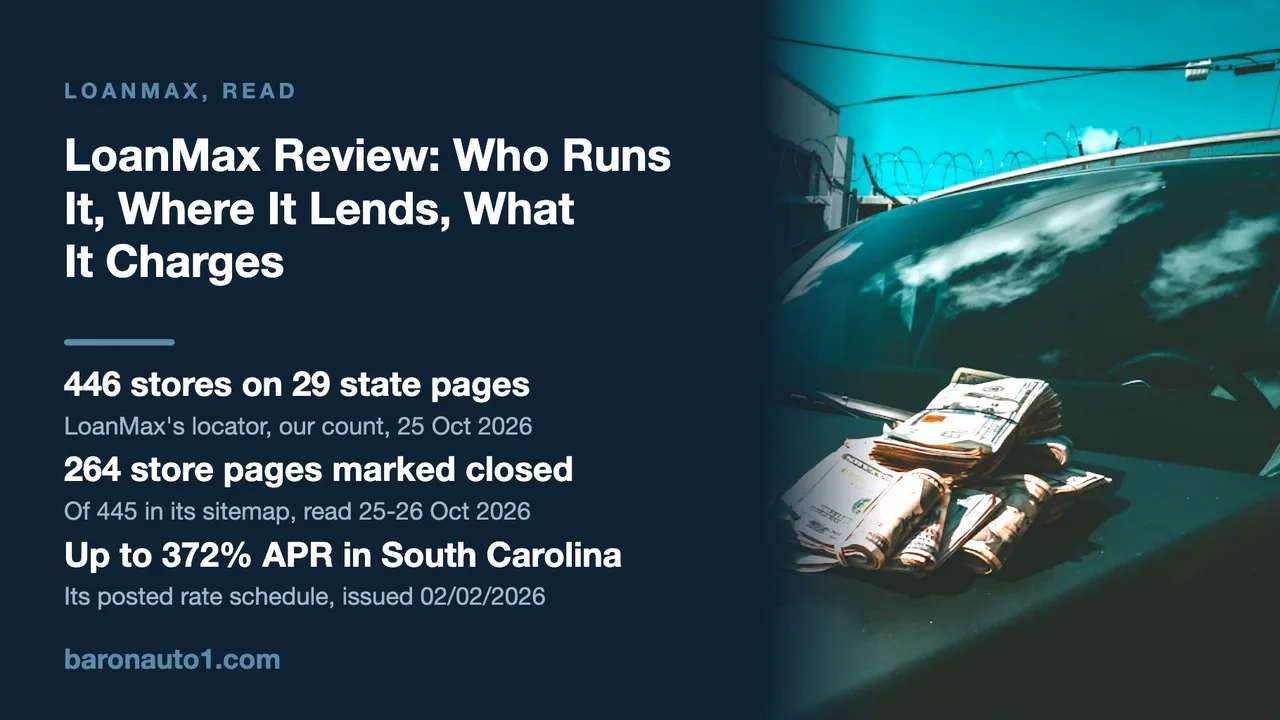
- Its locator counts 446 stores on 29 state pages, but three of those states, Ohio, California and South Dakota (119 listings), carry the notice “We no longer offer title loans.” Of the 445 store pages we read, 264 say the location is closed, 71 of 87 in Virginia; 181 in 26 states do not.
- LoanMax prints no rate on its web pages. Its South Carolina rate schedule, issued on 2 February 2026, posts a maximum of 372% APR on secured loans of $601 and up; its New Mexico sheet repeats that state’s 36% cap.
- In 2021 a federal court confirmed an arbitrator’s award voiding a LoanMax loan made in Virginia to a North Carolina borrower and striking the lien on the car, under the arbitration clause in LoanMax’s own loan agreement.
- The CFPB database has no company called LoanMax; 376 complaints name Select Management Resources, LLC, 285 of them about title loans.
LoanMax Title Loans lends against a car you own outright: you hand over a clear title, the lender records a lien, and you keep driving while you repay. This review is LoanMax’s own record; our car title loans guide covers title loans in general, and our TitleMax review covers another chain. On 25 October 2026 we read LoanMax’s product pages, FAQ, privacy policy and privacy notice, its state disclosure pages and the license and rate PDFs they link, and its locator and all 29 state location pages; over 25 and 26 October we read every one of the 445 store pages in its sitemap. We also read two federal court opinions and pulled CFPB complaint counts. LoanMax publishes no loan agreement or terms of use. We have no relationship with any lender and applied for nothing.
Who runs LoanMax
LoanMax’s website does not name a parent company. Its About page says “LoanMax and its affiliated companies operate in communities across the country,” and its annual privacy notice says its affiliates “include financial companies with LoanMax Title Loans in their names.” The state papers it posts, and the court records we read, name the companies behind the brand:
| State | Company | Record | Date of record |
|---|---|---|---|
| Virginia | Fairfax Elite Financial Services, LLC d/b/a LoanMax | LoanMax’s site footer: licensed by the State Corporation Commission, License CFI-246 | Read 25 October 2026 |
| Virginia | Anderson Financial Services, LLC d/b/a LoanMax | Federal court opinion, M.D.N.C. No. 1:19-CV-321: lender on a loan made at a LoanMax office in Virginia | 28 June 2021 |
| Michigan | Vista Financial Services of MI, LLC dba LOANMAX | Regulatory Loan Act license RL 0026158, posted by LoanMax | Effective 20 August 2024 |
| New Mexico | North American Title Loans, LLC dba LoanMax | Small Loan Company Licenses 02107 and 02093, posted by LoanMax | Signed 16 April 2025; copies expire 30 June 2026 |
| Delaware | EasyDollar Loans, LLC, D/B/A LoanMax, D/B/A Northeastern Title Loans | The state’s licensee list, posted by LoanMax as its Delaware licenses | Printed 17 August 2023 |
| South Carolina | Brookview Financial Services, LLC (filing names www.loanmaxtitleloans.net) | Consumer credit grantor notification CGL-165051 and maximum rate schedule | Issued 2 February 2026 |
| Minnesota | Northeastern Title Loans LLC, d/b/a Loan Max | Federal court order, D. Minn. Civil No. 08-5144 | 10 July 2009 |
All four state papers that print an address give the same one, 3440 Preston Ridge Road, Suite 500, Alpharetta, Georgia; so do LoanMax’s privacy policy and its New Mexico complaint contact, which is an address at selectmgmt.com. The link to Select Management Resources comes from a federal court. In its October 2019 opinion, the U.S. District Court for the Middle District of North Carolina wrote that “Select has admitted that it accepts payments on car title loans made by its lender co-defendants” and that it is an “affiliated company” of those lenders, for whom it provides “back-office support services.” A separate federal case in Washington named one of those lenders, Anderson Financial Services, LLC, “dba NORTHWEST TITLE LOANS”: the same companies trade under more than one name. We read no record of who owns Select, so we do not say.
Where LoanMax lends, and the stores it has closed
LoanMax’s locator splits its states in two. Under “Browse by state” it shows 26 states; under “Other States” it shows California, Ohio and South Dakota, and each of those three state pages carries the same line: “We no longer offer title loans in Ohio; however, here are the nearest title loans locations,” with the state’s name changed. The 29 state pages still count 446 stores between them, 119 in the three states it has left, Ohio alone 113.
The store pages tell the rest. We read all 445 store pages in LoanMax’s sitemap once, on 25 and 26 October 2026. 264 of them (59.3%) read “This location is currently closed” and describe a “former LoanMax location”; the other 181 show store hours and no closure notice. Every page in the three states LoanMax has left is closed, and in its other 26 states 145 of 326 pages (44.5%) are closed too. Virginia, the biggest state on the locator with 87 listings, has 71 closed pages (81.6%) and 16 without a closure notice.
| State | Stores on the state page | Store pages marked closed | Store pages without a closure notice |
|---|---|---|---|
| Kansas | 27 | 6 | 21 |
| Arizona | 19 | 3 | 16 |
| Virginia | 87 | 71 | 16 |
| Georgia | 19 | 5 | 13 |
| Mississippi | 19 | 6 | 13 |
| New Mexico | 18 | 5 | 13 |
| Wisconsin | 29 | 17 | 12 |
| Nevada | 15 | 5 | 10 |
| New Hampshire | 11 | 2 | 9 |
| Iowa | 14 | 7 | 7 |
| Michigan | 7 | 0 | 7 |
| Kentucky | 6 | 0 | 6 |
| Alabama | 8 | 3 | 5 |
| Colorado | 5 | 0 | 5 |
| Florida | 5 | 0 | 5 |
| Utah | 8 | 3 | 5 |
| Arkansas | 4 | 0 | 4 |
| Oregon | 3 | 0 | 3 |
| Minnesota | 3 | 1 | 2 |
| Montana | 6 | 4 | 2 |
| South Carolina | 4 | 2 | 2 |
| Delaware | 3 | 2 | 1 |
| Idaho | 4 | 3 | 1 |
| Maine | 1 | 0 | 1 |
| Tennessee | 1 | 0 | 1 |
| Texas | 1 | 0 | 1 |
| California (says it no longer offers title loans) | 5 | 5 | 0 |
| Ohio (says it no longer offers title loans) | 113 | 113 | 0 |
| South Dakota (says it no longer offers title loans) | 1 | 1 | 0 |
Two cautions. A page without a closure notice shows hours and a phone line; it does not prove the store makes title loans or what kind of loan it offers, so call before you go. And the counts do not quite match: the state pages add up to 446 stores, the sitemap lists 445 store pages, a gap of 1 in Georgia.
How a LoanMax title loan works, in LoanMax’s words
LoanMax describes its product as “a short-term loan that uses your free and clear vehicle title as collateral,” with the amount set by “vehicle value, state rules, your need, and your ability to repay.” Its FAQ adds that a title loan is “also referred to in some places as a title pawn or a motor vehicle equity line of credit,” and its home page says that in some states the product is called “a title pawn or auto pawn,” with the local store explaining “how the product works where you live.” The general mechanics, and why the label matters, are in our car title loans guide.
The steps it lists are short. You can start online or by phone, but the FAQ is plain that “All customers must visit a LoanMax Title Loans location” to submit the application, have the vehicle evaluated, sign and collect the money. Its title loans page asks for:
- the vehicle title, “free and clear of liens”;
- a valid government-issued photo ID;
- “Proof of income or regular benefits”; and
- the vehicle itself, for inspection.
Size and speed. The home page advertises “up to $10,000” with an asterisk that reads “Maximum Loan Amount Varies by State.” Elsewhere: “In many states, amounts range from $100 to $10,000,” and the maximum is “$10,000 in most states. However, several states have maximums below $10,000.” Most pages promise funding in about 20 minutes.
How it is repaid. The benefits page offers “30-day terms for a single installment or monthly payments for multi-installment loans,” with weekly or bi-weekly payments if you prefer, and another page says a title loan is “usually repaid like an installment loan.” The cash loans page says the store “explains payment, renewal, refinance, and account options” and “renewal rules for your state.” LoanMax says it has no prepayment penalty, and online payments are “available for most of our customers.”
Does LoanMax check credit? Its pages answer both ways. The FAQ asks whether a low credit score matters and answers “No,” but the title loans page says “Credit may be reviewed” and the privacy policy lists credit history from consumer reporting agencies among the information it collects. Assume your credit report will be pulled.
While the loan is open, the lender’s lien sits on your title; our guide to checking a car for a lien explains how that record looks and how it is released.
What LoanMax prints about rates and fees
None of LoanMax’s web pages states an interest rate, APR or fee. They promise that the store will show “the requested amount, fees, due dates, payment choices, and account details before you accept funds.” The only figures are in PDFs linked from the state disclosure footer.
South Carolina. LoanMax’s South Carolina maximum rate schedule is a filing by Brookview Financial Services, LLC, which names www.loanmaxtitleloans.net. Creditors there must post the maximum APR they intend to charge, and its one entry is secured personal loans of $601.00 and up, “372% FIXED.” The schedule (CLL-165083) was issued on 2 February 2026 and expires on 31 January 2027. A 372% APR is a simple 31% a month (our arithmetic). It is a posted ceiling, not a quote; your contract’s APR is the number to read. For comparison, the FTC says title loans “often have monthly finance fees as high as 25%, which translates to an APR of about 300%”; our title loans guide shows the arithmetic.
New Mexico. LoanMax’s New Mexico “Loan Rates and Fees” sheet repeats the state’s cap: the NM-APR on a Small Loan Act loan “of more than $500 and up to $10,000” “cannot exceed thirty-six percent.” It lists two fees: a late fee of “5% of the unpaid portion of each installment payment with a maximum of $10.00,” and a lien fee equal to the state’s charge, which “In New Mexico” is “$5.00.” South Carolina’s posted maximum is about 10.3 times New Mexico’s cap (our arithmetic): state law, not the brand, sets the price.
Delaware. The footer links an “itemization of charges for title loans” for Delaware. It is a one-page image with no readable text, so we did not read it and give no Delaware figure.
| State | Document | Dated | What it says |
|---|---|---|---|
| South Carolina | Maximum Rate Schedule, Brookview Financial Services, LLC | Issued 2 February 2026, expires 31 January 2027 | Secured personal loans of $601.00 and up: maximum 372% APR, fixed |
| New Mexico | Loan Rates and Fees | Undated | NM-APR capped at 36% on loans over $500 to $10,000; late fee 5% of the unpaid installment, up to $10; lien fee $5 |
| Delaware | Itemization of charges for title loans | Not readable | An image PDF; no figure could be read |
| Michigan | Regulatory Loan Act license | Effective 20 August 2024 | A license certificate; no rate |
| All states | FAQ | Read 25 October 2026 | “LoanMax does not have prepayment penalties.” |

State title-loan rules where LoanMax lists stores
Because LoanMax prints so little about price, state law does most of the work. Our title loans guide read the title-loan rules of eight states in primary sources on 6 October 2026; LoanMax’s locator includes seven of them. The table copies those rules as the guide recorded them and adds what LoanMax’s own pages showed on 25 October 2026.
| State | LoanMax’s pages | Law | Price limit | After default |
|---|---|---|---|---|
| Virginia | 87 store pages, 16 without a closure notice | Va. Code §§ 6.2-2215 to 6.2-2217 (amended 2020) | 36% simple annual interest, plus a monthly fee of 8% of the loan or $15, whichever is less | No deficiency judgment unless the car is damaged, hidden or already pledged; 10 days' written notice before repossession |
| Arizona | 19 store pages, 16 without a closure notice | A.R.S. § 44-291(G) | 17% a month up to $500; 15% to $2,500; 13% to $5,000; 10% above | Not read for this page |
| Delaware | 3 store pages, 1 without a closure notice | 5 Del. C. §§ 2250-2261 | The title-loan subchapter sets no maximum rate | Workout plan (at least 10% a month) must be offered before repossession; no deficiency after sale |
| Wisconsin | 29 store pages, 12 without a closure notice | Wis. Stat. § 138.16 | No limit on interest before maturity; 2.75% a month after it | 20 days' notice before taking the car; no deficiency unless the car is damaged, hidden or already pledged |
| Florida | 5 store pages, 5 without a closure notice | Fla. Stat. § 537.011 | 30% a year on the first $2,000, 24% on the next $1,000, 18% above $3,000 | Not read for this page |
| Texas | 1 store page, 1 without a closure notice | Tex. Fin. Code ch. 393 (credit access businesses), per the OCCC | A credit access business arranges the loan from a third-party lender and charges its own fee | Not read for this page |
| South Dakota | Says it no longer offers title loans; 1 store page, all closed | SDCL 54-4-44 | 36% a year, including all fees and add-ons, for licensed lenders | A loan over the cap is void |
Two cautions. A statute applies to the kind of license a lender holds, and LoanMax’s Virginia offices operate under “License CFI-246”; we could not read the commission’s records, so check which license and which state’s law your contract names. And 22 of the 29 states on LoanMax’s locator are not in the guide’s table. For those, the FTC’s advice stands: “check with your state attorney general or state regulator about payday and title lending laws in your state.”
If you fall behind: default, repossession and any surplus
LoanMax’s FAQ is short on this. Asked whether the car will be repossessed if you do not pay, it answers that “Repossessions are uncommon but can occur in certain instances,” that repossession “is a final measure” and that “LoanMax believes in working with customers who fall behind on payments.” It gives no number of days late, no notice period and nothing on what happens after a sale. Its New Mexico brochure adds only that in default “the lender may demand full payment of the remaining debt.”
The South Carolina pamphlet LoanMax posts is the most specific document on its site. Default usually means a late payment “or failing to keep insurance on a vehicle,” and after a missed payment the lender must send a “Notice of Right to Cure.” You then have “twenty (20) days to make the missed payment(s).” There are limits: no notice is required if you are in default for another reason or surrender the car, and “If you miss another payment, you will not receive any additional Right to Cure notices, unless you renew your account or it is a revolving account.” After a sale, “You could be responsible for paying any amount not repaid by selling the collateral.” A renewal, it adds, “means you are taking out a new loan.”
What happens after a repossession depends on your state, not on LoanMax’s pages. South Carolina’s pamphlet warns you could owe the shortfall after a sale. Virginia’s title-loan statute requires 10 days’ written notice before repossession, bars a deficiency judgment unless the car is damaged, hidden or already pledged, and gives the borrower sale proceeds above the debt within 10 days; Delaware requires a workout offer before repossession and bars any deficiency after the sale; Wisconsin requires 20 days’ notice and bars most deficiency claims. The FTC warns that “In some states, lenders can keep all the money they get from selling the vehicle, even if they get more than you owe,” and that some title lenders insist on GPS and starter-interrupt devices. Ask before you sign.
Where no title-loan statute changes the rule, Article 9 of the Uniform Commercial Code sends sale proceeds to the costs of taking and selling the car, then to the debt, and the lender “shall account to and pay a debtor for any surplus.” Our car repossession guide covers notices, redemption and the sale, and the title loans guide has the CFPB’s 2016 finding that “one-in-five loan sequences result in the repossession of the borrower’s vehicle.”
Arbitration, and the North Carolina borrowers’ cases
LoanMax does not publish its loan agreement, so the clearest view of its contract terms comes from two opinions of the U.S. District Court for the Middle District of North Carolina, in cases North Carolina borrowers brought against Select Management Resources and affiliated lenders (lead docket No. 1:19-CV-321). We read both on govinfo.gov.
The 2019 opinion. On 17 October 2019 the court described the plaintiffs as North Carolina residents who each borrowed from Anderson Financial Services, LoanSmart, Kipling Financial Services or North American Title Loans, alleging that each loan “was secured by the plaintiff’s car title” and that the lender “charged an illegally high interest rate.” Those are allegations. The lenders argued that North Carolina’s Consumer Finance Act could not apply to them “because all lending activities took place out of state.” It was the borrowers who asked for arbitration, under clauses the lenders had written. As the court quoted them, either side may “elect to arbitrate a Claim,” defined as “any claim, dispute or controversy” that “in any way arises from or relates to the Loan Agreement,” with “the broadest reasonable meaning”; some agreements chose South Carolina law, “while others are governed by Virginia law.” The court sent the claims against the four lenders to arbitration and stayed the case, refused arbitration for Select, which had not signed, and dismissed the claims against “defendant LoanMax LLC” without prejudice, as the plaintiffs agreed, because no plaintiff alleged an agreement with it.
The 2021 opinion. On 28 June 2021, in six consolidated cases, the court ruled on one borrower’s award. It names the lender as “Anderson Financial Services LLC, d/b/a LoanMax.” The contract chose Virginia law, and the rate “was illegal under North Carolina law and legal under Virginia law.” It was undisputed that the borrower “called LoanMax from North Carolina and discussed obtaining a loan before he drove to the LoanMax office in Virginia.” North Carolina’s statute refuses to enforce such out-of-state loans unless “all contractual activities” happen “entirely outside North Carolina,” so the arbitrator held the agreement void, “struck LoanMax’s lien” on the vehicle and ordered that LoanMax “shall not collect, receive, or retain any principal or charges whatsoever with respect to the loan.” No damages were awarded.
LoanMax asked the court to vacate the award. The court refused: review of an award “is among the narrowest known at law,” and “as the drafter of the choice-of-law provision, LoanMax could have unambiguously excluded federal constitutional questions from arbitration. It did not do so.” It confirmed the award and ordered Anderson Financial Services, LLC d/b/a LoanMax to pay $4,900 in attorneys’ fees (14 hours at $350). That is one borrower’s award on that borrower’s facts; we did not read the other arbitrations, so we do not say how they ended.
Other records. Two short orders on govinfo.gov ended suits by stipulation: one in Minnesota against “Northeastern Title Loans LLC, d/b/a Loan Max” and others (10 July 2009), and one in Washington against Anderson Financial Services, Select and a recovery company after the parties said “this matter has settled” (24 September 2019). Neither states what was alleged. We read no regulator order naming LoanMax or Select: Virginia’s State Corporation Commission closes its website to crawlers, the CFPB’s enforcement list filtered by “select management” and by “loanmax” returned “no results” on 25 October 2026, and a 2009 District of Columbia matter appears only in secondary copies, so we do not describe it.
Military borrowers
None of the LoanMax pages or PDFs we read mentions the Military Lending Act, servicemembers or military borrowers. The law is not silent. The Defense Department’s rule makes it unlawful for a creditor other than a bank, savings association or credit union to extend consumer credit to a covered borrower when it “uses the title of a vehicle as security for the obligation,” and caps the Military Annual Percentage Rate at 36 percent on other covered credit. A covered member is on active duty under a call or order that does not specify a period of 30 days or fewer, and the CFPB says the law reaches loans to active-duty servicemembers “and their dependents.” Our title loans guide explains who counts.
Complaints filed with the CFPB
The CFPB’s complaint database has no company called LoanMax. A search of its company names for “loanmax” or “loan max” returns nothing, and a search for “select management” returns one name: “Select Management Resources, LLC,” with 376 complaints received from 14 April 2014 to 8 October 2026. Of those, 285 (75.8%) sit under a title-loan product label; our title loans guide counted 283 on 6 October 2026, so 2 have arrived since. Pulled on 26 October 2026:
- What went wrong: among the 285 title-loan complaints, fees or interest the consumer did not expect account for 87 (30.5%, two labels combined), struggling to pay for 66, and the vehicle being repossessed or sold for 54 (18.9%). Payoff problems account for 30, and a damaged or destroyed vehicle for 13.
- How they closed: 237 of the 285 (83.2%) closed with non-monetary relief and 48 with an explanation. Across every title-loan complaint in the database on 6 October 2026, 478 of 5,863 (8.2%) closed with non-monetary relief (our arithmetic on the guide’s pull), a far smaller share. Only 1 of all 376 closed with monetary relief.
- Where from: consumers in Texas filed 75 of the title-loan complaints (26.3%), then Ohio 36, Kansas 24 and Virginia 22. LoanMax’s locator lists a single store page in Texas; the state in the database is where the consumer lives, not necessarily where the loan was made.
- When: the busiest year was 2018, with 48 complaints (40 about title loans); 2026 had 32 by the pull date.
- Who: 38 title-loan complaints carry a Servicemember tag, which also covers veterans and retirees.
These are unverified consumer reports; the consumer picks the company and the product; counts grow with a company’s size; and the CFPB has served no complaint narratives since 30 September 2026. The company named is the back-office firm for several affiliated lenders, some trading under other names, so the counts are not LoanMax’s alone.
Where LoanMax’s own pages disagree
- How long it has been in business. The About page says “For 25 years.” The FAQ says “Starting from 1990, we have never had a data security breach,” which is 36 years before 2026 (our arithmetic).
- Credit. The FAQ says a low score does not matter; the title loans page, the personal loans page, the privacy policy and the New Mexico rate sheet say credit is reviewed or collected.
- Paperwork. The benefits page says “We only need your title, vehicle, and a photo ID”; the home page, the title loans page and the FAQ also ask for income.
- Online or in person. “Start online in minutes,” says the home page; “All customers must visit a LoanMax Title Loans location,” says the FAQ.
- Store counts. The state pages add up to 446 stores and the sitemap lists 445 store pages; the locator still counts 119 stores in the three states where LoanMax says it no longer offers title loans; and 145 store pages in its other 26 states read “This location is currently closed.”
- The product’s name. A “title pawn or auto pawn” on the home page, “a title pawn or a motor vehicle equity line of credit” in the FAQ; Michigan’s page drops “title” and offers “loans.”
- The state papers. The “South Carolina licenses” PDF is an unfilled license form with blank name, number and date fields. The New Mexico license copies say they expire on 30 June 2026, months before we read them; the Delaware “licenses” PDF is a regulator’s list printed on 17 August 2023, showing licenses that expire on 31 December 2023 and seven branch locations for the LoanMax company, against 3 Delaware store pages today.
Before you sign with LoanMax
- Open your store’s own page first. 264 of the 445 store pages we read on 25 and 26 October 2026 say the location is closed, and a closed store keeps its page.
- Ask which company is the lender, under which state license, and which state’s law the contract chooses. The LoanMax name sits on several different companies.
- Get the APR and the total of payments in writing, not just the monthly payment, and compare them with the state’s cap if it has one.
- Ask how renewals work. In South Carolina’s words, a renewal means “a new loan.”
- Read the arbitration clause. The contracts quoted in court let either side elect arbitration of almost any dispute. Ask whether yours has an opt-out and how long you have to use it.
- Ask what happens after a missed payment: how many days late before repossession, what notice you get, whether a GPS or starter-interrupt device comes with the loan, and whether any surplus from a sale is paid to you.
- If you or your spouse is on active duty, federal law bars a car title loan from any lender that is not a bank, savings association or credit union.
- Confirm there is no prepayment penalty, as LoanMax says, and get the lien release in writing when you pay off.
If the title loan is a stopgap, our title loans guide lists the alternatives that come with a federal rulebook, including credit union payday alternative loans, and our OneMain review covers a lender whose installment loans can be secured by a car.
Common questions
Who owns LoanMax?
LoanMax’s website names no parent. Its state papers show different companies using the LoanMax name, all at one suite in Alpharetta, Georgia, and a federal court recorded in 2019 that Select Management Resources, LLC provides “back-office support services” to affiliated lenders and accepts payments on their title loans. We read nothing showing who owns Select.
Is LoanMax a licensed lender?
Its state companies say so. The footer names Fairfax Elite Financial Services, LLC as licensed by Virginia’s State Corporation Commission under License CFI-246; its posted papers include a Michigan Regulatory Loan Act license and New Mexico Small Loan Company licenses. A license is permission to lend under a state’s rules, not a verdict on price.
Does LoanMax check your credit?
Expect it to. Its FAQ says a low score does not matter, but its title loans page says “Credit may be reviewed,” and its privacy policy says it collects credit history from consumer reporting agencies.
How much can you borrow from LoanMax?
LoanMax advertises up to $10,000, with amounts in many states from $100 to $10,000 and lower maximums in several states. The amount depends on the car’s value, state rules and, it says, your ability to repay.
Which states does LoanMax operate in?
On 25 October 2026 its locator listed stores in 29 states, but it says it no longer offers title loans in California, Ohio and South Dakota, and store pages without a closure notice were in 26: Alabama, Arizona, Arkansas, Colorado, Delaware, Florida, Georgia, Idaho, Iowa, Kansas, Kentucky, Maine, Michigan, Minnesota, Mississippi, Montana, Nevada, New Hampshire, New Mexico, Oregon, South Carolina, Tennessee, Texas, Utah, Virginia and Wisconsin. Check your store’s own page, then call.
Can LoanMax repossess my car?
Yes, if you default. LoanMax calls repossession “a final measure.” The notice you get, whether you can catch up, and whether you owe a shortfall or get back a surplus after the sale depend on your state’s law and your contract.
Sources and further reading
- CFPB consumer complaint database
- FTC vehicle repossession
- UCC Article 9, part 6 — default (uniform text)
- 12 CFR §1026.4 (Regulation Z, finance charge)
Recall, complaint and safety-rating figures on this page were retrieved from the federal databases above on August 19, 2026. Federal data changes — re-check any VIN before you rely on it.
Published October 25, 2026 · last updated October 25, 2026. Found something out of date or wrong? Tell us and we will correct it.