GM Extended Warranty: Who Backs the Protection Plan and What Its Contract Says
GM publishes its protection plan contract in full, so it can be read. GM Protections, LLC owes the repair, Safe-Guard decides claims, three levels cover very different things, and the term runs through the factory warranty. What Chevrolet's booklet covers, where the 2017 brochure and the contract disagree, and GM Financial's complaint file.
The short version
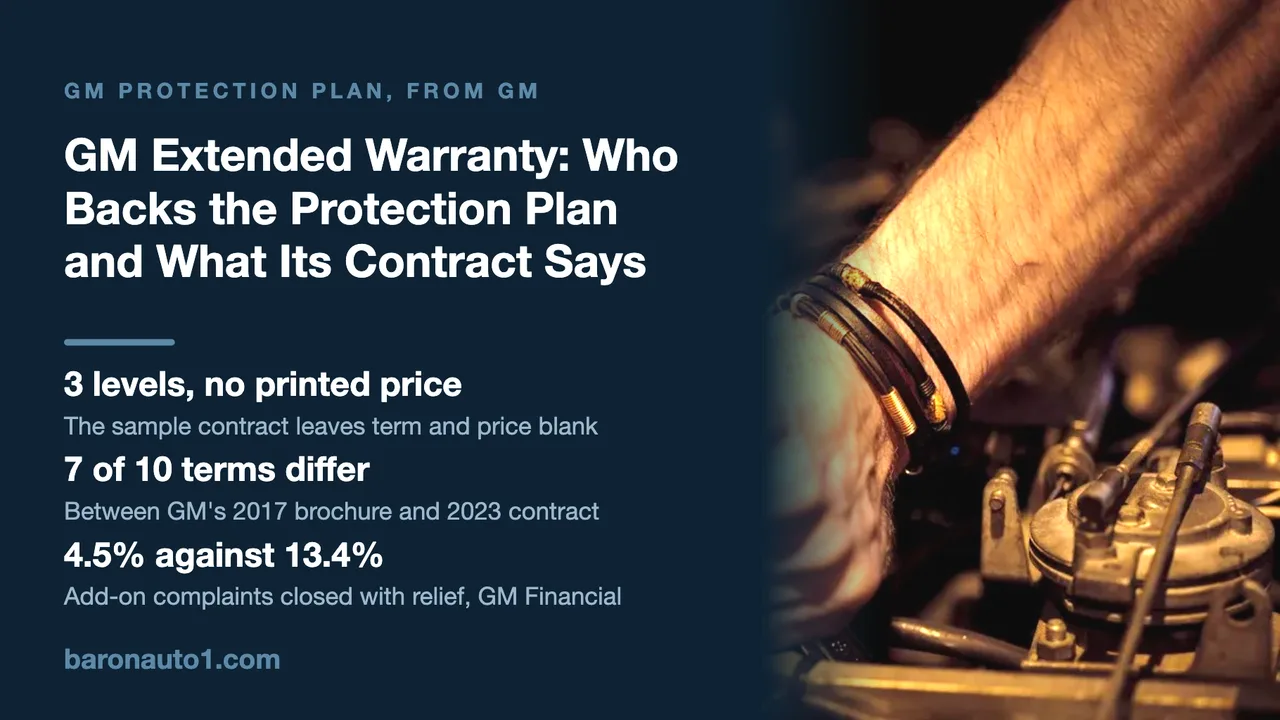
- GM’s extended warranty is a service contract separate from the factory warranty; on a GMC it is the GMC Protection Plan. GM’s published sample contract names GM Protections, LLC as the company that owes you the repair, and Safe-Guard Products International as the administrator that decides claims.
- The contract has three levels: Powertrain and Silver cover listed parts only, while Platinum covers any mechanical breakdown except 16 groups of exclusions. It prints no term, mileage limit, deductible or price; those are left blank on the sample.
- Unless you buy the Wrap option, the contract clock starts on the day you buy it. Either way, the term includes any time left on the factory warranty, and parts still under that warranty aren’t covered by the plan until it ends.
- A new 2025 Chevrolet has 3 years or 36,000 miles bumper-to-bumper and 5 years or 60,000 miles on the powertrain, or 5 years or 100,000 miles on Duramax diesels, Silverado TurboMax engines and qualifying fleet vehicles.
- GM’s own 2017 brochure for the plan disagrees with the 2023 sample contract on 7 of the 10 terms we compared, including who provides it and how long you have to cancel for a full refund.
- GM Financial has 3,042 vehicle loan or lease complaints at the CFPB. The 133 about add-on products closed with relief 4.5% of the time, against 13.4% for the rest.
GM’s extended warranty is a vehicle service contract sold through its dealers. The Chevrolet warranty booklet describes optional Protection Plans in different levels of coverage and sends owners to a dealer for details, and GMC publishes its version as the GMC Protection Plan. It isn’t the factory warranty. The factory warranty comes with the car at no separate charge and is written by the brand that built it. The protection plan is a separate purchase with its own contract, its own obligor and its own cancellation rules. GMC publishes a full sample of that contract on gmc.com, so this page can say what the plan actually promises. It draws on four GM documents: the 2025 and 2024 Chevrolet warranty booklets, the GMC Protection Plan sample contract dated May 2023 and the GMC Protection Plan brochure dated 2017, all read on 11 September 2026 and re-checked on 30 September 2026. It also draws on the CFPB complaint file for GM Financial.
One scope note before the detail. The warranty booklets are Chevrolet’s. GMC, Buick and Cadillac each publish their own, which we didn’t read. The contract and brochure are GMC’s, and the contract says the covered vehicle must be a GMC. We haven’t read the Chevrolet contract, so where this page quotes the contract it is quoting the GMC version, and the terms on another brand’s contract may differ. Buick’s and Cadillac’s contracts, booklets and plan pages are read in our Buick and Cadillac extended warranty guides.
Who owes you the repair: GM Protections, LLC and Safe-Guard
The sample contract, form GMVSC 5/23, is 16 pages long and every page is stamped SAMPLE. It names two companies. The obligor, which it also calls the provider, is GM Protections, LLC, of Fort Worth, Texas. That is the company contractually bound to pay your claim. The administrator is Safe-Guard Products International, LLC, of Atlanta, Georgia, or Safe-Guard Warranty Corporation in Florida. The administrator takes the claim call, authorizes repairs and can inspect the vehicle first. The contract doesn’t describe GM Protections, LLC’s corporate relationship to General Motors.
How your claim is backed depends on where you live. In 27 jurisdictions, 26 states plus the District of Columbia, the obligor’s obligations are insured by a service contract reimbursement insurance policy issued by Virginia Surety Company, Inc. If a covered claim or a refund isn’t paid within 60 days (30 in Alaska) after you have met the requirements, you can claim directly against that insurer. Everywhere else, the contract says the obligations are backed by the obligor’s full faith and credit and aren’t guaranteed under a reimbursement policy. The listed jurisdictions include California, Illinois, New York, Texas, Virginia and Washington. Check the list in your own contract; our guide to who actually owes you the repair explains why the insurer behind the obligor matters.
Massachusetts is the exception to all of this. There, the contract says, the obligor is the selling dealer. The Massachusetts amendment also warns that the coverage isn’t required to register or finance a vehicle, that its benefits may duplicate warranties that come automatically with every sale, and that the seller can require you to use those warranties first.
The contract says three more things about what it is. It is “not an insurance policy, a warranty, or a guarantee.” Buying it is optional and won’t be a factor in the sale, the lease or the credit approval. And neither the loan nor its terms may be conditioned on buying it. If a finance office tells you the plan is needed to get approved, the contract itself says otherwise.
Powertrain, Silver and Platinum: what each level covers
The contract lists three levels. The difference between them isn’t just how many parts they cover. It is how coverage is defined.
| Level | Component groups | How coverage is defined |
|---|---|---|
| Powertrain | Engine; transmission, transaxle and transfer case; drive axle; hybrid and electric components | Listed parts only. A part not listed is excluded even if a covered part damaged it. |
| Silver | Everything in Powertrain, plus front and rear suspension, climate control, electrical, steering and brakes | Listed parts only, same rule |
| Platinum | Everything in Powertrain and Silver, plus any other mechanical breakdown | Exclusionary: everything is covered except the listed exclusions. If a covered part damages a non-covered part, that repair is covered too. |
That last rule matters more than it looks. On Powertrain and Silver, a failed covered part that takes a non-listed part with it leaves you paying for the second part. On Platinum, it doesn’t. Platinum’s exclusions run to 16 groups as printed:
- clutch disc, pressure plate and release bearing
- hinges, glass and glass framework
- lenses and sealed beams
- body parts and panels
- structural framework and welds
- bumpers, trim, moldings, door panels and handles
- tires, wheels and wheel alignment unless needed for a covered repair
- batteries, except hybrid and electric batteries
- wiper blades
- brake pads and rotors
- lights, fuses and bulbs
- filters, lubricants and fluids not replaced with a covered repair
- upholstery, vinyl and convertible tops
- paint, bright metal and sheet metal
- freeze plugs, heater and radiator hoses
- the exhaust system and catalytic converter
The contract defines a mechanical breakdown to include wear. It covers the failure of a covered part due to a defect in materials or workmanship, or due to “a gradual reduction in operating performance as a result of normal wear and tear.” If you are pricing a third-party contract, check how it defines a breakdown.
Some vehicles and uses are shut out. Fully electric vehicles aren’t eligible. Professional use, including ride share, and heavy-duty use, including towing and hauling, are excluded unless the matching optional coverage is selected and its surcharge paid. The contract allows some modification: mid-size trucks and SUVs may have up to a 4-inch lift with tires up to 33 inches, full-size trucks and SUVs up to a 6-inch lift with tires up to 35 inches, and rims up to 2 inches larger in diameter. Outside those limits, read the contract before relying on it.
When the contract clock starts, and the factory-warranty overlap
The contract offers two ways to measure the term. Without the Wrap option, coverage begins on the day you buy the plan and ends when the months listed have passed or the miles listed have been added to the odometer, whichever comes first. With the Wrap option, the term is measured from the vehicle’s original in-service date and zero miles. Both figures are left blank on the sample, so the quote or the registration page is where you find out which one you have.
Either way, one clause governs the overlap. The customer agrees that the term “begins to run even though any components or parts covered by a manufacturer, supplier, or other warranty are NOT covered by this Agreement until the expiration of that warranty.” The term also includes any period of the factory warranty. So a plan bought with a new Chevrolet or GMC spends its first years behind the factory warranty, paying only for what that warranty doesn’t cover, while its own clock runs. The plan’s term and the factory warranty’s don’t add together.
There is a waiting period in one case: when the plan is bought after the vehicle and the vehicle is no longer under the original manufacturer’s warranty. Then no claim is covered for the first 30 days or 1,000 miles, whichever comes first. The contract adds an extra 30 days and 1,000 miles to the end of the term to make up for it. The 2017 brochure describes a different trigger: a waiting period whenever the contract is bought more than 10 days after the vehicle. The contract you sign decides which applies.
What a new Chevrolet already carries: the 2025 booklet
Chevrolet’s 2025 warranty booklet prints seven coverage terms, plus emissions coverage. We compared 14 terms with the 2024 booklet, the seven below and seven emissions terms, and none changed.
| Coverage | Term | What the booklet says |
|---|---|---|
| Bumper-to-Bumper | 3 years or 36,000 miles | The complete vehicle, except the other coverages and the listed exclusions. The tires supplied with the vehicle are covered here, on a prorated basis. |
| Powertrain Component | 5 years or 60,000 miles | Engine, transmission and transaxle, transfer case and drive systems as listed. Sensors, wiring, connectors, the engine radiator, coolant hoses, heater core, starter motor and the entire pressurized fuel system are excluded. |
| Powertrain, listed engines and fleet | 5 years or 100,000 miles | Silverado TurboMax engines, 3.0L and 6.0L Duramax turbo-diesel engines, and certain commercial, government and qualifying fleet vehicles |
| Hybrid Vehicle Propulsion Battery | 8 years or 100,000 miles | The battery pack and its internal components. Gradual capacity loss is expected and not covered. |
| Restraint System | 6 years or 72,000 miles | Seatbelts and the airbag system |
| Sheet Metal, surface corrosion | 3 years or 36,000 miles | Body sheet metal panels. Corrosion from stone chips, dents or scratches isn’t included. |
| Sheet Metal, rust-through | 6 years or 100,000 miles | Body panels that rust through to an actual hole |
The 100,000-mile powertrain sentence names 3.0L and 6.0L Duramax engines in the 2025 booklet and 3.0L and 6.6L in the 2024 booklet. We record both as printed.
After Bumper-to-Bumper coverage ends at 3 years or 36,000 miles, powertrain coverage continues until 5 years or 60,000 miles, whichever comes first. The difference between those end points is 2 years and 24,000 miles; that subtraction is ours, not GM’s, and it isn’t what every car gets. A Chevrolet that reaches its third birthday on low mileage keeps up to 2 more years of powertrain cover. One that reaches 36,000 miles early keeps up to 24,000 more miles, which may take longer than 2 years to drive. On a Duramax Silverado the powertrain runs to 5 years or 100,000 miles instead, so a high-mileage diesel keeps it much longer in miles.
The powertrain exclusions are the part to read twice. The radiator, coolant hoses, heater core, starter motor, sensors, wiring and the entire pressurized fuel system aren’t powertrain on a Chevrolet, even though most owners would think of them as engine parts. After 3 years or 36,000 miles, those are the repairs no factory warranty pays for, and they are what a Silver or Platinum plan is really selling.
Some items are covered for less than the full Bumper-to-Bumper term. The booklet treats these as maintenance after the point shown:
- Up to 7,500 miles: audio system cleaning, brake pads and linings, coolants and fluids, filters, rear axle service, tire rotation, wheel alignment and balance, and wiper inserts and blades.
- 12 months: keyless entry and other remote transmitter batteries.
- 12 months, any mileage: windshield cracks caused by a defect in material or workmanship.
- 12 months or 12,000 miles: chemical paint spotting from airborne fallout.
Tires follow their own schedule. Defective tires are replaced at full cost up to 12,000 miles. After that you pay a growing share of the tire price: Chevrolet covers 60% up to 15,000 miles, 50% to 20,000, 40% to 25,000, 30% to 30,000 and 20% to 36,000 miles, and nothing after. Mounting and balancing labor is covered in full for the whole Bumper-to-Bumper period. Wear-out isn’t a defect and can happen before the coverage ends.
Roadside assistance lasts as long as the powertrain coverage, but the booklet says it isn’t part of the New Vehicle Limited Warranty and GM can change or end it at any time. The same goes for courtesy transportation during warranty repairs. If a car sits at a dealer for warranty work, the booklet extends the warranty by a day for each day beyond the first 24 hours.
The factory warranty’s rules: transfer, parts, software and salvage
The Chevrolet warranty passes to later owners. The booklet says it is provided to the original owner and any subsequent owners during the warranty period. One exception: on a Corvette Z06 or E-Ray, coverage is voided if ownership is transferred within the first six months after delivery.
The booklet is more permissive about parts than some owners expect. Maintenance and repairs can be done by any qualified shop, and the warranty doesn’t depend on using any particular brand of replacement part. But parts, calibrations or software changes not issued through GM void coverage for the components they damage or affect. Damage from missing scheduled maintenance, or from not using or maintaining the proper fluids, isn’t covered, and GM may deny an emissions warranty claim if skipped maintenance caused the failure, though not solely because records are missing.
The 2025 booklet adds a rule that the 2024 booklet doesn’t have. The owner must install GM’s over-the-air software updates within 45 days of their availability to the vehicle. Damage caused by an update is covered, but damage from failing to install one isn’t. It also warns that running on fuel below 91 octane, where premium is required, may not be covered, and that fuel with more than 15% ethanol isn’t allowed in vehicles that aren’t flex-fuel.
Three conditions end coverage altogether. The warranty is void on vehicles currently or previously titled as salvaged, scrapped or junked, or otherwise considered a total loss, and it doesn’t cover a rebuilt vehicle after a write-off. Coverages don’t apply if the odometer was disconnected or altered, or if the mileage can’t be determined. And coverage may be void or restricted on vehicles imported or exported for resale. On a used Chevrolet or GMC, check the title history before counting on any remaining warranty. A salvage or rebuilt brand ends it.
Past the warranty, the booklet leaves two doors open. Chevrolet or its dealers may help after the warranty has expired, reviewed case by case, when the problem comes from a defect. And GM sometimes runs special coverage adjustment programs that pay for certain repairs the warranty doesn’t cover. Ask a dealer to check your VIN for both before paying for a repair out of pocket.
The plan’s printed benefits, and its limits
The contract prints benefit caps that the factory warranty doesn’t offer. The booklet says economic loss and extra expenses, including lodging, meals, travel and loss of use, aren’t covered by the factory warranty.
- Rental car: up to $40 a day for a maximum of 10 days. That is up to $400 per repair, our multiplication.
- Roadside assistance: up to $100 per occurrence, and up to 3 gallons of emergency fuel up to three times per calendar year.
- Trip interruption: $200 a day for up to five days, a $1,000 maximum, when a breakdown happens 100 miles or more from your residence. Expenses must be incurred within 72 hours and receipts sent within 60 days. The benefit isn’t available to New York residents.
The contract caps what it pays in two further ways. Repair payments are limited to reasonable and customary charges, and can’t exceed the manufacturer’s suggested retail price for parts and labor as listed in a national guide such as Mitchell or Alldata. And for any single repair visit, benefits can’t exceed the vehicle’s actual cash value just before the breakdown. Over the whole term, total benefits can’t exceed the price paid for the vehicle.
If no deductible is printed on the registration page, the contract says a $0 deductible applies. Where there is one, it applies per repair visit. A disappearing deductible, if you choose it, is waived when the covered repair is done at the selling dealer. The deductible is also waived if the same covered part fails again after a repair under the plan. The contract won’t pay diagnosis or teardown time if the diagnosis finds a breakdown that isn’t covered.
If another warranty, recall or repair adjustment also covers the breakdown and pays less, the obligor pays the difference. So GM’s own special coverage programs and the plan don’t cancel each other out.
Making a claim: prior authorization, records and deadlines
The contract’s claim procedure is strict, and most of it has to happen before the repair. Return the vehicle to the selling dealer if you can; otherwise call the administrator for instructions. Prior authorization from the administrator is required for any covered repair, and the administrator can inspect the vehicle before authorizing it. Teardown authorization has to be given when asked, and replaced parts kept until the claim is settled. The repair facility must submit the claim within 30 days of authorization. For an emergency repair outside business hours, documents are due no later than 30 days after the breakdown.
The maintenance clause is the one most likely to decide a disputed claim. You must service the vehicle on the manufacturer’s schedule and keep the original repair orders, invoices and receipts; failing to can mean a denied claim. Any breakdown resulting from a pre-existing condition isn’t covered. Keep every oil-change receipt with the contract.
Transferring and cancelling the plan
The plan can pass to the next owner, but only in a private sale. The contract says it is transferable when a private party buys the vehicle directly from you, or takes over your lease, for a $50 fee ($40 in Florida), requested within 30 days of the sale. It isn’t transferable if a dealership is a party to the resale, and it can’t be moved to another vehicle. So trading in a Silverado with a GM Protection Plan on it means the plan doesn’t go with the truck, and you should cancel it for a refund instead.
You can cancel at any time by written notice. The refund depends on timing:
- Within 30 days of purchase, with no claim paid: the full price is refunded. California and Florida amendments set that window at 60 days.
- After that, or if a claim was paid: a pro rata refund, based on whichever of time or mileage has run further, less claims paid and a $50 processing fee. California caps the fee at $25 or 10% of the price, whichever is less; Florida at 10% of the pro rata refund or $50, whichever is less.
- If the plan was financed: the refund goes to the lender, lessor or payment plan provider unless you show the loan is paid off.
The obligor can cancel only for material misrepresentation, fraud, a substantial breach of your duties under the contract, or nonpayment. Our guides cover cancelling a plan and how cancellations go wrong.
Disputes: arbitration in the plan, not in the warranty
The two documents handle disputes differently. The Chevrolet warranty booklet has no binding arbitration clause, which is an observation about its text, not a GM statement. Its dispute program is BBB AUTO LINE, run by BBB National Programs, Inc. It is free, available in all 50 states and the District of Columbia, and a case will generally be heard within 40 days. You may be required to use it before going to court, but you can reject its decision and pursue any other remedy. The booklet does bar warranty claims brought as a class representative or in any other representative capacity.
The protection plan contract does require arbitration. All individual disputes arising from it go to impartial arbitration. You propose at least three arbitrators, the administrator may question them for neutrality and chooses one, and the cost is shared equally unless the arbitrator directs otherwise.
That base clause doesn’t apply everywhere. The sample’s state amendments change it in 20 states. Georgia, Mississippi, Nebraska and Wisconsin delete it entirely. Vermont says residents aren’t required to abide by it but may choose to. Fifteen more amend or replace it: Alabama, Arizona, California, Connecticut, Florida, Indiana, Maine, Missouri, Nevada, New Hampshire, Oklahoma, Oregon, Utah, Washington and Wyoming, each with its own wording. Read your state’s page of the contract before you rely on the base clause either way.
The 2017 brochure versus the 2023 contract
GMC still serves a protection plan brochure, form EW-BR-0175-16, dated 2017, alongside the 2023 sample contract. The brochure says of itself: “This is not a contract.” It is worth reading side by side with the contract because the two disagree on 7 of the 10 terms we compared.
| Term | 2017 brochure | 2023 sample contract |
|---|---|---|
| Provider | AMT Warranty Corp. (Wesco Insurance Company in Florida) | GM Protections, LLC as obligor; Safe-Guard as administrator |
| Coverage levels | 2: Platinum and Silver | 3: Powertrain, Silver and Platinum |
| Rental, per day | $40 | $40 |
| Rental, maximum | $280 per visit | 10 days |
| Towing or roadside, per occurrence | $150 | $100 |
| Trip interruption, per day | $200 | $200 |
| Trip interruption, maximum days | 4 | 5 |
| Trip interruption, distance from home | More than 100 miles | 100 miles or more |
| Full-refund window | 60 days | 30 days (60 in California and Florida) |
| Waiting period applies when | The contract is bought more than 10 days after the vehicle | The contract is bought after the vehicle, once the factory warranty has ended |
The brochure’s rental cap works out to 7 days at the full $40, and its trip interruption cap to $800; both are our arithmetic, since the brochure prints neither total. The brochure also names AMT Warranty Corp. and Wesco Insurance Company as “GM-approved providers” that aren’t related entities of GM or its dealerships. The current contract names neither. If a dealer hands you the brochure, ask for the contract, and check which company is printed as obligor.
The brochure prints one set of figures the contract doesn’t: average retail repair costs, which it attributes to the plan administrator’s own claims experience for GMC vehicles between 1 January 2014 and 12 August 2016, parts and labor included. It gives $6,935 for an engine, $3,213 for a transmission, $1,318 for rack-and-pinion steering, $689 for an alternator, $663 for air conditioning, $642 for a fuel pump, $505 for a front control arm, $431 for a starter, $402 for a water pump, $289 for a brake caliper and $277 for a power window motor. These are the company’s own figures, can’t be checked independently, are about ten years old and come from an administrator the current contract doesn’t name. They are a sales argument, not a price list. For current repair costs, our guides to alternator replacement cost and transmission repair cost are a better starting point.
What the complaint file of GM’s lender shows
No public database records how protection plan claims are decided. The lending side is public, and a plan sold inside a car loan shows up there when it goes wrong. On 11 September 2026 we pulled every vehicle loan or lease complaint the CFPB holds against General Motors Financial Company, Inc.: 3,042 of them, received between 24 April 2017 and 1 September 2026. 2,060 are about loans, 980 about leases and 2 about title loans. Of the 1,144 companies listed under vehicle loans and leases, GM Financial has the 11th-largest count. The file is 31.5% of the 9,649 complaints against the company across all products. Ally Financial, formerly GMAC, is a separate company and isn’t included. A complaint is an allegation, not a finding, and the response field is the company’s own label.
GM Financial answered 3,040 of the 3,042 on time. It closed 2,637 with an explanation, 327 with non-monetary relief and 68 with monetary relief, and 10 were still in progress. That is 395 closed with relief, 13%, against 9.4% across all 102,556 complaints in the product.
The 133 add-on complaints go the other way. They are 4.4% of the file, a little under the 5.5% share across the whole product, and split 113 loans to 20 leases. Only 6 closed with relief: 3 monetary and 3 non-monetary, 4.5%. The rest of GM Financial’s complaints closed with relief 13.4% of the time, nearly three times as often. Across the product, the 5,611 add-on complaints close with relief 7.9% of the time. Of the two add-on sub-issues, the main one has 110 complaints and 6 with relief, 5.5%; the other has 23 and none. Billing problems, for comparison, closed with relief in 77 of 541 cases, 14.2%.
| Year | Complaints | About add-on products | Add-on share |
|---|---|---|---|
| 2017 | 129 | 4 | 3.1% |
| 2018 | 378 | 10 | 2.6% |
| 2019 | 260 | 5 | 1.9% |
| 2020 | 315 | 6 | 1.9% |
| 2021 | 287 | 8 | 2.8% |
| 2022 | 253 | 14 | 5.5% |
| 2023 | 263 | 12 | 4.6% |
| 2024 | 328 | 20 | 6.1% |
| 2025 | 480 | 22 | 4.6% |
| 2026 | 349 | 32 | 9.2% |
The add-on share stayed between 1.9% and 3.1% from 2017 to 2021, rose to between 4.6% and 6.1% from 2022 to 2025, and is 9.2% so far in 2026. With 32 add-on complaints in eight months, 2026 already has more than any full year before it.
Of the 1,587 complaints with a written narrative, 70 (4.4%) mention a protection product by keyword. 42 use the word warranty or warranties, 24 write GAP in capitals, 10 mention an extended service, warranty, plan, coverage or protection, 7 say service contract, 3 say maintenance plan and 2 say protection plan. None names GM Protections, and none uses VSC. One narrative can match several terms. It is a keyword floor, not a census. Across all 1,587 narratives, 75 mention cancelling something and 82 mention a refund, though those counts aren’t limited to protection products.
Where those 70 were filed matters if you search the database yourself. Only 19 sit under the main add-on sub-issue and 2 under the other add-on label. The rest are spread across problems paying off the loan (5), billing (4), denied requests to lower payments (4) and a long tail of other labels. A search by sub-issue alone misses most of them.
A GM Protection Plan, a third-party contract, or neither
Whether a service contract is worth buying at all is covered in our guide to whether an extended warranty is worth it. For a GM vehicle, three questions narrow it.
First, which level. Powertrain adds little on a new vehicle whose factory powertrain coverage runs to 5 years or 60,000 miles, or 100,000 on a Duramax, and the plan’s clock runs through those years anyway. The repairs GM’s factory powertrain warranty leaves out, such as the radiator, starter, sensors, wiring and fuel system, sit in Silver’s component groups or under Platinum’s exclusionary cover. Check the Silver parts list for the specific components you are worried about, because anything not listed isn’t covered.
Second, who backs it and where you live. GM Protections, LLC owes the repair, Safe-Guard decides the claim, and in 26 states and the District of Columbia an insurer stands behind them. A third-party contract names its own obligor, administrator and insurer. Our guide to what a state register will tell you shows how to check any of them.
Third, the price. The contract leaves it blank, and the brochure doesn’t print one. Why there is no sticker price and where the markup comes from explain how the number is set and why it is negotiable. Because the contract allows a full refund within 30 days, or 60 in California and Florida, a plan bought in the finance office can still be reconsidered at home.
For an older vehicle past the factory terms, the remaining routes are a plan bought after the fact, with its 30-day, 1,000-mile waiting period, a third-party contract, or, from some insurers, mechanical breakdown insurance.
- Get the blanks filled in. The term in months and miles, the price and the deductible are blank on the sample. All four should be printed on your registration page.
- Ask whether it is Wrap. Without Wrap the term starts on the day you buy; with Wrap it starts from the vehicle’s in-service date and zero miles.
- Check the level against the gaps. The factory powertrain warranty excludes the radiator, hoses, starter, sensors, wiring and fuel system. Make sure the level you buy covers the parts you care about.
- Check your state’s page. Arbitration, refund windows, fees and whether an insurer backs the plan all vary by state.
- Keep every service receipt. The contract can deny a claim if maintenance records are missing.
- Don’t let a repair start before authorization. Prior authorization from Safe-Guard is required.
- Cancel at trade-in. The plan can’t transfer through a dealer sale, so claim the refund instead.
Calls saying your Chevy or GMC warranty is about to expire are a separate matter. In 2022 the FTC sued American Vehicle Protection Corp., a Florida seller it alleged had falsely claimed to be, or to be associated with, consumers’ carmakers or dealers, and had promised bumper-to-bumper or full coverage that was much more limited than represented. A stipulated order in March 2023 and a further order that July banned defendants from selling extended auto warranties and from outbound telemarketing. In 2024 the FTC sent more than $449,000 in refunds to consumers. See what regulators have done.
Common questions
How much does the GM extended warranty cost?
GM doesn’t publish a price. The sample contract leaves the price, term and deductible blank, and the brochure prints none. The price comes from a dealer quote and varies with the vehicle, level, term and deductible. Our guide to extended car warranty cost explains what moves it.
Who administers the GM Protection Plan?
In the 2023 sample contract, the obligor is GM Protections, LLC, of Fort Worth, Texas, and the administrator is Safe-Guard Products International, LLC, of Atlanta, or Safe-Guard Warranty Corporation in Florida. The 2017 brochure named AMT Warranty Corp., and Wesco Insurance Company in Florida, instead. Your contract’s obligor line is the one that counts.
Is the GM Protection Plan transferable?
Yes, to a private buyer or someone taking over your lease, for a $50 fee ($40 in Florida), if requested within 30 days of the sale. It isn’t transferable when a dealership is part of the sale, and can’t be moved to another vehicle.
Can I buy a GM extended warranty after I bought the car?
The contract allows it. If the plan is bought after the vehicle and the factory warranty has already ended, a waiting period applies: nothing is covered for the first 30 days or 1,000 miles, and the same is added to the end of the term.
Does the Chevrolet powertrain warranty transfer to a second owner?
Yes. The 2025 booklet says the warranty is provided to the original owner and any subsequent owners during the warranty period. The exception is the Corvette Z06 and E-Ray, whose coverage is voided if ownership changes in the first six months after delivery.
Is a GM extended warranty worth it?
It depends on the level, what it adds beyond the 5-year, 60,000-mile powertrain warranty, and the price. The factory powertrain warranty excludes the radiator, starter, sensors, wiring and fuel system, so the case for Silver or Platinum rests on those. Our guide to whether an extended warranty is worth it walks through the arithmetic.
Sources and further reading
- CFPB consumer complaint database
- CFPB auto loan resources
- FTC: auto service contracts and warranties
- FTC: a businessperson’s guide to federal warranty law
- 15 U.S.C. § 2301 (Magnuson-Moss definitions)
- 15 U.S.C. § 2308 (Implied warranties)
- Texas Department of Licensing and Regulation — service contract providers, Occupations Code Chapter 1304
- Florida CFO — motor vehicle service agreements, Chapter 634
- FTC v. American Vehicle Protection Corporation — case docket
- FTC — industry ban and judgment, American Vehicle Protection
- FTC — refunds paid to consumers harmed by an extended vehicle warranty scheme
- FTC withdrawal of the CARS Rule (91 FR 6507)
Recall, complaint and safety-rating figures on this page were retrieved from the federal databases above on August 19, 2026. Federal data changes — re-check any VIN before you rely on it.
Published September 30, 2026 · last updated October 1, 2026. Found something out of date or wrong? Tell us and we will correct it.