Mopar Extended Warranty: What FlexCare Covers and When It Starts
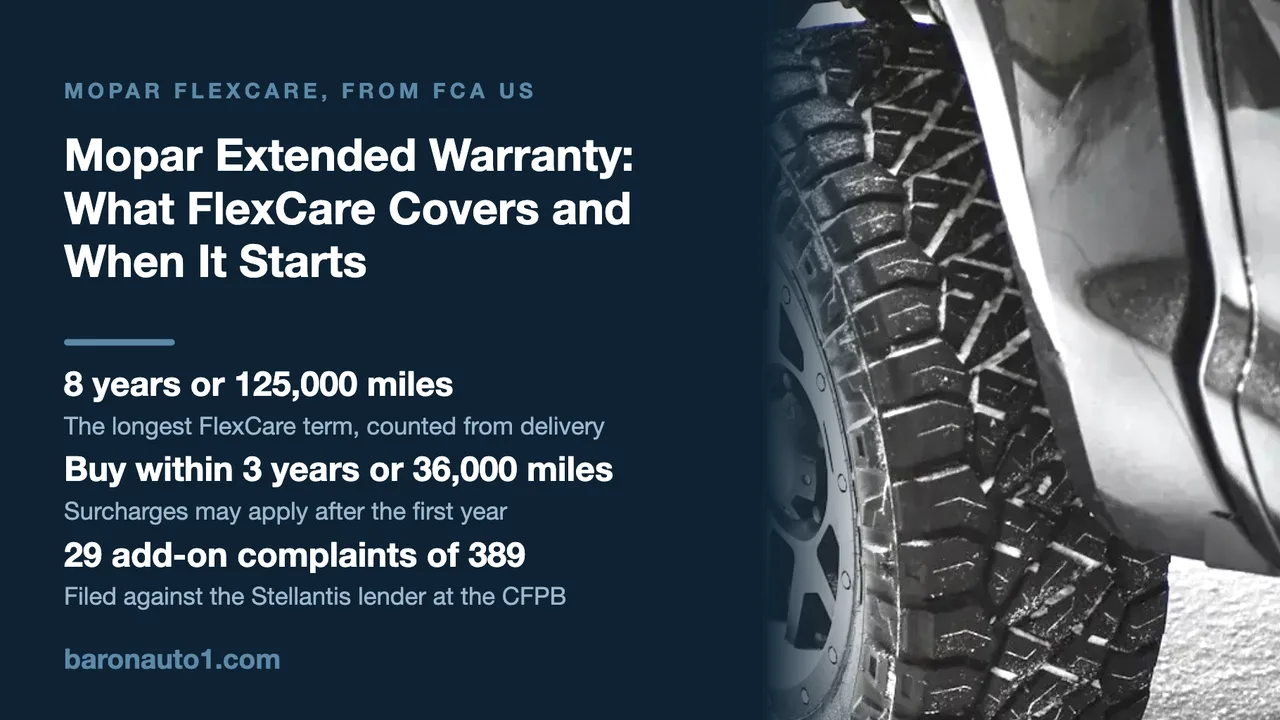
FlexCare is the Stellantis-backed plan for Jeep, Ram, Dodge and Chrysler. Its FAQ caps terms at 8 years or 125,000 miles, counted from the day the vehicle was first delivered. What FCA US's booklets and brochures print, the free 10-year Ram powertrain extension, and the lender's complaint file.
The short version
- The Mopar extended warranty is now sold as FlexCare, a service contract backed by Stellantis and separate from the factory warranty. The main plans are Extended Care Premium, Extended Care Plus and Extended Care. FlexCare’s own FAQ puts the longest term at 8 years and 125,000 miles, and prints no price.
- A new-vehicle FlexCare plan starts on the day the car was first delivered, at zero miles, not when the factory warranty runs out. An 8-year plan bought two years in still ends eight years after delivery.
- New-vehicle plans can be bought any time within 3 years and 36,000 miles of that start date, but surcharges may apply after 1 year or 12,000 miles.
- A 2025 Jeep carries a 3-year, 36,000-mile Basic Limited Warranty and a 5-year, 60,000-mile powertrain warranty. Brakes, bulbs, wiper blades and five other listed items are covered for only 1 year or 12,000 miles.
- 2026 Ram trucks bought new from a dealer get a 10-year, 100,000-mile powertrain warranty at no charge. It is for the original owner only and is not a FlexCare plan.
- Stellantis Financial Services has 389 vehicle loan or lease complaints at the CFPB. 29 concern add-on products, and those closed with relief 24.1% of the time, against 25.6% for the rest.
Mopar’s extended warranty is a vehicle service contract sold under the name FlexCare, for Chrysler, Dodge, Jeep, Ram and FIAT vehicles. Older paperwork calls it Mopar Vehicle Protection, and the plan names Maximum Care and Added Care still turn up on quotes and resale listings. It isn’t the factory warranty. The factory warranty comes with the car and is set out in FCA US LLC’s warranty booklet. FlexCare is a separate purchase with its own contract, its own terms and its own cancellation rules. This page draws on FCA US’s own documents: the 2025 and 2024 Jeep warranty booklets, the current FlexCare page on mopar.com, the Ram powertrain extension terms and three older Mopar Vehicle Protection brochures, all read on 30 September 2026. It also draws on the CFPB complaint file of the Stellantis lender.
FlexCare, Mopar Vehicle Protection and Maximum Care: one product line, three names
If you are shopping for a Jeep, Ram, Dodge or Chrysler extended warranty from the dealer, the product on the quote sheet will be one of these names. FlexCare is the current one. The FlexCare page on mopar.com describes it as the only vehicle protection provider endorsed by Stellantis, honored at all authorized Chrysler, Dodge, Jeep, Ram and FIAT brand dealers in the United States, Canada and Mexico. That is the company’s claim about its own product, and it tells you what makes FlexCare different from a third-party plan: it is the one the carmaker stands behind.
Mopar Vehicle Protection is the older name. The three brochures FCA US still serves from mopar.com are dated by their own copyright lines to 2016, 2017 and 2018, and they sell plans called Maximum Care and Added Care Plus. The FlexCare FAQ still uses both names side by side, “Mopar® Vehicle Protection or FlexCare”, and says a FlexCare Advantage plan can pick up when either one ends. So a used Jeep advertised with “Mopar Max Care” remaining is carrying one of these contracts, and the contract itself, not the listing, says what is left on it.
Who owes you the repair is printed in the older brochures’ small print. Mopar Vehicle Protection plans are offered and issued by FCA US LLC. FCA Service Contracts LLC, a wholly owned subsidiary of FCA US LLC, and Extended Vehicle Protection LLC “may in some instances be the obligor and/or administrator of a plan”. The current FlexCare page names no obligor. The word matters because the obligor is the company contractually bound to pay your claim. Our guide to who actually owes you the repair sets out each role. On a FlexCare contract, find the obligor line and check that it names one of these companies.
The factory booklet draws the same line from the other side. It says the warranties it contains are the only express warranties FCA US LLC makes for your vehicle, and it describes Mopar Vehicle Protection plans as optional service contracts that complement but don’t replace those warranties. It adds that they are the only extended protection plans authorized, endorsed and backed by FCA US LLC. A plan from anyone else can still be a legitimate contract, but it isn’t that one.
The FlexCare plans, and what the page prints about them
The FlexCare page lists three mechanical plans for gas and diesel vehicles, new or pre-owned, and three for new battery-electric vehicles. It describes each one by what it covers, not by what it costs.
| Plan | Vehicles | What the page says it covers |
|---|---|---|
| Extended Care Premium | New and pre-owned, gas and diesel | Over 5,000 components. The page’s line is “if it’s mechanical, it’s covered”. |
| Extended Care Plus | New and pre-owned, gas and diesel | Over 800 major components |
| Extended Care | New and pre-owned, gas and diesel | Engine, transmission, driveline, steering and air conditioning |
| Extended Care Premium | New, battery electric | The electric drivetrain and over 2,500 components |
| Extended Care Plus | New, battery electric | The electric drivetrain and over 1,100 major components |
| Extended Care | New, battery electric | The electric drivetrain and over 500 major components |
Every one of the six cards ends the same way: available with a variety of time and mileage terms, and deductibles. None prints a term, a mileage limit, a deductible or a price. The FAQ further down the same page gives the ceiling for the whole line. It says Mopar Vehicle Protection or FlexCare is offered “with a wide variety of time and mileage terms, up to 8 years and 125,000 miles.” So 8 years and 125,000 miles is the most you can buy. Which terms are offered for your car, and at what deductible, isn’t printed anywhere on the page.
The one deductible the page does print belongs to a lease bundle. It packages Extended Care Premium mechanical protection with a $100 deductible, together with rental, towing, roadside assistance, key fob cover, road hazard tire and wheel protection, dent repair, and oil changes and tire rotations every 5,000 miles. Don’t read that $100 as the deductible on a stand-alone plan. The page doesn’t say it is.
The extra benefits have printed caps:
- Rental car: up to $45 a day, with a $175 maximum per occurrence.
- Trip interruption: up to $1,000 for lodging, meals and car rental when the failure happens more than 100 miles from home.
- Key fob: up to three repairs or replacements, with a total maximum benefit of $600.
The page also sells non-mechanical products under the same name: prepaid maintenance, road hazard tire and wheel cover, dent repair, a MultiCare bundle of up to 7 years that is not available in all states, lease wear-and-tear cover of up to $7,500, and GAP. They are separate contracts. A dealer quote that bundles several of them into one monthly figure is worth pulling apart line by line.
Ask for the contract, not the plan card. The page gives you a plan name, a component count and a ceiling of 8 years and 125,000 miles. The term you are being offered, its mileage limit, the deductible and the price come from the dealer. Ask for the contract with your VIN on it, check that the obligor is FCA US LLC, FCA Service Contracts LLC or Extended Vehicle Protection LLC, and read the list of what isn’t covered before you read the list of what is.
When a FlexCare plan starts, and why that decides what you are buying
This is the part of the FAQ that changes the arithmetic most, and it is easy to miss. A New Vehicle plan, or a plan on a Certified Pre-Owned vehicle, begins on the vehicle’s warranty start date, which the FAQ defines as the date the vehicle was delivered to its original owner, and at zero miles. It says plainly: “This coverage does not begin upon expiration of the new vehicle warranty.” The certified program those cars come from has its own clocks, set out in our Jeep certified pre-owned guide.
The FAQ’s own worked example makes the point. A car is delivered on 1 July 2019. The owner buys a 5-Year / 100,000-Mile Maximum Care plan on 1 November 2019, four months later, with 10,000 miles on the clock. That coverage started on 1 July 2019 and ends on 1 July 2024, or at 100,000 miles on the odometer, whichever comes first. Buying later doesn’t move the end date.
Two things follow. First, a new-vehicle plan overlaps the factory warranty for as long as the factory warranty lasts. On a 2025 Jeep, the first 3 years or 36,000 miles are already covered bumper to bumper by FCA US, and the powertrain is covered to 5 years or 60,000 miles. What a new-vehicle plan adds is mostly what lies beyond those points, plus the benefits the factory warranty excludes, such as rental cars, which the booklet lists among the incidental costs it won’t pay. Second, the later you buy, the less time is left on any given term. An 8-year plan bought two years after delivery has six years left, not eight.
The buying window is printed too. New Vehicle plans can be bought any time within 3 years and 36,000 miles of the warranty start date. Surcharges may apply after 1 year or 12,000 miles. The page doesn’t say how large the surcharge is. If a dealer tells you a plan must be bought on the day you take delivery, the FAQ says otherwise, although the price may rise after the first year or 12,000 miles.
Pre-owned plans work differently. A traditional Pre-Owned plan starts on the date and at the mileage when you buy it. It can be bought on a vehicle no more than 10 model years old with an odometer reading under 150,000 miles, or under 125,000 miles for vehicles whose manufacturer powertrain warranty was 5 years or 60,000 miles. The dealer completes a vehicle inspection first to confirm the vehicle is eligible. A Certified Pre-Owned plan needs an active Certified Pre-Owned Limited Warranty and an odometer under 75,000 miles, and starts from the original delivery date like a new-vehicle plan.
What a new Jeep already carries: FCA US’s 2025 warranty booklet
FCA US publishes a warranty booklet for each brand and model year. The one recorded here is the 2025 Jeep booklet, First Edition V2. It prints 15 coverage terms for gas and plug-in hybrid vehicles and 6 for electric vehicles. We compared all 21 with the 2024 Jeep booklet, and none changed. Ram, Dodge and Chrysler booklets are separate documents; the Ram diesel and heavy-duty terms aren’t in this one.
| Coverage | Term | Applies to |
|---|---|---|
| Basic Limited Warranty | 3 years or 36,000 miles | Any item as it left the plant that is defective in material, workmanship or factory preparation, apart from parts covered by other warranties, such as tires and headphones |
| Basic Limited Warranty, specified components | 1 year or 12,000 miles | The eight items listed below |
| Powertrain Limited Warranty | 5 years or 60,000 miles | Gas engines. Manual transmission clutch parts are excluded. |
| Corrosion, all panels | 3 years, no mileage limit | All panels |
| Corrosion, outer panels | 5 years, no mileage limit | Outer panels |
| Federal Emission Warranty | 2 years or 24,000 miles | Specified components run 8 years or 80,000 miles |
| Emission Performance Warranty | 2 years or 24,000 miles | Specified components run 8 years or 80,000 miles |
| California Emission Warranty | 3 years or 50,000 miles | Specified components run 7 years or 70,000 miles |
| FCA US LLC Limited Emission Warranty | 8 years or 100,000 miles | Plug-in hybrids only |
| High Voltage Lithium-Ion Battery | 8 years or 100,000 miles | Plug-in hybrids outside TZEV states. Gradual capacity loss is not covered. |
| High Voltage Lithium-Ion Battery, TZEV states | 10 years or 150,000 miles | Plug-in hybrids |
| California Emission Warranty, TZEV states | 15 years or 150,000 miles | Plug-in hybrids |
Electric Jeeps get the same 3-year, 36,000-mile Basic Limited Warranty and the same corrosion terms, plus an Electric Powertrain Limited Warranty and a High Voltage Lithium-Ion Battery Limited Warranty of 8 years or 100,000 miles each.
After the Basic Limited Warranty ends at 3 years or 36,000 miles, the powertrain warranty keeps running until the vehicle reaches 5 years or 60,000 miles, whichever comes first. The difference between the two end points is 2 years and 24,000 miles. That subtraction is ours, not FCA US’s, and it isn’t what every Jeep gets. A Jeep that reaches its third birthday on low mileage keeps up to 2 more years of powertrain cover. A Jeep that reaches 36,000 miles in its second year keeps up to 24,000 more miles, which may take well over 2 years. Either way, from that point until the powertrain warranty ends, the engine and transmission are covered and almost nothing else is. That window is where a buyer’s exposure starts, and it is what a new-vehicle FlexCare plan is mostly selling.
The Basic Limited Warranty is broader than it first looks, and narrower in one place. The booklet says it covers “the cost of all parts and labor needed to repair any item on your vehicle when it left the manufacturing plant that is defective in material, workmanship or factory preparation.” There is no list of covered parts. But eight items are covered for only 1 year or 12,000 miles:
- Brakes: rotors, pads, linings and drums
- Bulbs
- Clutch discs or modular clutch assembly, if equipped
- Key fob battery
- Wheel alignment
- Wheel balancing
- Windshield and rear window
- Wiper blades

These are the parts a service contract is least likely to pay for. The 2016 Maximum Care pre-owned brochure lists wear items such as brake pads, shoes, rotors and drums, belts, wipers, tires and the manual clutch assembly as not covered, along with glass, lenses and bulbs. The 2017 Added Care Plus brochure says brake shoes, pads, rotors and drums, manual transmission clutch parts and latches of any kind are “not covered at any time.” Those brochures are old. Still, if keeping brakes and glass covered is why you want a plan, check the current contract’s exclusions first.
Roadside assistance runs longer than the Basic warranty: 5 years or 60,000 miles on gas Jeeps, and 8 years or 100,000 miles on 4xe plug-in hybrids and electric vehicles. The booklet says fuel delivery is limited to 2 gallons, twice in any 12-month period, and that FCA US may change or discontinue the program at any time.
The 2026 Ram powertrain extension: a warranty, not a plan
Ram owners searching for an extended warranty will find one that costs nothing. FCA US’s Ram powertrain warranty extension covers the powertrain on 2026 model Ram vehicles for 10 years or 100,000 miles. It is part of the New Vehicle Limited Warranty, not a service contract, and it has conditions:
- It is provided to the original owner of a 2026 Ram, excluding fully electric vehicles, who bought it through an FCA US franchised dealer in a retail purchase.
- It applies to the original owner only. Second and later owners get the standard powertrain coverage: 5 years or 60,000 miles, or 5 years or 100,000 miles for diesel engines.
- Its terms list roadside assistance and towing among the incidental or consequential damages it doesn’t cover.
- All other terms and exclusions stay as the warranty booklet states them. Where the booklet conflicts, the page says its own terms control.
Against the standard gas-engine powertrain term, the extension adds 5 years and 40,000 miles at the end points. Against the diesel term it adds 5 years and no miles, since both end at 100,000 miles. Those are our subtractions. For a diesel Ram driven hard, the extension may add nothing, because the truck reaches 100,000 miles long before 10 years.
Two consequences for buyers. A used 2026 Ram doesn’t carry the 10-year powertrain warranty to its second owner, whatever the listing says. And an original owner who buys a FlexCare plan should check what the plan adds beyond a powertrain warranty that already runs to 10 years or 100,000 miles. For most, the answer is everything that isn’t powertrain.
What the older Mopar Vehicle Protection brochures printed
The three older brochures are useful because they print the figures the current page leaves out. Each says it is general information and that the purchased contract governs, so treat them as dated evidence of how the plans were built, not as today’s terms.
Maximum Care for pre-owned vehicles, form 81-770-2080, copyright 2016, offered coverage from 1 to 5 years on over 5,000 components, for vehicles up to 10 model years old. It listed mileage options of 12,000, 15,000 and unlimited, and deductibles of $100 or $200. Coverage started on the date you bought the plan. Remaining coverage could be transferred to a later buyer when the vehicle was sold, for a $50 fee in most states. It said all pre-owned vehicles must be inspected before the plan is sold and that pre-existing conditions are not covered.
Added Care Plus for new vehicles, form 81-770-2071, copyright 2017, offered terms from 5 to 8 years on 850 components. Its mileage options ran from 60,000 to 75,000, 85,000, 100,000, 125,000 and 150,000 miles, with deductibles of $200, $100 or $0. It was sold on vehicles within 36 months and 36,000 miles of the warranty start date. Not all plans were transferable, and transfer required the remaining factory warranty to transfer too.
Maximum Care for new vehicles, form 81-770-2029A, copyright 2018, offered up to 8 years or 125,000 miles on over 5,000 components, with deductibles of $200, $100 or $0. It excluded several vehicles by name: SRT8, Viper, diesel-equipped vehicles, all Ram Cab/Chassis, ProMaster, Hellcat models, Scat Pack, all Alfa Romeo vehicles and vehicles with dual rear wheels. It also said rental, towing, roadside assistance and trip interruption benefits expire at 100,000 miles, below the plan’s 125,000-mile maximum.
Two differences are worth noticing. The 2017 Added Care Plus brochure lists a 150,000-mile option, while today’s FAQ gives 125,000 miles as the top of the range. And the rental allowance has moved: $35 a day in all three older brochures, $45 a day on the current page, with the same $175 maximum per occurrence where both print one. We record both figures and don’t reconcile them. If you are buying a used vehicle that already has a Mopar plan, the contract’s own terms are the only ones that apply to it.
FlexCare Advantage: coverage for when a plan runs out
FlexCare Advantage is described on the page as continued mechanical coverage when an existing FlexCare or Mopar Vehicle Protection plan ends, “similar coverage to your existing plan”. It runs until the vehicle is 15 years old or reaches 160,000 miles, whichever comes first. To enroll, the vehicle must be 11 years old or newer with no more than 140,000 miles.
That makes it the longest coverage in anything FCA US publishes, but it only follows an existing plan. A vehicle that never had a Mopar plan doesn’t qualify on this description. And a plan bought at 11 years and 140,000 miles has at most four years, or twenty thousand miles, to run before the age and mileage limits end it. That arithmetic is ours.
Cancelling, and where the refund goes
The page prints a cancellation policy. If you are the original purchaser of the plan and coverage hasn’t expired or been terminated, you may cancel, provided you haven’t authorized a transfer of coverage to a new owner. You cancel by taking the plan to any dealer, which asks FCA US to terminate the contract.
The policy then separates two cases. If the plan wasn’t financed, any refund due is paid to you by check from FCA US LLC. If it was financed with the vehicle and the vehicle is repossessed or declared a total loss, your rights under the plan transfer to the lienholder, which becomes responsible for requesting termination through the selling dealer. In practice, a plan rolled into your loan is refunded against the loan, not to you. The page doesn’t print how a refund is calculated or whether a cancellation fee applies. Get both in writing from the contract before you sign. Our guides cover cancelling a plan and how cancellations go wrong.
The factory warranty’s own rules: maintenance, modifications and salvage titles
A service contract usually borrows the factory warranty’s conditions, so it helps to know them. The 2025 booklet says FCA US may restrict the warranty if a vehicle isn’t properly maintained, or is abused or neglected in a way that interferes with its proper functioning. If that happens, coverage may be denied or need FCA US’s approval before a repair. In a dispute about maintenance, FCA US will require proof the vehicle was properly maintained. So keep the receipts. The booklet recommends returning to the selling dealer for maintenance but doesn’t say dealer maintenance is required.
On modifications, installing non-FCA parts doesn’t by itself void the warranties, but they don’t cover those parts or any repair they cause. Performance or racing parts count as non-FCA parts. That matters on Jeeps, which are often lifted or re-geared: a failure traced to an aftermarket part is on the owner.
Two rules end coverage outright. Disconnecting, tampering with or altering the odometer voids the warranties. And a vehicle has no warranty coverage of any kind if an insurer declares it a total loss, if it is rebuilt after that, or if it gets a salvage, junk, rebuilt, scrap or similar title. FCA US says it will deny coverage without notice if it learns of this. The exclusion doesn’t apply to emission warranties or recall campaigns. Before buying a used Jeep, Ram or Dodge on the strength of its remaining warranty, check the title history. A salvage or rebuilt brand means the factory warranty is gone, whatever the odometer says.
Disputes: arbitration unless you opt out within 30 days
The 2025 booklet sets out a dispute route in stages. FCA US offers a voluntary, non-binding process run by the National Center for Dispute Settlement at no cost to the owner. Its decision binds FCA US but not you unless you accept it. The booklet says the center will acknowledge a request within 10 days and that the whole process will normally take no longer than 40 days. For California residents, the booklet says you must use the dispute settlement program before seeking remedies in court under the Magnuson-Moss Warranty Act.
If a written dispute isn’t resolved within 60 days, it goes to binding individual arbitration administered by the American Arbitration Association under its Consumer Arbitration Rules. The arbitrator can’t hear class or representative claims. FCA US pays all AAA fees and costs, and the hearing is held where you live. You can take an individual dispute to small claims court instead.
The 30-day opt-out. You can opt out of arbitration within 30 days of taking delivery and signing the Arbitration Acknowledgment Form at the dealer. You do it by letter to FCA US LLC’s Office of the General Counsel, giving your name, VIN and intent to opt out. If you don’t, the arbitration provision is binding. This is the factory warranty’s clause; a FlexCare contract has its own dispute terms, which are worth reading separately.
What the complaint file of the Stellantis lender shows
No public database records how FlexCare claims are decided. The finance side is public. Dealers often sell a service contract inside the car loan, and complaints about those add-ons are filed against the lender. On 30 September 2026 we pulled every vehicle loan or lease complaint the CFPB holds against Stellantis Financial Services US Corp.: 389 of them, received between 7 February 2022 and 16 September 2026. 295 are about loans and 94 about leases. Of the 1,146 companies listed under vehicle loans and leases, it has the 46th-largest count. A complaint is an allegation, not a finding, and the response field is the company’s own label.
That file covers the Stellantis-owned captive lender only. Loans made under the Chrysler Capital brand are serviced by Santander and filed under Santander’s company names, where they can’t be separated out. A full-text search for “Chrysler Capital” returned 0 complaints. The vehicle loan and lease file is 35.7% of the 1,091 complaints the database holds against the company across all products; most of the rest are about credit reporting and debt collection.
Stellantis answered 388 of the 389 on time and 1 late. It closed 290 with an explanation, 66 with non-monetary relief and 33 with monetary relief. That is 99 closed with relief, 25.4%. Across all 103,777 vehicle loan or lease complaints in the database, the relief rate is 9.4%. On this measure the Stellantis lender closes with relief far more often than the product as a whole, though the company chooses its own label.
29 complaints fall under the two add-on sub-issues, 7.5% of the file against 5.5% across the whole product. They split 18 loans to 11 leases. 7 closed with relief, 24.1%, against 25.6% for the other 360 complaints. So add-on complaints against this lender close with relief about as often as everything else it gets, which isn’t the pattern at every captive lender. Across the whole product, the 5,707 add-on complaints close with relief 7.9% of the time.
| Year | Complaints | About add-on products | Add-on share |
|---|---|---|---|
| 2022 | 26 | 1 | 3.8% |
| 2023 | 37 | 4 | 10.8% |
| 2024 | 80 | 5 | 6.3% |
| 2025 | 114 | 8 | 7% |
| 2026 | 132 | 11 | 8.3% |
The file has grown every year: from 26 complaints in 2022 to 132 in 2026 so far. The add-on counts are small, so the share moves a lot from year to year; 11 add-on complaints in 2026 is already the highest yearly count. The largest single sub-issue is billing problems, with 78 complaints and 24 closed with relief, 30.8%. The main add-on sub-issue has 25 complaints and 7 with relief, 28%. Complaints about the lender trying to repossess or disable the vehicle number 22, with 5 closed with relief, 22.7%.
One limit on this file. The CFPB export we pulled carried no complaint narratives for this company, so unlike our Honda and Ford pages, we can’t count how many complaints mention a warranty or service contract in their own words. The sub-issue label is the only signal, and a complaint about a cancelled plan filed under billing wouldn’t show up in it.
FlexCare, a third-party contract, or neither
Whether a service contract is worth buying at all is covered in our guide to whether an extended warranty is worth it. On a Stellantis vehicle the question narrows to three things.
First, what is already covered. A new Jeep, Dodge or Chrysler has bumper-to-bumper cover to 3 years or 36,000 miles and powertrain cover to 5 years or 60,000 miles. A 2026 Ram bought new has powertrain cover to 10 years or 100,000 miles for its first owner. Every new-vehicle plan starts at delivery, so its early years duplicate what you already have. Price the plan by the years and miles past those points.
Second, who stands behind it. FlexCare is the plan the booklet calls the only one authorized, endorsed and backed by FCA US, and the page says it is honored at every Chrysler, Dodge, Jeep, Ram and FIAT dealer in the United States, Canada and Mexico. A third-party plan names its own obligor and administrator, and may pay a dealer or an independent shop. The questions to ask are the same for both: who is the obligor, is it registered where you live, and who authorizes the claim? Our guide to what a state register will tell you shows how to check.
Third, the price, which nothing FCA US publishes will tell you. Why there is no sticker price and where the markup comes from explain how the number is set, and why it is negotiable. The buying window gives you time: a new-vehicle plan can be bought any time within 3 years and 36,000 miles, so you don’t have to decide in the finance office.
For a vehicle past the pre-owned limits, 10 model years or 150,000 miles, the remaining routes are FlexCare Advantage if it already has a Mopar plan, a third-party contract, or, from some insurers, mechanical breakdown insurance.
- Get the start date in writing. A new-vehicle plan runs from the original delivery date and zero miles. Ask the dealer to print the plan’s actual end date and mileage on the quote.
- Get the missing numbers. The term, mileage limit, deductible and price should all be on the contract, because the FlexCare page prints only the 8-year, 125,000-mile ceiling.
- Check the obligor. It should be FCA US LLC, FCA Service Contracts LLC or Extended Vehicle Protection LLC. Anyone else is a different product.
- Check what is already covered. On a 2026 Ram bought new, the powertrain runs to 10 years or 100,000 miles for you, but not for the next owner.
- Read the wear-item exclusions. The factory warranty covers brakes, bulbs and glass for only 1 year or 12,000 miles, and the older brochures excluded them from the plans too.
- Don’t buy on day one unless the price is right. You have 3 years and 36,000 miles, though surcharges may apply after 1 year or 12,000 miles.
- Settle cancellation first. If the plan is in your loan, a refund goes against the loan, and the lienholder handles termination after a repossession or total loss.
- Decide about arbitration. The opt-out letter for the factory warranty is due within 30 days of delivery.
Calls saying your Jeep or Ram warranty is about to expire are a separate matter. In 2022 the FTC sued American Vehicle Protection Corp., a Florida seller it alleged had falsely claimed to be, or to be associated with, consumers’ carmakers or dealers, and had promised bumper-to-bumper or full coverage that was much more limited than represented. A stipulated order in March 2023 and a further order that July banned defendants from selling extended auto warranties and from outbound telemarketing. In 2024 the FTC sent more than $449,000 in refunds to consumers. See what regulators have done.
Common questions
How much does the Mopar extended warranty cost?
FCA US doesn’t publish a price. The FlexCare page prints no price, and no deductible for its main plans, only that terms run up to 8 years and 125,000 miles. The price comes from a dealer quote, varies with the vehicle, plan, term and deductible, and is negotiable. Our guide to extended car warranty cost explains what moves it.
Is Mopar Maximum Care the same as FlexCare?
They belong to the same line. Maximum Care is a Mopar Vehicle Protection plan name from brochures dated 2016 to 2018. The current page sells the line as FlexCare, and its top gas and diesel plan is Extended Care Premium, covering over 5,000 components, the same component count the older Maximum Care brochures printed. The FAQ treats Mopar Vehicle Protection and FlexCare as one line. A plan you already hold keeps the terms printed in its own contract.
When does a Mopar extended warranty start?
A new-vehicle or Certified Pre-Owned plan starts on the vehicle’s warranty start date, the day it was delivered to its first owner, at zero miles. It doesn’t start when the factory warranty ends. A traditional pre-owned plan starts on the day and at the mileage you buy it.
Can I buy a Jeep or Ram extended warranty after I bought the vehicle?
Yes. The FlexCare FAQ says a new-vehicle plan can be bought any time within 3 years and 36,000 miles of the warranty start date, with surcharges that may apply after 1 year or 12,000 miles. After that, pre-owned plans are available on vehicles up to 10 model years old with under 150,000 miles, or under 125,000 miles for those with a 5-year, 60,000-mile powertrain warranty, after a dealer inspection.
Is the Ram 10-year warranty transferable?
No. FCA US says the 10-year, 100,000-mile powertrain extension on 2026 Ram vehicles applies to the original owner only. A second owner gets the standard powertrain coverage of 5 years or 60,000 miles, or 5 years or 100,000 miles for diesel engines.
Is a Mopar extended warranty transferable?
The current page implies transfers exist, since its cancellation policy applies only if you haven’t authorized a transfer to a new owner, but it prints no transfer terms. The older brochures allowed remaining coverage to pass to a later buyer at the time of sale, for a $50 fee in most states, and said not all plans were transferable. Check the transfer clause in your own contract.
Sources and further reading
- CFPB consumer complaint database
- CFPB auto loan resources
- FTC: auto service contracts and warranties
- FTC: a businessperson’s guide to federal warranty law
- 15 U.S.C. § 2301 (Magnuson-Moss definitions)
- 15 U.S.C. § 2308 (Implied warranties)
- Texas Department of Licensing and Regulation — service contract providers, Occupations Code Chapter 1304
- Florida CFO — motor vehicle service agreements, Chapter 634
- FTC v. American Vehicle Protection Corporation — case docket
- FTC — industry ban and judgment, American Vehicle Protection
- FTC — refunds paid to consumers harmed by an extended vehicle warranty scheme
- FTC withdrawal of the CARS Rule (91 FR 6507)
Recall, complaint and safety-rating figures on this page were retrieved from the federal databases above on August 19, 2026. Federal data changes — re-check any VIN before you rely on it.
Published September 30, 2026 · last updated September 30, 2026. Found something out of date or wrong? Tell us and we will correct it.