Southeast Toyota Finance Review: Who Holds Your Loan or Lease
Southeast Toyota Finance is a trade name of World Omni Financial Corp., a JM Family company that holds and services SETF loans and leases. What SETF’s own pages say about paying, payoff, title and lease-end charges, and what World Omni’s SEC filings and the CFPB record show.
The short version
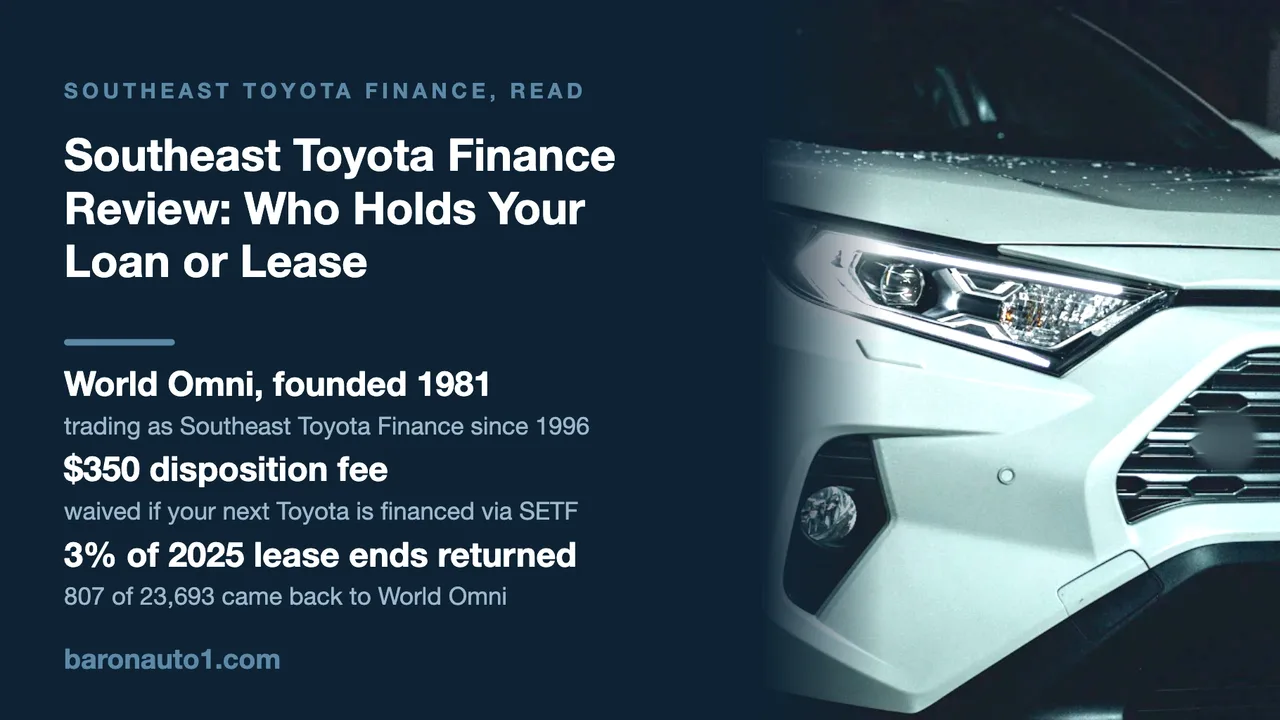
- Southeast Toyota Finance (SETF) is not Toyota Motor Credit. It is a trade name of World Omni Financial Corp., a JM Family Enterprises company financing Toyotas sold in Alabama, Florida, Georgia, North Carolina and South Carolina since 1981, as SETF since 1996.
- World Omni is the lienholder on a financed car. A leased car is titled to its trust, World Omni LT, with a first lien for AL Holding Corp.
- Auto Pay and online bank payments carry no SETF fee; debit cards stopped after March 2026 and credit cards are not taken. A late charge applies if payment is not received in full within 10 days of the due date.
- Payoffs go by mail, not online. With a personal check the title is mailed up to 14 business days after the account closes; Florida lease buyouts carry a $500 title add-on, any unused part refunded.
- Returning a lease costs a $350 disposition fee, waived if you finance or lease a new Toyota through SETF within 30 days. Only 807 of 23,693 leases scheduled to end in 2025 came back to World Omni (3%).
- The CFPB lists no enforcement action against World Omni, SETF or JM Family. Its database holds 1,755 complaints under World Omni Financial Corp., 686 about vehicle loans or leases.
If Southeast Toyota Finance holds your car loan or lease, the answers on paying, payoff and lease end are on SETF’s own help pages, and the company behind them is World Omni Financial Corp., not Toyota’s national lender. On 9 October 2026 we read SETF’s help center, payment, payoff and lease-end pages, terms, licenses page and privacy notice; World Omni’s site; JM Family’s release of 12 March 2026; World Omni’s prospectuses for its 2026-C retail and 2026-A lease securitizations; and CFPB records. We entered no login or application, and this site has no commercial relationship with SETF, World Omni, Toyota or any lender. SETF’s terms bar scripted scraping, so its pages were read once by hand and are quoted briefly.
Who is behind Southeast Toyota Finance, and who holds your loan
Every SETF page’s copyright line names Southeast Toyota Finance “a d/b/a of World Omni Financial Corp.” SETF’s terms say the site is “owned and operated by World Omni Financial Corp.,” and its licenses page calls SETF “a trade name of World Omni Financial Corp.,” licensed in Maryland under NMLS ID 1073. World Omni’s 2026-C prospectus, filed on 20 August 2026, calls it a Florida corporation and “an indirect wholly-owned subsidiary of JM Family Enterprises, Inc.” that “has operated under the ‘Southeast Toyota Finance’ name since 1996.”
The Toyota link runs through a sister company, Southeast Toyota Distributors, LLC, the exclusive Toyota distributor in the five states under an agreement with Toyota Motor Sales, U.S.A. dating from 1968 and renewed through October 2029. World Omni buys contracts from participating Toyota dealers there, and SETF’s terms say its programs are available “only” through them, so a Toyota bought in Atlanta or Orlando may be financed by SETF while one bought elsewhere is not. Toyota Motor Credit Corporation’s 10-K, read for our Toyota Financial Services review, leaves “sales of a private Toyota distributor” out of its market share.
| Company | Role |
|---|---|
| World Omni Financial Corp. | Buys retail contracts from dealers, is the lienholder on financed cars, services every SETF account and does business as Southeast Toyota Finance |
| World Omni LT (trustee: VT Inc.) | Titling trust that owns leased cars; SETF tells lessees who move to list “VT Inc. as Trustee World Omni LT” as owner |
| AL Holding Corp. | Holds the first lien recorded on leased cars’ titles, as collateral agent |
| WOFC QI Exchange LLC | The payee SETF names for lease payoff checks |
| World Omni Auto Receivables Trusts | Securitization trusts that buy pools of retail contracts; World Omni keeps servicing them |
| JM Family Enterprises, Inc. | World Omni’s parent; also owns Southeast Toyota Distributors, LLC |
| Toyota dealers in AL, FL, GA, NC and SC | Write the contract and sell it to World Omni; SETF’s terms say the deal’s terms “are set by you and the dealership” |
So who holds your loan? If you financed, World Omni is the lienholder; SETF’s moving-states page says SETF itself “is not the lienholder” and retail accounts must list World Omni Financial Corp. The dealer “thereafter sells the contract to World Omni Financial Corp.,” the prospectus says. Your contract may later go into a securitization trust, but World Omni stays the servicer, so everything still runs through SETF.
If you leased, the car belongs to the trust: titles are issued to “World Omni LT” or “VT Inc. as Trustee of World Omni LT” with “a first lien recorded in favor of AL Holding Corp.,” per the 2026-A lease prospectus, and SETF acts as “servicer.”
The group’s pages describe all this inconsistently. World Omni’s home page calls it “a division of JM Family Enterprises,” its investor FAQ a “wholly owned subsidiary.” SETF’s About page says “we changed our name to Southeast Toyota Finance in 1996,” yet the legal name on its terms and licenses is still World Omni Financial Corp., and JM Family’s 2026 release calls SETF both “part of World Omni Financial Corp.” and “a subsidiary of JM Family Enterprises.” World Omni’s home page counts 178 Toyota dealerships, its FAQ 177. For a borrower, the name on the title settles it. By our arithmetic, 2026 is World Omni’s 45th year and SETF’s 30th.
How to pay SETF, and what each way costs
SETF’s How to Pay page and help center list five routes. Every route SETF runs itself draws on a bank account: the page ends by saying SETF “cannot accept payments via debit or credit card, only through your bank account.” Its debit-card answer explains that debit cards stopped after March 2026 because of “the rising costs” of processing them.
| Method | Cost as printed | What to know |
|---|---|---|
| Auto Pay (checking or savings) | No fee: “we do not charge a fee” | You pick the draft day; keep paying until SETF confirms enrollment |
| Online at setf.com | No fee | Schedule up to 30 days ahead or split a payment between 3 different sources; shows in your history within 3 business days, credited as of the day you submitted it |
| Phone (check by phone, ACH) | No fee printed | Customer Care takes payments Monday to Friday, 8 a.m. to 6 p.m. ET; pay before 4 p.m. ET for same-day credit |
| Mail (check, cashier’s check or money order) | No fee printed | Allow up to 3 business days; retail and lease accounts use different addresses |
| MoneyGram, at an agent location | “Additional service fees may apply”; SETF prints no amount | Bring your account number; payee is World Omni Financial Corp. |
| Debit or credit card | Not accepted | Debit cards ended after March 2026 |
SETF’s terms say it “does not currently charge” for online payments but may start, with notice, and that an online payment that bounces earns no credit. Weekend and holiday payments post the next business day.
Extra money goes to principal only if you say so: SETF offers a one-time principal payment online, an add-on amount in Auto Pay, or a check marked “Principal Only,” and regular payments stay due. Ordinary payments go to accrued interest first, then principal, then late charges and fees.
Due dates, late charges, extensions and falling behind
SETF retail contracts are simple interest: its explainer says “Interest will accrue every day,” so paying early shrinks the interest share of a payment and paying late grows it. In SETF’s own worked example, a $20,000 balance accrues $2.74 a day, and paying five days early saves $13.70 in interest while paying five days late costs $13.70 more. SETF’s help center says paying before each due date means paying “a smaller amount in interest” than the contract discloses.
On late charges, SETF’s grace-period answer points to your contract and says the payment must be posted within the grace window. Its retail and lease help pages both say a late charge is assessed if payment “is not received in full within 10 days after the contract due date.” SETF prints no amount. Unpaid late charges from earlier months stay on later statements.
You can move your due date to any day from the 1st to the 28th if the account is current and your first payment is made; it can take one billing cycle. For a tight month, SETF says “approved customers” may defer one or two payments to the end of the contract, extending the term, and may have to make an “online extension payment” of an amount the page does not give. World Omni’s 2026-C prospectus adds that extensions are “generally” granted if they bring the account current and the borrower “has made 6 or more scheduled monthly payments,” and refers to “extension fees.” Since interest accrues daily, ask what the longer term adds before you accept.
World Omni counts an account as delinquent once more than 10% of a scheduled payment is unpaid by the due date (the threshold in its reported figures was $40 until January 2026). After repossession, which independent contractors carry out, cars are generally sold at auction and any deficiency “may be pursued” by World Omni or a collection agency; see our car repossession guide. Servicemembers can ask about Servicemembers Civil Relief Act benefits: a rate reduction on retail accounts, early termination on leases and repossession protection on both.
Paying off an SETF loan and getting your title
You cannot pay off an SETF account with the online payment button. Asked whether a vehicle can be paid off online, SETF’s answer is “No,” and payoff funds “must be mailed” to its Payoff Processing Center. The Payoff options page sets out the steps: sign in, open “View Vehicle Payoff” from the vehicle dashboard, print the payoff form, which shows the amount and a good-through date, then mail a check or money order with the form. Your monthly statement also prints a payoff amount. SETF accepts personal, certified and cashier’s checks, and says certified funds are processed faster.
The statement’s “must be received by” date applies only to a full payoff; your regular due date does not move, so keep paying until the payoff posts.
On the title, SETF’s payoff-title answer separates two cases. Payoffs by certified check, cashier’s check, official bank check or from a dealer are generally mailed “within a few days after receipt.” With a personal check, the title is mailed “up to fourteen (14) business days after the account closes,” to let the check clear, and SETF adds that this “may vary in some states.” All required documents must come with the payoff check to avoid delays.
Many owners will not get paper at all. SETF lists 28 states that issue electronic titles; there, or where the owner already holds the title, you receive a Release of Lien or a letter saying the lien is released, and you deal with the state for the title. Four of SETF’s five states (Florida, Georgia, North Carolina and South Carolina) are on that list; Alabama is not, by our count. If you have moved, SETF’s moving page says the DMV request must name World Omni Financial Corp. as lienholder on retail accounts, not SETF.
SETF prints no prepayment penalty. World Omni’s prospectus says its contracts are prepayable “at any time without charge,” “subject to certain exceptions,” yet lists “prepayment charges” among fees the servicer may keep where law allows, so read your contract. To refinance, the new lender pays SETF the payoff amount.
Ending an SETF lease: buy it, extend it or hand it back
SETF’s lease-end pages offer three paths: buy the car, extend for a few months, or return it, ideally into a new Toyota. World Omni’s lease prospectus puts it in contract terms: buy “AS IS” for the Contract Residual Value plus a purchase option fee and taxes, or return the car and pay the disposition fee and any mileage and wear charges, and “Both the purchase option fee and the disposition fee may be waived in whole or in part by the Servicer.” SETF prints no purchase option fee; check your lease.
Buying the car. SETF says you can buy “by contacting us directly and paying the Payoff Amount” without a dealer, who may charge for its services. Lease payoffs are payable to WOFC QI Exchange LLC. The quote does not deduct your security deposit; apply it with the Security Deposit and Titling form, or it is returned once the payoff is processed, which “could take up to 14 business days.” If a third party pays the lease off and its payment bounces, you stay liable. Our lease buyout guide walks through the numbers.
Florida lessees: the payoff includes a $500 title add-on. SETF says it uses an outside agency for the title on Florida lease purchases and has added $500.00 to the payoff to cover titling, licensing, registration and the agency’s processing fee. If those costs come to less than $500, the agency refunds the difference by check. Ask for the actual costs if you are comparing SETF’s payoff with a dealer’s offer.
Selling to someone else. SETF’s help center answers “Yes” to whether someone else can buy your leased car and tells you to call Customer Care. The lease prospectus says World Omni “may permit or deny such purchase within its sole discretion,” so get the answer before you agree a sale. Our guide to a car lease takeover covers the other route out.
Extending. SETF’s lease-end page says you “may be able to extend” and links a Lease Extension Request Form under its account-settings path, which we did not open; no public page prints the extension terms.
Returning early. Per the lease prospectus, an early return costs the remaining base payments, other lease charges, the disposition fee, taxes, excess mileage and World Omni’s “reasonable estimate” of wear repairs; some lease forms instead use the car’s realized value, which you may have set by an independent appraiser at your own expense. World Omni also offers selected lessees early-termination programs that waive some payments if they take a new Toyota financed through World Omni. SETF’s remaining-payments quote includes every remaining payment plus the $350 disposition fee and taxes, but not wear or mileage charges.
Coming back for another Toyota. SETF’s loyalty page prints $500 in Loyalty Cash plus a $350 disposition fee waiver, $850 in all, if the new Toyota is financed or leased through SETF at a participating dealer in the five states within 30 days of maturity; the cash goes toward the down payment, one offer per account. No end date is printed, but SETF’s terms say all programs “are subject to change or termination at any time,” so get the voucher in writing. See our lease or buy guide.
Returning the car: inspection, wear standards and the final bill
SETF’s vehicle return timeline counts down from 90 days (choose to buy, extend or move to a new Toyota) to 60 (a free inspection “at your home, office or other convenient location”) to 30 (book the turn-in with your Toyota dealer); about 45 days out SETF mails an odometer statement. OPENLANE Inspections calls between 45 and 60 days before the end if you have not booked, and the inspection should be no more than two months before turn-in. In Maryland, SETF says, the inspection happens at the dealership after return.
At turn-in, hand over every key and key fob, the owner’s manual, the spare tire, head rests and any third-row seats. If you repaired anything after the inspection, mail SETF the receipts with your name, VIN and account number. SETF’s wear page lets you turn the car in “as is” and be billed, or buy it instead of paying for damage. It warns that improper repairs still count as excess wear.

| Area | Normal wear | Excess wear (billed) |
|---|---|---|
| Dents and dings | 1 inch across or smaller; six or fewer per panel | Larger than 1 inch; seven or more per panel |
| Paint | Chips or scratches 2 inches long or less; ten or fewer chips | Longer than 2 inches; eleven or more chips |
| Windshield | Repairable chip, star or light scratch under half an inch; three or fewer pits or scratches | Non-repairable damage over half an inch; four or more pits or scratches |
| Tires | Tread ⅛ inch or deeper | Tread under ⅛ inch; wrong size or speed rating; cut, torn or plugged sidewalls; missing spare, jack or tools |
| Wheels | Scratched wheel covers | Missing or broken covers; gouges of one inch or more; alloy wheels over 50% oxidized |
| Interior | Scratches; stains that clean out easily | Tears, burns or singes; heavy stains that cannot be removed |
| Everything else | No damage, Toyota-approved accessories only | Frame damage, aftermarket modifications, truck bed or tailgate damage, and any other damage costing $50 or more to repair, insured or not |
Mileage works the usual way, and the rate is in your lease, not on the website. SETF’s own example assumes a 36-month lease with 36,000 miles allowed and an excess charge of $0.18 a mile: return it at 37,000 miles and the 1,000 extra miles cost $180. That rate is an illustration; yours may differ. SETF’s wear page stresses scheduled maintenance and notes that ToyotaCare covers regular maintenance for the first 2 years or 25,000 miles, whichever comes first.
Then the bill: excess wear, excess mileage, past-due payments and charges “such as disposition fee and property tax,” per the wear page. SETF prints the disposition fee as $350, waivable if you lease or finance again with SETF. Its two lease-end pages disagree on timing: the invoice may arrive “Within one to two weeks” after turn-in (return timeline) or “within two to three weeks” after SETF is notified (wear page). Keep your inspection report and receipts until the balance is zero.
SETF versus Toyota Financial Services: not the same lender
Because both finance Toyotas, people often search one name for the other. They are separate companies with separate websites, contracts and terms; World Omni’s investor FAQ sends anyone with a World Omni contract to setf.com, and Toyota Financial Services is the brand of Toyota Motor Credit Corporation. The table sets SETF’s printed terms against those our Toyota Financial Services review read on TFS’s pages on 6 October 2026.
| Question | Southeast Toyota Finance | Toyota Financial Services |
|---|---|---|
| Company | World Omni Financial Corp. (JM Family) | Toyota Motor Credit Corporation |
| How long a payoff quote is good | A good-through date on the payoff form; no fixed number printed | 10 days |
| Title after payoff | Within a few days for certified funds; up to 14 business days after closing for a personal check | Paper title or lien release in 25 to 40 business days |
| Excess mileage rate | In your lease; SETF’s example uses $0.18 | Typically $0.15 a mile |
| Disposition fee | $350; waived if you finance or lease a new Toyota through SETF within 30 days | Waived (up to $350) for returning customers who meet TFS’s conditions |
| Final lease invoice | One to two weeks, or two to three weeks, depending on the page | 60 to 120 days after return, per TFS’s lease-end guide |
The practical rule: if your title or statement says World Omni or Southeast Toyota Finance, use only SETF’s site, phone line and payoff instructions. If it names Toyota Motor Credit Corporation, our TFS review applies; TMCC also services the accounts in our Mazda Financial Services review.
GAP, insurance, add-ons and your data
Whether you have GAP depends on the contract: for a loan, SETF says to check the “Other Charges” section; a lease has “a limited Guaranteed Auto Protection provision.” After a total loss SETF files the GAP claim, may ask for a police report, buyer’s order and affidavit of loss, and warns that GAP may not cover past-due payments, extensions, deductibles or earlier damage. It also cancels service contracts and other add-ons and applies the refunds to your balance. Our GAP insurance guide explains the product. Physical damage coverage is required, and World Omni’s prospectus says it performs “no ongoing verification of insurance coverage,” so keeping it in force is up to you.
World Omni’s privacy notice (revised March 2024) says it shares customer information for all seven standard purposes and lets you limit three: affiliates’ use of your creditworthiness, affiliates’ marketing and nonaffiliates’ marketing; nonaffiliates “can include motor vehicle dealers” in the five states. Affiliates named include Southeast Toyota Distributors and CenterOne Financial Services LLC, a third-party servicer our Volvo Car Financial Services review found on Volvo’s licenses page. SETF’s terms treat use of its website as consent to calls and texts, including by automated dialing.
What World Omni’s filings show about its loans and leases
World Omni files prospectuses and monthly reports with the SEC for the trusts that fund its loans and leases, which gives a rare look at a privately owned lender. Its 2026-C prospectus says the retail book it services held 587,017 contracts and about $14.9 billion at 30 June 2026, and that World Omni has securitized about $70.4 billion of retail contracts since 1994 without any of its securitizations defaulting. The same document prints five years of portfolio performance:
| Period | Contracts | 31+ days delinquent | Repossessions | Net charge-offs |
|---|---|---|---|---|
| 2021 | 602,402 | 1.76% | 6,757 | 0.24% |
| 2022 | 596,766 | 2.21% | 6,137 | 0.29% |
| 2023 | 610,440 | 2.38% | 6,180 | 0.38% |
| 2024 | 613,932 | 2.45% | 7,469 | 0.58% |
| 2025 | 600,879 | 2.72% | 9,016 | 0.69% |
| First half of 2026 | 587,017 | 2.60% | 4,873 | 0.81% (annualized) |
By our arithmetic, the delinquency rate rose 0.96 points from 2021 to 2025, repossessions rose 33.4% and the net charge-off rate was 2.9 times its 2021 level, though still below 1%. The securitized pools are prime: the 2026-C pool of 34,343 contracts, which excludes FICO scores from 1 to 649, has a weighted average score of 758; 98.48% of its balance is on new Toyotas, 82.23% on terms over 60 months, and 97.56% in the five states (Florida 46.21%). In August 2026 the seasoned World Omni Auto Receivables Trust 2024-A reported 3.14% of its balance 31 or more days delinquent and cumulative net losses of 0.85%, with no delinquency trigger hit.
Leases have shrunk: 95,935 outstanding at the end of 2025, down 34.9% from 147,367 at the end of 2021 by our arithmetic, per the 2026-A lease prospectus, with 1.67% 31 or more days delinquent. Its most striking table is turn-ins: of 23,693 leases scheduled to end in 2025, only 807 came back to World Omni (3%), against 22% in 2021. The prospectus says used-car values above the contract residual “may incentivize lessees to purchase or trade in the vehicle in lieu of turning it in.” World Omni’s investor page reports 2025 financing revenue of $1,711.7 million and long-term ratings of BBB+ (Fitch) and BBB (S&P).
Regulators and CFPB complaints
The CFPB’s enforcement-action search returns “no results” for “world omni,” “southeast toyota” and “jm family” (checked 9 October 2026). Searching “toyota” returns two listings for Toyota Motor Credit Corporation, a different company whose 2016 and 2023 orders our TFS review covers. Searching “omni” returns a consent order of 30 December 2020 (docket 2020-BCFP-0028) against Omni Financial of Nevada, Inc., a Las Vegas military-loan lender fined $2.175 million; it is not World Omni. World Omni’s prospectus says it has been under CFPB supervision since 31 August 2015 and that no legal or governmental proceedings material to noteholders are pending, and its ABS-15G for 2025 reports no repurchase demands. Web searches found no state attorney-general action naming World Omni or SETF; we did not search each state’s site, and the NMLS database blocked our reading.
The CFPB’s complaint database has no Southeast Toyota Finance name; its company search returns only “World Omni Financial Corp.” Through 8 October 2026 that name has 1,755 complaints since February 2013, 686 of them (39.1%) about vehicle loans or leases since April 2017, plus 105 filed under the older “Consumer Loan” product. Another 687 concern credit reporting. Complaints are unverified, they scale with a lender’s size, and the name may also cover World Omni’s other servicing work. Even so, 87.7% came from the five SETF states, Florida alone 51.7%.
| Issue | Complaints | Share of 686 |
|---|---|---|
| Managing the loan or lease | 215 | 31.3% |
| Problems at the end of the loan or lease | 124 | 18.1% |
| Repossession | 99 | 14.4% |
| Getting a loan or lease | 94 | 13.7% |
| Struggling to pay your loan | 66 | 9.6% |
Billing problems lead with 89, fees 54 and add-on products 50; 43 (6.3%) are about not receiving the title after payoff. Loans account for 534 and leases 152. World Omni closed 21 vehicle complaints (3.1%) with relief, the rest with an explanation, and answered all but 2 on time. Complaints are rising: 397 arrived in 2025, up 52.7% on 2024 and 3.2 times the 2021 count, and the 137 vehicle complaints of 2026 to 8 October are already 93.8% of 2025’s 146. For scale, the database held 3,659 vehicle complaints against Toyota Motor Credit Corporation when our TFS review read it.
If you have an SETF loan or lease
- Check the lienholder line on your title or registration: World Omni Financial Corp. for a loan, World Omni LT and AL Holding Corp. for a lease.
- Pay from a bank account through Auto Pay or setf.com; cards are not accepted, and MoneyGram may add a fee.
- Get each payment in within 10 days of the due date to avoid a late charge, and ask before a deferral what it adds in interest.
- Pay off by mail with certified funds and the printed payoff form, before its good-through date, and keep paying until it posts.
- Expect a lien release, not a paper title, in Florida, Georgia and the Carolinas.
- In Florida, ask what the $500 title add-on covers before buying out a lease, and send the Security Deposit and Titling form with the payoff.
- Book the lease inspection 45 to 60 days out, fix what it finds with receipts, and return every key, the spare and the manual.
- Get loyalty cash and the disposition waiver in writing if your next Toyota goes through SETF within 30 days.
Common questions
Is Southeast Toyota Finance the same as Toyota Financial Services?
No. SETF is a trade name of World Omni Financial Corp., a JM Family company serving Toyota dealers in five southeastern states. Toyota Financial Services is Toyota Motor Credit Corporation. Their payment sites, payoff rules and lease terms differ.
Who is World Omni Financial Corp.?
The legal name behind SETF. Founded in 1981 and now owned by JM Family Enterprises, it buys contracts from Toyota dealers in the five states, owns leased cars through its World Omni LT trust, and has traded as Southeast Toyota Finance since 1996. Its own FAQ sends World Omni customers to setf.com.
How do I pay Southeast Toyota Finance?
Through Auto Pay or setf.com from a bank account, with no SETF fee; by phone, before 4 p.m. ET for same-day credit; by mail; or at a MoneyGram agent, which may charge a fee. No debit or credit cards.
How long does SETF take to send the title after payoff?
Within a few days for certified funds or a dealer payoff; up to 14 business days after the account closes for a personal check. In electronic-title states, including Florida, Georgia and the Carolinas, you get a lien release instead of a paper title.
What does SETF charge at the end of a lease?
A $350 disposition fee unless you finance or lease a new Toyota through SETF within 30 days, plus excess mileage at your lease’s rate, excess wear, unpaid payments and property tax.
Can I refinance or sell a car financed by SETF?
Yes: the new lender or buyer’s dealer pays SETF the payoff amount, and SETF prints no prepayment penalty. For a lease, ask SETF first, because World Omni may refuse a third-party purchase. Shopping again? See our Toyota certified pre-owned guide.
Sources and further reading
- CFPB consumer complaint database
- CFPB auto loan resources
- CFPB: what is Guaranteed Asset Protection (GAP)?
- 12 CFR Part 1013 — Consumer Leasing (Regulation M)
- FTC vehicle repossession
Recall, complaint and safety-rating figures on this page were retrieved from the federal databases above on August 19, 2026. Federal data changes — re-check any VIN before you rely on it.
Published October 9, 2026 · last updated October 9, 2026. Found something out of date or wrong? Tell us and we will correct it.