Copart Fees: What a Public Buyer Pays, and How to Buy
Copart prints four versions of every fee and no effective date. We added up its own schedule, counted the states where the public can bid without a broker, and list where its documents disagree.
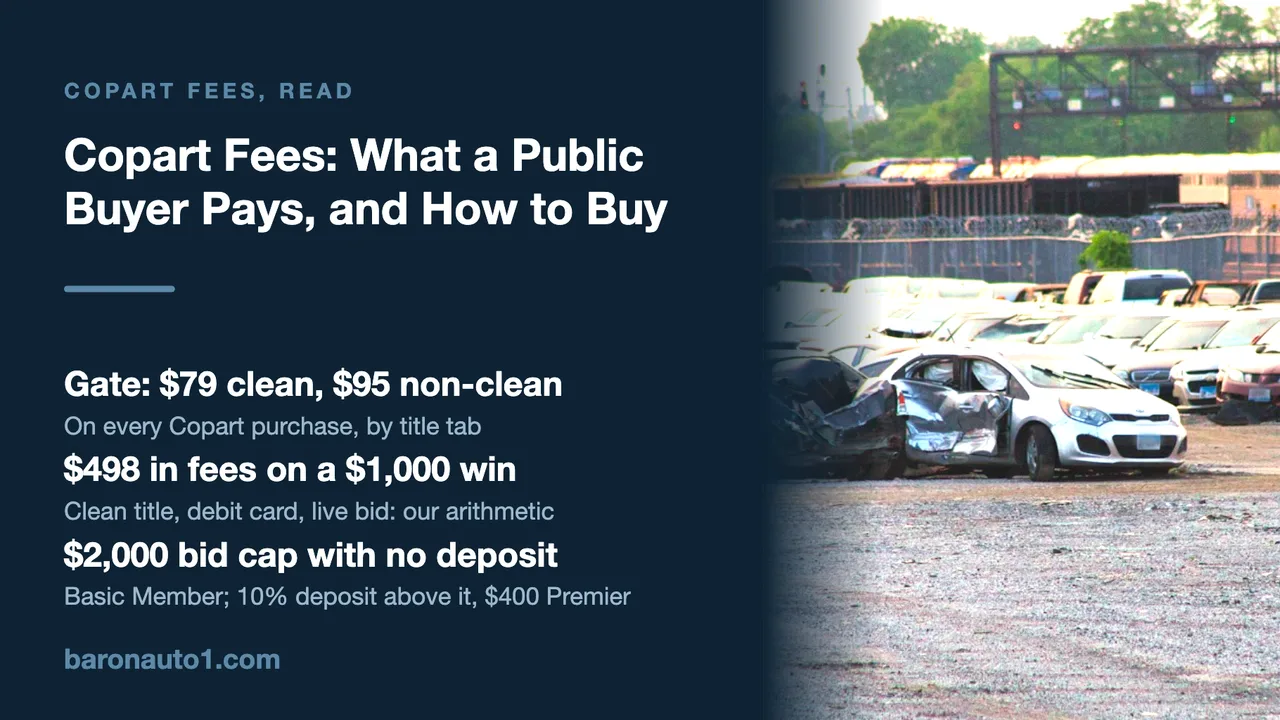
The short version
- Anyone 18 or older can join Copart, but only paying Basic ($99) and Premier ($249) Members can bid, and what you may bid on depends on the state the car sits in. Copart’s own grid lets a private individual bid without a broker on both clean and salvage lots in 15 states, and on neither in 25.
- Every win carries at least four Copart fees: a buyer fee set by the final bid, a virtual bid fee, a gate fee ($79 clean title, $95 non-clean) and a $15 environmental fee.
- Paying by credit card or a wallet app counts as “unsecured” and raises the buyer fee; a debit card counts as secured. On a $5,000 clean-title car the difference is $250, by our arithmetic.
- Our arithmetic from Copart’s printed schedule: a $1,000 clean-title win paid by debit card costs $498 in fees, 49.8% of the bid. A $500 salvage-title win paid by credit card costs $410, or 82%.
- The clock starts on sale day: pay within 3 business days or a $50 late fee applies; unpaid after 8 calendar days, the car is relisted and you owe 10% of the price, at least $600.
- The $400 is the Premier Member security deposit. A Basic Member bids up to $2,000 with no deposit and puts down 10% of anything above that.
Copart’s buyer fees are a printed schedule, but it has four versions of every number (clean or non-clean title, secured or unsecured payment), no effective date, and a blog and help center that describe several fees differently. On 7 October 2026 we read Copart’s Member Terms and Conditions (last revised 9 July 2026), its Website Terms of Service, its public US fee pages, its deposit, payment and broker pages, its State Licensing Overview, a yard’s storage table, two blog posts and the relevant help-center articles, plus Copart’s Form 10-K filed 29 September 2026 and the Texas salvage-dealer statute. We did not register, sign in or bid. Copart’s Terms of Service bar “linking” its content for any commercial purpose without consent, so this page names Copart’s documents instead of linking them. This site has no relationship with Copart or with any broker.
Can a normal person buy from Copart?
Yes, with two conditions. The first is membership. Copart’s Member Terms say “Only registered and active Basic and Premier Members are permitted to bid on vehicles.” A free Registered Guest can search and keep a watchlist but “will not be able to bid on or purchase vehicles.” Members must be “at least 18 years of age” and pass Copart’s “onboarding and screening requirements,” including “a government-issued photo ID.” The terms also disclose that Copart collects “geometric facial patterns derived from photographs” to verify identity and keeps them no longer than three years.
The second condition is the state the car is in. Copart’s help center says “what vehicles you can buy will be determined by the laws of where the vehicles you want to buy are located,” and that “Most states require a license to purchase vehicles of each type of title.” Paying for Premier does not change that: “your Membership type (Basic or Premier) doesn’t change your bidding eligibility.”
Copart’s annual report confirms the public is part of its market. The 10-K says it sells “principally to licensed vehicle dismantlers, rebuilders, repair licensees, used vehicle dealers, exporters, and to the general public,” keeps “a database of approximately 1 million registered members,” and that “We may sell to the general public either directly or members may purchase a vehicle offered at Copart through a registered broker.” The same filing says 79% of the vehicles it processed in fiscal 2026 came from insurance company sellers, and the Member Terms sell every car “AS-IS WHERE-IS.” Our Copart VIN check guide covers what Copart disclaims about each lot; this page is about the cost and the mechanics. A member of the public who uses a broker signs that broker’s contract instead: our AutoBidMaster review reads one, under which an affiliated dealer, not Copart, sells you the car.
Membership, buying power and the $400 deposit
Copart’s help article “Choosing a Membership” (updated 18 February 2025) prints three tiers: Guest, free; Basic, $99, “for someone who occasionally wants to buy cars, such as a rebuilder, hobbyist, or consumer”; and Premier, $249, for someone who “regularly buys cars and/or buys in high volume.” Both paid tiers renew yearly with “an annual nonrefundable Member renewal fee,” and Copart may change the fees “at any time without prior notice.” We opened no account, so we did not see the checkout price.
- Basic. “A Basic Member may bid up to a maximum bid of $2,000 without payment of a security deposit,” and above that “A security deposit of 10% of the maximum amount” is required. Copart’s examples: $300 to bid up to $3,000; $2,000 for $20,000 of “Buying Power.”
- Premier. “Make a one-time deposit of $400 to bid up to $100,000 at any given time.” Premier Members “may request approval to bid or win above $100,000.”
So the $400 is the Premier Member security deposit. Copart returns it on request “if all invoices and charges have been paid in full; however, the Member’s account will then be downgraded to Basic Membership,” and if an invoice goes unpaid, “Copart will use the Premier Member’s security deposit to satisfy the debt.”
Whether Premier is worth it depends on how much you bid; we make no recommendation, but the arithmetic is short. Premier costs $150 more a year than Basic. The same $400 on a Basic account buys $4,000 of buying power at the 10% rate, against Premier’s $100,000. Upgrading later costs a “$159 Member Upgrade fee,” $9 more than the gap between the two prices. The help center also caps activity: Basic without a deposit “Can bid on 1 vehicle per day, up to $2,000,” and Premier “Can place 10 preliminary bids per day and win up to 3 lots per day.” A first membership can be refunded “within 7 days if they don’t bid on or buy any vehicles”; renewals cannot.
Which lots you can bid on depends on where the car sits
Copart’s State Licensing Overview has one row per state and columns for dealers and dismantlers, for businesses and exporters, and for private individuals, each cell marked YES, BROKER, BID CARD or DISMANTLER. Copart calls it “a general guideline,” says it “is by no means a comprehensive or complete listing of eligibility rules,” and that its websites “will determine bid eligibility in real time.” We counted the 50 US rows by the two private-individual columns for cars:
| Private individual may bid directly on | States | Count |
|---|---|---|
| Both titled and salvage lots | Arizona, Arkansas, Idaho, Iowa, Louisiana, Minnesota, Mississippi, Montana, Nebraska, North Carolina, Oklahoma, Oregon, Pennsylvania, Vermont, Wyoming | 15 |
| Titled lots only | Michigan, Missouri, Utah | 3 |
| Salvage lots only | Colorado (only the title documents Copart footnotes), Georgia, Hawaii, Kansas, Ohio, Texas, Washington | 7 |
| Neither (broker for both) | Alabama, Alaska, California, Connecticut, Delaware, Florida, Illinois, Indiana, Kentucky, Maine, Maryland, Massachusetts, Nevada, New Hampshire, New Jersey, New Mexico, New York, North Dakota, Rhode Island, South Carolina, South Dakota, Tennessee, Virginia, West Virginia, Wisconsin | 25 |
“Titled” is not the easy column: in 7 states a private individual may bid on salvage but needs a broker for clean-titled cars. And the grid is keyed to “Vehicle Location,” the yard’s state, so the same buyer can meet a YES in one yard and a BROKER in the next. After the sale, Copart “does not guarantee that any vehicle sold can be legally registered in any state or country”; our guide to salvage, rebuilt and clean titles explains what each brand means once the car is home.
Texas shows how the grid lines up with a statute. Copart’s Texas page says that for individuals “Titled Items” are “Broker Required” and “Salvage” is “No Broker Required.” The Texas Occupations Code, chapter 2302, requires a salvage vehicle dealer license to “act as a salvage vehicle dealer or rebuilder” (section 2302.101), but section 2302.204 says the chapter “does not apply to a person who purchases fewer than five nonrepairable motor vehicles or salvage motor vehicles from a salvage vehicle dealer, an insurance company or salvage pool operator in a casual sale at auction.” We read no other state’s statute, so for the other rows Copart’s grid is the only source here. The Texas DMV’s salvage brand page lists the brands a Texas salvage title carries.
There is a third route: “All Basic and Premier Members can bid on our No License Required inventory,” which the help center describes as “vehicles that anyone can purchase without special credentials.” On any lot, Copart says the vehicle details page shows whether a broker is needed in its “Eligibility Status field.” IAA publishes its own state grid, and it gives a different answer from Copart’s for 15 of the 50 states, as our IAA auction page shows.
Brokers: what Copart says, and what it does not
Copart’s Member Terms call brokers “Copart’s independent third party registered brokers or Alliance Gateways” and spell out the legal position: those who use one “purchase the vehicles solely from the Broker, not from Copart, and are not parties to purchases made by Brokers on Copart’s Websites.” Copart’s own descriptions are blunt. A 2023 member-news item says brokers “have all the credentials to buy vehicles at auction and will lend them to you for a fee,” and the help center says a broker “will let you borrow them for a fee.” The 10-K calls it “the Registered Broker program through which the public can purchase vehicles through a registered member,” and lists “heightened regulation and litigation risk related to vehicle sales to the general public” among its risks.
Copart prints no broker’s fee. Its terms tell buyers to read “the Broker’s terms and conditions, including payment terms and conditions, conditions of sale, and fees charged,” and its broker page warns that “Not all Brokers are able to purchase vehicles in every state or every type of vehicle.” Copart’s broker picker is disallowed to automated readers in its robots.txt and was not opened; we name no broker and recommend none. If you use one, the Copart fees below are the floor, with the broker’s charges on top under a contract Copart is not part of.
How Copart’s fee schedule is built
The page that applies to a member of the public is “Copart U.S. Non-Licensed Fees,” headed “Standard Pricing,” and it is the page Copart’s own fee blog links as its “Fees Page.” Licensed buyers pick between two others: one for those who “buy fewer than 25 vehicles OR spend less than $75K in vehicle sales per year OR have 5 or more bidder accounts,” and “Preferred Pricing” for those buying “25 or more vehicles AND” spending “$75K or more” with “less than 5 bidder accounts.” We compared every table on the non-licensed page with the smaller-buyer licensed page, string for string: all 12 were identical. A license alone does not lower the schedule; volume does.
Each page is a set of tabs: Clean Title or Non-Clean Title (the title group is “shown in the Title Code tooltip on Lot Details pages”), then Standard or Heavy Vehicles (heavy means industrial equipment, “medium duty/box trucks, heavy duty trucks, RVs and trailers” and similar), each with a table for “Secured Payment Methods” and one for “Unsecured Payment Methods.” The fee is “Based on your final bid price and added to the total,” and mixing payment types costs you: “If any portion of the payment is applied with non-secure funds, non-secure funds fees apply for that unit.”
Secured means the money is likely to arrive. The help center classes methods “based on the risk of the funds not reaching Copart,” lists “ePay, debit cards, wire transfers, and payments sent by MoneyGram and Western Union” as secure, and says “Non-secure payment methods include credit cards and wallet apps.” Card purchases are limited to “around $20,000 USD per day,” and Copart does not take personal checks.
The standard tables have 45 bands, starting at $25.00 secured and $27.50 unsecured for a bid under $50 and switching to a percentage of the final bid at $15,000: 7.25% secured and 12.25% unsecured for clean titles, 7.50% and 12.50% for non-clean. Heavy vehicles switch much earlier, to 15.0% secured and 20.0% unsecured, from a $5,000 bid on a clean title and one band higher on a non-clean one.
Because the fees are banded, a cent can matter. By our arithmetic, a clean-title unsecured bid of $9,999.99 carries a $1,090 buyer fee and $10,000 carries $1,200. The largest step is at the percentage line: $1,200 at $14,999.99, then 12.25% of $15,000, or $1,837.50, a $637.50 jump for one cent.
Two caveats. The fee page prints no effective date; Copart’s content sitemap gives its last change as 11 April 2025, which dates the page file, not necessarily any fee. And the Member Terms say “All fees are subject to change without prior notice,” that registered Members see “current fee schedules” on their account page, and that the Member “is solely responsible for ascertaining applicable fees prior to bidding.” We could not read the logged-in schedule, so compare it with the public page before you bid.
The fees added to every win, and the ones that can be
| Fee | Clean title | Non-clean title | When it applies |
|---|---|---|---|
| Bidding (buyer) fee | $25.00 to $850 secured, $27.50 to $1,200 unsecured; 7.25% / 12.25% from $15,000 | $25.00 to $1,000 secured, $27.50 to $1,400 unsecured; 7.50% / 12.50% from $15,000 | Every win, by final bid and payment type |
| Virtual bid fee | Pre-bid $39 to $129; live bid $49 to $149 | Pre-bid $40 to $140; live bid $50 to $160 | Online bids; free under $100 |
| Gate fee | $79 | $95 | “assessed to all Copart purchases” |
| Environmental fee | $15 | $15 | “applied to each item sold” |
| Title mailing | Up to 10 titles: $15 USPS, $20 FedEx | Up to 10 titles $15 USPS; up to 20 titles $20 FedEx | Optional; Limited Power of Attorney on file |
| Title picked up in person | $20 per title | $20 per title | Optional |
| Late payment fee | $50 per vehicle | $50 per vehicle | Not paid within 3 business days, sale day included |
| Relist fee | 10% of the final sale price, minimum $600 | Same | Not paid in full within 8 calendar days |
| Storage | By yard | By yard | Car left past the free period |
| Third-party finance fee | $69 | $69 | Buying through a Copart-affiliated finance company |
| Paying at a Copart yard | $20 per vehicle | $20 per vehicle | Payment page surcharge |
The gate fee “covers administrative costs and the movement of the item from our storage location to the Buyer loading area.” The virtual bid fee applies to “All bids placed through terminals, Members’ computers, smartphones, tablets or other bidding devices.” Copart’s blog says the lower Pre-Bid maximum is for “vehicles sold outside of a live auction, like Buy It Now purchases,” and the higher one for “vehicles won during live online auctions”; the live table is $10 to $20 higher in every paid band, by our arithmetic. The finance fee is called a “flooring service fee” for non-licensed buyers and an “administrative fee” for licensed ones.
The Member Terms add charges that are not on the fee page: a processing fee “of $75 per item” for parking tickets, tolls and other “Vehicle Fines” that arrive after a sale, plus up to 150% of the fine if Copart pays it, and a finance charge of “1.5% per month (18% per annum)” on balances unpaid 30 days after the sale. Sales tax depends on “vehicle type, title type, and Members address” and where the car is stored.
What a win actually costs: our arithmetic
To calculate Copart’s fees, add four lines from the tables above: the bidding fee for the final bid, the virtual bid fee, the gate fee for the title tab and the $15 environmental fee. The figures below are our arithmetic on Copart’s printed non-licensed schedule for standard vehicles, using live-bid fees. They leave out sales tax, storage, title mailing, transport and any broker’s charge.
| Winning bid | Clean title, debit card (secured) | Clean title, credit card (unsecured) | Non-clean title, debit card | Non-clean title, credit card |
|---|---|---|---|---|
| $500 | $338 (67.6%) | $365.50 (73.1%) | $380 (76%) | $410 (82%) |
| $1,000 | $498 (49.8%) | $558 (55.8%) | $570 (57%) | $635 (63.5%) |
| $2,500 | $693 (27.7%) | $843 (33.7%) | $830 (33.2%) | $995 (39.8%) |
| $5,000 | $953 (19.1%) | $1,203 (24.1%) | $1,010 (20.2%) | $1,260 (25.2%) |
| $10,000 | $1,093 (10.9%) | $1,443 (14.4%) | $1,270 (12.7%) | $1,660 (16.6%) |
| $20,000 | $1,693 (8.5%) | $2,693 (13.5%) | $1,770 (8.9%) | $2,770 (13.9%) |
One cell, built step by step: a $1,000 clean-title car paid by debit card falls in the “$1,000.00 - $1,199.99” band, where the secured fee is $325. The live-bid fee for “$1,000.00 - $1,499.99” is $79. Add the $79 gate fee and the $15 environmental fee: $498 on top of the bid, before tax.
Three patterns follow. Fees weigh most on cheap cars: two thirds or more of a $500 bid, under 14% of a $20,000 one in every column. The payment method matters more as the price rises: the unsecured fee is $27.50 more on a $500 clean-title car and $1,000 more on a $20,000 one. And a non-clean title costs more on every win, from $42 at $500 to $177 at $10,000 when paying by debit card, because three of the four fees are higher. Volume buyers pay less: on the licensed “Preferred Pricing” page the secured clean-title fee is $200 at $1,000 against $325 here, and $625 at $5,000 against $750.
A $1,000 lot that costs about $1,500 to get out of the yard is not a $1,000 car, and that is before transport, title and registration. Our out-the-door price guide explains why a dealer must show you the all-in figure; at Copart, adding it up is your job.
Deadlines: late fees, relisting, storage and interest
Several clocks start on sale day, and the fee page counts that day in both of its deadlines:
- 3 business days to pay. “The vehicle amount and all applicable fees must be paid within 3 business days of purchase, including the day of sale, to avoid a fee of $50.00 per vehicle.”
- 8 calendar days before relisting. “If the lot is not paid in full within 8 calendar days (including the day of sale), the vehicle will be relisted. The Relist Fee will be 10% of the final sale price with a minimum of $600.” The 10% only exceeds $600 above a $6,000 sale, so an unpaid $1,000 win costs $600 and an $8,000 one $800 (our arithmetic). The fee “will be taken out of your existing deposit.”
- 30 days to interest. A finance charge of “1.5% per month (18% per annum)” may run on unpaid balances from 30 days after the sale: $15 a month on $1,000, by our arithmetic.
- A few days to collect. Storage rates “may vary by location.”
Copart describes the free storage window in three ways (see the contradictions below), so plan on the shortest. Its Phoenix, Arizona page says “Storage fees are charged daily if you leave your vehicle at a Copart location for longer than three business days” and prints this table, dated “Storage Rates as of: 1/7/2019”:
| Day | Online bids | Buy It Now |
|---|---|---|
| 1 (day of sale) | Free | Free |
| 2 | Free | Free |
| 3 | Free | $5 |
| 4 | $5 | $5 |
| 5 | $10 | $10 |
| 6 | $15 | $15 |
| 7 | $20 | $20 |
| 8 | $25 | $25 |
| 9 | $25 | $25 |
| 10 and later | $30 | $30 |
The page does not say whether each figure is that day’s charge or a running total, so we have not added them up. Storage is also charged “on weekends and holidays unless the weekend or holiday occurs within the first three days for online bids or first two days for buy-it-now bids.” Other yards print their own tables; we read only this one. A car bought at an offsite sale and not collected “within six (6) calendar days of sale” may be moved to a Copart yard, with the towing charges on you.
Getting the car and the title home
The car becomes your risk when the bid is accepted: each Member “assumes all risk of loss for all vehicles purchased from the time Copart accepts the Member’s bid,” and Copart, holding it as bailee, answers only for damage from its own “direct willful or grossly negligent act or omission.” On a lot with a seller’s minimum or “On Approval,” the seller “has until 7:45 p.m. (Pacific Time) on the next business day” to accept your bid.
You cannot drive the car away: the help center says “you can’t drive vehicles off Copart facilities for legal and liability reasons,” and the Member Terms bar repairs on site and tools “including diagnostic code readers and jump boxes.” From the Payments Due page you can order Copart Delivered, send your own transporter a gate PIN, or schedule a pickup yourself. Copart “is not responsible for any damage caused by third-party transporters, nor does it have any control over any additional fees such transporters may charge”; our guides to car shipping companies and Montway cover what a carrier’s contract usually says.
The title travels separately. “Members must have Limited Power of Attorney on file to have titles mailed to them.” The help center prices single titles at “Fed-Ex ($20 per title) or the United States Postal Service ($10 per title)” and charges “a $20 per title handling fee” to send one with a driver or hand it over at the yard, where no power of attorney is needed. Payments go to fees first, and Copart “has no duty to release vehicles or vehicle titles until all fees are paid in full.” The Member Terms also say transaction data “may be reported” to NMVTIS and that “Members may be subject to independent NMVTIS reporting requirements when purchasing certain vehicles”; Copart sends buyers to the NMVTIS site for “reporting requirements, exemptions, and how to obtain an NMVTIS Reporting ID,” and the federal reporting rules are worth reading before you buy.
Inspect before any of this. During preliminary bidding, Members “may preview the offered vehicles either online or in person”; our pre-purchase inspection guide covers inspecting a car you cannot drive. If the lot is a repossession rather than an insurance total loss, see our repossessed car auctions guide.
Where Copart’s own documents disagree
| Topic | One Copart document says | Another says |
|---|---|---|
| Environmental fee | Fee pages: $15 per item sold | Fee blog (updated 21 August 2024): “a flat $10 fee” |
| Late payment fee | Fee pages: $50 per vehicle | Fee blog: “$50 a day until payment is received” |
| Relist fee | Fee pages: 10%, minimum $600 | Member Terms: “Relist fees may vary by facility” |
| FedEx title bundle | Clean Title tab: up to 10 titles for $20 | Non-Clean Title tab and blog: up to 20 titles |
| Free storage | Member Terms: remove by 5:00 p.m. on the third business day following the sale | Help center: three days “including the day on which you bought it”; Phoenix charges Buy It Now lots from day 3 |
| Basic bidding limit | 10-K and 2024 blog: one vehicle at a time without a deposit, five with one | Help center (2025): 1 vehicle per day without a deposit, 5 per day with one |
| Premier bidding limit | 10-K: “bid on multiple vehicles at the same time” | Help center: “win up to 3 lots per day” |
| Deposits and invoices | Fee page: relist fee “taken out of your existing deposit” | Upgrades page: deposits “cannot be applied toward lot purchases or other invoices” |
| Preferred Pricing line | Fee page: 25 or more vehicles and $75K or more, fewer than 5 bidder accounts | Payments FAQ: “more than 25 vehicles” and “more than $75,000” |
The figures most often quoted in search answers ($79 and $95 gate fees, $15 environmental, $50 late, 10% or $600 relist) all match Copart’s fee pages, but the gate fee depends on the title tab, the late fee is per vehicle, and the relist fee “may vary by facility.” Copart’s blog also says clean-title fees “average around 7.25% of the final sales price”; on the schedule, 7.25% is the rate for bids of $15,000 and above, and with the other fees a $5,000 win costs 19.1% of the bid. Where documents differ, the fee page is the one Copart’s blog links, and the Member Terms are the contract.
The 10-K also discloses that the US Department of Justice, Consumer Protection Branch “is conducting an ongoing investigation into potential violations by the Company of certain money laundering laws related to its practices and procedures for preventing and detecting money-laundering activity by its auction platform members,” following a letter in October 2023, and that Copart “is cooperating.” That is a disclosed investigation, not a charge or a finding. Buyers meet its practical side in rules such as payments coming “from an account belonging to the Member or authorized user.”
Before you place a bid
A bid is a contract. The Member Terms say a submitted bid “cannot be retracted, deleted, or cancelled,” and a Make an Offer bid stays valid for 2 business days. Win and fail to pay within 8 calendar days, and the relist fee is at least $600, taken from any deposit you hold.
- Check eligibility on the lot. The “Eligibility Status” field decides; the state grid is “a general guideline.”
- Read the title group. Clean or non-clean sets the buyer fee table, the virtual bid fee and a $79 or $95 gate fee.
- Choose how you will pay first. Any credit card or wallet-app money on a car puts the unsecured fee on it.
- Add the four fees to your maximum bid, then tax, transport and title mailing, and check you are not one cent over a band edge.
- Read the yard’s storage table and book transport early. You cannot drive the car out.
- Put a Limited Power of Attorney on file if you want the title mailed.
- Run the history checks first. See our Copart VIN check guide, what a Run and Drive label means and earlier auction records.
- Price the repair and the insurance. See when a salvage car is defensible, the rebuilt-title inspection and insuring a salvage-title car.
Common questions
Can a normal person buy off Copart?
Yes. Anyone 18 or older can register, and Basic ($99) or Premier ($249) Members can bid. Which cars depends on the state where each sits: by our count of Copart’s grid, private individuals can bid directly on titled and salvage lots in 15 states, need a broker for both in 25, and can bid on one type but not the other in 10. Copart also lists “No License Required” inventory any member can bid on.
What is the $400 deposit for on Copart?
It is the Premier Member security deposit. It lets a Premier Member bid up to $100,000 at a time, is refundable once all invoices are paid (which downgrades the account to Basic), and is used to cover any past-due invoice. Basic Members bid up to $2,000 with no deposit and deposit 10% of their maximum above that.
Is Copart membership worth it?
We make no recommendation. Premier costs $150 a year more than Basic plus a refundable $400 deposit, and lifts the bid ceiling from $2,000 to $100,000; upgrading later costs $159. Copart refunds a first membership within 7 days if you have not bid. Neither tier changes which lots you are eligible for.
How can I calculate the Copart fees?
Add four amounts to the bid: the bidding fee for your bid from the right title and payment table, the virtual bid fee, the gate fee ($79 clean, $95 non-clean) and the $15 environmental fee. By our arithmetic a $1,000 clean-title win paid by debit card comes to $498 in fees, and a $5,000 non-clean win paid by credit card to $1,260, before tax, storage and transport.
Does Copart charge more if you pay by credit card?
Yes. Credit cards and wallet apps are “non-secure,” and the unsecured buyer fee is higher at every bid: $60 more on a $1,000 clean-title car, $250 on a $5,000 one and $1,000 on a $20,000 one, by our arithmetic.
What happens if you win a Copart auction and do not pay?
After 3 business days, counting sale day, a $50 late fee applies. After 8 calendar days the car is relisted and you owe 10% of the sale price, at least $600, taken from any deposit. Copart says members with “an excessive number of unpaid invoices, relist fees or NSF checks” face automatic account suspension.
For sale near you
Dealer listings, checked liveFinding used cars near you…
Sources and further reading
- NMVTIS (US Department of Justice)
- 28 CFR Part 25 Subpart B — NMVTIS reporting rules (eCFR)
- TxDMV salvage vehicles and title brands
Recall, complaint and safety-rating figures on this page were retrieved from the federal databases above on August 19, 2026. Federal data changes — re-check any VIN before you rely on it.
Published October 7, 2026 · last updated October 7, 2026. Found something out of date or wrong? Tell us and we will correct it.