BidFax Explained: What a Copart or IAAI Auction Record Really Shows
BidFax and its look-alikes copy Copart and IAAI lot pages. What each line means in the auctions’ own words, why Run and Drive is no promise, and why a missing record proves nothing when removal sells for $40.
The short version
- BidFax (bidfax.info) is one of several free sites that republish old Copart and IAAI salvage-auction listings under each car’s VIN: photos, the auction’s damage label, sale date, final bid and odometer line. Stat.vin, bid.cars, AutoBidCar and bidfaxi.info do the same.
- An auction record describes a car on the day it reached the auction yard. It is the auction’s label, not a repair record, and it says nothing about what was fixed afterwards, by whom or how well.
- “Run and Drive” means the car started, went into gear and moved when it arrived at the yard. Copart and IAAI both say that is no promise for the day of sale or pickup, and their two tests differ.
- A car sold on a salvage certificate can come back with a rebuilt or revived-salvage brand after repair and a state inspection. The brand, not the auction page, is what follows the VIN in the federal title system.
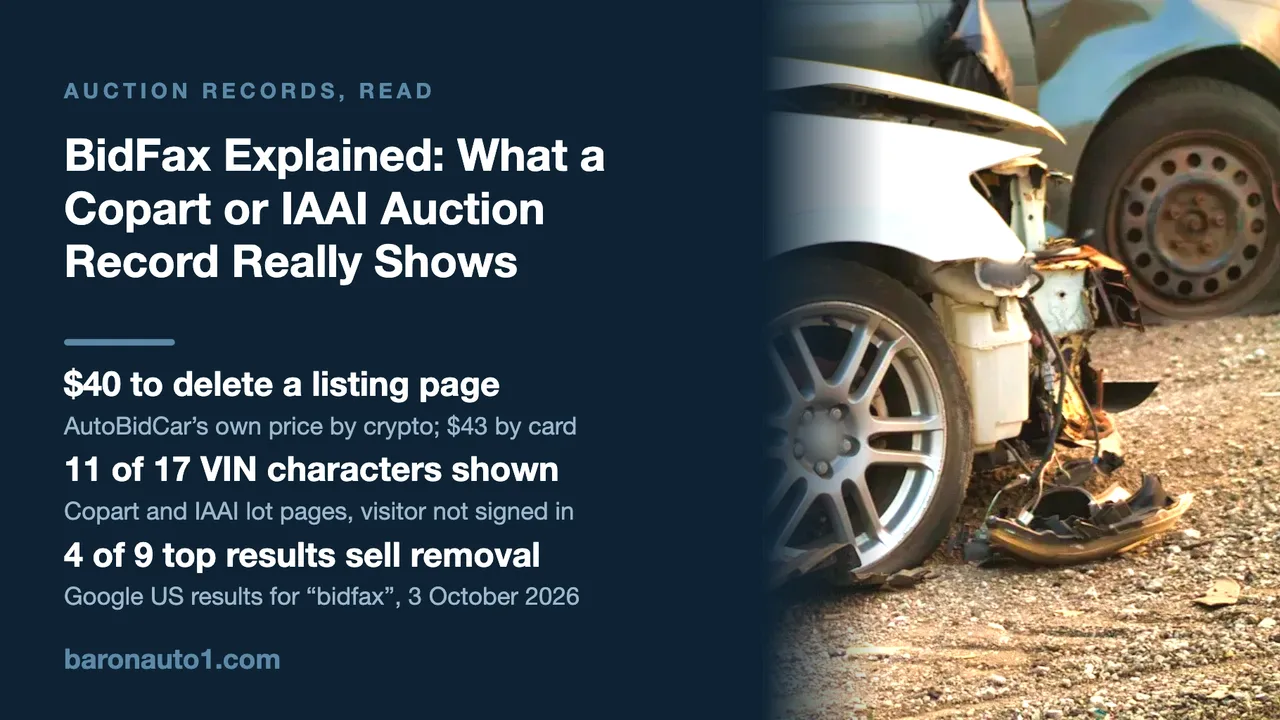
- Removal is for sale. AutoBidCar prints $40 by crypto or $43 by card to delete its copy, and three resellers print $40 to remove a BidFax record. No record on these sites proves nothing.
- Use a lot record as a list of questions: ask the seller for the repair invoices and photos, check the title history, and pay for an inspection that looks at the damaged area.
BidFax is a free website that shows the auction history of cars sold at Copart and IAAI, the two salvage auction companies: the lot photos, the damage the auction recorded, the sale date, the winning bid and the odometer reading, all searchable by VIN. Several look-alike sites do the same. This page reads what those sites say about themselves (their own pages, terms and privacy policies), what Copart’s glossary, lot highlights and terms and IAAI’s start-code page and terms of use say the copied fields mean, and what the federal NMVTIS program and two state DMVs say about salvage and rebuilt titles, all read on 3 October 2026. BidFax itself refused every connection we tried, so it is described through Google’s own listing. We have no relationship with any site named here.
What BidFax and the look-alike sites are
The sites behind the searches “bidfax”, “bidfax info” and “stat vin” are archives of finished auction listings. A car consigned to Copart or IAAI gets a public lot page with photos and a short description, and these sites keep a copy that anyone can pull up by VIN or lot number long after the sale. Several are aimed at buyers importing American cars abroad: bid.cars says plainly that more and more Poles, Ukrainians and others import cars from the USA, and Stat.vin’s home page walks a buyer through creating an account, bidding, paying and tracking delivery.
bidfax.info and its English-language site en.bidfax.info returned HTTP 403 to a scripted request, to a reader service, to a desktop browser and to a commercial page crawler on 3 October 2026, and the Internet Archive’s most recent copy listed was from 21 August 2023 and could not be opened. What we can say comes from Google: its result for en.bidfax.info describes the site as one that “provides free information on the statistics of prices for beaten cars from the USA after insurance claims”, and its sitelinks show a Telegram handle (@BidFax) and a Gmail address. No company name appears in Google’s listing.
| Site | Who runs it, as stated | What it says it is | What it sells |
|---|---|---|---|
| bidfax.info / en.bidfax.info | Not stated anywhere readable; Google shows a Telegram handle and a Gmail address | Free price statistics for damaged US cars after insurance claims (Google’s snippet) | Could not be read |
| bidfaxi.info | Not named; prints BidFax’s Telegram handle and the same Gmail address | “Free history of sales, prices and damage insurance cars” at Copart and IAAI | Nothing visible beyond sign-up |
| bid.cars (its BidFax page) | A business trading as BidCars in Poznań, Poland; terms dated 8 June 2019, under Polish law | A free archive of Copart and IAAI sales, “downloaded automatically” | Bidding at Copart and IAAI and shipping to Europe; sourcing US vehicles since 2015 |
| AutoBidCar (autobidcar.com) | No company named; terms say the service is hosted in Ukraine and governed by Ukrainian law | “A free auctions archive” and a “bidfax alternative”; claims 1.2M+ cars archived | Removal of its own listing pages ($40 or $43); advertising |
| Stat.vin | PAR Soft, Inc., with a Dover, Delaware address in its member terms | “Vehicle auction statistics, bidding and delivery” | Access to Copart and IAAI bidding and delivery |
Two of the five are really bidding services. Stat.vin’s member terms say it is a membership service giving access to the Copart and IAAI marketplace, that it does not run auctions, and that purchases are fulfilled by its dealers. bid.cars is a Polish import business whose About page says it has been sourcing and transporting vehicles from the United States since 2015. For them the free archive is the shop window. AutoBidCar’s pages sell advertising space and charge to take listings down. bidfaxi.info names BidFax.info in its meta description and prints the same Telegram handle and e-mail address Google shows for en.bidfax.info, but its page head also carries the title of a generic car-listing template, and nothing on it says who runs it.
For our wider look at where auction data sits and why coverage differs between providers, see auction history by VIN. This page is about the free archive sites and the records they copy.
The auctions show visitors only part of the VIN
On the Copart and IAAI lot pages we opened without signing in on 3 October 2026, the VIN was cut short. Two Copart lots and one IAAI lot each showed the first 11 characters of the 17-character VIN followed by 6 asterisks, and the IAAI page carried the same masked number in its page source, not just on screen, so neither page let a signed-out visitor read the whole number. The archive sites print all 17 characters on their pages, which is how a VIN pasted into a search engine can lead to them; AutoBidCar’s removal offer and one removal seller both describe their pages as showing up in Google.
The auctions publish rules about their listing data. IAAI’s Terms of Use (revised 4 December 2025) say content on its site, photos and data included, belongs to IAA and its partners, that users may copy it only for personal, informational purposes, and that users may not use a robot, spider or data-extraction tool to copy information about vehicles offered at auction or the results of any auction. The same terms define “Auction Sales Data” (bids, selling prices and other sale information) and list publishing or distributing it for money or other value among the uses not permitted. None of the five sites says whether it has permission from Copart or IAAI, and we draw no conclusion about that.
The archive sites’ own terms set rules for their copies. Stat.vin’s website terms (updated 6 March 2026) forbid reproducing its images and descriptions on other websites, mirroring the site, and copying it by automated or manual scraping. AutoBidCar’s terms forbid systematically retrieving its data to build a collection or database without written permission. bid.cars’s terms say its texts and databases are protected and users acquire no licence to them. All three describe content that, by their own accounts, came from Copart and IAAI. Our reviews of bid.cars and AutoHelperBot read two more archive sites’ own terms.
What an auction record shows, line by line
Every one of these sites copies a subset of the same lot-page fields. On a Copart salvage lot opened on 3 October 2026 the public page showed the current bid, a masked VIN, lot number, sale name and location, “Engine starts” and “Transmission engages” checks, seller, title code, odometer, primary and secondary damage, estimated retail value, keys, engine, drivetrain, fuel, body style, sale date and highlights. An IAAI page showed stock number, branch, masked VIN, loss type, primary damage, title or sale document, start code, key, odometer, airbags, actual cash value and estimated repair cost. AutoBidCar’s vehicle pages list 21 such labels; bidfaxi.info’s show 22, including “Final bid” and the seller, which on the page we read was an insurance company.
| Field | What it is (in the auction’s words where it gives any) | What it does not tell you |
|---|---|---|
| Final bid / sold for | The winning bid at a salvage or wholesale auction, for the car as it stood | What the car is worth repaired, or what the next buyer paid |
| Primary and secondary damage | Copart: known or reported damage; neither code carries more weight than the other; not to be relied on for bidding | The full extent of the damage, or any repair |
| Run and Drive / start code | What the car did when it arrived at the yard | Whether it ran at the sale, at pickup, or today |
| Odometer and its status | Copart’s four descriptions: Actual, Exempt, Not Actual, Exceeds Mechanical Limits | Mileage added since the sale |
| Estimated retail value | Copart: a value submitted by the seller, from before the damage; no representation as to accuracy | The value of this car now |
| Title code or sale document | The state document the car was sold on | The brand it carries after it is retitled elsewhere |
| Photos | Copart takes ten (10) images of each vehicle processed for sale | Anything that happened after they were taken |
| Seller | Who consigned the car (an insurer, on the bidfaxi.info record we read) | What any insurance claim paid for |
Two lines need more than a table row: the damage codes and “Run and Drive”. Both are the ones these sites put in the headline, and both are the ones the auctions hedge most.
Primary damage is the auction’s label, not a repair record
Copart’s glossary lists 26 two-letter damage codes, from AO (all over) and FR (front end) to WA (water/flood). Three describe earlier work rather than an event (damage history, partial or incomplete repair, rejected repair) and 2 are about the VIN itself, missing or altered and replaced. Under the table, Copart says the codes indicate known or reported damage only, are limited by nature, may not reflect the type or extent of damage, and may not be used or relied upon for bidding. It also says the primary and secondary codes both carry significant information and that neither should be read as more important than the other.
That last sentence matters on the copies. bidfaxi.info’s listing cards show a single “Damage” line; a buyer skimming one sees “Side” or “Front End” and stops. Stat.vin’s own member terms go further than Copart: what the auction identifies as primary damage may not be the only damage, or the most significant damage, on the vehicle. Our Copart VIN check guide covers the full code list and what Copart’s terms disclaim before a bid.
The damage line also cannot tell you whether the car was repaired, how, or by whom. A record that says “Front End” at a sale years ago says nothing about the car that a private seller is offering today. Copart’s member terms (last revised 9 July 2026) disclaim the accuracy and completeness of all vehicle information, in writing or in images, and tell members not to rely on it in deciding whether or how much to bid. If the auction will not stand behind the line for the person bidding on the car, a later buyer should not treat a copy of it as a finding.
“Run and Drive” at Copart and at IAAI
The two auctions define “Run and Drive” differently. Copart’s lot-highlight text says that at inventory the vehicle started under its own power or with an external jump box, was put into gear, and moved forward. IAAI’s start-code page says that on arrival at the branch the motor started (with or without a jump) and idled, both forward and reverse gears engaged, and the steering wheel turned one full rotation in each direction. Both are tests at check-in. Neither is a road test.
| Highlight | What was checked | When | What the auction does not promise |
|---|---|---|---|
| Copart: Run and Drive | Started (jump box allowed), put into gear, moved forward | At inventory | That it is roadworthy, or will start, go into gear or move at the time of the sale |
| Copart: Engine Start Program | Started and ran at idle | When it arrived at the facility | That it will start or idle when picked up |
| Copart: Enhanced Vehicles | The seller authorised a wash, vacuum or protective covering | Not stated | That any enhancement was done |
| IAAI: Run & Drive | Started (with or without a jump) and idled; forward and reverse engaged; steering turned fully each way | Upon arrival at the branch | These functions at pickup; that it is roadworthy |
| IAAI: Starts | Started and idled | Upon arrival at the branch | That it will start, drive or move at pickup |
| IAAI: Stationary | Would not start, has engine damage, or was not tested | Upon arrival at the branch | That it will start, drive or move at pickup |
Copart’s wording is not even uniform on its own site: the Run and Drive text disclaims the car’s ability to move “at the time of the sale”, while the Engine Start Program text disclaims it at pickup. IAAI ties its codes to pickup and adds that all vehicles sold through its auctions are sold as is, where is, with no warranty. So a copy that prints “Run and Drive” tells you what happened in a yard on one day, under one of two different tests, and the copies do not say which.

For a used-car buyer years later, the useful reading is the opposite one. IAAI uses Stationary for a car that would not start, had engine damage or was not tested. If a car listed that way is now sold as a daily driver, something happened in between. Ask what was done, and where.
Title at sale, and why the car may come back salvage or rebuilt
The title line on a lot page is the document the car was sold on in one state. It is not a promise about the brand the car will carry later. Stat.vin’s member terms say it outright. A vehicle listed with a clean or clear title may have a salvage, junk or other history, and whatever the listing says, the document may become salvage, reconstructed or otherwise branded when the buyer registers it in another state. Copart’s terms make the same point with an example, covered in our Copart VIN check guide.
Then comes the repair. The Texas DMV says a salvage vehicle is one damaged to the point where repair (parts and labour) cost more than it was worth before the damage, usually as decided by the insurer, and that such a vehicle must be rebuilt and inspected before it can be driven on the road again. California’s DMV calls the result a revived salvage: a salvage vehicle repaired and reregistered with the DMV. It adds that most states put history brands on their titles but the wording varies from state to state. So the car from a salvage auction page can turn up a year later on a rebuilt, reconstructed or revived-salvage title, or on a title that reads clean in one state despite that history, which Stat.vin’s terms say can happen. Our guides to salvage titles and rebuilt titles explain what each brand means for insurance, finance and resale.
The record that follows the VIN between states is federal, not an archive site. The Justice Department’s NMVTIS consumer page says a report covers 5 indicators: current state of title and last title date, brand history, odometer reading, total loss history and salvage history. It keeps the history of brands applied to the vehicle by any state. It also says NMVTIS is the only publicly available US system to which all insurers, auto recyclers, junk yards and salvage yards must report under federal law, and that it is not meant to hold repair histories. Our NMVTIS report guide shows what one looks like and who sells it.
What the copies get wrong
The sites present their pages as history. Their own terms say otherwise, and the pages themselves show why.
- Disclaimers. AutoBidCar’s home page offers “complete vehicle history reports”; its terms make no warranty about the accuracy or completeness of its content and warn that it may contain typographical errors. Stat.vin’s FAQ says its information fully corresponds to what Copart and IAAI provide; its member terms call the same information an unverified starting point that nobody, Copart included, has inspected. bid.cars’s terms say it is not responsible for vehicle data, naming incorrect mileage, technical condition and appearance. bid.cars’s help page is the most candid: what is on the site is all the data it has, and buying at US auctions means relying mainly on the photos.
- Typing errors in the VIN. We ran every VIN on three home pages through the standard check-digit test on 3 October 2026. All 71 on AutoBidCar and all 24 on Stat.vin passed. On bidfaxi.info, 3 of 129 failed (2.3%, our arithmetic), each a near-copy of another VIN on the page, and one lot number appeared with two different VINs. A record found by a mistyped VIN is a record about someone else’s car, or about no car.
- Fields in the wrong boxes. Of 130 cards on bidfaxi.info’s home page, the 3 whose auction is given as Sixt show “Clean Title” in the Damage field, and the condition line spells Run and Drive 6 ways, one of them “Run and dive”. Read together, these look like hand-typed entries rather than a live feed (our reading).
- Machine-written reassurance. Of the first 9 vehicle pages linked from AutoBidCar’s home page on 3 October 2026, 3 carried a generated sentence saying the car kept its “fundamental integrity” or “core integrity” despite the listed hail or front-end damage. Nothing in an auction record can support that: Copart disclaims its own damage codes, and Stat.vin’s terms say no one in its chain, Copart included, inspects the vehicles.
- Who the auctions are. bid.cars’s BidFax page calls Copart and IAAI “the biggest American insurance companies”. Copart describes itself as an online auto auction listing 175,000+ salvage, used and repairable vehicles; insurers are among the sellers, not the auction.
Photos are the strongest part of an auction record, for the reason our VIN check with photos guide gives: pre-repair images show damage that a good repair hides. But a photo is evidence about the car photographed. Match the VIN on the car in front of you, at every location it is stamped, before you treat an old photo as its history.
Removal is for sale, so a missing record proves nothing
Of the 9 organic Google results for “bidfax” in a US English pull on 3 October 2026, 4 were pages selling removal of a car’s BidFax record (44%, our arithmetic). The sites themselves handle removal in different ways.
| Who | Printed price | What they say |
|---|---|---|
| AutoBidCar (its own pages) | $40 by crypto (USDT or USDC); $43 by card | Removes its page, photos, damage details, mileage and final bid, usually within 2-4 hours; for owners or people authorised to act for them; removes “AutoBidCar’s copy of the listing and nothing else” |
| Stat.vin (its own pages) | None printed | Free-form e-mail request; it may anonymise a listing, correct it, or refuse; it does not generally remove factual history because it is commercially inconvenient to an owner or reseller |
| removevin.com (third party) | $40 for bidfax.info; “from $40” up to $150 per site | 2-8 working days; recommends ordering no earlier than one week after the auction, because search engines show the pages 3-7 days after they appear |
| hide.vin and cleanautohistory.com (third parties) | $40 for en.bidfax.info on their Russian-language pages; “Free consultation” on the English ones | One lists 39 domains it offers removal from and promises removal from BidFax “within 1 day” |
AutoBidCar’s own removal dialog states the limit plainly: removing its page leaves the vehicle’s history on Carfax, AutoCheck, NMVTIS, DMV and title records and with the auction houses, “where any buyer can still check it”. The removal market sells invisibility on free archive pages and in Google, not a change to the title record.
“Not found on BidFax” is not a clean history. A record can be missing because the car never went to a salvage auction, because the site never copied it, because the VIN was typed wrong, or because someone paid $40 to have it taken down. A seller who shows you an empty search proves none of those. The title history and an inspection are the checks that cannot be bought away.
Stat.vin’s privacy policy is worth reading for the opposite reason: it says vehicle-history transparency is a consumer-protection function on the used-car market and that it weighs prospective buyers’ interest in checking a used vehicle’s history against a removal request. That is a site describing its own policy, not a guarantee that any record stays up.
How to use a lot record when you buy
An auction record is most useful as a list of questions for the seller and the inspector, and least useful as an answer. The FTC’s used-car advice puts it simply: a vehicle history report is not a substitute for an independent inspection, and the mechanic’s written report should include the car’s make, model and VIN. The NMVTIS consumer page strongly encourages an independent inspection alongside the federal report. Both auctions disclaim their listings, and Stat.vin’s terms say no one in its chain, Copart included, inspects vehicles.
- Match the VIN first. Read it off the car in several places and compare all 17 characters with the record. A one-character difference means a different car, or a typing error on the archive site.
- Read the date and the damage together. Note the sale date, the primary and secondary damage, and whether airbags are shown as deployed. That is the starting point for every question that follows.
- Ask the seller directly. “This car was sold at a salvage auction with front-end damage. Who repaired it?” Compare the answer with the photos.
- Ask for the repair invoices and photos of the repair. Parts lists show whether structural parts, airbags and sensors were replaced or patched. No paperwork after a salvage sale is itself an answer.
- Check the title history. Look for the salvage, rebuilt or revived-salvage brand, and for a clean title issued in another state after the auction date. See our title check by VIN and total loss check guides.
- Compare the odometer. The auction’s reading and its status word (Actual, Not Actual, Exempt) against the dashboard today; our odometer check guide covers the federal readings.
- Treat Run and Drive as history. It described one day in a yard. The test drive and the inspection describe today.
- Send the photos to the inspector. Ask a body shop or inspector to look hardest where the auction photos show damage: frame rails, pillars, welds, panel gaps and paint. Our pre-purchase inspection guide covers what that costs.
- Price it as a branded car if it ever was one. The auction’s final bid is a salvage price, not a value; the brand is what the next buyer will see.
A water or flood code on the record calls for a flood-specific check; our flood damage check guide covers the signs and the records.
Where the sites contradict themselves
Read side by side, the sites’ own pages disagree in at least four places that a buyer should know about:
- Stat.vin’s fee: its FAQ says the service fee is “fixed at $450” in one answer and “500 USD” in another, a $50 gap on the same page (our arithmetic).
- Stat.vin’s accuracy: the FAQ’s “fully corresponds” against the member terms’ “not verified or confirmed”.
- AutoBidCar’s scope: “complete vehicle history reports” on the home page against “AutoBidCar’s copy of the listing and nothing else” in its removal dialog.
- bidfaxi.info’s identity: BidFax’s name, handle and e-mail on a template site whose footer years (2018-2025) do not match those in Google’s result for en.bidfax.info (2018-2027).
And the two auctions disagree with each other on what Run and Drive means, as set out above. None of this makes the photos less useful. It is a reason to quote any of these pages with its site and date, and to check anything that matters against the title record and the car.
Common questions
Is BidFax free?
Google’s description of bidfax.info says it provides free information, and bid.cars, AutoBidCar, bidfaxi.info and Stat.vin all describe their archives as free to browse. The sites earn money elsewhere: bidding and shipping services (Stat.vin, bid.cars), removal fees and advertising (AutoBidCar). bidfax.info itself could not be read on 3 October 2026.
Are bid.cars, bidfaxi.info and AutoBidCar part of BidFax?
No company links them on any page we could read. bid.cars runs a page titled “BidFax” on its own Polish import site. bidfaxi.info names BidFax.info and prints BidFax’s Telegram handle and e-mail address, but does not say who runs it. AutoBidCar calls itself a “bidfax alternative”. Treat them as separate sites copying the same auction data.
What is Stat.vin?
A service run by PAR Soft, Inc., which gives a Delaware address in its own terms. It gives access to bidding at Copart and IAAI through its dealers, arranges delivery, and keeps a free archive of past lots. Its privacy policy says it aggregates and republishes vehicle information from publicly accessible auction platforms and generates none of it itself.
Does “Run and Drive” mean the car drives?
It means the car started, went into gear and moved when it arrived at the auction yard. Copart adds that it is no promise the car is roadworthy or will do the same at the sale; IAAI says the same about pickup, and its test also checks reverse gear and the steering. Years later it tells you almost nothing about the car today.
Why is a car with a clean title on BidFax?
Clean-title cars are sold at these auctions too, and a clean title at sale can still become a salvage or rebuilt brand once the car is registered in another state, as Stat.vin’s terms note. A damage record with a clean title is a reason to ask about the repair and to check the full title history, not a contradiction to ignore.
Can I remove my car from BidFax?
Third-party sellers print $40 for a BidFax record, and AutoBidCar charges $40 or $43 to remove its own page; Stat.vin takes free e-mail requests and may anonymise. AutoBidCar itself says removal leaves the car’s history with Carfax, AutoCheck, NMVTIS, DMV and title records and the auctions. If the car carries a brand, a title check will still show it.
Sources and further reading
- NMVTIS (US Department of Justice)
- Understanding an NMVTIS Vehicle History Report
- TxDMV salvage vehicles and title brands
- California DMV branded titles
- FTC used car buying guide
Recall, complaint and safety-rating figures on this page were retrieved from the federal databases above on August 19, 2026. Federal data changes — re-check any VIN before you rely on it.
Published October 3, 2026 · last updated October 3, 2026. Found something out of date or wrong? Tell us and we will correct it.