Car Battery Warranty Compared: Interstate, O’Reilly, NAPA, OPTIMA
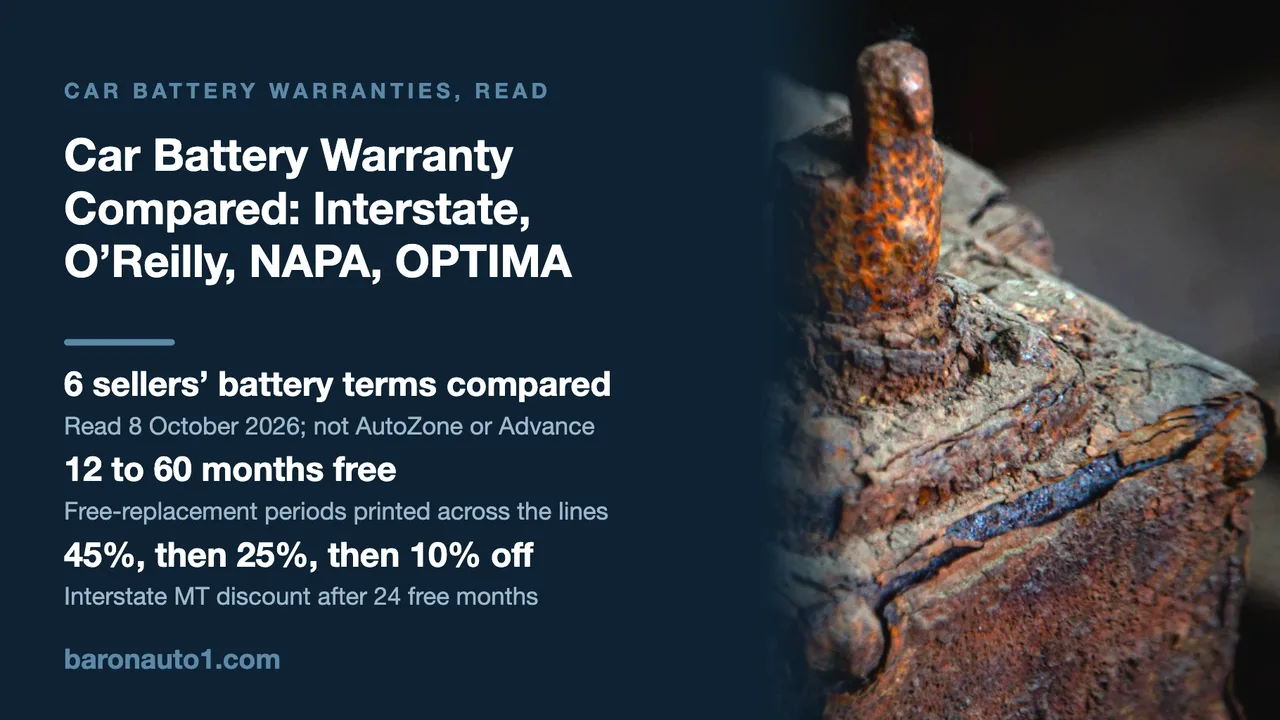
Four battery sellers' and makers' own warranty documents read side by side, with Costco and Walmart: which lines are free replacement only, Interstate's discount period priced off its suggested retail price, who takes the claim, what commercial use and a sale do to the term, and why AutoZone's and Advance's terms are missing.
The short version
- Many battery warranties we read are a free-replacement promise and nothing more: OPTIMA, NAPA’s 2022 lines other than AAA and Interstate’s M, MTX and MTZ models print no prorated period.
- Interstate is the exception. Its MT and MTP models add a “Discount Period”: 45%, then 25%, then 10% off Interstate’s suggested retail price on the day you return the battery, not off what you paid.
- The free periods in our comparison run from 12 months (NAPA Proformer, 2022 terms) to 60 months (OPTIMA ORANGETOP bought direct). For a battery bought through a store or dealer the longest we found is 48 months: Interstate MTZ.
- A warranty replacement keeps the old battery’s clock at Interstate, NAPA (free period) and OPTIMA. It does not start a new warranty.
- Bring the receipt and expect a test on a charged battery. Interstate, O’Reilly, NAPA and Costco all treat a battery that is merely discharged as not defective, and commercial use cuts the term to 90 days at O’Reilly.
- Two big sellers are missing: AutoZone’s website refused every request we made on 8 October 2026, and Advance Auto Parts (DieHard) bars AI readers in its robots.txt, so their terms are not on this page. NAPA’s newest document we could reach dates from 2022.
A car battery warranty is a limited warranty that replaces a battery that fails from a defect, free for a set period from the purchase date and, in a few cases, at a discount after that. The terms depend on the seller and the line. On 8 October 2026 we read each company’s own warranty document: Interstate Batteries’ US limited warranty (the editions for 2025 and 2026 purchases), O’Reilly Auto Parts’ warranty page and Super Start battery page, NAPA’s battery warranty policy file (dated 2022) and OPTIMA’s warranty page and guide. We add what this site already read for Costco and Walmart on 7 October 2026, and the federal rules for written warranties. This site has no commercial relationship with any battery maker or seller, and nothing here is a ranking.
Free replacement, a discount, or a refund: three shapes of battery warranty
Every document we read warrants the battery against defects in material and workmanship from the date you bought it. What happens when it fails takes one of three shapes.
- Free replacement, then nothing. OPTIMA, NAPA (all 2022 lines except AAA) and Interstate’s M, MTX and MTZ models. Inside the period you get a battery; after it, nothing.
- Free replacement, then a discount. Interstate’s MT and MTP models and NAPA’s AAA batteries. After the free months you buy the replacement at a stated percentage off a retail price.
- A pro-rata refund. Costco, which sells Interstate batteries under its own warranty, refunds “a pro-rata portion of the original purchase price and sales tax paid” and prints no free period and no formula.
The FTC’s guide for businesses describes a pro rata warranty as “one which provides a refund or credit that decreases during the life of the product according to a formula.” Interstate and NAPA print their formula; Costco and O’Reilly do not.
| Seller and line | Free replacement | After that |
|---|---|---|
| Interstate, models beginning M | 18 months | No coverage |
| Interstate, models beginning MT | 24 months | Months 25 to 36: 45% off SRP; 37 to 48: 25% off; 49 to 60: 10% off |
| Interstate, models beginning MTP | 30 months | Months 31 to 48: 45% off SRP; 49 to 60: 25% off; 61 to 72: 10% off |
| Interstate, models beginning MTX / MTZ | 36 / 48 months | No coverage |
| Super Start Platinum / Extreme / Premium / Economy (O’Reilly) | “Warranty” of 4 / 3 / 2 / 1 years | No free or prorated split printed |
| NAPA AAA (2022 file) | 3 years | Months 37 to 72: 40%, 25%, then 10% off NAPA’s retail price |
| NAPA OPTIMA, Legend Premium AGM / Legend / Proformer (2022 file) | 3 / 2 / 1 year | “N/A” |
| OPTIMA YELLOWTOP, REDTOP / BLUETOP / ORANGETOP (non-commercial) | 36 / 24 / 60 months | None; commercial use 12 months |
| Costco (Interstate) | None printed | Pro-rata refund over the period on the battery’s label (36-month headline) |
| Walmart (EverStart) | 90-day money back or exchange | Exchange “per the warranty terms”, not printed on its policy pages |
SRP is Interstate’s suggested retail price. AutoZone and Advance (DieHard) are missing for the reasons in their sections.
AutoZone battery warranty (Duralast): what we could and could not read
We could not read AutoZone’s battery warranty. On 8 October 2026 autozone.com answered every request from us with “Access Denied” or an HTTP 403 error: plain requests, the browser we use for hand readings, and a second fetching service. A reading service got a bot-check page instead. We did not try to get around either, or use an archived copy, because this page should carry what AutoZone prints now. So there is no Duralast free-replacement period, credit formula or claim rule here.
What we could read is AutoZone’s annual report. Its Form 10-K for the fiscal year to August 30, 2025 names “Duralast and the family of Duralast brands” among its in-house brands, and says:
- “The Company or the vendors supplying its products provides the Company’s customers limited warranties on certain products that range from 30 days to lifetime.”
- “In most cases, the Company’s vendors are primarily responsible for warranty claims.”
That does not give the term on any Duralast battery. Until AutoZone’s terms can be read, use the receipt: the parts-store documents we did read (O’Reilly, NAPA) tie the period, or its start date, to the receipt or invoice, and federal rules require the seller to let you read the warranty text before you buy (see what federal law requires). Ask for it at the counter, and ask whether the period on the receipt is free replacement throughout or free for part of it.
Interstate battery warranty: free months, then a discount off a list price
Interstate publishes its US limited warranty as a two-page PDF, one edition per purchase-date range. The editions for batteries bought on or after July 15, 2026 and for March 15, 2025 to July 14, 2026 print the same automotive terms. The warranty covers “the original retail purchaser” of an Interstate-branded battery bought from “an IB Authorized Dealer or an All Battery Center Store” in the 50 states or the District of Columbia.
| Model begins with | Free replacement | Discount period (off Interstate’s SRP) | Coverage ends |
|---|---|---|---|
| M | 18 months | None | Month 18 |
| MT | 24 months | 25 to 36: 45%; 37 to 48: 25%; 49 to 60: 10% | Month 60 |
| MTP | 30 months | 31 to 48: 45%; 49 to 60: 25%; 61 to 72: 10% | Month 72 |
| MTX | 36 months | None | Month 36 |
| MTX-AUX | 12 months | None | Month 12 |
| MTZ | 48 months | None | Month 48 |
The discount is off a list price, not your price. In the discount period you buy a replacement at Interstate’s suggested retail price (SRP) “at the time you return your original battery, minus a percentage discount”. Interstate warns that this SRP “will not be the same price you paid for your original battery”; dealers may choose to charge less. By our arithmetic, the bands leave you paying 55%, then 75%, then 90% of that SRP, plus taxes, “legislatively imposed fees” and possibly labor and installation.
The same month can be free on one line and discounted on another. Month 30 is the last free month for MTP but in MT’s first discount band: free on one, 55% of SRP on the other, by our arithmetic. The model prefix on the label decides it. In years, MT cover ends at 5 and MTP at 6.
Who takes the claim. You present the battery to an authorized warranty dealer or All Battery Center Store “that has an appropriate replacement battery in stock,” which gets “a reasonable time to test your original battery.” Interstate’s warranty page adds: “the battery must be fully-charged at the time of testing.” Its FAQ says you do not need to go back to the store where you bought it. Batteries sold at Costco are different: Costco’s FAQ says they carry “a different warranty program,” serviced at Costco (see Costco and Walmart).
No receipt. You can prove the purchase date with the receipt; otherwise “your dealer will estimate your date of purchase from the manufacturer code”. Interstate’s documents do not explain how to read that code.
What shortens or ends it. In a vehicle used for commercial purposes, a truck over one ton, or a diesel vehicle (other than a personal car or pickup), cover drops to a one-year free period, two years for MTZ. Excluded: a battery that is “merely discharged,” or damaged by abuse, neglect, freezing, overcharging, improper installation, “use of special additives” or poor maintenance. Installation, towing, testing and rental cars are not paid. A replacement inherits what is left of the original warranty: it has no “new or separate warranty coverage.”
Disputes. The warranty opens with a warning that it contains “mandatory and binding individual arbitration and class-action waiver provisions.” Claims must be brought within 2 years of the events behind them, Texas law applies, and small claims court remains open. It limits implied warranties to the length of the written one.
Two editions, one stamp. Both PDFs Interstate links for 2025 and 2026 purchases carry the same footer code and the date “2026.07.15”, so the footer will not tell you which edition you hold. The purchase-date line under the title does. Interstate’s own folder for its October 2023 edition is labelled as running to “mar-14-2015”.
Advance Auto Parts and DieHard battery warranty: why this page does not describe it
Advance Auto Parts says in its annual report that it owns the right to sell batteries under the DieHard brand. This page does not describe the warranty on them. Advance’s robots.txt, the file a website uses to tell automated readers what they may read, bars AI readers from the whole site: it lists ClaudeBot, GPTBot, Google-Extended and other AI crawlers, each with “Disallow: /”. We read and check every document on this page with the help of an AI system, so we follow that file and use nothing from Advance’s pages: not its battery warranty, not the DieHard periods, not its core-charge page.
What we can use is that annual report, filed with the SEC. Advance’s Form 10-K for the fiscal year to January 3, 2026 says:
- “The risk of loss arising from warranty claims is typically the obligation of the Company’s suppliers; however, we have an obligation to provide customers replacement of certain merchandise at no cost if the merchandise is under a warranty and not covered by the manufacturer.”
- From the third quarter of fiscal 2025 it began recording warranty liabilities for “certain battery products sold due to contractual changes with vendors”.
That says who carries the cost behind the counter, not what your battery’s warranty promises. If you are buying a DieHard or any other battery at Advance, ask to see the printed warranty before you pay; federal rules require the seller to make it available (see what federal law requires). Then check it against the questions in our checklist: how long the free-replacement period is and whether anything follows it, where claims are taken, whether a replacement starts a new warranty, and what commercial use does to the term.
O’Reilly battery warranty (Super Start): free replacement, with a 25-mile rule
O’Reilly’s Super Start chart gives a “Warranty” of 4 years (Platinum), 3 (Extreme), 2 (Premium) and 1 (Economy). Its warranty page sets out the battery terms:
- Term. It runs from the purchase date and “expires at the end of the warranty period stated on the receipt,” and a battery that fails “during the free replacement period” is replaced “at no cost to the original purchaser”, with the same model or one of “like kind and quality”.
- A sentence without a formula. The coverage section also says replacement is “based on the actual number of months of service delivered”, with part of a month counted as a whole month. No separate free period or charge method is printed. If your receipt shows anything other than free replacement for the whole term, ask how any charge is worked out.
- Who stands behind it. The warranty is “extended by Super Start batteries exclusively,” with Automotive Business Solutions Inc. as administrator, and only to the original purchaser.
- Testing. The Super Start page says exchanges “require the battery to be tested and confirmed defective” by store staff and “may require battery recharging to ensure accurate testing.” O’Reilly says it offers “free battery testing, as well as battery charging.”
- Exclusions. Rechargeable discharged batteries; labor; batteries opened, frozen or abused; fire, wreck or explosion; additives; failure “as a result of a faulty electrical system”; a battery “of an electrical size smaller than the one specified by the vehicle manufacturer”; incorrect installation or charging; and failures outside the United States, Canada or Puerto Rico.
- Commercial vehicles. O’Reilly’s general terms give any product used on a commercial vehicle a 90-day warranty.
Where to take it is the part to read twice. The page’s general section says a defective product may be returned “to any O’Reilly Auto Parts store,” and the Super Start page says an exchange “can be completed at any O’Reilly Auto Parts.” The battery section says something narrower: within 25 miles of the original place of purchase “you must return the battery to that place of purchase,” and beyond 25 miles you must call the Warranty Administration Office first, which names a participating facility. If none exists, you may have to pay another shop and send the invoice to the administrator within 60 days.
O’Reilly’s general policy also covers a replaced product for 90 days from the exchange “or for the remainder of the warranty period, whichever is greater.” The battery section does not say whether that applies to a battery.
NAPA battery warranty: the 2022 policy, and what we could not confirm
NAPA’s own site blocked us: napaonline.com returned a Cloudflare error saying the owner had “banned the country or region” of our connection, and a reading service got a security check, which we did not attempt. The newest NAPA warranty document we could reach is a policy file NAPA hosts on Adobe’s content network, dated February 2022, with editions for batteries bought before and on or after March 1, 2022. Treat it as NAPA’s terms as of 2022: today’s line names may differ, and your receipt governs.
| Line | Free replacement | Pro rata period |
|---|---|---|
| AAA | 3 years | Months 37 to 72: 40%, then 25%, then 10% off NAPA’s applicable AAA Member or non-AAA Member retail price |
| OPTIMA, Legend Premium AGM | 3 years | N/A |
| Legend, OPTIMA Marine, OPTIMA Commercial | 2 years | N/A |
| Proformer (and listed model numbers) | 1 year | N/A |
The consumer “MUST present original receipt” from a NAPA Auto Parts Store or Authorized Distributor, and the period starts on the purchase date on that receipt. Replacement is made only for a defect, “(NOT MERELY DISCHARGED)”. Not included: a discharged battery that can be recharged, poor maintenance such as “low water caused by overcharging”, broken cases and posts, frozen batteries, and explosion, fire or collision damage. Installation and lost time are not covered.
The clock rule differs by line. A replacement in the free period “does not renew; it continues on from the purchase date of the original battery.” But a pro-rated replacement AAA battery “will be covered under a new limited warranty.” By our arithmetic, the AAA bands leave you paying 60%, 75% and 90% of the retail price.
The pre-March 2022 edition still matters for older batteries. It gave Legend batteries 18 months free and pro rata cover to month 75 (six years and three months), and Proformer 18 months free and cover to month 65. Its method: a monthly fee found by dividing “the selling price by the number of months in the warranty,” multiplied by the months the battery was in service, is what you pay for the new battery. As a share only, by our arithmetic, a Proformer in service 19 months of a 65-month warranty pays about 29% of the selling price for its replacement.
OPTIMA battery warranty: free replacement, and why the receipt matters
OPTIMA’s warranty page lists free-replacement periods by line and use, with no prorated period:
- YELLOWTOP automotive and listed models (non-commercial): 36 months. Commercial: 12 months, or 24 months for D31A and D31T.
- REDTOP passenger vehicle or light truck (non-commercial): 36 months; commercial 12 months; abusive service, deep-cycle use and car audio “Not covered”.
- BLUETOP starting and dual-purpose (non-commercial): 24 months; commercial 12 months.
- ORANGETOP (non-commercial): 60 months; commercial 12 months. OPTIMA says an ORANGETOP “must be purchased directly from OPTIMA, not another retailer,” and is serviced only by its HyperCare team.
The page says the receipt “Establishes the beginning date of service,” identifies the original purchaser and shows “a consumer (not commercial) application.” “An OPTIMA battery does not have a lifetime warranty,” and “Warranty replacement batteries do not carry a new warranty.” Reconditioned OPTIMA batteries resold by third parties “would have absolutely no factory warranty coverage,” and the linked guide says used batteries, shipping-damaged ones and anything “sold through unapproved channels have no warranty whatsoever.”
That linked “Warranty Guide Manual” is older than the page: OPTIMA Batteries, Inc.’s Limited Consumer Warranty of February 1, 2009, revised 10/11/2012. It has no ORANGETOP, and two of its terms are not on the page. A battery bought at a store goes back with the receipt “to the location where the battery was originally purchased,” and “Most retail locations will only support our warranty policy” for batteries bought from them. You pay labor, taxes and any shipping for evaluation.
Before you claim, OPTIMA suggests measuring voltage: about 14.0V for a charged ORANGETOP, 12.6 to 12.8V for a REDTOP (and the 34M BLUETOP), and 13.0 to 13.2V for other YELLOWTOP and BLUETOP batteries, and a full charge if it reads low. OPTIMA also runs a promotion adding a year when a battery and a 1200+ series charger are bought together directly from OPTIMA; it says the promotion can change or end without notice.
Costco and Walmart: the store’s terms, not the maker’s
Costco sells Interstate batteries, but its FAQ says they carry “a different warranty program” from Interstate’s. Its terms, read on 7 October 2026, cover the battery for its designated period or “for as long as it remains in the vehicle in which it was originally installed,” whichever is shorter, with the period “indicated on the battery itself” and a 36-month headline. The remedy is a refund of “a pro-rata portion of the original purchase price and sales tax paid” at any US or Puerto Rico warehouse, with no free period or method printed; proof of purchase is required. See the Costco battery warranty in detail.
Walmart prints a “90-Day Automotive Battery Guarantee”: money back or an exchange for the original purchaser if the battery tests bad within 90 days, then exchange only “per the warranty terms.” When we read its pages on 7 October 2026, no Walmart policy, help or category page printed those terms for any EverStart line; its FAQ points to “the product page and the paperwork that comes with the battery.” See where Walmart prints the EverStart length.
Making a claim: receipt, a charged battery, a test, and the core
A battery that is only flat is not a warranty case: Interstate excludes one that is “merely discharged,” NAPA and O’Reilly say so in their coverage terms and exclusion lists, and Costco’s terms exclude “merely the battery being discharged”. Expect the store to charge and test it. If it keeps going flat after a good test, look at the car; see a battery that keeps dying and the signs of a failing alternator.
| Seller | Proof | Where | Replacement’s warranty | Commercial use |
|---|---|---|---|---|
| Interstate | Receipt, or the dealer’s estimate from the manufacturer code | Authorized warranty dealer or All Battery Center Store with stock | The rest of the original; nothing new | One-year free period (MTZ two years) |
| O’Reilly (Super Start) | Original purchase invoice | Place of purchase if within 25 miles; otherwise call the administrator | Battery terms silent (general parts: 90 days or the remainder, whichever is greater) | 90 days |
| NAPA (2022 file) | Original receipt | Not printed (the receipt must be from a NAPA store or authorized distributor) | Does not renew; AAA pro-rated replacement gets a new warranty | Not printed |
| OPTIMA | Original receipt | Store where bought (2012 guide); ORANGETOP through OPTIMA only | Original purchase date; no new warranty | 12 months |
| Costco | Proof of purchase; date code intact | Any US or Puerto Rico warehouse | Not applicable: a refund, not a replacement | Covered only “for its intended purpose in a personal automobile” |
No receipt. Only Interstate’s document offers a fallback, the manufacturer code. Costco’s battery page, as we read it, explains the one on the batteries it sells: a letter for the month (A is January) and a digit for the year, so “B1” is February 2021. Costco says the code shows when the battery “was shipped from the manufacturing plant”, so a date taken from it cannot be later than your purchase date, and may be months earlier.
The core charge. None of the warranty documents mentions it, but you will meet it at the counter. Costco’s FAQ, as we read it, calls it “a deposit paid when you purchase a battery” that you get back by recycling the old one, and some states set it by law. Two state laws we have read: Washington requires a core charge of “not less than five dollars” when no old battery is traded in, and Minnesota a surcharge “of at least $10”, refundable if you return a battery with the receipt within 30 days. More on both in our Costco battery page.
Commercial use changes the warranty more than the line does. Any O’Reilly product used on a commercial vehicle gets 90 days, whatever its line. Interstate cuts a commercial, diesel or over-one-ton truck to a one-year free period, and OPTIMA gives commercial use 12 months.
Cover also stops at a sale: O’Reilly’s battery warranty does not pass to anyone who buys the vehicle from you, and Costco’s lasts only while the battery stays in its first vehicle. A used car’s battery rarely brings a warranty with it, as our page on battery replacement cost explains.
What federal law requires of a written battery warranty
The FTC’s guide says the Magnuson-Moss Warranty Act “does not require any business to provide a written warranty,” but once one is offered on a consumer product, “it must comply with the Act”; the Act does not reach products sold “for commercial purposes”. What it requires:
- A title. Under 15 U.S.C. 2303, a written warranty that does not meet the federal minimum standards must be “conspicuously designated a ‘limited warranty’”. Every battery warranty document we read calls itself limited. A full warranty, under section 2304, could not “impose any duty other than notification” on you without showing it is reasonable.
- One readable document. 16 CFR 701.3 requires a warrantor, for products costing more than $15.00, to state in a single document who is covered if it is limited to the original purchaser, what the warrantor will do and pay for, when the term starts “if different from the purchase date,” and “A step-by-step explanation” of how to claim.
- Seeing it before you buy. 16 CFR 702.3 requires the seller to make the warranty text “readily available for examination by the prospective buyer,” displayed near the product or furnished on request before the sale.
- Implied warranties. A supplier that gives a written warranty may not disclaim implied warranties, but under 15 U.S.C. 2308 may limit their length to that of “a written warranty of reasonable duration”. Interstate does that; O’Reilly’s battery terms disclaim the implied warranties of merchantability and fitness, noting some states do not allow limits on them.
- No tie-ins. Section 2302(c) bars conditioning a warranty on using a branded article or service unless it is free, and 16 CFR 700.10 applies that to repair service. A warrantor may still exclude damage it can show unauthorized work caused.
Two points touch Interstate’s dispute terms. The FTC’s guide notes that state limitation periods for breach of warranty are “generally four years from date of purchase”; Interstate’s warranty requires any claim within 2 years of the events behind it. And where a warrantor requires an informal dispute mechanism before a lawsuit, 16 CFR 703.5(j) says its decisions “shall not be legally binding on any person”; Interstate’s warranty instead provides for binding individual arbitration under the Federal Arbitration Act. How these fit together for a given claim is a question for a lawyer, not this page; the FTC’s guide is the plainest summary of the rules.
Before you buy a battery: a checklist
- Read the receipt, not the shelf tag. Check that it shows the free-replacement period, and whether anything follows it.
- Ask to see the warranty text before the sale, and note its edition date.
- Know what any discount is taken from: Interstate’s list price on the day of return, not what you paid.
- Ask where claims are taken. The store you bought from if you are within 25 miles (O’Reilly’s battery terms), an authorized dealer with stock (Interstate), or the club warehouse (Costco).
- Say if the vehicle is used for work. Commercial use cuts cover to 90 days at O’Reilly, a one-year free period at Interstate and 12 months at OPTIMA.
- Keep the receipt with the car. Interstate’s warranty says to keep it in the glove compartment. Without it you depend on a date code, if the seller accepts one at all.
- Charge and test before you claim. A battery that is only discharged is not defective under these terms.
Common questions
How long is a car battery warranty?
It depends on the line: the free-replacement periods we compared run from 12 months (NAPA Proformer, 2022 terms) to 60 months (OPTIMA ORANGETOP bought direct), and 48 months (Interstate MTZ) is the longest for a battery bought through a store or dealer. The period runs from the purchase date.
Is a car battery warranty prorated?
Often not, among the documents we read. Interstate’s MT and MTP models add 45%, 25% and then 10% off its suggested retail price, NAPA’s 2022 terms give AAA batteries 40%, 25% and 10% off, and Costco refunds a pro-rata share without printing the method. The rest are free replacement only.
What is the Interstate battery warranty?
By model prefix: 18 months free (M), 24 months free then a discount to month 60 (MT), 30 months free then a discount to month 72 (MTP), 36 months (MTX) and 48 months (MTZ). Interstate batteries bought at Costco follow Costco’s terms.
Do I need a receipt for a battery warranty claim?
O’Reilly, NAPA, OPTIMA and Costco require proof of purchase. Only Interstate offers a fallback: the dealer estimates the purchase date from the manufacturer code.
Does a warranty replacement battery get a new warranty?
Not at Interstate, OPTIMA, or NAPA in its free period: the replacement keeps the original purchase date. NAPA’s 2022 terms give a pro-rated AAA replacement a new warranty; O’Reilly’s battery terms do not say.
What voids a car battery warranty?
Abuse, freezing, improper installation, accident or fire damage and additives appear in most lists. O’Reilly also excludes a battery smaller than the vehicle maker specifies and failures caused by a faulty electrical system, NAPA excludes broken cases and posts, OPTIMA excludes an opened case, and moving the battery to another car ends Costco’s cover.
Sources and further reading
- FTC: a businessperson’s guide to federal warranty law
- 15 U.S.C. § 2301 (Magnuson-Moss definitions)
- 15 U.S.C. § 2308 (Implied warranties)
- 16 CFR Part 702 (Pre-Sale Availability of Written Warranty Terms)
Recall, complaint and safety-rating figures on this page were retrieved from the federal databases above on August 19, 2026. Federal data changes — re-check any VIN before you rely on it.
Published October 8, 2026 · last updated October 8, 2026. Found something out of date or wrong? Tell us and we will correct it.