Bank of America Auto Loan: Rates, Rules and What It No Longer Does
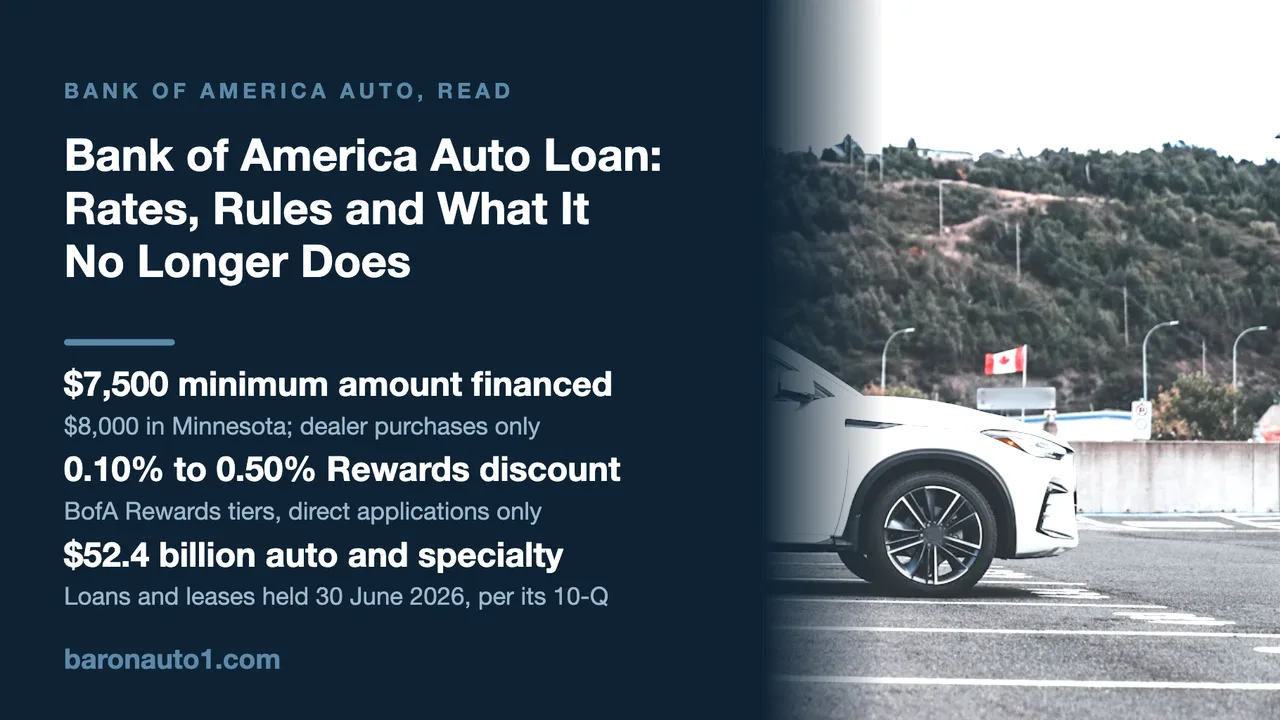
Dealer purchases only now: no refinancing, lease buyouts or private sales. The rates Bank of America showed on 7 October 2026 with every condition, the car and amount limits, the BofA Rewards discount and what its filings show.
The short version
- A Bank of America auto loan now pays only for a car bought from a dealer, new or used. Its rates page says the bank “no longer offers Refinance or Lease Buyout auto loans,” and its FAQ says it “doesn’t offer financing to purchase a vehicle from private parties.”
- On 7 October 2026 the rates page showed “as low as” 5.49% APR for a new car and 5.69% APR for a used car from a dealer, for 60 months, labelled “Results shown are for VA.” Bank of America says these assume excellent credit and leave out the BofA Rewards discount. They are advertised rates, not an offer.
- BofA Rewards members get 0.10% to 0.50% off the rate by tier, but only on applications made directly to the bank. Applications that come through a dealer or carmaker get no discount, and a loan you already have is not repriced.
- The car must be no older than 10 calendar years, under 125,000 miles and worth at least $6,000, and the bank finances at least $7,500 ($8,000 in Minnesota). A prior-model-year car financed on or after 1 July gets the used-car rate.
- Prequalification needs a Bank of America login, is for one person only, shows amounts from $10,000 to $85,000 and “won’t impact your credit score.” The full application is a hard pull, and an approved rate is held for 30 calendar days.
- Bank of America’s filings put its auto and specialty lending at $52.4 billion on 30 June 2026, down from $55.3 billion six months earlier. None of the seven CFPB enforcement actions naming the bank concerns auto lending; the CFPB complaint file holds 1,316 vehicle loan or lease complaints.
A Bank of America auto loan is a fixed-rate loan for buying a new or used car from a dealer: you apply with the bank, get a rate held for 30 days, and take the approval to the dealer. On 7 October 2026 we read Bank of America’s auto loan page, its rates page and auto loan FAQ, the BofA Rewards terms, the auto lines of its 2025 annual report and June 2026 quarterly report, the CFPB’s enforcement and complaint records, and a federal court memorandum. We applied for nothing, and this site has no commercial relationship with Bank of America or any lender.
What a Bank of America auto loan covers now: dealer purchases only
The FAQ answers in one line: “Bank of America offers dealer purchase financing for new or used vehicles.” The rest of the menu is gone. The rates page, read on 7 October 2026: “Bank of America no longer offers Refinance or Lease Buyout auto loans.” The old refinance and lease buyout pages now redirect permanently to the main auto loan page. Review pages that still describe those loans are out of date. Bank of America also funds Volvo’s own finance company; see our Volvo Car Financial Services review.
Private sales are out too: “Bank of America doesn’t offer financing to purchase a vehicle from private parties, or individual sellers.” One leftover calculator note on the main page still tells customers to visit a financial center “to apply for your private party loan”; treat the FAQ as the rule. Buying from a person? See where private-party loans come from; for a lease, how lease buyouts are financed; to replace a loan, refinancing a car loan.
Within dealer purchases the net is wide: “franchised dealers, electric vehicle only manufacturers, and many used vehicle only dealers.” The FAQ’s examples are Ford, Toyota and Mercedes-Benz dealers; Tesla and Rivian, which sell direct; and CarMax, Enterprise Car Sales and Carvana. The dealer-network page says Tesla, Carvana, Karma and Rivian are not authorized dealers, but Bank of America “offers auto loans” for their cars, finished by phone with a loan specialist. Lucid is separate: the bank and Lucid Motors “offer auto loans and leases for new Lucid vehicles under either the Lucid Financial Services or Bank of America branding.” RVs are financed only “through our Authorized RV Dealers,” and loans are “available in all 50 states and the District of Columbia.”
Bank of America auto loan rates on 7 October 2026, with every condition
The rates page draws its figures by script for one state at a time. We chose no state and entered nothing; the page showed its default, labelled “Results shown are for VA.” Under “60-month auto loan options” it displayed “as low as” 5.49% APR for a new car from a dealer and 5.69% APR for a used car from a dealer, “as of Oct. 7, 2026.” The main auto loan page showed the same two rates, “Rate as of October 7, 2026 for a 60-month term.” These are the rates the page displayed for Virginia that day. They are not an offer to you, they change without notice, and the conditions below come with them.
| What the page shows | New car (dealer) | Used car (dealer) |
|---|---|---|
| Advertised “as low as” APR | 5.49% | 5.69% |
| Term the rate is for | 60 months | 60 months |
| State the display used | VA (the page default; no state was chosen) | VA |
| Credit assumed | “excellent borrower credit history” | Same |
| BofA Rewards discount | Not included (up to 0.50% more) | Not included |
| AutoPay discount | None printed | None printed |
| Fees named beside the rate | “No loan documentation fee, but title and state fees may apply” | Same |
| Bank of America’s representative example | $54,000 for 60 months: 60 payments of $1,032 | $34,000 for 60 months: 60 payments of $653 |
Bank of America’s condition, in full: “Advertised as low as APRs (Annual Percentage Rate) assume excellent borrower credit history. Your actual APR may differ based on your credit history, approved loan amount, term, state of residence and applicable discounts, such as BofA Rewards.” The online application “allows you to select term lengths of 48, 60 or 72 months”; other lengths can be discussed with a loan officer after you apply. Only 60-month rates are displayed, and we found no AutoPay discount on any page we read.
The examples are “representative credit terms” that “may not reflect the loan amount, term, APR and estimated payment for your loan.” By our arithmetic, 60 payments of $1,032 total $61,920, or $7,920 of interest on $54,000; 60 payments of $653 total $39,180, or $5,180 of interest on $34,000. The standard loan formula gives $1,031.21 and $652.43, so the printed payments are rounded up. The used-car rate sat 0.20 percentage points above the new-car rate. See how the loan term changes the price.
Two rules decide which rate a car gets. The new-car rate needs a car that has “Never been titled or registered with the DMV” with an odometer that “has less than 10,000 miles.” And: “Any financing obtained on July 1 or after to purchase vehicles from the prior year will qualify for used auto loan rates.” A leftover new car from last year’s model, financed in the second half of the year, gets the used-car rate.
The dating is loose: the page said “as of Oct. 7, 2026,” the rate data behind it carried a time stamp of 6 October 2026, 7:00:45 a.m. Eastern, and the main auto loan page showed the same rates with its state line blank. Pick your own state before comparing, and keep applications to other lenders within a short window, as our guide to rate shopping explains. Our credit union rate guide shows another source of published rates.
The BofA Rewards discount: four tiers and three conditions
The relationship program is now called BofA Rewards; its page still refers to customers who “enrolled in Preferred Rewards before May 26, 2026,” the old name many reviews use. It lists four tiers, starting with a Member tier that needs no minimum balance. Membership needs “an eligible Bank of America personal checking account,” and “Checking accounts may have a monthly maintenance fee if waiver requirements are not met.” Higher tiers depend on combined Bank of America deposit and Merrill investment balances.
| Tier | Balance to qualify | Auto loan rate discount | Example APR after discount | Example payment, by our arithmetic | Saved over 60 months, by our arithmetic |
|---|---|---|---|---|---|
| Member | No minimum balance | 0.10% | 5.39% | $1,028.72 | $149 |
| Preferred Plus | $30,000 or more combined average 3-month balance | 0.25% | 5.24% | $1,024.99 | $373 |
| Preferred Honors | $100,000 or more | 0.35% | 5.14% | $1,022.51 | $522 |
| Premier | $1 million or more | 0.50% | 4.99% | $1,018.80 | $745 |
Against the standard payment of $1,031.21 at 5.49%, the Member discount saves about $2 a month on that example and Premier about $12, by our arithmetic. The conditions matter more than the size:
- Apply directly. “Discounts are only available on auto loan applications submitted by you directly to Bank of America through its website, Financial Centers, or Bank call centers. Discounts are not available for motor vehicle leases or for applications sourced from car dealerships, car manufacturers, or third-party branded/co-branded relationships.” See how a dealer-arranged rate is built.
- Your tier at application counts. The discount is “based on their BofA Rewards tier at the time of auto loan application.” Moving money in after you apply does not change it.
- No repricing. Bank of America’s example: “if you have an auto loan with us when you join the BofA Rewards program, we can’t retroactively apply the discount to that loan.”
The displayed rates leave the discount out: it “is not reflected in all our published rates on our website but will be confirmed and reflected in the interest rate quoted upon loan approval.” And membership is not an approval: “Your BofA Rewards program status doesn’t guarantee approval for lending and credit products.”
Which cars and borrowers Bank of America will finance
Applicants “must be at least 18, or have the ability to enter into a legal contract for auto financing in their state of residence,” and must be “a U.S. citizen or resident alien (permanent or non-permanent).” No Bank of America page we read prints a minimum credit score or income. The FAQ lists what to expect before applying: “The minimum amount we finance is $7,500 ($8,000 in Minnesota),” “Term limitations may apply,” “Loan-to-value restrictions apply,” “A down payment may be required” and “Title and state fees may apply.” The loan-to-value line matters if you are rolling an old balance into the new loan; see what negative equity does to a loan.
The car list is specific. These, in the FAQ’s words, “are not eligible for financing”:
- Age, miles and value: “Vehicles older than 10 calendar years,” “Vehicles with 125,000 miles or more,” and “Vehicles valued at less than $6,000,” with value based on the franchise dealer invoice for a new car or a used-car guide “such as J.D. Power.”
- Title and history: “Salvaged or branded-title vehicles” and “Gray market or lemon law vehicles.” Our guide to what a salvage title means covers the brands.
- Use and type: vehicles “used for commercial and/or business purposes,” heavy-duty trucks and vans of the 450/4500 series, “Conversion or delivery vehicles,” and “Motorcycles, boats or aircraft.” RVs only through authorized RV dealers.
A car at exactly 125,000 miles is out, the age rule counts calendar years, and the value floor rules out many cheap older cars that pass the other two tests.
No page we read gives a maximum loan. The calculator accepts amounts “not to exceed $1,000,000,” and Google’s AI overview turned that into a lending range on 7 October 2026; it is an input limit, not a loan promise. Prequalification shows only “amounts between $10,000 and $85,000.”
Prequalification, the application and the two credit pulls
Prequalification is “only available if you have a Bank of America login”; everyone else “may apply for an auto loan online, by phone, or by visiting a financial center.” It is for one person (“Joint prequalification requests aren’t available”), covers only dealer purchases, and presents amounts from $10,000 to $85,000.
On the credit check, the FAQ is clear: “A prequalification request may result in a soft credit pull, which is a check of your credit report for informational purposes, but it won’t impact your credit score. When you submit your complete loan application and the lender checks your credit report to make a credit decision, that’s called a hard credit pull which can impact your credit score.” Prequalifying still “requires your written instructions for a consumer reporting agency to release your credit information,” and it is “not a commitment to lend or a loan approval.” Our guide to prequalification and pre-approval explains the difference.
The application decides the loan, “based on, but not limited to: employment, housing expense, ability to repay, collateral, co-applicant information (if applicable) and any other information required.” Three practical points from the FAQ:
- No application fee: “No, there’s no charge to apply for an auto loan.”
- Unfreeze your credit first: a frozen report must be temporarily unfrozen “with all three credit bureaus (Equifax, TransUnion and Experian) to proceed.”
- Saved applications expire: “You can access your saved application for 30 days.”
The 30-day rate hold, and changing the car
The rates page sells a “30-day rate lock guarantee,” and the FAQ sets the clock: “Your loan offer and rate are guaranteed for 30 calendar days from the date of your original application approval.” Counted from approval, not from when you find the car.
You can apply before choosing a car, but the car can move the deal: “Changes to the loan amount or collateral may affect your approval and loan terms.” A pricier, older or higher-mileage car is new collateral.
For a car delivered later, such as an electric car on order: “Interest accrual begins as of the date the auto loan is funded even if you accept delivery of the vehicle at a later date.” Time the application to the delivery date.

At the dealer: authorized dealers, the Approval Code and title work
Bank of America runs a network of authorized dealers, “authorized to submit loan applications via our streamlined process.” After approval “you’ll receive an Approval Code that lets authorized dealers quickly retrieve your information.” At an authorized dealer “you’ll complete all your paperwork at the dealership to finalize your loan,” and “the dealer will complete the title work on your behalf.” At any other dealer, “we’ll provide information on how to complete your title work.” Tax, tag and title fees “vary by state.”
Bank of America “is not affiliated with these dealerships” and “is not otherwise responsible for any aspect related to the purchase of your vehicle and associated products and services.” Its car-shopping tool runs on Dealertrack, which lists “over 1 million vehicles”; on our reading day it said “Vehicles at California dealerships are currently unavailable,” a limit on the tool, not the loans. Price, add-ons and fees are the dealer’s: compare the out-the-door price and read our guide to dealer fees.
Do not let the dealer re-apply for you. A Bank of America approval comes with a rate held for 30 days and, for BofA Rewards members, a discount that applies only to applications “submitted by you directly to Bank of America.” If the finance office sends a fresh application to Bank of America or other lenders, the discount does not apply to a dealer-sourced application, and each lender’s check can add a hard inquiry. Bring the Approval Code and finance on the terms you were approved for.
Paying the loan, paying it off and getting the title
Interest is “calculated using daily simple interest.” Bank of America’s example: “$10,000 multiplied by 8.5% interest divided by 365 days in the year = $2.33 per diem,” and after 33 days “$76.85” of the payment goes to interest (that uses the unrounded daily figure; $2.33 times 33 is $76.89, by our arithmetic). Paying early cuts the interest; paying late adds to it, as our guide to how loan interest accrues shows. “Bank of America does not charge prepayment penalties for auto loans.”
A welcome package arrives within 10-15 business days of closing. Ways to pay, from the FAQ:
- Bill Pay in Online Banking, from checking or money market. The Online Banking Service Agreement says “There are no service fees for use of the Bill Pay Service,” and vehicle-loan payments made “before 5 p.m. ET on a business day will be applied on the same day.” Other banks’ accounts may be linked.
- By phone, 24/7, but “same-day payments cannot be canceled.”
- By mail, in person at a financial center (about 3,600, per the 10-K), or by automatic payment.
Three traps are spelled out. An autopay confirmation letter takes 3-4 weeks, so “To avoid late charges, continue to make your payment as usual until you receive the confirmation letter.” Enrolling by paper form and online “can result in multiple payments being made from your account each month.” And on Online Bill Pay autopay, “you won’t receive monthly statements by mail”; otherwise statements come 20 days before the due date, and 18 months stay online. A returned payment is reversed “and you may incur late payment or other fees.” No page we read gives the late fee or grace period; your contract sets both.
Payoff runs on a quote. A “10-day payoff quote” is available in Online Banking with an estimated payoff amount and a good-through date. After you pay, “The process to payoff and release the lien can take up to 10 – 12 business days,” and then “you can expect to receive your lien release, paid-in-full letter and title (if the title is not electronic) within 7-10 business days.” Bank of America “is unable to expedite your state’s titling office process,” so keep your address current and cancel any bill-pay schedule once paid. After a move, “Original title cannot be provided without a request from the state DMV.” And: “Is my loan assumable by another party? No.”
A tax note: the bank said it would tell clients “that may have qualified vehicle accounts under federal law” the interest they paid for 2025, warning it “may not be fully deductible” and that “place of assembly” among other things affects eligibility. Ask a tax adviser.
What Bank of America’s 10-K and 10-Q show about its auto lending
Bank of America Corporation does not report car loans as their own line. They sit inside “direct/indirect consumer” loans, $118.3 billion on 30 June 2026, which also hold securities-based lending to wealth clients. A footnote gives the auto part: “auto and specialty lending loans and leases.” At 30 June 2026, 44 percent of the direct/indirect portfolio sat in Consumer Banking, described as “consumer auto and recreational vehicle lending.” Charge-offs are printed only for the whole direct/indirect portfolio.
| Year or period | Auto and specialty lending loans and leases at period end | Direct/indirect consumer net charge-offs | Net charge-off ratio |
|---|---|---|---|
| 2021 | $48.5 billion | $1 million | Printed as a dash |
| 2022 | $51.8 billion | $18 million | 0.02% |
| 2023 | $53.9 billion | $92 million | 0.09% |
| 2024 | $54.9 billion | $239 million | 0.23% |
| 2025 | $55.3 billion | $235 million | 0.21% |
| First six months of 2026 | $52.4 billion (30 June) | $130 million | 0.23% |
The balance grew $6.8 billion, or 14.0%, from the end of 2021 to the end of 2025, then fell $2.9 billion, or 5.2%, in the first half of 2026, by our arithmetic. The filings’ wording tracks the turn: the 2022 report credited portfolio growth to “growth in our auto portfolio,” the 2024 report to “securities-based lending and consumer auto,” the 2025 report to “securities-based lending” alone. They give no reason for the 2026 drop; ending refinance and lease buyout loans would fit it, but the filings do not say so.
The borrowers are mostly prime. Bank of America scores this portfolio by refreshed (current) FICO, except the securities-based loans, measured by “other internal credit metrics.” The FICO-scored part came to $52.5 billion on 30 June 2026, close to the $52.4 billion auto footnote, though the filing does not label it auto. By our arithmetic, 78.4% of it had a FICO of 740 or more, 16.5% sat at 660 to 739 and 5.1% below 660; for loans made in early 2026, 79.2% were at 740 or more.
Charge-offs were small but rose: from $1 million in 2021 to $239 million in 2024 and $235 million in 2025, with $176 million of direct/indirect loans nonperforming at the end of 2025. Car loans stop accruing interest at 90 days past due and are “charged off to the estimated fair value of the collateral less expected disposal costs when the loans become 120 days past due, upon repossession of the collateral,” or on bankruptcy, death or fraud. A charge-off is not forgiveness; see what survives a repossession.
Three more lines. The bank “securitizes originated and purchased credit card and automobile loans as a source of financing” and keeps servicing them. It has a commitment “to originate or purchase up to $4.0 billion, on a rolling 12-month basis, of auto loans and leases from a strategic partner,” extended to November 2030 from November 2026 and $3.8 billion at 30 June 2026; the partner is not named. And it lends to dealers: commercial exposure to “Vehicle dealers” was $19.8 billion drawn at 30 June 2026. For another bank read through its filings, see our Capital One auto loan guide.
CFPB complaints, enforcement actions and a repossession case
On 7 October 2026 we pulled CFPB complaint counts for “BANK OF AMERICA, NATIONAL ASSOCIATION” under “Vehicle loan or lease,” received through 6 October 2026. The file holds 1,316, received between 1 May 2017 and 29 September 2026: 1,293 about loans and 23 about leases. That is 0.7% of the 188,008 complaints naming the bank across all products, by our arithmetic, and the 20th-largest count among 1,153 companies named in the vehicle category. The yearly count went from 203 in 2024 to 206 in 2025, with 192 more in 2026 to 6 October.
Complaints are unverified consumer reports. The CFPB says its database “is not a statistical sample of consumers’ experiences in the marketplace,” and counts grow with a lender’s size: Bank of America held $52.4 billion of auto and specialty lending on 30 June 2026. The CFPB has served no complaint narratives since 30 September 2026, so these are counts only.
| Issue | Complaints | Share | Largest sub-issue |
|---|---|---|---|
| Managing the loan or lease | 418 | 31.8% | Billing problem (280) |
| Getting a loan or lease | 351 | 26.7% | Credit denial (173) |
| Problems at the end of the loan or lease | 212 | 16.1% | Unable to receive car title or other problem after the loan is paid off (128) |
| Repossession | 111 | 8.4% | Account reinstatement or redemption after repossession (32) |
| Struggling to pay your loan | 80 | 6.1% | Denied request to lower payments (46) |
| Incorrect information on your report | 78 | 5.9% | Account status incorrect (41) |
Bank of America closed 1,050 with an explanation and 255 (19.4%) with monetary or non-monetary relief; 11 were in progress, and it responded on time to 1,282. Title problems after payoff (128) line up with the release process above.
CFPB enforcement actions naming Bank of America
The CFPB’s enforcement list returned seven actions for “bank of america” on 7 October 2026. We read each page. None concerns auto lending:
| Filed | Docket | Product (CFPB’s label) | Subject, in the CFPB’s words | Status |
|---|---|---|---|---|
| 9 April 2014 | 2014-CFPB-0004 | Credit Cards | “credit card add-on products” | Expired/Terminated/Dismissed |
| 4 May 2022 | 2022-CFPB-0002 | Deposits | “processing of garnishment notices” | Post Order/Post Judgment |
| 14 July 2022 | 2022-CFPB-0004 | Prepaid | unemployment and benefit prepaid debit cards | Post Order/Post Judgment |
| 11 July 2023 | 2023-CFPB-0006 | Deposits | non-sufficient funds fees | Post Order/Post Judgment |
| 11 July 2023 | 2023-CFPB-0007 | Consumer Reporting, Credit Cards | credit card accounts opened “without consumer consent” and rewards bonuses | Post Order/Post Judgment |
| 28 November 2023 | 2023-CFPB-0016 | Fair Lending, Mortgage Origination | Home Mortgage Disclosure Act reporting; order terminated 5 June 2025 | Expired/Terminated/Dismissed |
| 20 December 2024 | 2:24-cv-03652 (D. Ariz.) | Deposits, Payments | a lawsuit over Zelle, voluntarily dismissed with prejudice in March 2025 | Expired/Terminated/Dismissed |
The 2025 annual report’s litigation note describes no auto-lending matter. We did not search the OCC’s or state attorneys general’s records for this page, and a web search on 7 October 2026 surfaced no auto-specific regulator action against Bank of America: a search result, not a clearance.
The Pennsylvania repossession-notice case
One court record does concern car loans. In Nelson v. Bank of America, National Association, No. 23-0255 (E.D. Pa.), two borrowers brought a class action over post-repossession notices. The court’s memorandum of 18 May 2023 recounts the complaint’s allegations: that Nelson’s notice set a sale date “thirteen days from the date on which the Notice was mailed,” Potter’s “fourteen days,” while Pennsylvania law gives “the right to redeem the vehicle within fifteen days.” These are allegations. The ruling was procedural: the court kept the case in federal court, finding “removal was proper.” We could not read the later docket or any settlement papers, so this page does not report how the case ended. The lesson stands: the notice sets your deadline to get the car back, so count the days yourself; see what repossession notices must say.
Before you apply for a Bank of America auto loan
- Confirm the deal type. A dealer purchase only: no private seller, no refinance, no lease buyout.
- Check the car against three numbers. No more than 10 calendar years old, under 125,000 miles, worth at least $6,000.
- Check the model year and the date. A prior-year car financed on or after 1 July gets the used-car rate.
- Choose your state on the rates page. The default display is for Virginia and assumes excellent credit.
- Apply directly if you are a BofA Rewards member. Dealer-sourced applications get no discount, and your tier is fixed at application.
- Unfreeze your credit before applying. All three bureaus, temporarily.
- Get one outside approval too. A credit union or another bank gives you something to compare.
- Shop within 30 calendar days of approval. Tell the bank if the price or the car changes.
- Read the contract’s late-fee terms. No Bank of America page we read prints them.
Common questions
What are Bank of America’s auto loan rates?
On 7 October 2026 its rates page showed “as low as” 5.49% APR for a new car and 5.69% APR for a used car from a dealer, for 60 months, for Virginia (the page’s default state). These assume excellent credit and exclude the BofA Rewards discount of up to 0.50%. Rates change without notice; check the page for your state.
Does Bank of America refinance auto loans or do lease buyouts?
No. Its rates page says “Bank of America no longer offers Refinance or Lease Buyout auto loans,” and its old refinance and lease buyout pages redirect to the main auto loan page. Our guides to refinancing and lease buyouts cover other routes.
Can I use a Bank of America auto loan to buy from a private seller?
No. The FAQ says “Bank of America doesn’t offer financing to purchase a vehicle from private parties, or individual sellers.” It finances purchases from franchised dealers, electric-vehicle makers such as Tesla and Rivian, and used-car dealers such as CarMax, Enterprise Car Sales and Carvana.
Does Bank of America auto loan prequalification hurt your credit?
Bank of America says a prequalification request “may result in a soft credit pull” that “won’t impact your credit score,” while the complete application is a hard pull “which can impact your credit score.” Prequalification needs a Bank of America login and is for one person only.
What credit score do you need for a Bank of America car loan?
Bank of America prints no minimum. Its advertised rates assume “excellent borrower credit history,” and its filings show a prime book: by our arithmetic, 78.4% of the FICO-scored part of its direct/indirect consumer loans had a score of 740 or more on 30 June 2026.
How do I pay or contact Bank of America about my car loan?
Through Bill Pay in Online Banking (no service fee; payments before 5 p.m. ET on a business day apply the same day), by phone 24/7, by mail, at a financial center, or by automatic payment. For questions, the FAQ points to Contact us in Online Banking or Erica in the mobile app.
Sources and further reading
- CFPB consumer complaint database
- CFPB auto loan resources
- CFPB: how does a lender decide what interest rate to offer me on an auto loan?
- CFPB: what is a credit score?
- CFPB: what is the difference between dealer-arranged and bank financing?
- FTC vehicle repossession
- UCC Article 9, part 6 — default (uniform text)
Recall, complaint and safety-rating figures on this page were retrieved from the federal databases above on August 19, 2026. Federal data changes — re-check any VIN before you rely on it.
Published October 7, 2026 · last updated October 7, 2026. Found something out of date or wrong? Tell us and we will correct it.