VW Credit Review: Login, Payments, Payoff, Lease End and Record
VW Credit, Inc. is Volkswagen and Audi Financial Services, but since 1 May 2025 new VW and Audi loans go to Wells Fargo. What VW Credit’s own pages and terms say about paying, payoff, titles and lease-end charges, what its bond filings show about its leases and loans, and its record.
The short version
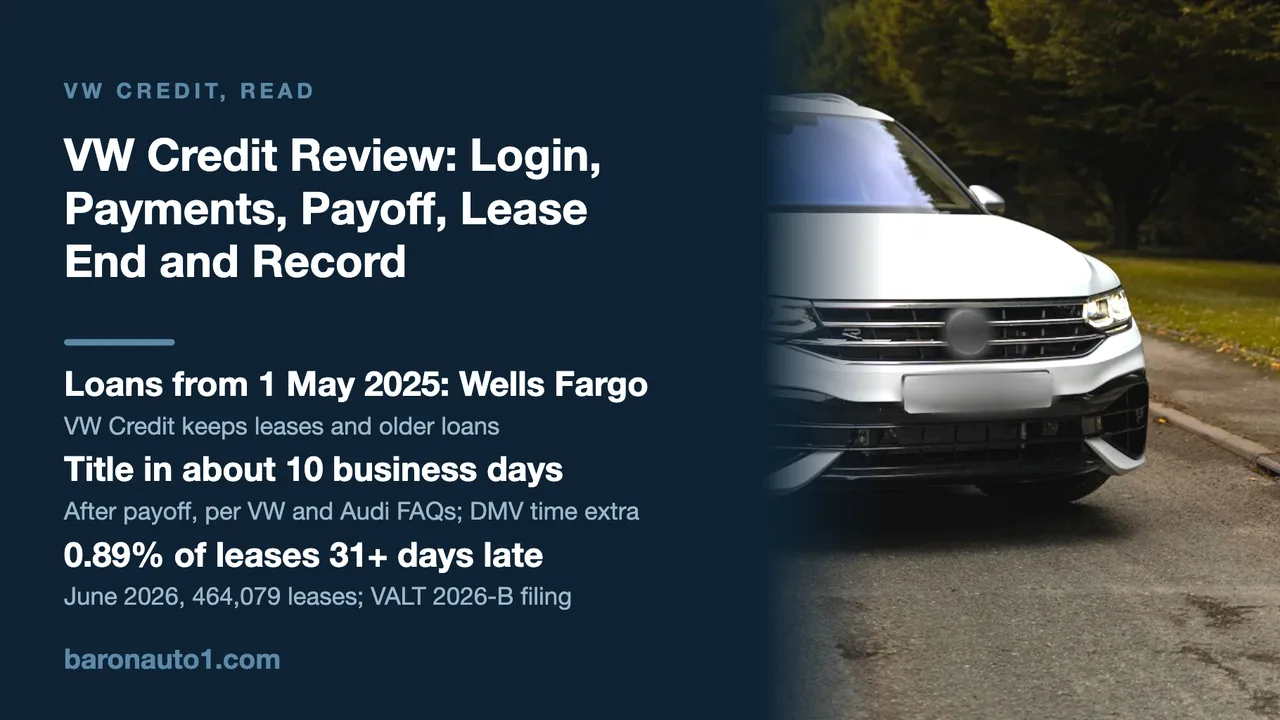
- VW Credit, Inc. is the lender behind the Volkswagen Financial Services and Audi Financial Services names. Since 1 May 2025, new Volkswagen and Audi loans have been written as Volkswagen or Audi Retail Finance, which Wells Fargo owns and services. VW Credit keeps every lease and the loans started before that date.
- VW Credit takes payments from a checking account, online, by AutoPay or by automated phone; “Credit cards are not accepted.” Its online terms print “no monthly or transaction fees.”
- After a loan is paid in full, VW Credit says it mails the title or releases it to the DMV in about 10 business days. After a lease buyout it says to allow 2 to 4 weeks.
- At lease end only an AiM inspection counts, and its report is valid for 90 days. The turn-in fee and per-mile charge are in your lease, not online; the fee is waived if your next Volkswagen goes through VW Credit within 90 days, or 120, depending on the page.
- VW Credit’s bond filings show 464,079 leases at 30 June 2026, 0.89% of them 31 or more days late. Lease net losses rose to an annualized 0.61% in the first half of 2026, and 47.2% of the leases due to end came back to VW Credit.
- We found no CFPB, Justice Department or state action naming VW Credit. The CFPB holds 2,622 complaints under “VW Credit”, 1,080 about vehicle loans or leases, and 28.9% of those closed with relief against 9.4% across the product.
Most people who search “VW Credit” want to log in, make a payment, pay a car off or hand a lease back. On 7 October 2026 we read what VW Credit publishes on those questions: the Volkswagen Financial Services FAQ, its Accounts & Payments, Lease Transition Options and Turn-in Process pages, Audi Financial Services’ FAQ, and VW Credit’s own Online Access and Usage Agreement, payment authorizations and Privacy Notice. We also read VW Credit’s prospectuses for Volkswagen Auto Lease Trust 2026-B, filed on 17 September 2026, and Volkswagen Auto Loan Enhanced Trust 2025-2, filed on 20 November 2025, a servicer report and the FTC’s 2016 diesel order. We entered no login, payment or credit application, and this site has no commercial relationship with VW Credit, Volkswagen, Audi, Wells Fargo or any lender. Where VW Credit’s documents disagree, we say so.
Who VW Credit is, and why your loan may not be with it
VW Credit, Inc. uses several names. Volkswagen’s lease pages say “VW Credit, Inc. (dba Volkswagen Financial Services) is a servicer for VW Credit Leasing, Ltd. And VCI Loan Services, LLC,” and its Online Access and Usage Agreement calls VW Credit and its affiliates both “Audi Financial Services” and “Volkswagen Financial Services.” The lease prospectus says VW Credit was incorporated in Delaware in April 1981, is wholly owned by Volkswagen US-Holding, Inc. and so by Volkswagen AG, and works through about 931 Volkswagen and Audi dealers. The dealer writes your contract; VW Credit buys and services it. VW Credit also trades as Audi Financial Services; see our Audi Financial Services review.
For loans, that changed in 2025. On 16 September 2024 VW Credit and Wells Fargo announced that Wells Fargo would be “the preferred purchase financing provider for the Volkswagen, Audi, and Ducati brands,” starting for Volkswagen and Audi “in May 2025.” VW Credit “will continue to service existing customer contracts” and now focuses on “consumer leasing, floorplan lending and usage-based products.” Volkswagen’s FAQ turns that into a simple test:
| Your contract | Who holds and services it | Where you log in |
|---|---|---|
| Any Volkswagen or Audi lease | VW Credit (Volkswagen or Audi Financial Services) | My Account (Volkswagen) or myAudi |
| Loan begun before 1 May 2025 | VW Credit | My Account or myAudi |
| Loan begun on or after 1 May 2025 | Wells Fargo Bank, N.A., as Volkswagen or Audi Retail Finance | Wells Fargo Online or the Wells Fargo Mobile app |
The footnote is plain: “Auto finance accounts are owned and serviced by Wells Fargo.” Audi’s FAQ says the same of Audi Retail Finance. If you financed a Volkswagen or Audi recently, this page is probably not about your loan; our Wells Fargo auto loan page reads that lender’s own pages. The loan prospectus notes “a significant reduction in Volkswagen Financial Services retail originations,” and the FAQ says VW Credit “does not refinance vehicles at this time.”
VW Credit files no annual report with the SEC (its own EDGAR list holds only Form ABS-15G), so its business is disclosed in the prospectuses of the bond trusts it sponsors. Even those differ on names: the 2025 loan prospectus calls Volkswagen Financial Services “an affiliate of VW Credit.”
Logging in, statements and privacy
The FAQ answers the login question first: “Register for My Account at vwcredit.com/register. You’ll need your account number, Social Security number, and email address.” Audi customers use myAudi. The account number arrives in a welcome booklet a few weeks after you leave the dealer and is printed on your contract. If it has been “12 weeks since you logged in on that device,” VW Credit asks you to re-authenticate. We have left phone numbers off this page; the FAQ lists them.
Save statements as they arrive. The FAQ says Document Center shows “previous statements over the last 12 months.” VW Credit’s Online Access and Usage Agreement, effective since 1 July 2024, says “Your statements are available online for up to a maximum of 90 days,” and that older ones may cost a fee, though its Online Fees clause says “There are no monthly or transaction fees for Online Service(s)” and names none.
The Privacy Notice, last updated on 1 June 2026, lists what VW Credit may collect, including “Biometric Information” and “Geolocation Data,” and says it may “jointly market financial products and services with affiliated and non-affiliated companies.” You can limit some sharing through the privacy link in your online account, though VW Credit warns you then “may not receive coupons, refunds, discounts, or any other special programs.”
How to pay VW Credit, what it costs and when it counts
VW Credit takes payments from a bank account only. The FAQ says “We only accept checking accounts as a form of monthly payment” and lists three routes: AutoPay, a one-time payment online, and the automated phone system, which it suggests for a first payment due before your account details arrive.
| Method | Fee printed | What VW Credit adds |
|---|---|---|
| AutoPay (My Account or myAudi) | None; “no monthly or transaction fees for Online Service(s)” | One enrollment per vehicle; not open to accounts with any payment past due |
| One-time payment online | None | Can be cancelled while “Pending,” not once “Posted” |
| Automated phone payment | None printed | Account number or Social Security number; from a checking account |
| Check by mail | None printed | Left off the FAQ’s list; VW Credit’s AutoPay terms and its prospectus mention checks |
| Credit card | Not accepted | “Credit cards are not accepted” |
VW Credit’s own payment authorizations read slightly wider than the FAQ: both draw on “the financial institution checking/savings account you selected.” They also list “late charges, returned payment fees, parking tickets or personal property taxes” among amounts a payment may cover, without printing any fee amount.
Timing is where the documents part company. The FAQ says: “If you scheduled your payment by 11:59 p.m. CT, Monday through Saturday, it will be credited to your account for the date you selected,” while Sunday and bank-holiday payments are credited “on the second business day.” The ACH Payment Authorization says “Payments are processed at 5 p.m. CT on the selected payment date, and cannot be modified or canceled after that time.” One is about crediting and the other about processing, but near a due date, schedule a day early. The FAQ also says to “allow up to 6 business days for the payment to withdraw from your account.”
AutoPay has its own rules. If the AutoPay date you pick falls after your next due date, or “within 12 calendar days before your next payment is due,” make a one-time payment that month. The FAQ says “You can cancel AutoPay at any time”; the Automatic Payment Plan authorization says a cancellation must arrive “at least 5 days before the scheduled payment date” or that month’s draw still goes through. If a draw bounces, VW Credit “may discontinue processing of recurring charges.”
Lessees in 11 states, among them Connecticut, Massachusetts, Texas and Virginia, may also see a yearly property tax bill: local offices bill VW Credit, which adds the tax to your balance, and AutoPay takes it with the regular payment.
Falling behind, deferrals and insurance
If money is tight, the FAQ says “you may be eligible to receive payment assistance” and asks for a secure message. For leases the usual tool is a deferral, and VW Credit spells out the catch: “if you defer two months of payments, instead of having one monthly payment due on your final payment date, you would have three monthly payments due.” If that final bill is not paid in full, “late charges may be applied” and there may be “credit reporting impacts.” The Turn-in Process page says those payments may be rolled into a new Volkswagen lease or loan with VW Credit, subject to credit approval.
The prospectuses describe what happens when payments stop. A lease payment is late when the lessee “fails to make at least 75% of a scheduled payment”; a loan is late if “more than 25% of the scheduled monthly payment is past due.” Notices start between 3 and 20 days late on a lease (2 and 28 on a loan). Then: “If the delinquent lease cannot be brought current or completely collected within 60 to 90 days, VW Credit generally assigns the vehicle to a repossession agent.” Accounts are charged off by the 120th day, and VW Credit generally pursues any shortfall after the sale “to the extent practicable and legally permitted.” See our guide to getting a repossessed car back.
Keep your insurance in force until VW Credit confirms a return. A lease must carry the coverage printed on the back of the contract, naming “VW Credit Leasing, Ltd. as the additionally insured and loss payee.” The lease prospectus says VW Credit “is not obligated to monitor whether a lessee continues to satisfy its insurance requirement,” so a lapse is your risk. After an accident, keep paying until you are told the account is closed; a GAP plan bought from an outside insurer is claimed with that insurer. See our guide to GAP on a lease.
VW Credit takes credit-report disputes in writing, and service members activate Servicemembers Civil Relief Act benefits by secure message. Since 31 August 2015 it has been subject to CFPB supervision.
Paying off, buying out a lease and getting the title
Payoff starts in your account: “Select ‘Request payoff quote,’ on the homepage.” The 11:59 p.m. CT rule decides which day a payoff payment is credited. VW Credit does not print how long a quote stays good, so check the date on it. On timing, the FAQ says: “Paper titles are generally mailed and electronic titles and/or liens are released to the DMV approximately 10 business days after the account is paid in full. In some states, this might be faster as required by state law.” Your DMV adds its own time. Audi’s FAQ gives the same 10 business days.
One FAQ answer adds a condition: the title comes once the car is paid off “and you have completed and returned the Bill of Sale and Odometer Statement.” If a title is slow, ask whether VW Credit is waiting for paperwork. It will send the title to an address you authorize, but “We cannot release the title in the name of a third party.” Since VW Credit does not refinance, a new lender pays it off directly; see our guide to refinancing a car loan.
You can buy a leased car at any time. “Get a payoff quote” produces a Purchase Agreement Package with a bill of sale, odometer disclosure statement, titling page and checklist. Pay online, or by check to VCI Account Services, LLC, and “allow 2-4 weeks to receive your title and final purchase documents.” A security deposit lowers the price. In Colorado, Florida and South Dakota, “Any off-lease purchase must be made at your local or preferred Volkswagen dealership.” Buying also cancels the lease-end bill: “You do not have to pay a turn-in fee, excess wear and use, or excess mileage if you purchase your vehicle.” Our lease buyout guide explains how to judge the price.
Some Volkswagen customers have a balloon contract, under which, the FAQ says, “you automatically became the owner of your vehicle.” At the end you pay the balance in one sum or sell the car back, with a notarized Power of Attorney form and Motor Vehicle Sales Agreement mailed to you “approximately 90 days before your term ends.”
Ending a lease: inspection, turn-in and extensions
Volkswagen’s Accounts & Payments page sets the clock: explore your options with 6 months left, receive the Wear and Use guide at 3 months, schedule the complimentary inspection at 45 days, make the final payment at 30 days, and turn in or buy the car at 0 days. VW Credit also contacts each lessee “At 90 days and 45 days prior to maturity,” the prospectus says.
The inspection decides most of the bill. VW Credit uses AiM, a third-party company inspecting “at your home, office, or dealership,” and the FAQ is firm: “Volkswagen Financial Services only accepts inspections done by AiM to determine if there are charges for excess wear and use.” The Turn-in Process page says “This inspection is free” and the report “will be valid for 90 days, provided no additional damage occurs.” Skip it and, per the prospectus, one is done at the dealership where you return the car. Repairs must be made at “a Volkswagen Authorized Collision Repair Facility,” and “You cannot repair the items on the inspection report yourself.” Email the receipts to VW Credit before the turn-in.
“Only your original dealer is required to take your vehicle back,” so call any other dealer first. Leave with the Lessee Vehicle Return Receipt and the Odometer Disclosure Statement and upload both through your account’s Message Center. One version of the FAQ says you may cancel your insurance once VW Credit receives the documents “and confirm[s] this with you”; another on the same page drops the confirmation. Wait for it. California lessees also file a release of liability. The final invoice follows “within six weeks of the date we receive your Odometer Disclosure Statement,” per the FAQ, or “in about four to six weeks,” per the turn-in page.
Only Volkswagen’s Lease Transition Options footnote prints extension terms: lessees “can extend their current lease for an additional three months, or up to six months for select models,” with the mileage allowance raised pro rata and Lease-End Protection extended “for 180 days beyond the contract lease maturity date.” The lease must be fully current, “Not all lessees will qualify,” and you “may also have to pay a turn-in fee” at the end.
Ending early costs money, and VW Credit prints only the warning: “The earlier you end the lease, the greater this charge is likely to be.” The prospectus formula adds the turn-in fee, unpaid amounts and the remaining payments, less unearned rent charges, adjusted for what the car sells for. VW Credit also runs “Lease Pull Ahead incentives,” financed by Volkswagen Group of America, that “may include waiver of one or more monthly payments” if you lease a new car early. On transfers, one FAQ answer cites “state laws and account details”; another says VW Credit “does not allow transfers ... under normal circumstances,” as our lease takeover guide records.
The turn-in fee, extra miles and wear
The FAQ lists what a final lease invoice may include: outstanding payments or taxes, personal property tax, parking tickets, excess wear and use, excess mileage, the turn-in fee, late payment fees, “Late vehicle return fees” and other unpaid contractual charges. Your security deposit is applied to the charges and any remainder returned. Volkswagen calls its disposition fee a turn-in fee, which “goes toward cleaning and reconditioning the vehicle for its next owner.” No page we read prints the amount; the prospectus calls it “the turn-in fee, if any, specified in the lease.”
The waiver depends on which page you trust. The FAQ (and Audi’s) waives the fee “if you lease or purchase a new or Certified Pre-owned Volkswagen through Volkswagen Financial Services within 90 days of returning your leased vehicle.” The Lease Transition Options footnote says “within 120 days,” 30 days longer by our arithmetic. The Turn-in Process page charges the fee “If you didn’t lease a new vehicle,” leaving buyers out. To be safe, replace the car within 90 days through VW Credit and get the waiver in writing. A certified pre-owned Volkswagen or certified Audi counts if VW Credit finances or leases it, but since 1 May 2025 Wells Fargo is the preferred provider of purchase loans.
Miles are the other big line. Standard leases allow “typically 15,000 or fewer per year,” and for miles over the allowance the Turn-in Process page says: “Refer to your lease agreement for the per-mile rate.” Find that rate in your lease now. “Eligible customers will have the option to purchase additional miles at the halfway point during their lease,” subject to “eligibility, availability, and applicable fees.” Our lease-or-buy guide shows how allowances work.

For wear, the Turn-in Process page gives examples; the full guide arrives by mail with a measuring tool.
| Area | Normal wear and use | Excess wear and use |
|---|---|---|
| Body | Scratches, dents or gouges smaller than 2 inches on a bumper or panel; three or fewer quarter-sized dings per panel | Scratches, dents or gouges larger than 2 inches; more than three dings per panel; poor body repairs; missing badges or trim |
| Glass | A single windshield chip without spidering | Chips, cracks or pits more than 1/8 of an inch; improperly tinted windows |
| Interior | Minor staining or carpet wear; all keys, manuals, headrests and cargo cover present | Holes, tears, burns or singes; excessive staining |
| Mechanical | All equipment working | Warning lights on; unfinished warranty repairs or scheduled maintenance |
| Tires | All four tires and the spare with more than 1/8 of an inch of tread | Any tire, including the spare, under 1/8 of an inch; on 4MOTION cars, tires that do not match in brand, size and rating |
| Modifications | None listed | Aftermarket changes left on the car; color changes or non-original paint |
The lease prospectus uses the same 2-inch line and adds a sentence the website does not: “VW Credit may waive all or part of the excessive wear and mileage billed to the lessee.” If you repaired damage after the inspection, the FAQ says receipts sent in will be reviewed and the invoice adjusted. Lease-End Protection, an add-on, covers some wear charges; our Volkswagen extended warranty page describes it.
What VW Credit’s bond filings show
VW Credit funds much of its business by selling bonds backed by its leases and loans: at 31 July 2026, 62.79% of its receivables, about $15.1 billion by our arithmetic, were pledged to those deals. Each prospectus also reports VW Credit’s whole serviced book. Since January 2025 there have been six, two loan deals in 2025 and four lease deals, and none for loans in 2026, which fits the move to Wells Fargo.
| Period | Leases outstanding | 31+ days late | Net losses | Leases due that came back |
|---|---|---|---|---|
| First half of 2026 | 464,079 | 0.89% | 0.61% | 47.2% |
| First half of 2025 | 452,024 | 0.99% | 0.45% | 42.8% |
| 2025 | 475,609 | 1.07% | 0.51% | 46.1% |
| 2024 | 447,064 | 1.19% | 0.34% | 45.6% |
| 2023 | 435,427 | 1.20% | 0.27% | 41.9% |
| 2022 | 448,447 | 1.10% | 0.17% | 39.0% |
| 2021 | 567,498 | 0.89% | 0.16% | 51.3% |
The lease book, about $17.3 billion at 30 June 2026 by our arithmetic, mostly pays on time, but losses are rising from a low base: annualized net losses went from 0.45% to 0.61% in a year, and VW Credit repossessed 1,646 leased cars in the first half of 2026 against 3,011 in all of 2025. More lessees are handing cars back: 47.2% of the leases due to end in the first half of 2026 came back to VW Credit, 4.4 points more than a year earlier.
The residual table is the part a lessee can use. On those leases, VW Credit’s stated residual, the end-of-lease value your monthly payments were calculated on, averaged 56.84% of the sticker price, against 49.73% from ALG, which the prospectus calls “an independent publisher of residual value percentages”: a gap it prints as 7.11 points. VW Credit’s average gain over ALG’s figure on returned cars fell to $877 from $2,116 a year earlier, a 58.6% drop by our arithmetic. If your purchase price sits near the stated residual, buying the car may cost more than it is worth, so compare the payoff quote with market value first. If the car is worth less, a closed-end lease protects you: lessees “will not be responsible for any amount by which the stated residual value of the leased vehicle exceeds the sales proceeds.”
The newest lease pool, 35,178 leases cut off on 31 July 2026, was 51.63% Audi by value, with an average original term of 36.25 months and a weighted average FICO score of 775 (from 600 to 900); 13.47% of its value came from lessees scoring under 700, by our arithmetic.
The loan book is shrinking and slipping. At 30 September 2025 VW Credit serviced 519,221 retail loans worth about $10.6 billion, 13.5% fewer loans and 21.7% less principal than a year before, by our arithmetic. Loans 30 or more days late rose to 2.09% from 1.67%, and annualized net losses to 1.22% from 0.95%. The last public loan pool, Volkswagen Auto Loan Enhanced Trust 2025-2, held 37,329 loans with an average contract rate of 5.03% (from 0.00% to 23.83%), 16.15% of the balance at under 1%, an average original term of 65.32 months and a weighted average FICO score of 773. Those are averages for one bond pool, not rates on offer. By 31 August 2026 its cumulative net losses were 0.97%.
Regulators and the diesel settlement
We found no enforcement action against VW Credit. On 7 October 2026 the CFPB’s enforcement list returned no results for titles containing “volkswagen” or “vw,” and web searches turned up no Justice Department or state attorney-general action naming VW Credit. The lease prospectus says only that VW Credit and its affiliates are “periodically otherwise involved in, reviews, investigations, and proceedings,” naming none.
The diesel emissions case touched VW Credit’s leases, though not as a defendant. The FTC sued Volkswagen Group of America (FTC Matter 162 3006), and the FTC’s case page names it as the only defendant. The court-approved partial order for 2.0-liter diesels, stamped filed on 10/25/16, entered a $10,033,000,000 judgment against Volkswagen Group of America. It defined an “Eligible Lessee” by “a lease issued by VW Credit, Inc.,” which it said includes “VW Credit Inc. d/b/a Volkswagen Credit and Audi Financial Services,” and said “no person shall be considered an Eligible Lessee by virtue of holding a lease issued by a lessor other than VW Credit, Inc.” Those lessees could end the lease “without paying an early termination penalty,” with Volkswagen paying the early termination fees, and the order refers to $26,000,000 “earmarked to pay a portion of the remaining future lease payments previously owed to lessors” by lessees who gave up their leases early. The order did not make Volkswagen pay excess wear and mileage charges, late fees, tickets or tolls owed under the lease.
CFPB complaints filed under VW Credit
The CFPB’s database holds 2,622 complaints under “VW Credit,” received from 7 May 2012 to 24 September 2026; no separate Volkswagen Financial Services or Audi Financial Services name appears in its company list. Complaints are unverified consumer reports, their number grows with a lender’s size, and since 30 September 2026 the CFPB publishes no narratives, so only counts are used here. The file cannot separate Volkswagen from Audi customers.
Vehicle loans and leases account for 1,080 complaints (41.2%), 592 about leases and 488 about loans, or 1.03% of the 104,437 such complaints in the database; credit reporting accounts for 1,038 (39.6%). In the vehicle file, problems at the end of a loan or lease lead with 327, including 120 about getting the title after payoff (11.1% of the file), 53 about mileage, damage or wear fees, 52 about early-termination charges and 35 about buying the car at lease end. Managing the account follows with 316, including 195 billing problems (18.1%) and 60 about fees. Add-on products account for 47 (4.4%) and repossession for 75. VW Credit closed 312 vehicle complaints (28.9%) with monetary or non-monetary relief, against 9.4% across the whole product, by our arithmetic, and answered all but 5 of its 2,622 complaints on time.
The count is rising even as the loan book shrinks: vehicle complaints went from 148 in 2023 to 191 in 2025, 1.29 times as many by our arithmetic, and 173 had arrived by 24 September 2026. Our Audi extended warranty page reads the same file for add-on products.
If you have a VW Credit loan or lease
- Check who holds your account. A loan begun on or after 1 May 2025 is with Wells Fargo, not VW Credit.
- Pay from a checking account a day before the due date; the FAQ says 11:59 p.m. CT, the payment terms say 5 p.m. CT.
- Cancel AutoPay at least 5 days before a draw if you need to stop it that month.
- After payoff, chase the title if it has not arrived about 10 business days after the account is paid in full, plus your DMV’s time.
- Book the free AiM inspection about 45 days before lease end and fix damage only at an authorized collision repair facility.
- Keep the Lessee Vehicle Return Receipt and odometer statement, upload them, and keep your insurance until VW Credit confirms the return.
- Replace the car within 90 days through VW Credit if you want the turn-in fee waived, and get the waiver in writing.
Common questions
Is VW Credit the same as Volkswagen Financial Services?
Yes. VW Credit, Inc. does business as Volkswagen Financial Services and Audi Financial Services. The exception is newer loans: since 1 May 2025, new Volkswagen and Audi loans are Volkswagen or Audi Retail Finance, owned and serviced by Wells Fargo.
How do I log in to VW Credit?
Volkswagen customers use My Account at vwcredit.com, registering with the account number, Social Security number and email address; Audi customers use myAudi. Loans begun on or after 1 May 2025 are managed in Wells Fargo Online or the Wells Fargo Mobile app instead.
Can I pay VW Credit with a credit card?
No. The FAQ says “Credit cards are not accepted” and “We only accept checking accounts as a form of monthly payment.” Online, AutoPay and automated phone payments are the routes it lists.
How long does VW Credit take to send the title after payoff?
VW Credit says paper titles are mailed, and electronic titles or liens released to the DMV, about 10 business days after the account is paid in full, with extra time at the DMV. After a lease buyout it says to allow 2 to 4 weeks for the title and purchase documents.
What is the VW Credit turn-in fee, and how do I avoid it?
It is Volkswagen’s name for a disposition fee, charged for “cleaning and reconditioning” a returned car; the amount is in your lease. The FAQ waives it if you lease or buy a new or certified pre-owned Volkswagen through VW Credit within 90 days of the return (another page says 120), and buying the leased car avoids it.
Can I extend or refinance a VW Credit lease or loan?
Volkswagen says lessees can extend for three months, or up to six for select models, if the lease is fully current. VW Credit “does not refinance vehicles at this time,” so refinancing means a new lender paying it off; see our guides to refinancing a car loan and preapproval. Our reviews of Toyota Financial Services, Kia Finance, Ford Credit, BMW Financial Services, Hyundai Motor Finance, TD Auto Finance, Chase and Bank of America read other lenders the same way.
Sources and further reading
- CFPB auto loan resources
- CFPB consumer complaint database
- CFPB Supervisory Highlights: Auto Finance (October 2024)
- CFPB: what is Guaranteed Asset Protection (GAP)?
- 12 CFR Part 1013 — Consumer Leasing (Regulation M)
- FTC vehicle repossession
Recall, complaint and safety-rating figures on this page were retrieved from the federal databases above on August 19, 2026. Federal data changes — re-check any VIN before you rely on it.
Published October 7, 2026 · last updated October 7, 2026. Found something out of date or wrong? Tell us and we will correct it.