Capital One Auto Loan: How It Works, Its Limits and Its Lending
Pre-qualify with a soft pull, then sign at a dealer in Capital One’s network. The limits on borrowers, cars and refinancing, who pays whom, and what Capital One’s filings show about who it lends to.
The short version
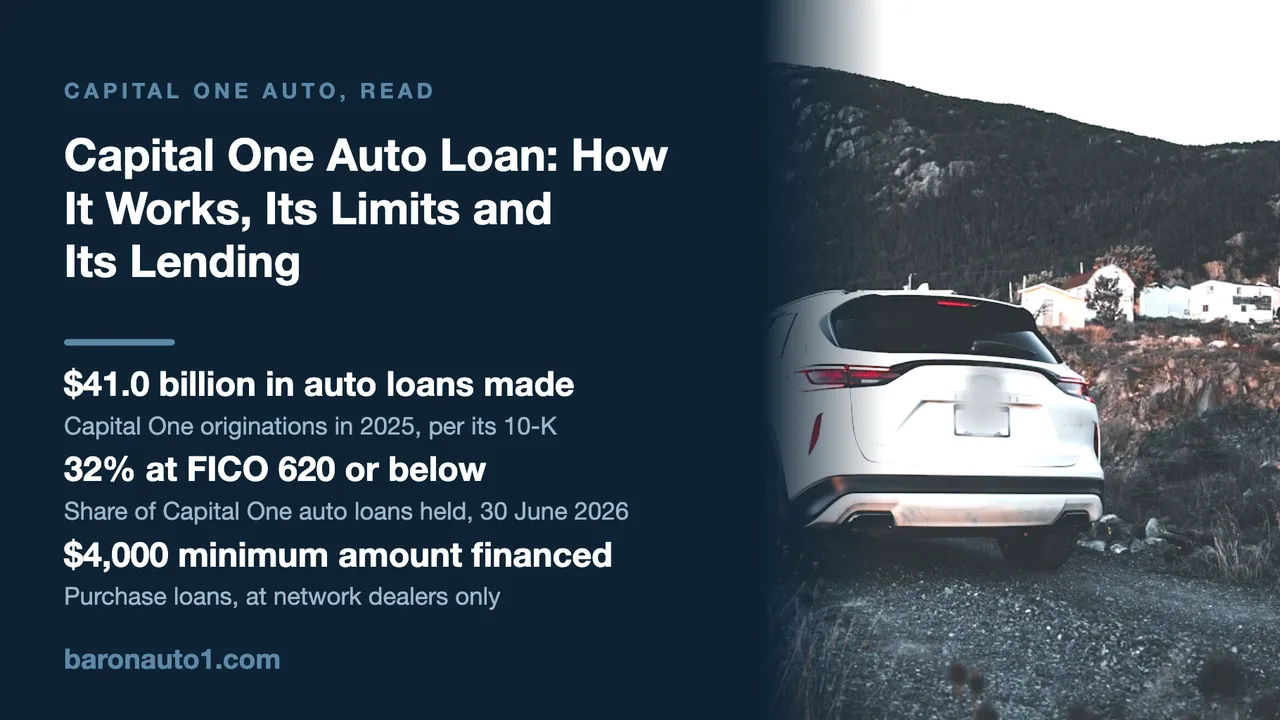
- A Capital One auto loan is arranged at a dealer. You pre-qualify online, sign a retail installment contract “with the dealer as the original creditor,” and the dealer assigns it to Capital One. Only dealers in Capital One’s network qualify: no private sellers, no brokers, and at least $4,000 financed.
- Pre-qualifying is a soft pull: Capital One says it “uses a ‘soft’ credit inquiry, which means your credit score remains completely unaffected.” The dealer’s final application is a hard inquiry. A pre-qualification lasts 30 days and covers one car.
- You must be at least 18, live in the contiguous United States, earn at least $1,500 a month and have fewer than 3 open Capital One auto loans totalling no more than $100,000. The car should generally be within 10 model years and under 120,000 miles.
- Money moves both ways. Capital One’s 10-K counts “incentives paid to our network of auto dealers for loan referrals,” and some dealers pay Capital One; their cars carry a “Dealer Partner” badge. Capital One publishes no rate sheet, so compare its APR with an outside approval.
- Capital One made $41.0 billion of auto loans in 2025 and held $89.3 billion on 30 June 2026, 32% of it at an origination FICO score of 620 or below, which its 10-K calls subprime. Its auto net charge-off rate rose from 0.28% in 2021 to 2.05% in 2024, then fell to 1.54% in 2025.
- Refinancing runs from $7,500 to $75,000, for other lenders’ loans only, with no application fee. The CFPB file holds 4,987 vehicle loan complaints naming Capital One, and a 2012 Justice Department settlement covered repossessions of servicemembers’ vehicles.
A Capital One auto loan is a dealer-arranged car loan: Capital One pre-qualifies you online, a dealer in its network writes the contract, and Capital One takes it over and collects the payments. On 6 October 2026 we read Capital One’s pre-qualification disclosures, its pre-qualification page and FAQs, its Auto Loan FAQ, its refinance terms, and the auto lines of its 2025 annual report and quarterly report to 30 June 2026, plus a Justice Department release and the CFPB complaint file. We filed no application, so there is no personal rate here, and this site has no commercial relationship with Capital One or any lender.
How a Capital One auto loan works: a dealer contract Capital One takes over
Capital One does not hand you a check to spend anywhere. Its FAQ: “you will sign a retail installment contract with the dealer as the original creditor. The retail installment contract will include your purchase and financing terms and will be assigned by the dealer to the lender you’ve chosen.” The annual report says the same from the lender’s side: “We originate auto loans through a network of auto dealers and direct marketing. Our auto loans have fixed interest rates.”
The shopping front end is Auto Navigator, “an online auto marketplace owned and operated by Capital One, N.A.” The disclosures add: “Capital One is not a car broker or dealer.” Car details come “from dealers and/or third-party sources, not Capital One,” and Capital One makes no “warranties, guarantees or representations about the quality, safety, condition or availability” of the cars. The loan is Capital One’s; the car is the dealer’s, and our guide to checking a used car’s history covers that part.
The FAQ counts “over 3 million new and used cars from over 15,000 dealerships nationwide.” The disclosures print “more than 15,000 thousand dealers nationwide (excluding Alaska and Hawaii),” a slip for 15,000, and warn that Capital One “may add or remove dealers from its financing network at any time.” Some network dealers list no cars online, so ask the dealer. A mailed pre-approval is narrower: it “can only be used at the listed dealer.” Capital One also lends through other retailers: CarMax’s annual report names “Capital One Auto Finance” among its outside lenders, as our CarMax Auto Finance guide shows.
Pre-qualification: the soft pull, in Capital One’s words
Capital One says the same thing on every page we read. Its car-shopping FAQ: “The pre-qualification process uses a ‘soft’ credit inquiry, which means your credit score remains completely unaffected.” And: “We will then pull a soft inquiry of your credit report, which will not impact your credit score.” The Auto Loan FAQ: “If you request pre-qualification for auto financing or refinancing from Capital One online, we will submit a soft credit check to the CRA(s). Soft credit checks are only visible to you on credit reports and don’t impact your credit score.”
The hard pull comes at the dealer. Asked whether a credit application is still needed, the pre-qualification page answers: “Yes. You’ll have to complete a final credit application at the dealership where you are getting your vehicle. This will result in a hard inquiry on your credit report and can impact your credit score.” The dealer “may submit your credit application to multiple lenders,” each inquiry “may be visible on your credit report for two years, even for the lenders who do not fund your loan,” and inquiries “typically within 14 to 45 days” may count as one. Our guide to rate shopping without wrecking your score covers that window.
You create an account and give your name, address, Social Security number, date of birth and “Employment status, employer, and salary.” You need not be a Capital One customer. What comes back is “an estimate for financing given by a lender based on information provided by you and a review of your credit history,” and “the rates will vary from car to car as you shop.” Four limits sit in the small print:
- It lasts 30 days. “You may use your offer on, but not after, the expiration date.”
- It covers one car. It “may only be used in connection with the financing of one car.”
- It is not final. Terms can change “if you give the dealer different information,” choose a different car or lender, or “if your credit history changes after you pre-qualify.”
- The dealer is not bound. “Capital One and participating lenders do not guarantee that the dealer will provide you with the same terms outlined in your pre-qualification offer.”
That is a pre-qualification, not a pre-approval you can take to any seller; our guide to pre-qualification and pre-approval explains the difference. If asked for proof of income, Capital One wants a pay stub “issued within 45 days” and a 90-day history to count overtime or bonuses; proof of residence must be “dated within the last 60 days.”
Who and what Capital One will finance
The disclosures set three personal requirements: be at least 18, have “a valid street address within the contiguous United States (a valid APO/FPO address also works),” and “Have a minimum monthly income of at least $1,500.” Then: “your existing Capital One accounts must be in good standing (not over limit, past due or charged off) and you must not have 3 or more open Capital One Auto accounts or an aggregate Capital One auto loan amount over $100,000.” No Capital One page we read prints a minimum credit score. Search results still quote an income minimum of “$1,500 or $1,800, depending on your credit qualifications”; that sentence was on no Capital One page we read on 6 October 2026.
For the car, the rule “In general” is a car, light truck, minivan or SUV that “Was manufactured for personal use,” “Has fewer than 120,000 miles,” “Has a model year within the last 10 years” and comes from a network dealer, though “In some instances, a car from an older model year or that has higher mileage may be eligible.” The FAQ adds that “the minimum amount financed is $4,000.” No current Capital One page we read prints a maximum purchase loan or term. The exclusions are each “not limited to” what they name:
- Titles and histories: branded titles, vehicles “repurchased by the manufacturer or dealer under state lemon laws,” cars with “a history of chronic malfunctions,” and cars without a VIN or title. See what a salvage title means.
- Types and makes: commercial vehicles, motorcycles, RVs, ATVs, camper vans and motor homes (the FAQ adds boats), and Oldsmobile, Daewoo, Saab, Suzuki and Isuzu (the FAQ’s list leaves out Oldsmobile).
- Deals: lease buyouts, and any car from “dealers who don’t provide Capital One auto financing, auto brokers or private party sellers.” Our lease buyout guide covers the other routes.
Capital One also “may determine a vehicle to be commercial or otherwise ineligible based on the model and/or information provided to us,” and its refinance FAQ gives an example: “those used for ride share services.”
Participating lenders, “Dealer Partner” badges and who pays whom
Your request does not stay with Capital One: it “may also be submitted to our participating lenders,” whose terms “are solely determined and provided by that lender.” If one of them funds the loan, its rules apply, not the Capital One terms below. Three kinds of payment run through the system, and Capital One discloses each:
- Some lenders pay Capital One. Participating lenders “may have their own eligibility restrictions, and some pay Capital One if you finance with them.”
- Some dealers pay Capital One. “Cars available from dealers who pay Capital One display a badge that says ‘Dealer Partner.’” The 2023 annual report described revenue “earned on certain marketing and promotional events from our auto dealers”; the 2025 report calls it revenue “from services provided to auto industry participants.”
- Capital One pays dealers. The 10-K’s note on loan costs: “Costs deferred include, among other things, incentives paid to our network of auto dealers for loan referrals.”
The dealer also shapes which offer you see. If you pre-qualify with several lenders, the site shows one per car, chosen partly by “whether or not the participating lender is the dealership’s preferred participating lender,” and “You may have other pre-qualified offers available.” Ask to see them.
No document says how a referral incentive or a Dealer Partner payment affects your rate. Our guide to how a dealer-arranged rate is built shows how dealer compensation can enter one. Capital One’s FAQ gives the practical answer: if you find better financing at a credit union or another bank, “you are free to do so.” Our Navy Federal and PenFed auto loan reviews read two credit unions’ own terms. Add-ons are the dealer’s too: extended warranties, service contracts and GAP “are not offered by or through Capital One or participating lenders,” so price them apart from the loan with our GAP guide and the out-the-door price.
What Capital One says about rates
Capital One prints no rate sheet or APR range a buyer can hold it to. Its rates page shows “As low as rates for a new or used Capital One auto loan in October,” based on “the previous month’s Capital One funded loan data for loan terms of 60 and 72 months for individuals with excellent credit characteristics.” Those figures did not render in our reading, change monthly and apply only to excellent credit, so we do not quote them. The refinance page’s “representative example” carries no date and sits beside “Advertised rates are subject to change without notice”; we do not quote it either.
What moves your rate, in the disclosures’ words: “your credit history, the total amount you are financing, the down payment and loan term you select, the loan-to-value ratio and certain car characteristics.” Online term lengths come with a warning: “not everyone qualifies for each of these term lengths.” The last limits Capital One printed are dated. Its 2023 annual report said its auto loans “have fixed interest rates and loan terms of 75 months or less, but can go up to 84 months,” with loan size limits “generally less than $75,000.” The 2025 report drops both. Our guides to used car loan rates and the credit score you need show how term and tier change the price.
Refinancing with Capital One: limits and conditions
Capital One refinances other lenders’ loans, never its own: it “only refinances auto loans that you have with other lenders, not including Capital One or its subsidiaries.” Pre-qualifying is a soft inquiry, and you “will typically receive a decision within 30 seconds.” After you e-sign an offer, “We’ll wait to do a hard credit check until we’ve verified all of your required information,” and you have “at least 15 days to provide any required information or documents.” Capital One then pays off your old lender and helps transfer the title.
- Loan size: “The minimum loan amount is $7,500 and maximum loan amount is $75,000,” and your balance “cannot be significantly greater than the estimated value of your vehicle.” See why negative equity blocks a refinance.
- Your current loan: a standard loan with one lienholder, from a lender that reports to a major bureau, is FDIC or NCUA insured, or is BBB-accredited and state-registered. “We do not offer cash-back refinancing or lease buyouts.”
- Your credit: “no material changes to your credit in the last 90 days,” no open bankruptcy, and no dismissed bankruptcy within 5 years before the current loan.
- Coverage: Capital One “will not finance new GAP or other coverage to cover any canceled coverage due to refinancing,” though a cancelled policy may bring a refund.
On cost: “No, you will not be charged an application fee.” Your state’s title fee is added to the loan, and there are no prepayment fees. Capital One adds its own caution: “If you decide to refinance for a longer term length, that may increase the total amount paid when compared to your current loan.” Our guide to the ways a refinance costs you money works through it.
| Rule | Purchase loan at a network dealer | Refinance of another lender’s loan |
|---|---|---|
| Smallest loan | $4,000 financed | $7,500 |
| Largest loan | Not printed | $75,000 |
| Vehicle age and miles | Within 10 model years, under 120,000 miles, with exceptions | “no older than 10 years”; no mileage printed |
| Monthly income | At least $1,500 | At least $1,500, “sufficiently greater” than debts and living costs |
| Other Capital One loans | Fewer than 3 open auto accounts; not over $100,000 in auto loans | Fewer than 3 open auto accounts; no “aggregate limit over $100,000 with Capital One” |
| Credit check | Soft to pre-qualify; hard at the dealer | Soft to pre-qualify; hard after verification |
| Offer lasts | 30 days | 30 days |
| Fees named | None by Capital One; the dealer’s contract sets the deal | No application fee; state title fee added; no prepayment fees |

Paying a Capital One auto loan: interest, fees and payoff
The Auto Loan FAQ: “You have a simple interest loan. It accrues interest daily from the day it’s signed until it’s paid off or the loan is matured, whichever is earlier.” Each payment goes first “to the interest that has accrued since the last payment was received,” then “towards your principal or any outstanding fees based on the status of your account.” Our guide to how loan interest accrues shows the arithmetic. Three rules follow:
- Extra principal does not buy time. “Principal payments do not move your due date forward or stop the interest from accruing daily.” You can pay ahead up to 3 months, but interest keeps accruing.
- Moving the due date costs interest. You can move it “by as many as 15 calendar days,” which “will likely result in additional interest accruing.”
- The last payment can grow. Due-date changes, extensions, late payments, late fees and a repossession can leave “an outstanding balance at maturity.”
On fees: “Capital One Auto does not charge fees for any type of payment made directly to us (online, mobile, phone, check, etc.). Debit card payments may be processed through CheckFreePay, which charges a service fee.” MoneyGram and Western Union charge their own. A returned payment can bring a “Returned Check Fee” under your contract, and a late fee applies if you miss “11:59 pm CT on the day your grace period ends,” with the grace period set in the contract. You can pay online or in the app from a bank account, by phone, through MoneyGram or Western Union, or by mail. There are “no payment coupon books,” and statements are generated “about 21 days prior to your due date,” though the online terms say Capital One “will no longer issue monthly periodic statements to users who have established recurring payment instructions through Online Banking.” On recurring payments, check the account rather than waiting for a statement.
- Payoff: quotes are “good for 10 days,” and overpayments are refunded within 30 days. Certified funds start the lien release “the next business day”; a personal check or online payment “may take up to five business days.”
- Credit reporting: Capital One reports accounts “30 days or more past due” monthly, and late payments “could remain on a credit report for up to 7 years.”
- A total loss: “After your insurance pays the settlement, you will be responsible for any remaining balance.” Refinance borrowers must carry comprehensive and collision cover with a maximum deductible of $1,000.
The online servicing terms add two clauses worth knowing: consent to calls and texts “made using an auto-dialer or prerecorded message,” and “We reserve the right to file a lawsuit to collect whatever you owe us and reserve the right to collect our reasonable expenses associated with the same, including attorneys’ fees and court costs, as allowed by law.”
A Capital One pre-qualification is not a blank check. It works only at a dealer in Capital One’s network, for one car, for 30 days, and the dealer is not bound by its terms. A car at a dealer outside the network, from a private seller or through a broker cannot be financed with it. Get a separate bank or credit union approval before you shop, so the dealer’s offer has something to beat.
What Capital One’s 10-K and 10-Q show about its auto loans
Capital One Financial Corporation reports auto lending inside its Consumer Banking segment. The figures below are the auto lines only, from the annual reports for 2023 and 2025 and the quarterly report to 30 June 2026. The FICO column is the share of auto loans held whose average score from three bureaus at application was 620 or below; the scores “are not refreshed thereafter,” and loans with no valid score count in that band.
| Period | Auto loans made | Auto loans held at period end | Net charge-off rate | 30+ days delinquent | Share at FICO 620 or below |
|---|---|---|---|---|---|
| 2021 | $43.1 billion | Not in filings read | 0.28% | Not in filings read | Not in filings read |
| 2022 | $37.0 billion | $78.4 billion | 1.00% | 6.26% | 27% |
| 2023 | $27.0 billion | $74.1 billion | 1.72% | 7.16% | 27% |
| 2024 | $34.5 billion | $76.8 billion | 2.05% | 6.81% | 27% |
| 2025 | $41.0 billion | $83.6 billion | 1.54% | 5.79% | 30% |
| First six months of 2026 | $24.0 billion | $89.3 billion | 1.53% | 4.80% | 32% |
Originations fell 37.4% from 2021 to 2023, then rose 51.9% to 2025, by our arithmetic. In the first half of 2026 Capital One lent $24.0 billion for cars against $20.1 billion a year earlier, a rise the 10-Q prints as 20%, and the segment’s loan growth was “primarily driven by growth in our auto loan portfolio.”
The auto net charge-off rate, write-offs less recoveries as a share of average auto loans, went from 0.28% in 2021 to 2.05% in 2024, 7.3 times the 2021 rate by our arithmetic, then fell to 1.54% in 2025, when the provision for losses fell “primarily driven by favorable credit performance in our auto loan portfolio.” In 2026 it turned again: the 10-Q says the provision rose “primarily driven by allowance builds in our auto loan portfolio,” with the auto allowance up from $1,869 million on 31 December 2025 to $2,142 million on 30 June 2026.
“Our charge-off period for auto loans is 120 days past due,” the 10-K says, or earlier “upon repossession of the underlying collateral.” A charge-off is a write-down, not forgiveness. The 10-K also names the auction risk behind every repossession: the auto business is “exposed to collateral risks arising from the auction markets that determine used car prices.” When auction prices fall, a repossessed car covers less of the debt; see what survives a repossession.
Who Capital One lends to: the FICO mix and what it calls subprime
The 10-K draws its own line: “For purposes of auto lending in our Consumer Banking business, we generally consider FICO scores of 620 or below to be subprime.” And it says the lending is deliberate: “we have made the strategic choice to originate and service subprime credit card and auto loans, which typically have higher delinquencies and charge-offs than prime customer accounts.” The share of the auto book at 620 or below was 27% at the end of 2022, 2023 and 2024, 30% at the end of 2025 and 32% on 30 June 2026, while the share above 660 slipped from 54% at the end of 2024 to 49%. The 10-Q’s vintage table shows the newest loans lean furthest that way:
| Year the loans were made | Balance still held | Share above 660 | Share at 620 or below |
|---|---|---|---|
| 2026 (to 30 June) | $23.0 billion | 48.4% | 33.7% |
| 2025 | $31.0 billion | 46.9% | 34.6% |
| 2024 | $17.5 billion | 53.3% | 28.0% |
| 2023 | $8.2 billion | 48.0% | 30.6% |
| 2022 | $6.0 billion | 54.1% | 25.6% |
| Earlier | $3.7 billion | 50.7% | 29.3% |
| All auto loans | $89.3 billion | 49.3% | 31.9% |
These are balances still held, not amounts lent, and a vintage’s mix shifts as loans pay down or charge off. About a third of what Capital One lent for cars in 2025 and early 2026, by remaining balance, went to borrowers it classes as subprime. For a buyer with a damaged file, that shows Capital One lends in that tier; it says nothing about the rate you would pay there.
The same risk factor describes what happens when such loans fail: recovery comes “primarily through customer communications, the filing of litigation against customers in default, the periodic sale of charged off debt and vehicle repossession.” Most repossessions need no court order, as our guide to how repossession works explains, and rolling an old balance into the loan leaves little margin; see negative equity.
CFPB complaints and public enforcement
On 6 October 2026 we pulled CFPB complaint counts for “CAPITAL ONE FINANCIAL CORPORATION” under “Vehicle loan or lease,” received through 5 October 2026. The file holds 4,987, received between 24 April 2017 and 25 September 2026: 4,846 about loans, 137 about leases and 4 about title loans, the fifth-largest count among 1,152 companies named in the category. Vehicle loans are 2.9% of the 173,593 complaints naming the company, by our arithmetic. The yearly count went from 614 in 2024 to 1,123 in 2025, 1.83 times as many, with 920 more in 2026.
Complaints are unverified consumer reports. The CFPB says its database “is not a statistical sample of consumers’ experiences in the marketplace,” and counts grow with a lender’s size: Capital One held $89.3 billion of auto loans on 30 June 2026. The CFPB has served no narratives since 30 September 2026, so these are counts only.
| Issue | Complaints | Share | Largest sub-issue |
|---|---|---|---|
| Managing the loan or lease | 1,394 | 28.0% | Billing problem (732) |
| Getting a loan or lease | 863 | 17.3% | Credit denial (235) |
| Problems at the end of the loan or lease | 650 | 13.0% | Unable to receive car title or other problem after the loan is paid off (309) |
| Repossession | 633 | 12.7% | Loan balance remaining after the vehicle is repossessed and sold (143) |
| Struggling to pay your loan | 571 | 11.4% | Denied request to lower payments (345) |
| Incorrect information on your report | 505 | 10.1% | Account status incorrect (221) |
Capital One closed 4,818 with an explanation, 96 with non-monetary relief and 33 with monetary relief; 40 were in progress, and it responded on time to 4,983. Of the 4,987, 493 carry the CFPB’s Servicemember tag. The issues track the terms above: billing, title release after payoff, balances left after repossession, and requests to lower payments.
The 2012 Justice Department settlement
On 26 July 2012 the Justice Department announced that Capital One N.A. and Capital One Bank (USA) N.A. “have agreed to pay approximately $12 million to resolve a lawsuit by the Department of Justice alleging the companies violated the Servicemembers Civil Relief Act.” The release says the complaint alleged that from at least July 15, 2006 to Nov. 21, 2011, Capital One “repossessed certain SCRA-protected service members’ motor vehicles without court orders” and wrongly denied requests to cut the rate on credit cards and “motor vehicle finance loans” to 6 percent. The agreement provided “at least $10,000 in compensation plus compensation for any lost equity (with interest) to each servicemember whose motor vehicle was unlawfully repossessed,” within about $7 million in damages, plus a $5 million fund for under-paid benefits.
The release calls it a proposed consent order, “subject to court approval.” The 64-page order returned no readable text, and we did not read the docket, so this page does not say what the order states about admission or denial, or when the court entered it. The 2025 annual report’s litigation note lists no auto-lending matter among its potentially material proceedings, and a search of the CFPB’s enforcement pages on 6 October 2026 found no action about Capital One’s auto lending: a search result, not a clearance.
Before you sign a Capital One auto loan
- Get an outside approval first. A bank or credit union approval gives the dealer’s offer something to beat.
- Confirm the dealer is in Capital One’s network. The pre-qualification cannot be used at dealers outside it, with brokers or for private sales.
- Check the car against the limits. Model year, mileage, title brand and lease-buyout status can each rule it out.
- Ask which lender each offer comes from. A participating lender’s loan follows that lender’s terms.
- Treat pre-qualified terms as estimates. The dealer’s application is a hard inquiry and sets the final terms.
- Read the contract’s late-fee and grace-period terms. Capital One’s FAQ points to the contract for both.
- Price add-ons apart from the loan. Warranties, service contracts and GAP are not Capital One products.
- Pay from a bank account. Capital One charges no fee for direct payments; debit cards and cash services go through third parties that do.
Common questions
Is it hard to get an auto loan with Capital One?
Capital One prints no minimum credit score. To pre-qualify you must be at least 18, live in the contiguous United States, earn at least $1,500 a month and have fewer than 3 open Capital One auto loans. Its filings show it lends across tiers: 32% of its auto balance on 30 June 2026 had an origination FICO of 620 or below.
Does Capital One auto pre-qualification hurt your credit?
Capital One says no: pre-qualifying “uses a ‘soft’ credit inquiry, which means your credit score remains completely unaffected.” The final application at the dealer “will result in a hard inquiry on your credit report and can impact your credit score.”
What are Capital One’s auto loan rates?
Capital One posts monthly “as low as” rates for excellent credit on 60 and 72 month terms, and no rate sheet. Your pre-qualified APR depends on your credit history, the amount financed, the down payment, the term, the loan-to-value ratio and the car.
Can I use a Capital One auto loan at any dealership or for a private sale?
No. Capital One finances only cars from dealers in its network, not from “auto brokers or private party sellers.” The car should generally be within 10 model years and under 120,000 miles, and at least $4,000 must be financed.
How do I pay my Capital One auto loan?
Online or in the Capital One app from a bank account, by phone, through MoneyGram or Western Union, or by mail. Capital One charges no fee for payments made directly to it; debit cards go through CheckFreePay, which charges a fee, as do MoneyGram and Western Union.
Can Capital One refinance my car loan?
Only if another lender holds it. Capital One refinances $7,500 to $75,000 on cars no older than 10 years, with no application fee and no prepayment fees, but not its own loans, lease buyouts or cash-out deals.
Sources and further reading
- SEC EDGAR filings: Capital One Financial Corporation
- CFPB consumer complaint database
- CFPB auto loan resources
- CFPB: what is the difference between dealer-arranged and bank financing?
- CFPB: how does a lender decide what interest rate to offer me on an auto loan?
- CFPB: what is a credit score?
- FTC vehicle repossession
Recall, complaint and safety-rating figures on this page were retrieved from the federal databases above on August 19, 2026. Federal data changes — re-check any VIN before you rely on it.
Published October 6, 2026 · last updated October 6, 2026. Found something out of date or wrong? Tell us and we will correct it.