Car Title Loans: How They Work, What They Cost, What the Law Says
A car title loan borrows against a car you own, usually at a monthly fee. What the CFPB found in 3.5 million loans (83% reborrowed the same day, 1 sequence in 5 ending in repossession), what is left of the 2017 rule, the military ban and seven states' laws.
The short version
- A car title loan is cash borrowed against the title to a car you own, sized on the car’s value rather than your credit. The FTC says they typically last 15 or 30 days and are for 25% to 50% of the car’s value.
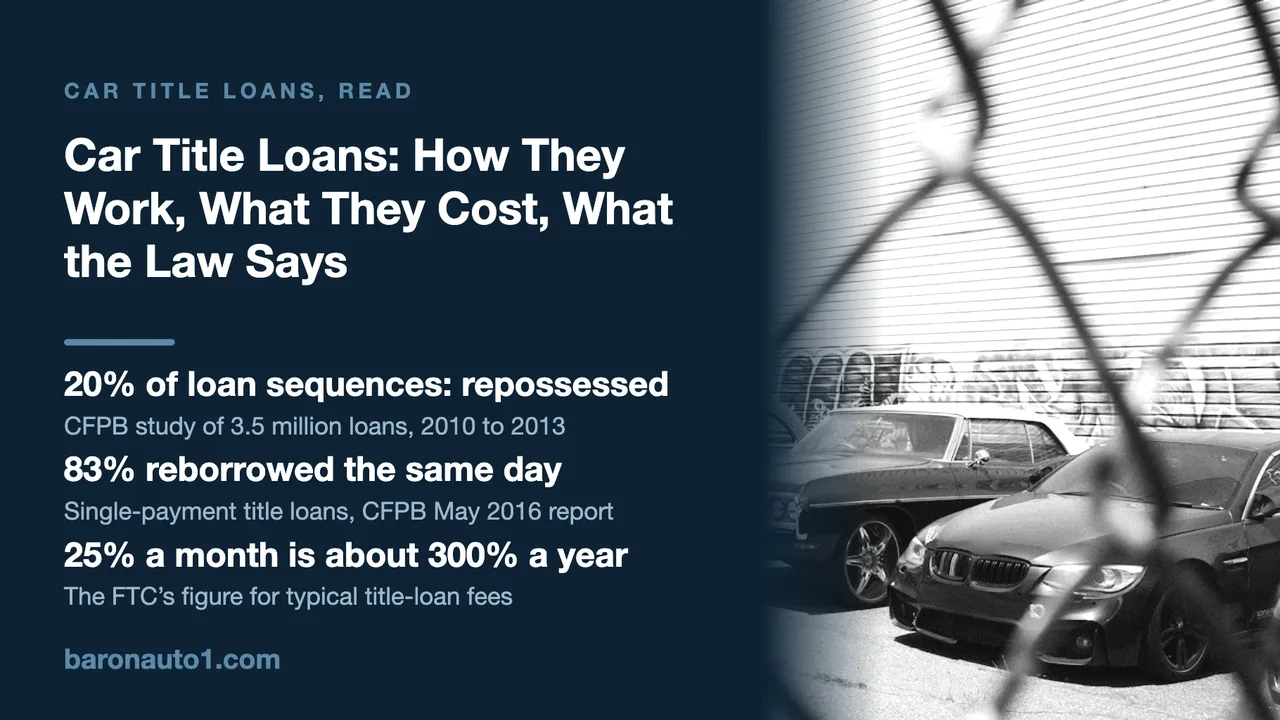
- The price is quoted by the month. The FTC says monthly fees run as high as 25%, about 300% a year. The CFPB’s study found a median loan of $694 at a median APR of 317%.
- When the CFPB followed nearly 3.5 million single-payment title loans, 83% were reborrowed the same day the last one was repaid, about one sequence in eight was a single loan paid off, and one in five ended with the vehicle repossessed.
- At 25% a month, a borrower who renews by paying only the fee has paid the whole loan in fees after four loans and still owes it, by our arithmetic.
- The 2017 federal rule lost its ability-to-repay part in 2020; what is left governs withdrawals from bank accounts. The firmest federal line is military: a lender that is not a bank or credit union may not take a car title from an active-duty servicemember or dependent at all.
- State law sets the price. Of the states we read, Wisconsin sets no limit on interest before the due date, Arizona allows up to 17% a month on small loans, and Illinois and South Dakota cap loans at 36% a year.
A car title loan, also called an auto or vehicle title loan, is a loan against a car you own outright, with the lender holding your title until you repay. It is expensive because the fee is charged by the month and most borrowers renew, and risky because the car is the collateral. On 6 October 2026 we read the CFPB’s May 2016 report on single-payment vehicle title lending, the 2017 federal rule and the documents that cut it back, the Military Lending Act rule, the FTC’s consumer page on car title loans, the CFPB’s orders against TMX Finance LLC (2016 and 2023) and an Arizona title lender, the title-loan laws of seven states, Texas’s 2025 regulator data and the CFPB complaint database. This site has no relationship with any lender and recommends none; this is an explainer, not legal or financial advice.
How a car title loan works
The CFPB’s 2016 report defines it: the lender “takes a security interest in the borrower’s vehicle and the loan approval and amount is primarily based on the vehicle’s value, rather than a credit check and traditonal underwriting” (the spelling is the report’s). Instead of a post-dated check, the borrower hands over the title, “which generally must be owned free and clear,” and keeps driving. Because no bank account is needed, title borrowers “may not have an account with a bank or credit union,” and lending is “typically conducted in storefronts so that the lender can assess the vehicle’s condition.”
There are two shapes. A single-payment loan is due in full, principal plus fee, after a short term; the loans the CFPB studied “typically have 30-day terms.” An installment title loan runs for months: TitleMax’s parent makes loans “from 30 days to 48 months,” the CFPB’s 2023 order says, and Virginia now requires 6 to 24 months. The CFPB’s 2016 figures cover only the single-payment kind, where the key word is renewal: “Reborrowing occurs when a loan is rolled over by paying a fee to extend the loan another 30 days, or when a subsequent loan is taken soon after repayment.” The fee buys another month. It does not reduce the debt. How one store-based lender describes its title loans, and where it still lends, is on our LoanMax review.
The lender either records a lien on your title or, as the 2023 TMX order describes, buys non-file insurance against its failure to record one and charges you for it, “typically $35.” Either way the car now carries a lien, which our guide to checking a car for a lien explains. The FTC adds that some lenders “insist on installing Global Positioning System (GPS) and starter interrupt devices,” the hardware described on our buy here pay here page, and often add “processing, document, and loan origination fees” and add-ons “like a roadside service plan.”
What lenders ask for, and how much you can borrow
The FTC’s list: “Usually, you need to own the vehicle free and clear, but some lenders will take your title if you’ve paid off most of your vehicle loan. The lender will want to see the vehicle, a photo ID, and proof of insurance. Many lenders also want a duplicate set of keys.” The 2017 rule adds that there is “generally no requirement that the borrowers have a bank account, and some lenders do not require a copy of a pay stub or other evidence of income.”
So what rules you out is mostly the car and where you live: a large loan still on the car, a title not in your name, a state that does not license title lending at the prices lenders want, and, with a nonbank lender, being an active-duty servicemember or dependent. Even the keys are not universal: Virginia says a licensee shall not “require or accept from a borrower a set of keys,” and Wisconsin bars requiring “a key or copy of a key.”
The FTC puts the usual amount at 25% to 50% of the vehicle’s value. Wisconsin caps principal at 50% of retail value and defines a title loan as $25,000 or less; Virginia caps it at $2,500. In the CFPB’s data the median loan was $694, the average $959 and the 75th percentile $1,080.
What it costs: turning a monthly fee into an APR
The FTC is direct: “Title loans often have monthly finance fees as high as 25%, which translates to an APR of about 300%.” The conversion is the monthly rate times twelve, a method Arizona’s statute writes into law (“multiplying the monthly secondary motor vehicle finance rate by twelve”). The CFPB found a median APR of 317%, an average of 291% and a 25th percentile of 300%.
Enforcement records show real price sheets. The CFPB’s 2016 TMX order found a “monthly pawnshop charge equal to 9.99% to 24.99% of the principal” in Alabama and Georgia, and in Tennessee “interest of 2% per month and a monthly customary fee of 10.99% to 21.99%.” Times twelve, that is 119.88% to 299.88% a year and 155.88% to 287.88%, our arithmetic: a simple annual figure, not a regulated APR.
Federal law requires the APR in writing before you sign; the FTC says lenders “must tell you the finance charge, which is a dollar amount, and the APR, which is a percentage.” Advertising is covered too. In September 2016 the CFPB sued five Arizona title lenders, alleging they advertised monthly rates without an APR; one, it said, “asked consumers to take its advertised rate and multiply it by 12, but did not inform consumers that the calculated number is the annual percentage rate.” Those were allegations. One of the five, Oasis Title Loans, consented to an order filed on 1 November 2016 that found its website listed “varying monthly rates of finance based on the loan amount” without an APR, with a $20,000 penalty.
For a rough calculator: one month’s fee is the loan times the monthly rate, and the yearly rate is about the monthly rate times twelve. Here is one month on $1,000 under the price rules we read, our arithmetic.
| Price rule | Source | One month |
|---|---|---|
| 25% monthly finance fee | FTC’s typical title loan | $250 |
| 15% a month (over $500, up to $2,500) | Arizona’s maximum | $150 |
| 36% a year plus a fee of up to $15 a month | Virginia’s statute | $45 |
| 36% a year, every fee included | South Dakota and Illinois caps | $30 |
| 30% a year on the first $2,000 | Florida’s title loan statute | $25 |
| 28% a year | Federal credit union payday alternative loans | $23.33 |
A 25% fee and a 30% rate sound alike. One is per month and the other per year, and over the same 30 days the monthly fee costs ten times as much.
The rest of the cost is renewal. The FTC’s example: borrow $1,000 for 30 days at a 25% fee and you owe $1,250; roll it over and “now you owe $1,500,” and “the rollover brings your cost of borrowing $1,000 for 60 days to at least $500.” Four renewals at $250 come to $1,000 in fees, the whole loan, with the $1,000 still owed.
| Loans | Fees paid | Fees as share of the loan | Total paid if the last loan is repaid | CFPB sequences this long or longer |
|---|---|---|---|---|
| 1 | $173.50 | 25% | $867.50 | 12% were a single loan, repaid |
| 4 | $694 | 100% | $1,388 | 56% |
| 7 | $1,214.50 | 175% | $1,908.50 | 36% |
| 10 | $1,735 | 250% | $2,429 | 23% |
| 12 | $2,082 | 300% | $2,776 | 15% |
This is an illustration, not a typical bill. It holds the principal fixed, and the CFPB found 37% of multi-loan sequences ended smaller than they started, while those that grew rose by a median of over 50% ($322 to $325). The 25% is the FTC’s figure and the 2017 rule’s “common fee limit,” not any lender’s quote. The pattern holds at any monthly rate r: renewals cost the full principal after 100 divided by r months.
What the CFPB found when it followed 3.5 million loans
The May 2016 report is still the largest public measurement of single-payment title loans: “nearly 3.5 million loans made to over 400,000 borrowers in ten states during 2010-2013,” from storefronts, on 30-day terms. The CFPB grouped them into sequences, a first loan plus any taken within 14, 30 or 60 days of repaying the last, and followed each for up to 12 months.
| Outcome | 14-day | 30-day | 60-day |
|---|---|---|---|
| Single loan, repaid | 13% | 12% | 11% |
| Single loan, defaulted | 9% | 9% | 9% |
| Several loans, repaid | 55% | 56% | 56% |
| Several loans, defaulted | 22% | 23% | 25% |
| Ran to 10 or more loans | 21% | 23% | 26% |
| Ended in repossession | 19% | 20% | 20% |
“Over 80% of vehicle title loans are reborrowed on the same day a previous loan is repaid,” 83% exactly, and 87% within 60 days. “Only about one-in-eight loan sequences consist of a single loan that is repaid without reborrowing,” leaving 88% renewed, defaulted or both, our arithmetic. The business rests on long sequences: “about half of all loans are in sequences of ten or more loans,” and fewer than 20% of loans were the first in a sequence. And “about a third of loan sequences experience a default and one-in-five loan sequences result in the repossession of the borrower’s vehicle.”
Two caveats come from the CFPB’s own documents. Its press release turned the sequence figure into “one-in-five borrowers,” but the report counts sequences, with customer IDs specific to each lender, so it cannot follow one person across lenders. And the 2017 rule describes the same 3.5 million loans as made “in 20 States,” not ten, with the same $694 median.
A later CFPB survey saw the same persistence from the borrower’s side. Its 2021 Making Ends Meet brief says 2.0% of consumers took out an auto title loan in the six months before June 2019, 83% of them still owed on it at the survey, and 32.1% took out another within the next year.
Default, repossession and what is left afterwards
Per loan, default looks rare: 6% of loans defaulted and 3% were repossessed in the CFPB’s data. Per sequence it is 33% and 20%. The renewals make the difference, because each month is a new chance to fall short.
The contract and state law decide the trigger. In the 2016 TMX order, if a borrower “does not repay at least the accrued finance charge by the deadline set forth in the contract,” the lender “may repossess the consumer’s car in accordance with state law requirements.” The FTC warns a lender may repossess “even if you’ve been making partial payments,” and that “In some states, lenders can keep all the money they get from selling the vehicle, even if they get more than you owe.”
Partial payments do not protect the car. The FTC says a title lender may repossess even after partial payments, and one CFPB sequence in five ended that way. Before signing, find out exactly what amount, on what date, keeps the loan out of default.
After the sale, states differ most. The 2017 rule counted nine “non-recourse” states, where the lender’s remedy is the car unless the borrower damaged or hid it. Of those we read, Virginia bars a judgment for “any deficiency resulting after the sale,” requires written notice 10 days before repossession, caps repossession and sale costs at 5% of the loan and returns any surplus within 10 days. Delaware says the borrower “shall not be liable for any deficiency” and requires a workout offer cutting the balance by at least 10% a month before repossession. Wisconsin requires 20 days’ notice and bars most deficiency claims. Elsewhere the general rules apply; see our page on car repossession.

One state’s own numbers: Texas in 2025
In Texas, “Credit access businesses obtain credit for a consumer from an independent third-party lender in the form of a deferred presentment transaction or a motor vehicle title loan,” and report to the Office of Consumer Credit Commissioner each year. Its report for 2025 gives these figures for single-payment auto title loans:
- 74,839 consumers; 150,086 new loans totalling $232 million, an average of $1,545 (our arithmetic); 3,485 loans over $7,500.
- 228,399 refinances of loans made in the year, 1.52 per new loan (our arithmetic), worth $723.1 million.
- $247.8 million in fees, 106.9% of the year’s new lending (our arithmetic; the fees include refinances of older loans, so this compares two annual totals).
- Of 27,463 loans closed, 7,561 (27.5%) were never refinanced; 4,849 (17.7%) were paid off only after more than 10 refinances.
Installment title loans add 84,693 consumers and $333.4 million in fees. The OCCC notes the data are location-level and that customer-level data “could produce different results.” Its loan amounts by size add to $62 more than its stated total, and the PDF’s publication date (24 April 2026) differs from the reports page (24 March 2026). Neither changes the picture, which is the CFPB’s a decade on: fewer than three in ten Texas single-payment title loans closed without a refinance.
The federal payday and title loan rule: what is left of it
The CFPB’s 2017 rule (82 FR 54472) had two parts. One made it “an unfair and abusive practice” to make short-term or balloon-payment loans, “including payday and vehicle title loans,” without checking the borrower could repay; short-term means due within 45 days, which takes in a 30-day title loan. The other limits withdrawals from bank accounts. The rule said it “operates as a floor,” leaving states free to go further.
| Date | Document | What it did |
|---|---|---|
| 17 November 2017 | Final rule, 82 FR 54472 | Ability-to-repay underwriting, including for title loans, plus withdrawal limits; effective 16 January 2018, compliance due 19 August 2019 |
| 17 June 2019 | Final rule, 84 FR 27907 | Delayed the underwriting provisions by 15 months, to 19 November 2020 |
| 13 July 2020 | Ratification, 85 FR 41905 | Ratified the payment provisions |
| 22 July 2020 | Final rule, 85 FR 44382 | Revoked the underwriting provisions (§§ 1041.4 to 1041.6, 1041.10, 1041.11), effective 20 October 2020 |
| 28 March 2025 | CFPB statement | Payment provisions operative 30 March 2025; the CFPB will not prioritize penalties under them |
The revocation removed the part aimed squarely at month-after-month renewals. What survives is § 1041.7, which bars further withdrawal attempts “after the lender’s second consecutive attempts to withdraw payments from the accounts from which the prior attempts were made have failed due to a lack of sufficient funds,” unless the borrower re-authorizes, plus notices before withdrawals. A payment transfer is a “lender-initiated debit or withdrawal of funds from a consumer’s account,” and the official interpretation says a consumer who pays “in cash withdrawn by the consumer from the consumer’s account” has not triggered one. For a borrower paying cash at the counter, the surviving rule has nothing to act on. In the complaint database, 111 title-loan complaints (1.9%) concern bank-account withdrawals or charges.
The CFPB then stepped back from those provisions as well. Its statement of 28 March 2025 says it “will not prioritize enforcement or supervision actions with regard to any penalties or fines” under them, and is “contemplating issuing a notice of proposed rulemaking to narrow the scope of the rule.” We did not read the court orders behind the 30 March 2025 date. On 6 October 2026 the Federal Register’s API lists 7 documents touching part 1041, the newest the 2020 revocation, and the CFPB’s interactive regulation says “Most recently amended Oct. 20, 2020.” The CFPB’s own page for the 2017 rule, last modified in July 2021, still shows the 19 August 2019 compliance date.
Military borrowers: a ban, not only a rate cap
The FTC says the Military Lending Act “limits the Military Annual Percentage Rate (MAPR) on many types of credit, including payday loans, car title loans, personal loans, and credit cards, to 36%,” and an Ask CFPB answer lists “vehicle title loans” among credit capped at 36%. The Defense Department’s rule goes further. 32 CFR 232.8(f) makes it unlawful to lend to a covered borrower when “The creditor uses the title of a vehicle as security for the obligation,” with banks, savings associations and credit unions excepted from that paragraph. A contract that breaks the rule is “void from the inception of the contract” (232.9(c)), and the 36% MAPR cap in 232.4(b) applies to every lender. Covered borrowers are active-duty members on orders not limited to “a period of 30 days or fewer” and their dependents. Loans to buy a car are excluded, so the ban reaches loans against a car you already own.
The CFPB’s February 2023 order against TMX Finance shows the ban broken. TitleMax’s own policy said covered borrowers “are not eligible for a loan,” yet between 3 October 2016 and 17 September 2021 it made 2,670 prohibited loans to them, 2,655 of them title loans; 2,569 had MAPRs above 36%, and “many of those loans had APRs in excess of 100%.” The CFPB found TitleMax “changed consumers’ personally identifiable information” to get database answers saying borrowers were not covered, and “in certain instances, repossessed and sold the Covered Borrowers’ vehicles.” It also charged non-file-insurance fees on 15,386 loans whose lien was already recorded, understating the finance charge on 15,468 loans in all. The order required $5,050,000 in redress and a $10,000,000 penalty, $15.05 million together (our arithmetic). TMX consented “without admitting or denying any of the findings.” The press release rounded the count to “at least 2,670 prohibited auto title loans”; the order separates the 2,655 title loans.
In the complaint database, 877 of 5,863 title-loan complaints (15%) carry the “Servicemember” tag, which also covers “anyone who previously served and is a veteran or retiree,” so it is not a count of covered borrowers.
State law sets most of the rules
In 2017, citing a 2015 Pew report adjusted for South Dakota’s new 36% cap, the CFPB counted “24 States that permit some form of vehicle title lending,” and said “A common fee limit is 25 percent of the loan amount per month, but roughly half of the authorizing States have no restrictions on rates or fees.” Those counts are dated. The same rule described Virginia’s fees as “tiered at 22 percent per month for amounts up to $700”; Virginia’s code, amended in 2020, now allows 36% a year plus a small monthly fee. We copied no private compilation, and the table covers only states whose statute or regulator page we read on 6 October 2026.
| State | Law | Price limit | Size and term | After default |
|---|---|---|---|---|
| Virginia | Va. Code § 6.2-2216 and nearby sections | 36% a year, plus a monthly fee of 8% of the loan or $15, whichever is less | Up to $2,500; 6 to 24 months | No deficiency judgment unless the car is damaged, hidden or already pledged |
| Florida | Fla. Stat. § 537.011 | 30% a year on the first $2,000, 24% on the next $1,000, 18% above $3,000 | Extensions in 30-day periods by mutual consent | Not read |
| Arizona | A.R.S. § 44-291(G) | Per month: 17% up to $500, 15% to $2,500, 13% to $5,000, 10% above (204%, 180%, 156%, 120% a year, our arithmetic) | Not limited in this section | Not read |
| Delaware | 5 Del. C. §§ 2250-2261 | No maximum rate in the title-loan subchapter | Term and rollovers end 180 days after payout | Workout offer before repossession; no deficiency |
| Wisconsin | Wis. Stat. § 138.16 | “no limit on the interest” before maturity; 2.75% a month after | Up to $25,000 and 50% of retail value; 6 months or less | 20 days’ notice; no deficiency unless the car is damaged, hidden or already pledged |
| South Dakota | SDCL 54-4-44 | 36% a year, every fee and add-on included | Since 16 November 2016 (Initiated Measure 21) | A loan over the cap is void |
| Illinois | 815 ILCS 123/15-5-5 | 36% APR on any consumer loan, measured the military way | Since 23 March 2021 (Public Act 101-658) | Not read |
| Texas | OCCC, credit access businesses | A credit access business arranges the loan from a third-party lender and charges its own fee | Single-payment and installment loans reported separately | Not read |
South Dakota’s cap counts “all charges for any ancillary product or service,” and Illinois uses the military MAPR method, so neither leaves room for fees on top. Wisconsin’s statute says outright that it “imposes no limit on the interest that a licensed lender may charge before the maturity date.” For any other state, the FTC’s advice is practical: “check with your state attorney general or state regulator about payday and title lending laws in your state.”
What regulators found at title lenders, and what consumers report
TMX Finance, then with about 1300 storefronts in 18 states, was the subject of the CFPB’s order of 26 September 2016 (2016-CFPB-0022). The CFPB found staff offered a “monthly option” and a payback guide spreading a 30-day loan over a default 12 months, and that the guide “does not disclose the total cost of the transaction” if renewed. It called that abusive, and found staff made “in-person visits” to borrowers’ homes and references until December 2015. The order banned payback guides and in-person collection visits to homes and workplaces and imposed a $9 million penalty; TMX consented without admitting or denying the findings. Six later modifications are listed on the CFPB’s case page; we did not read them. TitleMax’s own record, including its 2023 sale to CCF Holdings, is on our TitleMax review.
The complaint database is the other public record. Title loans sit under four product labels over time, each with a “Title loan” sub-product, and together they hold 5,863 complaints received from 21 July 2014 to 5 October 2026, pulled on 6 October 2026. The yearly count rose from 177 in 2015 to 889 in 2025, about 5 times as many, with 722 in 2026 so far. The commonest issue is fees or interest the consumer did not expect (1,622, or 27.7%), then struggling to pay (945), payoff problems (842) and repossession or sale of the vehicle (813, or 13.9%). 156 complaints (2.7%) closed with monetary relief. TMX Finance LLC is named in 823 (14%). These are unverified consumer reports: the consumer picks the label, so some name lenders that do not market title loans, and counts grow with a company’s size. The database has served no narratives since 30 September 2026.
Alternatives that come with a federal rulebook
The FTC’s alternatives start with asking creditors for more time and trying a credit union, since “some federal credit unions offer ‘payday alternative loans,’ or ‘PAL loans,’ for small loans” that are “much less expensive than payday or car title loans.” It also lists community banks, small loans at large banks, an early tax refund, nonprofit credit counseling, family and local charities.
PAL terms are written into 12 CFR 701.21. A federal credit union may charge 1000 basis points above the NCUA Board’s maximum, which the NCUA’s February 2026 letter puts at “up to 28 percent,” with the general ceiling held at 18% through 10 September 2027. A PALs I loan is $200 to $1,000 over one to six months, fully amortized, never rolled over, with an application fee that “in no case exceeds $20,” after at least one month of membership, and no more than three in a rolling six months. PALs II go up to $2,000 for up to 12 months. Not every credit union offers them. Our page on credit union loan rates explains the ceiling.
A bank or credit union may also lend against a car, including a cash-out refinance, which the CFPB excluded from its definition of a title loan; see refinancing a car loan, negative equity and credit scores and car loans. The CFPB’s 2021 survey found 33% of auto title borrowers had at least $300 of unused credit-card credit. Which option fits depends on facts this page cannot see. Some installment lenders also take a car as security for a personal loan; our OneMain Financial review reads one lender’s rules for the pledged car.
- Get the APR and finance charge in writing. A monthly rate on a poster is not an APR.
- Ask what you owe on day 30 and what a renewal costs. At 25% a month, four renewals equal the loan.
- Check the lender’s state license. Your attorney general or state regulator can tell you the local rules.
- Ask about GPS, starter interrupts and keys. Virginia and Wisconsin bar requiring your keys.
- Find out what happens after a sale. Some states bar deficiency claims; the FTC says some let the lender keep the surplus.
- List every add-on. Document fees, roadside plans and non-file insurance all add cost.
- On active duty or a dependent? A nonbank title loan is prohibited, and a contract that breaks the rule is void.
Common questions
Is a title loan ever a good idea?
This page does not make that call. The records show the product works as designed for a minority: about one CFPB sequence in eight was a single loan repaid, one in five ended in repossession, and in Texas in 2025, 27.5% of single-payment loans closed without a refinance. The cost depends on how many months the loan stays open, so know where the full payoff will come from on day 30.
What disqualifies you for a title loan?
Mostly the car: lenders usually want it owned free and clear, plus a photo ID and proof of insurance. A large existing car loan, a title not in your name or a state that caps rates low can end it. Active-duty servicemembers and dependents cannot lawfully borrow against a title from a nonbank lender. Weak credit usually does not disqualify you, because approval rests on the car’s value.
How much can I borrow with a title loan?
The FTC says usually 25% to 50% of the car’s value. Virginia caps loans at $2,500; Wisconsin at $25,000 and 50% of retail value. The CFPB’s median was $694, and Texas’s 2025 average for new single-payment loans was $1,545, our arithmetic.
What are typical title loan interest rates?
Usually a monthly fee: up to 25% a month, about 300% a year, says the FTC, and a 317% median APR in the CFPB’s data. State limits run from 17% a month on small Arizona loans to 36% a year in Illinois and South Dakota.
Can I get a title loan if my car is not paid off?
Sometimes. The FTC says some lenders accept a title if you have paid off most of the loan, and the CFPB says some take a second lien. Expect a smaller amount, since the first lender is paid first.
Can the lender take my car if I have been making payments?
Yes, if they fall short of what the contract requires; the FTC says repossession can happen “even if you’ve been making partial payments.” Some states add steps first, such as Virginia’s 10 days’ notice and Wisconsin’s 20. Our repossession guide covers what follows.
Sources and further reading
- CFPB consumer complaint database
- FTC vehicle repossession
- UCC Article 9, part 6 — default (uniform text)
- 12 CFR 701.21 — loans and lines of credit to members
- 12 CFR §1026.4 (Regulation Z, finance charge)
Recall, complaint and safety-rating figures on this page were retrieved from the federal databases above on August 19, 2026. Federal data changes — re-check any VIN before you rely on it.
Published October 6, 2026 · last updated October 6, 2026. Found something out of date or wrong? Tell us and we will correct it.