American Credit Acceptance Review: Login, Payments and Record
American Credit Acceptance buys car loans from dealers and publishes no rates. How to log in, pay without fees and reach the right phone line, why payments go to fees first, the 2016 Massachusetts GAP settlement, and 4,102 CFPB complaints.
The short version
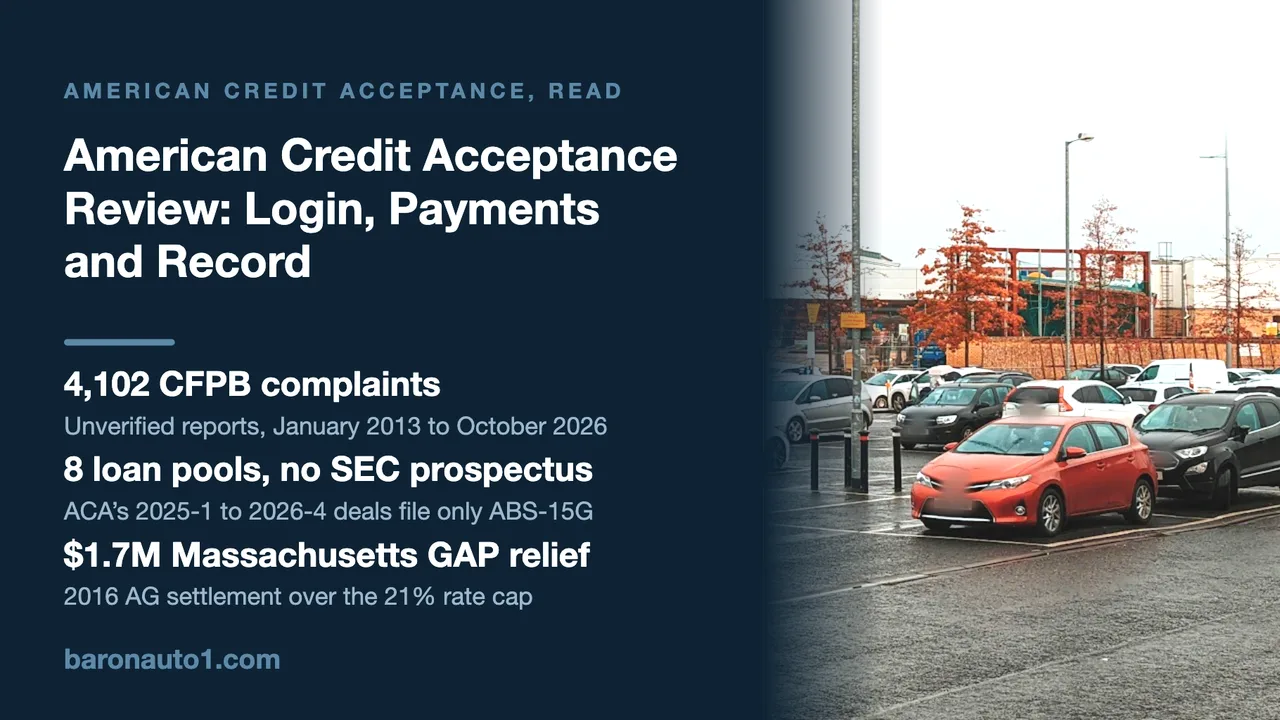
- American Credit Acceptance (ACA) is an auto lender in Spartanburg, South Carolina, that files no annual report with the SEC. A dealer writes your contract and ACA buys it, then collects the payments. It is not Credit Acceptance Corporation, the Michigan lender in the September 2026 multistate settlement.
- To log in or pay, use ACA’s customer portal (myloan.acacceptance.com) with your 11-digit account number, or call 1-866-544-3430, weekdays 8 a.m. to 10 p.m. and Saturdays 8 a.m. to 5 p.m. Eastern. AutoPay and mailed payments are free; card, phone and one-time online payments carry a processing fee ACA does not print.
- ACA publishes no rates. Its own simple-interest example uses a 25% APR, where $14,600 accrues $10 a day; paying on the 29th instead of the 15th sends $140 more of a $600 payment to interest, by our arithmetic from ACA’s figures.
- ACA applies each payment to “Miscellaneous fees (e.g., repossession fee)” before interest and principal. It says it “does not offer contract refinancing,” and interest keeps accruing during payment extensions.
- In 2016 the Massachusetts Attorney General announced about $1.7 million in relief on ACA loans whose GAP charges, the state alleged, pushed effective rates past the 21% cap. A 2017 Division of Banks consent order, agreed without admitting the allegations, also barred interest after repossession on Massachusetts accounts; it ended in December 2021. The CFPB lists no action against ACA.
- The CFPB database holds 4,102 complaints naming American Credit Acceptance, LLC; 40.5% concern credit reporting, and 2026 has already passed 2025’s total. Trustpilot shows 1.9 from 15 reviews. ACA says it is BBB-accredited, which we could not check.
American Credit Acceptance is a real, licensed lender (NMLS 345863) that buys car loans from dealers, for borrowers it calls “the emerging credit consumer.” On 6 October 2026 we read ACA’s customer, payment, FAQ, contact, complaints, portal and reinstatement pages, its dealer pages, its Terms of Service, privacy policy and licensing page; its filings on the SEC’s EDGAR system; the Massachusetts Attorney General’s 2016 release and the Division of Banks’ 2017 consent order; and its CFPB and Trustpilot counts. ACA’s terms bar using its trademarks as a link without approval, so we name its pages rather than link them. We entered no login, payment or application, and this site has no commercial relationship with ACA or any lender.
How American Credit Acceptance works, and why it is not Credit Acceptance
ACA is an indirect lender. You sign a retail installment contract at a dealership, the dealer sends the application to lenders, and if ACA buys the contract you pay ACA from then on. ACA’s FAQ refers to “The Retail Installment Sales Contract that you signed at the dealership.” Its own pages never use the word subprime; the Massachusetts Attorney General did, describing ACA’s and Westlake’s “subprime auto loans” in 2016.
ACA’s dealer pages list “Non Reserve Program,” “No Recourse,” “No GPS” and “No Dealer Enrollment Fees,” with divisions for franchise, independent, motorcycle and buy here pay here dealers. A dealer reserve is usually the part of your interest rate a dealer keeps for arranging the loan (the CFPB explains dealer-arranged financing); ACA’s pages do not say how it pays dealers instead. CarMax’s 10-K lists American Credit Acceptance among its “third-party finance providers” as of 28 February 2026; our page on CarMax Auto Finance explains how CarMax passes applications to outside lenders.
ACA claims more than 1,000 associates, more than 630,000 customers helped, “more than 2,500 dealer partners in all 50 states” and, on its dealer page, “more than $3 billion in assets.” It has offices in Spartanburg, South Carolina; Forest Park, Georgia; and Meridian, Idaho, and calls itself “part of the Johnson Group.” Its division Spartan Financial Partners (founded in 2010, ACA says) buys loan portfolios from buy here pay here dealers, so a contract signed at a buy here pay here lot can also end up owned by ACA.
The name causes real confusion. American Credit Acceptance, LLC is a South Carolina company whose only SEC filings are asset-backed securities forms. Credit Acceptance Corporation is a separate lender in Southfield, Michigan, traded on Nasdaq as CACC. The $700 million settlement the New York Attorney General announced on 17 September 2026 is with “Credit Acceptance Corporation (CAC)”; ACA is not a party. Our Credit Acceptance review covers that company. Our reviews of Westlake Financial, Exeter Finance and Global Lending Services read other lenders that buy dealer contracts.
American Credit Acceptance login and payments: the portal, Speedpay and the fees
ACA’s customer portal is at myloan.acacceptance.com. To register, ACA’s sign-up page says you need your account number, Social Security number, date of birth and a valid email address. A one-time online payment needs “your 11-digit ACA customer account number, the last 4-digits of your Social Security Number, and the 5-digit zip code associated with your account”; the account number is on “the upper left corner of your statement coupon.” Passwords must be 8 to 16 characters, and there is no online reset: “For issues logging into your account or to reset your password, please call us at 1-866-544-3430.”
The portal shows due dates, payment history and loan information, and hands payments to an outside processor: “You will be redirected to the Speedpay website to submit your payment.” Only two methods are free.
| Method | Fee, per ACA | Timing and conditions |
|---|---|---|
| AutoPay (recurring ACH from checking or savings, through ACI) | “FREE”; “no processing fees” | “Your account must be current to enroll” |
| Mail (check or money order with the payment voucher) | “FREE” | Send “at least 5 business days before your scheduled due date” |
| One-time online payment through ACI (bank account, Mastercard or Visa debit, Mastercard credit, prepaid cards with the STAR logo) | “subject to processing fee”; amount not printed | Received before 8 p.m. Eastern, applied that day, weekends and holidays excluded |
| Phone (automated line, processed by ACI) | “Processing fees do apply”; amount not printed | 1-866-544-3430 |
| MoneyGram, Check FreePay (“At most Wal-Mart locations”), Western Union | “may be subject to processing fees” | Use the codes on ACA’s Payment Options page |
Once processed, ACA says a payment “will be posted to your account within 1 business day,” and an email confirms it. If an AutoPay draft or check bounces, ACA tries again “within the next week,” and after two failed attempts an NSF fee “may be assessed on your account, if permitted under applicable law.” Card payments are not retried. A payment can take time to reach ACA’s systems, “which could result in our call(s) to you”; keep the confirmation.
One oddity: on 6 October 2026 the FAQ’s “CLICK HERE” links for payment options and AutoPay pointed to a host named acatest.wpengine.com rather than ACA’s own domain. Reach the payment pages from ACA’s menu, and enter your Social Security digits only on an address you have checked.
American Credit Acceptance phone numbers and hours
ACA’s main line, 1-866-544-3430, handles payments, payoffs and general servicing. Its customer pages give hours of Monday to Friday 8 a.m. to 10 p.m. and Saturday 8 a.m. to 5 p.m. Eastern, closed Sunday; its complaints page gives weekday “General Servicing” hours of 8 a.m. to midnight. Departmental lines are spread across ACA’s customer and dealer pages:
| What you need | Number or channel | Notes |
|---|---|---|
| Payments, payoffs, account questions | 1-866-544-3430 | The automated line gives same-day payoffs only; ask a representative for a 10-day payoff |
| Chat with an agent | Inside the customer portal | Monday to Thursday 9 a.m. to 5:30 p.m., Friday 9 a.m. to 4:30 p.m. Eastern |
| Complaints (Customer Experience Team) | 1-866-544-3430, email or mail | Monday to Friday 8:30 a.m. to 5:30 p.m. Eastern |
| Servicemembers Civil Relief Act (SCRA) | 1-855-292-6426 | Call “to speak with an associate” |
| Total and partial loss insurance claims | 1-855-292-6430 | Call your insurer first, ACA says |
| Titles | 877-811-1620 | ACA prefers title paperwork by email |
| Service contract and GAP cancellations (“Rebates”) | 855-292-6429 | Listed on ACA’s dealer contact page |
| Impound notifications | 877-204-6757 | Listed on ACA’s dealer contact page |
| New-customer interview | 888-941-7233, or a text from 70611 | From ACA’s New Customer page |
| Employment verification (W-2 workers) and dealer support | 855-295-8810 | Same number as ACA’s dealer line |
ACA offers spoken support in Spanish and, through a language line, other languages. For a credit-report error, file a dispute with ACA or the credit bureau before you call: ACA warns that calling first “may limit our ability to provide complete information during the phone call.” It “generally submits updates to the credit bureaus on a monthly basis.”
After you sign: the interview, the employment check and a 48-hour text
ACA does not finish underwriting at the dealership. Its New Customer page opens with “Action required to finalize your account!” and lists what ACA needs: “Call us at 888-941-7233 to complete your customer interview or look for a text from 70611 to complete the interview by text”; verify your employment (W-2 employees call 855-295-8810 “to provide your HR representative’s contact info,” self-employed and 1099 workers send a business license or recent bank statements, and people on fixed income send an award letter and bank statements).
ACA’s dealer pages describe the rest. Customers get a text from 869-40 with a link “to review and confirm the details of their loan,” and “The customer must confirm the loan details within 48 hours”; if not, ACA calls. When an income, residence or ID document is missing from the dealer’s packet, a “Missing Stip Text” asks you to photograph it.
Treat the interview and the confirmation text as your check on the dealer: compare the amount financed, payment, term and every add-on with your contract, and speak up if anything differs. Our guides to dealer fees and the out-the-door price list what to look for. If ACA declines you, its FAQ says you can request the specific reasons in writing “within 60 days of the date of the Adverse Action letter,” and ACA will answer “within 30 days”; our page on the notice a lender must send explains what it should contain.
Simple interest, late fees and hardship: ACA’s own numbers
ACA prints no rate for borrowers; the APR is in your contract. The closest thing to a rate on its site is the worked example in its FAQ, which ACA says shows how to calculate “daily and monthly interest accruals on a simple interest contract.” Interest “starts accruing as of the date of your contract and continues to accrue each day until your account is paid off.” The example: a principal balance of $14,600 at an APR of 25% costs $3,650 a year; divided by 365 that is a “Per Diem” of $10; over 30 days, $300 of interest. ACA adds that you should review your contract for your own figures, and the 25% is an illustration, not an ACA rate.
ACA then runs the same account with a $600 payment due on the 15th. Paid on the 1st, about $450 goes to principal and $150 to interest. Paid on the 15th, $300 and $300. Paid on the 29th, $160 to principal and $440 to interest. By our arithmetic from ACA’s figures, paying 14 days late moves $140 more of the payment to interest, only 26.7% of the payment reaches principal, and the $440 is 44 days of interest; paying two weeks early saves $150 against paying on time. ACA’s FAQ is blunt about the pattern: paying late regularly “can greatly increase the size of the final loan payment,” and your payment “may not be enough to cover the accrued interest owed.”
The order in which ACA applies a payment matters as much. Its FAQ lists: “Miscellaneous fees (e.g., repossession fee) if applicable,” then interest due, then current principal, then “Fees (e.g., late/NSF),” then the remaining principal. Late fees “will only be collected from the payment if your account is current, and the payment is processed prior to the next statement cycle.” ACA’s website prints no late-fee amount or grace period: “Late fees and grace periods vary from state to state. Your contract will include information when a late fee will be assessed and the amount of any late fee.”
ACA does not refinance, and it publishes no extension rules. Its FAQ says plainly: “ACA does not offer contract refinancing.” For a temporary hardship it tells you to call 1-866-544-3430, and a due-date change is possible only “Depending on the status of your account.” Its simple-interest notes add that “Interest continues to accrue during extension periods.” ACA’s pages give no eligibility rule, limit or fee for extensions, so ask for every term in writing; ACA’s Terms of Service say a contract modification or settlement you agree with ACA controls over the website terms.
If you want a lower rate, you need another lender to pay ACA off. Our guide to refinancing and loan-to-value explains why that is hard when you owe more than the car is worth, and a pre-approval from a bank or credit union is the comparison to bring to the dealer next time.

Payoff, title and insurance
For a payoff figure, ACA’s FAQ says you can call or “obtain and print a 10-day payoff quote by logging in to the Customer Portal,” adding that “Our IVR phone system can only provide same-day payoff information.” Where to send the money is less clear. The FAQ and the Payment Options page give a PO box in Dallas, Texas (and a lockbox in Irving, Texas, for overnight delivery) and say those addresses “are for payments and payoffs only.” The customer Contact Us page says “Payoff checks should be sent to the address below” and gives ACA’s office in Spartanburg. Use the address printed on your payoff quote, and confirm it by phone before mailing a large check.
ACA’s pages say nothing about how long it takes to release its lien or send the title once a loan is paid. That is a question to ask when you request the payoff, and the CFPB data suggests it matters: 61 of ACA’s vehicle-loan complaints are tagged “Unable to receive car title or other problem after the loan is paid off.” ACA’s title line is 877-811-1620, and its FAQ says its “preferred method of contact is via email.”
Moving states takes paperwork. ACA tells you to get a State Change Request form from the new state’s DMV and send it to ACA, which prepares the title and sends it to the DMV: up to two weeks to prepare, an additional week to send, three weeks in all. If you are moving from Kentucky, Michigan, Minnesota, Missouri, New York or Oklahoma “and currently hold the title to your vehicle, you may complete the transfer yourself.” Removing a living person’s name needs a request “signed by both parties on the account and notarized” or a court order.
After an accident, ACA says to call your insurer, then ACA’s claims line. Insurers often ask for the lienholder address: ACA’s dealer contact page lists a “Lien Holder” address “(For all states)” in Wilmington, Ohio, and a “Loss Payee” address in Carmel, Indiana. If you pay off early or the car is totaled, ask about refunds on any service contract or GAP you bought: ACA lists a “Rebates” line for “Extended Service Contracts & GAP Cancellations,” and our guide to cancelling GAP explains how refunds are usually figured.
Repossession and getting the car back
ACA posts the script its agents read when a borrower wants a repossessed car back. The PDF version (“Script Revision Date: 02/05/2021”) says “ACA will continue to prepare the vehicle for auction until payment is made and all documents are received,” and asks you to drop the key at the repossession lot: “Failure to do so, could result in a key fee.” It warns that “In addition to your past-due payments, there are repossession fees associated with recovery of your vehicle,” and that ACA “may not have received all invoices for repossession related fees” when it quotes you; later invoices “must be paid with your next scheduled payment.” The web-page version of the same disclosure leaves out the sentence about repossession fees.
Two more lines are easy to miss. “The total amount collected by ACA will not include the amount owed to the repossession lot or auction,” so you pay the lot or auction separately. And payment other than money gram or certified funds “may delay the reinstatement process.” Personal property is free to retrieve, ACA says, but unclaimed property “may be disposed of after a period of time, as permitted by state law.”
State law sets the floor. ACA posts South Carolina’s consumer-loan pamphlet, which says the lender “must send you a ‘Notice of Right to Cure’ before repossessing the property,” after which “you have twenty (20) days to make the missed payment(s).” In Massachusetts, the 2017 consent order (below) required ACA to stop charging interest after the date of repossession. ACA’s dealer page says “No GPS,” unlike the tracking devices common on buy here pay here loans. Repossession is the issue in 351 of ACA’s vehicle-loan complaints (21.4%), including 89 about the balance left after the sale. Our guides to getting a repossessed car back and what you owe after the sale cover the general rules.
Where ACA’s loans go: private securitizations, not SEC prospectuses
ACA funds itself partly by bundling loans into trusts named American Credit Acceptance Receivables Trust and selling notes to investors. Its depositor’s SEC filings name eight such deals from 2025-1 (filed 8 January 2025) to 2026-4 (filed 28 September 2026), about four a year. None is registered with the SEC. On EDGAR, American Credit Acceptance, LLC has 22 filings since 2012 and its depositor, American Credit Acceptance Receivables LLC, has 41 since 2017, and every one is a Form ABS-15G. The 2025 and 2026 forms give each trust’s EDGAR number as “Not applicable,” and the accountants’ report filed with the 2026-4 deal refers to “the offering memorandum,” the document used when securities are sold privately rather than registered. No document we read names the exemption used, and we did not use rating-agency presale reports.
That matters for anyone judging ACA’s pricing. Lenders that register their deals publish pool tables with average APRs, credit scores and losses; our Exeter Finance review reads them. For ACA, no public filing prints any of that. ACA’s first ABS-15G, filed 10 February 2012, is a securitizer’s report covering 2009 to 2011, and its annual repurchase reports for 2024 and 2025 say there was “no activity to report.” Nothing in the filings changes how you pay: ACA’s pages send every customer’s payments to ACA.
The Massachusetts record, ACA’s licences and what else we checked
On 16 March 2016 the Massachusetts Attorney General announced that “Two national auto lenders have agreed to provide a total of $7.4 million in relief to thousands of Massachusetts consumers over allegations they charged excessive interest rates on their subprime auto loans.” Under assurances of discontinuance filed in Suffolk Superior Court, ACA and Westlake agreed “to eliminate interest on certain loans they purchased that allegedly included excessive interest rates due to the inclusion of so-called GAP coverage,” to forgive outstanding interest and to reimburse interest already paid. The release puts ACA’s share at “approximately $1.7 million,” about 23% of the total by our arithmetic, and explains the mechanism: GAP fees “caused the effective interest rates on the loans to exceed the 21 percent state interest cap.” We did not find the assurance itself on mass.gov.
On 14 November 2017 the Massachusetts Division of Banks issued a consent order (Docket Number 2016-003) after an examination as of 29 December 2015, whose report “alleged substantial non-compliance.” ACA agreed “without admitting any allegations.” The order required ACA to stop acquiring Massachusetts accounts above the 21% limit; to review Massachusetts GAP accounts acquired since 1 January 2008 and refund those whose “GAP Test APR” exceeded 21%; to “immediately cease assessing interest after the date of repossession” and refund such interest on repossessions since 21 June 2013; to build a compliance management system; and to file quarterly progress reports. The order page says it “was terminated on December 6, 2021,” about 4.1 years later by our arithmetic. Westlake’s own Massachusetts order is in our Westlake review.
| Date | What happened | Source |
|---|---|---|
| 16 March 2016 | Massachusetts assurances of discontinuance with ACA and Westlake over GAP and the 21% cap; about $1.7 million in relief for ACA loans; allegations, settled | Massachusetts AG release |
| 14 November 2017 | Division of Banks consent order, Docket 2016-003: 21% limit, GAP testing, no interest after repossession, compliance program; no admission | Consent order |
| 6 December 2021 | The 2017 consent order is terminated | Consent order page |
| 17 September 2026 | Multistate settlement with Credit Acceptance Corporation, a different company; ACA is not a party | New York AG release |
| 6 October 2026 | The CFPB’s enforcement index lists no action under the title “american credit acceptance” | CFPB enforcement page |
The CFPB index check has a control: the same filter with “credit acceptance” returns Credit Acceptance Corporation, so the empty result for ACA is real. Searches of official sources found no other state action naming ACA, though such searches are never complete, and we read no court docket, so we describe no lawsuit.
ACA’s licensing page lists NMLS 345863, Alabama Consumer Credit License MC 20521, South Carolina Supervised Lenders licenses SL and SLW1 345863, and Wisconsin Sales Finance License 506. The Alabama link points to a file whose name gives a 31 December 2022 expiry; we could not open it and did not check for a renewal. Confirm current licenses on the NMLS Consumer Access site.
CFPB complaints and Trustpilot: what 4,102 reports and 15 reviews show
The CFPB’s complaint database held 4,102 complaints naming “American Credit Acceptance, LLC” (the CFPB’s spelling; a free-text search finds the same 4,102), received from 10 January 2013 to 6 October 2026 and pulled on 6 October 2026. They are unverified reports that consumers submit and the company answers, and their number grows with a lender’s size, so they show what people complain about, not how likely a problem is. The CFPB stopped publishing narratives on 30 September 2026; only counts are used here.
By product, 1,662 complaints (40.5%) fall under the three credit-reporting labels the CFPB has used, 1,644 (40.1%) concern the vehicle loan itself, and 618 (15.1%) debt collection; 134 older ones sit under the CFPB’s former “Consumer Loan” label. The largest issues overall are “Incorrect information on your report” (821) and “Improper use of your report” (634). Within the car-loan complaints, managing the loan leads (530, including 212 billing problems), then repossession (351), struggling to pay (239, of which 129 are a “Denied request to lower payments”), getting the loan (178) and the end of the loan (164, including 61 about the title). ACA closed 3,800 (92.6%) “with explanation” and 16 with monetary relief, and the CFPB marks 395 (9.6%) as not answered on time.
| Year | All complaints | Vehicle loan or lease | Credit reporting | Debt collection |
|---|---|---|---|---|
| 2021 | 222 | 98 | 85 | 33 |
| 2022 | 281 | 117 | 130 | 30 |
| 2023 | 389 | 189 | 169 | 26 |
| 2024 | 554 | 234 | 259 | 55 |
| 2025 | 1,017 | 365 | 469 | 178 |
| 2026 (to 6 October) | 1,023 | 419 | 393 | 204 |
Complaints in 2025 were 1.84 times the 2024 count and 4.58 times the 2021 count, and by 6 October 2026 the year had already passed all of 2025, by our arithmetic. ACA publishes no history of its loan book, so we cannot say how much of that rise is growth.
On Trustpilot, read once on 6 October 2026, ACA’s profile is marked “Unclaimed profile” and shows a TrustScore of 1.9 (“Poor”) from 15 reviews, 9 of them in the past 12 months; 80% are one-star and 7% five-star. Trustpilot notes “No history of asking for reviews.” Fifteen reviews is too few to say much. ACA’s customer and dealer pages say it “is accredited with the Better Business Bureau”; BBB’s site blocked our reading, so we could not confirm the rating or the accreditation, and you can check it on bbb.org yourself.
The fine print, and a checklist before you sign
ACA’s Terms of Service (last updated 14 May 2024) govern its website, not your loan: where they conflict with “any retail installment contract, modification to a retail installment contract, or settlement,” the contract or settlement controls. For website disputes they require individual claims “without resort to any form of class actions,” a one-year deadline and South Carolina courts, and cap ACA’s liability for use of the site at $100. They ask for notice of disputed charges “within [ten (10)] business days,” template brackets included.
The privacy policy (last updated 14 July 2025) says ACA may share “your name, contact details, and account history” with “non-affiliated financial institutions” under joint marketing agreements, and lists “data brokers” among the third parties it may disclose information to. It records calls (“audio information (e.g., call recordings)”) and says “We recognize the Global Privacy Control.” Its federal financial privacy notice is available only by email request.
- Bring your own financing quote. ACA publishes no rates, so a bank or credit union offer is the simplest way to judge the APR on the contract.
- Read the APR, finance charge and term before signing. ACA’s own example shows how a 25% simple-interest loan punishes late payments; the Finance Charge box on the first page of your contract shows the interest cost.
- Check every add-on line. In Massachusetts, GAP charges were what pushed ACA loans past the state’s 21% cap, the Attorney General alleged. Know what each product costs and whether you can cancel it.
- Answer the interview and confirm the text carefully. ACA asks you to confirm loan details within 48 hours; if what you hear differs from your paperwork, say so before confirming.
- Set up AutoPay once you are current. It is free, avoids processing fees and keeps simple interest from piling up on late days.
- Get hardship terms in writing. ACA does not refinance, and interest accrues during extensions.
- At payoff, use the address on your quote and ask when the title will be released. ACA’s pages disagree on the payoff address and give no title-release timeline.
Common questions
What is the American Credit Acceptance phone number?
ACA’s customer service number is 1-866-544-3430, for payments, payoffs and account questions, Monday to Friday 8 a.m. to 10 p.m. and Saturday 8 a.m. to 5 p.m. Eastern. Separate lines exist for SCRA requests (1-855-292-6426), insurance claims (1-855-292-6430) and titles (877-811-1620).
How do I log in or make a payment to American Credit Acceptance?
Use ACA’s customer portal at myloan.acacceptance.com, with your 11-digit account number from your statement. Payments run through Speedpay. AutoPay and mailed checks are free; card, phone and one-time online payments carry a processing fee. Password problems are handled by phone.
Is American Credit Acceptance the same as Credit Acceptance?
No. American Credit Acceptance, LLC is a lender in Spartanburg, South Carolina, whose only SEC filings are asset-backed securities forms. Credit Acceptance Corporation is a separate, Nasdaq-listed lender in Southfield, Michigan. The $700 million settlement announced on 17 September 2026 is with Credit Acceptance Corporation; ACA is not part of it.
Is American Credit Acceptance legit?
It is a licensed lender (NMLS 345863) that buys and services real car loans, works with dealers including CarMax, and has filed securitization reports with the SEC since 2012. Its record includes the 2016 Massachusetts settlement over GAP and the state’s 21% cap and a 2017 Massachusetts consent order, agreed without admission and terminated in 2021. Whether a loan from ACA is a good deal depends on the APR and add-ons in your contract.
Does American Credit Acceptance refinance loans or give payment extensions?
ACA’s FAQ says “ACA does not offer contract refinancing.” For a temporary hardship it asks you to call 1-866-544-3430, and a due-date change depends on the status of your account. ACA posts no extension rules, but says interest continues to accrue during extension periods. To lower your rate, you would need another lender to refinance the loan and pay ACA off.
What is American Credit Acceptance’s lienholder or payoff address?
ACA’s dealer contact page lists a lienholder address “(For all states)” in Wilmington, Ohio, and a loss-payee address in Carmel, Indiana, for insurers. For payoffs, its FAQ gives a Dallas PO box (with an Irving lockbox for overnight delivery) while its Contact Us page names its Spartanburg office, so use the address printed on your 10-day payoff quote and confirm it with ACA before you send money.
Sources and further reading
- CFPB auto loan resources
- CFPB consumer complaint database
- CFPB: what is the difference between dealer-arranged and bank financing?
- FTC vehicle repossession
- CFPB: what is Guaranteed Asset Protection (GAP)?
- SEC EDGAR filings: CarMax, Inc.
- SEC EDGAR filings: Credit Acceptance Corporation
Recall, complaint and safety-rating figures on this page were retrieved from the federal databases above on August 19, 2026. Federal data changes — re-check any VIN before you rely on it.
Published October 6, 2026 · last updated October 6, 2026. Found something out of date or wrong? Tell us and we will correct it.