CarShield Review: What Its Contracts Say About Cost, Cover and Refunds
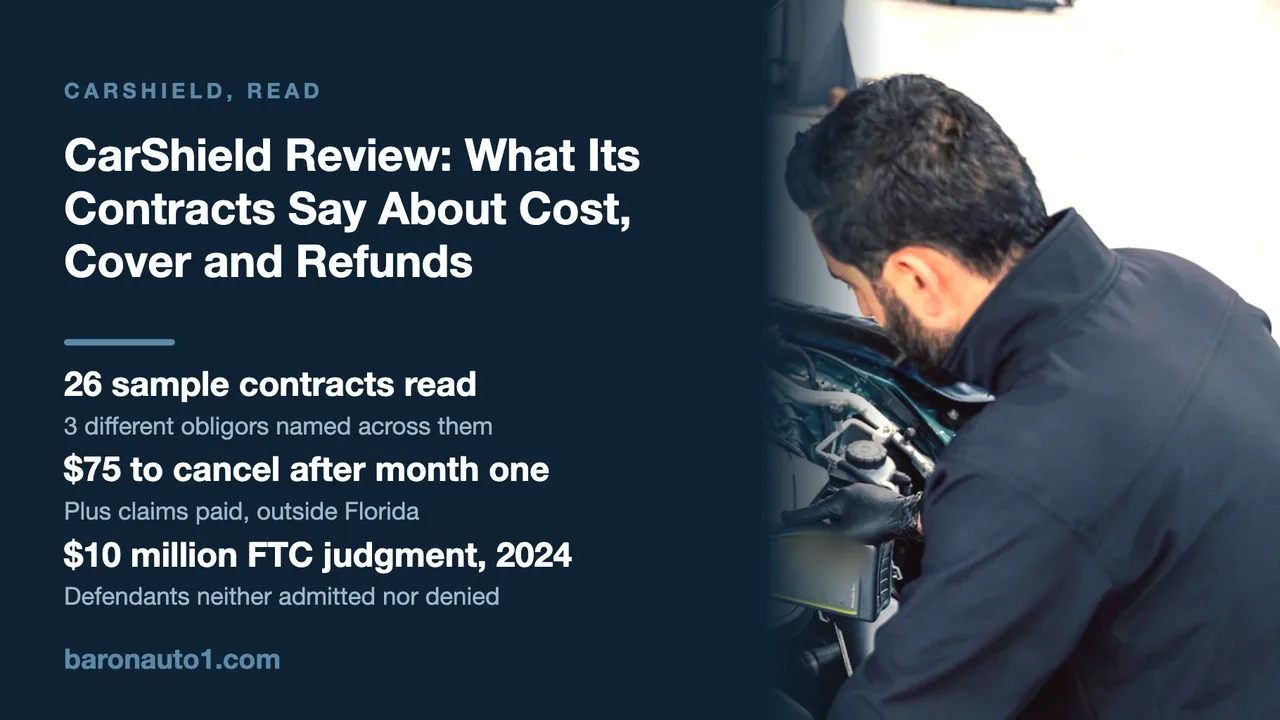
CarShield sells the contract; on its 12 car contracts outside Florida, American Auto Shield, Ltd owes the repair, and Florida buyers get a different obligor. What all 26 sample contracts say about the waiting period, the $75 cancel fee and what each plan covers, beside the FTC’s 2024 order and BBB counts.
The short version
- CarShield sells the contract; it does not owe you the repair. On the 12 car contracts it publishes for states other than Florida, the company that owes the repair and decides the claim is American Auto Shield, Ltd, which CarShield calls “a CarShield company.” Florida buyers get a different obligor depending on how they pay.
- No CarShield page prints a price. Every sample contract shows $0.00 and a blank deductible. The only public figure is the FTC’s: its 2024 complaint said month-to-month plans cost approximately $80 to $120 a month.
- Cover does not start on day one. Term contracts begin paying after 30 days and 1,000 miles, or 90 days and 200 miles. Breakdowns in that window are excluded as pre-existing.
- CarShield’s plan page promises “no cancellation penalties.” The contracts outside Florida print a $75 cancel fee, taken from any refund after the first month along with claims paid.
- In 2024 CarShield and American Auto Shield agreed to a $10 million judgment to settle FTC charges of deceptive advertising, without admitting or denying them. In December 2025 the FTC began sending 168,179 refund checks totalling more than $9.6 million.
- CarShield has been BBB-accredited since 29 March 2024 and is rated A+. BBB shows 2,437 complaints against it in three years, and 563 more against American Auto Shield.
CarShield is a real company selling real contracts, and whether one is worth buying depends almost entirely on what the contract says, not on the advertising. On 6 October 2026 we read all 26 sample contracts CarShield links from its own site, its plan page, FAQ, claims page and Terms & Legal page. We also read the Federal Trade Commission’s complaint, the signed court order and the FTC’s refund notices, and BBB’s public counts for CarShield and American Auto Shield. We requested no quote, and this site has no commercial relationship with CarShield or any other seller of service contracts.
Who owes you the repair: the seller, the obligor and the insurer
A vehicle service contract has three roles that buyers tend to blur together, and the first page of every CarShield contract separates them. The seller is the company you bought from. The obligor is the company that owes the repair. The contract defines the obligor as the party “responsible for meeting the obligations provided to perform under this CONTRACT.” The administrator handles claims and cancellations. Some contracts add a fourth party: an insurer that stands behind the obligor if it fails to pay. Our guide to who owes you the repair explains why that last name matters most.
On every CarShield sample the seller is printed as CARSHIELD. CarShield is the trade name of NRRM, LLC, a Missouri-based company that BBB lists as a “Marketer of Vehicle Service Plans.” Who sits in the other boxes depends on your state and on whether you pay by the month or for a fixed term:
| Sample contracts | How many | Obligor and claims administrator | Insurer named behind it |
|---|---|---|---|
| Car and EV plans, term or monthly, outside Florida | 12 | American Auto Shield, Ltd | None |
| Motorcycle and ATV (monthly) | 2 | American Auto Shield, Ltd. | American Bankers Insurance Company of Florida |
| Florida term contracts | 6 | American Auto Shield, Inc (FL Company Code: 14044) | American Bankers Insurance Company of Florida |
| Florida monthly contracts | 6 | Liberty STF, Inc (FL Company Code: 11947) | None |
Three things follow. First, CarShield is not the company you would claim against if a repair went unpaid. The obligor is “WE, US, OUR” in the contract, and the administrator is “who YOU contact for all BREAKDOWNS, CONTRACT cancellation requests and any other questions.”
Second, the two companies are close. CarShield’s FAQ says it “administers its own vehicle service contracts through American Auto Shield, a CarShield company,” not “an unrelated third-party administrator.” The FTC’s 2024 complaint put it the other way round: CarShield sells “on behalf of” American Auto Shield, which “determines the ‘coverage’ provided.” An earlier version of this page called American Auto Shield a separate company; on CarShield’s current description it is part of the same group.
Third, only 8 of the 26 samples name an insurer. On those, if the obligor fails to pay “within sixty (60) days after YOU request performance or payment, YOU may apply directly to the Insurer.” The other 18, including every car contract sold outside Florida, name none. States usually require some form of backing, often set out in a state endorsement, but none of the samples includes one. Ask for your state’s version and look the obligor up in your state’s service contract register before you pay.
Even the administrator’s name shifts: American Auto Shield, Ltd on contracts outside Florida, American Auto Shield, Inc on Florida term contracts, American Auto Shield, LLC in the FTC case and on BBB. CarShield’s footer gives a Florida Company Code of W111454, which appears on none of the samples. We cannot tell whether these are one company or several, which is why you check the name on your own declarations page.
The CarShield plans, and what each one actually covers
CarShield sells five car plans, an electric-vehicle plan and motorcycle and ATV contracts. Each car plan is published in four editions: Term, Monthly, Term (Florida) and Monthly (Florida). The plan page describes them in marketing terms. The contracts describe them in two very different ways. Diamond is exclusionary: it covers everything except a list. The others are listed-component contracts: they cover only the parts they name.
| Plan | CarShield’s label | How the term contract defines cover | Check marks in CarShield’s 21-row table |
|---|---|---|---|
| Diamond | Best coverage | “All components of the VEHICLE, EXCEPT” 52 listed entries, by our count | 21 |
| Platinum | Extensive | 15 named system groups, each with an “includes” and a “does not include” list | 21 |
| Gold Select | Powertrain plus | 8 groups: engine, transmission, turbocharger, cooling, transfer unit, drive axle, air conditioning, electrical | 10 |
| Silver | Powertrain | 6 groups: engine, transmission, turbocharger, cooling (water pump only), transfer unit, drive axle | 5 |
| Aluminum | Specialty coverage | 10 groups, none of them the engine or transmission | 17 |
| Platinum EV with Battery Pack | Electric | 11 groups, including the drive unit and the high-voltage battery | Not in the table |
Diamond is the plan CarShield calls “most similar to the manufacturer warranty that accompanies a new car.” The FTC’s complaint quotes American Auto Shield’s own 2019 warning to CarShield that consumers wrongly believed it gave “bumper to bumper” cover. The exclusion list is why: paint and upholstery, the battery and cables, the whole exhaust system, struts and shocks, glass, the clutch friction disc and pressure plate, spark plugs, hoses and belts, and “Any part that the original vehicle manufacturer has provided a replacement, maintenance or limited-service life or replacement interval for.”
Platinum lists 15 groups, each with its own exclusions; the cooling group, for example, covers the radiator and water pump but not coolant hoses. Gold Select, marketed as “great for vehicles with over 100,000 miles,” has a short electrical list (alternator, starter, ignition switch, coil packs, wiper and window motors, door lock actuators) and excludes anything “related to Body Control, Audio/Entertainment Systems, Engine Fuel Control.” Silver is powertrain only; its cooling group covers the water pump but expressly not the radiator. Aluminum covers electrical, steering, brakes, suspension and electronics but, in CarShield’s own table, not the engine, transmission, drive axle or transfer case, so it makes sense only alongside other cover.
The EV plan covers the drive unit and the high-voltage battery, with a separate battery limit of $6,000 a year, including “Excessive Voltage Loss if Battery Capacity falls below 70% of its original charge capacity.” Diamond, Platinum and Aluminum add emissions sensors (not the catalytic converter) and a Luxury Electronics Package, under which screens, cameras and GPS units get “1 (one) replacement or 1 (one) repair per component for the life of the Contract.”
What CarShield does not cover
The general exclusions apply to every plan, Diamond included. These are the ones most likely to decide a claim:
- Anything that broke before cover started. “BREAKDOWNS that occurred prior to the CONTRACT Purchase Date or during the WAITING PERIOD, whether known to YOU or not.”
- Maintenance and wear items, “regardless of when they occur”: 12 are named, including brake pads and rotors, shocks and struts, timing belts, tires, and “Lithium-ion or Hybrid Batteries.”
- Missing maintenance records. “If YOU cannot provide maintenance records, logs, and/or receipts, WE may deny COVERAGE for a BREAKDOWN.” If you do your own oil changes, the contract requires a log with dates, mileage and receipts for supplies.
- Driving after a warning. Damage “caused by CONTINUED OPERATION after a BREAKDOWN/FAILURE” is excluded.
- Anything the carmaker should fix. Breakdowns covered by a recall, technical service bulletin or special policy are excluded, and any warranty or other contract pays first.
- Parts that have not failed, “even if a REPAIR FACILITY has recommended repair or replacement,” and shop supplies, storage, freight and unverifiable labor hours.
- Commercial, rideshare or delivery use, branded titles, lifted trucks and turbo or diesel engines unless the matching surcharge is printed on your declarations page. CarShield’s FAQ says it can cover salvage or branded-title cars for a surcharge; read our guide to salvage titles before buying cover for one.
- Modifications such as tuners, straight-pipe exhausts and snowplows, an altered odometer, and airbags and seat belts on every plan.
Diagnosis can be your bill. The contract says a teardown the administrator requires is at its expense. It separately excludes “the cost of diagnosis, disassembly or assembly of a VEHICLE BREAKDOWN not covered by this CONTRACT, unless requested by US.” The FTC’s complaint alleged that when a claim was denied, consumers were “financially responsible for the cost of this diagnostic work.” Before a shop opens the engine, ask the administrator in writing who pays if the claim is refused.
When cover starts: the waiting period
CarShield’s FAQ says “Your protection begins once your waiting period ends.” The length is printed on each declarations page.
On the term samples, breakdown cover begins after “30 days AND 1,000 miles; OR 90 days AND 200 miles from the Contract Effective Date.” Both conditions in a pair must be met. A car driven a lot is covered from day 30 once it has done 1,000 miles; a car that is barely driven waits until day 90 and 200 miles. Read it by its end points: some cars will wait the full 90 days.
On the monthly samples, the first combination is printed blank (“days AND miles”), and the second is “40 days AND 250 miles.” We checked this on the rendered page, not just the extracted text. Ask what your own declarations page says before you sign.
Three things shorten or remove the wait. Roadside assistance has “No Waiting Period.” The wait is waived if a factory warranty or another service contract is in force when you buy. And on monthly contracts, later months carry no new waiting period as long as each payment arrives within 35 days of expiry. Miss that window and the contract ends. Buying the day after your factory warranty runs out therefore gives you less than buying the day before.
What CarShield costs, and why no page tells you
CarShield prints no price. Its Terms & Legal page says “All of our coverage options require a live conversation with a customer representative in order to start coverage,” and every sample reads “Contract Price: $0.00” with the deductible left blank, plus a second blank deductible for engine or transmission replacement. The price is whatever the phone call produces, which is common in this market; see why service contracts have no sticker price.
The one public figure comes from the regulator. The FTC’s July 2024 complaint said that since 2019 CarShield has mainly sold month-to-month plans costing “approximately $80 to $120 per month, depending on the plan type, vehicle type, and any discounts applied.” By our arithmetic that is $960 to $1,440 a year. It is the FTC’s description, not a CarShield price list, and it is two years old. The complaint also said the sales script promised “just a $100 deductible for any covered repair”; treat that as the FTC’s account of a script, not your deductible.
The other half of cost is the cap on what the contract pays. On the term samples, all claims together are capped at the car’s “Average Retail Value” from a guide the administrator chooses, or a defined amount, “whichever is greater.” On the monthly samples the cap applies “for each one-month contract term” and is a defined amount printed as $0.00. On an older car, a cap tied to its value can be lower than one large repair. Ask for the number, and see how the price splits between seller and administrator.
Monthly or term: two different contracts
CarShield’s plan page says “Most CarShield vehicle protection plans run month-to-month” and “There’s no fixed end date, no long-term commitment.” That is true of the monthly contract, but CarShield also publishes a Term edition of every car plan. A term contract has “Term Months,” “Term Miles” and an expiration date on its declarations page. Ask which one you are being sold.
The monthly contract renews one month at a time, in both directions. It is “optionally renewable on a monthly basis by US or YOU,” the company can give “notice of OUR intent not to renew,” and paying for the next month “constitutes YOUR consent to the most up to date contract Terms and Conditions.” CarShield’s FAQ says “Your rate stays the same, no matter how many claims you file,” but nothing in the contract fixes the price. Keep the declarations page from the month you signed up. Repairs are excluded whenever “YOUR CONTRACT payments are not current,” and the site’s terms say recurring charges are billed in advance.
How a claim works under the contract
Every page of every sample carries the line “NO CLAIMS WILL BE PAID WITHOUT PRIOR AUTHORIZATION.” The process the contract sets out, step by step:
- Stop driving. Damage from continued operation is excluded. Roadside assistance tows the car, capped at $125 per occurrence and four a year, with no deductible.
- Use a shop the administrator will authorize. The contract allows “any licensed automotive REPAIR FACILITY chosen by YOU and is authorized by US.” CarShield says its Shield Repair Network has over 15,000 shops; its FAQ speaks of “ASE-certified” shops, which the contract does not require.
- The shop sends an itemized estimate, and the administrator may ask for maintenance records, a teardown or a third-party inspection, at its expense when it requires them.
- The administrator decides parts and labor. It may approve “new, re-manufactured, or used parts of like kind and quality” and ship them in; if the shop refuses them, you pay the difference. Labor is paid “up to the regional average labor rate, as determined by US.”
- You pay the deductible to the shop, plus anything not approved.
Out of hours, if you cannot reach the administrator and cannot safely drive, the contract reimburses covered repairs without prior authorization up to $500 per occurrence, claimed within 5 business days. Further repairs on the same problem within the longer of 90 days or 1,000 miles count as part of the first claim, under its limits.
The rental benefit is narrower than the ads suggest. It is limited to $60 a day. Diamond and Platinum allow 14 days for an engine or transmission replacement and 7 for anything else; the other plans allow 7. By our arithmetic the most it can pay is $840 for one engine or transmission job and $420 for any other repair. It covers only days the car is at the shop for a covered repair, and not days lost to “REPAIR FACILITY scheduling conflicts or delays.” Trip interruption pays up to $125 a day for four days of lodging and meals, $500 per breakdown, if the car is stuck more than 100 miles from home.
If a claim is refused, the contract offers a review: an online form within 90 days of the decision, with contact “no later than three (3) business days.” After that, disputes go to binding arbitration through the BBB in Denver, Colorado, before a single arbitrator. You waive class actions and jury trials, the companies “shall not pay YOUR attorney’s fees,” and any lawsuit belongs in Jefferson County, Colorado. On the five non-Florida term samples the arbitration paragraph stops mid-sentence at the foot of a page. The monthly and Florida samples print it in full.
How to cancel CarShield, what you get back, and selling the car
CarShield’s FAQ answers “How do I cancel my coverage?” with a phone number. The contract gives you more options. You can cancel “by contacting the ADMINISTRATOR, in writing” at its Lakewood, Colorado address, by phone, “or as otherwise required by law.” Write, keep a copy, and note the date and odometer reading. On a monthly contract you can also stop paying: missing a renewal payment by 35 days is “a valid and automatic termination,” and the contract says “no written notice of YOUR termination will be provided by US.” The FTC’s complaint alleged that callers who phoned to cancel were routed to a “retention” department that tried to “rebut” their reasons. A written request avoids that conversation.
| Contract | Cancel early | Cancel later |
|---|---|---|
| Term, outside Florida | Within 1 month and no claim: full refund | Pro rata by the greater of time or miles used, less claims paid, less the $75 cancel fee |
| Monthly, outside Florida | Within the first month and no claim: that month’s payment back | Pro rata for days left in the current month, less claims paid, less the $75 cancel fee |
| Florida, term or monthly | Within 60 days and no claim: full refund less a 5% administrative fee | 90% of the pro rata amount, less claims paid; no $75 fee in the endorsement |
Those terms sit oddly beside CarShield’s plan page, which promises “no cancellation penalties.” The $75 is printed as “Cancel Fee” on every non-Florida declarations page, and on a monthly contract it can wipe out the part-month refund entirely. Every sample also says a state “Individual State Variance Requirements” endorsement overrides these rules, and none includes one. See cancellation rights and how to cancel an extended warranty.
The administrator can cancel too, immediately, for non-payment, for misrepresentation when you bought or claimed, or if the car is found to be modified in a way the manufacturer does not recommend. In those cases the refund follows the pro rata formula.
Selling the car. CarShield’s plan page says “Many of our car protection plans are transferable.” The contract allows a transfer to a private buyer of the same car “With OUR approval,” which “may be declined for any reason.” It costs $50 ($40 in Florida, where a notarized bill of sale is also required). It must be requested within 30 days and completed within 45 days of the sale, with the odometer reading and your last maintenance receipts. It cannot go to a dealer or a dealer’s customer. The FAQ’s “Absolutely!” to moving coverage to a new car describes cancelling one contract and starting another; the contract itself “may not be transferred to another VEHICLE.”
The FTC case: what was alleged and what the order requires
The “CarShield lawsuit” people search for is Federal Trade Commission v. NRRM, LLC, also dba CarShield, and American Auto Shield, LLC, No. 4:24-cv-01055-HEA in the United States District Court for the Eastern District of Missouri (FTC matter 2223031). The FTC filed its complaint on 31 July 2024, together with a stipulated order the defendants had already signed. The Commission voted 5-0 to file. The signed order was filed on 17 September 2024 as docket entry 10. The FTC’s case page lists it under 20 September 2024 and, as of its last update on 11 December 2025, still shows the case status as “Pending.”
What the FTC alleged: that the advertising and telemarketing represented that all repairs, or all repairs to “covered” systems, would be paid; that a rental car came at no cost; and that buyers could use any repair facility. In the FTC’s words, “none of CarShield’s VSCs covers all repairs or even repairs to ‘covered’ vehicle systems.” It also alleged that celebrity endorsers shown as customers had never used the contracts, that one advertisement aired at least 18,000 times, and that the contract arrives after payment as “a dense, 25- to 30-page document”; the car samples we read run 23 to 31 PDF pages. It said American Auto Shield earned over $1 billion selling contracts from September 2019 to November 2022, with CarShield generating about 80% of its sales.
What the order says: “Defendants neither admit nor deny any of the allegations in the Complaint, except as specifically stated in this Order.” It enters a judgment of $10,000,000 against both companies, jointly and severally, payable within 7 days. It bars the misrepresentations described in the complaint and misrepresentations about any endorser’s use of a product. It requires American Auto Shield to give the order to every seller of its contracts within 7 days and to monitor their marketing. It imposes record-keeping for 10 years and compliance reporting the FTC describes as lasting up to 10 years. The FTC thanked the Missouri Attorney General’s Office for its help.
On 11 December 2025 the FTC announced it was sending 168,179 checks totalling more than $9.6 million. The checks went to people who paid CarShield for a contract between September 2019 and September 2024 and had a claim denied, and were to be cashed within 90 days. By our arithmetic that is about 96% of the judgment and an average of at least $57 a check.
The complaint also lists earlier actions we have not read in the original: a Missouri Consent Judgment and Permanent Injunction since 26 November 2012, a Georgia Letter of Understanding since 7 July 2021, and BBB “alerts” in 2021. We found references to private lawsuits naming NRRM, LLC but did not read their dockets, so we do not describe them.
Telemarketed warranty offers are a separate problem from CarShield. In 2022 the FTC sued American Vehicle Protection Corp., a Florida seller it alleged had falsely claimed to be connected to consumers’ carmakers or dealers and had promised bumper-to-bumper cover that was much more limited than represented. Orders in March 2023 and that July banned the defendants from selling extended auto warranties and from outbound telemarketing, and in 2024 the FTC sent more than $449,000 in refunds. See what regulators have done across this market.
CarShield reviews and complaints: what the counts show
CarShield’s reputation figures depend on where you look. These are the public BBB numbers on 6 October 2026, for the seller and for the administrator that decides claims:
| BBB measure | CarShield (NRRM, LLC) | American Auto Shield, LLC |
|---|---|---|
| Rating and accreditation | A+, accredited since 3/29/2024 | A+, not accredited |
| Business started (BBB) | 1/12/2005 | 1/14/2002 |
| Complaints in 3 years | 2,437 (742 closed in the last 12 months) | 563 (128 closed in the last 12 months) |
| Largest complaint type | Order Issues, 1,595 (65.4%) | Service or Repair Issues, 423 (75.1%) |
| Marked resolved | 620 (25.4%) | 222 (39.4%) |
| Customer reviews | 3.31 of 5, from 3,392 reviews | Not recorded here |
Read these with BBB’s own cautions. Its letter grade does not use customer reviews, and it asks readers to weigh complaints against “the company’s size and volume of transactions.” CarShield sells at national scale, and a complaint is one customer’s account, not a finding. The split between the two profiles is still telling. Most complaints about the seller are filed under BBB’s “Order Issues” type; most about the administrator under “Service or Repair Issues,” which is where claim decisions land. A buyer reading only CarShield’s profile misses most of the claim complaints.
CarShield’s home page shows its own badges, a 4.3 Google rating from 14,929 reviews and “50,000+ reviews from Google, TrustPilot, and Customer Lobby.” We did not check those platforms. CarShield also says it has protected “3 MILLION+” vehicles on its home page and “over two million vehicles” on its Customer Commitment page, both read the same day.
Is CarShield worth it, and how to compare it with another contract
Whether any service contract is worth buying depends on the car, its repair risk and what you could pay from savings. Our guide to when an extended warranty is worth it works through that. For CarShield specifically, the case for it is access: it sells month-to-month cover with no long commitment, including plans it markets for cars over 100,000 miles. The case against it is in the contract: a waiting period, exclusions that bite on older cars, payments that must stay current, administrator control of parts and labor rates, and a cap that may be tied to the car’s value.
People ask whether there is a better company than CarShield. We do not rank sellers. The useful comparison is contract against contract, on the same questions, using the actual form each seller will issue for your state. Our page on Endurance reads another direct-marketed contract the same way. In California CarShield does not sell service contracts at all; its site says it “may refer a licensed CA Mechanical Breakdown Insurer.” See mechanical breakdown insurance, the insurance alternative. Our CARCHEX review applies the same questions to the 24 sample contracts CARCHEX publishes.
- Get the contract for your state before you pay, including the “Individual State Variance Requirements” endorsement the samples refer to but leave out.
- Read the obligor’s name on the declarations page and look it up in your state’s service contract or insurance register.
- Find out whether an insurer stands behind the obligor, and how you claim from it if the obligor does not pay.
- Write down the waiting period in days and miles, and confirm whether it is waived because a factory warranty is still running.
- Ask for the deductible, the engine and transmission deductible, the monthly price and the limit of liability as numbers, in writing.
- Ask whether it is a term or monthly contract and what happens to the price on renewal.
- Check that your mechanic will accept the contract, the administrator’s labor rate and shipped-in parts before you need a repair.
- Keep every maintenance receipt with date, mileage and VIN, or a log if you do the work yourself.
- Know the cancellation formula, including the $75 fee outside Florida, and cancel in writing.
Common questions
Is CarShield legit?
Yes, it is a real company selling real contracts, BBB-accredited since 29 March 2024 and rated A+. It is also the company that agreed in 2024 to a $10 million judgment to settle FTC charges of deceptive advertising, without admitting or denying them. Judge it by the contract you would sign, not by the ad.
How do I cancel my CarShield contract?
Write to the administrator named on your declarations page, or call the number on the contract. Within the first month and with no claim, you get a full refund. After that, outside Florida, the refund is pro rata, less claims paid and a $75 cancel fee. Florida samples refund in full less 5% within 60 days, then 90% of the pro rata amount. A monthly contract also ends if a payment is 35 days late.
What does CarShield Platinum coverage cover?
The Platinum contract lists 15 groups: engine, transmission, cooling, transfer unit, drive axle, electrical, steering, air conditioning, suspension, brakes, electronic high-tech, fuel system, turbocharger or supercharger, audio and emissions. Each has its own “does not include” list, and only named parts are covered.
What does CarShield not cover?
On every plan: faults that began before cover or during the waiting period, maintenance and wear items, damage from driving after a warning, recall repairs, parts that have not failed, airbags and seat belts, and breakdowns where you cannot show maintenance records. Even Diamond excludes 52 listed entries by our count.
How much does CarShield cost per month?
CarShield publishes no price. The FTC’s 2024 complaint said its month-to-month plans cost approximately $80 to $120 a month, or $960 to $1,440 a year by our arithmetic, before any deductible.
Is there a better company than CarShield?
We do not rank sellers. Compare contracts: the obligor and any insurer behind it, the waiting period, the price and deductibles in writing, the limit of liability, the parts and labor clauses, and the cancellation formula, using each seller’s contract for your state.
Sources and further reading
- FTC: auto service contracts and warranties
- FTC consumer alert — auto service contracts and extended warranty scams
- FTC — suit against robocallers pushing vehicle warranty extensions
- FTC: a businessperson’s guide to federal warranty law
- 15 U.S.C. § 2301 (Magnuson-Moss definitions)
- Texas Department of Licensing and Regulation — service contract providers, Occupations Code Chapter 1304
- Florida CFO — motor vehicle service agreements, Chapter 634
- FTC v. American Vehicle Protection Corporation — case docket
- FTC — industry ban and judgment, American Vehicle Protection
- FTC — refunds paid to consumers harmed by an extended vehicle warranty scheme
Recall, complaint and safety-rating figures on this page were retrieved from the federal databases above on August 19, 2026. Federal data changes — re-check any VIN before you rely on it.
Published September 11, 2026 · last updated October 6, 2026. Found something out of date or wrong? Tell us and we will correct it.