CARCHEX Review: Who Owes the Repair and What Its Contracts Say
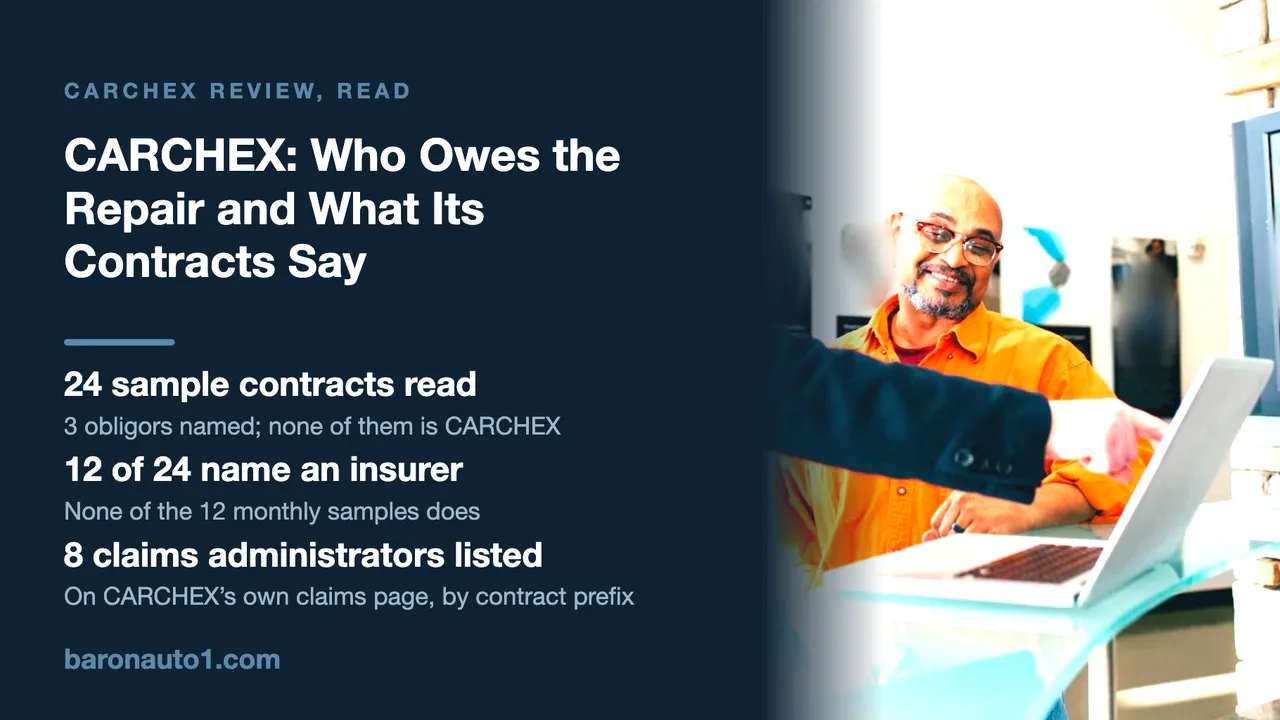
CARCHEX sells the contract; American Auto Shield owes the repair on 18 of its 24 sample contracts, and only the 12 term samples name an insurer. What the contracts say about waiting periods, refunds and transfers, beside CARCHEX's own claims and a 2020 federal court opinion.
The short version
- CARCHEX sells the contract; it does not owe you the repair. On its 24 sample contracts, the obligor is American Auto Shield, Ltd outside Florida, and American Auto Shield, Inc or Liberty STF, Inc in Florida.
- Whether an insurer stands behind the contract depends on how you pay. All 12 term samples name American Bankers Insurance Company of Florida; none of the 12 monthly samples names any insurer.
- Cover does not start on day one. Term samples outside Florida print a wait of 90 days and 200 miles, with the first option left blank; monthly samples print 40 days and 250 miles.
- CARCHEX advertises a 30-day money-back guarantee. The contracts refund in full within 30 days only if no claim has been made; after that, pro rata less claims paid and a $75 cancel fee outside Florida.
- CARCHEX calls its plans “fully transferable.” The contracts say a transfer needs the administrator’s approval, which “may be declined for any reason.”
- In 2020 a federal court in Maryland let parts of a 2019 class action against CARCHEX go forward at the motion-to-dismiss stage. We found no FTC or state attorney-general action naming CARCHEX, and no CFPB complaints under its name.
CARCHEX is a Maryland company that sells vehicle service contracts, often called extended car warranties, by phone and online. It is a seller, not the company that pays for your repair, and what matters is printed on the contract. On 9 October 2026 we read all 24 sample contracts linked from CARCHEX’s Plan Coverages page, its benefits, FAQ, claims and about pages, and its Website Terms of Use (last updated 11/2/2023). We also read an older sample agreement on CARCHEX’s content domain, the two published opinions in a 2019 federal class action against the company, and the CFPB’s complaint database. CARCHEX’s terms prohibit “unauthorized hypertext links” to its site, so its documents are named here, not linked. We requested no quote, and this site has no commercial relationship with CARCHEX or any seller of service contracts.
Who owes you the repair on a CARCHEX contract
A service contract has a seller, an obligor and an administrator, and sometimes an insurer behind the obligor. The obligor is the party “responsible for meeting the obligations” under the contract: the company that owes you the repair. The administrator handles claims and cancellations. Our guide to who owes you the repair explains why the obligor matters most. On all 24 CARCHEX samples the seller is CARCHEX; the obligor changes with your state and how you pay:
| Sample contracts | How many | Obligor and claims administrator | Insurer named behind it | Labor rate paid |
|---|---|---|---|---|
| Term, outside Florida | 6 | American Auto Shield, Ltd | American Bankers Insurance Company of Florida | Up to the shop’s posted rate |
| Monthly, outside Florida | 6 | American Auto Shield, Ltd | None | Up to the shop’s posted rate |
| Term, Florida | 6 | American Auto Shield, Inc (FL Company Code: 14044) | American Bankers Insurance Company of Florida | Up to a regional average |
| Monthly, Florida | 6 | Liberty STF, Inc (FL Company Code: 11947) | None | Up to a regional average |
CARCHEX is not the party you would claim against. The administrator is “who YOU contact for all BREAKDOWNS” and cancellations, and every sample points to Lakewood, Colorado, not to CARCHEX in Maryland. A federal court said the same in 2020: “the ‘obligor’ in the VSC is AAS, not CarChex.”
The insurer depends on how you pay. On the 12 term samples, if the obligor fails to pay “within sixty (60) days” of your request, you may apply directly to American Bankers Insurance Company of Florida. The 12 monthly samples name no insurer, although CARCHEX’s older FAQ page calls the claims reserve accounts “fully insured by highly rated carriers.” Look the obligor up on your state’s service contract register and ask what backs a monthly plan.
The website footer names a different company. The footer on every carchex.com page we read says vehicle service contracts are “provided by Liberty STF, Inc,” with a Florida Company Code of W469753. Liberty STF appears on only 6 of the 24 samples, the Florida monthly ones, and there under code 11947. The code W469753 appears on none of the 24. The other 18 name American Auto Shield. The name that counts is the one on your own declarations page.
The administrator is the one CarShield calls its own. The American Auto Shield samples use the same declarations codes as the samples CarShield publishes, which we read on 6 October 2026 for our CarShield review, and CarShield’s FAQ says it administers its contracts “through American Auto Shield, a CarShield company.” So a CARCHEX buyer outside Florida holds a contract owed by a company another seller calls part of its group. The printed terms still differ in places; see the comparison near the end.
If you already have a CARCHEX contract: check the prefix
CARCHEX says it has sold service contracts since 2004, and not all of them were written by American Auto Shield. Its How to File a Claim page lists 8 claims administrators, each matched to the first characters of a contract number:
| If your contract number starts with | The claims administrator CARCHEX lists |
|---|---|
| ABC | American Auto Shield |
| SDR1 | American Guardian Warranty Services |
| 801 or 802 | Assurant Solution |
| 9005 | Enterprise Financial Group |
| BAA | National Administration Services Co. |
| 137, 491, 611, 642, 734, 820, RAD or SAD | Royal Administration Services |
| CX | The Warranty Group |
| PV | Zurich |
The phone numbers are on CARCHEX’s page and your contract. Terms change with the administrator, and two older samples on CARCHEX’s content domain show how much. A sample agreement on form UC1387-1012, a file dated 2013 to 2015, names United Service Protection Corp., “an Assurant Solutions Company,” as administrator and obligor. A Zurich specimen, form M46640KV (10/20), which this site coded on 7 September 2026 for our Zurich extended warranty page, names Universal Underwriters Service Corporation, with a 10-day waiting period, no cancellation fee and no transfer to a new owner. If you hold an older contract, read that contract, not this page’s summary of the current samples.
The six CARCHEX plans and what each one covers
CARCHEX’s Plan Coverages page lists six plans, each in four editions: Term, Monthly, Term (Florida) and Monthly (Florida). Titanium is exclusionary: it covers everything except a list. The other five are listed-component contracts that cover only the parts they name, group by group, each group with its own exclusions. Several plans carry a different name in the contract than on the page.
| Name on CARCHEX’s page | Name printed in the contract | How the contract defines cover |
|---|---|---|
| Titanium | CARCHEX CARE TITANIUM | All components except 52 listed entries and a catch-all, by our count |
| Platinum | CARCHEX CARE PLATINUM | 15 named system groups |
| Powertrain Plus | GOLD SELECT (CARCHEX CARE GOLD SELECT in Florida) | 8 groups: engine, transmission, turbocharger, cooling, transfer unit, drive axle, air conditioning, electrical |
| Powertrain | CARCHEX CARE POWERTRAIN (POWERTRAIN SILVER in Florida) | 6 groups: engine, transmission, turbocharger, cooling, transfer unit, drive axle |
| Extra Care | CARCHEX CARE EXTRA | 10 groups, none of them the engine or transmission |
| EV | CARCHEX CARE ELECTRIC VEHICLE AND BATTERY PACK | 10 groups plus a separately capped high-voltage battery section |
Titanium. CARCHEX’s page calls it the plan most similar to factory coverage, with “only a short list of excluded items.” The contract’s list has 52 entries by our count, including the battery and cables, the exhaust system, brake pads and rotors, struts and shocks, glass, spark plugs, hoses and belts and the clutch disc. A catch-all then excludes any part the carmaker gives a replacement, maintenance or limited-service interval, which can reach parts a buyer would not call wear items.
Platinum names 15 groups, from engine and transmission to brakes, suspension, fuel system, audio and emissions; its cooling group covers the radiator and water pump but not coolant hoses.
Powertrain Plus is printed GOLD SELECT in the contract. Its electrical group is short (alternator, starter, ignition switch, coil packs, wiper, window and door lock motors, a few switches) and excludes anything related to “Body Control, Audio/Entertainment Systems, Engine Fuel Control.” A plan sold as “Powertrain Plus (Gold)” is the one in the 2019 lawsuit described below.
Powertrain covers six powertrain groups. Its cooling group covers only the water pump, its gasket and housing; the radiator, thermostat and cooling fan are listed as not covered. Extra Care covers 10 groups such as electrical, steering, suspension and brakes, but not the engine or transmission.
EV covers the electric drive unit and nine other groups, plus a high-voltage battery section capped at $6,000.00 a year from the contract’s effective date. That section covers “Excessive Voltage Loss if Battery Capacity falls below 70% of its original charge capacity.” Titanium and Platinum add an emissions package, which excludes the catalytic converter, and a Luxury Electronics Package for screens and cameras; Extra Care and the EV term contract add the electronics package only, limited to one replacement or one repair per component for the life of the contract.
Not every car qualifies. The contracts exclude any vehicle missing from the administrator’s “Rate and Class Guide,” naming motorhomes, motorcycles, recreational vehicles and exotic vehicles, and promise a full refund if one was sold by mistake.
What every CARCHEX contract excludes
These general exclusions apply to every plan, Titanium included:
- Anything that broke before cover started. Pre-existing conditions are defined as breakdowns that happened before the purchase date “or during the WAITING PERIOD.”
- Maintenance and wear items, whenever they occur. The non-EV contracts name 11, including brake pads and rotors, shocks and struts, timing belts, tune-ups and lithium-ion or hybrid batteries.
- Missing maintenance records. Without records, logs or receipts, the administrator “may deny COVERAGE.” Do-it-yourself servicing needs a dated log and receipts.
- Gradual wear. Loss of performance from normal use is excluded unless a part is worn beyond the maker’s tolerance, naming valve guides, valves, piston rings and transmission clutch packs.
- Driving after a breakdown can leave the additional damage uncovered.
- Anything the carmaker should fix. Breakdowns covered by a recall, technical service bulletin or special policy are excluded, and a factory warranty or other contract pays first.
- Parts that have not failed, even if a shop recommends replacing them, plus shop supplies, storage and labor hours a labor guide cannot verify.
- Uses and equipment that need a surcharge. Commercial, agricultural, rideshare and delivery use, branded titles, lift kits, diesel and turbo engines and four-wheel drive are excluded unless the surcharge is paid and printed on your declarations page. See our guide to salvage and branded titles.
- Odometer problems, airbags and seat belts. A car whose true mileage cannot be determined is excluded, and so are failures of airbags, seat belts and restraint systems on every plan.
A teardown can become your bill. The contract says a teardown the administrator requires is “at OUR expense.” It also excludes “the cost of diagnosis, disassembly or assembly” of a breakdown the contract does not cover. Before a shop opens an engine, ask the administrator in writing who pays if the claim is refused.
When cover starts: the waiting period
Every CARCHEX sample prints a waiting period on its declarations page. Breakdown cover starts only after the car has passed both a number of days and a number of miles from the contract’s effective date, and any breakdown in that window is excluded as pre-existing. Roadside assistance has “No Waiting Period.” What the samples print:
- Term, outside Florida: the first days-and-miles pair is printed blank (“days AND miles”); the second is 90 days and 200 miles.
- Monthly, outside Florida and in Florida: the first pair is blank; the second is 40 days and 250 miles.
- Term, Florida: 30 days and 1,000 miles, or 90 days and 200 miles.
Both conditions in a pair must be met. On the Florida term samples, a car driven a lot is covered from day 30 once it has done 1,000 miles; a car barely driven waits until day 90 and 200 miles. Outside Florida the first pair is blank, so ask what yours will print.
The wait is waived if a factory warranty or another service contract is in force on the day you buy, so buying before a factory warranty expires gives you more. On monthly contracts, later months carry no new waiting period if each payment arrives within 30 days of expiry outside Florida, or within 35 days in Florida.
What CARCHEX costs, and why no page says
CARCHEX prints no price. Every sample reads “Contract Price: $0.00” or “Monthly Contract Price: $0.00,” with blank deductibles, including a separate one for engine or transmission replacement. The FAQ says each covered repair visit requires a deductible and offers payment plans “with no credit check.” Getting a figure means filling in the quote form, and the Terms of Use say that submitting it gives “EXPRESS CONSENT TO RECEIVE TELEPHONE CALLS” from CARCHEX, call centers and third parties. Our guide to why service contracts have no sticker price explains what drives the number you are quoted.
CARCHEX promotes a “No Haggle, Low Price, Every Day Guarantee.” Its own Terms of Use say it does not guarantee that terms or rates offered through the site “will be the best or lowest terms or rates available in the market.” The FAQ says CARCHEX sells “the very same” plans dealerships sell, so compare a dealer quote line by line. See how the price splits between seller and administrator.
The other half of cost is the cap on what the contract pays. On the term samples, all claims together are capped at the car’s “Average Retail Value” from a guide the administrator uses, or a defined amount printed as $0.00, “whichever is greater.” On the monthly samples the cap applies to “each one-month contract term” and is a defined amount printed as $0.00. On an older car that cap can be smaller than one large repair; see how the cap changes the arithmetic.
On monthly contracts, paying for a new month “constitutes consent to the most up to date contract terms and conditions,” and the administrator can decline to renew on written notice. Keep your first declarations page.
How a claim works, and where the repair can be done
Every page of every sample carries the line “NO CLAIMS WILL BE PAID WITHOUT PRIOR AUTHORIZATION.” The contract’s sequence:
- Stop driving and get the car to a shop. Damage from continued operation can go uncovered. Roadside assistance tows the car, up to $125 per occurrence, with no deductible.
- The shop sends a written estimate to the administrator, which may ask for maintenance records and may require a teardown or a third-party inspection, at its own expense.
- The administrator confirms cover and issues a claim number. If the administrator and the shop disagree, the contract reserves the right, “after consulting with YOU,” to move your car to a different shop.
- Parts: the administrator may approve new, re-manufactured or used parts “of like kind and quality” and may ship them in. If you choose the shop’s parts instead, the approved amount is credited and any difference is yours.
- You pay the deductible to the shop. CARCHEX’s claims page says the shop is paid by credit card once the repair is done.
Where you can take the car. CARCHEX’s claims page says its plans are accepted “at any licensed repair facility nationwide”; its benefits page mentions over 30,000. The contract is narrower: a facility “chosen by YOU and is authorized by US.”
What the shop gets paid for labor depends on your edition. The 12 samples outside Florida authorize labor “up to the REPAIR FACILITY’S posted labor rate,” with hours from a national labor guide. The 12 Florida samples pay “up to the regional average labor rate” and let the administrator cut a rate it considers excessive, which can leave you paying the difference.
After hours, if you cannot reach the administrator or drive safely, covered repairs without prior approval are reimbursed up to $500 per occurrence, claimed within 5 business days. A shop’s own parts must carry a warranty of at least 12 months or 12,000 miles, whichever is less.

Rental and trip benefits have limits the benefits page does not spell out. Rental is limited to $60 a day. Titanium and Platinum allow 14 days for an engine or transmission replacement and 7 for anything else; the other plans allow 7. By our arithmetic the most the benefit can pay is $840 for one engine or transmission job and $420 for any other repair. It excludes days lost to “REPAIR FACILITY scheduling conflicts or delays.” Two editions of the rental clause circulate in the same set. On 4 of the 24 samples (the Titanium, Platinum, Powertrain and Extra Care term contracts outside Florida), rental starts only when the repair takes 4 or more hours of authorized labor. The other 20 allow rental “on a case-by-case basis” even during the initial assessment, if a covered breakdown looks more likely than not. Trip interruption pays up to $125 a day for 4 days of lodging and meals, $500 per breakdown, if the car is stuck more than 100 miles from home.
Cancelling, refunds, the 30-day guarantee and selling the car
CARCHEX’s benefits page offers a “risk-free, 30-day Money Back Guarantee”: a full refund if you contact CARCHEX within 30 days, “for any reason.” A footnote says refund methods vary by state. The contracts are tighter:
| Contract | Cancel early | Cancel later |
|---|---|---|
| Term, outside Florida | Within 30 days and no claim made: full refund | Pro rata by the greater of time or miles used, less claims paid, less the $75 cancel fee |
| Monthly, outside Florida | Within the first month and no claim made: that month’s payment back | Pro rata for the days left in the current month, less claims paid, less the $75 cancel fee |
| Term, Florida | Within 60 days and no claim made: full refund less a 5% administrative fee | 90% of the pro rata amount, less claims paid |
| Monthly, Florida | Within 60 days and no claim made: the monthly price paid, less 5% | 90% of the unearned pro rata monthly price, less claims paid |
Three differences matter. The full refund depends on no claim having been made. The contract says to cancel by writing to the administrator, not CARCHEX; Florida contracts also accept a phone call. And in Florida an early cancellation still costs 5%, and a later one keeps 10% of the pro rata amount by our arithmetic. Florida declarations pages still print a $75.00 cancel fee “unless otherwise specified” in a state endorsement, while the Florida cancellation endorsement uses the 5% and 90% terms and mentions no $75. Ask which applies before you sign.
A monthly contract also ends if a renewal payment is 45 days late outside Florida, or 35 days in Florida. Write anyway, with the date and odometer reading. One unusual clause outside Florida: a refund you do not accept or cash within 90 days is applied to extend your coverage instead. The administrator can also cancel immediately for misrepresentation, modifications the carmaker does not recommend or, on term contracts, non-payment. See cancellation rights and how to cancel an extended warranty.
Selling the car. CARCHEX’s FAQ answers “Absolutely” to whether its plans transfer, calling them “fully transferable for a fee (usually $50),” or $40 for Florida residents. The contract makes the transfer conditional: “Approval of transfers is at OUR discretion and may be declined for any reason.” Outside Florida the request must come within 30 days of the sale and be completed within 45, with the odometer reading and your last maintenance receipts. In Florida the fee is $40 and a notarized bill of sale signed by both parties is required. A contract cannot move to a dealer, a dealer’s customer or another car.
Disputes, arbitration and the 2020 court opinions
If a claim is refused, the contract offers a review by American Auto Shield: an online form within 90 days, with contact “no later than three (3) business days” after. Then disputes go to binding arbitration through the Better Business Bureau in Denver, Colorado; any lawsuit belongs in Jefferson County, Colorado. You waive class actions and jury trials, the companies will not pay your attorney’s fees, and CARCHEX is a third-party beneficiary of that clause. CARCHEX’s website terms have their own arbitration clause, in Maryland, but say a separate agreement such as your contract controls where they conflict.
The one court record we found and read is Rosedale v. CarChex, LLC, et al., No. 1:19-cv-02780-SAG, in the United States District Court for the District of Maryland, against CARCHEX and National Auto Inspections, LLC. A Pennsylvania buyer who bought a “Powertrain Plus (Gold)” contract from CARCHEX in 2018 filed a class action alleging consumer protection violations, fraud, negligent misrepresentation and unjust enrichment after an engine claim was denied. Both published opinions rule on motions to dismiss: they take the allegations as true for that purpose and make no findings.
- 2 March 2020 (Document 21): the court granted the motion in part and denied it in part. The consumer protection claim went forward; the class allegations and the other claims were dismissed without prejudice, and the plaintiff could seek leave to amend. Among the allegations the court summarised: that CARCHEX “falsely assures consumers” its obligations are insured by American Bankers Insurance.
- 19 November 2020 (Document 37): on the amended complaint, the court held that statements such as having “an A plus rating with the Better Business Bureau” were puffery, but that one statement was pleaded with enough particularity: a sales representative’s alleged statement that the contract “protects big ticket items, like your internally lubricated parts in the engine.” It noted the defendants’ point that the contract text does cover internally lubricated engine parts, and that “the ‘obligor’ in the VSC is AAS, not CarChex.” It dismissed the proposed Maryland class and the negligent misrepresentation claim, and let the Pennsylvania class allegations and the remaining claims proceed.
The court added that the defendants “may ultimately be able to establish” that CARCHEX could not know which claims American Auto Shield, LLC would deny. We did not read the docket after November 2020, so its later history is not described here.
CARCHEX complaints, regulators and the FTC
CFPB. On 9 October 2026 we queried the CFPB’s public complaint database for complaints whose company is CARCHEX, American Auto Shield or Liberty STF. All four searches returned 0, while a control search on a lender returned results. That says little on its own: the database covers financial products, service contract sellers are rarely the company named, complaints are unverified consumer reports, and counts scale with size.
BBB. CARCHEX says on its about page that it has “an A+ Rating and Accreditation with the Better Business Bureau.” BBB’s site blocked our request on 9 October 2026, so we have not checked that claim or counted complaints there.
Regulators. Searches of the FTC’s, CFPB’s and Justice Department’s sites and for state attorney-general releases on 9 October 2026 found no action naming CARCHEX; that is a search result, not a clearance. The closest FTC case names a different seller. In FTC v. NRRM, LLC (CarShield) and American Auto Shield, LLC, No. 4:24-cv-01055-HEA (E.D. Mo.), the defendants agreed in 2024 to a $10 million judgment while they “neither admit nor deny” the FTC’s allegations, as recorded on our CarShield page from the order read on 6 October 2026. The order requires American Auto Shield to give a copy, within 7 days, to each seller of any contract for which it is the administrator or obligor, and the FTC said it must monitor third-party marketers’ advertising. CARCHEX’s samples print American Auto Shield, Ltd, not LLC, and the documents we read do not say whether the order reaches CARCHEX. See what regulators have done.
Is CARCHEX worth it, and how to compare it with another contract
Whether any service contract is worth buying depends on the car, the cap and the price; see when an extended warranty is worth it. Below, CARCHEX’s printed terms sit beside those of another seller using the same administrator outside Florida. Terms only, not prices.
| Term | CARCHEX samples | CarShield samples |
|---|---|---|
| Waiting period, term contracts | First pair blank; or 90 days and 200 miles | 30 days and 1,000 miles; or 90 days and 200 miles |
| Insurer named, term contracts | American Bankers Insurance Company of Florida | None |
| Labor rate paid | Up to the shop’s posted rate | Up to a regional average rate |
| Monthly: no new wait if renewal paid within | 30 days | 35 days |
| Monthly: contract ends if payment missed by | 45 days | 35 days |
| Full refund window, term contracts | 30 days, no claim made | 1 month, no claim made |
| Cancel fee and transfer fee | $75 and $50 | $75 and $50 |
On term contracts the CARCHEX samples name an insurer and pay labor up to the shop’s posted rate; the CarShield samples do neither. The blank waiting-period pair cannot be compared until you see your own declarations page. Run the same exercise on any quote, and on other contracts we have read, such as Endurance. CARCHEX does not operate in California and says it may refer buyers to a licensed insurer; see mechanical breakdown insurance in California. Buying a used car? A pre-purchase inspection comes first.
- Get the obligor’s name in writing and check it against your state’s register.
- Ask whether an insurer is named. On the samples, term contracts name one and monthly contracts do not.
- Ask what the first waiting-period pair will say. The samples outside Florida leave it blank.
- Get the deductible, the price and the limit of liability. All three are blank or $0.00 on the samples.
- Read the plan’s own coverage list under the name the contract prints.
- Get the shop and repair authorized before any teardown.
- Cancel in writing to the administrator and keep a copy with the date and odometer reading; cash any refund within 90 days.
- Request a transfer early when selling: it needs approval and has a 30-day deadline.
Common questions
Who is the administrator for CARCHEX warranties?
On the 24 sample contracts CARCHEX links today, American Auto Shield, Ltd is the obligor and claims administrator outside Florida. In Florida it is American Auto Shield, Inc on term contracts and Liberty STF, Inc on monthly ones. Older contracts may differ: CARCHEX’s claims page lists 8 administrators by contract-number prefix.
Is CARCHEX legit?
CARCHEX is a real Maryland seller that says it has offered service contracts since 2004; its samples name an administrator and, on term contracts, an insurer. We found no FTC or state attorney-general action naming it and no CFPB complaints under its name. A 2019 class action over how a powertrain contract was sold partly survived motions to dismiss in 2020; we did not read its later history. Judge the contract you are offered.
How do I cancel a CARCHEX extended warranty?
The contracts say to cancel by contacting the administrator in writing at its Lakewood, Colorado address; Florida contracts also allow a phone call. Outside Florida, a term contract cancelled within 30 days with no claim is refunded in full; later, pro rata less claims paid and a $75 fee.
Is a CARCHEX plan transferable when I sell my car?
CARCHEX’s FAQ says yes, for a fee of usually $50, or $40 in Florida. The contract says a transfer needs the administrator’s approval, which may be declined for any reason, must be requested within 30 days of the sale, and can go only to a private buyer of the same car, never to a dealer.
Does CARCHEX have a waiting period?
Yes. Term samples outside Florida print 90 days and 200 miles, with the first option left blank; monthly samples print 40 days and 250 miles; Florida term samples print 30 days and 1,000 miles, or 90 days and 200 miles. The wait is waived if a factory warranty or another service contract is in force when you buy.
What does CARCHEX Titanium cover?
Titanium is the exclusionary plan: the contract covers all components except a list of 52 entries, by our count, plus any part the carmaker gives a replacement or maintenance interval. Excluded items include brake pads and rotors, the battery, the exhaust system, struts and shocks, glass, spark plugs, hoses and belts. The general exclusions apply too.
Sources and further reading
- FTC: auto service contracts and warranties
- FTC consumer alert — auto service contracts and extended warranty scams
- FTC: a businessperson’s guide to federal warranty law
- 15 U.S.C. § 2301 (Magnuson-Moss definitions)
- Texas Department of Licensing and Regulation — service contract providers, Occupations Code Chapter 1304
- Florida CFO — motor vehicle service agreements, Chapter 634
- CFPB consumer complaint database
Recall, complaint and safety-rating figures on this page were retrieved from the federal databases above on August 19, 2026. Federal data changes — re-check any VIN before you rely on it.
Published October 9, 2026 · last updated October 9, 2026. Found something out of date or wrong? Tell us and we will correct it.