Fifth Third Auto Loan: Dealer Loans, Discounts, Payoff and Title
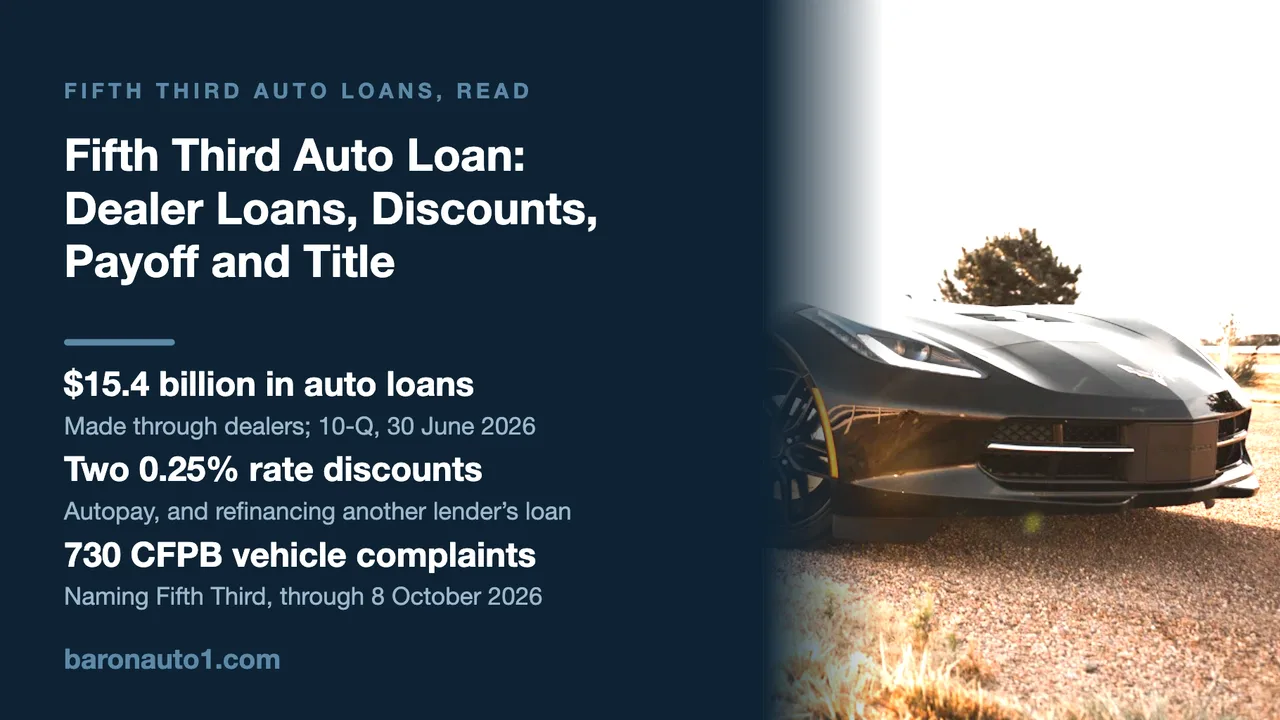
Fifth Third's car loans in its own words and filings: dealer-arranged lending with no printed rate, two 0.25% discounts, daily simple interest, lien release within 10 business days, a $15.4 billion auto book, the CFPB's 2015 markup and 2024 force-placed insurance orders, and 730 CFPB complaints.
The short version
- Fifth Third’s car lending is built around dealers. Its auto page, read on 9 October 2026, tells buyers to “ask your dealership if they participate in our lending program,” and its filings call the $15.4 billion auto book (30 June 2026) indirect lending.
- No auto rate, loan amount, term limit or fee is printed on Fifth Third’s auto pages, and there is no online application link. Refinancing goes through a branch or an appointment.
- Two standing discounts are printed: 0.25% off for paying from a Fifth Third checking account with Automatic Payments, and 0.25% off for refinancing a loan from another lender. Clients with $100,000 at the bank are promised unquantified “Preferred rates on Direct Auto Loans.”
- The loans use daily simple interest, so paying after the due date costs you. After payoff, Fifth Third says it releases the lien within 10 business days.
- In July 2024 the CFPB ordered a $5 million penalty and redress over Fifth Third’s former force-placed car insurance program, finding 1,005 repossessions tied to duplicative coverage. A 2015 order capped how far dealers could mark up its rates.
- The CFPB database holds 730 vehicle loan or lease complaints naming “FIFTH THIRD FINANCIAL CORPORATION” through 8 October 2026; 120 arrived in 2025 and 116 in 2026 to that date.
Can you get a Fifth Third auto loan, and on what terms? Usually at a car dealership that sends your application to Fifth Third, or through a branch if you want to refinance. Fifth Third’s Auto Loans and Financing page, read on 9 October 2026, prints two 0.25% discounts but no rate. We read that page, the bank’s loan FAQ, payment assistance, calculator and Preferred Checking pages, Fifth Third Bancorp’s June 2026 10-Q and 10-K reports for 2023 to 2025, the CFPB’s enforcement records naming the bank, and CFPB complaint counts. We applied for nothing, and this site has no commercial relationship with Fifth Third or any lender.
How Fifth Third auto financing works
Fifth Third’s auto page opens with a sales line, “Apply for a Fifth Third auto loan today,” but offers no place to do it. On 9 October 2026 the page showed no apply button, no rate and no loan limits. What it did show was one instruction for buyers and one for refinancers:
- Buying from a dealer. “Simply ask your dealership if they participate in our lending program.” The page covers new and used cars alike, and the contract is written at the dealership.
- Refinancing. “Refinancing options are also available to lower your interest rates and reduce current payments.” Fifth Third’s car loan calculator page adds the route: “Questions about refinancing your existing vehicle loan? Visit a branch or schedule an appointment.” Our refinancing guide covers when that pays.
- Direct loans. The only page we found naming them is Fifth Third’s Preferred Checking page, whose footnotes offer “Exclusive Preferred rates on Direct Auto Loans” to clients who keep $100,000 with the bank. The CFPB’s 2024 consent order also says Fifth Third “extends automobile loans directly to consumers, including through its more than 1,000 full-service branches”.
The filings put the weight on the dealer side. Fifth Third Bancorp’s 2025 10-K says “Indirect lending activities include extending loans to consumers through automobile dealers,” along with motorcycle, powersport, RV and boat dealers, and its June 2026 10-Q counts the $15.4 billion of automobile loans in that indirect portfolio.
| Route | How you get it | Rate printed | Limits printed |
|---|---|---|---|
| Dealer purchase, new or used | Ask the dealership whether it takes part in Fifth Third’s lending program | None | None |
| Refinance a loan from another lender | Visit a branch or schedule an appointment; no online application linked | None; 0.25% discount for a non-Fifth Third loan | None |
| “Direct Auto Loans” for Preferred clients | Named only in Preferred Checking footnotes; $100,000 across deposit and investment accounts | “Preferred rates”, no figure | None |
| Private seller, lease buyout or auto lease | Not mentioned on any Fifth Third auto page we read | Not applicable | Not applicable |
Fifth Third’s sitemap lists a single personal auto loan page, with no separate refinance, rates or application page. The only condition printed for borrowers is the footer note: “All loans are subject to credit review and approval.”
So the dealer’s finance office, not Fifth Third’s website, is where you will see a rate. To have a number to compare, bring a pre-approval from elsewhere; our pre-approval guide covers what happens at the desk, and credit scores and the buy rate explains how a dealer-arranged rate is set.
Fifth Third auto loan rates: none printed, two discounts
Fifth Third publishes no auto loan rate. None of its auto pages, calculators or FAQs read on 9 October 2026 showed an APR, a range or a rate table, and the page rendered in a browser showed the same. Fifth Third keeps a rates folder on its site, but its robots.txt file disallows that folder for all automated readers, so we did not request it and quote nothing from it. Its calculators, it says, are “provided by a third-party.”
What the auto page does print are two standing discounts:
- “Receive a 0.25% rate discount when your payment is deducted from a Fifth Third checking account, using Automatic Payments.”
- “Receive a 0.25% rate discount when you refinance a non-Fifth Third auto loan.” The calculator page repeats it: “Non-Fifth Third auto loans receive a 0.25% rate discount.”
It adds that “you may be eligible for additional discounts based on your checking relationship,” and that Preferred Checking customers “may be eligible for additional loan benefits.” Fifth Third does not say whether the two can be combined, and prints no base rate to apply them to. Our pages on PNC, U.S. Bank, Huntington and Truist read other banks’ rate pages the same way.
To show what a quarter point is worth we need a starting rate, and Fifth Third gives none. The nearest grounded figure is the 5.53% average yield its June 2026 10-Q reports for the whole indirect book (cars, RVs and boats) in the second quarter of 2026. That is a portfolio average, not an APR or anyone’s quote; we use it only as a reference point for a $30,000 loan over 60 months.
| Rate used | Monthly payment | Total of payments | Interest |
|---|---|---|---|
| 5.53% (Q2 2026 average yield on the indirect book) | $573.45 | $34,407.00 | $4,407.00 |
| 5.28% (one 0.25-point discount) | $569.99 | $34,199.40 | $4,199.40 |
| 5.03% (both discounts, if they combined) | $566.55 | $33,993.00 | $3,993.00 |
By our arithmetic one discount saves $3.46 a month, or $207.60 over the loan; two would save $6.90 a month and $414.00. Small, but the autopay discount costs nothing if you already bank there. The rate itself matters far more; see how the term moves the rate.
Preferred rates. Fifth Third’s Preferred Checking footnotes promise “Exclusive Preferred rates on Direct Auto Loans” and other loans. To get them a customer “must be eligible for premium tier benefits at the time of loan account opening,” which means holding $100,000 across deposit and investment accounts; below that, the account carries a $25 monthly fee. Neither page says how large the Preferred rate advantage is.
Where Fifth Third lends, and what the Comerica merger changed
Fifth Third’s auto pages print no list of states, and its dealer network is not mapped anywhere we read. The filings describe the branch footprint:
- End of 2025. The 2025 10-K: 1,130 full-service banking centers “in Ohio, Kentucky, Indiana, Michigan, Illinois, Florida, Tennessee, West Virginia, Georgia, North Carolina, South Carolina and Alabama.”
- The merger. The June 2026 10-Q: “On February 1, 2026, Fifth Third Bancorp closed the merger with Comerica Incorporated in an all-stock transaction valued at approximately $12.7 billion.” Comerica had 351 banking centers “primarily located in Michigan, Texas and California,” and its two banks were merged into Fifth Third Bank, National Association the same day.
- Mid-2026. The same 10-Q: 1,500 full-service banking centers “in fifteen states throughout its retail footprint,” 370 more than at the end of 2025 by our count. It does not name the fifteen states.
What does the merger mean for car loans? The filings do not say. The 10-Q reports $4.1 billion of consumer loans acquired with Comerica without breaking them out, and the indirect book moved only from $17,964 million to $18,186 million between December and June. Fifth Third’s Comerica Welcome Center answers no auto loan questions.
Paying a Fifth Third auto loan: daily simple interest and autopay
Fifth Third’s auto FAQ lists four ways to pay: the mobile app, online banking, by phone, and by mail with a check or money order “made out to Fifth Third Bank, National Association.” Take the mailing address from your statement; Fifth Third uses separate addresses for payments and third-party payoffs. Automatic payments are set up in the app or online banking under the loan account, and paying that way from a Fifth Third checking account is what earns the 0.25% discount.
The interest method matters more. Fifth Third calls it “daily simple interest”: “It is calculated by multiplying the outstanding principal balance of your loan each day by the daily interest rate (the annual rate divided by the number of days in the year).” Its own example is a $500 payment due on the 5th of every month for 48 months:
- Pay $500 on the 5th every month and the last payment is $500.
- “If you pay later than the 5th of the month for any payment, the additional interest accrued will be collected first from your monthly payment,” so less goes to principal, and the final payment can be larger than expected.
- Pay more than the amount due and you cut the total interest, because each day’s interest runs on a lower balance.
To put a number on it: on a $30,000 balance at the 5.53% reference rate, one day’s interest is about $4.55, so paying 10 days late shifts about $45.45 from principal to interest (our arithmetic). The auto page makes the same point in reverse: “Or, pay the same car loan payment amount and pay off your loan sooner.” Our guide to how interest accrues on a car loan walks through the mechanics.
Behind on payments: what Fifth Third offers
Fifth Third’s Payment Assistance page has an “Auto Loan Assistance” panel: “We understand that life can impact your ability to make auto loan payments.” It lists five options:
- Repayment plans
- Short-term customer assistance
- Long-term customer assistance
- FEMA Disaster Assistance
- Settlements
None is described further; the page says to call the Payment Assistance Team to find out what you may qualify for. Online, the customer service FAQ gives a self-serve route: log in, “Select your auto loan, personal loan or credit card. Click ‘Hardship Assistance’ and follow the prompts.” The auto FAQ adds that you can message the bank around the clock through online banking or the app.
Fifth Third’s pages disagree on when its people answer. The auto FAQ gives the hardship line Saturday morning hours; the Payment Assistance page says the team is available Monday through Friday only. The customer service page prints two different sets of hours for the same main line, one in its Call Us panel and another in its FAQ. If a deadline is close, use the secure message in online banking, which Fifth Third says is open 24/7, and keep a copy.
Fifth Third’s 10-K says these loans are “generally placed on nonaccrual status” at 90 days past due. That is an accounting rule, not a repossession timetable. Our guide to what to do before a repossession covers the rights that apply whoever holds the loan.
Fifth Third auto loan payoff, lien release and the title
Getting a payoff. The auto FAQ says payoff details are “available in your account summary” in the mobile app or online banking, or by phone. The customer service page adds that “You may request a payoff letter by using the messaging function within online and mobile banking.” With daily interest, a payoff figure holds only for its stated date.
The lien release. “Fifth Third releases all vehicle liens within 10 business days of payoff.” What you receive depends on how the title is held:
- If Fifth Third held a paper title, you get the title back with the lien released.
- If you hold the title yourself, Fifth Third sends a release of lien to keep with it.
- If the lien is electronic with your state, you get “a letter with further instructions specific to your state’s process.”
- If you moved to another state and never transferred the car with Fifth Third, “your title and release is processed based on your prior state’s titling requirements.”
Two warnings follow. Updating your address with Fifth Third “does not update your address with the Department of Motor Vehicles (DMV),” and a stale DMV address can stop the title reaching you. And converting an electronic title to paper “may take 30 days or longer for your DMV to process the change.”
Lost the paperwork? To reissue a lien release Fifth Third asks for the VIN, the year, make and model, the state where the car was last titled, and the name on the title. Our guide to liens explains what a later buyer will want to see.
Refunds after payoff. Fifth Third’s FAQ says paying off early may entitle you to a full or partial refund of Guaranteed Asset Protection (GAP) coverage and of optional service or maintenance contracts “if you have transferred ownership or experienced a total loss on the vehicle.” It sends you to “the seller (most often, the dealer who sold you the vehicle)” to claim it. See cancelling GAP and getting the unused premium back.
Total loss. The auto page carries a Vehicle Loss Claims form for owners and insurers; owners also email the settlement breakdown and vehicle valuation to an address on the page. “A Fifth Third representative will reach out to you in 2 to 3 business days.”
Keep your insurance on file: the 2024 force-placed insurance order
“Typically, when borrowers obtained a Loan from Fifth Third, borrowers signed agreements that required them to maintain insurance” against physical damage to the car, the CFPB found. If that coverage lapsed, the bank could buy a policy and add the cost to the loan. On 9 July 2024 the CFPB issued a consent order, File No. 2024-CFPB-0006, against Fifth Third Bank, N.A. over how it did that. Fifth Third agreed to it “without admitting or denying any of the findings of fact or conclusions of law,” except those establishing jurisdiction. The order’s findings, in its own figures:
- Cost. “Under Fifth Third’s FPI program, the cost of an FPI policy was between 13% and 14% of the outstanding balance of the Loan,” an average annual premium of $1,703 to $1,847, adding “an average of nearly $200” to monthly payments. The cover protected only the car up to the loan balance; “it does not include liability or no-fault insurance.”
- Duplicates. Fifth Third placed 32,283 policies on cars whose owners “had always maintained the requisite insurance” and 5,493 where the owner got insurance within 30 days of a lapse; “over 37,000 times” in all from 2011 through 2019.
- Repossessions. Despite delinquencies “being caused by Fifth Third’s charging for duplicative and unnecessary FPI premiums, Fifth Third repossessed consumers’ vehicles in 1,005 cases.” Borrowers paid over $12.7 million in premiums and fees for policies later cancelled, and instead of refunding that money directly, Fifth Third applied it to their loan balances.
- Notices and timelines. Updated coupon books showing the higher payment sometimes arrived too late, and about 8,500 of those borrowers were reported delinquent and charged late fees. Staff told borrowers to “allow 30 days for resolution,” when cancellation “could be done in two to four days.” About 2,000 borrowers who paid the amount in an incorrect right-to-cure letter “did not cure their defaults.”
- Proof. One vendor’s system cut notice addresses to 25 characters, leaving out details “such as apartment numbers.” For another, which accepted a declarations page, the policy or a letter from the insurer, “insurance cards and binders were not acceptable forms of proof”; it wanted the insured’s name, the car, the VIN, carrier, policy number, comprehensive and collision coverage, dates, and the lienholder’s name and address.
The order required Fifth Third to pay redress and a $5 million penalty, and it runs for 5 years from its effective date. The CFPB lists its status as “Post Order/Post Judgment.” The order says Fifth Third “ended its FPI program in January 2019,” and Fifth Third’s 8-K calls it “a since-discontinued program”. The CFPB’s press release counted about 35,000 harmed consumers, “including about 1,000 who had their cars repossessed,” and $20 million in penalties across this order and a separate fake-accounts settlement.
The lesson outlasts the program: whenever you change insurers, send the lender the full declarations page listing the lienholder, not just an insurance card, and keep proof you sent it.
At the dealer: the 2015 markup order and other records
When a dealer arranges a loan, two rates can exist: the lender’s buy rate and the rate on your contract. On 28 September 2015 the CFPB, after a joint investigation with the Justice Department’s Civil Rights Division, entered a consent order against Fifth Third Bank over the gap between them (File No. 2015-CFPB-0024). It said Fifth Third had a policy that “provides dealers discretion to mark up a consumer’s interest rate above Respondent’s established risk-based buy rate,” and that it “compensates dealers from the increased interest revenue.” Fifth Third consented “without admitting or denying any of the findings of fact or conclusions of law.” The order found:
- “During the Relevant Period, Respondent limited the dealer markup to 175-250 basis points with variation based on term, geography, and time period.” The CFPB’s release put it as markups of “as much as 2.5 percent.”
- African-American borrowers paid about 35 basis points, and Hispanic borrowers about 36 basis points, more in dealer markup than similarly situated non-Hispanic white borrowers. The release said thousands of minority borrowers were charged, on average, “over $200 more for their auto loans.”
- At the time Fifth Third was “the ninth largest depository auto loan lender in the United States,” with a 1.3 percent share of originations.
The order required $18 million in redress and a new dealer pay policy. Under one option, dealer discretion was capped at 125 basis points for contracts of 60 months or less and 100 basis points for longer ones; the order also allowed a move to non-discretionary compensation. The CFPB “did not assess penalties against Fifth Third because of the proactive steps the company is taking.” The order ran for 3 years and the CFPB lists it as “Expired/Terminated/Dismissed.” Its action page now opens with a note that on 22 April 2026 the Bureau amended Regulation B to state that the Equal Credit Opportunity Act “does not authorize disparate-impact liability.”
A markup is negotiable; an outside pre-approval helps you spot one. The CFPB’s page on dealer-arranged and bank financing explains the mechanism.
The other records. The CFPB’s enforcement index lists 4 actions with Fifth Third in the title; two concern auto loans (the 2015 and 2024 orders above). The others are a 2015 order over credit card add-on products (2015-CFPB-0025) and a lawsuit the CFPB filed on 9 March 2020 over accounts opened without consent. The court entered the settlement on 18 July 2024; Fifth Third’s 8-K says it agreed to a $15 million penalty and redress for checking, savings and credit card accounts opened from 2010 to 2016. Neither concerns car loans. Fifth Third’s 10-Q also says it “has been cooperating with investigations by a number of state attorneys general regarding consumer solar lending,” not auto lending. We could not reach the OCC’s enforcement search and read no state attorney-general action over Fifth Third’s car loans, so we say nothing about either.
What Fifth Third Bancorp’s 10-K and 10-Q say about its auto loans
Fifth Third reports car loans inside a broader class it calls “indirect secured consumer loans”, which also holds RV, boat, motorcycle and powersport loans made through dealers. The narrative paragraphs give the car-only balance; the credit tables cover the whole class.
| Date | Automobile loans | Whole indirect book | Lent above the car’s value (LTV over 100%) | 30 to 89 days past due | Net charge-offs |
|---|---|---|---|---|---|
| 31 Dec 2023 | $11.9 billion | Not transcribed | Not transcribed | Not transcribed | $72 million (0.45%), 2023 |
| 31 Dec 2024 | $13.3 billion | $16,313 million | 27.5% | 0.80% | $90 million (0.57%), 2024 |
| 31 Dec 2025 | $15.1 billion | $17,964 million | 27.9% | 0.72% | $82 million (0.47%), 2025 |
| 30 Jun 2026 | $15.4 billion | $18,186 million | 28.8% | 0.59% | $42 million (0.47% annualized), first half |
Growth. Automobile loans rose from $11.9 billion at the end of 2023 to $15.4 billion at 30 June 2026, up $3.5 billion or 29.4% by our arithmetic, and made up 84.6% of the indirect book by mid-2026. The 2025 10-K credits “higher indirect automobile loan production due to strong industry sales volume.”
Who borrows. At 30 June 2026, 82% of the indirect book had a FICO score of 720 or higher at origination and 1% had 659 or lower. That describes who got loans, not the score you need, which Fifth Third does not publish.
Lending more than the car is worth. This is the line buyers should read. The 10-Q says “It is a common industry practice to advance on these types of loans an amount in excess of the collateral value due to the inclusion of negative equity trade-in, maintenance/warranty products, taxes, title and other fees paid at closing.” At 30 June 2026, $5,230 million of the $18,186 million book, 28.8% by our arithmetic, started with a loan-to-value above 100%, averaging 110.2%. Those loans produced $20 million of net charge-offs in the first half of 2026. If a dealer offers to roll an old balance or add-ons into your loan, our guide to rolling over negative equity shows what it costs.
Credit quality. At 30 June 2026, $108 million was 30 to 89 days past due and $62 million was nonperforming (0.34% of the book). Net charge-offs on the class were $42 million in the first half of 2026, 0.47% annualized; recoveries covered 44.7% of gross charge-offs by our arithmetic. The allowance for losses was $321 million, 1.77% of the class.
Yield. The class earned an average 5.53% in the second quarter of 2026 and 5.62% across 2025, up from 4.31% in 2023. These are portfolio averages, not offers.
Securitization. In August 2023 Fifth Third “transferred $1.74 billion in aggregate automobile loans to a bankruptcy remote trust which subsequently issued approximately $1.58 billion of asset-backed notes, of which approximately $79 million were retained by the Bancorp.” Fifth Third still consolidates the trust; the loans left in it had run down to $358 million by 30 June 2026, 2.0% of the book.
CFPB complaints about Fifth Third auto loans
The CFPB’s complaint database spells the company “FIFTH THIRD FINANCIAL CORPORATION.” Through 8 October 2026 it held 730 vehicle loan or lease complaints under that name, the earliest received on 25 April 2017: 720 about loans, 9 about leases and 1 about a title loan. Complaints are unverified consumer reports, not findings, and a lender with a bigger book draws more of them. The CFPB no longer publishes complaint narratives, so we counted only.
- Managing the loan: 307 complaints (42.1%). The largest single sub-issue is “Billing problem” with 205 (28.1%), which fits the daily-interest and payment questions above.
- End of the loan: 162 (22.2%), including 75 (10.3%) about being unable to get the title or another problem after payoff.
- Repossession: 64 (8.8%). Getting a loan: 62 (8.5%). Struggling to pay: 61 (8.4%). Incorrect information on a credit report: 40 (5.5%).
The yearly count has risen: 46 in 2023, 77 in 2024 and 120 in 2025, a 55.8% jump in a year by our arithmetic, then 116 in 2026 up to 8 October, 4 short of all of 2025. The data do not say why; Fifth Third’s auto book also grew over the same years. Fifth Third closed 34 vehicle complaints with monetary relief (4.7%) and 85 with non-monetary relief, and the CFPB marks 728 (99.7%) as answered on time. Vehicle loans and leases are 4.7% of the 15,663 complaints naming the company across all products. Comerica, now part of Fifth Third, still appears separately with 3 vehicle complaints.
The CFPB’s auto loan resources cover your options if a problem is not resolved.
Before you sign anything involving Fifth Third
- Ask the dealer who the lender is. Fifth Third’s dealer route depends on the dealership taking part in its program; the contract, not the website, sets your rate.
- Bring an outside quote. Fifth Third prints no rate, so a pre-approval from a credit union or another bank is your only benchmark against the dealer’s offer.
- Ask for the two discounts by name. 0.25% for Automatic Payments from a Fifth Third checking account; 0.25% for refinancing a loan from another lender. Ask whether they combine and get the answer in writing.
- Watch the amount financed. Fifth Third’s own filing says lenders commonly lend above the car’s value to cover negative equity, warranties, taxes and fees; 28.8% of its indirect book started that way.
- Pay on or before the due date. With daily simple interest, late payments go to interest first and can enlarge the final payment.
- Keep insurance proof on file. Send the full declarations page listing the lienholder each time you change insurers, and keep a copy of what you sent.
- Use secure messages for anything with a deadline. Fifth Third’s pages give conflicting phone hours; a message in online banking leaves a record.
- After payoff, check the title. Fifth Third says liens are released within 10 business days; update your address with the DMV too, or the title may not reach you.
Common questions
Does Fifth Third Bank do auto loans?
Yes, mostly through dealers. Its auto page tells buyers to ask a dealership whether it takes part in Fifth Third’s lending program, and its 10-Q shows $15.4 billion of automobile loans made that way at 30 June 2026. Refinancing a loan from another lender goes through a branch or an appointment, with a 0.25% rate discount. The page links no online application.
What are Fifth Third auto loan rates?
Fifth Third does not publish them. Its auto pages, read on 9 October 2026, show no APR or range; the rate comes from the dealer’s contract or a branch quote. The only printed figures are the two 0.25% discounts. For context only, the indirect book earned an average 5.53% in the second quarter of 2026, according to the 10-Q; that is not an offer.
How do I pay my Fifth Third auto loan?
Fifth Third lists the mobile app, online banking, phone, and mail by check or money order made out to Fifth Third Bank, National Association, with your account number on it. Set up Automatic Payments under the loan account online or in the app; paying from a Fifth Third checking account that way earns the 0.25% discount. Use the payment address on your statement.
How long does Fifth Third take to release the lien after payoff?
Fifth Third says it “releases all vehicle liens within 10 business days of payoff.” If it held a paper title, it mails the title back; if you hold the title, it sends a lien release; if the lien is electronic, you get a letter with your state’s steps. A switch from an electronic to a paper title can take your DMV 30 days or longer.
Is Fifth Third Bank a good bank for auto loans?
We do not rank lenders. What the records show: a large, mostly prime dealer-arranged book (82% of the indirect book had a FICO of 720 or higher at origination), no published rates, two small standing discounts, a 2024 CFPB order over its former force-placed insurance program, a 2015 order over dealer markups, and 730 CFPB vehicle complaints. Compare its offer with an outside pre-approval.
How much would I pay monthly for a $30,000 car loan for 60 months?
It depends on the rate, which Fifth Third does not print. At 5.53%, the average yield on Fifth Third’s indirect book in the second quarter of 2026, the payment works out to $573.45 a month and $4,407.00 of interest over the loan; at 5.03%, $566.55 (our arithmetic, not a Fifth Third quote). Every point higher adds to both.
Sources and further reading
- CFPB consumer complaint database
- CFPB auto loan resources
- CFPB: what is the difference between dealer-arranged and bank financing?
- CFPB: how does a lender decide what interest rate to offer me on an auto loan?
- CFPB: what is Guaranteed Asset Protection (GAP)?
- FTC vehicle repossession
- UCC Article 9, part 6 — default (uniform text)
Recall, complaint and safety-rating figures on this page were retrieved from the federal databases above on August 19, 2026. Federal data changes — re-check any VIN before you rely on it.
Published October 9, 2026 · last updated October 9, 2026. Found something out of date or wrong? Tell us and we will correct it.