PNC Auto Loan: Lending Paused, Dated Rates, Payoff and Title
PNC's site says it is not currently offering auto loans, yet it services a $15.9 billion book made mostly through dealers. The rates it last printed (as of 1/26/26), its vehicle limits, payoff and title rules, filings and CFPB complaint counts.
The short version
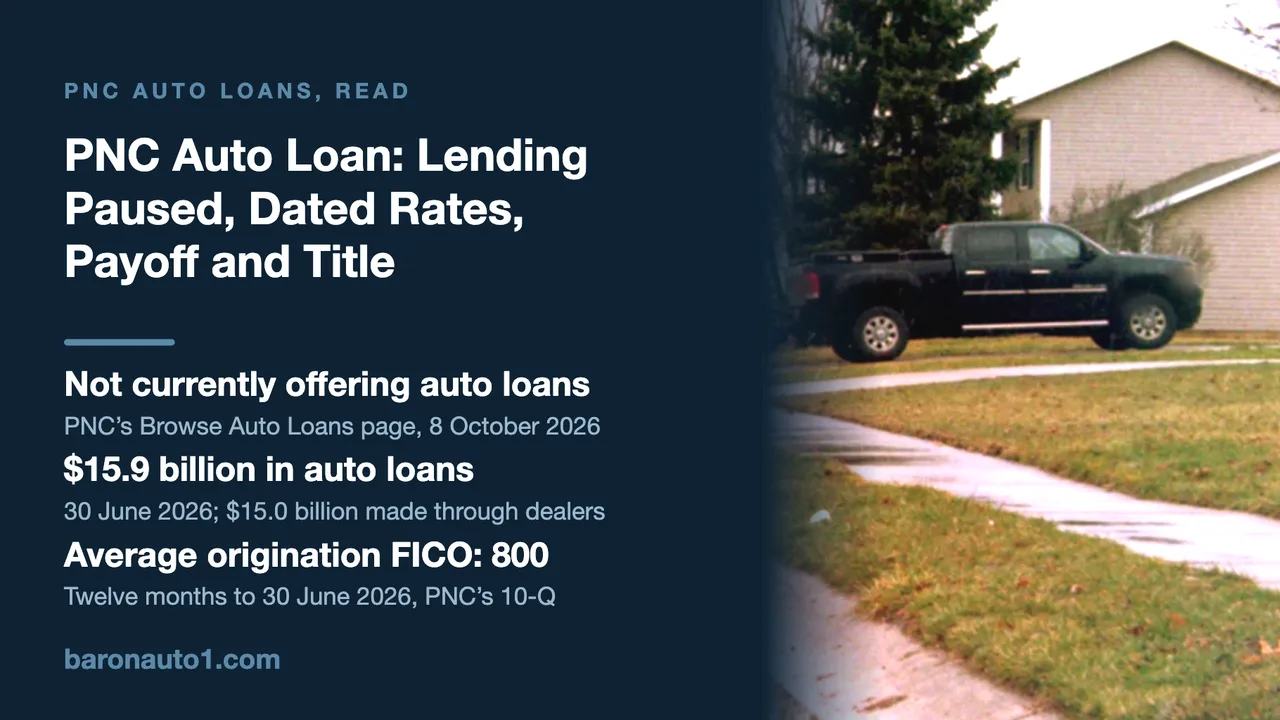
- On 8 October 2026 PNC’s Browse Auto Loans page said: “PNC is not currently offering auto loans, as we are working to improve our suite of offerings.” Its dealer purchase, refinance, lease buyout and private party pages still exist, but none shows a rate, a loan amount or an apply button.
- The only auto rates PNC prints are on a disclosure dated “as of 1/26/26”: purchase APRs from 5.34% to 20.69% and refinance APRs from 5.69% to 23.79%. That was 255 days before our reading, and the figures include a 0.25% discount for automatic payment from a PNC checking account.
- PNC’s printed vehicle limits: a 2018 to 2027 model year, non-commercial vehicle with up to 80,000 miles, or up to 100,000 miles “based on credit qualifications.” No minimum or maximum loan amount, fee amount or longest term is printed on any page we read.
- Most of PNC’s auto lending happens at the dealer. Its June 2026 10-Q puts the auto book at $15.9 billion, of which $15.0 billion is indirect (made through dealers) and $0.9 billion direct, with a weighted-average origination FICO score of 800 and a 72-month average term.
- PNC’s own filings show low losses: 2025 net charge-offs of $36 million, 0.23% of average auto loans, and by our arithmetic 0.49% of the book 30 or more days past due on 30 June 2026.
- The CFPB’s enforcement index returned no action with PNC in its title. Its complaint database holds 754 vehicle loan or lease complaints naming “PNC Bank N.A.”, received from 31 May 2017 to 3 October 2026; 104 of them concern getting the title after payoff.
Can you get a PNC auto loan right now? PNC’s own answer, read on 8 October 2026, is no: its Browse Auto Loans page says it is “not currently offering auto loans” while it makes “enhancements to our auto lending experience.” We read PNC’s auto pages, its auto rates disclosure, its title, payment and hardship pages, the auto lines of The PNC Financial Services Group’s June 2026 10-Q and its 10-K reports, and the CFPB’s records. We applied for nothing and ran no rate check, and this site has no commercial relationship with PNC or any lender.
Is PNC making auto loans right now?
Not through its website, on the day we looked. The Auto Loans hub’s “Get a New Vehicle Loan or Refinance” button leads to the Browse Auto Loans page, which opens with the notice: “PNC is not currently offering auto loans, as we are working to improve our suite of offerings.” Below it PNC adds, “We’re making enhancements to our auto lending experience to better serve our customers.” The notice gives no date it began and no date it will end.
The same page still lists four routes under “Choose Your Loan”: buy from a dealer, refinance, buy out a lease, and buy from a private party. Each leads to general guidance, a calculator link and a phone line, with no rate, loan amount, term, fee or application button. PNC’s old “Check Ready” auto loan address now redirects to the dealer purchase page.
What PNC’s pages and filings still show:
- Servicing. The auto customer service page, title page and hardship page are live, with payment, payoff and lien instructions for existing borrowers.
- A sales line. Each product page says to call 1-888-370-7344, Monday to Friday 8 a.m. to 9 p.m. and weekends 8 a.m. to 5 p.m. ET. The rates disclosure gives the same number to confirm whether a loan “is available in your area.”
- Dealer lending. PNC’s June 2026 10-Q still says, “We offer both new and used auto financing to customers through our various channels,” and its credit tables show $3.1 billion of loans made in 2026 still on the books at 30 June. The filing does not split those 2026 loans between dealers and direct borrowers.
Read any “PNC auto loan rates” page with care. Pages quoting PNC rates, minimum loan amounts or an online “Check Ready” approval describe terms PNC’s site does not show today. PNC’s own printed rates were dated 26 January 2026.
The four loan routes PNC still describes
PNC’s pages describe the same four kinds of car loan most banks offer. What each page says, and what it leaves out:
| Route | What PNC’s page says | Rate, amount or term printed? |
|---|---|---|
| Dealer purchase | For a “new or used car, truck, SUV, or van” from a dealer; budgeting advice (insurance, fuel, maintenance, registration fees and taxes) and a call line | No |
| Refinance | “the replacement of your current auto loan with an entirely new one”; check whether you owe more than the car is worth, its age and mileage, fees and prepayment penalties | No (the disclosure prints a dated refinance APR range) |
| Lease buyout | Paying the purchase price in your lease, “often called the residual value,” plus taxes and fees | No |
| Private party | Financing a car bought from its owner “may require additional documentation related to the vehicle and seller” | No |
| Through a dealer (indirect) | Not described on the consumer pages; PNC’s filings say indirect loans come “primarily through independent franchised dealers” | No consumer terms printed |
PNC’s title page adds a fifth type. Its “Onboarding Steps for Each Loan Type” lists Dealer Purchase, Refinance, Private Party Purchase, Lease Buyout and “Cash Out.” PNC does not define Cash Out there; its only step is that if the title was not given to PNC at closing, you must send it.
PNC’s “Finance a vehicle” calculator (run on a PNC subdomain by the software firm Leadfusion) defines “Purchase” as buying “a new vehicle as an original owner” from a franchised dealer, leaving no choice for a used car from a dealer, though used cars are 58% of PNC’s auto book. It says it “does not assure your eligibility for an auto loan product”; we entered nothing.
If you are refinancing or buying out a lease while PNC’s direct lending is paused, the steps are the same at any lender; see how to shop a refinance, how lease buyouts are financed and where private-party car loans come from.
PNC auto loan rates: the ranges it printed “as of 1/26/26”
PNC’s auto rates disclosure is the only page we found with numbers on it. It says: “Rates, terms and conditions are as of 1/26/26 and subject to change at any time.” On our read date that was 255 days old, by our count, and the Browse Auto Loans page said PNC was not offering new auto loans. Treat the figures below as what PNC last printed, not as a rate anyone can get today.
| What the disclosure says | Auto purchase | Auto refinance |
|---|---|---|
| APR range (“currently range from”) | 5.34% to 20.69% | 5.69% to 23.79% |
| Width of the range (our arithmetic) | 15.35 percentage points | 18.10 percentage points |
| Automatic-payment discount | 0.25% included in the APRs | 0.25% included in the APRs |
| Lowest APR without that discount (our arithmetic) | 5.59% | Not computed |
| Who gets the low end | “well-qualified applicants” | Same |
| Vehicles | 2018 to 2027 model years, non-commercial, up to 80,000 miles (100,000 on credit) | Same |
| Fees printed | None | None |
PNC lists what moves your rate within those bands: “credit qualifications, loan amount, repayment term, model year, automated payment from a PNC checking account and number of days to first payment.” The last means the APR also depends on how soon your first payment falls due. The refinance range starts 0.35 points above the purchase range, by our arithmetic, and runs higher at the top.
The one standing discount: 0.25% for automatic payment
On the pages we read, PNC prints no relationship discount beyond this one: “APRs include a 0.25% discount for automated payment from a PNC checking account.” Three conditions come with it. The automatic payment “must be set up at loan closing”; it must come from a PNC checking account; and if it stops, “your rate will increase 0.25%.”
Because the discount is already inside the printed APRs, the lowest purchase rate without a PNC checking account and autopay would have been 5.59%, not 5.34%. What that is worth, in our arithmetic on $30,000 over 72 months (PNC’s average term):
| APR | Monthly payment | Total of 72 payments | Interest |
|---|---|---|---|
| 5.34% (lowest printed, with autopay discount) | $487.89 | $35,128.08 | $5,128.08 |
| 5.59% (same, without the 0.25% discount) | $491.40 | $35,380.80 | $5,380.80 |
| 20.69% (highest printed purchase APR) | $730.63 | $52,605.36 | $22,605.36 |
The discount was worth $3.51 a month on that loan, or $252.72 over six years. The spread between the bottom and the top of PNC’s own range is far larger: $17,477.28 more interest on the same $30,000 at 20.69% than at 5.34%. Which end you land on depends on your credit; our guide to rate shopping explains how to keep the credit checks inside one short window, and how the loan term changes the price shows what 72 months costs against shorter terms.
Model year, mileage, term and where PNC lends
The vehicle rule is printed twice, on the rates disclosure and in a footnote on the auto customer service page: “Auto Loans to be secured by a 2018-2027 model year non-commercial vehicle with up to 80,000 miles. Based on credit qualifications, the vehicle may have up to 100,000 miles.” Read by its end points: a 2017 model is out whatever its mileage, and a car with more than 80,000 but no more than 100,000 miles is in only if your credit qualifies for the higher cap.
On terms, PNC says only: “Maximum available repayment term may vary by model year.” No page we read prints the longest term, a term table or a minimum or maximum loan amount. The calculator lets you pick 12, 24, 36, 48, 60, 72 or 84 months, but those are calculator choices, not loan terms PNC promises. PNC’s filings report what it actually lent: a weighted-average term of 72 months for loans made in the twelve months to 30 June 2026, and 71 months in each of 2024 and 2025.
Where PNC lends is also loosely drawn on the consumer side: “Auto Loan products are only available to applicants currently residing in an area in which PNC offers auto loans.” No consumer page lists those areas. PNC’s dealer-finance page is more specific about its retail (dealer) financing. It groups its footprint into seven regions (Pacific, Northeast, Midwest, Southeast, South Central, Central and West) and names four “PNC Non-Lending States”: Montana, North Dakota, South Dakota and Wyoming. PNC’s 10-K calls its branch network “coast-to-coast.”
PNC financing at the dealer: the indirect side
Most of PNC’s auto lending runs through dealers. The 10-Q says that at 30 June 2026, “total auto loans of $15.9 billion were comprised of $15.0 billion in the indirect auto portfolio and $0.9 billion in the direct auto portfolio.” By our arithmetic that is 94.3% indirect, up from 92.6% at the end of 2022. PNC describes the indirect book this way: “The indirect auto portfolio consists of loans originated primarily through independent franchised dealers. This business is strategically aligned with our core retail banking business.”
In an indirect loan you sign a retail installment contract with the dealer, and the dealer sells that contract to a lender such as PNC. The rate on your contract is set at the dealer. PNC’s dealer-finance page lists what it offers dealers for this business, including “Special rate promotions,” “Automated credit approval,” “Buy-down and flat programs,” “Extended term financing” and “Customized reserve programs.” Reserve and flat programs are the ways a lender pays a dealer for placing a loan, often as part of the gap between the lender’s rate and the rate on your contract. Our page on the buy rate and dealer markup explains how that works; PNC does not publish its dealer rate sheets.
If a dealer assigns your contract to PNC, the payment, title and hardship pages below are the ones PNC publishes for its auto borrowers. To judge the dealer’s rate, arrive with your own approval from another lender; see using a pre-approval at the finance desk.
Paying a PNC auto loan, and what happens if you cannot
PNC’s auto customer service page lists six ways to pay: Online Banking, the PNC Mobile app, automated payments, Voice Banking by phone, a branch, and mail. Rules worth knowing:
- Branch payments are dated the day you pay, but “it may take up to 2 business days for the payment to be reflected on your account.”
- Automated and recurring payments differ. Automated payments run through PNC’s Automated Payment Program, a “free service” that can take “up to ten (10) business days” to set up; recurring payments are ones you schedule in Online Banking. PNC ties its 0.25% discount to “automated payment” and does not say whether recurring payments count.
- Skipping one automated draft needs notice. You can suspend it for one month if you contact PNC at least three business days before the due date, and you remain “responsible for making your payment on time to avoid late fees.”
- Paying early can leave you without a statement. “If the minimum payment due has already been made for the billing period, currently a statement is not generated.” PNC says it is looking at changing that.
For questions, PNC’s customer care line is 1-888-PNC-BANK (1-888-762-2265), with automated account information around the clock and consultants Monday to Friday 8 a.m. to 9 p.m. and weekends 8 a.m. to 5 p.m. ET. No page we read prints a late fee or a grace period; those are in your contract.
Hardship: an extension of one or two months
PNC’s Lending Hardship page describes one option for auto loans by name: “An extension moves the due date of an auto loan payment to the end of the loan and extends the loan term by one (1) or two (2) months.” The payment moved “can be past due, currently due, or a payment not yet billed.” Interest keeps running, but “you will not be charged fees related to the scheduled non-payment(s),” and your credit is reported “based on the status of your loan when you requested the extension.” That last line matters: ask before you fall behind, not after.
PNC is direct about the stakes: “Not acting could result in the loss of your vehicle, a negative impact on your credit score, or keep you from obtaining financing in the future.” Hardship requests go through PNC’s online application or its line at 1-800-642-6323, and PNC says the options “may not be available” to borrowers in an active bankruptcy. PNC applies Servicemembers Civil Relief Act protections to eligible accounts “including: Auto loans.” For what a lender can do after a default, see our guide to car repossession. PNC’s 10-K says it charges off secured consumer loans “no later than 180 days past due”; that is an accounting rule, not a repossession date.

PNC auto loan payoff, lien release and the title
Payoff starts in Online Banking: PNC’s customer service page says to sign on, choose the loan and “Select View Loan Payoff Quote in the Account Actions section,” adding that “There are some circumstances where payoff information will not be displayed,” in which case you call 1-888-762-2265. Before you pay off, PNC’s Vehicle Title Information page asks you to make sure it has your current address, because the paperwork goes there.
What arrives depends on who holds the title:
- PNC holds a paper title: it “will be mailed with the Paid in Full letter.”
- You hold the title, or PNC never received it: you get only the Paid in Full letter.
- Electronic title: “only a Paid in Full letter will be received, and the PNC lien will be released,” with the final release depending on your state’s motor vehicle department.
Timing, in PNC’s words: “Once the loan is paid off, you will receive a Paid in Full letter within 7 to 10 days at the account address.” If it does not come, PNC points to VehicleTitleMyWay.com, “a service provided by BerkOne,” which can supply a lien satisfaction letter “as soon as 7 business days after the loan is paid in full.” PNC says that letter can stand in for a duplicate title in seven situations, including trading in, selling or donating the car, an insurance claim and a warranty or GAP request. Otherwise, see replacing a lost title when a lien is involved.
The page contradicts itself on one detail. One answer says, “KY, MD, MI, MO and NY are title holding states where you as the customer hold the title document. In other states, PNC holds the title document.” Another, on refinancing, names “KY, MD, MI, MN, MO, MT and NY.” Minnesota and Montana appear only in the second list, and PNC’s dealer-finance page lists Montana among its “PNC Non-Lending States.” If you live in Minnesota or Montana, ask PNC who holds your title before you rely on either list.
Getting PNC onto the title in the first place is the borrower’s job: “Because you are financing your vehicle loan with PNC, you are responsible for listing PNC as the lienholder.” For a dealer purchase, tell the dealer to list PNC, and if the dealer handed you the title, send it to PNC. To check a lien yourself, see how a payoff clears a lien.
GAP refunds after an early payoff
PNC’s title page sends GAP refund questions elsewhere: “You may be entitled to a refund of the unearned portion of GAP charges” if the GAP contract was cancelled or you paid off early, and you should “contact the dealership where you purchased your vehicle or the administrator listed on your GAP contract.” Our guides explain how GAP cancellation works and how refunds are figured.
What PNC’s 10-K and 10-Q say about its auto loans
The PNC Financial Services Group reports “Automobile” as its own consumer loan class, so its filings give a clean picture of the book. We read the auto lines of the 10-Q for the quarter ended 30 June 2026 (filed 5 August 2026), the 2025 10-K (filed 20 February 2026) and the 2023 10-K.
| Date | Auto loans | Indirect / direct | Net charge-offs (ratio) | 30+ days past due, accruing | Nonperforming | Allowance (% of loans) |
|---|---|---|---|---|---|---|
| End of 2022 | $14.8 | $13.7 / $1.1 | $28 (0.18%) | 0.93% | $155 | 1.52% |
| End of 2023 | $14.9 | $13.8 / $1.1 | $21 (0.14%) | 0.79% | $104 | 1.16% |
| End of 2024 | $15.4 | $14.4 / $1.0 | $34 (0.23%) | 0.74% | $86 | 1.04% |
| End of 2025 | $16.6 | $15.6 / $1.0 | $36 (0.23%) | 0.58% | $83 | 0.95% |
| 30 June 2026 | $15.9 | $15.0 / $0.9 | $19 in six months (0.24%, annualized) | 0.49% | $82 | 1.01% |
Three readings stand out. First, the book grew $1,755 million from the end of 2022 to the end of 2025 (11.8%, by our arithmetic), then fell $719 million in the first half of 2026 (4.3%); the 10-Q attributes the drop to “declines in the automobile portfolio as paydowns outpaced originations.” The filing does not mention a pause in lending, and PNC’s website notice gives no start date, so we cannot say whether the two are connected. Second, the direct book, the loans PNC made to borrowers who applied to it, shrank to $0.9 billion, 5.7% of the total. Third, losses are small against the size of the book, and recoveries are large next to charge-offs: in 2025 PNC charged off $130 million gross and recovered $94 million, so recoveries were 72.3% of gross charge-offs by our arithmetic, down from 81.6% in 2022.
The past-due share (accruing loans 30 or more days late) fell at every date we read, from 0.93% to 0.49%; nonperforming loans, counted separately, were $82 million, 0.52% of the book, at 30 June 2026. Used cars were 58% of the book. For the same lines at other banks, see the filings sections of our Wells Fargo, Bank of America and Chase auto loan pages.
Who PNC lends to: an 800 average FICO and 72-month terms
PNC reports the credit profile of the loans it makes. For the twelve months to 30 June 2026, the “weighted-average loan origination FICO score, calculated using the auto enhanced FICO scale, was 800 and the weighted-average term of loan originations was 72 months.” The 2025 figures were 799 and 71 months; 2024’s were 793 and 71 months. The 2023 10-K split them by channel: indirect loans averaged 788 with a 73-month term, direct loans 787 with a 65-month term. An average of 800 on FICO’s auto scale means PNC’s new loans lean heavily toward borrowers with very strong credit; it says nothing about the lowest score PNC accepts, which it does not publish.
The filings also show the whole book by “updated” FICO score, the borrower’s current score rather than the score when the loan was made:
| Updated FICO | Whole book, end of 2025 ($16.6 billion) | Whole book, 30 June 2026 ($15.9 billion) | Loans made in 2026, at 30 June ($3.1 billion) |
|---|---|---|---|
| 780 or higher | 50.2% | 51.0% | 58.9% |
| 720 to 779 | 28.8% | 28.4% | 29.2% |
| 660 to 719 | 13.7% | 13.5% | 10.2% |
| Below 660 | 7.3% | 7.1% | 1.6% |
Loans made in 2026 are the most tightly drawn: 88.2% sat at 720 or higher and 1.6% below 660, by our arithmetic. Young loans tend to look cleaner as scores drift over time, so this shows a direction, not PNC’s cut-off. Loans made in 2026 were 19.5% of the book at 30 June. Of the $60 million PNC charged off gross in the first half of 2026, none came from 2026 loans; the 2025 and 2024 vintages accounted for $18 million and $17 million.
What this means for a shopper: PNC says its displayed rates were “available to well-qualified applicants,” and its book leans heavily toward scores of 780 and up. If your score is lower, get quotes from several lenders before you judge any one. Our guide to the credit score you need to buy a car explains why lenders set no single minimum, and our credit union rate guide shows another source of published rates.
Regulators and CFPB complaints about PNC auto loans
Enforcement. We searched the CFPB’s enforcement actions index for “pnc” on 8 October 2026 and got “Sorry, there were no results based on your filter selections.” A control search for another bank returned results. PNC’s 2025 10-K legal note describes card-interchange antitrust litigation and patent cases brought by USAA; none concerns auto lending, and its paragraph on regulatory inquiries names no auto matter. We could not reach the OCC’s enforcement search from our network, and we read no state attorney-general record, so this page makes no statement about OCC or state actions.
Complaints. The CFPB’s complaint database names the company “PNC Bank N.A.” We pulled counts only, through 7 October 2026. Complaints are unverified consumer reports, not findings, and counts rise with a lender’s size; the CFPB itself says its database “is not a statistical sample of consumers’ experiences in the marketplace.” Since 30 September 2026 the CFPB no longer serves complaint narratives, so we counted none.
| Issue (CFPB label) | Complaints | Share | Most common sub-issue |
|---|---|---|---|
| Managing the loan or lease | 289 | 38.3% | Billing problem (209) |
| Problems at the end of the loan or lease | 186 | 24.7% | Unable to receive car title or other problem after the loan is paid off (104) |
| Getting a loan or lease | 107 | 14.2% | Credit denial (29) |
| Struggling to pay your loan | 58 | 7.7% | Denied request to lower payments (25) |
| Incorrect information on your report | 46 | 6.1% | Account status incorrect (20) |
| Repossession | 40 | 5.3% | Notice to repossess (10) |
| Four smaller issues (credit reporting and monitoring) | 28 | 3.7% | Various |
| Total | 754 | 100% |
Vehicle loans are a small slice of what people complain to the CFPB about PNC: 754 of 32,711 complaints naming the bank, or 2.3%. Yearly counts were 105 in 2022, 63 in 2023, 80 in 2024 and 95 in 2025; 2026 had reached 100 by 7 October, already above the whole of 2025. The data do not say why. The CFPB marks PNC’s response as timely on all 754, and 82 (10.9%) were closed with monetary or non-monetary relief. The file also holds 334 complaints under an older “Consumer Loan” product name, which we did not split out. Across all companies, the CFPB file held 104,570 vehicle loan or lease complaints in the same window.
Before you sign anything involving PNC
- Call before you count on a direct loan. PNC’s page said it was “not currently offering auto loans”; its disclosure gives 1-888-370-7344 to confirm whether a product is available where you live.
- Ignore undated rates. PNC’s own ranges were dated “as of 1/26/26.” A rate without a date, from any site, tells you nothing about today.
- Check the car against the printed limits. A 2018 to 2027 model year, non-commercial, up to 80,000 miles (100,000 only on credit).
- Bring your own approval to the dealer. If the dealer places your contract with PNC, the rate was set at the dealer; compare it with an approval from another lender.
- Ask whether the 0.25% autopay discount applies. It needs a PNC checking account and automated payment set up at closing, and the rate rises 0.25% if autopay stops.
- Know who holds your title. In KY, MD, MI, MO and NY PNC says you do; if you live in Minnesota or Montana, confirm it, because PNC’s two lists differ.
- Update your address before payoff. The Paid in Full letter, and any paper title PNC holds, go to the address on file.
- Ask for an extension early. PNC reports your credit based on the loan’s status when you ask.
Common questions
Is PNC still offering auto loans?
Not on its website, on our read date. On 8 October 2026 PNC’s Browse Auto Loans page said it is “not currently offering auto loans,” with no end date. PNC still services existing loans, its dealer-finance page still offers retail financing to franchised dealers, and its June 2026 10-Q shows $15.0 billion of its $15.9 billion auto book was made through dealers.
What are PNC auto loan rates?
The only rates PNC printed were dated “as of 1/26/26”: auto purchase APRs from 5.34% to 20.69% and auto refinance APRs from 5.69% to 23.79%, including a 0.25% autopay discount. They were 255 days old when we read them, and PNC was not offering new auto loans, so they are history, not a quote.
How old can the car be for a PNC auto loan?
PNC’s disclosure says loans are “secured by a 2018-2027 model year non-commercial vehicle with up to 80,000 miles,” and that “Based on credit qualifications, the vehicle may have up to 100,000 miles.” It prints no term table and no loan amount limits.
What is the PNC auto loan phone number?
For an existing loan, PNC’s auto customer service page gives 1-888-PNC-BANK (1-888-762-2265), with consultants Monday to Friday 8 a.m. to 9 p.m. and weekends 8 a.m. to 5 p.m. ET. For hardship help on an auto loan, PNC lists 1-800-642-6323. For new loans and availability, its product pages and disclosure give 1-888-370-7344.
How do I get my title after paying off a PNC auto loan?
PNC says a Paid in Full letter arrives “within 7 to 10 days at the account address.” If PNC held a paper title, it is mailed with that letter; if you hold the title or it is electronic, you get only the letter, and for an electronic title PNC releases its lien. If nothing comes, PNC points to VehicleTitleMyWay.com, run by BerkOne, for a lien satisfaction letter “as soon as 7 business days after the loan is paid in full.”
Does PNC refinance car loans?
PNC still has a refinance page and a refinance APR range dated “as of 1/26/26,” but on 8 October 2026 its Browse Auto Loans page said it was “not currently offering auto loans.” Its disclosure’s own example applies anywhere: refinance a “60-month loan that matures in 55 months” into another 60 months and “you will pay interest for an additional 5 months.” See when refinancing is worth it.
Sources and further reading
- CFPB consumer complaint database
- CFPB auto loan resources
- CFPB: what is the difference between dealer-arranged and bank financing?
- CFPB: how does a lender decide what interest rate to offer me on an auto loan?
- CFPB: what is Guaranteed Asset Protection (GAP)?
- FTC vehicle repossession
- UCC Article 9, part 6 — default (uniform text)
Recall, complaint and safety-rating figures on this page were retrieved from the federal databases above on August 19, 2026. Federal data changes — re-check any VIN before you rely on it.
Published October 8, 2026 · last updated October 8, 2026. Found something out of date or wrong? Tell us and we will correct it.