Hyundai Extended Warranty: What the Protection Plan Contract Says
Hyundai's extended warranty is a Hyundai Protection Plan contract owed by Hyundai Protection Plan, Inc. and administered by Safe-Guard. Which box on page one starts the clock, what each plan covers, three different term ceilings, the refund rules, and a lender that closed 1 of 212 add-on complaints with relief.
The short version
- Hyundai’s extended warranty is the Hyundai Protection Plan Vehicle Service Protection (VSP) contract. The obligor, the company that owes the repair, is Hyundai Protection Plan, Inc., which Hyundai Capital America calls its subsidiary. Safe-Guard Products International, LLC administers claims. In Massachusetts the selling dealer is the obligor.
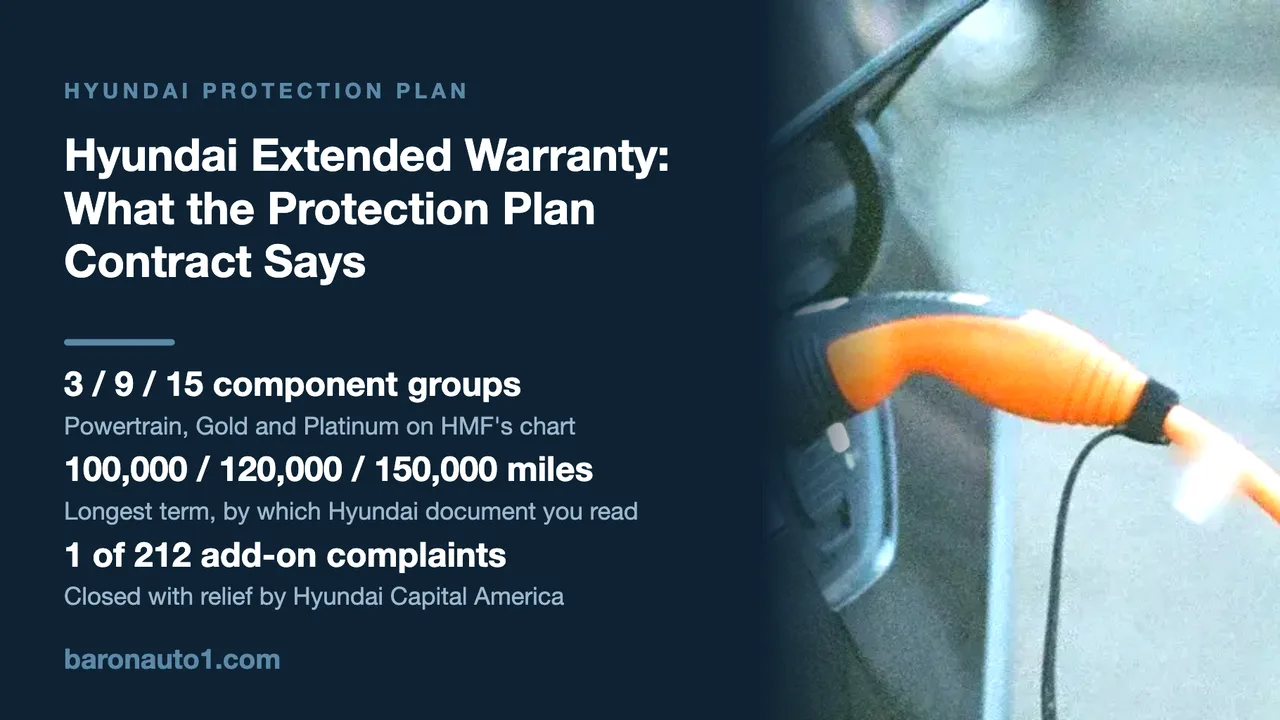
- The current sample contract has six plans: Powertrain, Gold and Platinum, plus High Technology, EV Battery and Wear Protection. Hyundai Motor Finance’s chart ticks 3 component groups for Powertrain, 9 for Gold and 15 for Platinum.
- The box ticked on page one sets the clock. New and Used plans count from the day you buy; Certified Used and Pre-Owned-Original Owner plans count from the car’s first day in service.
- Hyundai prints no price, and three different mileage ceilings for a 10-year plan: 150,000 on Hyundai Motor Finance’s page, 120,000 on a 2023 product sheet and 100,000 on the online store.
- You can cancel at any time. The refund is full within 30 days (60 in California, Florida and Utah) if no claim was authorized or paid, then pro-rata, less claims and, in most states, a $75 fee. A financed plan’s refund goes to the lender.
- Hyundai Capital America has 4,067 vehicle loan or lease complaints at the CFPB. It closed 1 of the 212 about add-on products with relief, and 1 of the 3,576 received since 2020.
Hyundai’s extended warranty is sold as the Hyundai Protection Plan, and its mechanical product is a vehicle service contract called Vehicle Service Protection. It isn’t the factory warranty. Hyundai Motor America’s New Vehicle Limited Warranty comes with the car, while a Protection Plan contract is bought separately, from a dealer or online, and pays under its own terms. This page is built from documents read on 30 September 2026: the plan’s sample customer agreement (form HUVSP 1/26) and transfer form linked from myhyundaiprotection.com, that site’s plan and help pages, Hyundai Motor Finance’s protection and cancellation pages and forms, and Hyundai’s 2026 Owner’s Handbook & Warranty Information. It also uses the CFPB complaint file of Hyundai’s lender.
Hyundai Protection Plan: who sells it, and who owes the repair
Hyundai Motor Finance, the lending brand of Hyundai Capital America, sells four products on its mechanical-coverage page: Vehicle Service Protection, Vehicle Service Protection Original Owner, the Certified Used Vehicle Wrap and Wear Protection. The online store at myhyundaiprotection.com sells Vehicle Service Protection and an electric-vehicle version called EV Care. Older paperwork, such as Hyundai Motor Finance’s 10/23 cancellation form, says “Vehicle Service Contract” and “CPO Wrap Vehicle Service Contract”. A used Hyundai sold with a Hyundai extended warranty remaining carries one of these contracts, and the contract, not the listing, says what is left.
The sample contract names the obligor on its first page: “Service Contract Provider/Obligor: Hyundai Protection Plan, Inc.” In California it does business as Hyundai Capital Extended Services, and in Florida the obligor is Hyundai Protection Plan Florida, Inc. Claims go through the administrator, Safe-Guard Products International, LLC (Safe-Guard Warranty Corporation in Florida), which must authorize a repair before it is done. Our guide to who actually owes you the repair explains why the obligor line matters more than the brand.
How the obligor relates to Hyundai depends on the document. Hyundai Capital America’s company page calls it “our subsidiary”. The contract’s Georgia amendment calls it “a subsidiary of the vehicle manufacturer, Hyundai Motor Company.” Hyundai Motor America, which issues the factory warranty, isn’t named in the sample contract at all. Calling it “the only VSP backed by Hyundai” is Hyundai Motor Finance’s own claim.
Two exceptions matter. In Massachusetts, “The Obligor of this Agreement is the Dealer listed on the Registration Page”. And only in California, Mississippi, Nebraska and North Dakota does a reimbursement insurance policy from American Bankers Insurance Company of Florida, an Assurant Solutions company, guarantee the contract; the Arkansas and Washington amendments also name a guarantee. “In all other states”, its obligations “are backed only by the full faith and credit of Hyundai Protection Plan, Inc.”
Powertrain, Gold, Platinum and the three add-on plans
The 1/26 sample says: “There are six (6) coverage plans (Powertrain, Gold, Platinum, High Technology, EV Battery, and Wear Protection) described in this Agreement.” Hyundai Motor Finance sells the first three. The online store’s plan page describes only Platinum and Gold.
| Plan | What the contract covers | Chart groups |
|---|---|---|
| Powertrain | Only the listed engine, transmission and transfer case, drive axle and hybrid drive parts | 3: engine, transmission, drive axle |
| Gold | Powertrain plus listed suspension, climate control, fuel, electrical and hybrid parts, including the hybrid high-voltage battery | 9: adds climate control, shocks, suspension, fuel and electrical systems |
| Platinum | The Powertrain, Gold, High Technology and, if applicable, EV Battery lists, plus any other mechanical breakdown not excluded | 15: adds steering, brakes, CV boots, navigation, audio and high-tech |
| High Technology | Factory-installed driver-assistance systems and cameras, navigation, screens, audio, charging pads and ports | Not shown |
| EV Battery | Fully electric cars only: battery pack and modules, battery management, degradation, traction motor, onboard charger, inverter, converter | Not shown |
| Wear Protection | One set of brake pads, one 12-volt battery, one set of wiper blades and one alignment; headlamps, fuses and bulbs; listed belts and hoses. No deductible. | Not shown |
- Listed or excluded. Powertrain and Gold pay only for listed parts, “regardless of whether the damage to the non-covered part is caused by a Covered Part.” Platinum pays for “ANY OTHER MECHANICAL BREAKDOWN EXCEPT” the exclusions, including damage a covered part does to a non-covered one.
- Wear counts. A Mechanical Breakdown includes failure “due to a gradual reduction in operating performance as a result of normal wear and tear”, so a covered part needn’t be defective.
- Parts counts are marketing. Hyundai Motor Finance says Platinum covers “more than 1,500 vehicle parts”; the administrator reads the contract’s lists.
The Powertrain plan’s engine list names the “water pump; fuel pump; thermostat”, where Hyundai’s own powertrain warranty names no fuel pump or thermostat. The EV Battery plan lists “Battery Degradation (more than seventy (70%) percent”, printed without a closing bracket or a definition, beside a factory warranty that already keeps a repaired battery at “no less than 70% of the original battery capacity.” Ask what the plan adds, in writing.
When a plan starts and ends: the box ticked on page one
The registration page has four Vehicle Ownership boxes: New, Pre-Owned-Original Owner, Certified Used Vehicle and Used. Section 3.A uses the box to pick the clock.
- New and Used: months are counted “as measured from the Agreement Effective Date”, the day you buy (or the end of a waiting period), and miles “as measured from the Current Odometer Reading”.
- Certified Used and Pre-Owned-Original Owner: months count “from the Manufacturer’s Original In-Service Date”, and the plan ends when “the Covered Vehicle’s odometer ... reaches the number of miles listed”. Time and miles already used count against the term.
The store’s explainer says “Term length is measured in time and miles starting from the Agreement Purchase Date and current odometer.” That is true of the New and Used boxes only. Hyundai Motor Finance sells the Original Owner product, “built for lessees who are buying their vehicle as well as original Hyundai owners”, for “10 years or 100,000 miles”, and the Certified Used Vehicle Wrap “for the full term of your Hyundai CUV Program coverage”. If you buy either, check which box is ticked.
Every clock runs alongside the factory warranty. The term “includes any periods of applicable manufacturer’s warranties”, parts under those warranties “are NOT covered by this Agreement until the expiration” of them, and where both apply, “WE WILL PAY THE DIFFERENCE”. A plan bought with a new car spends its first years overlapping Hyundai’s own warranty. If instead you buy after the car’s sale and the New Vehicle Limited Warranty has already ended, “A MANDATORY WAITING PERIOD OF THE LESSER OF 30 DAYS OR 1,000 MILES, WHICHEVER OCCURS FIRST, WILL APPLY”, and the same is added at the end.
The online store takes only cars “5 years or less from in-service date” with less than 60,000 miles, for “up to a total of 10 years/100,000 miles”. How far a plan can run is where Hyundai’s documents disagree most. Hyundai Motor Finance says “for up to 10 years or 150,000 miles”, a 2023 product sheet “up to 10 years or 120,000 miles” and the store “up to 10 years or 100,000 miles”: a 50,000-mile spread, by our arithmetic. The sample leaves the term blank, so only your registration page binds.
| Used box | Certified Used Vehicle box | |
|---|---|---|
| Term written on page one | 48 months / 48,000 miles | 120 months / 100,000 miles |
| Plan ends | 30 September 2030, or at 100,000 miles on the odometer | 15 March 2032, or at 100,000 miles on the odometer |
| Factory cover left at purchase | To 15 March 2027 or 60,000 miles | The same, plus certified powertrain cover to 15 March 2032 or 100,000 miles |
Written as 48 months and 48,000 miles under the Certified Used Vehicle box, the same contract would have expired before it was sold, because both limits count from 15 March 2022.
Check the Vehicle Ownership box before you sign. Ask for the registration page with the VIN, the Manufacturer’s Original In-Service Date, the odometer reading, the term, the deductible and the price filled in, then work out the end date and mileage yourself from the rule for that box. If it isn’t what you were told, don’t sign: the contract says “NO ORAL REPRESENTATION OR STATEMENT SHOULD BE RELIED UPON BY YOU.”
What a new Hyundai already has: the 2026 warranty handbook
Hyundai Motor America’s 2026 Owner’s Handbook & Warranty Information sets the baseline any Protection Plan is added to.
| Coverage | Term | Note |
|---|---|---|
| New Vehicle Limited Warranty | 5 years or 60,000 miles | Transfers to later owners |
| Powertrain Limited Warranty | 10 years or 100,000 miles | Original owner only |
| Powertrain parts, later owners | 5 years or 60,000 miles | Under the New Vehicle Limited Warranty |
| Hybrid and electric vehicle components | 10 years or 100,000 miles | A repaired battery keeps at least 70% of capacity |
| 12-volt battery | 3 years or 36,000 miles | |
| Maintenance items, defects only | 12 months or 12,000 miles | Brake pads, belts, filters, wiper blades, bulbs |
| Roadside assistance | 60 months, unlimited miles | Trip interruption up to $100 a day for 3 days, more than 150 miles from home |
Against the store’s longest plan, a total of 10 years or 100,000 miles, the New Vehicle Limited Warranty ends 5 years and 40,000 miles sooner, and the original owner’s powertrain warranty ends at the same point. Those are our subtractions of end points, not cover every car gets: a car driven little keeps the extra years, a car driven far the extra miles.
The factory warranty excludes incidental costs such as “LOSS OF USE OF THE VEHICLE” and prints no rental-car benefit, and its trip benefit stops at $300 an incident by our arithmetic. New Hyundais from the 2020 to 2025 model years also get complimentary maintenance for 3 years or 36,000 miles, which Hyundai says is “not transferable” except between spouses. The 2026 handbook doesn’t contain the word “deductible”.
The 10-year powertrain warranty, and who doesn’t get it
The handbook’s Powertrain Limited Warranty is for original owners only. It takes over when the 5-year, 60,000-mile New Vehicle Limited Warranty ends and runs “up to 10 years from the date of original delivery or the date of first use, or 100,000 miles, whichever occurs first.” It covers two lists and nothing else:
- Engine: “Cylinder block/head and all internal parts, manifolds, timing gears, timing chain, timing cover, gaskets and seals, oil pump, water pump, fly-wheel, oil pan assembly, rocker cover and engine mounts, and turbocharger.”
- Transmission/transaxle: “Case and all internal parts, axle shafts (front/rear), constant velocity joints, front/rear hub bearings, propeller shafts, seals and gaskets, torque converter and converter housing and clutch cover and housing, transfer case, and rear differential for Hyundai vehicles.”
The original owner is “the first retail purchaser of the vehicle who took delivery of the vehicle on its date of first use.” The warranty stays in effect if “the lessee purchased the vehicle at the end of the lease”, and it “may remain in effect when an original owner transfers the vehicle to a spouse”. Cars “placed in commercial use” are excluded.
Everyone else loses it. “The Powertrain Limited Warranty is not transferable to any other subsequent owner”, and later owners keep powertrain cover only under the New Vehicle Limited Warranty, to 5 years or 60,000 miles: end points 5 years and 40,000 miles short of the first owner’s, by our subtraction. A certified car gets a separate 10-year, 100,000-mile powertrain warranty from its first day in service, with a $50 deductible per repair visit; our Hyundai certified pre-owned guide covers it.
So for a first owner, a Powertrain plan ending at 10 years or 100,000 miles ends where the factory powertrain warranty ends, and pays only the difference where both apply. Its own value is the benefits and the few parts the factory list doesn’t name. For a second owner, the same plan covers years and miles the factory warranty no longer does. That is our reading of the two documents, not a statement by Hyundai.

Deductible, price and the printed benefit caps
Deductible. The sample’s “Deductible $” line is blank. The amount written there is charged “For each repair visit”, waived if a part already repaired under the contract fails again, and “There is no deductible associated with Wear Protection.” No Hyundai page lists the choices. The earlier 6/24 form said “If no deductible is listed, the $100 deductible will apply”; the 1/26 form has no default, so get a figure written in.
Price. No Hyundai document prints one. The sample leaves “Agreement Retail Price $” blank, and the store quotes only after you give the car’s mileage and state; we didn’t request a quote. Hyundai Motor Finance says “the cost can be rolled into your auto-financing plan”. The store offers “monthly payment options up to 36 months” with “no finance charges or credit checks”, but a payment 30 days late gets the cover “automatically canceled”. Our guides explain why there is no sticker price and where the markup comes from.
Benefits. The contract prints each as included with all six plans:
- Rental car: up to $55 a day for up to 10 days, $550 a breakdown by our arithmetic, with prior authorization, ending “ON THE DATE OF REPAIR COMPLETION.” Both 2023 product sheets printed $35 a day.
- Trip interruption: 100 miles or more from home, when “the repair is delayed overnight due to the unavailability of required parts”: up to $300 a day for five days, $1,500 in all, for travel costs within three days (72 hours). Not for New York residents.
- Roadside: “Sign & Drive” towing, jump starts, flat-tire changes, fluid delivery, lockouts and fuel “Up to three (3) times per calendar year”. The contract adds: “Roadside Assistance is NOT A WARRANTY.”
- Limits: no more than “the actual cash value of the Covered Vehicle” per repair visit, or “the price You paid for the Covered Vehicle” over the term, with labor paid from a guide “such as Mitchell or Alldata”.
Three things the store says aren’t in the contract it links. It offers “6 complimentary roadside service events per year”, the 6/24 form’s limit; the 1/26 form prints no such limit. It caps EV towing at “$200 per occurrence”; the contract prints no cap. And it wants trip receipts “within 30 days of the vehicle’s breakdown”, where the contract allows “sixty (60) days”. The contract calls itself “THE FULL AND COMPLETE AGREEMENT”; sending receipts inside 30 days satisfies both.
What no Hyundai Protection Plan pays for
Section 5 of the contract excludes, on every plan:
- Other cover: “THAT PORTION OF THE COST TO REPAIR OR REPLACE A COVERED PART WHICH IS COVERED BY ANY MANUFACTURER WARRANTY OR ANY OTHER COVERAGE”, pre-existing conditions and claims in a waiting period.
- Damage and neglect: accidents, theft, fire, hail, water and floods; misuse, improper towing and lack of maintenance; “OVERHEATING, LACK OF COOLANT OR LUBRICANTS” and sludge, a word Georgia’s amendment strikes.
- Water, titles and identity: engine water ingestion, cars “LABELED OR BRANDED AS DISMANTLED, FIRE-DAMAGED, FLOOD-DAMAGED, JUNK, REBUILT, SALVAGE”, and altered VINs or odometers. A salvage or rebuilt title ends Hyundai’s factory warranty too.
- Changes and use: unapproved aftermarket parts, oversized or undersized tires, “REFUSING TO UPDATE VEHICLE SOFTWARE” where that adds work, racing, use outside the United States, its territories or Canada, and commercial work such as hauling, delivery, daily rentals and livery. The permitted uses include “ride share vehicles”.
- Routine costs: maintenance, shop supplies, core charges and fees, and failures caused by a part the plan doesn’t cover.
Even Platinum excludes manual clutch parts, airbags, glass, body panels and trim, tires, wheels, upholstery, paint, heater and radiator hoses, the exhaust and the catalytic converter. Batteries, wiper blades, brake pads and rotors, lights, fuses and bulbs are out “UNLESS COVERED UNDER WEAR PROTECTION”.
How a claim works, and how one gets denied
- Return to the seller if you can. The contract says to take the car back, “if possible”, to “the Dealer listed on the Registration Page”, and otherwise to call the administrator. The sample never says “Hyundai dealer”, while the store says repairs happen “at an authorized Hyundai repair shop”.
- Get authorization first. “Claims must be approved in advance, or the claim could be denied.”
- Know who pays for a teardown. If the failure turns out not to be covered, “You agree to assume the cost of diagnostic/teardown”.
- Emergencies. If the office is closed and the car is inoperable or unsafe to drive, repairs can start, but the administrator must hear about them the next business day, with paperwork within 30 days.
- Paperwork. Approved claims are paid to the shop, less the deductible. If you paid, claim “within thirty (30) days of authorization”, and “Retain all replaced parts until Your claim is settled”.
- Maintenance. Keep “original copies of all repair orders, invoices, and receipts”, service on schedule and “stop the Covered Vehicle immediately” after a breakdown. Failing these “may result in the denial of Your claim.”
Cancelling, transferring, and where the refund goes
“You may cancel this Agreement at any time for any reason”. Within 30 days of the Agreement Effective Date, or 60 in California, Florida and Utah, the refund is full “if no claim has been authorized or paid.” After that it is pro-rata, “based upon the greater of time or mileage expired”, less claims paid and a processing fee that “will not exceed the amount of any refund due”. Arkansas, California, Idaho, Louisiana, Nevada, New Hampshire and Washington don’t deduct claims.
| State | Processing fee |
|---|---|
| Alabama, Nevada, Washington | $25 |
| Arkansas, Idaho, Louisiana, Missouri, Texas | $50 |
| California | $25 or 10% of the price |
| Illinois | $50 or 10% of the price paid |
| Arizona, Iowa, Maine, Mississippi, New Hampshire, New Mexico, Washington D.C., Wisconsin | $75 or 10% of the price paid |
| Florida, Georgia, North Carolina, Oklahoma | $75 or 10% of the unearned pro-rata price |
| Every other state | $75 |
If the plan was financed, the contract pays the refund to the lender unless you prove the loan is paid off, and lets the lender cancel after a total loss or repossession, except in California. Hyundai Motor Finance’s form is blunter: “All cancellation refunds with an active lease, loan, or payment plan are due to the lienholder or Payment Plan Provider.” Requests are “processed within 5-10 business days”, and cancelling one product in a Multi-Coverage Protection package cancels them all. The store warns: “You may not be able to re-enroll for a Hyundai Protection Plan after cancelling.” Our guides cover cancelling a plan and how cancellations go wrong.
Transfers. The plan passes only to “a private party within the United States” who buys the car from you or takes over your lease, for a $75 fee ($40 in Florida, $25 in Nevada), with the paperwork in within 30 days. It never goes “to another vehicle or to a dealership via sale or trade-in.” The new owner gets cover only “for the remaining term of the original Agreement”. Sell or trade to a dealer, and cancelling for a refund is the option left.
Arbitration, insurance backing, and what changed since 2024
Disputes with the administrator, obligor, dealer or insurer “will be settled by impartial arbitration.” You put forward “at least three (3) proposed arbitrators”, the administrator picks one, and “You agree to abide by the Arbitrator’s decision and share the cost of arbitration equally unless the Arbitrator directs otherwise.” The clause is deleted in Georgia, Mississippi, Nebraska and Wisconsin, non-binding in Florida, Indiana, Oklahoma and Oregon, voluntary in Missouri and Vermont, and varied elsewhere. It is also new. The earlier 6/24 form offered “neutral non-binding arbitration by The American Arbitration Association”.
The backing changed too. The 6/24 form listed 17 states where a reimbursement insurance policy guaranteed the contract; the 1/26 form lists 4 in its Settlement section, plus Arkansas and Washington by amendment. By our comparison, 11 states drop out: Hawaii, Iowa, Montana, New Jersey, New York, Oklahoma, Oregon, South Carolina, Texas, Vermont and Wyoming. The contract doesn’t say why. In an insured state, if a valid claim isn’t paid within 60 days of proof of loss, or the obligor goes out of business, you can claim from the insurer directly. Elsewhere, look the provider up on your state’s register; our guide to what a state register will tell you shows how.
Louisiana’s amendment calls the current contract “A VEHICLE MECHANICAL BREAKDOWN INSURANCE POLICY”, while California’s says it isn’t one; our page on mechanical breakdown insurance explains the difference.
Hyundai’s factory warranty uses BBB AUTO LINE, free, which the handbook says you must try before suing under the Magnuson-Moss Warranty Act (except in Georgia); for California buyers, either side can choose binding arbitration unless the buyer opts out within 30 days. None of that governs a Protection Plan contract.
What the Hyundai Capital America complaint file shows
No public database records how Protection Plan claims are decided, but the lender side is public. On 30 September 2026 we pulled every vehicle loan or lease complaint the CFPB holds against Hyundai Capital America: 4,067, received from 24 April 2017 to 22 September 2026, the eighth-largest count among 1,147 companies. It lends as Hyundai Motor Finance, Genesis Finance and Kia Finance America, so the file can’t be split by brand. Genesis plans are owed by the same Hyundai Protection Plan, Inc.; our Genesis extended warranty guide reads that contract. A complaint is an allegation, not a finding, and the response is the company’s own label.
It closed 76 with relief, 1.9%, against 9.4% across all 103,865 vehicle loan or lease complaints. The 212 complaints about add-on products bought with a loan are 5.2% of its file, against 5.5% product-wide; it closed 1 of them with relief, 0.5%, against 7.9% across the product. Before 2020 it closed 75 of 491 complaints with relief, 15.3%. From 2020 to 22 September 2026, it closed 1 of 3,576.
| Year | Complaints | About add-on products | Closed with relief |
|---|---|---|---|
| 2017 | 89 | 5 | 6 |
| 2018 | 208 | 9 | 57 |
| 2019 | 194 | 10 | 12 |
| 2020 | 372 | 6 | 0 |
| 2021 | 477 | 21 | 0 |
| 2022 | 476 | 28 | 0 |
| 2023 | 523 | 32 | 0 |
| 2024 | 415 | 29 | 0 |
| 2025 | 623 | 33 | 1 |
| 2026 | 690 | 39 | 0 |
The export we pulled carried no complaint narratives, so a complaint about a cancelled plan filed under billing, the largest sub-issue with 809 complaints, wouldn’t show up in the add-on count.
Hyundai’s plan, a third-party contract, or neither
Whether any service contract is worth buying is covered in our guide to whether an extended warranty is worth it. On a Hyundai, the documents narrow it to three questions.
Who are you to the car? A first owner already has powertrain cover to 10 years or 100,000 miles; a later owner who bought uncertified has everything only to 5 years or 60,000; a certified buyer has a separate 10-year, 100,000-mile powertrain warranty. The same plan buys different things in each case.
Which plan, clock and backer? Powertrain and Gold pay only for what they list; Platinum pays for anything not excluded. Check the Vehicle Ownership box, the term, the deductible and the obligor, which is backed by an insurer only in a few states. A third-party contract names its own obligor and backing, and the same questions apply.
What does it cost? Nothing Hyundai publishes says. Get the dealer’s price in writing and an online quote for the same plan, term and deductible. You don’t have to decide at the finance desk: the store sells VSP on Hyundais up to 5 years old with less than 60,000 miles, and a plan cancelled within 30 days with no claim is refunded in full.
- Read the obligor line. Hyundai Protection Plan, Inc., Hyundai Protection Plan Florida, Inc. in Florida, or the dealer in Massachusetts. Anything else is a different product.
- Check the Vehicle Ownership box. New and Used count from your purchase; Certified Used and Pre-Owned-Original Owner from the car’s first day.
- Get the blanks filled in. Term, deductible and price belong on the registration page before you sign.
- Match the plan to your warranty. A first owner’s powertrain is covered to 10 years or 100,000 miles already; a later owner’s stopped at 5 years or 60,000.
- Read Platinum’s exclusions. Brakes, batteries, wipers and bulbs need Wear Protection; glass, tires, paint and the exhaust are never covered.
- Get authorization first, and keep receipts. An unauthorized repair or missed service can sink a claim.
- Know the exits. A full refund within 30 days (60 in California, Florida and Utah) with no claim; a private-sale transfer within 30 days for $75. A financed plan’s refund goes to the lender.
Calls saying your Hyundai warranty is about to expire are a separate matter. In 2022 the FTC sued American Vehicle Protection Corp., a Florida seller it alleged had falsely claimed to be, or to be associated with, consumers’ carmakers or dealers, and had promised bumper-to-bumper or full coverage that was much more limited than represented. A stipulated order in March 2023 and a further order that July banned defendants from selling extended auto warranties and from outbound telemarketing. In 2024 the FTC sent more than $449,000 in refunds to consumers. See what regulators have done.
Common questions
How much does a Hyundai extended warranty cost?
Hyundai doesn’t publish a price. The sample contract leaves the Agreement Retail Price blank, and the online store quotes only after you enter the car’s mileage and state. You can pay in full, roll it into a car loan or, online, spread it over up to 36 months with no finance charge. See our guide to extended car warranty cost.
Is the Hyundai powertrain warranty transferable?
No. The 2026 handbook says the 10-year, 100,000-mile Powertrain Limited Warranty “is not transferable and applies only to the original owner”, though a lessee who buys at lease end keeps it and it may continue after a transfer to a spouse. A later owner has powertrain parts covered under the New Vehicle Limited Warranty, for 5 years or 60,000 miles from first use. A certified car gets its own 10-year, 100,000-mile powertrain warranty.
Can I buy a Hyundai extended warranty after I bought the car?
Yes. The online store sells VSP on Hyundais “5 years or less from in-service date” with less than 60,000 miles, with no waiting period while the New Vehicle Limited Warranty is running. If the factory warranty has already ended when you buy, the contract adds a waiting period of 30 days or 1,000 miles, whichever comes first, and the same at the end. A New or Used plan counts from the day you buy it.
Can I cancel a Hyundai Protection Plan and get a refund?
Yes, at any time. Within 30 days of the effective date (60 in California, Florida and Utah), with no claim authorized or paid, you get the full price back. After that the refund is pro-rata by time or miles used, whichever is greater, less claims and a processing fee that is $75 in most states. If the plan was financed, the refund goes to the lender unless you show the loan is paid off.
Is the Hyundai extended warranty backed by Hyundai?
The obligor is Hyundai Protection Plan, Inc., which Hyundai Capital America calls its subsidiary and the contract’s Georgia amendment calls a subsidiary of Hyundai Motor Company. An insurance policy guarantees the contract in California, Mississippi, Nebraska and North Dakota, and by amendment in Arkansas and Washington; elsewhere it is backed only by the obligor’s “full faith and credit”. In Massachusetts the selling dealer is the obligor.
Sources and further reading
- CFPB consumer complaint database
- CFPB auto loan resources
- FTC: auto service contracts and warranties
- FTC: a businessperson’s guide to federal warranty law
- 15 U.S.C. § 2301 (Magnuson-Moss definitions)
- 15 U.S.C. § 2308 (Implied warranties)
- Texas Department of Licensing and Regulation — service contract providers, Occupations Code Chapter 1304
- Florida CFO — motor vehicle service agreements, Chapter 634
- FTC v. American Vehicle Protection Corporation — case docket
- FTC — industry ban and judgment, American Vehicle Protection
- FTC — refunds paid to consumers harmed by an extended vehicle warranty scheme
- FTC withdrawal of the CARS Rule (91 FR 6507)
Recall, complaint and safety-rating figures on this page were retrieved from the federal databases above on August 19, 2026. Federal data changes — re-check any VIN before you rely on it.
Published September 30, 2026 · last updated September 30, 2026. Found something out of date or wrong? Tell us and we will correct it.