Volkswagen Extended Warranty: What Drive Easy Covers and Who Pays
Volkswagen's extended warranty is sold as Drive Easy, a service contract owed by VWFS Protection Services rather than Volkswagen. What Powertrain, Gold and Platinum cover on VW's own plan grid, why a plan bought early counts from the car's first day, the electric plan that leaves out the battery, and VW Credit's complaint file.
The short version
- Volkswagen’s extended warranty is Volkswagen Drive Easy Vehicle Service Protection, a service contract sold through VW dealers. It is owed by VWFS Protection Services, Inc., not Volkswagen of America, and administered by Safe-Guard Products International, LLC.
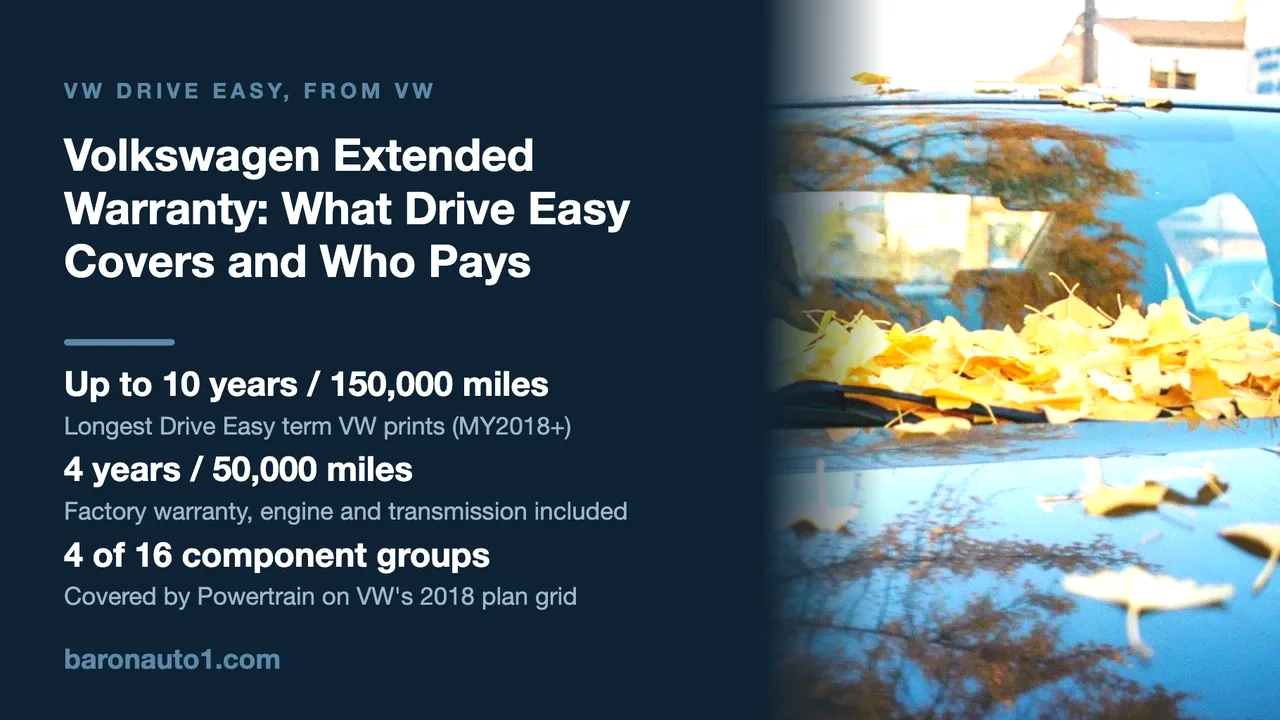
- There are three levels: Powertrain, Gold and Platinum. On Volkswagen’s 2018 plan grid they tick 4, 10 and all 16 of 16 component groups. The longest term printed is 10 years or 150,000 miles. No Volkswagen document we read prints a price.
- Bought while the factory warranty still runs, a plan is measured from the car’s first day, at zero miles. A 10-year plan bought on the car’s third birthday has at most 7 years left. Bought after the factory warranty, it runs from the purchase date and that day’s odometer reading.
- A new VW’s New Vehicle Limited Warranty runs 4 years or 50,000 miles, and the MY2024 booklet lists no separate powertrain warranty. The engine and transmission lose factory cover at the same point as most of the car.
- The All-electric plan runs up to 8 years or 100,000 miles and excludes the high-voltage battery, whose own factory warranty ends at the same point.
- VW Credit has 1,072 vehicle loan or lease complaints at the CFPB. The 46 about add-on products closed with relief 23.9% of the time, against 29.2% for the rest of the file.
Volkswagen’s extended warranty is a vehicle service contract sold through its dealers as Volkswagen Drive Easy. The mechanical plan, Vehicle Service Protection, comes in Powertrain, Gold and Platinum levels. Electric VWs get a single All-electric plan, and certified cars a version of their own. None of it is the factory warranty, and none of it is owed by the company that issues the factory warranty. This page draws on Volkswagen’s own documents: the Drive Easy plan pages on vw.com, three Drive Easy brochures from 2018 and 2019 still served there, the Volkswagen Financial Services FAQ, the MY2024 and MY2021 warranty booklets and the MY2026 California warranty supplement, all read on 30 September 2026. It also draws on the CFPB complaint file of VW Credit.
Volkswagen Drive Easy: the name on the contract, and who owes the repair
Drive Easy is the service contract vw.com offers, and you buy it from a participating Volkswagen dealer; each plan page ends by telling you to contact one. Nine products share the name, from GAP to Key Protection. Three pay for mechanical breakdowns: Vehicle Service Protection, its certified-car version, and Term Protection in its Plus form.
Who owes you the repair is printed in the footnote of every plan page. The obligor, the company the contract binds to pay for covered repairs, is VWFS Protection Services, Inc. The administrator is Safe-Guard Products International, LLC. In Florida they are VWFS Protection Services FL, Inc. and Safe-Guard Warranty Corporation. The 2018 and 2019 brochures and the Volkswagen Financial Services FAQ name the same companies. Our guide to who actually owes you the repair explains why the obligor is the name that matters: it is the only party whose failure leaves you with nothing.
Volkswagen of America is not that company. The MY2024 booklet says the New Vehicle Limited Warranty “is issued by Volkswagen Group of America, Inc.”, while the plan pages say the Volkswagen name and logo are used by VWFS Protection Services “with the permission of their respective owners”. The obligor’s initials match Volkswagen Financial Services, the name on VW’s loan and lease pages, but no document we read says how the companies are related. As for the administrator, the FTC’s description quoted in that guide says administrators decide whether claims get paid. Safe-Guard also works outside the Volkswagen family: GM’s sample contract names it as administrator too, as our GM extended warranty page records.
Every page adds that Drive Easy is optional, is not insurance and is “not required for you to obtain financing for the purchase or lease of a vehicle.” If a finance office presents a plan as part of getting the loan approved, that sentence is Volkswagen’s own answer.
Powertrain, Gold and Platinum: what each level covers
The Drive Easy plan page describes the three levels in these words:
- Powertrain covers “your vehicle’s engine, transmission, transaxle or transfer case, drive axles, and certain hybrid and electric components.”
- Gold covers Powertrain “plus front and rear suspension, climate control, fuel, electrical, and certain additional hybrid and electric components.”
- Platinum covers “all mechanical parts of your vehicle in the event of a mechanical breakdown, unless they are specifically listed as ‘not covered’ in your Customer Agreement (such as maintenance and cosmetic items).”
The 2018 brochure calls Platinum “exclusionary coverage”, since it names what isn’t covered: “maintenance items such as spark plugs and wiper blades, as well as items such as trim pieces, upholstery, and body panels.” It also prints a grid of 16 component groups, repeated in the certified-car brochure. The ticks are drawn rather than typed, so we read them off the page:
| Component group | Powertrain | Gold | Platinum |
|---|---|---|---|
| Engine | Yes | Yes | Yes |
| Transmission | Yes | Yes | Yes |
| Drive axle | Yes | Yes | Yes |
| Hybrid/electric | Yes | Yes | Yes |
| Climate control | No | Yes | Yes |
| Shocks | No | Yes | Yes |
| Front suspension | No | Yes | Yes |
| Rear suspension | No | Yes | Yes |
| Fuel system | No | Yes | Yes |
| Electrical system | No | Yes | Yes |
| Steering | No | No | Yes |
| Brakes | No | No | Yes |
| CV boots | No | No | Yes |
| Navigation | No | No | Yes |
| Audio | No | No | Yes |
| High-tech | No | No | Yes |
| Groups ticked | 4 of 16 | 10 of 16 | 16 of 16 |
Gold adds 6 groups to Powertrain, and Platinum 6 more, from steering and brakes to audio and what the grid calls high-tech. If a failed steering rack or infotainment screen is the repair you worry about, only Platinum ticks it. The grid doesn’t say which brake parts it means, and pads and rotors are wear items with a Drive Easy contract of their own, Term Protection. The current page uses the same words for each level but prints no grid, so check the component list in the contract you are offered.
The CPO benefits page adds a figure no plan page repeats: vehicle service protection “safeguarding over 1,500 parts against mechanical breakdowns”. It doesn’t say which level that count describes.
Ask for the contract, not the plan card. Volkswagen prints the level names, a ceiling of 10 years or 150,000 miles and the benefit caps. The term you are offered, its mileage limit, the deductible and the price come from the dealer. Ask for the Customer Agreement with your VIN on it, check that the obligor is VWFS Protection Services, Inc. (VWFS Protection Services FL, Inc. in Florida), and read what isn’t covered before what is.
When a Drive Easy plan starts, and why buying later doesn’t buy more time
The rule that decides what a plan is worth sits in a footnote. Vehicle Service Protection “runs concurrently with any applicable manufacturer’s warranties”. For a plan bought while the factory warranty runs, “plan expiration is measured in time/miles from the Manufacturer’s Original In-Service Date and zero (0) miles.” For one bought afterwards, expiration is measured “from the Agreement Purchase Date and the Current Odometer Reading.” The 2018 brochure says the same, and the All-electric and certified plans follow the same rule.
Take a VW bought new. Three years later, at 30,000 miles, the owner buys the longest printed term, 10 years or 150,000 miles. It doesn’t run for 10 years from that day. It ends 10 years after the car was first put in service or at 150,000 miles on the odometer, whichever comes first, which leaves at most 7 years and 120,000 miles. For up to 1 more year or 20,000 more miles of that, the factory warranty is still paying for defects, and the plan excludes “Mechanical breakdowns covered by your vehicle’s manufacturer’s warranty.” That arithmetic is ours.
So at the longest term, what a plan really adds is what lies beyond 4 years and 50,000 miles: up to 6 more years and 100,000 more miles, stated by end points. That subtraction is ours too, and not every car gets both halves. A car that turns four on low mileage keeps the extra years; one that reaches 50,000 miles early keeps up to 100,000 more miles, still inside the 10-year limit. And the later you buy within the factory warranty, the less of any term is left, with no printed price to show whether the cost falls with it.
Bought after the factory warranty, a plan’s whole term lies ahead, counted from your purchase date and odometer. Bought the day before, it counts from the car’s first day. The page doesn’t say which terms are offered on an older car, or up to what age and mileage one can be enrolled, so the later route may come with shorter terms. Near 4 years or 50,000 miles, ask the dealer to put both possible end points in writing.
What counts as “in warranty” is defined in the Customer Agreement, as the All-electric footnote says outright, and Volkswagen doesn’t publish that agreement. The one number you can rely on is the end date and odometer reading on your own registration page.
Terms, deductibles, benefit caps and price
The current page offers “parts and labor up to 10 years or up to 150,000 miles.” That is a ceiling, not a menu. The 2018 brochure split it by model year, up to 10 years and 150,000 miles for model year 2018 and newer and 120,000 miles for 2017 and older, and the certified-plan page still prints that split.
The documents diverge on deductibles. The current page says only that you pay “the deductible you select at the time of purchase.” The 2018 brochure listed $0, $100 disappearing, $100 and $250 per visit, the disappearing one “waived if repairs are made at the selling dealership.” The certified plan has a flat $50 per covered repair visit in both documents.
The benefits have printed caps. Towing, rental and trip interruption apply only when a covered mechanical breakdown makes them necessary:
- Towing: up to $100 to the nearest authorized Volkswagen dealer or service provider. The All-electric plan pays up to $200 and adds the nearest compatible charging station.
- Rental car: up to $35 a day for up to 10 days, so $350 at most by our multiplication.
- Trip interruption: up to $200 a day for up to 5 days. The 2018 brochure printed the total, $1,000 per occurrence. Not available to residents of California or New York.
- Roadside: 24-hour help including battery service, flat tires, lockouts and up to 3 gallons of fuel, up to 3 times per calendar year; other fluids are yours to pay for. The 2018 brochure capped these services at $100 per occurrence. The current page prints no cap.
Then the price, which nothing Volkswagen publishes will tell you. The CPO benefits page says you “can secure this essential protection online today”, but its buy button opens the certified-plan page, which sends you to a participating dealer. The number comes from a dealer quote, so our guides to why there is no sticker price and where the markup comes from apply in full.
What a new Volkswagen already carries
A plan is worth what it adds to the factory warranty. Volkswagen’s coverage page gives every model year 2020 and newer VW a New Vehicle Limited Warranty of 4 years or 50,000 miles, and the MY2026 California supplement refers to the same term. The newest full booklet we could reach, the MY2024 gasoline booklet, prints the detail.
| Coverage | Term | What it covers |
|---|---|---|
| New Vehicle Limited Warranty | 4 years or 50,000 miles | Any repair to correct a defect in material or workmanship, except wheel alignment, tire balance and tires. No separate powertrain warranty is listed. |
| 12-volt battery, paint, halogen or xenon bulbs | 3 years or 36,000 miles | Defects |
| Roadside assistance | 3 years or 36,000 miles | From the original in-service date |
| Brake pads, wiper blades, key fob batteries, other bulbs | 1 year or 12,000 miles | Defects. Worn pads, shoes, discs and drums are also covered to 1 year or 12,000 miles, worn wiper blades to 6 months or 6,000 miles. |
| Carefree Maintenance | 1 year or 10,000 miles, then 2 years or 20,000 miles | The first two scheduled services, at no charge |
| Federal emissions defect warranty | 2 years or 24,000 miles | Emission control defects |
| Major emission components | 8 years or 80,000 miles | Catalytic converter, gateway control module, engine and transmission control modules, on-board diagnostic device |
| Corrosion perforation | 7 years or 100,000 miles | Body panels rusted through from the inside out |
| High-voltage battery, electric models | 8 years or 100,000 miles | Defects, and net capacity below 70% |
| High-Voltage System, MY2021 electric models | 4 years or 50,000 miles | Electric motor, power electronics, charger, charging socket and other high-voltage parts |
The first row is the one that matters. The booklet names the New Vehicle Limited Warranty, the corrosion warranty and the emissions warranties as the only express warranties, with no separate powertrain term. So the engine and transmission lose factory cover at 4 years or 50,000 miles along with the electrics, suspension and air conditioning. What remains is corrosion to 7 years or 100,000 miles, the listed emission parts to 8 years or 80,000 and, on an electric VW, the battery to 8 years or 100,000. That cliff is the gap Drive Easy is sold to fill.
Wear parts leave sooner, at 1 year or 12,000 miles, and the 12-volt battery at 3 years or 36,000. A mechanical plan rarely pays for those, and Drive Easy sells Term Protection for them. The booklet also says the New Vehicle Limited Warranty and Carefree Maintenance transfer automatically, at no cost, when the car changes hands within their terms.
Electric VWs: the All-electric plan leaves out the battery
Electric Volkswagens get one plan, All-electric Vehicle Service Protection. The page calls it Platinum Protection and says it “covers all mechanical components of your vehicle unless specifically listed in the exclusions section of your Customer Agreement.” It runs up to 8 years or 100,000 miles on the same two clocks, with towing up to $200, to a dealer or the nearest compatible charging station.
Its exclusions add one line: “Repair or replacement of hybrid high-voltage batteries and high-voltage electric batteries.” The battery sits under Volkswagen’s High-Voltage Battery Limited Warranty instead, 8 years or 100,000 miles for “your ID.4 or ID. Buzz electric vehicle”, for defects and for net capacity of at least 70%. The MY2021 booklet adds that gradual capacity loss of up to 30% isn’t a defect.
So the plan’s longest term ends exactly where the battery warranty ends, and for the battery it adds nothing. That comparison is ours. What it can add is the rest of the high-voltage system. The MY2021 booklet covers the electric motor, power electronics, charger, charging socket, high-voltage heating and air conditioning and the orange cables for only 4 years or 50,000 miles. On the plan page’s description, those parts fall under the All-electric plan after that, for up to 4 more years and 50,000 more miles by end points, unless the contract excludes them. Check the exclusions section before you count on it.
Certified cars, wear items and the other Drive Easy contracts
Certified Pre-Owned Service Protection has the same three levels, clocks and benefit caps, a flat $50 deductible per covered repair visit, and terms up to 10 years or 150,000 miles for model year 2018 and newer, or 120,000 miles for 2017 and older. A model year 2020 or newer VW sold as certified since 1 April 2026 already carries Volkswagen’s certified warranty: 2 years or 24,000 miles from the end of the factory warranty, or from the sale if that has passed, with a $50 deductible per dealer visit. For a car certified inside its factory warranty, our Volkswagen certified pre-owned guide puts the end of that cover no later than 6 years from first in-service and no higher than 74,000 miles. The plan page doesn’t say whether certified cover alone counts as “in warranty”, so check the registration page.
Term Protection pays for parts that wear out, for up to 6 years or 72,000 miles, with no deductible. It covers one set of front and rear brake pads, one battery, most major engine belts and hoses, one set of wiper blades, one wheel alignment, headlamps, and fuses and bulbs; optional rotor cover adds one set of rotors. Carbon or ceramic brakes and high-voltage batteries are excluded. It runs from its own purchase date and odometer, but must be bought within 18 months or 12,000 miles of the factory warranty’s start, while the factory still covers pads for a year and the 12-volt battery for 3 years. So the pads and battery it pays for are most useful later. That reading is ours; the contract’s list decides.
Its documents disagree twice. The 2019 brochure allowed purchase within 12 months, not 18. And it said Term Protection Plus, which adds breakdown cover for “all mechanical and electrical parts” not excluded, was “only available for MY2017 and older vehicles.” The current page says “model year 2020 and new vehicles.” Only the contract you sign settles which version you have.
The rest of the line isn’t mechanical cover. Lease-End Protection waives up to $10,000 of excess wear and use charges, for VW Credit Leasing, Ltd. customers only and not in New York. Multi-Coverage, Tire & Wheel, GAP, Theft and Key Protection are separate products, and prepaid maintenance is sold as Volkswagen Care. A quote that folds several of them into one monthly figure is worth pulling apart.
What Drive Easy won’t pay for, and the factory rules underneath it
Every level lists three exclusions, and the page says more may apply: breakdowns covered by the manufacturer’s warranty; breakdowns caused by accident, collision, vandalism or weather; and breakdowns caused by lack of maintenance or pre-existing conditions. Add Platinum’s maintenance and cosmetic items, the All-electric battery line and Term Protection’s carbon and ceramic brakes, and that is everything the public pages print.
The maintenance line is the one to plan for, because Volkswagen’s booklet contradicts itself on proof. Near the front it says Volkswagen “may not deny a warranty claim based solely on inadequate maintenance records”. In the warranty section it says “your dealer will deny warranty coverage unless you present to the dealer proof in the form of Service or Repair Orders that all scheduled maintenance was properly performed with the correct materials in a timely manner.” Those are factory rules, but a plan with a maintenance exclusion will ask the same question. Keep every receipt.
The factory warranty also excludes vehicles “severely damaged or declared to be a total loss by an insurer”, and damage caused by non-genuine replacement parts. A total-loss declaration usually brings a salvage or rebuilt title. The Drive Easy pages say only that not all vehicles may be eligible, so get the dealer’s answer on a branded title in writing.
Claims, transfers and cancelling
Covered repairs are done at “any authorized Volkswagen dealer or authorized service provider”, with OEM or OEM-approved parts, for the deductible you chose; the 2018 brochure said “participating” dealers. Towing, rental and trip costs are reimbursed, so keep the receipts. No page describes how a claim is approved, so ask who calls whom and whether a repair needs approval before work starts.
- Transfer: “Transferable for a fee if you sell your vehicle to a private party.” The 2018 brochures said $50. Term Protection transfers only “if your finance agreement is assumed”.
- Cancelling: “Cancelable at any time; subject to a fee after 30 days.” The 2018 brochures said $50 here too.
- Refunds: not described for the mechanical plans. Only Key Protection’s page does: after 30 days, “pro rata refund will be provided, and $50 fee will apply.” Get the service contract’s own refund clause in writing.
If the plan is in your loan, cancelling is a loan question too. Our guides cover how to cancel a plan and how cancellations go wrong.
Disputes: BBB AUTO LINE for the factory warranty, the contract for the plan
For its own warranties, Volkswagen uses BBB AUTO LINE, run by the Council of Better Business Bureaus and described in the booklet as an arbitration program. It is free, with vehicle age and mileage limits, and the booklet says you must use it before asserting California’s lemon-law presumption in court or pursuing a remedy under 15 U.S.C. 2310(d), the federal warranty law, over the New Vehicle Limited Warranty. A decision binds Volkswagen only if you accept it; reject it and you can pursue other remedies. For California purchasers, a decision should ordinarily come within 40 days, Volkswagen complies within 30 days of your acceptance, and claims must be filed within 6 months after the warranty expires. We found no binding-arbitration clause or class-action waiver in the booklets we read.
That program covers Volkswagen’s written warranties. Drive Easy’s dispute terms, including any arbitration clause, are in the Customer Agreement that Volkswagen doesn’t publish. Read them before you sign, not after a claim is declined.
What VW Credit’s complaint file shows
No public database records how Drive Easy claims are decided, but the finance side is public. Dealers often sell a service contract inside the car loan, and complaints about those add-ons are filed against the lender. The Volkswagen Financial Services FAQ sends account holders to vwcredit.com, and the CFPB lists the company as VW Credit. On 30 September 2026 we pulled all 1,072 of its vehicle loan or lease complaints, received between 3 May 2017 and 15 September 2026: 586 about leases and 486 about loans, the 25th-largest count among 1,147 companies. The file can’t be split by the make of car financed, and a complaint is an allegation, not a finding.
VW Credit answered 1,071 of them on time. It closed 754 with an explanation, 165 with non-monetary relief and 146 with monetary relief, with 7 still in progress. That is 311 closed with relief, 29%, against 9.4% across all 103,865 vehicle loan or lease complaints. The response label is the company’s own.
46 complaints fall under the two add-on sub-issues, 4.3% of the file against 5.5% across the product; 26 concern loans and 20 leases. 11 closed with relief, 23.9%, against 29.2% for VW Credit’s other 1,026 complaints and 7.9% for the product’s 5,713 add-on complaints. VW Credit closes add-on complaints with relief less often than its other complaints, but far more often than lenders as a whole do.
| Year | Complaints | About add-on products | Add-on share | Closed with relief |
|---|---|---|---|---|
| 2017 | 41 | 1 | 2.4% | 48.8% |
| 2018 | 58 | 1 | 1.7% | 32.8% |
| 2019 | 70 | 3 | 4.3% | 22.9% |
| 2020 | 88 | 1 | 1.1% | 50% |
| 2021 | 101 | 6 | 5.9% | 38.6% |
| 2022 | 92 | 7 | 7.6% | 22.8% |
| 2023 | 148 | 7 | 4.7% | 33.8% |
| 2024 | 118 | 4 | 3.4% | 18.6% |
| 2025 | 191 | 9 | 4.7% | 19.9% |
| 2026 | 165 | 7 | 4.2% | 25.5% |
Complaints rose from 41 in 2017, counted from May, to 191 in 2025, with 165 by mid-September 2026. Add-on complaints run between 1 and 9 a year, so their share jumps around. The largest sub-issue is billing problems: 195 complaints, 25.1% closed with relief. Excess mileage, damage or wear fees after a lease, the charges Lease-End Protection is sold to waive, account for 52, with 61.5% closed with relief.
The export we pulled carried no complaint narratives, so we can’t count complaints that mention Drive Easy or a service contract in their own words. A complaint about a cancelled plan filed under billing won’t show up in the add-on label.
Drive Easy, a third-party contract, or neither
Whether any service contract is worth buying is covered in our guide to whether an extended warranty is worth it. On a Volkswagen it comes down to four things.
The cliff. Factory cover for the engine, transmission and nearly everything else ends at 4 years or 50,000 miles. Price a plan by what it adds past that point, up to 6 years and 100,000 miles at the longest term by end points, not by its headline term.
The clock. Bought in warranty, a plan counts from the car’s first day; bought later, from your purchase. Which suits you depends on the terms and prices you are offered, and Volkswagen prints neither.
Who stands behind it. Drive Easy is repaired at Volkswagen dealers with OEM or OEM-approved parts, but owed by VWFS Protection Services and administered by Safe-Guard. A third-party plan names its own obligor and administrator. Ask the same questions of both: who is the obligor, is it registered where you live, and who authorizes claims? Our guide to what a state register will tell you shows how to check.
The car. An electric VW’s battery is outside the plan and inside the factory warranty to 8 years or 100,000 miles, and a certified VW already has 2 years or 24,000 miles of certified cover. Volkswagen says not all vehicles may be eligible; for one it won’t take, the options are a third-party contract or, from some insurers, mechanical breakdown insurance.
- Check the obligor. It should be VWFS Protection Services, Inc., or VWFS Protection Services FL, Inc. in Florida. Any other name is a different product.
- Get the end date and mileage in writing. A plan bought in warranty counts from the car’s first in-service date and zero miles; the registration page should print where yours ends.
- Get the missing numbers. Term, mileage limit, deductible and price belong on the contract, because vw.com prints only the 10-year, 150,000-mile ceiling.
- Match the level to the parts you worry about. On the 2018 grid, steering and brakes appear only under Platinum.
- On an electric VW, read the battery line. The All-electric plan excludes high-voltage batteries; the factory warranty covers them to 8 years or 100,000 miles.
- Price wear items separately. Term Protection is its own contract, and must be bought within 18 months or 12,000 miles.
- Settle cancellation first. A fee applies after 30 days. Ask for the amount and the refund method, especially if the plan is in your loan.
- Keep every service record. The plan excludes breakdowns caused by lack of maintenance, and the booklet says missing records can cost you a claim.
Calls saying your Volkswagen warranty is about to expire are a separate matter. In 2022 the FTC sued American Vehicle Protection Corp., a Florida seller it alleged had falsely claimed to be, or to be associated with, consumers’ carmakers or dealers, and had promised bumper-to-bumper or full coverage that was much more limited than represented. A stipulated order in March 2023 and a further order that July banned defendants from selling extended auto warranties and from outbound telemarketing. In 2024 the FTC sent more than $449,000 in refunds to consumers. See what regulators have done.
Common questions
How much does a VW extended warranty cost?
Volkswagen doesn’t publish a price. No Drive Easy page, brochure or FAQ we read prints one, and the current plan page doesn’t print the deductible options either. The price comes from a dealer quote and varies with the car, level, term and deductible. Our guide to extended car warranty cost explains what moves it and why it can be negotiated.
Is the Volkswagen extended warranty worth it?
That depends on the car and the price, and Volkswagen prints no price. Its documents do show where the value sits: the factory warranty ends at 4 years or 50,000 miles with no longer powertrain term, and a plan bought while it runs counts from the car’s first day, so the useful part is what lies beyond that point. Is an extended warranty worth it covers the rest of the decision.
What does VW Drive Easy cover?
It depends on the level. Powertrain covers the engine, transmission, transaxle or transfer case, drive axles and certain hybrid and electric parts. Gold adds suspension, climate control, fuel and electrical. Platinum covers all mechanical parts the contract doesn’t exclude. All three come with roadside help and capped towing, rental and trip-interruption reimbursement. Maintenance and cosmetic items are excluded, as are breakdowns from accidents, weather, missed maintenance or pre-existing conditions.
When does a VW extended warranty start?
A Drive Easy plan bought while the factory warranty runs is measured from the car’s original in-service date and zero miles, not from the day you buy it or the day the factory warranty runs out. A plan bought after that is measured from its purchase date and that day’s odometer reading.
Can I buy a VW extended warranty after the factory warranty expires?
The plan page describes out-of-warranty plans, measured from the purchase date and current odometer, and the CPO benefits page pitches vehicle service protection to owners “whose warranty is nearing its end”. Neither prints the oldest car or highest mileage Drive Easy will enroll, and Volkswagen says not all vehicles may be eligible, so ask a dealer with your VIN. Term Protection is the exception: it must be bought within 18 months or 12,000 miles.
Does the VW extended warranty cover the ID.4 battery?
No. The All-electric plan excludes “repair or replacement of hybrid high-voltage batteries and high-voltage electric batteries.” The battery is covered by Volkswagen’s High-Voltage Battery Limited Warranty instead: 8 years or 100,000 miles, for defects and for net capacity of at least 70%.
Sources and further reading
- CFPB consumer complaint database
- CFPB auto loan resources
- FTC: auto service contracts and warranties
- FTC: a businessperson’s guide to federal warranty law
- 15 U.S.C. § 2301 (Magnuson-Moss definitions)
- 15 U.S.C. § 2308 (Implied warranties)
- Texas Department of Licensing and Regulation — service contract providers, Occupations Code Chapter 1304
- Florida CFO — motor vehicle service agreements, Chapter 634
- FTC v. American Vehicle Protection Corporation — case docket
- FTC — industry ban and judgment, American Vehicle Protection
- FTC — refunds paid to consumers harmed by an extended vehicle warranty scheme
- FTC withdrawal of the CARS Rule (91 FR 6507)
Recall, complaint and safety-rating figures on this page were retrieved from the federal databases above on August 19, 2026. Federal data changes — re-check any VIN before you rely on it.
Published September 30, 2026 · last updated September 30, 2026. Found something out of date or wrong? Tell us and we will correct it.