Tesla Extended Warranty: What the ESA Costs, Covers and Leaves Out
Tesla sells its extended warranty itself, in the app, at a printed monthly price. Tesla, Inc. owes the repair with no insurer behind it, and cover stops 48 months or 50,000 miles after the Basic warranty. What the contract, the Battery ESA and Tesla’s support pages say, and where they disagree.
The short version
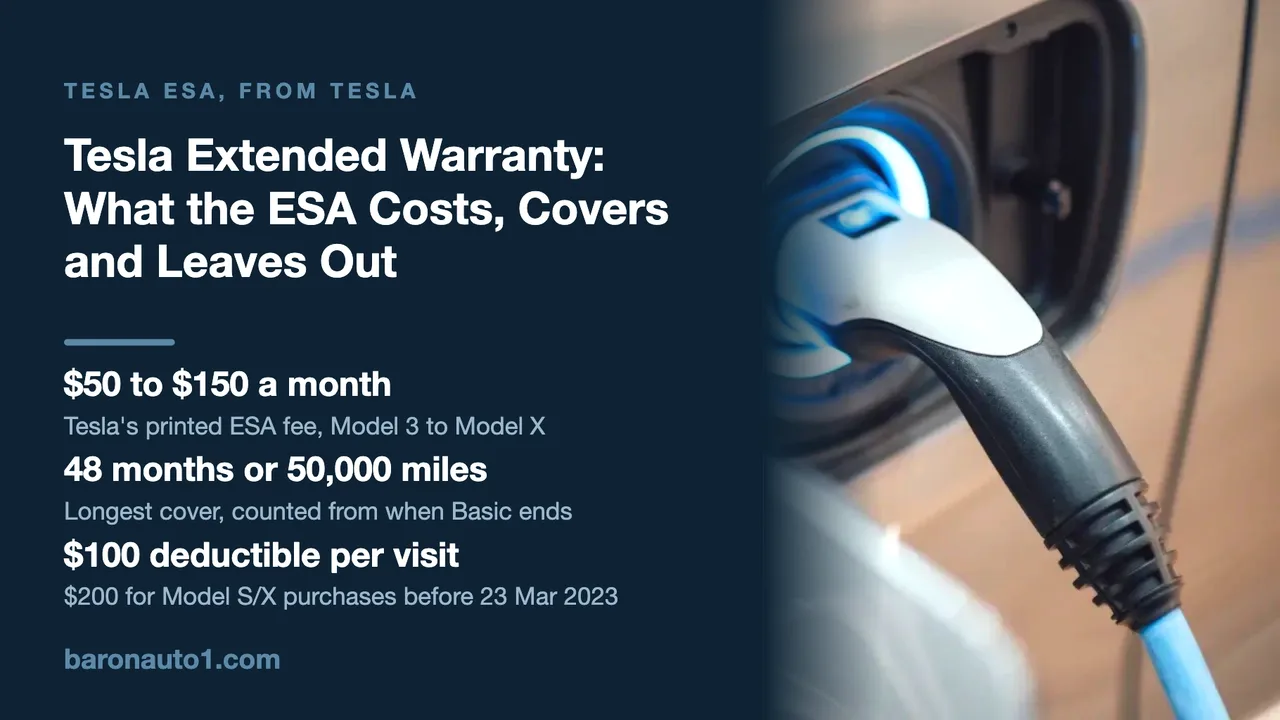
- Tesla’s extended warranty is the Extended Service Agreement (ESA), a monthly subscription sold only in the Tesla app for the Model S, Model 3, Model X and Model Y. Tesla, Inc. owes you the repair, and the contract says no reimbursement insurance policy guarantees it.
- Tesla prints the price: $50 a month for a Model 3, $60 for a Model Y, $125 for a Model S and $150 for a Model X, plus a $100 deductible per repair visit. The most you can pay in fees is 48 months’ worth, $2,400 to $7,200 before tax.
- Cover starts when the 4-year, 50,000-mile Basic warranty ends and lasts up to 48 months or 50,000 miles from then, never past 8 years or 100,000 miles. The support page quotes only the 8-year, 100,000-mile cap. A car that reaches 4 years with 30,000 miles is covered only to 80,000 miles (our arithmetic).
- The ESA excludes the high-voltage battery and drive unit. Model 3 and Model Y owners can buy a separate Battery ESA for $2,000 before the battery warranty ends: 2 years or 30,000 miles more, a $500 deductible per visit, and no cover for lost capacity.
- You can subscribe without an inspection until the Basic warranty ends, and for up to 1 year after with a paid inspection if the car is under 5 years’ production age and 62,500 miles. A cancelled ESA can never be restarted. Tesla’s documents disagree in places; the contract you accept governs.
Tesla’s extended warranty is the Extended Service Agreement, or ESA: a vehicle service contract that Tesla sells itself, as a monthly subscription in the Tesla app, to follow the factory Basic Vehicle Limited Warranty. The contract says it is “not simply an extension of Your New or Pre-Owned Vehicle Limited Warranty, but instead has its own exclusions and deductible.” Tesla publishes both the full contract and the price, so what the plan promises can be read rather than guessed. This page works from Tesla’s own documents: the ESA terms dated 1 July 2026 (form SC-25-00-004 R4) and the July 2025 revision they replaced, the Battery ESA terms dated 11 December 2025, the New Vehicle Limited Warranty effective 1 September 2026, the Roadside Assistance policy and six Tesla support pages, all read on 30 September 2026.
What Tesla sells, and who owes you the repair
Tesla’s support page calls the product the ESA subscription; the contract is the “Vehicle Extended Service Subscription Agreement”. It replaced a “two-year ESA” paid for up front, which Tesla says provides “the same coverage”. Tesla also sells a separate Battery ESA for the Model 3 and Model Y, and monthly plans for windshields and for wheels and tires.
The contract names the obligor, the company bound to pay your claim: “‘Tesla’ means the obligor, Tesla, Inc.” In Florida, Nevada, New York and Texas it is a separately named Tesla entity, such as Tesla Motors TX, Inc. in Texas. Many service contracts split the work between an obligor and an administrator that decides claims. The ESA names no administrator: a claim is a request for service at a Tesla Service Center, and Tesla does the repair. Our guide to who actually owes you the repair explains why the obligor is the name to check.
One sentence deserves a second read. Tesla’s obligations “are backed by the full faith and credit of Tesla and are not guaranteed under a service contract reimbursement policy.” A reimbursement policy is insurance that pays covered claims if the obligor doesn’t. The ESA has none, so Tesla’s promise is the whole of the backing, and the Battery ESA says the same. For Missouri the contract adds that it “is not an insurance contract”. Service contracts are regulated state by state; our guide shows what a state register will tell you.
The sales channel is narrow too. Tesla offers the ESA “as a monthly subscription in the Tesla app”, only to the registered owner and only after delivery. It can’t be added to the price of a financed car, and it isn’t a condition of buying, leasing or financing one.
The price: a monthly fee Tesla prints, plus a deductible per visit
The fee appears in the contract and on the support page, and the two agree. The contract also prints a “Maximum Subscription Cost”, defined as “the total Monthly Fee multiplied by 48 months.”
| Model | Monthly fee | 12 months (our arithmetic) | Maximum subscription cost (Tesla, 48 months) |
|---|---|---|---|
| Model 3 | $50 | $600 | $2,400 |
| Model Y | $60 | $720 | $2,880 |
| Model S | $125 | $1,500 | $6,000 |
| Model X | $150 | $1,800 | $7,200 |
The deductible is $100 “for each Visit there is a covered Failure”, or $200 “for Model S/X Purchases prior to March 23, 2023”. The terms don’t say whether that means cars or earlier agreements bought before that date. A visit can be at a Tesla Service Center or a mobile service call, and the deductible is charged per visit, not per part. Taxes come on top of fees and deductibles. The fee is “subject to change at any time”, with at least 30 days’ notice. Payments are collected automatically, Tesla Credits can’t be used, and nothing is charged until the Basic warranty expires.
Our guides explain why most plans have no sticker price and where a dealer’s markup comes from. Neither applies here: there is no dealer and no quote to negotiate. The figure to watch is the total, which the section on deciding works out by driving pace.
How long it runs: four limits, and the one the support page leaves out
The contract covers “up to 4-Years (48 Months) or 50,000 miles from the Coverage Start Date, whichever comes first, but not to exceed 8 years in total vehicle age or 100,000 total vehicle miles”. The Coverage Start Date is the day the Basic warranty expires, at 4 years or 50,000 miles from first delivery. So there are four limits, and cover ends at the first one reached: 48 months after the start, 50,000 miles after the start, 8 years from first delivery, or 100,000 miles on the odometer.
The support page mentions only the last two: cover “will last until your vehicle reaches 8 years or 100,000 miles, whichever comes first.” That was the whole rule in the July 2025 terms. The July 2026 terms added the two limits counted from the start date.
| When the Basic warranty ends | ESA ends at (contract) | Support page | Contract falls short by |
|---|---|---|---|
| On the calendar at 4 years, with 30,000 miles on the odometer | 8 years or 80,000 miles | 8 years or 100,000 miles | 20,000 miles |
| On the odometer at 50,000 miles, 2 years after first delivery | 6 years or 100,000 miles | 8 years or 100,000 miles | 2 years |
| At 4 years and 50,000 miles together | 8 years or 100,000 miles | 8 years or 100,000 miles | Nothing |
For any car that subscribes before its Basic warranty ends, the outer cap never bites. That warranty ends by year 4 and by 50,000 miles, so 48 more months can’t pass year 8 and 50,000 more miles can’t pass 100,000 (our arithmetic). The ESA buys at most 48 months and at most 50,000 miles of driving. The gap shows when driving changes, as when a low-mileage car goes to a long-distance commuter.
Work out your own end date. The support page’s “8 years or 100,000 miles” is the outer limit, not the term. Note the date and odometer reading on the day your Basic warranty expires, then add 48 months and 50,000 miles. Whichever comes first, capped at 8 years and 100,000 miles, is when cover stops.
The start date is described three ways. The contract ties it to the Basic warranty alone. The ESA page says cover begins when “your original New Vehicle Basic or Pre-Owned Vehicle Limited Warranty expires”. Tesla’s warranty page says the ESA starts when “your original New Vehicle Limited Warranty expires”, a warranty that also contains coverages running to 8 and 12 years. For a car bought new they land on the same day; for a Certified Pre-Owned car they may not. However it starts, the plan “may not be renewed by You” once its period ends.
Who can subscribe, and when the window closes
The support page lists the Model S, Model 3, Model X and Model Y, “with Cybertruck coming in the future.” It lists no model years. Eligibility follows the warranty clock instead:
| Where the car stands | Inspection | Age and mileage limit |
|---|---|---|
| Basic warranty still running | None | None beyond the Basic warranty itself |
| Certified Pre-Owned, Pre-Owned warranty still running | None | Production age under 5 years, odometer under 62,500 miles |
| Within 1 year after the Basic or Pre-Owned warranty expired | A paid inspection by Tesla, which the car must pass | Production age under 5 years, odometer under 62,500 miles |
After that year the July 2026 terms offer no route in, and none once the car passes 5 years of production age or 62,500 miles. The terms don’t define production age.
The owner pays for the inspection, and any repairs it calls for “must be completed prior to purchasing the ESA.” Tesla doesn’t print the inspection price, and the checklist the contract refers to, form SC-25-00-005, sits behind a sign-in on Tesla’s service portal, so we couldn’t read it. Pass, and the July 2026 terms give you 7 days to subscribe. Fail, and you have 30 days to fix the faults at your expense and return for a free second inspection. The support page offered owners whose warranty expired before the launch “up to 30 days or 1,000 miles after your scheduled appointment”. Plan on 7.
Leased cars don’t qualify, though the page still says Tesla “will begin offering ESA subscription eligibility by the end of 2025” to drivers who buy out their lease. Cars with a salvage, rebuilt or similar branded title, or an insurance total loss, are excluded. The plan is sold in the United States and Canada only.
Who sold you the car matters, and here the documents part company. The July 2025 terms covered cars “sold ... by Tesla or a third party”. The July 2026 terms cover “a purchased Vehicle sold by Tesla directly to You”, or “a subsequent owner who assumes this Agreement from a valid transfer”. The page’s checklist says nothing about the seller. If you bought a used Tesla privately and the last owner never subscribed, only the app can tell you whether you qualify.
Certified Pre-Owned cars
Tesla “now offers the ESA subscription to Certified Pre-Owned titled vehicles”. Their Pre-Owned warranty adds 1 year or 10,000 miles, and on a young car that year starts when the Basic warranty ends, so it can run to 5 years from first delivery. Our Tesla Certified Pre-Owned guide explains how the two warranties stack. Because the no-inspection route closes at 5 years of production age, a CPO owner who waits for the Pre-Owned year to run out may find the car has aged out. Billing is unclear too: the support page says payments begin once the Pre-Owned warranty “has fully expired”, while the contract ties the first charge to the Basic warranty. Confirm it in the app.
What the car already has: Tesla’s New Vehicle Limited Warranty
The ESA follows the New Vehicle Limited Warranty, which “begins on the first day a new vehicle is delivered by Tesla to the first retail or corporate purchaser(s) or lessor(s)” and transfers to later owners at no cost. The version recorded here is effective 1 September 2026; Tesla says a car bought earlier keeps the warranty in force on the day it was bought.
| Coverage | Term | What the ESA does with it |
|---|---|---|
| Basic Vehicle Limited Warranty | 4 years or 50,000 miles | Follows it |
| Supplemental Restraint System (seat belts, air bags) | 5 years or 60,000 miles | Unclear: the support page excludes restraint systems; the contract doesn’t |
| Battery and Drive Unit | 8 years or 100,000, 120,000 or 150,000 miles by model and tier, minimum 70% capacity | Excluded; a Battery ESA can follow it on a Model 3 or Model Y |
| Body Rust (perforation) | 12 years, unlimited miles | Corrosion and paint are ESA exclusions |
| High-Priced Propulsion-Related Parts, model year 2026 and later | 7 years or 70,000 miles | Overlaps it; no duplicate remedy |
| Emissions Performance Warranty, Model 3 and Model Y, model year 2027 and later | 8 years or 80,000 miles on major components | Overlaps it; no duplicate remedy |
So the ESA carries the Basic warranty’s kind of cover, repairs to parts Tesla made or supplied, past 4 years or 50,000 miles. It is written as a list of exclusions, not of covered parts: a “Covered Part” is any Tesla part “excepting any part excluded”, and a repair “may include a change to software”.
Newer cars overlap it. Model year 2026 and later cars carry a High-Priced Propulsion-Related Parts warranty of 7 years or 70,000 miles on parts “that reach a certain pricing threshold”; Tesla lists them in a PDF for each model, which we couldn’t open. Model 3 and Model Y cars from model year 2027 add an Emissions Performance Warranty of 8 years or 80,000 miles on components “needed to charge the high voltage battery, store energy or transmit power to move the vehicle.” While those run, the ESA adds nothing for the parts they cover, because Tesla “is not obligated to provide duplicate remedies for the same issue under this Vehicle ESA and any Tesla limited warranty.” Tesla also says it “may occasionally offer to pay” for repairs no longer covered, through adjustment programs: goodwill, not cover.
The battery and drive unit: excluded, and sold separately
The ESA excludes “The HV Battery and Drive Unit, including repairs covered under other applicable limited warranties”, and the low-voltage battery. For the Model 3 and Model Y, Tesla sells a second contract for the years after the battery warranty, the Battery ESA:
- Price: $2,000, paid once. It can’t be paid monthly or added to a car’s financing.
- Deductible: $500 per service visit with a covered repair.
- Term: 2 years (24 months) or 30,000 miles, whichever comes first, from the day the battery warranty expires.
- Deadline: it must be bought before that warranty expires. “There is no grace period.”
- Eligibility: a new or Certified Pre-Owned Model 3 or Model Y, not leased, without a branded title; one per car. Tesla, Inc. is again the obligor, with no reimbursement policy behind it.
Stacked on the battery warranty, it can run to 10 years from first delivery, or 130,000 miles on a standard-tier car and 150,000 on a long-range or Performance car. Those are end points (our arithmetic); each term still ends at whichever limit comes first.
The exclusions matter more than the term. The battery warranty includes a minimum 70% retention of battery capacity. The Battery ESA excludes “Failures or degradation specific to Battery capacity or energy retention”, so it pays for a battery or drive unit that fails, not one that has lost range. It also excludes external components, fuses, wire harnesses and cables, sensors, coolant hoses, damage from outside forces or flooding, and off-road driving, with no exception for the Model Y. Refunds are gentler than the ESA’s: in full before cover starts and for 60 days after if you haven’t claimed, then based on unused time or mileage, less claims. Tesla offers no Battery ESA for the Model S or Model X.
What the ESA doesn’t cover
Besides the battery and drive unit, the July 2026 contract excludes the low-voltage battery; tires and wheels; body and trim, including paint, glass and the windshield, bumpers, upholstery, interior trim and seals; charging accessories; and maintenance items, including brake pads and rotors, alignment, wheel balancing, hoses, fluids, filters and wiper blades. It also excludes damage by cause: accidents and weather, commercial use such as “pick-up and delivery service”, overloading, off-road driving (the Model X and Model Y excepted), racing, “squeaks, rattles, water leaks, or wind noise” and “the gradual reduction in operating performance due to normal wear and tear.” Skipped maintenance or recall work can cost you a claim, and Tesla “may exclude coverage for any issue arising from maintenance, service, repairs, or parts not provided by Tesla.”
The support page’s list differs. It also excludes “shocks and struts”, “keys” and “safety and restraint systems”. The July 2026 contract names none of them. The July 2025 contract named shock absorbers, lenses and light bulbs, which have also gone. If one of those parts fails, the contract you accepted is what governs.
For glass, wheels and tires Tesla sells separate monthly plans: a Windshield Protection Plan at $16 to $23 a month across the four models, with one free replacement every 12 months, and a Wheel and Tire Protection Plan at $12 to $25 a month, with a $25 deductible per replacement appointment. Each has its own terms, which we didn’t read.
Making a claim: Tesla decides, and Tesla repairs
A claim is a service appointment, and the contract is strict about where: “You must bring the Vehicle to a Tesla Service Center, not a TABS or TACC”, meaning the Tesla-approved body shops and collision centers it describes as independently owned. Tesla won’t pay for work done by anyone other than “a Tesla Service Center or Tesla Mobile Service.” Tell Tesla about the ESA “before repairs are performed”, stop driving if that prevents further damage, and expect to show maintenance records and authorize access to vehicle data. If an uncovered modification or a refused software update adds work, you pay for it. If payments are behind, Tesla “may decline to provide service” until they are made.
Tesla decides whether to repair or replace, and may use “non-original manufacturer’s parts or remanufactured parts”. Liability is capped at each part’s suggested retail price, at the car’s fair market value for any one failure, and at the price originally paid to Tesla for the car in total. Rental cars, “loss of use” and “transportation to and from a Tesla Service Center” are disclaimed.
Roadside assistance does come with it, though Tesla changed its position. The July 2025 terms said it “is not provided under this Vehicle ESA”; the July 2026 terms say it “is available to those covered under this Agreement”, and Tesla’s roadside policy calls it complimentary for cars with an active Basic warranty or ESA. The policy covers transport of up to 500 miles to the nearest Tesla Service Center after a breakdown from a covered fault, and flat-tire help within 50 miles of a service center, with the tire repair at your cost. Running out of charge is “not a financially covered service,” and the policy says “This is not a warranty.”
Selling the car, cancelling, and why cancelling is final
The ESA goes with the car. Record the sale in the Tesla app, your payments stop, and “the new owner will have the option to continue this Vehicle ESA”. Don’t cancel before a sale; the contract says to transfer instead. For a used-car buyer, taking over an existing ESA is the one route the July 2026 terms spell out for a car Tesla didn’t sell them.
You can cancel in the app at any time without a fee, though in Alabama Tesla may keep up to $25. Cancellation takes effect at the end of the monthly period. Before cover starts, you get back any payment you made. After it starts, “there is no refund provided for cancelation in most states”. The exceptions, a full refund minus claims if you cancel within a set number of days of the start, are California, 60 days; Missouri, 45 days; and Iowa, Missouri, New Jersey, Vermont and Wisconsin, 30 days. Missouri appears twice, and the contract doesn’t say which figure applies. A refund paid more than 30 days after Tesla has the paperwork carries a penalty of 10% per month.
Cancelling is permanent. Once a cancelled subscription’s billing cycle ends, “you will not be able to resubscribe”, and no car that has had an ESA can get another. The support page lets you change your mind within the same billing cycle, but not after. If you want cover in the later years, the only way to have it is to keep paying through the earlier ones.
Tesla can cancel too, for non-payment, fraud, the destruction of the car or a branded title, with at least 30 days’ notice unless the law allows less. Holders of the old two-year ESA follow their own contract; cancelling one that has started takes a paper form with a “wet signature”. More in our guides to cancelling a plan and how cancellations go wrong.
Disputes: arbitration that reaches your finance contract
A dispute starts with a written notice to resolutions@tesla.com. If it isn’t resolved within 60 days, it goes to a single arbitrator at the American Arbitration Association, not to a court. Tesla pays all AAA fees, the hearing is held in your city or county, class claims are barred, and small claims court stays open to you. You can opt out within 30 days after signing, by letter giving your name, order number or VIN. If you don’t, the clause “overrides any different arbitration agreement between us, including any arbitration agreement in a lease or finance contract.” In Washington, buying the ESA within 90 days of buying the car from Tesla doesn’t waive the car’s implied warranty of merchantability; elsewhere the contract disclaims implied warranties or limits them to its own term.
What changed between the July 2025 and July 2026 terms
Both revisions are still online, and the support page links the July 2026 one. They differ on most of what a buyer would check.
| Term | July 2025 | July 2026 |
|---|---|---|
| How long it runs | Up to 8 years or 100,000 miles in total | Up to 48 months or 50,000 miles from the start, within 8 years or 100,000 miles |
| When cover starts | When the Basic or Used Vehicle Limited Warranty expires | When the Basic Vehicle Limited Warranty expires |
| Whose car qualifies | Sold by Tesla or a third party | Sold by Tesla directly to you, or taken over by transfer |
| Price and deductible | Neither printed | Fee table printed; $100 per visit, or $200 for Model S/X purchases before 23 March 2023 |
| Days to subscribe after passing an inspection | 30 | 7 |
| Refund after cover starts | Full within 60 days if no claim, then based on unused time or mileage | None in most states; exceptions of 30 to 60 days |
| Roadside assistance | Not provided under the ESA | Available to those covered |
| Named exclusions | Included shock absorbers, lenses, light bulbs | None of these named |
| Covered visits | At a Tesla Service Center | At a Service Center or by mobile service |
Some changes favor owners: a printed price and deductible, roadside assistance and mobile service. Others don’t: shorter cover for cars whose driving changes, no 60-day refund, a 7-day window after an inspection and narrower wording on whose car qualifies. The support page still describes the older term and still carries launch text, such as a 30-day grace period that ended on 18 July 2025. Its own advice is the right rule: go by “the terms and conditions provided when you subscribed to the ESA”, and save a copy.
Is it worth it? The arithmetic Tesla’s numbers allow
Whether any service contract pays is covered in our guide to whether an extended warranty is worth it. Tesla publishes no repair prices or claim data, so we can’t say what an out-of-warranty repair would cost. Its terms do show what the cover costs a given driver, because the fee is monthly and the cover stops at 50,000 miles.
| Miles a year after Basic ends | Months of cover | Model 3 | Model Y | Model S | Model X |
|---|---|---|---|---|---|
| 12,500 or fewer | 48 | $2,400 | $2,880 | $6,000 | $7,200 |
| 15,000 | 40 | $2,000 | $2,400 | $5,000 | $6,000 |
| 20,000 | 30 | $1,500 | $1,800 | $3,750 | $4,500 |
| 25,000 | 24 | $1,200 | $1,440 | $3,000 | $3,600 |
Heavy drivers pay for fewer months and use all 50,000 miles; light drivers pay for all 48 months and use fewer. Deductibles come on top. Two more things narrow the decision. What is already covered: the battery and drive unit have their own 8-year warranty, and on a 2026 or later model some high-priced propulsion parts run to 7 years or 70,000 miles. And what else is on offer: a third-party contract names its own obligor and administrator and may let you use independent shops, which matters if you live far from a Tesla Service Center. Ask who the obligor is and whether it is registered in your state. Some insurers sell mechanical breakdown insurance instead.
- Find your Basic warranty end date on the app’s Specs & Warranty screen. Add 48 months and 50,000 miles, capped at 8 years and 100,000 miles.
- Subscribe before the Basic warranty ends to avoid a paid inspection. Nothing is charged until it expires.
- On a Certified Pre-Owned car, act early, while it is under 5 years’ production age and 62,500 miles.
- Diary the Battery ESA deadline on a Model 3 or Model Y: before the battery warranty ends, with no grace period.
- Save the contract you accept and every service record.
- Decide on arbitration within 30 days. The clause also reaches a lease or finance contract with Tesla.
- Don’t cancel casually. After the billing cycle ends, the car can never be enrolled again.
Calls and letters saying your Tesla warranty is about to expire are a separate matter. Tesla sells the ESA only in its app, so a caller offering a “Tesla extended warranty” is selling someone else’s contract. In 2022 the FTC sued American Vehicle Protection Corp., alleging it had falsely claimed to be, or to be associated with, consumers’ carmakers or dealers, and had promised bumper-to-bumper or full coverage that was much more limited than represented. A stipulated order in March 2023 and a further order that July banned defendants from selling extended auto warranties and from outbound telemarketing. In 2024 the FTC sent more than $449,000 in refunds to consumers. See what regulators have done.
Common questions
How much does the Tesla extended warranty cost?
Tesla prints it: $50 a month for a Model 3, $60 for a Model Y, $125 for a Model S and $150 for a Model X, before tax, plus a $100 deductible per covered visit. The most you can pay in fees is 48 months’ worth, $2,400 to $7,200. The Battery ESA for a Model 3 or Model Y is a one-time $2,000, with a $500 deductible per visit.
Is the Tesla extended warranty worth it?
It depends on how you drive and what your car already has. The ESA covers Tesla-made parts other than the battery, the drive unit and its listed exclusions, for up to 48 months or 50,000 miles after the Basic warranty ends. A driver covering 25,000 miles a year uses the 50,000 miles in 24 months and pays for 24; a light driver pays for all 48 (our arithmetic). Tesla publishes no repair prices, so weigh the total against a repair bill you could absorb.
Can I buy the Tesla extended warranty after my warranty expires?
For up to 1 year after, under the July 2026 terms, if the car passes a paid inspection and is under 5 years’ production age and 62,500 miles. You then have 7 days to subscribe. After that year, or once the car passes either limit, the terms offer no way in.
Does the Tesla extended warranty cover the battery?
No. The ESA excludes the high-voltage battery, the drive unit and the low-voltage battery. The battery and drive unit have their own warranty of 8 years and 100,000, 120,000 or 150,000 miles by model, whichever comes first, with a 70% capacity floor. On a Model 3 or Model Y, a $2,000 Battery ESA adds 2 years or 30,000 miles if bought before that warranty ends, but it doesn’t cover lost capacity.
Is the Tesla ESA transferable?
Yes. Record the sale in the Tesla app and your payments stop; the new owner can choose to continue the subscription. The Battery ESA transfers too. If you would rather have a Battery ESA refund, cancel before the transfer, because afterwards only the new owner can.
Can I get the Tesla ESA on a used Tesla?
On a Tesla Certified Pre-Owned car, yes, without an inspection while the Pre-Owned warranty runs, if the car is under 5 years’ production age and 62,500 miles. On a car bought privately or from another dealer, Tesla’s documents disagree, and the July 2026 terms clearly allow only an existing ESA taken over by transfer. Check eligibility in the app.
Sources and further reading
- CFPB consumer complaint database
- CFPB auto loan resources
- FTC: auto service contracts and warranties
- FTC: a businessperson’s guide to federal warranty law
- 15 U.S.C. § 2301 (Magnuson-Moss definitions)
- 15 U.S.C. § 2308 (Implied warranties)
- Texas Department of Licensing and Regulation — service contract providers, Occupations Code Chapter 1304
- Florida CFO — motor vehicle service agreements, Chapter 634
- FTC v. American Vehicle Protection Corporation — case docket
- FTC — industry ban and judgment, American Vehicle Protection
- FTC — refunds paid to consumers harmed by an extended vehicle warranty scheme
- FTC withdrawal of the CARS Rule (91 FR 6507)
Recall, complaint and safety-rating figures on this page were retrieved from the federal databases above on August 19, 2026. Federal data changes — re-check any VIN before you rely on it.
Published September 30, 2026 · last updated September 30, 2026. Found something out of date or wrong? Tell us and we will correct it.