Santander Consumer USA Review: Payments, Hardship and Record
Santander Consumer USA buys dealers’ car contracts, and since April 2025 Santander Bank services many of them. Its payment fees, title-release rules, extension and mature-modification terms, charge-off policy and settlement record, from its own pages and filings.
The short version
- Santander Consumer USA is the Dallas car lender of Santander Holdings USA, which Banco Santander owns. Since 1 April 2025 Santander Bank, N.A. has serviced many of its loans, and a December 2025 application to merge the two had not closed in any filing we read.
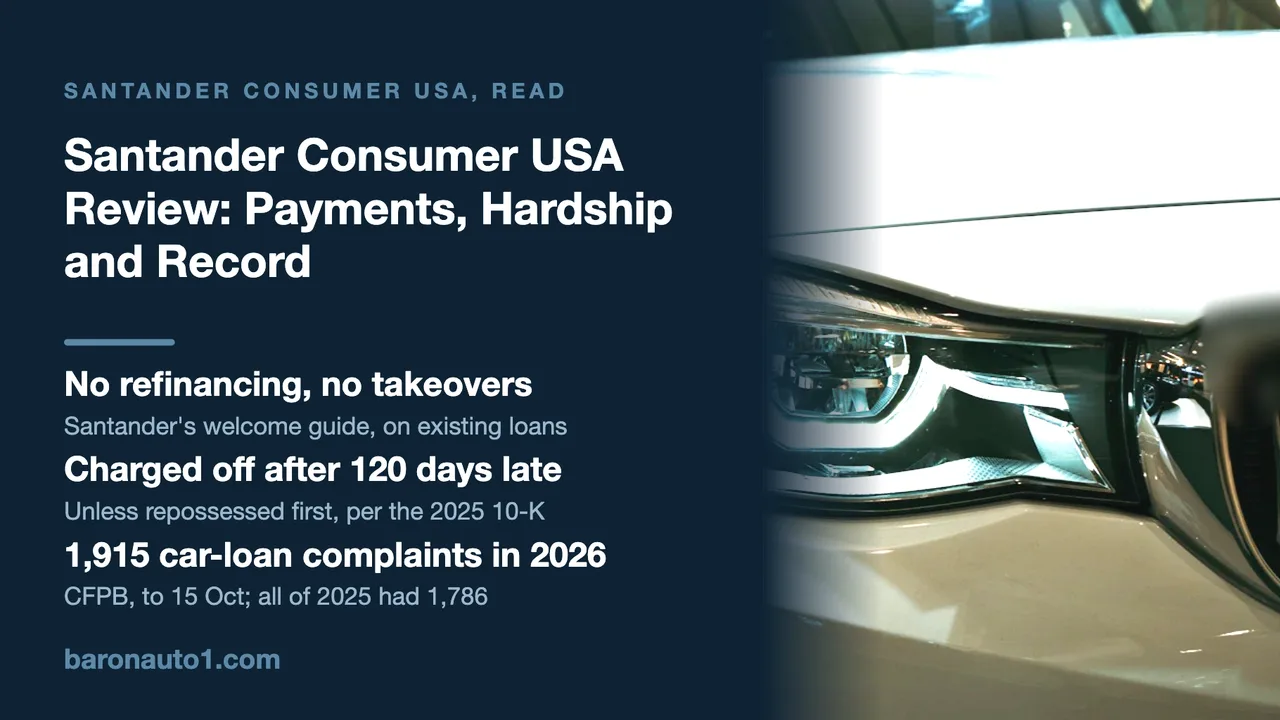
- Most Santander loans start at a dealer, which sells your contract to Santander. Its 10-K says it buys some at a discount and can pay dealers “participation fees” on loans that perform. Its welcome guide says it does not refinance existing accounts and its contracts cannot be taken over.
- AutoPay, bank payments and mail are free; a debit card costs $3.28, PayPal or Venmo $6.75 and PayNearMe cash $3.99. Mail takes seven to ten business days to process, says the payments page; the welcome guide says to mail 5 to 7 days early.
- If you are struggling, ask before you are 30 days late: Santander says a later extension does not remove the late mark. A “mature modification” can stretch a balance left at the end of the loan, with no fee but more interest.
- A loan more than 120 days late is charged off unless the car has been repossessed, the 10-K says, and Santander has an agreement to sell charged-off loans in bankruptcy to a third party each quarter.
- The record includes a 2015 Justice Department consent order over servicemembers’ repossessions, 2017 settlements with Massachusetts and Delaware, two CFPB consent orders and a 2020 settlement with 34 attorneys general. The CFPB logged 1,915 Santander car-loan complaints in 2026 by 15 October.
Most people who search for Santander Consumer USA already have one of its car loans and want to pay it, get out of it or get help with it. On 17 and 18 October 2026 we read what Santander publishes for those borrowers (its payments, titles, insurance and servicemember pages, its help articles and welcome guide), its parent Santander Holdings USA’s 10-K for 2025, 10-Q to 30 June 2026 and two 2026 8-Ks, Santander Consumer USA’s own 10-Q for mid-2017, and the CFPB’s complaint counts. The CFPB orders and the 2020 multistate settlement come from our Chrysler Capital review, which read them on 6 October 2026. We entered no login, application or payment, and this site has no commercial relationship with Santander or any lender.
Who owns Santander Consumer USA, and who services your loan
Santander Consumer USA Inc. (SC) is not a bank. Its parent’s 10-Q describes the holding company, Santander Consumer USA Holdings Inc., as “a consumer finance company headquartered in Dallas, Texas and a wholly-owned subsidiary of SHUSA,” meaning Santander Holdings USA, whose “two largest subsidiaries by asset size and revenue are SBNA and SC.” SBNA is Santander Bank, N.A., and “SHUSA is a wholly-owned subsidiary of Santander,” the Spanish bank Banco Santander.
The two subsidiaries are being pulled together. On 30 December 2025 the bank “filed applications with the FDIC and OCC for approval to merge Santander Consumer USA Holdings Inc.” into itself; the 10-Q to 30 June 2026 still calls it an application, and nothing we read says it has closed. The bank has also grown: SHUSA’s 8-K of 20 August 2026 reports that Banco Santander completed its purchase of Webster Financial Corporation and that Webster Bank “was merged with and into SBNA.”
Servicing has already moved for many borrowers. A help article dated 2 April 2025 says: “On April 1, 2025, Santander Consumer USA Inc. transferred the servicing rights for many accounts to Santander Bank, N.A.” Affected borrowers were notified by email, text or letter, MyAccount shows the current servicer, and from May 2025 those accounts report to the credit bureaus with “Santander Bank in the name.” Balance, rate, maturity date, account number, payment options and MyAccount access did not change. The current welcome guide carries the footnote “Serviced by Santander Bank, N.A.” Former Chrysler Capital accounts followed on 19 September 2026; our Chrysler Capital review covers that.
Santander uses other names too. RoadLoans, another of its trademarks, now opens on a page saying “Drive is a Santander Consumer USA Inc. program.” And SC services loans it did not make: its pages welcome borrowers of Happen Bank, the new name of LendingClub, and former customers of Gateway One Lending & Finance, “a TCF Bank company.” The 10-K calls this “serviced for others” business “a significant and growing portion of the auto lending business strategy,” which is why a Santander bill can arrive for a loan taken out elsewhere. The home page shows INEOS Grenadier, Lotus and Mitsubishi Motors logos under “Proud to be a preferred lender for major brands and vehicle manufacturers,” and the footer gives NMLS ID 4239 for the national licensing registry.
How a dealer’s contract becomes a Santander loan
Santander says it works “directly with trusted dealerships” and tells shoppers to “ask your dealer for financing through Santander Consumer USA.” Its parent’s 10-K describes the business as “indirect origination and servicing of vehicle loans and leases, principally through manufacturer-franchised dealers,” plus a “web-based direct lending program” and loans bought from other lenders. In practice you sign a retail installment contract with the dealer, and the dealer sells it to Santander.
The 10-K is plain about the money that changes hands. Santander’s contracts include receivables “acquired individually from dealers at a nonrefundable discount from the contractual principal amount,” a discount that applies when “the contractual interest rate on the loan is not sufficient to compensate for the credit risk of the borrower.” Money also flows the other way: “participation fees, or premiums, paid to the dealer as a form of profit-sharing, rewarding the dealer for originating loans that perform.” The filing does not say how large either payment is, but both are settled between Santander and the dealer, so arrive with a rate to compare; our guides to pre-approval and dealer fees explain how.
Santander’s page for dealers claims “14,000 active franchises dealer relationships,” “73% of applications submitted are approved” and that 96% of “complete contract packages fund on the same day they are received,” and offers dealers a “rehash tool” to “maximize profit on every deal.” Its page for shoppers says “We work with 15,000 dealerships nationwide.” The 10-K, as our Chrysler Capital review recorded on 6 October 2026, places each applicant “in one of 100 pricing tiers” using FICO scores, debt-to-income and loan-to-value ratios “and over 30 other predictive factors.” Santander publishes no APR.
The routes that look direct still end at a dealer. Drive, Santander’s pre-qualification tool, says starting “doesn’t impact a shopper’s credit,” but warns: “Final credit terms are subject to change based on submittal of a credit application at a participating dealer, which may impact your credit.” Since November 2025 Santander has been a lender on Amazon Autos, where a shopper “may receive offers from multiple lenders” and finishes with “their local participating dealer.”
After signing, your loan may be sold or pledged. The 10-K says Santander “sells consumer vehicle loans and leases through flow agreements” and securitizes them: about $8.0 billion on its SDART platform (Santander Drive Auto Receivables Trust) and $2.9 billion on its DRIVE platform in 2025. It keeps servicing them for “a monthly servicing fee,” with “supplemental fees, such as late charges” counted as servicing income, and at the end of 2025 it serviced $25.1 billion of contracts held in such trusts. You keep paying Santander either way.
Two lines in the welcome guide matter later: Santander contracts “cannot be taken over or assumed on your behalf by a third party,” and “Santander Consumer USA does not refinance existing accounts.” To lower the rate, another lender has to pay Santander off; our refinancing guide covers how.
Paying Santander: the free ways, the fees and the mail problem
Santander’s payment options page lists many ways to pay, and only some are free. Fees go to “third-party payment processing partners”; Santander says it “retains no part of these fees.” The amounts match what our Chrysler Capital review read there on 6 October 2026.
| Method | Fee printed | What the page adds |
|---|---|---|
| AutoPay from a checking or savings account | Free | Your account “must not be past due” to enroll |
| One-time bank (ACH) payment in MyAccount | Free | From a checking or savings account |
| Automated phone line, paying from a bank account | Free | A debit card by phone or with an agent costs $3.28 |
| Debit card online | $3.28 | Same-day payment |
| Apple Pay or Google Pay (debit) | $3.28 | In MyAccount |
| PayPal or Venmo | $6.75 | In MyAccount |
| Cash through PayNearMe | $3.99 | At 7-Eleven, CVS and other stores, with a code from MyAccount |
| Western Union, MoneyGram or CheckFreePay | “May charge a fee” | No amount printed; offered for urgent payments |
| Mail (personal check, cashier’s check or money order) | Free | “Seven to ten business days” to process |
Small fees add up. By our arithmetic, a year of monthly payments costs $39.36 by debit card, $81 by PayPal or Venmo and $47.88 through PayNearMe, and a five-year loan paid by debit card carries $196.80 in fees.
Timing matters as much as method. Santander’s explainer on its simple-interest contracts says “interest accrues daily,” so paying late “even by ONE DAY” sends more of the payment to interest. The payments page adds that “late fees may be assessed to your account in accordance with your contract and state law.” Santander prints no late-fee amount; it is in your contract.
Mail is where Santander’s own documents disagree. The payments page says “it takes seven to ten business days for a payment to process via mail” and that “it is inadvisable to send a late payment via regular mail.” The welcome guide says: “Mail your check 5 to 7 days before the due date to ensure the payment is received on time.” Go by the longer figure, write your 7-digit account number on the check, and never mail cash. Happen Bank borrowers who pay Happen Bank instead are told forwarding “may delay posting by a few days.”
Paying off the loan and getting your title
A payoff quote comes from MyAccount. The payments page says payoffs “can be made by the following methods only” (checks by regular or overnight mail) and warns: “Personal checks may have an extended title release timeframe.” A dealer paying off your trade-in “must enclose an authorization form signed by the borrower” for Santander to send the title to the dealership; ask the dealer for a copy.
Nothing moves until the balance is exactly zero: “If there is an amount due of any kind, it won’t prompt the title release process to begin,” Santander’s blog says. A help article dated 29 July 2026 says the title is released “based on your state’s law timeframe and final reconciliation of accounting,” under the rules of the state where the car is titled, which “may NOT be the state in which you reside.”
Where the lender holds the title, Santander sends it with a lien release; in a title-holding state you get a lien release to attach. For electronic titles Santander notifies the state, which prints and mails the title; the blog says to “allow up to three weeks” for that. Santander’s documents disagree on which states mail it to the registration address and which make you ask: the titles page names California and Florida, the July 2026 help article California and Texas, and Florida and Ohio, and the blog Ohio and Florida. Check with your own state’s titling office, and take a paper title or lien release there to have a new title issued “with no lienholder”; any state fee is yours.
Moving states during the loan takes longer. For an electronic title, Santander asks your old state to print it, which “averages four to six weeks,” and the new state “should receive your title within fifteen business days” after Santander gets the printed copy.
Paying off before the original maturity date can earn a refund on add-ons: Santander says you are then “entitled to a refund in the amount of the unused premium,” less any cancellation fee, and should ask the dealer to process the cancellation.
Insurance the contract requires, and what a total loss leaves behind
Santander’s claims page says: “Your contract includes a mandatory requirement to maintain an insurance policy which includes comprehensive and collision coverage, to have a loss payee and additional insured endorsement.” The welcome guide repeats it and asks you to list Santander Consumer USA as loss payee. Liability-only cover does not meet the contract.
After an accident you must keep paying (“you must remain current with your auto loan payments”) and report the insurer’s claim number to Santander. If the car is a total loss, the insurer “should contact Santander to obtain a payoff amount and request a Letter of Guarantee,” and “if a balance remains after all insurance proceeds are applied, you are responsible for paying the remaining balance.” That gap is what GAP coverage is for; our GAP guide explains how it pays. Santander warns, in an article our Chrysler Capital review read, that an extension “may” reduce what GAP covers. Once insurance money has been posted, you “may qualify for an insurance modification” of what is left.

Falling behind: extensions, the mature modification and what each costs
Santander’s welcome guide says it “will do its best to work with you,” and its help centre says “assistance is based on your unique situation,” with the options shown in MyAccount. There is no published menu; one article says “We do not have a ‘regular’ modification program.” The table pieces the options together from the help articles and the 10-K.
| Option | What Santander’s documents say | The cost or catch |
|---|---|---|
| Extension (deferral) | Up to three payments per event moved to the end of the loan, after at least eight payments, with eight between extensions and a lifetime maximum of eight months | No fee, but interest keeps accruing; it must be processed before you are 30 days past due to protect your credit |
| Natural-disaster extension | Requested online in MyAccount; the lifetime maximum rises to twelve months | Interest keeps accruing |
| Mature modification | For borrowers “unable to pay the remaining balance due on their contractual maturity date” | No fee, but more interest over the loan; if refused, the whole balance is due at maturity |
| Other modifications | The 10-K mentions rate reductions and maturity extensions “of up to 36 months beyond the current maturity date” | Not described on any public Santander page we read |
| Due-date change | A change is “permanent and allowed only one time per life of the loan” | Eligibility can depend on past due-date changes, deferrals and account status |
| Account already charged off | The account is “no longer eligible for assistance” | Ask before you reach that point |
The 10-K says interest keeps running: “During the deferral period, we continue to accrue and collect interest on the loan.” Santander’s help articles add that there is no fee and that afterwards “more of the payment will be applied to interest as opposed to principal.” The CFPB’s 2018 order turned on that point; our Chrysler Capital review sets out what it found.
Timing decides whether an extension helps your credit file. Asked whether an extension removes a 30-day late mark, Santander answers: “No, an extension would need to be processed to the account before the account reaches 30 days past due, otherwise it can negatively impact credit.” Asked whether it can stop reporting during a hardship, it says: “As a financial institution, we are required to report account delinquency accurately, even during times of hardship.”
The mature modification is for a balance still owed when the loan reaches its end date, which can happen after extensions, late payments and daily interest. Santander’s articles, several dated 23 September 2026, say there is “no fee to enter into a mature modification” but it “may increase the total amount of interest paid over the life of the loan.” If you are refused, “you will be required to pay the total remaining balance (which may be greater than your contractual monthly payment) on the date your account matures.” If you are approved, MyAccount shows “the new APR, next payment due date, and maturity date” the next business day, and the modification “will not change any previous credit reporting.”
Check your maturity date before the last payment. Santander says that date is when “the remaining balance is due in full,” and that late payments, extensions or modifications can mean more interest than your contract first showed. If MyAccount shows more than one payment still owed as that date nears, ask about a mature modification before it, not after.
Servicemembers: Santander’s SCRA programme and the 2015 consent order
Santander’s SCRA page says its programme “goes beyond the minimum requirements.” Once approved, it offers “a maximum 6% interest rate for the life of the loan,” “forgiveness of interest in excess of 6%” and “protection from repossession during a period of qualifying military service,” and leases can end early “without incurring an early termination fee” in the cases it lists. Active duty must start after the contract date, the request must come “no later than 180 days after” release from service, and repossession protection needs a deposit or payment made before entering service. Payments are still due.
Behind it is a 2015 consent order. Santander Consumer USA’s 10-Q for mid-2017 says that on 25 February 2015 it entered a consent order, approved by the federal court for the Northern District of Texas, resolving “the DOJ’s claims” that some “repossession and collection activities” from January 2008 to February 2013 violated the SCRA. Converted from the 10-Q’s thousands, it required a $55,000 civil fine and “at least” $9.36 million for servicemembers: $10,000 each plus lost equity with interest for each repossession, and $5,000 each where Santander sought repossession fees on cars repossessed “by a prior account holder.” The Justice Department’s own release was blocked to every reader we tried.
Default, charge-off and repossession, as the filings describe them
Santander publishes no page on how repossession works, how to redeem a car or what notices it sends; we found none, and its glossary entry for “repossess” redirects to the home page. Its parent’s 10-K gives the clearest account. A contract is non-performing once it is more than 60 days past due, and “RICs and auto loans are charged-off to the estimated net recovery value in the month an account becomes greater than 120 days delinquent if the Company has not repossessed the related vehicle”; a repossessed car’s account is charged off once the car is “legally available for disposition.” At the end of 2025, 6.3% of the book was non-performing (5.0% a year earlier), and Santander held repossessed vehicles worth $249.9 million, by our conversion of the 10-K’s thousands.
Charge-off is an accounting step, not forgiveness. The 10-K says SC “has a flow agreement in place with a third party for charged-off assets” and, since November 2015, has been “committed to sell $350.0 million in charged-off loan receivables in bankruptcy status on a quarterly basis.” Loans sold that way “are not on SC’s balance sheet.” If another company contacts you about an old Santander balance, ask it for the account history and the date of sale. Santander’s help article is blunt about the borrower’s side: once “your account has been charged off, it is no longer eligible for assistance.”
Anything left after a repossessed car is sold, the deficiency, is governed by your contract and your state’s law; our repossession guide explains the sale and what you can still owe. For some older Santander loans the 2020 multistate settlement waived deficiencies and let certain borrowers keep their cars; our Chrysler Capital review sets out who qualified.
The regulator and court record, stated exactly
Santander Consumer USA has settled with federal and state enforcers several times, and the documents word each outcome differently. The table keeps those words. Santander Holdings USA’s 10-K adds that at the end of 2025 it had accrued “approximately $16.0 million” for legal and regulatory matters and that its companies are party to “various lawsuits pending in federal and state courts alleging violations of state and federal consumer lending laws.”
| Date | Who and what | How it ended, in the document’s words |
|---|---|---|
| 25 February 2015 | Justice Department: servicemembers’ repossessions and collections, 2008 to 2013 | Consent order resolving “the DOJ’s claims”; $55,000 fine and at least $9.36 million for servicemembers (SC’s 10-Q) |
| 10 January 2017 | Mississippi Attorney General lawsuit, Hinds County Chancery Court, C.A. # G-2017-28 | “The complaint alleges” unfair and deceptive practices; we found no record of the outcome |
| March 2017 | Written agreement with the Federal Reserve Bank of Boston on compliance risk management | “In February 2021, the FRBB closed this matter” (SC’s 10-K for 2020) |
| 29 March 2017 | Massachusetts Attorney General and Delaware Department of Justice: loans Santander facilitated in those states | Assurance of Discontinuance and Cease and Desist by Agreement “to settle allegations”; about $26 million in all (SC’s 10-Q, our arithmetic) |
| November 2017 | CFPB investigation of “certain alleged violations” of the Equal Credit Opportunity Act | “Confidential agreement”; terms not public |
| 20 November 2018 | CFPB consent order 2018-BCFP-0008: GAP marketing and loan extensions | Consent “without admitting or denying”; about $9.29 million restitution and a $2.5 million penalty |
| 19 May 2020 | 34 attorneys general: subprime underwriting and servicing | Consent judgments “without Santander admitting any liability”; about $550 million in relief |
| 22 December 2020 | CFPB consent order 2020-BCFP-0027: credit reporting | Consent “without admitting or denying”; $4.75 million penalty |
The 2017 Massachusetts and Delaware settlements are the ones our Chrysler Capital review did not cover. Santander’s 10-Q says it entered them “to settle allegations that it facilitated the origination of certain Massachusetts and Delaware loans that it knew” (or should have known) “were in violation of applicable state consumer protection laws.” Converted from thousands, it agreed to pay $16.3 million into a trust for Massachusetts customers and $5.8 million to the Commonwealth, $2.875 million into a trust for Delaware customers and $1.025 million to the State, and to “enhance certain aspects of its dealer oversight and monitoring processes.” We did not read the agreements themselves. The Mississippi suit appears in Santander’s filings only as an allegation; the 10-K for 2025 does not mention it, and we found no record of how it ended.
The CFPB orders contain the Bureau’s findings, to which Santander consented without admitting or denying them: in 2018, that it sold S-GUARD GAP without telling buyers whether its “loan-to-value (LTV) limitation of 125%” applied, and misdescribed extensions; in 2020, inaccurate credit reporting. The CFPB lists both as “Expired/Terminated/Dismissed.” The 2020 multistate settlement resolved allegations that Santander placed subprime borrowers in loans “with a high probability of default.” Our Chrysler Capital review covers all three.
CFPB complaints filed under the Santander names
The CFPB’s database files Santander complaints under four company names. A company search for “santander” on 18 October 2026 returned four names: “SANTANDER HOLDINGS USA, INC.” (18,082 complaints), “Santander Consumer USA Holdings Inc.” (12,455), “SANTANDER BANK, NATIONAL ASSOCIATION” (4,274) and “SANTANDER BANCORP” (165). Santander Consumer USA’s car-loan complaints sit under its own holding-company name until 30 September 2022 and under Santander Holdings USA since; the bank’s own name has no complaints after September 2022 and only 10 about car loans or leases in total. The Santander Holdings name also covers checking accounts, mortgages and former Chrysler Capital loans, so we count only its “Vehicle loan or lease” complaints: 5,701, or 31.5% of the name’s total.
| Year | Santander Consumer USA Holdings Inc. | SANTANDER HOLDINGS USA, INC. | Both names |
|---|---|---|---|
| 2017 | 490 | 0 | 490 |
| 2018 | 723 | 0 | 723 |
| 2019 | 685 | 0 | 685 |
| 2020 | 889 | 0 | 889 |
| 2021 | 954 | 0 | 954 |
| 2022 | 505 | 240 | 745 |
| 2023 | 0 | 802 | 802 |
| 2024 | 0 | 958 | 958 |
| 2025 | 0 | 1,786 | 1,786 |
| 2026 (to 15 October) | 0 | 1,915 | 1,915 |
The two names together hold 9,947 car-loan and lease complaints, by our arithmetic, plus 2,467 filed before 2017 under the database’s older “Consumer Loan” product. The recent rise is steep: 2025 was 86.4% above 2024, and by 15 October 2026 the year’s count was already 7.2% above all of 2025. The database does not say why, and the counts cannot be split between Santander Consumer USA’s own loans, former Chrysler Capital accounts and loans it services for other lenders.
Of the 3,701 car-loan complaints received since 1 January 2025, 27.9% concern managing the loan (billing problems lead), 25.2% repossession and 18.6% the end of the loan, including 342 (9.2%) from borrowers “unable to receive car title or other problem after the loan is paid off.” Another 225 cite a “denied request to lower payments.” Santander closed 74 (2.0%) with monetary relief and 1,157 (31.3%) with non-monetary relief. Complaints are unverified, and a lender servicing more loans draws more of them, so read them as a map of where problems arise, not a rate. Our Westlake and Credit Acceptance reviews read the same database.
If your car loan is with Santander
- Check who services the account. MyAccount’s home page shows whether it is Santander Bank, N.A. or Santander Consumer USA.
- Pay by a free method. AutoPay or a bank payment costs nothing; a debit card costs $3.28 a time, PayPal or Venmo $6.75 and PayNearMe cash $3.99.
- Mail early or not at all. Processing takes seven to ten business days, Santander says.
- Ask for help before day 30. Get the new maturity date and the added interest in writing, and check your GAP contract.
- Watch the end of the loan. If a balance bigger than one payment remains as the maturity date nears, ask about a mature modification before that date.
- Keep the insurance the contract requires. Comprehensive and collision, with Santander as loss payee, and keep paying after an accident.
- Plan the payoff. Get the quote in MyAccount, avoid a personal check if you need the title quickly, and keep a copy of any dealer authorization form.
- Servicemembers: send your orders. Santander’s SCRA programme needs a request within 180 days of release from service.
Common questions
Is Santander Consumer USA the same as Santander Bank?
They are related but separate subsidiaries of Santander Holdings USA. Santander Consumer USA is the Dallas car lender; Santander Bank, N.A. is the bank, which has serviced many of its loans since 1 April 2025 and applied in December 2025 to merge Santander Consumer USA into itself.
Does Santander Consumer USA refinance car loans?
Not loans it already holds: “Santander Consumer USA does not refinance existing accounts,” its welcome guide says. Another lender would pay Santander off using a payoff quote from MyAccount; see our refinancing guide and our credit score guide.
Can someone take over my Santander car loan?
No. Its contracts “cannot be taken over or assumed on your behalf by a third party.” The loan has to be paid off, usually by selling the car; if you owe more than it is worth, see our guide to negative equity.
How long does it take to get my title after paying off Santander?
It depends on the state where the car is titled. The balance must reach zero, then Santander releases the title on “your state’s law timeframe.” For electronic titles the state prints and mails the paper (Santander’s blog says to allow up to three weeks), some states make you request it, and a personal check can add a hold.
Can I skip a payment with Santander Consumer USA?
Santander calls it an extension: up to three payments per event moved to the end of the loan, after at least eight payments, to a lifetime maximum of eight months (twelve after a natural disaster), according to its parent’s 10-K. Interest keeps accruing, and it must be processed before you are 30 days past due to protect your credit record.
What was the Santander Consumer USA settlement?
Several. The largest, in May 2020 with 34 attorneys general, gave about $550 million in relief “without Santander admitting any liability.” In March 2017 Santander settled with Massachusetts and Delaware for about $26 million in all, by our arithmetic from its 10-Q, and the CFPB issued consent orders in 2018 and 2020. Our Chrysler Capital review explains the 2020 relief.
Sources and further reading
- SEC EDGAR filings: Santander Holdings USA, Inc.
- CFPB auto loan resources
- CFPB consumer complaint database
- CFPB: what is Guaranteed Asset Protection (GAP)?
- FTC vehicle repossession
Recall, complaint and safety-rating figures on this page were retrieved from the federal databases above on August 19, 2026. Federal data changes — re-check any VIN before you rely on it.
Published October 16, 2026 · last updated October 16, 2026. Found something out of date or wrong? Tell us and we will correct it.