Chrysler Capital Review: Now Santander, Fees and Legal Record
Chrysler Capital was Santander Consumer USA’s brand for Stellantis loans and leases until the deal ended in September 2025. What changed for existing accounts, the fees to pay, how extensions and lease returns work, and the lender’s settlement and CFPB record.
The short version
- Chrysler Capital was never a separate lender. It was the trade name Santander Consumer USA used to finance and lease Chrysler, Dodge, Jeep and Ram vehicles under a private-label agreement with the carmaker, starting in May 2013. (Chrysler’s earlier captive, Chrysler Financial, became TD Auto Finance in 2011.)
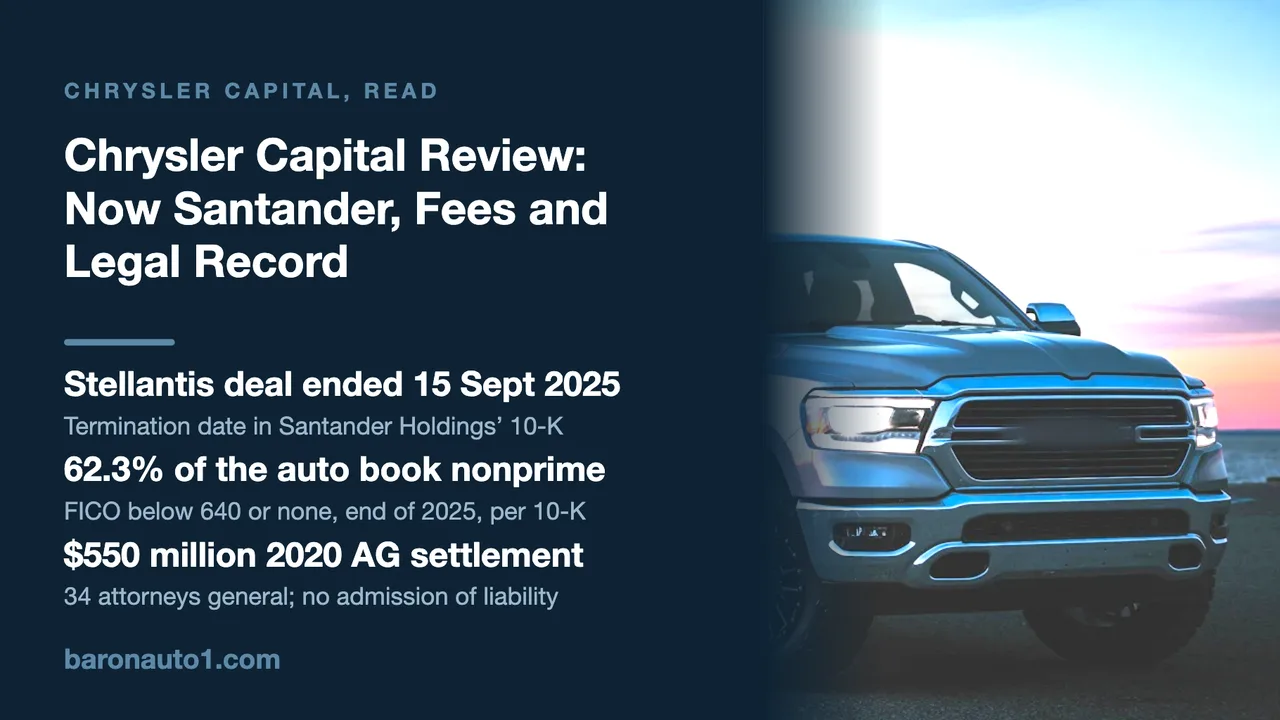
- That agreement is over. Santander Holdings USA’s 10-K says it was terminated effective 15 September 2025, and Stellantis’ own annual report says “in 2025 Stellantis terminated the agreement.” Stellantis now has its own lender, Stellantis Financial Services US.
- If you still have a Chrysler Capital loan or lease, Santander Consumer USA still owns it. Since 19 September 2026 Santander Bank, N.A. services it under the Santander name, and chryslercapital.com redirects to santanderconsumerusa.com. Santander says your balance, rate, account number, login and AutoPay stay the same.
- From October 2026 your credit report shows the account as Santander Consumer USA rather than Chrysler Capital. For Western Union or MoneyGram payments, the payee is now “Santander.”
- AutoPay, bank-account payments and mail are free. A debit card costs $3.28 a payment and PayPal or Venmo $6.75, in fees Santander says go to its processors.
- The lender has a public enforcement record: a $550 million settlement with 34 attorneys general in May 2020, and CFPB consent orders in 2018 (GAP marketing and loan extensions) and 2020 (credit reporting). Santander did not admit the findings or allegations in any of them.
Most people who search “Chrysler Capital” want to log in or make a payment, and the first thing they find is that the brand has been folded into Santander. On 6 October 2026 we read what Santander Consumer USA now shows former Chrysler Capital customers (its servicer notice, payment, title and lease-end pages and its help articles), the 10-K for 2025 and the 10-Q to 30 June 2026 filed by its parent, Santander Holdings USA, Stellantis’ annual report for 2025, the CFPB’s two consent orders against Santander Consumer USA, and North Carolina’s copy of the 2020 multistate settlement. We entered no login or credit application, and this site has no commercial relationship with Santander, Stellantis or any lender.
What happened to Chrysler Capital
Chrysler Capital was a brand, not a company. Santander Holdings USA’s 10-K defines it in one line: “CCAP: Chrysler Capital; trade name used in providing services under the MPLFA,” the MPLFA being a ten-year master private-label financing agreement with the carmaker now called Stellantis. Under it, Santander Consumer USA (SC) became the carmaker’s preferred provider of loans, leases and dealer financing. The 10-K for 2021 records the price of entry: in May 2013 SC paid “a $150 million upfront, nonrefundable payment, to be amortized over ten years,” and in June 2019 a further “$60 million upfront fee” when the agreement was amended.
The relationship was already shrinking before it ended. Stellantis set up its own captive lender, and on 27 April 2022 Santander Consumer USA announced that it had extended the agreement “through December 2025” and updated its terms “to allow SC to serve in a complementary role to Stellantis’ recently launched captive finance company, Stellantis Financial Services US.” The 10-K for 2024 still said the agreement was “scheduled to expire in December 2025.”
It ended earlier. The 10-K for 2025 says: “On July 28, 2025, the MPLFA was terminated effective September 15, 2025, except for certain trailing obligations for revenue- and risk-sharing on originations up to the termination’s effective date.” Santander frames this as an agreement between the two companies “to accelerate the termination.” Stellantis’ annual report on Form 20-F puts it in the active voice: “in 2025 Stellantis terminated the agreement with Santander Consumer USA Inc.” The filings show the wind-down in numbers: the “Stellantis relationship” intangible asset fell from $1,754 thousand to nil, and Santander’s purchases and originations of operating leases (the agreement covered leases as well as loans) fell from $6.2 billion in 2023 to $2.1 billion in 2025, a 66.4% drop by our arithmetic.
Then the brand itself went. Every chryslercapital.com address we tried now answers with a permanent redirect (HTTP 301) to the Santander Consumer USA home page. Under the line “Proud to be a preferred lender for major brands and vehicle manufacturers,” that page shows the logos of INEOS Grenadier, Lotus and Mitsubishi Motors, and no Stellantis brand. Chrysler Capital’s own pages no longer exist, so this page reads the Santander pages its customers are now sent to. Prestige Financial, a Utah lender that stopped taking applications and now only services its loans, is covered on our Prestige Financial review.
Who holds and services your account now
Santander posted a notice for “existing Chrysler Capital customers” dated 21 August 2026. It says that “as part of an internal reorganization within Santander, Santander Bank, N.A., will begin servicing Chrysler Capital accounts,” and that from 19 September 2026 “you will see Santander branding associated with your account instead of Chrysler Capital. Santander Consumer USA will continue to own your Chrysler Capital account, and Santander Bank, N.A., will service your account.” A welcome page published on 19 September tells Chrysler Capital customers to log in to MyAccount “using your Chrysler Capital username and password.”
So Santander Consumer USA owns the loan or lease and Santander Bank, N.A. collects the payments. Both sit under Santander Holdings USA, which its 10-K describes as “a wholly-owned subsidiary of Santander,” the Spanish bank Banco Santander. The 10-K adds one more change in progress: on 30 December 2025 the bank “filed applications with the FDIC and OCC for approval to merge Santander Consumer USA Holdings Inc.” into itself. No document we read says the merger has closed.
The notice says your balance, rate, maturity date, account number, account standing, payment methods, login and automatic payments stay the same. What changes is the branding, “some contact and payment details,” and the name on your credit report.
For new car buyers the change is bigger. A Stellantis dealer no longer has Chrysler Capital as the carmaker’s preferred lender. Stellantis’ 20-F says its own lender, Stellantis Financial Services US, plays “a predominant role in retail and leasing financing with a market share of approximately 18 percent and 90 percent respectively.” One loose end: on 6 October 2026 the certified pre-owned pages on chrysler.com and dodge.com still said “Ally and Chrysler Capital” finance certified cars, more than a year after the agreement ended. Our Jeep certified pre-owned guide covers what those programmes promise, and our Mopar extended warranty page reads the complaint file of the Stellantis-owned lender.
Logging in and paying: the options and their fees
You log in to Santander’s MyAccount with your old Chrysler Capital credentials; if you also have a Santander Consumer account, the welcome page says to use the Santander one. Santander’s payment options page lists the methods below. The fees are charged by “third-party payment processing partners,” and the page says “Santander Consumer USA retains no part of these fees.”
| Method | Fee printed | What the page adds |
|---|---|---|
| AutoPay from a checking or savings account | Free | Account must not be past due; setup takes about five to seven business days |
| One-time bank (ACH) payment online or by automated phone | Free | Funds can take 24 to 48 hours to leave your bank |
| Mail (personal check, cashier’s check or money order) | Free | Takes seven to ten business days to process; no credit cards or cash by mail |
| Debit card online, by phone or with an agent | $3.28 | Same-day payment |
| Apple Pay or Google Pay (debit) | $3.28 | Through MyAccount |
| PayPal or Venmo | $6.75 | Through MyAccount |
| Cash through PayNearMe (7-Eleven, CVS and others) | $3.99 | Uses a payment code from MyAccount |
| Western Union, MoneyGram or CheckFreePay | “May charge a fee” (no amount printed) | For Western Union and MoneyGram, list “Santander” as the payee |
Small fees add up. By our arithmetic, paying every month for a year by debit card costs $39.36, by cash through PayNearMe $47.88 and by PayPal or Venmo $81. The 2020 settlement, covered below, says Santander “shall not require Consumers to make payments through methods that require the Consumer to pay additional third-party fees.”
Mail is slow: Santander calls it “inadvisable to send a late payment via regular mail.” And interest keeps running: “When your account is past due, if applicable, late fees may be assessed to your account in accordance with your contract and state law. You may also accrue additional interest since interest accrues on a daily basis.” Santander’s pages print no late-fee amount or grace period and point to your contract and state law.
Your credit report, due date, payoff and title
Expect your credit report to change. Santander’s notice says: “Beginning October 2026, information reported to consumer credit bureaus will reflect Santander Consumer USA rather than Chrysler Capital.” If your report then shows both names for one car, ask Santander to confirm it is one account before disputing anything.
Santander’s help articles cover three common requests. A due-date change is requested through MyAccount, and “a due date change is permanent and allowed only one time per life of the loan,” with eligibility affected by “prior due date changes, payment deferrals, lease extensions, account status, and lease type.” A payoff quote is requested in MyAccount; if you are near the end of a lease or no quote appears online, the article says to ask a live chat agent. Payment help also starts there: “Assistance is based on your unique situation.”
On titles, Santander’s titles page explains that it depends on your state. In a state where the lender keeps the title, “Your lender holds onto the title until your loan is fully paid off”; in a title-holding state you get the title with Santander listed as lienholder and receive a lien release at payoff. Moving states can mean a new title from your new state, and the page says getting an electronic title printed for that “averages four to six weeks.” Its claims page adds that after an accident “you must remain current with your auto loan payments.”
Extensions and deferrals: what they really cost
When money is tight, Santander may let you push payments to the end of the loan. The 10-K sets the rules: a borrower may defer “a maximum of three payments per event,” only after at least eight payments from the start of the loan and eight payments between extensions, and for no more than eight months over the life of the loan (twelve for natural disasters). “During the deferral period, we continue to accrue and collect interest on the loan.” Other modifications can cut the rate or extend the maturity date by “up to 36 months,” which lowers the payment.
The catch is in how payments are applied afterwards, and it is the subject of a CFPB order. Santander’s help article now says the payment does not rise after an extension, “but more of the payment will be applied to interest as opposed to principal, which may result in more interest being paid over the life of the financing.” There is no fee for the extension itself (“No, but please refer to the question regarding additional interest accrual”), and another article warns that an extension may reduce what GAP pays, because GAP “assumes that all payments are made on time per the original contract terms.”
A worked example with hypothetical figures, not Santander’s: on a $20,000 balance at a 12% annual rate, two months of interest is about $400, by our arithmetic. The 2018 order described below found that such interest is paid first when payments resume, so borrowers “would have to continue to repay their loans for a greater number of months than the duration of the extension period.” Santander’s extension article has its own cost chart, an image we did not transcribe.
An extension is not a pause on interest. In 2018 the CFPB found that Santander’s call scripts told borrowers missed payments would be “moved to the end of the loan,” while in fact “the next payment the consumer made would first be applied to the interest accrued.” The order now requires Santander to disclose that on calls, forms and confirmation letters. Before you accept an extension, ask for the new maturity date and the extra interest in writing, and check what your GAP contract says about extensions.
Turning in a Chrysler Capital lease
Chrysler Capital leases now end on Santander’s process, set out on its lease-end page. It works backwards from the last 90 days: research your options at 90 days, book an inspection at 60, decide at 30. The inspection is free if done through Santander’s vendor, Manheim Mobile Inspections: “Santander Consumer USA will cover the cost of a prereturn inspection,” which “should be completed between 10 and 90 days before the end of your lease agreement.” It shows what you would be charged while you can still fix it.
The page does not print the disposition fee, the mileage allowance or the per-mile charge; it says to confirm them “by reviewing the Santander Consumer USA Lease Agreement.” After you return the car, “you’ll receive a vehicle return invoice outlining any remaining amounts due (if applicable), such as a disposition fee, unpaid payments, excess miles, excess wear, late charges, taxes or other fees,” about 30 days later, and it is “due upon receipt.” Unused miles earn nothing: “we do not apply credits or refunds for unused miles.” Santander says that re-leasing through it may bring “Up to $500 in waived wear and tear fees,” among other loyalty incentives.
| Item | Normal wear | Excess wear (chargeable) |
|---|---|---|
| Burn holes | 1/8 inch or less in diameter | Larger than 1/8 inch |
| Cuts, tears and singed areas | 1/2 inch or less in diameter | Exceeding 1/2 inch |
| Body damage | Single instances 2 inches or less, excluding hail damage and punctures | Body, bumper or molding damage greater than 2 inches |
| Windshield | Cracks, stars or chips 1/2 inch or less | Damage greater than 1/2 inch, or any hole |
| Lights and lenses | Cracks 2 inches or less | Cracks exceeding 2 inches |
| Tires | Tread of at least 1/8 inch at the shallowest point | Non-matching brands or improper sizes |
AutoPay cancels itself after the last scheduled payment, but if your account status changes that last payment “will NOT be drafted, and you will be responsible for making your payment by the due date.” Property tax billed once a year can reopen a closed account after you hand the car back, and so can plates you failed to cancel. If you have moved, Santander says you may return the car to “any participating dealership” rather than the dealer that sold it. To buy the car instead, Santander says to “contact the Lease Servicing Team to start the purchase process”; our guide to lease buyouts explains the fees to check, our lease-or-buy guide covers the end-of-lease choice, and our lease takeover guide covers handing a lease to someone else.
What Santander’s filings say about the auto book
Santander Holdings USA does not report Chrysler Capital separately, but its filings describe the auto portfolio the brand fed into. At the end of 2025 it held $42.7 billion of retail installment contracts and auto loans, down from $44.6 billion a year earlier, by our rounding of the 10-K’s figures; they were 51.4% of all its loans. The 10-Q puts the book at $43.5 billion on 30 June 2026.
Much of it is subprime. The 10-K says that “62.3% of the Company’s RIC and auto loan portfolio balance was comprised of nonprime loans (defined by the Company as customers with a FICO score of below 640),” including 6.5% with no FICO score at all; the 10-Q gives 62.1% for June 2026. Applicants are scored on FICO, debt-to-income, loan-to-value and “over 30 other predictive factors, placing the applicant in one of 100 pricing tiers.” Santander publishes no APR, but the 10-K prints the average yield it earned on the whole book in 2025: 13.6%, up from 13.11% in 2024. That is an average across all borrowers, not a quoted rate.
| Credit score band | Share of the book |
|---|---|
| No FICO score | 6.5% |
| Below 600 | 36.4% |
| 600 to 639 | 19.4% |
| 640 to 679 | 12.3% |
| 680 to 719 | 8.4% |
| 720 to 759 | 5.4% |
| 760 and above | 11.6% |
By our arithmetic, 42.9% of the book went to borrowers scoring below 600 or with no score, and 25.4% to borrowers at 680 or above. At the end of 2025, $6.7 billion of these loans, 15.8% of the book, were 30 days or more past due, and 1.6% were 90 days or more past due, by our arithmetic from the 10-K’s aging table. Santander treats an auto contract as non-performing once it is “more than 60 DPD,” and $2.7 billion was in that state, up 19.7% in a year. Gross write-offs on these loans were $4.4 billion in 2025, equal to 10.3% of the year-end balance by our arithmetic, though that figure is before recoveries. The 10-K’s net charge-off rate covers all consumer lending together: 4.0% in 2025, against 4.1% in 2024 and 3.6% in 2023. Our guide to repossession and the deficiency balance covers what follows a default.
The lease book shrank too: operating lease assets fell 28.4%, from $11.7 billion to $8.4 billion, during 2025. On litigation, Santander Holdings USA accrued “approximately $16.0 million” for legal and regulatory matters at the end of 2025 and says it is a party to “various lawsuits pending in federal and state courts alleging violations of state and federal consumer lending laws.”
The 2020 settlement with 34 attorneys general
On 19 May 2020 Santander Consumer USA settled a multistate investigation of its subprime lending. The North Carolina Attorney General’s release says the settlement “includes approximately $550 million in relief for consumers” and resolves “allegations that Santander violated consumer protection laws by exposing subprime consumers to unnecessarily high levels of risk and knowingly placing these consumers into auto loans with a high probability of default.” The coalition also alleged that Santander “actively misled consumers about their rights and risks of partial payments and loan extensions.” Nothing was tried.
North Carolina’s consent judgment (Wake County Superior Court, 20-CVS-5917, signed 26 May 2020) is entered “without the taking of proof and without trial or adjudication of any fact or law, without this Judgment constituting evidence of or an admission by Santander regarding any issue of law or fact alleged in the Complaint on file, and without Santander admitting any liability.” Santander Consumer USA’s own 8-K called it a “voluntary settlement with 33 states and the District of Columbia” resolving “a legacy underwriting issue” and said it was “fully reserved for this matter.”
The money, as the judgment and Santander’s 10-K for 2020 set it out: $65,000,000 into a settlement fund for consumers who defaulted on loans between 2010 and 2019; $5,000,000 to the states; up to $2,000,000 for the settlement administrator; and keep-the-car relief for borrowers with a loss-forecasting score of 401 or less, capped at $45,000,000, under which Santander “shall not repossess and instead shall provide the title to the vehicle and waive the outstanding Loan balance.” North Carolina’s release adds “approximately $433 million in immediate forgiveness” of deficiency balances on loans Santander still owned. By our arithmetic those parts add to $550 million. Deficiencies were also waived for low-score borrowers who defaulted within 12 months on loans made from 2013 to 2019, with Santander required to try for 150 days to buy back loans it had sold, and to ask the credit bureaus to delete those borrowers’ trade lines.
For loans made after the settlement, the judgment requires Santander to check a borrower’s residual income and not buy a loan if it “is zero or negative,” to set a debt-to-income ceiling, not to require dealers “to sell any Ancillary Product,” and to monitor dealers for income inflation and “power booking.” It must also back-test defaulted loans every quarter and waive deficiencies where the borrower’s residual income was zero or negative at signing and the loan defaulted early: within 18 months for loss-forecasting scores of 501 or below, 12 months for scores of 502 to 600, and 6 months for 601 and above. Extension calls and letters must say “that the interest accruing during the extension period becomes immediately due when the Consumer resumes making payments.” The judgment creates no private right to sue.
The CFPB’s consent orders of 2018 and 2020
The CFPB’s enforcement list shows two actions against Santander Consumer USA, dated 20 November 2018 and 22 December 2020 (a third, in 2016, was against Santander Bank, N.A. over “illegal overdraft service practices”). We found no public CFPB consent order against the company dated 2017. Its 10-K for 2017 does describe a November 2017 “confidential agreement with the CFPB to resolve an investigation regarding certain alleged violations by the Company of the ECOA,” the fair-lending law; its terms were not published.
The 2018 order (2018-BCFP-0008, filed 20 November 2018) names the company “including when doing business as Chrysler Capital or RoadLoans.com.” The Bureau found two deceptive practices. First, Santander marketed its S-GUARD GAP add-on as “true full coverage” when it “was actually subject to a loan-to-value (LTV) limitation of 125%,” did not tell buyers whether the limit applied to them, and sold it to “approximately 44,180 consumers with LTVs above 125%” from April 2012. Second, it misrepresented loan extensions, enrolling “more than 2.3 million.” The order required restitution to “approximately 3,493 accounts,” estimated at $1,980,873 by check and $7,312,953 in statement credits ($9.29 million, by our arithmetic and on the CFPB’s page), and a civil money penalty of $2,500,000. The order ran for 5 years and the CFPB lists it as “Expired/Terminated/Dismissed.” Our GAP guide explains why a loan-to-value cap matters.
The 2020 order (2020-BCFP-0027, filed 22 December 2020) is about credit reporting. The Bureau found that from January 2016 to August 2019 Santander furnished information it knew or should have known was inaccurate, did not promptly correct it, and left out the date of first delinquency on some seriously delinquent accounts. That date starts the seven-year clock for removing negative information. In “more than 23 million instances,” 35 percent of the times it reported that date, it simply used the date on which it pulled the data from its own system; in at least 9,730 instances it left the field blank on accounts more than 120 days late or charged off. The order imposed a penalty of $4.75 million and compliance steps and was set to run for 5 years; the CFPB lists it as “Expired/Terminated/Dismissed.”
In both orders Santander consented “without admitting or denying any of the findings of fact or conclusions of law, except that Respondent admits the facts necessary to establish the Bureau’s jurisdiction.” The table lists these and the other public actions.
| Date | What happened | How it ended, in the document’s words |
|---|---|---|
| February 2015 | Department of Justice consent order over repossession and collection activity toward servicemembers, 2008 to 2013 | Consent order approved by the federal court (per Santander’s 10-K) |
| March 2017 | Written agreement with the Federal Reserve Bank of Boston on compliance risk management | “In February 2021, the FRBB closed this matter” |
| November 2017 | CFPB fair-lending (ECOA) investigation | “Confidential agreement”; terms not public |
| 20 November 2018 | CFPB order: GAP marketing and loan extensions | Consent order “without admitting or denying”; $9.29 million restitution, $2.5 million penalty |
| 19 May 2020 | 34 attorneys general: subprime underwriting and servicing | Consent judgments “without Santander admitting any liability”; about $550 million in relief |
| 22 December 2020 | CFPB order: credit reporting | Consent order “without admitting or denying”; $4.75 million penalty |
CFPB complaints filed under the Santander names
The CFPB’s public complaint database does not list Chrysler Capital as a company. Its complaints are filed under two Santander names: “Santander Consumer USA Holdings Inc.” (12,455 complaints, February 2012 to September 2022) and “SANTANDER HOLDINGS USA, INC.” (17,853, from August 2018 to 5 October 2026). They cannot be split by brand, and the second name also covers Santander Bank’s own products, such as checking accounts and mortgages. Complaints are unverified reports, and their number grows with the size of a lender’s book, so they show what people complain about, not how likely a problem is. The CFPB stopped publishing complaint narratives on 30 September 2026, so only counts are used here.
Across both names, 9,848 complaints are about a vehicle loan or lease, plus 2,467 car loans and leases filed up to 2017 under the CFPB’s older “Consumer Loan” label. Under the current name, vehicle loans and leases are 31.4% of the file and credit reporting 41.8%. Within its 5,602 vehicle complaints, the largest issues are managing the loan (1,552), repossession (1,219, or 21.8%) and problems at the end of the loan or lease (938), including 449 about getting the title after payoff, 8% of the file. Santander closed 27.8% of those vehicle complaints with monetary or non-monetary relief, against 8.3% under the older name.
| Year | Santander Consumer USA Holdings Inc. | SANTANDER HOLDINGS USA, INC. |
|---|---|---|
| 2017 | 490 | 0 |
| 2018 | 723 | 0 |
| 2019 | 685 | 0 |
| 2020 | 889 | 0 |
| 2021 | 954 | 0 |
| 2022 | 505 | 240 |
| 2023 | 0 | 802 |
| 2024 | 0 | 958 |
| 2025 | 0 | 1,786 |
| 2026 to 5 October | 0 | 1,816 |
Vehicle complaints under the current name were 2.2 times higher in 2025 than in 2023, by our arithmetic, and the count for 2026 up to 5 October already exceeds all of 2025. A count cannot say whether that reflects more problems, more accounts filed under this name, or more people using the database. Santander Bank, N.A., the new servicer, had 10 vehicle loan or lease complaints under its own name when we pulled the data.
If you have a Chrysler Capital account
- Log in at santanderconsumerusa.com with your Chrysler Capital username and password, and bookmark it rather than following links in texts.
- Confirm AutoPay is still running by checking the next draft date in MyAccount.
- Update the payee for cash payments. Western Union and MoneyGram payments now go to “Santander.”
- Pay by a free method. AutoPay, a bank payment online or by phone, or mail sent well before the due date.
- Read your credit report after October 2026. The account should move to the Santander Consumer USA name with its history intact.
- Get extension terms in writing. Ask for the new maturity date and the added interest, and check your GAP contract.
- Book the free lease inspection. Between 10 and 90 days before the lease ends, and find your mileage charge and disposition fee in the lease agreement.
- Keep every invoice and letter; a property-tax bill can arrive after the lease ends.
Common questions
Is Chrysler Capital the same as Santander?
Yes. Chrysler Capital was a trade name of Santander Consumer USA, used under its agreement with Stellantis from 2013. Since 19 September 2026 the accounts carry Santander branding, Santander Consumer USA still owns them and Santander Bank, N.A. services them.
Does Chrysler Capital still exist?
Not as a lender for new business. The agreement with Stellantis was terminated effective 15 September 2025, chryslercapital.com redirects to santanderconsumerusa.com, and Stellantis has its own lender, Stellantis Financial Services US. Santander says existing Chrysler Capital accounts keep their terms.
How do I log in to my Chrysler Capital account now?
Go to Santander’s MyAccount and use your Chrysler Capital username and password; Santander says they did not change. If you also have a Santander Consumer account, its welcome page says to use the Santander credentials.
Can I still pay Chrysler Capital the same way?
Santander says “There are no changes to available payment methods,” but Western Union or MoneyGram payments must now list “Santander” as the payee, and mailed payments go to the address on the pay stub of your monthly statement.
Will the change hurt my credit?
Santander says the move does not affect whether your account is current or past due. From October 2026 the account is reported under Santander Consumer USA rather than Chrysler Capital. Check your report afterwards for a duplicate or missing account; our guide to credit scores and car loans explains what lenders read.
Can I refinance a Chrysler Capital loan?
Nothing in Santander’s notice stops you paying the loan off with another lender; request a payoff quote in MyAccount first. Compare offers with our guides to refinancing a car loan and credit union auto rates, and to the Capital One, Navy Federal and PenFed auto loans. Our Credit Acceptance and Westlake Financial reviews read other subprime lenders’ records the same way.
Sources and further reading
- SEC EDGAR filings: Santander Holdings USA, Inc.
- CFPB auto loan resources
- CFPB consumer complaint database
- CFPB: what is Guaranteed Asset Protection (GAP)?
- 12 CFR Part 1013 — Consumer Leasing (Regulation M)
- FTC vehicle repossession
Recall, complaint and safety-rating figures on this page were retrieved from the federal databases above on August 19, 2026. Federal data changes — re-check any VIN before you rely on it.
Published October 6, 2026 · last updated October 6, 2026. Found something out of date or wrong? Tell us and we will correct it.