Tesla Lease and Financing: Who Holds It and What It Costs
Who actually holds a Tesla lease or loan (Tesla Lease Trust, Tesla Finance or a bank such as Chase), and what Tesla's own pages say about credit pulls, lease terms, extra miles, wear charges, buyouts, early termination and insurance, read against Tesla's SEC filings and the CFPB's records.
The short version
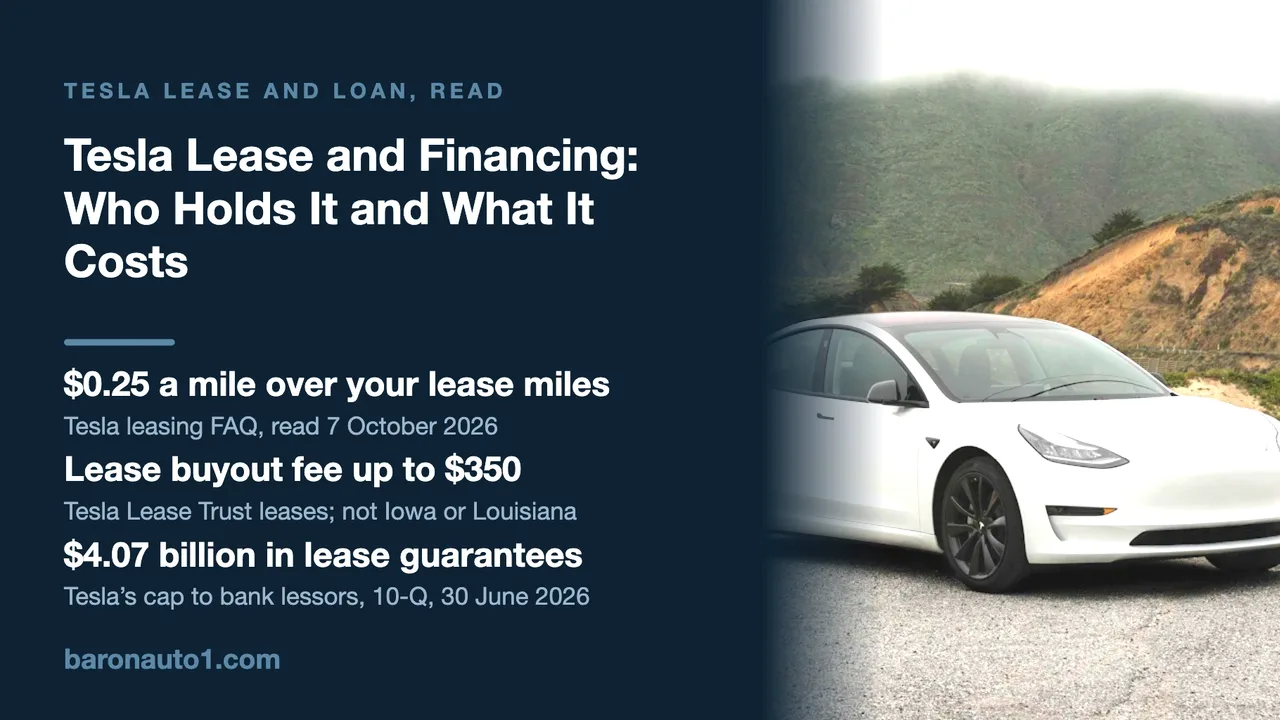
- Your lease agreement names who holds your Tesla lease. Tesla’s pages name Tesla Lease Trust and four banks (U.S. Bank, Ally, Santander Consumer and Chase), and the lease-end rules differ between them. Chase says the Tesla accounts it holds “are owned by Chase.”
- Tesla leases run 24 to 36 months and Tesla loans 36 to 84. Leasing is offered in 46 states plus DC, Tesla’s own loans in 33. Applying costs nothing but takes at least one hard credit pull, and an approval lasts up to 60 days.
- Miles over your allowance cost $0.25 each under Tesla’s leasing FAQ. Tesla Lease Trust customers leasing a new car can buy up to 20,000 extra miles at a time, at least three months before the lease ends.
- Since November 27, 2024 Tesla Lease Trust leases can be bought out, with a purchase fee of up to $350 (not in Iowa or Louisiana), and lease transfers have stopped. Chase charges the residual in your lease plus its purchase option fee and does not negotiate.
- On 7 October 2026 Tesla’s Compare page printed estimated leases of $419 a month for a Model 3 and $499 for a Model Y (36 months, 10,000 miles, $3,000 down), before destination and order fees and taxes. They are estimates, not offers.
- We found no CFPB enforcement action naming Tesla. The CFPB holds 710 complaints under “Tesla, Inc.,” 439 about vehicle loans or leases, and none was closed with relief.
A Tesla lease or loan can come from Tesla itself or from a bank, and that one fact decides how you pay, what a lease return costs and whether you can buy the car. On 7 October 2026 we read Tesla’s own support pages on leasing, lease end, ending a lease early, wear and use, payments, property tax, financing and insurance, plus its Compare page and terms. We also read Tesla, Inc.’s 2025 annual report and June 2026 quarterly report, its lease-securitization filings, the CFPB’s records and Chase’s Tesla lease-end FAQ. We opened no account, order or credit application. This site has no commercial relationship with Tesla or any lender, and where Tesla’s own pages disagree, we say so.
Who actually holds a Tesla lease or loan
Tesla’s leasing page opens with the caveat that matters most: “If your vehicle is leased with a third-party lessor, refer to your lessor for payment information.” To find out which you have, it says, “Find the name of your lessor on your lease agreement,” and it lists five: U.S. Bank, Ally Bank, Santander Consumer, Chase and Tesla Finance. The lease-end, early-termination and extra-mileage pages all describe leases held by Tesla Lease Trust, which Tesla’s pages call “the vehicle owner” and name as lienholder on your insurance. If a bank is your lessor, Tesla sends you to the bank, “as options may differ.”
Tesla’s annual report explains why a car ordered from Tesla can end up with a bank. It says Tesla offers “leasing and/or loan financing arrangements for our vehicles in certain jurisdictions in North America, Europe and/or Asia ourselves and through various financial institutions.” For some lease programs, “we originate the lease with our end customer and immediately transfer the lease and the underlying vehicle to our commercial banking partner.” Tesla is paid up front, does not bear credit risk, and guarantees the bank part of the car’s value at lease end, “capped to a limit.” Chase’s Tesla lease-end page, as recorded on our Chase auto loan review, says the Tesla name is licensed to Chase and “Auto finance accounts are owned by Chase and are subject to credit approval, terms and conditions.”
Loans work the same way. Tesla’s financing page says you can finance “with a Tesla financier or customers can use a third-party financier,” and it lists 11 financiers to contact if you have trouble paying: Ally, BMO, Capital One, Chase, FI Connect, PNC Bank, Santander, TD Bank, U.S. Bank, Wells Fargo and Tesla Finance. If your lender is Tesla Finance LLC you pay in the Tesla app; with “one of Tesla’s indirect partners,” you pay the lender named in your Retail Installment Contract. The app’s ‘Financing’ section works only if you deal “directly through Tesla.”
So open the agreement in the app’s Documents section and read the lessor or lender line before relying on anything below. Our reviews of BMW Financial Services and Toyota Financial Services read two other carmakers’ finance arms the same way.
Tesla lease terms, and the payments Tesla printed
Tesla’s financing-options page says: “You can lease a Tesla vehicle over the terms of 24 to 36 months.” Loans run “over the terms of 36 to 84 months.” Tesla’s annual report describes its direct leasing program in the U.S., Canada and parts of Europe as letting customers lease “for up to 48 months,” so older leases may run longer than today’s support page allows. Business-only, trust and commercial leases and loans are not offered.
Leasing covers more of the map than Tesla’s own loans. The leasing list names 47 codes, 46 states plus DC, against 33 for Tesla Financing. Fourteen codes on the leasing list are missing from the financing list (AK, AL, DC, IA, KS, LA, ME, MT, ND, SC, SD, VT, WV and WY), by our count, and every financing state can also lease. Certified Pre-Owned cars can be leased in fewer places, and the page gives two lists: 19 states in one section and 17 in its FAQ, which leaves out Missouri and Tennessee. If you live in either, ask before you plan around a used-car lease. Carrier deliveries are not available on lease orders.
Here is what Tesla printed on its Compare page on 7 October 2026, with every condition it printed. Tesla calls these estimates; its leasing page says they “are not guaranteed and are subject to our underwriting process,” and its legal notice says prices are “subject to change without notice.” They are not offers.
| Model | Printed estimate | Terms printed beside it | Our arithmetic |
|---|---|---|---|
| Model 3 Rear-Wheel Drive | $419 /mo, Est. Lease | 36 mo, 10,000 mi, $3,000 down | 36 payments total $15,084; $18,084 with the $3,000 |
| Model Y Rear-Wheel Drive | $499 /mo, Est. Lease | 36 mo, 10,000 mi, $3,000 down | 36 payments total $17,964; $20,964 with the $3,000 |
| Model 3 Rear-Wheel Drive | $539 /mo, Finance | 6.79% APR, 84 mo, $2,500 down | Not calculated (taxes and fees unknown) |
| Model Y Rear-Wheel Drive | $569 /mo, Finance | 1.99% APR, 72 mo, $2,850 down | Not calculated (taxes and fees unknown) |
Tesla’s footnote says the prices “do not include Destination and Order Fees, taxes and other fees”; with those fees but before taxes, a Model 3 Rear-Wheel Drive “starts at $38,630” and a Model Y Rear-Wheel Drive at $41,630, against cash prices of $36,990 and $39,990. The page does not say whether “10,000 mi” is per year, which credit tier the rates assume, or how long they apply. The Model 3 page added “Model 3 Performance: 1.99% APR Available” and “Model 3 Premium Lease From $429/mo,” with no terms or end date. Our guide to the two numbers that decide a lease explains the residual and the rate behind any payment; Tesla’s pages print neither.
Applying: credit pulls, approvals and who has to sign
You apply in the Tesla app after ordering, choosing ‘Tesla Lease’, ‘Tesla Loan’ or ‘Self-Arranged Loan’. You must be over 18 with a Social Security number, and Tesla charges no application fee.
The credit check is the part to plan for. Both pages say: “At least one hard pull of your credit report is required; however, for some applicants, additional inquiries may be needed as we work to find you the best credit offer possible.” Tesla also offers pre-qualification, which “uses a soft inquiry on your personal credit report” and “is not an approval or denial of credit,” and it says plainly that “A credit application using a hard credit pull will still be required.” Tesla suggests lifting credit freezes “for at least seven days” first. Our guide to the credit score you need to buy a car covers how lenders read those pulls.
Decisions are usually fast: “Many credit decisions are available within a few minutes, with most available within 48 hours.” Lease approvals “are valid for up to 60 days”; loan approvals are valid “for up to 60 days depending on the financier.” If your delivery slips past that, you may need to apply again, with another pull. At delivery:
- “The name on the lease application must match the name of the vehicle registration and this person must take delivery of the vehicle.”
- You sign the Lease Agreement or Retail Installment Contract in your Tesla Account before delivery, and “The credit applicant(s) must be present to take delivery of the vehicle.”
- “Texas and Michigan customers are required to submit final payment prior to scheduling their delivery appointment due to state restrictions.”
Tesla’s financing partners “do not offer financing options for vehicles that will be used for ridesharing or rental purposes.” If you bring your own loan, “Delivery cannot take place until we receive the funding in full.” A car loan preapproval gives you a rate to set against Tesla’s before you sign.
Tesla financing: paying and paying off a Tesla loan
The first bill can surprise people. Tesla says a welcome packet and first invoice arrive “around two to three weeks after taking delivery,” and warns that “The mailer may be undisclosed and may be easily mistaken as junk mail.” The first payment is “due 30 or 45 days from the delivery date depending on your financier,” and then on the same day each month.
With Tesla Finance LLC, you pay in the app: autopay, one-time payments and paperless billing. “Check payments via bill pay or personal checks are not accepted.” With a partner bank, you pay the bank.
Paying off early costs no penalty: “There are no prepayment penalties associated with Tesla financing and our partners.” Two details on Tesla Finance’s payments page are worth knowing before you request a payoff:
- A payoff quote is “good for 10 days from the date of request,” and it includes “any finance charges incurred (minimum of $75) through the date of request.” By that wording, even a payoff soon after delivery includes at least $75 of finance charges.
- Extra principal shortens the loan, not the bill: “Any amounts applied directly to your principal will shorten your term length; however, your monthly payment amounts will stay the same.” The principal-payment option disappears while any payment is overdue.
For a partner loan, Tesla says to “Contact your financier directly for payoff details.” Our guide to refinancing a car loan covers moving a loan elsewhere; Chase, for one, does not finance “Teslas older than 5 calendar years.”
Insurance and gap cover
A Tesla Lease Trust lease sets minimums “unless you’re subject to state-specific terms”: $100,000 for bodily injury to any one person, $300,000 for any one accident, $50,000 for property damage, “Physical damage insurance for full value of vehicle,” and a “Maximum deductible: $2,500.” You must list Tesla Lease Trust “as the lienholder and an additional insured party on the policy.” If a bank holds your lease, its requirements apply instead.
On gap, the leasing page says one line: “Note: Your lease comes with gap protection.” It does not say what the protection covers or excludes, so read that section of your agreement. For loans, Tesla’s financing pages say nothing about gap. Tesla Insurance lists “Auto Loan/Lease Gap Coverage” as optional cover in each of the 15 states on its coverage page; it “applies to the difference between the financed amount owed and the actual cash value of your insured vehicle at the time of the covered loss.” Tesla’s annual report, filed in January 2026, said its insurance was “currently available in 13 states”; the coverage page listed 15 when we read it. Our gap insurance guide explains when that difference is real money.
Mileage and wear: what a Tesla lease return can cost
Tesla’s leasing FAQ prices extra miles directly: “Any miles driven beyond the annual amount specified in your lease agreement may incur fees at a rate of $0.25 per mile.” At that rate, 1,000 miles over costs $250 and 5,000 miles over costs $1,250, by our arithmetic. The Excess Wear and Use Guide words it differently, a “per-mile fee in accordance with your lease agreement,” so the figure in your contract is the one that counts. Our guide to lease mileage allowances explains why people underestimate them.
If you can see the overage coming, Tesla Lease Trust lets some lessees buy miles in the app, “up to 20,000 miles per transaction,” with tax included in the total shown. The conditions are strict: you must be leasing a new car (“Certified Pre-Owned vehicles do not qualify”) directly from Tesla Lease Trust, have no outstanding payments, buy “at least three months prior to the original lease maturity date,” and not combine the purchase with a lease extension.
For wear, Tesla says “a few small door dings, chips or scratches” are normal and free, while “dents, cracks in glass, tears in the upholstery or poor-quality repairs” may be charged. Its table sets measurable limits:
| Area | Normal (no charge) | Excessive (may be charged) |
|---|---|---|
| Paint scratches | Break the paint but under 4 inches long, at most three per panel | Break the paint and are 4 inches or longer |
| Dents and dings | Paint unbroken, under 2 inches across, at most two per panel | More than three on one panel, or any over 2 inches across |
| Stone chips | 10 or fewer, each under 1/8 inch | 11 or more under 1/8 inch |
| Glass | One chip up to 1/4 inch, outside the driver’s line of sight | Two or more chips, anything larger than 1/4 inch, or any damage in the driver’s line of sight |
| Tires | Tread 4/32 inch or more, correct size and rating | Under 4/32 inch, mismatched tires, dry rot, cuts or sidewall plugs |
| Wheels | Scratches, gouges or dents under 6 inches per wheel | Bent or broken parts, mismatched wheels, or three or more scratches, gouges or dents per wheel |
| Window tint and add-ons | None allowed | “Any modifications to the original factory tint” or unauthorized modifications |
Two rows do not quite agree with each other. Three small dents on one panel are neither “maximum of two per panel” nor “more than three times on one panel,” so the table does not say how they are treated. And the guide’s text calls wheel scratches “less than 6" cumulative on a wheel” normal, while the table counts “three or more scratches, gouges or dents per wheel” as excessive whatever their length. If your car falls in either gap, photograph it and ask before the inspection; our guide to wear-and-use standards covers the federal disclosure rules.
Repairing before the inspection can avoid charges, but keep receipts: you “may be required to send copies of your receipts and other proof of the repairs before we remove the excess wear charges.” The table also says earlier repairs “must have been facilitated by Tesla through a Tesla Service Center or authorized service provider.” If the tires are near the limit, see our guide to tire manufacturer warranties before buying replacements.
Returning, extending or ending a Tesla lease early
For Tesla Lease Trust leases, Tesla says: “We will contact you 30-60 days prior to your maturity date to complete your final inspection and schedule your drop-off appointment.” Before you go, restore factory settings: “You are responsible for ensuring that your personal data is removed from your leased vehicle.” Remove all aftermarket parts, including “changes to the original factory window tint,” or face “additional fees.” At the appointment “you must bring” both key fobs and the mobile charging bundle. End-of-term charges show in the app “within two business days,” and “you will be billed for any remaining charges to meet your lease obligations.”
None of the Tesla lease pages we read names a disposition (turn-in) fee or its amount. Chase’s Tesla FAQ lists what its lease-end bill may include: an early termination charge, deferred payments or payment balance, an excess wear and use charge, an excess mileage charge, a “Turn–in fee (Disposition fee)” and tickets and citations. Check your agreement for the fee either way.
Trading up can bring “certain incentives,” which Tesla says “are subject to change at any time.”
Extending. If your account is in good standing, you can extend “for up to six months beyond your original lease-end date,” and “Lease extensions can only be granted once.” You must be within three months of maturity and current on payments. You can return the car before the extension ends, but “You will be billed for the entire month in which you return the vehicle. We will not prorate the monthly payment to the day.” So returning on the first day of a month costs the same as returning on the last.
Ending early. Tesla says an early termination “can be costly” and is allowed if you have one or more payments left. With less than three months to go, you pay the remaining lease balance and any end-of-term charges. With three or more months left, you pay “the difference between your adjusted lease balance and the current market value of your vehicle.” The app’s quote is good “up until the day prior to next payment due date” and can change after the inspection.
An early exit is priced against the car’s market value. With three or more months left, Tesla Lease Trust charges the gap between what you still owe under the lease and what the car is worth, so the bill rises when used-Tesla prices fall. Tesla’s annual report says it has made “certain adjustments to our prices from time to time,” which “may impact the residual values of our vehicles.” Chase warns that ending a lease early can mean “a substantial charge, which could be several thousand dollars.”
Lease transfers are no longer an exit: “Lease transfers are not available after November 27, 2024.” (Tesla’s 2021 Tesla Account page still lists “Request lease transfer”; rely on the newer FAQ.) Our lease takeover guide covers brands that still allow them.
Buying your leased Tesla
For years Tesla did not sell most leased cars to their drivers. Its lease-end page now says: “Starting November 27, 2024, you can purchase your leased vehicle.” For Tesla Lease Trust leases the rules are:
- “Refer to your lease agreement for your purchase option.” If none is listed, “contact us at the end of your lease to see what options are available to you.”
- “A purchase fee of up to $350 applies to all vehicles. Local taxes and fees apply.”
- “Iowa and Louisiana are not eligible for lease purchase.”
- You request an estimate in the app, give your registration address and title assignment, and receive a purchase packet with a “good through” date. Everyone on the lease signs it, you arrange any inspection your state requires, and the full amount must arrive by that date. Ownership documents are mailed afterwards.
A dealer can buy the car too: “Third-party dealerships are eligible to purchase leased vehicles. Contact us to initiate a third-party dealership purchase.”
A bank lessor sets its own rules, and Chase’s differ on several points:
| Question | Tesla Lease Trust | Chase |
|---|---|---|
| When can you buy? | “at the end of the lease” | “at any time during the lease” |
| Price | Your agreement’s purchase option, plus local taxes and fees | “the residual value provided in your Lease Agreement” at term end |
| Fee | Purchase fee “of up to $350” | “the purchase option fee specified in your lease agreement,” excluding tags, taxes and registration |
| Negotiable? | Not stated | “We don’t negotiate the purchase price.” |
| Can someone else buy it? | Third-party dealerships can | “We can’t accept purchases from third parties (such as friends and family).” |
| Where it is excluded | Iowa and Louisiana | Not stated |
| Title afterwards | Documents mailed on completion | Released “typically within 2-10 business days,” allow up to 30 days |
Our lease buyout guide explains how to compare a fixed buyout price with the market, and its section on purchase-option and disposition fees covers the fee lines. If you keep the car, see our Tesla extended warranty guide and used Tesla buying guide.
What Tesla’s SEC filings show about its leases
Tesla, Inc.’s 10-K for 2025 (filed January 29, 2026) and 10-Q for the quarter to June 30, 2026 show the leasing business moving off Tesla’s own books and onto banks’:
- Tesla’s own lease income is falling. Automotive leasing revenue was $2,120 million in 2023, $1,827 million in 2024 and $1,712 million in 2025, down 19.2% over two years by our arithmetic. In the first half of 2026 it was $745 million against $882 million a year earlier, a 15.5% drop.
- Fewer cars on its lease book. The gross cost of Tesla’s operating lease vehicles fell from $7.03 billion at the end of 2024 to $6.12 billion at the end of 2025, a drop of $0.91 billion.
- More leases guaranteed to banks. Tesla’s maximum exposure under the resale value guarantees it gives its “commercial banking partners” was $1.45 billion at the end of 2024, $3.45 billion at the end of 2025 (2.4 times as much, by our arithmetic) and $4.07 billion on June 30, 2026. Tesla calls the recorded liability “immaterial”; the figure is a cap, not an expected loss.
- Securitized leases and loans. Unpaid principal on Tesla’s Automotive Asset-backed Notes, backed by leases and loans, fell from $4,329 million at the end of 2024 to $2,366 million on June 30, 2026, though it issued $1.41 billion in 2025. In early 2026 it also signed a $1.50 billion bank warehouse facility, undrawn at June 30.
None of this changes your contract, but it is why a bank’s lease-end rules, not Tesla’s, may apply to you.
Tesla’s lease securitizations are not registered offerings, so no prospectus is on EDGAR. What is there are Forms ABS-15G from TALT Holdings, LLC, the depositor. Its September 4, 2026 filing concerns a new deal, Tesla Lease EV Securitization 2026-A, and attaches an Ernst & Young report dated September 3, 2026, which names “Tesla Finance LLC (the “Sponsor”).” Ernst & Young compared 125 randomly chosen leases from a pool cut off on 31 July 2026 with their signed contracts. Every field it checked matched except one: for 33 of the 125 leases (26.4%, by our arithmetic), the lease rate in Tesla’s data file, a field named “Buy Rate (APR),” was lower than the rate Ernst & Young recalculated from the contract’s rent charge. In one, the file showed 0.192% and the contract worked out to 4.193%; across the 33, the contract rate was higher by between 1.08 and 4.248 percentage points. The report does not explain the differences, and it says its procedures made no findings on whether the leases “complied with federal, state or local laws or regulations.”
We draw no conclusion from that table beyond the practical one: the rate you pay is the one built into your contract’s rent charge, not a figure in any advertisement or internal system. Regulation M’s required payment calculation includes the rent charge (see what a lease must disclose), and our guide to the gap between a buy rate and your contract rate explains how that gap arises on dealer-arranged loans.
Regulators and complaints
We found no regulator action against Tesla’s lending or leasing. The CFPB’s enforcement list, filtered for “tesla” on 7 October 2026, returned “Sorry, there were no results based on your filter selections.” Web searches for state attorney-general settlements or consent orders naming Tesla Finance LLC or Tesla Lease Trust found none, though we did not search every state’s records one by one. Tesla’s annual report says “To our knowledge no government agency in any ongoing investigation has concluded that any wrongdoing occurred.”
The CFPB’s public complaint database files Tesla under one name, “Tesla, Inc.,” with 710 complaints received from June 2019 through 30 September 2026. Of those, 439 (61.8%) concern a vehicle loan or lease: 239 about leases and 200 about loans. Complaints about Tesla leases or loans held by a bank are filed under the bank’s name and cannot be separated out. These are unverified consumer reports, not findings, and their number grows with a lender’s size.
- Getting a loan or lease: 169. The largest sub-issues are “Confusing or misleading advertising or marketing” (54) and “Changes in terms mid-deal or after closing” (45).
- Managing the loan or lease: 116, led by billing problems (45) and fees charged (33).
- Problems at the end of the loan or lease: 96 (21.9% of the vehicle complaints): 25 about excess mileage, damage or wear fees, 25 about ending a lease early, and 13 about getting the title after payoff.
- Repossession: 37.
Tesla closed 679 of all 710 “with explanation”; 17 drew an untimely response and 14 were in progress. None was closed with monetary or non-monetary relief, against 9.4% across every vehicle loan or lease complaint in the database. The CFPB marks 81.5% of Tesla’s responses as timely. For a bank-held lease, file a CFPB complaint against the bank.
One more term to know if you use Tesla’s ride services: its Robotaxi and rideshare terms say their arbitration agreement “overrides any different arbitration agreement between us, including any arbitration agreement in a lease or finance contract,” unless you opt out within 30 days of accepting them.
Before you sign, and before you hand it back
- Find your lessor or lender. Read the name in the agreement in the app’s Documents section. Tesla’s lease-end rules apply only to Tesla Lease Trust.
- Lift credit freezes for a week. Expect at least one hard pull, and plan delivery inside the 60-day approval.
- Treat printed payments as examples. Tesla’s estimates leave out destination and order fees and taxes; compare the contract’s rent charge, residual and fees instead.
- Set up insurance before delivery. Meet the $100,000/$300,000/$50,000 minimums with a deductible of $2,500 or less, and list the lessor as lienholder and additional insured.
- Check your miles three months out. That is the last point at which Tesla Lease Trust sells extra miles, and the window for asking about an extension.
- Repair and keep receipts. Check the wear table and fix what you can before the inspection.
- Price the buyout before you return it. Ask for the estimate and the purchase fee (up to $350 at Tesla Lease Trust), and check whether your state is excluded.
Common questions
What are Tesla’s financing rates?
Tesla does not publish a rate sheet. On 7 October 2026 its Compare page printed two estimate examples: a Model 3 Rear-Wheel Drive at 6.79% APR over 84 months with $2,500 down, and a Model Y Rear-Wheel Drive at 1.99% APR over 72 months with $2,850 down, and the Model 3 page said “1.99% APR Available” on the Model 3 Performance. None names a credit tier or end date. Your rate comes with your credit decision and is fixed in your Retail Installment Contract.
Can you buy out a Tesla lease?
Yes, for many leases. Tesla says that “Starting November 27, 2024, you can purchase your leased vehicle.” Tesla Lease Trust charges a purchase fee of up to $350 plus local taxes and fees, and excludes Iowa and Louisiana. If a bank holds the lease, its terms apply: Chase charges the residual and its purchase option fee and does not negotiate.
How much does Tesla charge for extra miles on a lease?
Tesla’s leasing FAQ says miles beyond your allowance “may incur fees at a rate of $0.25 per mile,” while the wear guide points to the rate “in accordance with your lease agreement.” Tesla Lease Trust lessees of new cars can prepay up to 20,000 miles at a time.
Does Tesla do a hard credit pull?
Yes. Tesla says “At least one hard pull of your credit report is required,” and some applicants get more than one. Pre-qualification uses only a soft inquiry.
Can I transfer my Tesla lease to someone else?
No. Tesla’s leasing FAQ says “Lease transfers are not available after November 27, 2024.”
What does a Tesla lease return cost?
Whatever your agreement and the inspection produce: excess miles, wear beyond Tesla’s table, missing items such as key fobs or the charging cable, and any remaining amounts owed. Tesla’s pages print no disposition fee; Chase’s lists a turn-in fee among possible lease-end charges, so check your contract. Tesla says end-of-term charges show in the app within two business days.
Sources and further reading
- 12 CFR Part 1013 — Consumer Leasing (Regulation M)
- CFPB auto loan resources
- CFPB consumer complaint database
- CFPB: what is Guaranteed Asset Protection (GAP)?
- CFPB: what is the difference between dealer-arranged and bank financing?
Recall, complaint and safety-rating figures on this page were retrieved from the federal databases above on August 19, 2026. Federal data changes — re-check any VIN before you rely on it.
Published October 7, 2026 · last updated October 7, 2026. Found something out of date or wrong? Tell us and we will correct it.