USAA Auto Loan: Rates by Model Year, Terms, GAP and Fine Print
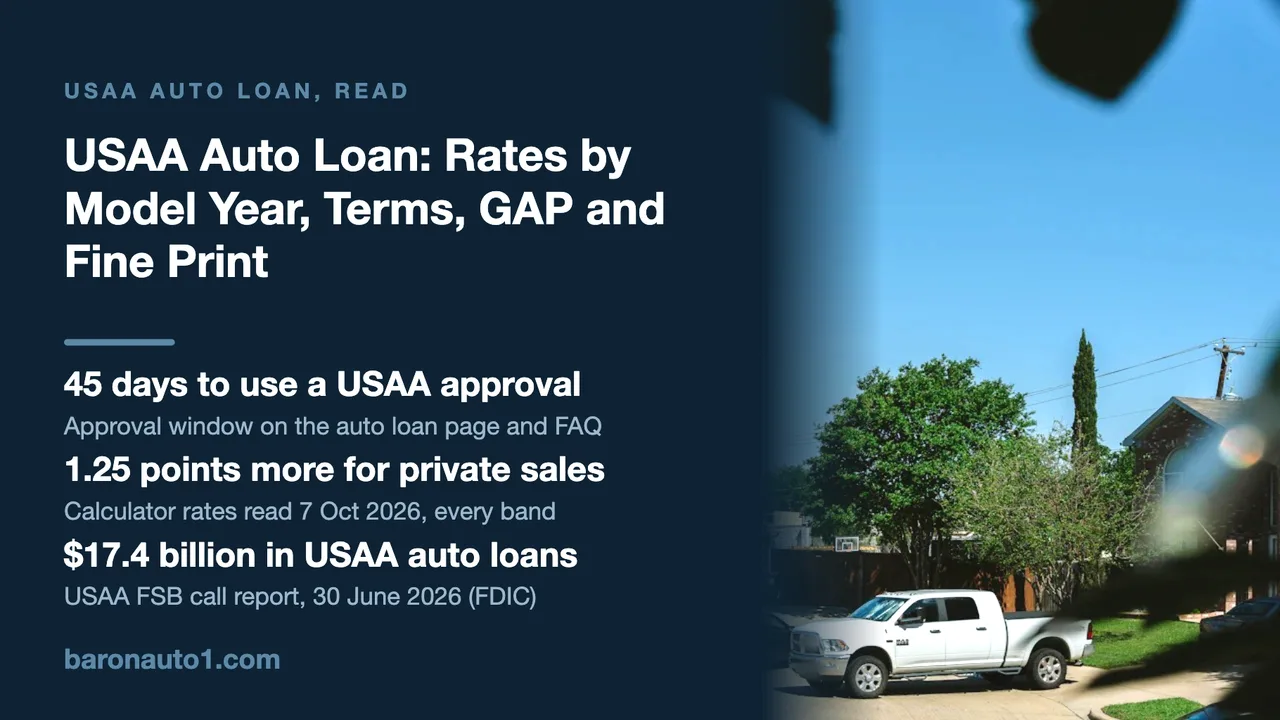
USAA auto loans are for members only. Its calculator, read 7 October 2026, priced every private sale 1.25 points above the dealer rate, its FAQ says the loan cannot finance GAP, and a 2024 OCC order still binds the bank.
The short version
- A USAA auto loan comes from USAA Federal Savings Bank and is for USAA members only. USAA’s own securitization filing calls the USAA membership the bank’s “only source of applicants.”
- On 7 October 2026 USAA’s loan calculator showed “as low as” 4.49% APR for a 2025 or newer car from a dealer over 36 months, including a 0.25-point automatic-payment discount. Older cars, longer terms and private sales cost more. These advertised rates change without notice and are not an offer.
- On every row we read, a private-party purchase cost 1.25 percentage points more than the same car from a dealer, while a refinance showed exactly the dealer rate. For 2018 and older models the calculator stops at 72 months.
- USAA Bank sells no GAP coverage, and its FAQ says the loan cannot pay for GAP or other credit-related add-ons bought from a dealer.
- An approval lasts 45 days. Terms run 36 to 84 months, with minimum amounts of $5,000 up to 60 months, $15,000 for 72 and $25,000 for 84. There is no application fee and no prepayment penalty.
- Three regulators took six enforcement actions against the bank from 2019 to 2024; none of the documents names auto loans. The OCC’s December 2024 order requires its sign-off before the bank adds riskier products or widens membership.
A USAA auto loan is a fixed-rate loan from USAA Federal Savings Bank for members buying a new or used car from a dealer or a private seller, buying out a lease, or refinancing, with terms of 36 to 84 months and a 45-day approval window. On 7 October 2026 we read USAA’s auto loan page, FAQ, refinance page, loan calculator, car title, membership and SCRA pages, the shelf registration its securitization arm filed with the SEC, the FDIC’s call-report figures and the CFPB, OCC and FinCEN records. We applied for nothing, so no rate or payment here is ours. This site has no commercial relationship with USAA or any lender, and because USAA’s Site Terms ask for permission before anyone links to usaa.com, we name its pages without linking them.
Who can get a USAA auto loan: membership comes first
USAA does not lend to the general public. Its Site Terms say its products “are generally available to military members and their families who meet certain membership eligibility criteria,” and the shelf registration that USAA Acceptance, LLC filed with the SEC on 5 August 2025 is blunter: the bank’s “only source of applicants” is USAA’s membership and associate membership, which it describes as mostly current and former officers, enlisted personnel, retirees and their families.
USAA’s membership page prints no single eligibility rule. Its questionnaire asks which description fits you: honorably served in the U.S. armed forces, enlisting, commissioning, NOAA or USPHS actively commissioned, federal agency employee, a parent who served or is a member, a spouse who served or is a member, or something else. We did not answer it, so we cannot say which of those routes leads to membership. Two rules are printed in its footnotes: separated military personnel need a discharge of Honorable or General Under Honorable Conditions, and “Eligible family members may also join USAA.” The page adds that a member’s children and spouse have a “good chance” of being eligible.
Joining costs nothing. USAA says creating a member account is free and that its products “have no membership fees.” Membership is a status, not ownership: USAA’s footnote says the word “member” does not convey “any legal or ownership rights in USAA.” No page we read asks for a savings deposit to hold membership, as credit unions do.
The regulator has a say too. The OCC’s order of 18 December 2024 bars the bank from expanding its membership criteria without the OCC examiner’s prior written no-objection.
USAA auto loan rates on 7 October 2026, with every condition
USAA’s auto loan page prints one rate: auto purchase loans “as low as 4.49% APR,” which “includes a 0.25% discount for using optional automatic payments.” Its footnote says that displayed rate is the lowest APR, “available on 36 month terms,” and applies to dealer purchases and refinancing. The refinance page advertises the same 4.49%. The full set of rates sits in USAA’s consumer loan calculator, which draws them by script for each loan purpose, model-year band and term.
We set the calculator by hand on 7 October 2026. We left its loan amount at the $30,000 it loads with and its automatic-payment discount box checked, as it loads. The table shows what it displayed for a purchase from a dealer. Refinance rates were identical on every row we read.
| Model year | 36 months | 48 months | 60 months | 72 months | 84 months |
|---|---|---|---|---|---|
| 2025 or newer | 4.49% | 5.55% | 5.65% | 5.81% | 6.33% |
| 2022 to 2024 | 5.74% | 5.90% | 5.90% | 6.01% | 6.64% |
| 2019 to 2021 | 6.09% | 6.25% | 6.25% | 6.36% | 7.05% |
| 2016 to 2018 | 6.30% | 6.56% | 6.84% | 7.52% | Not offered |
| 2015 or older | 7.25% | 7.51% | 8.04% | 8.72% | Not offered |
Every condition USAA prints beside these rates matters. The rates “vary based on approved credit and other factors, such as term, model year, loan amount, and loan purpose,” and are “subject to change without notice.” The calculator is “for illustrative purposes only,” USAA does “not guarantee these estimates, rates, or terms,” loan-to-value limits exist, and a dealer purchase needs a down payment “in some circumstances.” No minimum credit score is printed anywhere we looked. Our guide to credit scores and rate shopping covers comparing quotes.
USAA’s payment example, a 36-month loan at 6.40% APR costing $30.60 a month per thousand dollars borrowed, checks out by the standard formula. The calculator also offers 66, 75 and 78 months, which we did not read. Google’s AI summary on the read date mixed USAA’s current rate with an older review-site figure, so check the date on any USAA rate you see.
What moves a USAA rate: private sellers, older cars, longer terms and autopay
Four price rules show up in the calculator that USAA’s pages do not spell out. The gaps below are our arithmetic on its display.
A private seller costs 1.25 points more. The headline footnote says the displayed rates apply to “dealer purchases and vehicle refinancing.” On all 23 band-and-term pairs we read, a purchase from an individual was exactly 1.25 points above the dealer rate; on a 2025 or newer car over 60 months, the calculator’s finance charges on $30,000 were $1,050.15 higher.
| Model year | 36 months | 48 months | 60 months | 72 months | 84 months |
|---|---|---|---|---|---|
| 2025 or newer | 5.74% | 6.80% | 6.90% | 7.06% | 7.58% |
| 2022 to 2024 | 6.99% | 7.15% | 7.15% | 7.26% | 7.89% |
| 2019 to 2021 | 7.34% | 7.50% | 7.50% | 7.61% | 8.30% |
| 2016 to 2018 | 7.55% | 7.81% | 8.09% | 8.77% | Not offered |
| 2015 or older | 8.50% | 8.76% | 9.29% | 9.97% | Not offered |
Older cars cost more, and stop at 72 months. At 36 months, a 2015 or older car sat 2.76 points above a 2025 or newer one; at 60 months the gap was 2.39 points, worth $2,024.49 more in finance charges on the calculator’s $30,000 example. USAA’s refinance page says there are no age or mileage restrictions, and its auto loan page says its loans apply to “new, used and older vehicles,” so on the pages we read a car’s age sets its price band and term limit rather than a printed age cutoff.
Longer terms cost more, twice. For a 2025 or newer car the rate climbed from 4.49% at 36 months to 6.33% at 84, and the calculator’s finance charges from $2,120.08 to $7,213.58 on the same $30,000. See how the term changes what a loan costs.
Skipping automatic payments costs 0.25 points. With the discount box unchecked, the 60-month rate for a 2025 or newer car rose from 5.65% to 5.90%, and the calculator’s finance charges by $208.49. To get it, USAA’s FAQ says, set up automatic payments when you finalize the loan, before signing, from an account you own and verify; it can be at another bank.
One quirk before you budget with it: on every row we read, the calculator’s “Monthly payment” times the term exceeded its own “Total cost of loan.” At 60 months and 5.65%, $577.45 a month comes to $34,647.00, but the screen shows $34,505.40, a $141.60 gap; the standard formula gives $575.11 a month, which fits the total. The gap ran from $119.00 to $325.89 across our readings (our arithmetic). USAA does not explain it.
What USAA finances, and the amounts and terms
USAA’s purchase loan works with dealers, private sellers and lease buyouts, including cars equipped for people with disabilities. The FAQ fills in each route:
- Dealers. “You can use any dealer.” With online dealers, USAA advises verifying the VIN, seeing the car in person or through an inspection service, and avoiding sending money up front to an unverified seller; see checking a car’s history and a pre-purchase inspection.
- Private sellers. USAA mails a check payable to the seller once it has your documents; you pay the taxes and fees to move the title, and some states need notarized documents. See how the lien works in a private sale.
- Lease buyouts. “It depends on your lease contract,” but often you can, and USAA tells you to call to apply. Our lease buyout guide covers the other costs.
- Refinancing. Another lender’s loan, or a USAA loan “in good standing.” USAA needs a 10-day payoff amount, mails the old lender a check 2 to 3 business days after approval and signing, and may roll in negative equity. It warns a longer term “may cost you more in the long run.” See what a refinance needs and negative equity.
- A new car bought overseas. Allowed if it has never been titled and meets U.S. specifications, for members living in the U.S. or on a U.S. military base, subject to approval.
- Not covered. Motorcycles and vans converted to RVs (separate USAA loans exist) and commercial vehicles, from semi-trucks to food trucks.
On amounts and terms, the footnote is the rulebook. Terms of 36 to 60 months need at least $5,000 financed, 72 months needs $15,000, and 84 months needs $25,000 and is available on new cars (the current model year plus or minus one) and used ones “two or more years old.” “Maximum loan amounts apply,” but no maximum is printed for auto loans. The shelf registration ties the maximum to creditworthiness, debts, term, gross income and loan-to-value; USAA’s FAQ example is $27,000 borrowed on a $30,000 car, an LTV of 90%. There is no application fee or prepayment penalty; refinances may carry state and local fees.
The term rules do not quite agree with each other. The footnote offers 84 months on used cars two or more years old, but the calculator offers 84 months only for 2019 and newer models and shows “36 to 72 months” for anything older. The auto loan page says longer terms depend on “your credit”; the refinance page says they depend on “how much you borrow.” Ask before you count on 84 months for an older car.
Applying, the 45-day approval and how USAA underwrites
You apply online, in the USAA Mobile App or by phone, and USAA recommends applying before you shop. The FAQ lists what to have ready: income details, the loan amount you want, the vehicle’s age and trade-in details. If you are approved, “You have 45 days to finalize your loan and buy your car.” To finalize, USAA needs the VIN, the odometer reading, the seller’s details and the final amount, plus your choice of how to repay; documents are signed electronically, and changes can be requested online while you are still in the offer period and the loan is unfunded.
What USAA’s pages do not say is how it checks your credit. None of the auto loan pages we read says whether the application is a soft or a hard inquiry, or offers a prequalification. USAA’s advice article on the subject explains that prequalification usually uses a soft check and preapproval a hard one, then adds that “not all lenders offer both options” and to confirm with the lender. Assume a hard inquiry unless USAA says otherwise; see using a preapproval at the dealer.
The shelf registration describes the underwriting itself. The bank “directly originates” its auto loans and reviews each application first by an automated process: if the applicant meets certain criteria and has at least a specified credit score, the loan is approved; if not, an underwriter makes a judgmental review; otherwise the application is declined. The criteria named are payment and credit history, two income tests (total monthly debt to gross monthly income, and the loan payment to gross monthly income) and a loan-to-value test on the car’s market value. Exceptions need “compensating factors,” and the two examples given are an established deposit relationship with the bank and a positive credit history with it. The filing says the bank’s origination policies had no material changes in the three years before it.
Is there a USAA car buying service?
Not on any auto loan page we read. Neither the auto loan page, the FAQ, the refinance page nor the calculator mentions a USAA car buying service or a rate discount for using one, and the loan flow they describe is simple: get approved, then buy from any dealer or a private seller within 45 days. USAA’s own advice article on car buying services, updated 23 September 2025, describes brokers, concierges, online platforms, membership-based car buying programs, auctions and fleet sellers in general terms without naming a USAA program.
The bank’s securitization filing tells a different story about the past. Its form of prospectus includes an optional, bracketed passage about “the Bank’s TrueCar program,” under which a qualifying borrower’s rate “is reduced between 0.25% and 1.00%.” Bracketed text in a form is used only if it applies to a given pool, so the filing does not show the program is running today, and we found no consumer page offering it. If a dealer or a website tells you a USAA buying program cuts your rate, ask USAA to confirm it in writing. Our Carfax discount page, which read USAA’s public Perks page on 2 October 2026, found member discount categories, auto incentives among them, reached by logging on, and no USAA Carfax offer. Whatever route you take, compare out-the-door prices, not discounts off sticker.

No GAP from USAA, and what happens after a total loss
This is the condition most likely to surprise a buyer at the dealer’s finance desk. USAA’s FAQ asks whether you can finance GAP or other credit-related add-ons from the dealer, and answers: “No. You can’t use a USAA Bank Auto Loan to finance GAP or other credit-related products.” Some other add-ons, “things like extended warranties and vehicle protection plans,” may be financed. A separate answer says “USAA Bank doesn’t offer GAP coverage,” and that GAP on a loan you refinance into USAA ends, so you should ask your old lender for a refund of any unused premium.
Plan for GAP before you sign. If the dealer puts GAP on a contract you mean to pay off with a USAA loan, USAA says the loan cannot cover it. If you want GAP, it has to be paid for outside the USAA loan. Our guides to how GAP works and where it is sold cover the choices.
Without GAP, a total loss works the way USAA’s FAQ describes: you keep paying while your insurer handles the claim, USAA applies the settlement to your balance, any surplus is sent to you, and if you still owe, you keep making your contractual payments until the loan is paid off. If you bought a service contract or other protection product from the dealer, you may qualify for a refund. The shelf registration adds that every loan requires physical damage insurance on the car, that the bank “does not monitor” whether borrowers keep it, and that most borrowers buy it from USAA or an affiliate. None of the consumer pages we read states that requirement.
USAA no longer sells a service contract of its own either. Its Extended Vehicle Protection plan, provided by Assurant, was offered through 2018, and USAA says it “doesn’t currently offer an EVP plan for purchase.” Contracts bought before then run to their own expiry.
Payments, payoff and the title
USAA’s loans are simple-interest loans that accrue interest daily on the principal: balance times rate, divided by 365 (366 in a leap year). Its FAQ example is $10,000 at 8%, which is $800 a year, or $2.19 a day, and it warns that “longer months or gaps between payments will result in more interest.” Each payment goes first to unpaid fees and charges other than late charges, then interest due, principal due, unpaid late charges and finally the remaining principal. No late-fee amount is printed on any page we read.
Extra money can go two ways. You can make regular payments ahead of their due dates, or send a principal-only payment, which lowers the balance “but don’t satisfy the amount due for that period,” so the next installment is still owed. You can pay off early or make extra payments without penalty. The refinance page offers payments once a month, twice a month or every 2 weeks.
Payments made on a weekend, a holiday or after 9 p.m. CT may post the next business day. The due date “can’t be changed,” though you choose it at closing. On automatic payments, paying the full amount due at least 2 business days before the draft skips the next draft, while a smaller payment must arrive at least 12 days before to reduce it; the two windows differ as printed. Report payment errors within 60 days. An overpaid payoff is refunded 15 calendar days after the last payment posts, or 7 to 10 days later by mailed check.
USAA is the lienholder. A dealer in your home state should file the title for you. After a private sale you take the signed title to your state’s titling agency, pay the fees, put it in your name and add USAA as lienholder; in 12 jurisdictions, including Guam, Puerto Rico and the Virgin Islands, you also bring a copy of the signed Note, Disclosure and Security Agreement. After the final payment, USAA releases the title on a timetable that depends on the payoff method and state rules, and most states then want a release of lien.
USAA says it usually lets you take the car overseas when you deploy or move, but shipping it needs a USAA letter for U.S. Customs and Border Protection, which USAA will not process if your payment is more than 30 days overdue. After a move to another state, the new state’s titling agency requests the original title from USAA if it needs it.
Falling behind: extensions, SCRA and repossession
If you are current but expect trouble, USAA’s FAQ says you can ask online to extend a due date; extensions depend on availability and eligibility, and interest keeps accruing. If you are already past due, it says to call.
For servicemembers, USAA goes beyond the law. The Servicemembers Civil Relief Act caps interest at 6% on debt taken on before active duty; USAA says it caps qualifying accounts, auto loans included, at 4%, and will tell you within 30 days whether you qualify. A bracketed passage in the shelf registration says the servicer keeps the 4% cap for 12 months after active duty ends. USAA “can’t process” an application received more than 180 days after qualifying service ends, and when benefits end the regular rate returns. One trap: USAA warns that refinancing a loan that has SCRA benefits may end them.
The shelf registration describes what happens next for loans that go unpaid. The bank starts calling on day 1 for high-risk loans, day 7 for medium and day 10 for low risk. After 50 days it sends a right-to-cure letter on balances over $1,500, and “Generally, the Bank initiates repossession procedures” after 72 days of delinquency, sooner if the loan is deemed uncollectible, the car is at risk or the borrower surrenders it. Losses are recognized by 120 days, or within 60 days of a bankruptcy notice, and after a repossession sale the bank “pursues any deficiency” where practical and lawful. It also offers loss-mitigation options to members in hardship and may cut rates for some borrowers with a consistent payment history. Our repossession guide explains the notices and rights that state law adds.
Regulators, complaints and USAA’s auto loan book
None of the enforcement documents we read says an action concerned auto loans, but two touch borrowers: the OCC’s 2020 penalty names Servicemembers Civil Relief Act violations without saying which products were involved, and its 2024 order still binds the bank.
| Date | Regulator and document | What it says | Product |
|---|---|---|---|
| 3 January 2019 | CFPB consent order, 2019-BCFP-0001 | Stop-payment, error-resolution and account-reopening failures; about $12 million in restitution and a $3.5 million penalty, consented to “without admitting or denying”; terminated after 5 years. | Deposits |
| 7 January 2019 | OCC consent order, AA-EA-2018-90 | Ineffective risk management, compliance management, audit and IT programs; the bank “neither admits nor denies.” | Bank-wide |
| 14 October 2020 | OCC civil money penalty, AA-ENF-2020-67 | $85 million for compliance and IT risk governance failures that “resulted in violations of law, including but not limited to violations of the Military Lending Act and the Servicemembers Civil Relief Act”; neither admitted nor denied. | Not specified |
| 17 March 2022 | OCC penalty and cease-and-desist order | $60 million for Bank Secrecy Act violations and an order to fix the anti-money-laundering program. | Compliance program |
| 17 March 2022 | FinCEN civil money penalty | $140 million in total, crediting the OCC’s $60 million; FinCEN says the bank “admitted” willfully failing to keep an adequate anti-money-laundering program from at least January 2016 through April 2021. | Compliance program |
| 18 December 2024 | OCC comprehensive cease-and-desist order, AA-ENF-2024-96 | Replaces the 2019 and 2022 orders; unsafe or unsound practices including consumer compliance; requires finding and repaying harmed customers and OCC sign-off before riskier products or wider membership; neither admitted nor denied. | Bank-wide |
By our arithmetic the civil money penalties in these documents total $228.5 million, counting the OCC’s 2022 penalty once because FinCEN credited it against its own $140 million. The CFPB lists only the 2019 action; we found no 2022 CFPB order. The 2024 order found the bank still out of compliance with parts of the earlier orders. We could not open the OCC’s enforcement search, so a later change would not appear here.
The CFPB’s complaint database files USAA complaints under United Services Automobile Association. Through 6 October 2026 it held 713 vehicle loan or lease complaints, plus 186 car-loan complaints under the label used before 2017, 899 in all by our arithmetic, out of 19,868 naming USAA. The largest issue was managing the loan (241), then getting a loan (159) and problems at the end of the loan (126), within which 62 concerned the title or other problems after payoff. 389 complaints carried a servicemember tag; 87.2% were closed with an explanation and 91 with monetary or non-monetary relief. Counts rose from 86 in 2024 to 111 in 2025, with 99 so far in 2026. Complaints are unverified, and counts grow with a lender’s size; USAA ranked 33rd of 1,153 companies.
Size is in the call reports. The FDIC’s data show USAA Federal Savings Bank held $17.4 billion of auto loans on 30 June 2026, 37.7% of its $46.2 billion loan book, down $522 million, or 2.9%, from $17.9 billion at the end of 2024. Auto loans 30 to 89 days past due were $77 million, 0.44% of the total, with none reported 90 days or more past due and $45 million on nonaccrual. Net auto charge-offs were $91 million in 2025, 0.52% of the year-end balance, and $46 million in the first half of 2026 (our arithmetic from the FDIC’s figures).
USAA itself files with the SEC as an investment manager, with no annual report on the first page of its EDGAR filings. Its bank’s car loans reach the SEC through securitization: registered USAA auto owner trusts run from 2000-1 to 2019-1, which stopped reporting on 21 September 2022, and the depositor, USAA Acceptance, LLC, has a shelf registration effective 26 August 2025 and filed a due-diligence report for USAA Auto Owner Trust 2026-A dated 23 September 2026. The underwriting and collections passages above come from that registration.
Before you apply for a USAA auto loan
- Confirm membership first. USAA lends only to members.
- Price your exact deal in the calculator. The 4.49% headline needs a 2025 or newer car, a dealer or refinance, 36 months and autopay.
- Check the minimum for your term. $5,000 up to 60 months, $15,000 for 72 and $25,000 for 84. Ask about 84 months on a car older than a 2019 model before counting on it.
- Set up automatic payments before you sign. The 0.25-point discount needs autopay arranged when you finalize, from an account you own and have verified.
- Use the 45 days. Keep other applications in a short window and compare APR and total cost, not the monthly payment.
- Decide on GAP before the finance office. A USAA loan cannot pay for dealer GAP, and USAA Bank sells none.
- Plan the title. Buying privately, you file it and add USAA as lienholder yourself.
- Keep your car insured. USAA’s securitization filing says every loan requires physical damage insurance on the car.
We have read other lenders that serve military families the same way, Navy Federal and PenFed, and a bank lender, Wells Fargo. We do not rank lenders; compare the APR and total cost each quotes for the same car, term and date.
Common questions
What are USAA’s auto loan rates right now?
On 7 October 2026 USAA’s calculator showed “as low as” rates from 4.49% APR (2025 or newer, dealer or refinance, 36 months) to 8.72% (2015 or older, 72 months), and 9.97% for that older car from a private seller, all for $30,000 with autopay. A 2025 or newer car was 5.65% at 60 months, 5.81% at 72 and 6.33% at 84. Rates change without notice.
Who is eligible for a USAA auto loan?
Only USAA members: military members and families who meet its criteria. Its questionnaire covers those who served honorably, are enlisting or commissioning, NOAA or USPHS officers, federal agency employees, and parents and spouses of those who served or are members. Membership is free.
Can I use a USAA auto loan to buy from a private seller?
Yes. USAA mails a check payable to the seller, and you file the title, adding USAA as lienholder. The calculator priced every private sale we read 1.25 points above the dealer rate.
Does USAA offer GAP insurance on car loans?
No. USAA’s FAQ says USAA Bank “doesn’t offer GAP coverage,” and that a USAA auto loan cannot finance GAP or other credit-related products bought from a dealer. If you refinance into USAA, GAP on your old loan ends.
How long is a USAA auto loan approval good for?
45 days. USAA’s auto loan page says the approval “is good for 45 days,” and its FAQ says you have 45 days to finalize the loan and buy the car.
What is USAA’s longest auto loan term?
84 months, which needs at least $25,000 financed and, in the calculator, a 2019 or newer model. 72 months needs $15,000.
Sources and further reading
- CFPB consumer complaint database
- CFPB auto loan resources
- CFPB: what is Guaranteed Asset Protection (GAP)?
- CFPB: what is a credit score?
- FTC vehicle repossession
Recall, complaint and safety-rating figures on this page were retrieved from the federal databases above on August 19, 2026. Federal data changes — re-check any VIN before you rely on it.
Published October 7, 2026 · last updated October 7, 2026. Found something out of date or wrong? Tell us and we will correct it.