CarBrain Review: What Its Terms Say About Offers, Pickup and Pay
CarBrain is a marketplace: partner dealers bid on your car, and the Terms of Service they accept allow a counter-offer at pickup only if you substantially misrepresented the car. What CarBrain’s own documents say about towing, payment, titles, liens and arbitration.
The short version
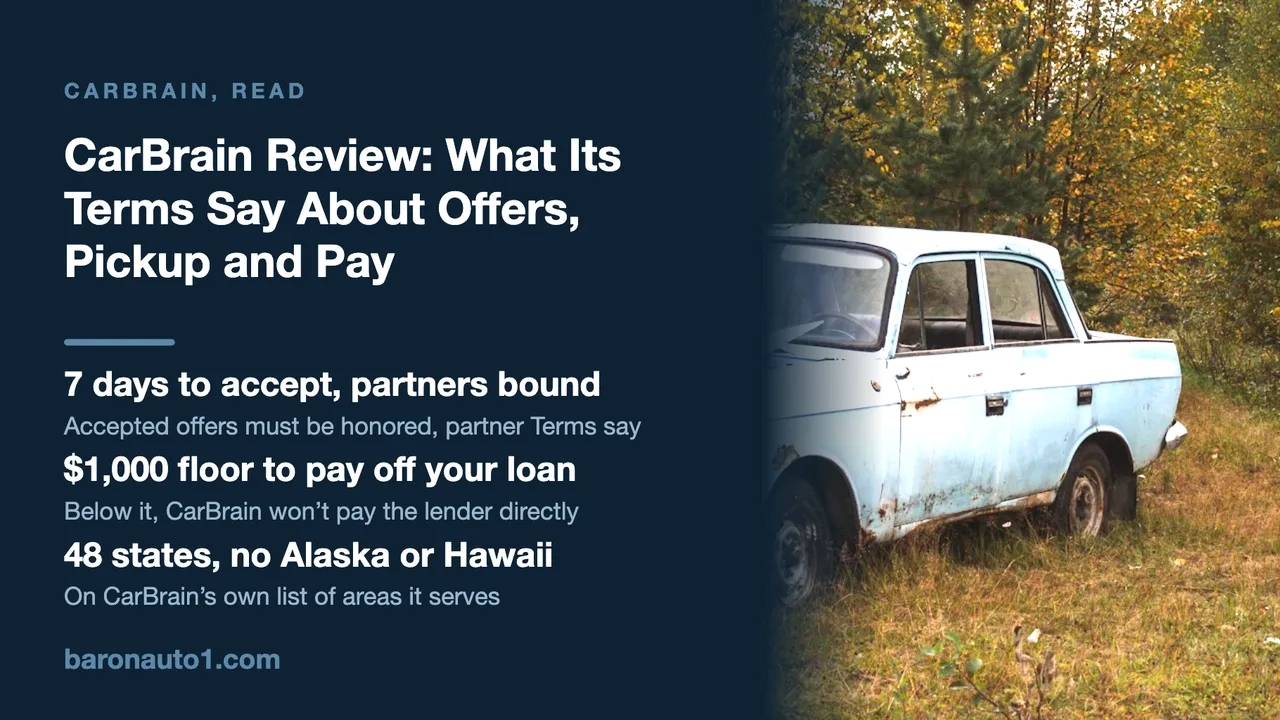
- CarBrain is a Miami Lakes, Florida, marketplace for damaged, junk and used cars, part of the CAS Automotive group. Partner dealers “view and bid on vehicles,” and a partner whose offer you accept handles pickup, payment and the title with you.
- CarBrain says you have up to 7 days to accept and the offer “will not be subject to change,” but another page adds: “as long as we can verify that the information you entered is correct.”
- Its partner dealers’ Terms of Service set the pickup rule: “Counter offers are unacceptable” unless the seller “substantially misrepresented vehicle condition, location, title status.”
- Towing is free because its cost is “included in the offer price.” Storage fees run up before the sale are yours. Payment is by check at pickup, or by mail if you choose.
- The FAQ says CarBrain “cannot buy your vehicle without a valid, signed title”; its title guide accepts substitutes in California and Washington. It pays a lender directly only on offers of $1,000 or more that cover the loan.
- The consumer Terms, which name CAS Auto, LLC and print no date, send disputes to individual arbitration under JAMS International rules in Miami, with a class-action waiver.
CarBrain is a real online buyer of damaged and unwanted cars, but it works as a marketplace: the offer you accept may come from one of more than 140 partner dealers, and if it does, that dealer is the one who inspects the car, pays you and takes the title. On 9 October 2026 we read 22 CarBrain documents, including its Terms and Conditions, the separate Terms of Service for its partner dealers, its FAQ, offer form, title-problems guide and privacy policy, plus 5 pages from its parent group, CAS Automotive. CarBrain’s Terms bar “back & direct-links,” so we name its documents rather than link them. No ZIP code, VIN or car was entered and no call was made, so no offer amount appears here; this site has no commercial relationship with CarBrain or any other buyer.
Who actually buys your car: CarBrain or a partner dealer
CarBrain’s marketing speaks as a buyer: “When you sell your car to CarBrain, we pay you, not the other way around.” The FAQ is more exact: “Offers to purchase are made by Us or by our network of Service Providers across the continental United States.” The privacy policy says: “We operate as a marketplace where partner dealers can view and bid on vehicles,” and puts the network at “140+ partner dealers in buyer network.” Once you accept a partner’s offer, CarBrain passes that dealer your phone number, address and vehicle details, and then “the partner handles the transaction directly with you, including pickup logistics, payment, and title exchange.” Photos of your title and ID stay with CarBrain.
The Terms of Service that partner dealers accept (CarBrain calls them Service Providers) describe “an online marketplace for damaged and end of life vehicles.” Partners set their own prices; the recruitment page tells them to “choose the type(s) of cars you want to buy, the prices you want to pay, and the distance you want to travel.” Section 3.1 makes each partner “solely responsible for their pre-configured offers and completing a transaction,” and section 20 calls CarBrain and its partners “independent contractors.”
CarBrain is paid by the dealer, not by you. Section 6.1: “CarBrain shall be compensated by Service Provider for each offer made by Service Provider and accepted by a vehicle seller at the rates set forth by CarBrain from time to time.” The rates are not published. A dealer must meet 8 minimum requirements to join, among them a “Required business license in your state,” “own tow trucks or sublet towing,” being “in business 3 or more years” and the “Ability to pay by check.”
For a seller, two things follow. Ask when you accept whether the offer is CarBrain’s or a partner’s, and get the dealer’s business name: that company hands you the check. And your description carries the deal, because section 11.1 tells dealers that CarBrain “DOES NOT INVESTIGATE OR WARRANT THE ACCURACY OR TRUTHFULNESS OF INFORMATION SUBMITTED BY POTENTIAL VEHICLE SELLERS.”
Who owns CarBrain, and is it legit?
CarBrain belongs to the CAS Automotive group of Miami Lakes, Florida, but its documents use three legal names. The consumer Terms say the site is “owned and operated by CAS Auto, LLC., a Delaware limited liability company, doing business as CarBrain.com.” The partner Terms name “CarBrain, LLC; a Delaware limited liability company; doing business as CarBrain.com.” The privacy policy “applies to CAS Automotive Group, LLC and its affiliated companies.” The footer adds a fourth spelling: “Carbrain is a registered trademark of Carbrain LLC.” For a dispute under the consumer Terms, the company to name is CAS Auto, LLC.
The start date varies too. CarBrain’s FAQ says it “is an evolution of DamagedCars.com, which was founded in 2007,” and “In 2017, CarBrain was born.” CAS Automotive’s history page dates CarBrain to 2016, and its brand page says “Since 2008.” The group began as College Auto Sales in 1985, “a small family-run business based in Miami, Florida,” and its privacy policy covers 11 websites, including damagedcars.com and junkcarmasters.com.
| Question | What we found | Source |
|---|---|---|
| Who runs the site | CAS Auto, LLC, a Delaware LLC doing business as CarBrain.com | CarBrain Terms and Conditions |
| Who runs the dealer network | CarBrain, LLC, a Delaware LLC doing business as CarBrain.com | Partner Terms of Service |
| Parent group | CAS Automotive Group, LLC, Miami Lakes, Florida | Privacy policy; CAS Automotive site |
| BBB rating | CarBrain claims “an A+ BBB rating” | Not checked: BBB blocked our browser |
| State company filings | Not read | Florida’s registry showed a bot check; Delaware’s was not tried |
| FTC or state attorney-general action | None found in web searches | A search result, not a clearance |
| Lawsuits | No complaint or docket found or read | Nothing to report either way |
| Licensing | “fully accredited, licensed, bonded and insured” | CarBrain’s claim; no state record looked up |
On what we could read, CarBrain is an established business with detailed dealer rules and no public enforcement action we could find. We could not confirm its BBB standing or its state filings, because both sites blocked access; those claims are its own. The harder question for a seller is what happens between the online number and the check.
How the offer is made, and how long it holds
The online form opens with one question, the ZIP code where the car sits, because “We need to know the ZIP where your car is located to make sure we give you the right offer and the most efficient service.” We stopped there, so the later questions were not seen. The FAQ lists what sets the number: “your location, the wholesale value of your car pre-accident, the extent of damage or mechanical and electrical problems, the current market demand for your vehicle and its parts, its make, model, mileage and age.” CarBrain says it uses its own “price engine technology” and asks for the VIN and photos of the “Front, Left Side, Right Side, Rear, Interior, VIN and other views of any damage.”
Is the offer instant? Sometimes. The home page promises “Instant Offer on Most Cars!” in “just 90 seconds,” and CAS Automotive’s brand page says “less than 60 seconds.” How-it-works is more careful: “an instant offer on some vehicles,” or a guaranteed offer “shortly after you finish entering your car’s details.” When more details are needed, the FAQ says, “you will receive a call from one of our car buyers.” Expect calls and texts: the TCPA notice treats using the site as consent to them, including “prerecorded/artificial voice messages,” though “Consent may be revoked at any time and by any reasonable means.”
Once you have a number, how-it-works says: “you have up to seven days to accept it. It will not be subject to change.” The partner Terms carry the same 7 days: in section 3.2, dealers agree to “honor offers made by Service Provider that are accepted by vehicle sellers within 7 days.” If you need longer, expect a new number.
What can change the offer at pickup
CarBrain’s marketing is firm. The junk-car page says “we guarantee no haggling and no last-minute negotiating with all our offers,” and criticizes buyers that “settle on a final price when they arrive to pick up the car.” The same page adds a condition: “The offer you accept is the payment you’ll get when you describe your car accurately.” The damaged-car page spells it out: the offer “will not change, as long as we can verify that the information you entered is correct,” and payment comes “After a quick inspection and transferring of your title.”
The consumer Terms say nothing about inspections. The rule is in section 6.4 of the partner Terms, on deals that fall through. A dealer whose offer you accepted “will be responsible for full payment of the vehicle based on the accepted offer to the seller” unless one of 3 things happened: it “was unable to reach the seller,” “the vehicle was sold to a different party,” or “the seller substantially misrepresented vehicle condition, location, title status and a counteroffer by Service Provider was rejected by seller.” Then: “Counter offers are unacceptable unless one of the previous conditions was met.”
| What the buyer finds | Where CarBrain says it | What follows |
|---|---|---|
| Condition substantially different from your description | Partner Terms, section 6.4; damaged-car page | A counter-offer; if you reject it, the dealer may walk away |
| The car is somewhere other than you said | Partner Terms, section 6.4 | Same |
| Title status differs (not in your name, a lien, no title) | Partner Terms, section 6.4; FAQ | A counter-offer, or no sale |
| Engine or transmission missing | FAQ: below “our minimum standards for purchase” | Not bought |
| Fewer than two tires | Junk-car page | Cannot be towed, so not bought |
| Information CarBrain cannot verify | Consumer Terms, “Breach” | CarBrain may “refuse to provide our services” |
Read together, a fair description should hold its price, and a materially wrong one opens the door to a lower offer you are free to refuse. “Substantially” is not defined, and the partner Terms are a contract between CarBrain and its dealer, not with you. Still, they are the rule CarBrain sets, and worth having on your phone if a driver starts to renegotiate over something you disclosed.
Describe the car the way the tow driver will see it. The grounds for a counter-offer are condition, location and title status, so a car that will not start on the day, a car moved to a shop, or a title still in a late relative’s name can each reopen the price. Photograph the odometer, every side and any damage the day before pickup, and mention anything missing before you accept.
Towing, fees, and what CarBrain will not take
“Free Tow and No Hidden Fees” is on the FAQ’s list of what CarBrain offers. The partner Terms explain how. Section 3.1: “Service Provider agrees that towing services will not be charged to CarBrain or the seller of the vehicle and all such costs are included in the offer price submitted by Service Provider.” Nobody bills you for the tow; its cost is inside the number you see. Partners also choose how far they will travel, so by our reading a car far from the nearest partner may draw fewer offers.
One cost is clearly yours: “You are responsible for any storage fees or repair expenses incurred prior to selling the vehicle to CarBrain.” If the car sits at a body shop or tow yard after a crash, those charges run until it is collected, and CarBrain’s blog asks sellers whose car is “at a shop, accruing fees” to tell it “ASAP.” Settle who pays the release bill before you book the pickup.
On timing, the FAQ says “On average, we can have your vehicle picked up 24 to 48 hours after you accept our offer,” the junk-car page says “under 48 business hours,” and the partner Terms give dealers “48 hours or otherwise with what was agreed with the seller” for the inspection, closing and tow. “Your driver will contact you an hour before arrival.”
Where CarBrain works: “CarBrain buys cars in cities across 48 states,” and its list has exactly 48 names. Alaska and Hawaii are not on it, and nor is the District of Columbia, though all 3 appear among the 51 jurisdictions on CarBrain’s title-signing page (our count). What it will not buy: “Most common cars missing major mechanical components such as Engine or Transmission do not meet our minimum standards for purchase,” and “all cars must have at least two tires for us to tow it.” Branded titles are welcome; the About page lists “previously damaged and repaired cars with salvage history / rebuilt titles.” After a total loss, CarBrain’s pitch is that you keep the car and receive “two payments, one from the insurance company for the damage settlement and a second from CarBrain.” Our guide to salvage titles explains the brand that usually follows.
How and when you are paid
The FAQ answers “How quickly can CarBrain pay for my vehicle?” with a method, not a time: “Payment is made by check when we or a member of our Service Provider Network picks up your vehicle, or by mail if you choose this option.” The junk-car page names the kind of check: “CarBrain pays with certified checks in order to protect both our drivers and our sellers.” The partner Terms are looser: dealers pay “in the manner agreed to in the offer.” No page we read mentions cash or a bank transfer.
| Document | What it says |
|---|---|
| How it works | “On average, we can pay you and have your vehicle picked up 24 to 48 hours after you accept our offer” |
| Areas served | “we’ll send you payment typically within 24 to 48 hours” |
| Home page | “payment in under 48 business hours” |
| FAQ | By check at pickup, “or by mail if you choose this option” |
| Partner Terms, section 3.2 | Inspection, closing and towing “within 48 hours or otherwise with what was agreed with the seller” |
The protection CarBrain stresses is the order of events: “When we purchase your car we deliver payment before we tow your car. We don’t get your car until you get your check.” The partner Terms back that with a duty to “only remove the vehicle from seller’s possession with seller’s consent and payment unless agreed upon by the seller.” That closing clause matters: agree to be paid by mail and you have agreed to let the car go first. At a normal pickup you “hand over the keys & title” and “The driver will hand over the check,” with “a bill of sale” to follow.
CarBrain does not say how long a check takes to clear or how to confirm one; Peddle, for comparison, says its check is active within 30 minutes of a confirmed pickup. A certified check is drawn on a bank, so confirm it with that bank before you sign, using a number you look up yourself, and check the payee name matches your title. The check may come from a partner dealer rather than from CarBrain.
The title, and selling without one
CarBrain’s FAQ is blunt: “CarBrain requires a title in the seller’s name. We cannot buy your vehicle without a valid, signed title from the registered vehicle owner.” On pickup day, “we require the properly signed original title to your car.” For some cars CarBrain first asks for “a signed photocopy or scan of your title” and a copy of your driver’s license, to match names and signatures; for “generally older vehicles,” the network member who collects the car checks the title on the spot.
The name on the title decides who can be paid: “Payment can only be issued to the listed owner on the title,” says the offer form. A title still in a previous owner’s name must be transferred into yours at the DMV first; selling on someone else’s signed title is what our guide to title jumping warns against. The one printed exception is for dealers: “If the title belongs to a licensed dealer we may purchase the vehicle on the title that was reassigned.”
Without a title, CarBrain’s documents disagree. The offer form’s answer to “I do not have a title for this vehicle” is a duplicate from the DMV; see our guide to replacing a lost title. The title-problems guide names two state substitutes: in California, for a car “registered and titled” in your name, “the Reg 262 and Reg 227 will be accepted in place of the title,” and in Washington, “the Affidavit in Lieu of title with an original Odometer Disclosure will be accepted in place of the title,” both only once “Any liens must be satisfied.” An undated CarBrain blog post goes further: “CarBrain buys all types of vehicles including those without a title,” though it still needs “some form of documentation” of ownership. Treat the FAQ and the offer form as the rule: outside California and Washington, plan on a title in your name. A bonded title is the usual state route when you cannot get one, and our guide to selling a junk car without a title covers what yards accept.
Signing matters too. CarBrain’s title-signing page warns that in states requiring notarization “you must wait to sign your title in front of a public Notary”; our guide to signing a title over covers the common mistakes. The privacy policy lists the extra papers CarBrain collects for harder cases, 12 by our count, from a divorce decree for a name change to a death certificate or will when the owner has died. After the sale, keep the bill of sale and file your state’s release of liability yourself.
Selling a car you still owe money on
CarBrain will pay a lender directly, within limits. The offer form says: “On offers above $1000, we are able to pay your finance company directly if your loan balance is equal or less than the offer amount.” The title-problems guide sets 3 conditions: “The confirmed offer is $1,000.00 or higher,” “Loan balance must be equal or less than the confirmed offer amount,” and “The finance company must provide a Letter of Guarantee or a Payoff Letter.” Note the gap between “above $1000” and “$1,000.00 or higher”: an offer of exactly $1,000 qualifies on one wording and not the other, so ask.
The damaged-car page gives CarBrain’s own example: with $1,000 still owed and an offer of $1,200, the seller keeps $200 once the loan is paid (the subtraction checks out, by our arithmetic). The reverse case is plain: “Our offers may not always exceed what is still owed on the vehicle. In this instance, we aren’t able to purchase the vehicle from you.” The FAQ mentions one other route, to “transfer the loan to your new vehicle (sometimes called a collateral swap)”; otherwise, by our reading, the gap has to be paid off before CarBrain can buy. Our guide to negative equity covers the options.
Before you accept, get a written payoff letter from your lender and check that the confirmed offer clears both the payoff and the threshold. CarBrain may ask for a “Lienholder authorization letter,” your registration and a “Payoff letter.” See our guides to getting a payoff quote and checking for a lien. For leases, the FAQ says only that “CarBrain can guide you through the title release process.”
The Terms: arbitration, the class waiver and what they leave out
CarBrain’s consumer Terms and Conditions print no date and describe a different business. They speak of a site that “lists a vast inventory of new and used vehicles,” call everything on it “advertising only,” and say nothing about offers, inspections, towing, payment, titles, liens or cancelling. Those rules live in the FAQ, the selling pages, the partner Terms and a “legal purchase agreement” the FAQ says you receive when you sell; we did not see one, because we did not start a sale.
What the Terms do settle is how you can bring a claim: “any controversy or claim arising out of or relating to the Terms and/or your use of the Website” goes to “binding arbitration in accordance with JAMS International Arbitration Rules,” on “an individual basis,” held “exclusively in Miami, Florida.” You “waive any right you may have to initiate and/or join any putative class-action,” and must “notify Us in writing of any claim or dispute” and allow “reasonable time to address it” first. Florida law governs, and the Terms can change “at any time.” Read the purchase agreement before you sign; it may have its own clause.
| Point | Consumer Terms and Conditions | Partner dealers’ Terms of Service |
|---|---|---|
| Company named | CAS Auto, LLC, a Delaware LLC | CarBrain, LLC, a Delaware LLC |
| Offers | Not mentioned | Honored within 7 days; counter-offers only on the grounds in section 6.4 |
| Towing | Not mentioned | Not charged to the seller; cost included in the offer price |
| Payment | Not mentioned | “in the manner agreed to in the offer”; car removed only with consent and payment |
| Disputes | Individual JAMS arbitration in Miami; class-action waiver | Mediation, then the courts in Miami |
| Changes | “at any time,” on posting | Dealers have 10 days to leave after a material change |
The privacy policy, issued for CAS Automotive Group, LLC, says “We DO NOT sell your personal information,” but shares hashed contact details with Google and Meta to measure advertising, which it says “may constitute ‘sharing’ under California law.” Data on a car not bought is “archived after 90 days”; for a completed sale it is “retained indefinitely.” The Do Not Call registry “does NOT apply” to calls about a pending sale; you can stop them, but then “your transaction will not be possible.” The Terms add that what you submit “becomes and remains the property of CAS Auto.”
Backing out is not covered. No CarBrain page we read explains how to cancel an accepted offer or a booked pickup, or mentions a fee for doing so; the partner Terms simply excuse a dealer when “the vehicle was sold to a different party.” If you change your mind, tell your account manager and the dealer in writing before the truck is dispatched.
CarBrain vs Peddle and Wheelzy, on their own terms
Searchers often set CarBrain against Peddle, and Wheelzy works the same way: a network of buyers behind the online offer and a tow driver who checks the car. The Peddle column was read for our Peddle review on 5 October 2026 and the Wheelzy column for our Wheelzy review on 6 October 2026, and both are repeated unchanged. We compare printed terms, never prices.
| Point | CarBrain (read 9 October 2026) | Peddle (read 5 October 2026) | Wheelzy (read 6 October 2026) |
|---|---|---|---|
| How long the offer holds | Up to 7 days; dealers must honor accepted offers | Up to 7 days to accept; can change until accepted | Kept “as long as we’re able to” before acceptance |
| Change at pickup | Dealer counter-offer only if condition, location or title status was substantially misrepresented | May “recalculate the Offer or refuse pick up” | Recalculation if parts are missing or the car differs (Terms, section 4) |
| How you are paid | Check at pickup, or by mail if you choose | Mainly a company check, active within 30 minutes of a confirmed pickup | 4 methods: cash, physical, electronic or mailed check |
| Car with a loan | Lender paid directly on offers of $1,000 or more that cover the balance | “all liens and loans must be paid in full” first | Not addressed on the pages read |
| No title | No sale without a valid, signed title; California and Washington substitutes | Has “many buyers that buy cars without a title” | “may be able to buy your car without a title” |
| Disputes | Florida law; individual JAMS arbitration in Miami; class waiver | New York law; individual JAMS arbitration | Florida law; negotiation, then Orange County courts |
All three make the online number depend on your description. CarBrain is the only one whose dealer contract we read, and it limits counter-offers more tightly than Peddle’s or Wheelzy’s consumer terms do; but CarBrain prints the least about when its checks clear and the most conditions on selling without a title. For other routes, see where to sell a car, selling a junk car and our We Buy Any Car review.
A checklist before you accept a CarBrain offer
- Describe the car as the driver will find it: whether it starts and drives, every area of damage, anything missing.
- Give the address where the car will be on pickup day, and say if it is at a shop or yard running up storage fees, which are yours.
- Photograph the car the day before pickup: the odometer, each side, the interior and any damage.
- Ask who is buying, CarBrain or a partner dealer, and get the dealer’s business name.
- Accept within 7 days, or expect a new number.
- Check the title is in your name, and sign it as your state requires, before a notary where required.
- If you owe money, get a payoff letter first and make sure the confirmed offer is at least $1,000 and covers the balance.
- Confirm a certified check with the issuing bank before you sign anything.
- Do not hand over the title or keys until you hold the payment.
- Keep the bill of sale and purchase agreement, and file your release of liability.
Common questions
Is CarBrain a legitimate company?
It is an established Miami Lakes, Florida, business that traces itself to DamagedCars.com, founded in 2007, inside a group that began in 1985, and it publishes detailed rules for its partner dealers. We found no FTC or state attorney-general action naming it. BBB and the Florida registry blocked our access on 9 October 2026, so its “A+ BBB rating” is CarBrain’s own claim.
How does CarBrain pay you?
By check: at pickup, “or by mail if you choose this option,” and the junk-car page says “CarBrain pays with certified checks.” Its pages say you are paid and the car collected 24 to 48 hours after you accept, on average. If a partner dealer bought the car, that dealer handles payment.
Can CarBrain lower the offer at pickup?
Only in limited cases. CarBrain says an accurate, verifiable offer “will not change.” Its partner dealers’ Terms allow a counter-offer only if the seller “substantially misrepresented vehicle condition, location, title status,” and you can refuse it.
Does CarBrain buy cars without a title?
Mostly no. The FAQ says it cannot buy without “a valid, signed title from the registered vehicle owner.” Its title guide accepts California’s Reg 262 and Reg 227 and Washington’s Affidavit in Lieu of title, with liens cleared, and a blog post claims more. Ask before you accept.
What does CarBrain do with your car?
Often it goes to a partner dealer: the privacy policy describes a marketplace where “partner dealers can view and bid on vehicles” and lists auction services among its providers. Its recruitment page speaks of “junk and rebuildable cars,” and in the same group, CAS Auto “specializes in global export,” the privacy policy says.
Is Peddle or CarBrain better?
We do not rank buyers. On printed terms, both hold offers for up to 7 days and both tie the number to your description. Peddle says many of its buyers take cars without titles; CarBrain generally needs a title in your name and pays lenders directly from $1,000. Getting both offers costs nothing.
Sources and further reading
- California DMV, notice of transfer and release of liability
- TxDMV, buying or selling a vehicle
- TxDMV add or remove a lien
- NHTSA odometer fraud
Recall, complaint and safety-rating figures on this page were retrieved from the federal databases above on August 19, 2026. Federal data changes — re-check any VIN before you rely on it.
Published October 9, 2026 · last updated October 9, 2026. Found something out of date or wrong? Tell us and we will correct it.