iSeeCars VIN Check: What the Free Tool Actually Returns
A genuinely free VIN tool that answers a different question from the one most people bring to it. The split between free and paid is the whole review.
The short version
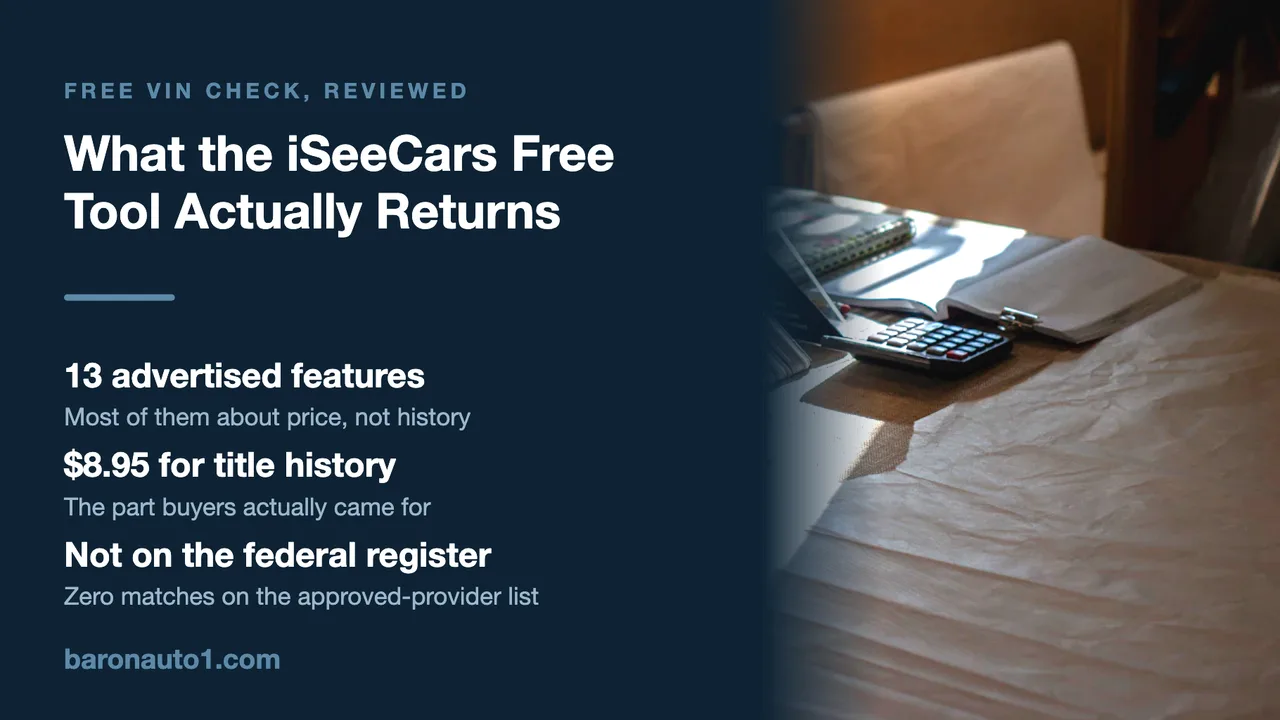
- iSeeCars runs a genuinely free VIN tool at iseecars.com/vin. It is real, it works without payment, and it is not a trimmed-down history report — it is a market-value and pricing analysis with some history fields attached.
- That distinction is the whole review. Most of what it returns free concerns what the car is worth: price analysis, depreciation, market supply and demand, dealer scoring, best times to buy and sell.
- The theft check is free and drawn from the National Insurance Crime Bureau. Title and lien information is stated to depend on what the state DMV supplies, so it is not guaranteed to appear.
- iSeeCars does not appear on the federal register of approved NMVTIS data providers. The word “iseecars” occurs zero times on that list.
- Its own published sample report names VinAudit — which is on the register — in the disclaimer covering NMVTIS access. The commercial arrangement behind that is not published, so this page does not characterise it.
- Paid tiers: a one-off report at $8.95, and monthly plans at $40 for 50 reports or $80 for 200. Monthly only, unused lookups expire, and no prorated refunds.
Search for a free VIN check and iSeeCars comes up quickly. It is one of the few results where the word free survives contact with the page: there is a working tool, it does not demand a card, and it returns a substantial amount of material.
What it returns is not quite what most people arriving from that search are looking for, and the gap between the two is worth setting out carefully — because it is not a trick, and the tool is not bad. It is simply built to answer a different question.
One more thing before the detail, because it changes how you should read everything below. The free lookup submits behind a CAPTCHA, and this review did not defeat it. Nothing here describes a report that was watched rendering on screen. Every description comes from the vendor’s own feature table and its published sample. Where that matters, it is said again.
What the free tool actually is
The tool lives at iseecars.com/vin, under the page title “Free VIN Check and Decoder with History Reports”. It accepts either a seventeen-character VIN or a licence plate with a state, and it offers three optional fields — mileage, asking price and postcode — that exist to sharpen the valuation rather than the history.
Eligibility is narrower than the marketing suggests. It covers United States passenger vehicles of model year 1981 and newer. The VIN itself excludes the letters I, O and Q, which is a property of the VIN standard rather than a limitation of the tool.
The advertised feature list runs to thirteen items: market value price analysis, vehicle condition analysis, similar cars comparison, market demand and supply, selling history, an unbiased dealer scorecard, multi-year depreciation analysis, best times to buy and sell, a free theft record check, recall history, key specifications, vehicle title and lien information, and an accident check.
Read that list slowly and the balance is obvious. Eight of the thirteen are about price, timing and market position. Five touch the vehicle’s past. This is a pricing product with history features, not a history product with pricing features.
Which is fine, if it is what you need
There is a real buyer for that. Somebody who has already satisfied themselves that a car is sound, and now wants to know whether the asking price is defensible, is being served well here. Depreciation curves, comparable listings and a read on local supply are genuinely useful at that stage, and most history-report vendors do not attempt them at all.
The buyer it does not serve is the one earlier in the process — the one who has found a car that looks too cheap and wants to know why. That question is answered by title brands, and title brands are the part of this product that is least free and least direct.
The theft check, which is the strongest free thing here
One item on that list deserves separating out, because it is unusually good for a free tool.
The theft record check is drawn from the National Insurance Crime Bureau and is explicitly labelled free. NICB data is the standard source for whether a vehicle has been reported stolen or recorded as an unrecovered theft, and getting it without payment is a real benefit.
It is not a complete answer on its own — a car can be perfectly clean on theft records and still carry a salvage brand from a flood two states away — but as a free first filter it does something concrete.
Title and lien, and the sentence that governs it
Title information is where the tool becomes conditional, and the vendor says so in its own words: title and lien data depends on what the state DMV supplies, and is not guaranteed.
That is an honest caveat and worth respecting rather than reading past. It means an empty title section carries two possible meanings that look identical on screen — either the vehicle has no brands, or the state did not supply the data. Those are opposite conclusions rendered the same way.
This is the single most important habit when reading any free vehicle-history output: an absent record and a clean record are not the same thing, and most free tools do not visually distinguish them. When the stakes are a salvage title, you want a source that tells you which one you are looking at.
The register question
The federal government maintains a list of companies approved to supply data from the National Motor Vehicle Title Information System. It is public, it is short, and it is the fastest way to check what any provider is actually plugged into.
iSeeCars is not on it. Searching the approved-provider list for “iseecars” returns zero occurrences, checked and independently re-checked on 1 September 2026.
That absence is not by itself an accusation. Plenty of legitimate businesses obtain federal title data through a company that does hold the approval rather than holding it directly, and the register is not a quality ranking. But it does mean the question moves: if iSeeCars is showing you title records, where are they coming from?
Their own published sample answers it. The disclaimer on the sample title report names VinAudit Inc. in connection with NMVTIS access. VinAudit is on the register. What is not published anywhere is the nature of that arrangement — reseller, licensee, white label — so this page names the disclosure and stops there rather than inventing a label for it. We have looked at that company separately in our review of VinAudit.
Two pages, two different vocabularies
A small detail that tells you a lot about how the product is positioned.
The word NMVTIS appears six times on the iSeeCars vehicle-history page. It appears zero times on the free VIN page.
That is not deception — the free page does not claim NMVTIS data, so there is no reason for the word to be there. But it does confirm the division cleanly. The federal title system is a feature of the paid product and is described where the paid product is sold. The free tool is a different animal, and its own page never suggests otherwise.

What the paid tiers cost
There are three published price points and a fourth that only appears inside the sample.
A one-off vehicle history report is $8.95. The same title and salvage report is offered at $5.95 to subscribers, printed inside the sample document as “Reg: $8.95 → $5.95” against a limited-time badge. Both figures were read on 1 September 2026.
The subscriptions are monthly: iVIN Lite at $40 a month for 50 reports, and iVIN Pro at $80 a month for 200 reports.
Three terms attached to those plans matter more than the headline figures. They are monthly only, with no annual discount. Unused lookups expire at the end of the month rather than rolling over. And there are no partial or prorated refunds.
For a dealer or a volume buyer, 50 reports at $40 is around eighty cents each and that is a strong number. For somebody buying one car, it is a subscription you must remember to cancel in order to spend $40 rather than $8.95 — and expiring lookups mean the value only exists if you actually use them.
Worth knowing if you go looking: the obvious URL for the plans, /pricing, returns a 404. The plans live at /subscription-vin-plans. A missing pricing page is a small thing, but it is the second time on this site that the guessable path is not the real one.
Against what we link to, printed plainly
CarCheckerVIN’s published rates, recorded 29 August 2026, are $14.99 for a single report and $9.00 each in a ten-report bundle, as a one-time payment with no subscription.
Against $8.95 for a single iSeeCars report, iSeeCars is cheaper on one report. That is the honest comparison.
Where the comparison turns is the shape of the purchase rather than the number. A one-time payment cannot renew, cannot expire and cannot need cancelling. A monthly plan at $40 with lookups that vanish at month end is a better deal per report and a worse deal for a person buying one car in a year. Which of those describes you is the entire decision.
The claim on the plans page
iSeeCars states on its subscription page that over seven million iVIN reports have helped its users so far.
That is a volume claim about the company, not a claim about what any individual report contains, and there is no public way to audit it. It is recorded here because it appears on the page, not because it was verified. Treat it the way you would treat any self-published usage figure.
What this review could not establish
Being specific about the gaps is more useful than pretending there are none.
The free report was never seen rendered. The lookup submits behind a CAPTCHA. Everything above about the free output comes from the vendor’s feature table and published sample. If the live free report differs from either, this page would not know.
Whether the free tier needs an email or an account before it returns anything. The page offers optional email capture for tracking and sharing a VIN, but whether a report renders with no sign-up at all was not confirmed.
Whether the free accident check returns populated data. It is listed in the feature table and appears in the sample summary, but a listed feature and a populated one are different claims.
The exact relationship with VinAudit. One disclaimer line names them. No contract scope is public.
And one figure that is circulating and should not be: several third-party pages state that free users are limited to five VIN searches per month. That number appears nowhere on the iSeeCars pages examined here — not on the VIN page, not on the vehicle-history page, not on the plans page. It is not published here as fact, and we would suggest not trusting it elsewhere either.
The valuation half, taken on its own terms
Because most of what the free tool returns is pricing work, it is worth asking whether that half is any good rather than treating it as filler around the history fields.
The honest answer is that it is doing something genuinely difficult, and that the difficulty is not the vendor’s fault. There is no such thing as a car’s value that can be looked up. What exists is a set of estimates built from listings, sales and depreciation curves, and every provider producing one is modelling rather than reporting. We set out why in our piece on what a market value by VIN actually is, and the short version is that the inputs which move a price most — condition, service history, how badly the seller wants out — are not decodable from seventeen characters.
Within that limit, offering depreciation across several years, comparable listings and a read on local supply and demand is a reasonable set of tools, and the optional mileage, asking price and postcode fields exist precisely to constrain the estimate with facts the VIN cannot carry. A buyer who fills those in gets a better answer than one who does not.
What none of it can do is tell you whether the specific car in front of you deserves to sit at the top or the bottom of its own range. A clean one-owner example and a flood-damaged rebuild of the same year and mileage decode identically. The valuation is an estimate for the model; the history is what tells you which end of the range this particular car belongs at.
The dealer scorecard, and what “unbiased” can mean
One feature deserves a closer look because of the word attached to it. The list advertises an “unbiased dealer scorecard”.
A dealer rating built from listing behaviour — how long cars sit, how prices move, how the advertised price compares to the market — is a legitimately interesting signal, and it is one a buyer cannot easily construct alone. It is also a signal about the seller rather than the vehicle, which makes it a different kind of thing from everything else on the page.
Treat it as a prompt rather than a verdict. A dealer scoring badly is a reason to be more careful with the paperwork, not evidence that a particular car is bad; a dealer scoring well has no bearing on whether the specific vehicle was in a collision. Neither result substitutes for reading the car’s own record, and the title and brand history attached to that VIN is indifferent to who is selling it.
How it compares with the others we have examined
This site has now looked at several providers in the same way, and iSeeCars sits in a distinct position among them.
VinAudit and EpicVIN both appear on the federal approved-provider register and both lead with title data. Bumper sells access on a monthly membership. iSeeCars is the only one of the group whose free product is primarily a pricing instrument, and the only one whose federal title access is disclosed in a sample-report footnote rather than on the register itself.
That makes it complementary to the others rather than a competitor to them. Running the free iSeeCars tool and then a title check from a provider that names its source is not redundant — the two answer different questions, and neither one covers the other’s ground. Our comparison of the two best-known report brands covers the same distinction at the paid end of the market.
Where it sits in the order of checks
Used for what it is, iSeeCars is a good free tool. Used as a substitute for a title check, it is the wrong instrument.
A sensible order looks like this. Run the free federal recall lookup, which costs nothing and is definitive about outstanding safety campaigns — our walkthrough of the recall check covers where. Run the iSeeCars free tool for the theft check and, if you are weighing an asking price, for the valuation work it genuinely does well.
Then, before money changes hands, get title and brand history from something that states its source and shows you the difference between a clean record and an absent one. A title and brand check against the VIN is where that sits, and our broader guide to choosing between report providers sets out how to test any of their claims in about two minutes.
And then look at the car. No database on this page, ours included, has ever seen the vehicle.
Common questions
Is the iSeeCars VIN check really free?
Yes, in the ordinary sense: there is a working tool that returns output without payment. What is free is mostly valuation and market analysis plus an NICB theft check. Full title and salvage history is a paid product at $8.95.
Does iSeeCars give you a full vehicle history report free?
No. The free tool and the paid vehicle history report are different products sold on different pages. The free page never claims NMVTIS title data and the word does not appear on it.
Is iSeeCars legitimate?
It is a real, operating company with a working product and published prices, which is more than several sites ranking for the same searches can say. It is not on the federal NMVTIS approved-provider register, and its sample report names VinAudit in connection with federal title data. Neither of those is a red flag on its own; both are worth knowing.
How much is an iSeeCars subscription?
$40 a month for 50 reports, or $80 a month for 200. Monthly only, unused lookups expire at month end, and there are no prorated refunds. For one car, the one-off report is the cheaper purchase.
Can I get title records free anywhere?
Not the federal title record, no. What is genuinely free is the NHTSA recall lookup, an NICB theft check of the kind iSeeCars offers, and whatever a seller will hand you. Title brands come from a system that charges for access, and any site promising them free is either not supplying them or not telling you where they came from.
Why does the pricing page 404?
The guessable path, /pricing, is not the real one; the plans live at /subscription-vin-plans. It looks like an ordinary broken link rather than anything deliberate, but it does mean searching for the price is harder than it needs to be.
Sources and further reading
Recall, complaint and safety-rating figures on this page were retrieved from the federal databases above on August 19, 2026. Federal data changes — re-check any VIN before you rely on it.
Published September 1, 2026 · last updated September 1, 2026. Found something out of date or wrong? Tell us and we will correct it.