FaxVIN Review: Who Runs It, NMVTIS Status and Refund Terms
A UK-run seller of one-time vehicle history reports that is not on the federal NMVTIS register and prints no price before you enter a VIN. What its terms, 14-day refund policy and sample reports show.
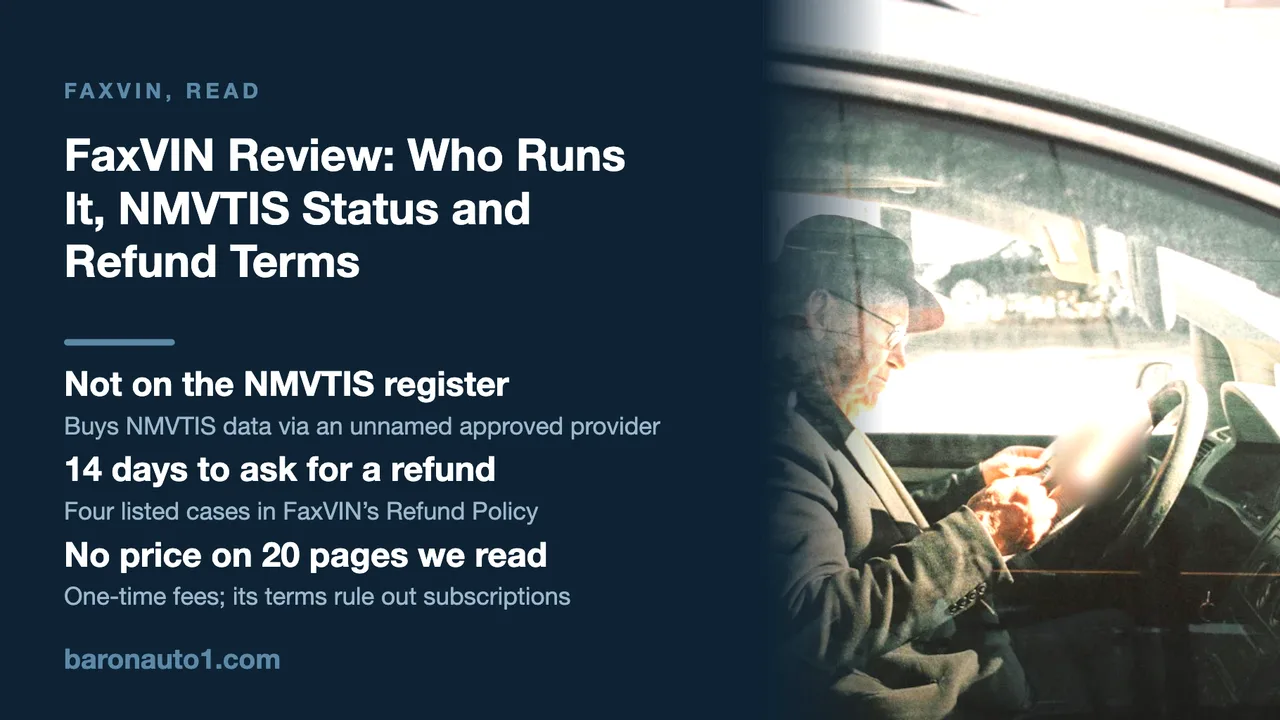
The short version
- FaxVIN has sold vehicle history reports since 2010, first as VINCarHistory. Its terms name the operator only as “FAXVIN”, with a legal address in Edinburgh, United Kingdom; a Companies House search on 9 October 2026 found no company under either name.
- FaxVIN is not on the Department of Justice’s NMVTIS approved-provider register. It says it gets federal title data “through an approved NMVTIS data provider”, which it does not name.
- There is no subscription: FaxVIN’s terms rule out recurring billing and its FAQ describes a one-time fee per report or package. None of the 20 FaxVIN pages we read printed that fee; the price appears only after you enter a VIN or plate.
- Refund requests must arrive within 14 days. The refund policy lists four cases, including a report with no history records at all, and pays out as a report credit or a refund to your card.
- A purchased report stays in your account for 180 days. Liability is capped at what you paid, the terms follow Scots law, US consumers can sue where they live, and there is no arbitration clause.
- FaxVIN’s four sample reports were run between 2016 and 2020. Three score between 82 and 89 on its 0–100 CarRank; a salvage-branded, rebuilt and exported 2012 Nissan scores 34.
Is FaxVIN legit? It is a long-running seller of one-time vehicle history reports, operated from the United Kingdom, that buys its federal title data from an approved provider rather than being one. Everything below was read on 9 October 2026 from the documents that print it: FaxVIN’s Terms and Conditions (effective 25 February 2026), its Refund Policy, FAQ, About and Contact pages, NMVTIS disclaimer, CarRank page, four sample reports and its VIN check, decoder, plate and recall pages; the NMVTIS provider register; and the UK Companies House register. We have no commercial relationship with FaxVIN or any report seller, and we entered no VIN or plate anywhere.
Who runs FaxVIN
FaxVIN’s About page gives its history in a fact box: VINCarHistory from 2010 to 2017, the FaxVIN logo since 2017, founded March 26, 2010, type “Limited Partnership”, serving the United States, Canada and Europe. It lists a legal address in Edinburgh, United Kingdom, and a US mailing address in Covina, California. The terms say the site is operated by FAXVIN at the Edinburgh address and targets the United States, Canada, the United Kingdom and the European Union.
What the pages do not give is a registered name. None of the 20 FaxVIN pages we read names a registered company or partnership or prints a registration number; the terms call the operator “FAXVIN” and say payments go through “our United Kingdom entity” without naming it. Our Companies House searches for “faxvin” and “vincarhistory” on 9 October 2026 both returned no company. That is a limited finding: a name search only finds registered names, and a partnership can trade under a different one, so it is not evidence that no registered business exists. It does mean a buyer cannot name, from FaxVIN’s own pages, the legal body on the other side of the contract.
The UK base has one practical effect: the terms warn that “your bank or card issuer may charge a foreign transaction fee”. Card payments go through Stripe and usually appear on a statement as “FAXVIN.com” followed by a transaction code beginning ST-. The About page adds that FaxVIN is not operated or endorsed by any government agency, and section 12 of the terms says it may receive referral fees from certain third parties.
Do not confuse it with vinfax.com, a different site that this site’s record of 1 September 2026 lists among sellers of discounted Carfax and AutoCheck reports (see our cheap Carfax report guide). FaxVIN’s pages do not mention Carfax or AutoCheck; it sells its own report.
Is FaxVIN an approved NMVTIS provider?
No. The Department of Justice keeps a public list of businesses approved to sell reports from the National Motor Vehicle Title Information System (NMVTIS), the federal database of title brands, insurance total losses and junk and salvage reports. This site’s record of that register from 31 August 2026 lists 14 consumer-facing providers, and our record of 3 October 2026 lists 12 primary entries in the section for commercial and public customers. FaxVIN is in neither. We read the register once more on 9 October 2026 and searched it for FaxVIN and VINCarHistory: no match anywhere, including the paragraphs listing additional websites that approved providers own.
FaxVIN does not claim otherwise. Its About page says it “accesses NMVTIS data through an approved NMVTIS data provider”, its NMVTIS page says any NMVTIS fields in its reports come from data delivered via that provider, and its FAQ gives title history, brands, total-loss indicators and the latest title-based odometer reading as examples of those fields. The terms add that coverage and update frequency are controlled by NMVTIS and may be “incomplete, delayed, or unavailable”. No page names the provider.
Buying federal data through an approved provider is common, and our Carfax alternatives guide explains why the same data turns up under many brands. What the buyer gives up is traceability: on a listed provider’s report, the register names the business answerable for the NMVTIS fields; on FaxVIN’s, they come from a supplier you cannot identify. If the federal title record is what you mainly want, the register lists the businesses approved to sell it to the public, and our NMVTIS report guide explains what it holds.
One homepage detail deserves a second look. Under “Our Sources” FaxVIN shows four logos: NMVTIS, the National Insurance Crime Bureau, the National Highway Traffic Safety Administration and Copart. The standard NMVTIS disclaimer printed in FaxVIN’s own sample report tells readers that approved providers can be recognised by the NMVTIS logo. On FaxVIN’s homepage the logo marks a data source, not an approval; our two-minute provider check shows how to confirm any seller on the register.
What a FaxVIN report contains, and where the data comes from
FaxVIN’s FAQ says that when you enter a VIN it queries licensed data providers and official databases and compiles the matches into “a single, time-stamped report”, without generating or altering data. It names its sources as NMVTIS (via approved providers), state motor vehicle agencies, insurers, salvage and auction platforms, manufacturer and recall databases, and service and inspection partners, with theft indicators from national theft databases via approved providers.
The FAQ’s list of what a report typically includes is the most specific one FaxVIN publishes: title history and brands such as salvage, junk or rebuilt; the latest title-based odometer reading; total-loss and theft indicators; lien, impound and export flags; prior registration states or provinces; open recalls; and service, inspection or auction entries from partner sources. The homepage markets the same report as eight checks, from accident and title status to service records and lien status. Both lists carry the FAQ’s condition that availability “varies by state, vehicle class, and data partner”, so they describe what a report can contain, not what yours will.
On coverage, the homepage claims all 50 US states plus the District of Columbia, Canada and “many international markets”; the FAQ calls Canadian coverage limited. FaxVIN says it can process many pre-1981 classics, with records that may be sparse, as well as motorcycles, RVs and heavy vehicles titled in covered places.
FaxVIN is direct about the limits. Asked whether reports include accidents never reported to insurance, the FAQ answers no: such collisions and repairs “will not appear”, and a clean report “doesn’t guarantee a damage-free vehicle”. Previous owners’ names and addresses are not shown, under the Driver’s Privacy Protection Act. The terms add that a report is a snapshot, that FaxVIN has no duty to tell you if records change, and that odometer figures “may include reading errors or estimates.” Pair any history report with a pre-purchase inspection; FaxVIN’s help page says the same.
Two account details matter after you pay. FaxVIN creates your account after the first purchase and emails a link and password. Purchased reports then stay in the account for 180 days, after which the terms say FaxVIN may remove them “without notice”, so save a copy the day you buy. Report credits last 1 year from purchase.
FaxVIN’s sample reports, read line by line
FaxVIN publishes four full sample reports, with the VIN partly masked, at a public address its robots.txt allows. They are the best preview of the product, as long as you read their dates.
| Sample vehicle | Report run date | Headline flag | Last odometer reading | CarRank | CarRank band |
|---|---|---|---|---|---|
| 2012 Nissan Pathfinder | April 7, 2020 | Have Accidents | 114,107 miles | 34 | 0–49, High-Risk History |
| 2013 Honda Civic | December 26, 2016 | No Accidents | 122,118 miles | 83 | 70–89, Above-Average History |
| 2010 Ford F-150 | December 5, 2016 | No Accidents | 72,712 miles | 89 | 70–89, Above-Average History |
| 2007 BMW 3-Series | August 30, 2016 | Have Accident | 95,359 miles | 82 | 70–89, Above-Average History |
The Nissan sample shows a FaxVIN report when something is wrong. In September 2015 the SUV was reported at an auto auction and listed for sale by a New Jersey dealer at 51,973 miles. In December 2017 comes a junk-and-salvage record from Copart, sourced to NMVTIS, with a 2017 salvage auction listing showing front-end damage estimated at $11,430. On 01/04/2018 Pennsylvania branded the title “Salvage: Damage or Not Specified” and the odometer “Not Actual”, against a registration at 89,000 miles marked “Not Actual Miles”. New Jersey added a salvage brand on 04/10/2018 and a “Rebuilt” brand on 04/26/2018, 16 days later and 112 days after the Pennsylvania brand (our arithmetic). An insurer’s total-loss record follows on 01/22/2019, 271 days after the rebuilt brand, and on 06/03/2019 the vehicle was exported to the Dominican Republic at 114,107 miles, 62,134 miles after the 2015 auction reading (both our arithmetic).
Three habits from that sample apply to any FaxVIN report. The sections carrying federal data say so: Title Records, Junk / Salvage / Insurance Records and Title Checks are each marked “Source: NMVTIS”, while Sale Records and Salvage Auction Records carry no source line. The Title Checks section is a long list of brands with “No” beside most, so scan for the few without it. And a salvage auction entry is a listing, not a repair record; our guide to auction history sites explains primary and estimated damage. For the brands themselves, see salvage titles, rebuilt titles and our odometer check guide.
Now the dates. The three clean samples were run in 2016 and the Nissan in 2020, so when we read them they were between 6 and 10 years old (our arithmetic), and the Nissan’s footer reads “Copyright © 2020”. A report bought today may look different and draw on different partners. Treat the samples as a guide to format, not a current specimen; our sample report guide compares other sellers’ formats.
CarRank: what FaxVIN’s 0–100 score is built from
Every FaxVIN report carries a CarRank from 0 to 100, which FaxVIN calls a decision aid, “not a mechanical inspection, warranty, or guarantee.” Its CarRank page lists eight inputs: title brands, accident and damage severity, odometer consistency, ownership and usage type, open recalls, service and registration activity, data completeness, and benchmarking against similar vehicles by age, class and mileage. Branded titles and total losses cap the maximum score, and the score can change as new records arrive.
| Score | FaxVIN’s label | What FaxVIN says puts a car there |
|---|---|---|
| 90–100 | Exceptional History | Clean title, no accidents or only minor cosmetic events, consistent odometer, 1–2 owners, documented service, no open recalls |
| 70–89 | Above-Average History | Minor accidents with limited damage, average or slightly high mileage, normal owner transfers, small service gaps, possibly one open recall |
| 50–69 | Mixed/Needs Attention | Moderate accidents such as airbag deployment or structural repairs, fleet or rental use, mileage jumps or gaps |
| 0–49 | High-Risk History | Branded title (salvage, rebuilt, flood, buyback or total loss), major odometer inconsistency, repeated severe accidents |
The samples fit those bands. The Nissan, with salvage and rebuilt brands, a “Not Actual” odometer brand and a total-loss record, sits at 34. The other three land in the 70–89 band, close together: the 2007 BMW, whose 2010 accident the sample records as minimum damage with no airbag deployment, scores 82, one point below the accident-free Honda at 83. FaxVIN publishes no weights, so a CarRank cannot be checked against the records beside it. Use it as FaxVIN suggests, to decide which records to read first, then read them. It is FaxVIN’s own scale and not comparable number for number with the AutoCheck score.
The free decode, plate lookup and recall check
FaxVIN’s homepage lays out the purchase in three steps: enter a VIN or plate, get a free VIN decode, then pay to unlock the full report. FaxVIN says the free decode confirms year, make, model, trim and engine and shows “whether a full history report is available”. We entered nothing, so this is how FaxVIN describes each tool, not a test of it.
- Free VIN decoder. FaxVIN says it returns up to 120 attributes from manufacturer data, from trim and engine to weights and safety equipment, and checks the VIN’s check digit. By FaxVIN’s own comparison table, recalls, accidents, title brands, odometer records, theft and liens are paid-report items.
- License plate lookup. The free plate search matches the plate to a VIN and returns factory specs, a “listing match” and a “record preview” showing whether history records exist. FaxVIN warns that paper transit tags and dealer plates are often not linked to a VIN, and that after a plate moves to another vehicle, state databases can take 30-90 days to update, so the result may be the previous car. Always match the returned VIN to the car in front of you; our license plate to VIN guide explains why.
- No owner details. FaxVIN’s plate page says it is illegal for an ordinary member of the public to get personal information from a plate, citing the Driver’s Privacy Protection Act, and that the owner and DMV are not notified of a search. See our VIN owner lookup guide for the narrow legal routes.
- Recall check. FaxVIN’s recall page takes a VIN and shows open safety recalls; the page itself points out that NHTSA offers a free VIN recall lookup, which our recall guide walks through.
FaxVIN’s VIN check page also says it is not the same thing as NICB VINCheck, the National Insurance Crime Bureau’s free theft and total-loss check, which allows five searches in 24 hours per IP address (this site’s record of 1 September 2026). Running it first costs nothing; our free VIN check guide lists the other free routes.
What FaxVIN costs, and the number we could not print
We cannot tell you what a FaxVIN report costs, because FaxVIN does not say on any page you can read without starting a search. None of the 20 FaxVIN pages we read on 9 October 2026 printed a price for a report or package, and its site map lists no pricing page. The only dollar figures on those pages are statutory penalties on the DPPA page, a marketing claim on the decoder page and figures inside a sample report. The price sits behind the free decode, after a VIN or plate is entered, and we will not repeat a figure from a third party or a coupon site as if FaxVIN had printed it.
What FaxVIN does print are the terms of how it charges:
- One-time fees. The FAQ says FaxVIN “charges a one-time fee per report (or discounted multi-report packages)”, with no subscriptions, auto-renewals or hidden fees. The terms put it in capitals: “We do NOT offer subscriptions or recurring billing.”
- The checkout price governs. Prices are shown in a display currency, sales tax or VAT is worked out at checkout, and FaxVIN “may change prices at any time before acceptance of your Order.”
- Offers do not stack. Promotional prices, coupons and bundles “may not be combined”. Coupon codes on third-party sites are not FaxVIN’s documents; whether one works is decided at its checkout under these terms.
- A possible card fee. Payments go through a UK entity, so your card issuer may add a foreign transaction fee.
With no subscription, there is no renewal date to beat, unlike the trial-and-renewal sellers in our GoodCar review and EpicVIN review. You can close a FaxVIN account at any time through support, but the terms say closing it “does not entitle you to refunds”, and unused package credits expire 1 year after purchase.
FaxVIN refunds: 14 days, four cases
FaxVIN’s Refund Policy, effective February 25, 2026, matches section 10 of its terms and says the terms win in a conflict. The deadline comes first: a request must be made within 14 days of purchase, and later requests “are not eligible.” If a request is approved, you choose an unused report credit or a refund to the original payment method.
| Case | What FaxVIN’s policy says | What it means for you |
|---|---|---|
| 1. Report not provided | A technical problem stopped access and FaxVIN cannot restore it within 24 hours after you contact support | Report the problem at once; the 24 hours run from your message |
| 2. No historical records | The report has not a single history event, only VIN decoding, specifications or other descriptive data; FaxVIN reviews it “to provide a fair remedy” | If a report shows only specifications, this is the case to cite |
| 3. Duplicate | Charged twice, or the same report bought twice for the same VIN and product | FaxVIN says it will correct the duplicate |
| 4. Everything else | Reviewed case by case “at our discretion” | A review, not a right |
The policy cannot help with a request made after 14 days, or with a transaction your bank has already refunded through a chargeback. If you open a chargeback first, FaxVIN says it generally pauses its own process until the dispute closes, and the terms ask you to contact FaxVIN first about billing. FaxVIN says it decides within 48 hours of receiving the request and details, excluding weekends and holidays; a credit is issued on approval, and a card refund may take up to 10 business days. Requests go through the contact form or support@faxvin.com, with the transaction ID, VIN and product, purchase date, payment method, a short description and any screenshots.
The report stays for 180 days; the refund window closes after 14. That leaves 166 days (our arithmetic) in which you can open a report you are unhappy with but can no longer ask for your money back. Read a FaxVIN report the day you buy it, and if it shows nothing but specifications, write to support inside the 14 days.
Case 2 deserves a note. FaxVIN’s homepage says that if records are not available for a VIN, “the system will notify you before purchase”; the refund case covers what that check misses. It is narrow: read literally, a report with even one history entry falls outside it, and FaxVIN decides the remedy. A written 14-day policy with listed cases is clearer than terms that simply rule refunds out, but it is still a review, not an automatic refund.
FaxVIN’s terms of use, and how a dispute would run
The Terms and Conditions we read took effect on February 25, 2026. If documents conflict, the order confirmation at checkout comes first, then the terms, then FaxVIN’s policies, and “FAQs/help never override these Terms.”
- Personal use only. A consumer may use a report for personal records about the vehicle, with no redistribution or publication. Each login is for one person.
- Not a consumer report. FaxVIN says it is not a consumer reporting agency under the Fair Credit Reporting Act, so its reports may not be used for credit, employment, insurance or tenant decisions.
- A snapshot, with no guarantee. FaxVIN does not guarantee completeness, accuracy or timeliness, and tells you to use a report “as one input only” and verify with the DMV, the manufacturer or dealer and a professional inspection before committing.
- Liability capped at what you paid for the report or service behind the claim.
- No automated use. Bots, scripts and scraping are barred without written consent, and FaxVIN reserves rights against text and data mining and AI training. That is why we read each FaxVIN page once, by hand, and do not re-check them by script.
The dispute section differs from GoodCar’s, which sends disputes to binding arbitration. Before going to court you send a written notice to support@faxvin.com headed “Legal Notice”; FaxVIN says it will try to respond within 14 days, and both sides then have 30 days to negotiate, up to 44 days in all (our arithmetic), with urgent relief excepted. Either side may then propose voluntary, non-binding mediation. Small-claims court is open to either party, including, for consumers, the one where they live. The terms follow the laws of Scotland, but consumers in the US, Canada, the UK and the EU may sue in the courts where they live and keep their local consumer protections. The word “arbitration” does not appear in the terms. The class-action waiver applies to business users, and the terms say it does not apply to consumers where mandatory law forbids it.
Next to two sellers this site has read. The table below compares printed terms only, not prices or quality. FaxVIN’s column was read on 9 October 2026; GoodCar’s and Carfax’s are copied from this site’s records of 3 October 2026.
| FaxVIN | GoodCar | Carfax | |
|---|---|---|---|
| How you pay | One-time fee per report or package; terms rule out subscriptions | Paid trial, then a monthly subscription until cancelled | One-time packages of 1, 2 or 4 reports |
| Refund wording | Request within 14 days; four listed cases | Will not refund the unused part of a month | A representative reviews each request and decides eligibility |
| Liability cap | What you paid for the report | $100 | Not in this site’s records |
| Disputes | Written notice, optional mediation, small claims or your home courts; no arbitration | Binding individual arbitration after a 30-day notice period; class-action waiver | Not in this site’s records |
| NMVTIS register | Not listed; buys NMVTIS data through an unnamed approved provider | Listed for commercial and public customers | Listed for commercial customers in California only; consumers cannot get NMVTIS reports from Carfax |
The table shows FaxVIN’s trade-off: billing and dispute terms that are simpler for a one-car buyer than a trial that renews, and federal data that comes second-hand from a provider it does not name. Our GoodCar review and VinAudit review read two listed providers the same way.
Where FaxVIN’s own pages disagree
- Support hours. The homepage promises “24/7” availability and a “4h” average response. The Contact page gives hours of Monday to Saturday, 9:00 AM to 6:00 PM Pacific time, and a response “Under 4 hours”. Plan on the Contact page’s hours if you are near the 14-day refund deadline.
- The first model year covered. The help page says records for “vehicles sold after 1982”; the About page says data collected “since 1981”; the FAQ accepts many pre-1981 classics.
- The sample’s name. The site footer labels the Nissan sample “2007 Nissan Pathfinder”; the report it opens is a 2012 Nissan Pathfinder.
- The decoder’s count. A badge says “120+ Data Points”; the text below says “up to 120”.
- NMVTIS participation. FaxVIN’s NMVTIS page says that as of FY2023, 50 states and DC participate “and one state is still in development”, which read literally counts more than 50 states. Check the NMVTIS site for current participation.
FaxVIN also publishes figures about itself that no outsider can check. Its About page, updated October 2026, claims 3,000,000+ reports, 350,000+ monthly unique visitors “According to Similarweb data”, 14 billion records and 820M+ vehicles; the homepage claims a 98% satisfaction rate. The decoder page cites an internal analysis of 375,000+ FaxVIN reports from 2024–2025: 1 in 5 vehicles with a hidden accident history, 1 in 5 reports with an open recall, 1 in 80 cars with hidden flood damage, and 1 in every 106 reports showing a rolled-back odometer at an average cost of $3,300. FaxVIN gives no method beyond that line. These are a seller’s marketing figures, repeated here so you can recognise them as such.
Before you pay FaxVIN, or any report seller
We do not recommend any paid provider, FaxVIN included. Its shape suits a buyer who wants one report on one car with nothing that renews, and who accepts that the federal title fields come through a supplier FaxVIN does not name. A buyer who wants the federal record from a business named on the register, or who wants to know exactly which company holds their card details, has reason to start with the register.
- Run the free checks first: NICB VINCheck for theft and total-loss flags, NHTSA for recalls, and FaxVIN’s free decode to confirm the VIN matches the car.
- Read the price and currency at checkout, since FaxVIN prints none before it, and allow for a foreign transaction fee.
- Check the register yourself if federal title data is why you are buying.
- Open and save the report the day you buy it: refund requests close after 14 days and the report leaves your account after 180.
- If it shows only specifications, write to support@faxvin.com inside the 14 days with the transaction ID, VIN and a screenshot.
- Contact FaxVIN before your bank about a billing problem; its policy pauses refunds while a chargeback is open.
- Treat a blank section as unknown, not clean, and book an independent inspection.
Common questions
Is FaxVIN legit?
FaxVIN is a real business that has sold vehicle history reports since 2010, first as VINCarHistory, and publishes full terms, a refund policy and sample reports. Two limits: it is not on the DOJ’s NMVTIS approved-provider register (it buys that data through an approved provider), and its pages name the operator only as “FAXVIN” with an Edinburgh address.
Is FaxVIN an approved NMVTIS data provider?
No. It is absent from this site’s register records of 31 August and 3 October 2026 and from the register page as we read it on 9 October 2026. FaxVIN says it accesses NMVTIS data through an approved provider, without naming which.
How much does a FaxVIN report cost?
FaxVIN prints no price on its public pages; it shows one after you enter a VIN or plate. Its FAQ describes a one-time fee per report with discounted multi-report packages, and its terms say prices may change before your order is accepted, so the checkout figure is the one that counts.
Does FaxVIN charge a monthly subscription?
Not according to its own documents. The terms say it does not offer subscriptions or recurring billing, and the FAQ rules out auto-renewals. Charges usually show as FAXVIN.com followed by a code beginning ST-.
Can I get a refund from FaxVIN?
You can ask within 14 days of purchase. The Refund Policy lists four cases: a report not delivered within 24 hours of your support request, a report with no history records, a duplicate charge, and anything else at FaxVIN’s discretion. Approved requests get a report credit or a card refund, which may take up to 10 business days.
Will FaxVIN’s license plate lookup tell me who owns a car?
No. FaxVIN’s FAQ says owner names and addresses are not shown, and its plate page says getting personal information from a plate is illegal for an ordinary member of the public under the Driver’s Privacy Protection Act. The lookup matches a plate to a VIN and the vehicle’s history.
Sources and further reading
- NMVTIS (US Department of Justice)
- NMVTIS approved data providers
- Understanding an NMVTIS Vehicle History Report
- 18 U.S.C. § 2721, Driver’s Privacy Protection Act
- NICB VINCheck
- FTC used car buying guide
Recall, complaint and safety-rating figures on this page were retrieved from the federal databases above on August 19, 2026. Federal data changes — re-check any VIN before you rely on it.
Published October 9, 2026 · last updated October 9, 2026. Found something out of date or wrong? Tell us and we will correct it.