carVertical Review: What a US Buyer Gets, Pays and Can Get Back
A registered Lithuanian company on the US federal provider list that never names a US data source. What its report holds for a US car, its $34.99 to $59.97 packages, and why its report return guarantee is mostly a credit.
The short version
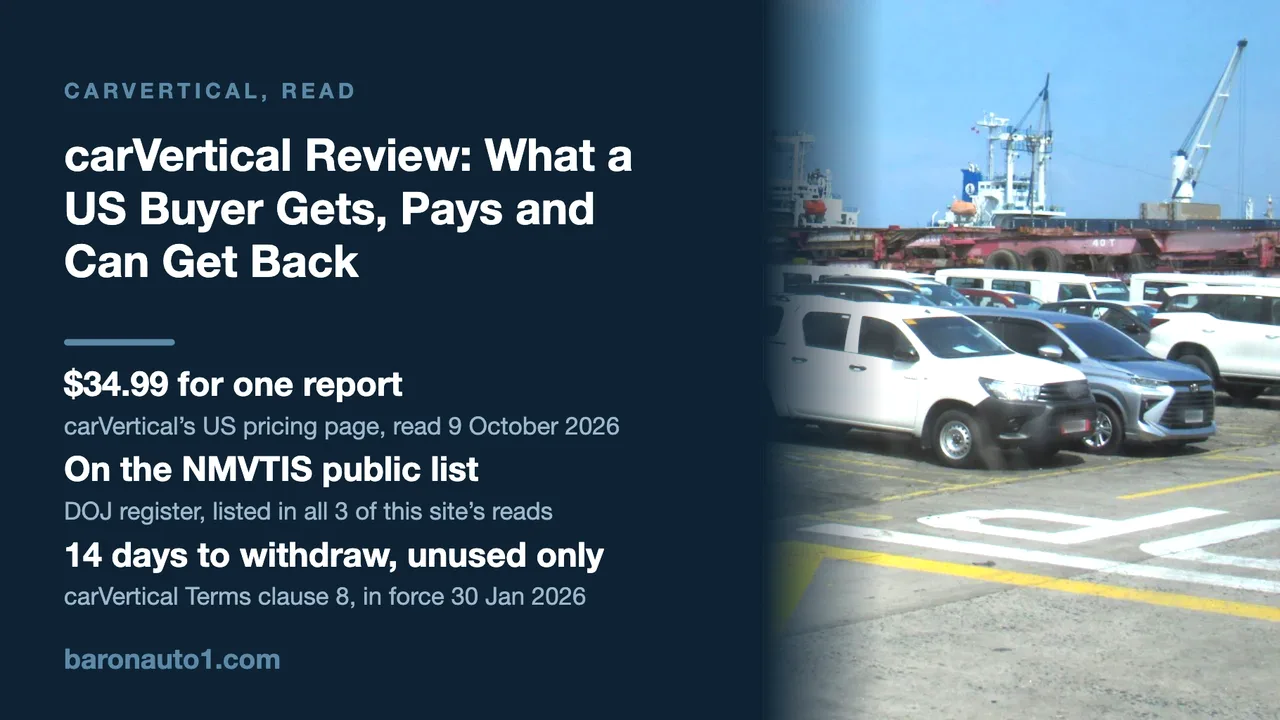
- carVertical is run by cV Group, UAB, a company registered in Vilnius, Lithuania (company code 303134915), with carVertical OÜ of Tallinn, Estonia, named as joint controller of its vehicle data. The Department of Justice’s NMVTIS register listed Carvertical.com among approved providers that sell to the public in all three readings this site has taken: 31 August, 3 September and 3 October 2026.
- Its own pages never name a US data source. They list categories such as state registries, law enforcement, repair shops and connected vehicle fleets, and none of the 27 carVertical pages we read mentions NMVTIS in its visible text.
- For a US car the report adds a Title check, which carVertical says works only for vehicles used or registered in the US. Its features page and blog frame that check around cars imported from the US, and other sections (emissions classes, technical inspections) read as written for European buyers.
- On 9 October 2026 the US pricing page sold 1 report for $34.99, 2 for $49.98 ($24.99 each) or 3 for $59.97 ($19.99 each), paid once. Unused reports expire after 6 months. There is no consumer subscription; carVertical’s subscription terms are for business users.
- “Report return guarantee” is narrower than it sounds. An empty report earns a report credit, not cash; errors can be raised within 30 days for a returned report; the 14-day right of withdrawal covers unused reports only.
- The terms have no arbitration clause. A complaint goes to carVertical first (answer within 30 days), then to a consumer authority, an alternative dispute resolution body or the courts of your own country; business users go to Lithuanian courts.
Is carVertical legit, and is it worth buying for a US car? It is a real, registered European company on the US government’s list of approved title-data providers. What it sells a US buyer is a report built for European markets first, with a US title section added. Everything below was read on 9 October 2026 from carVertical’s own pages: its Terms & Conditions (in force since 30 January 2026), Report Return Policy, subscription terms, two privacy documents, US pricing page, homepage, features page, US transparency-index page and more than a dozen help articles. We add the Estonian company register and this site’s own readings of the NMVTIS provider register. carVertical’s terms bar automated access, so each page was read once, by hand. We have no commercial relationship with carVertical or any report seller. Where its pages disagree, we print both versions.
Who runs carVertical, and where it is registered
The terms answer this in their second clause: carvertical.com “is managed and administered by cV Group, UAB, company code 303134915”, with an address in Vilnius, Republic of Lithuania. The privacy policy calls the same company “a private limited liability company incorporated in the Republic of Lithuania”, and the contact page lists offices in Vilnius and Kaunas.
A second company appears in carVertical’s privacy notice on vehicle data, which names UAB “cV Group” “and/or carVertical OÜ, legal entity code 14416655”, of Tallinn, Estonia, and says “Both companies are joint controllers” under the GDPR. We checked that one against a public record. Estonia’s e-Business Register, read by hand on 9 October 2026, lists carVertical OÜ (registry code 14416655) as a private limited company, registered on 26 January 2018, with “Other information technology and computer service activities” as its principal activity. Lithuania’s company register put a bot check in front of every page, so we could not read cV Group’s entry there; its Lithuanian registration rests on carVertical’s own documents. The same two names sell carVertical’s iPhone apps: when this site recorded vehicle-history apps on 2 September 2026, “carVertical: Check Car History” was sold by CV Group, UAB (4.39 stars from 210 US ratings) and “Car History Check: VIN Decoder” by carVertical OU.
carVertical’s about page lists four founders, with Rokas Medonis as CEO, and gives the company’s own figures: more than 12,400,000 cars checked, more than 2,000,000 unique users a year, “€75,000,000 Revenue”, 37 markets and 150+ employees. It says carVertical launched “the first global car history register” in 2019 and now covers markets “across Europe, North America, and beyond”. These are carVertical’s claims about itself; we did not check them against filed accounts. The narrow answer to “is carVertical legit” is yes. The rest of this review is about what that company sells to someone buying a car in the United States.
Is carVertical an approved NMVTIS provider?
Yes, on the federal list. The Department of Justice publishes the businesses approved to sell reports from the National Motor Vehicle Title Information System (NMVTIS), the US title database. This site has read that register three times. On 31 August 2026 it listed “CarVertical” among consumer-facing providers. On 3 September and 3 October 2026 it listed “Carvertical.com” in the section headed “Approved NMVTIS Data Provider’s Links for both Commercial & Public Customers”, one of 12 primary entries there in October. We did not re-read it for this page.
The listing is a qualification, not an endorsement: the register says providers “are listed in alphabetical order with no preference indicated of one provider over another”. It also does not say which parts of a provider’s report come from NMVTIS. For what the federal record holds, see our guide to the NMVTIS report.
Here carVertical differs from GoodCar, which states its NMVTIS approval in its own footer. We searched the visible text of all 27 carVertical pages we read, including the rendered US homepage and pricing page, for “NMVTIS”. It does not appear. The word exists only inside the site’s embedded translation data, as a label reading “approved data provider” that none of those pages displayed. A US buyer reading carVertical’s site would not learn that it holds the approval, or whether its title section draws on that system.
Which US data sources carVertical names
None by name. Its help page on where the data comes from lists the kinds of places it checks: “State registries Law enforcement databases Auto repair shops Technical inspection centers Financial institutions Connected vehicle fleets Various third-parties”. Its vehicle-data privacy notice adds “vehicle dealers, insurance claims administrators, and information publicly available on the internet.” No page names a US state agency, an insurer, an auction house, a police database or NMVTIS. carVertical is plain that the records are not its own: “No, carVertical does not own or create the data in our reports.”
How many sources? That depends on the page. We recorded every count carVertical printed on 9 October 2026.
| carVertical page | Sources claimed | Countries claimed |
|---|---|---|
| US homepage | 1000+ | 45+ |
| US homepage, mileage panel | 1000+ | 45 |
| Pricing page | 1000+ | not stated |
| Help: How does the service work? | over 1000 | 45+ |
| Help: What makes a report different? | over 1000 | 45+ |
| Help: Where does the data come from? | over 900 | 40+ |
| Features page, mileage section | 900+ | 35 |
Five claims say 1000+ and two say 900+; the country counts run from 35 to 45+. Some lines may describe a subset, such as mileage sources only. Either way, the count describes carVertical’s whole network, not what it can reach for a car registered in Ohio. Its terms say so: “Data availability may depend on the country of registration of the vehicle, the manufacturer, the model, or other factors.”
What a carVertical report holds for a US car
carVertical’s help page lists 13 sections that may appear in a report: accident and damage history, odometer readings, theft records, ownership history, title check, specifications and equipment, market value, safety and recalls, photos, financial and legal status, purpose (taxi, rental or fleet use), emissions and a timeline. Theft is checked against “various databases worldwide”; safety means crash-test ratings “from top agencies” and recalls.
The section that is specifically American is the Title check. carVertical defines it as “a carVertical report feature that allows you to check the title of a vehicle that was used or previously registered in the United States”, and says “this feature only works for vehicles used or previously registered in the US”. If a brand such as salvage, rebuilt or junk is on record, “a yellow ‘Record found’ warning will appear next to the specific brand, showing the date it was issued.” If you suspect a cleaned title, the same page suggests “requesting a title search from the state’s Department of Motor Vehicles (DMV)”. For what each brand means, see our guide to salvage titles.
Two features carry their own caveats. carVertical says that if its “AI detects damage in recorded photos, that information will also appear in your report, even without an official record.” That is an inference from a picture, not a claim file: a prompt to inspect that part of the car. And its natural-disaster data flags whether the car “was in a region impacted by floods or storms at the time”. Being in a flooded region is not the same as being flooded; a flood-damage check by VIN explains which records exist.
The homepage says a report takes “just 40 seconds”, a help page says “within a minute” and the terms say “within a few minutes”. Then a clock starts: clause 4.7 keeps the report in your browser “for a period of 30 calendar days”, after which you “will not be able to save it in PDF format.” Save the PDF the day you buy it.
What the report leaves out, or was built for elsewhere
carVertical is candid that a report shows what its sources hold and nothing more. Its damage page says “not all accidents and repairs are reported to insurance companies or authorities. If that is the case, this information will not appear in the carVertical report.” Its mileage page says “Odometer data may not be available in your country.” And clause 4.4 says the list of categories you see after entering a VIN shows “what areas of information will be checked”, but a category without data “will remain empty in the final Report.” That free list is a menu, not a preview.
For a US car, three things stand out in carVertical’s own wording.
The title check is pitched at Europeans importing US cars. The features page says its title data helps “especially for vehicles imported from the US”, because “A branded title doesn’t travel with the car.” The blog post introducing the feature opens: “Used car buyers can find great deals in the United States, but since most vehicles imported from there are damaged, it’s essential to know how severe the damage is.” That tells you whom the feature was designed for.
Some sections read as European by design. The emissions panel “places your vehicle in a class from ‘A’ to ‘G’” and mentions “any taxes tied to those emissions”. The legal-status section covers “the last technical inspection (and its result)”, and the no-findings definition counts “technical inspections (MOT)”, a British term, as history. On a car from a US state without periodic inspections, those sections may have little to show.
No US service-history source is named. carVertical lists “Auto repair shops & service logs” among the categories it checks but names no US repair network, and its section list has no separate service-record section. Whether a US car’s maintenance shows up depends on sources carVertical does not identify.
None of this means a report on a US car will be empty. It means carVertical’s pages do not tell you in advance what it will hold, and the company does not claim otherwise. Its help page says carVertical “neither evaluates vehicles, nor provides suggestions for whether you should or shouldn’t purchase a particular vehicle”, and clause 5.6 recommends checking with “the relevant state authorities, the vehicle owner, a technical inspection centre, an authorised car service centre, or an auto appraiser” even when a report looks clear. In US terms, that is a pre-purchase inspection and, for a doubtful title, the state DMV.

carVertical’s own US numbers do not agree with each other
carVertical publishes statistics about the American cars its customers check, on two kinds of page, and they tell different stories.
| What is measured | US homepage and features page | US transparency-index page (2025 view) |
|---|---|---|
| Share of US cars checked with a damage record | “Around 1 in 4” | 45.27% |
| Size of an odometer rollback | “around 35,000 miles” | 52,533 miles on average |
| Cost of damage | “around $3,000 per record” | €3,832 average damage value |
By our arithmetic, 1 in 4 is 25%, which is 20.27 percentage points below the index figure, and the index rollback is 17,533 miles larger than the homepage’s. The index page explains part of the gap: it uses reports “bought by our customers over a period of 12 months, from October to September each year”, and only those meeting carVertical’s quality standard of “at least three odometer reading records”. Cars with more recorded history have more places for damage to show. Either way, these are statistics about cars carVertical’s customers chose to check, from records carVertical could reach. They say nothing about the car in front of you.
carVertical prices and plans, as printed on 9 October 2026
carVertical sells reports, paid once, in three package sizes. These are the prices its US pricing page showed on 9 October 2026, before any VIN was entered. The cards load in the browser rather than in the page’s HTML, so we read them in a browser.
| Package | Price per report | Total | Struck-through figure shown | Badge |
|---|---|---|---|---|
| Check 1 car | $34.99 | $34.99 | none (“Full price”) | -0% |
| Check 2 cars (“Most popular”) | $24.99 | $49.98 | $69.98 | -29% |
| Check 3 cars | $19.99 | $59.97 | $104.97 | -43% |
The struck-through figures are not old prices. By our arithmetic they are the single-report price times the number of reports: 2 × $34.99 = $69.98 and 3 × $34.99 = $104.97. The 2-report package saves $20.00 ($10.00 a report, 28.58%) and the 3-report package $45.00 ($15.00 a report, 42.87%). The homepage advertises “Bundle deal: save up to 40%”; the pricing page’s -43% and our arithmetic both put the 3-report saving slightly above that. Every card carries the label “Report return guarantee”, which the refunds section unpacks.
Three standing terms shape what you pay and get:
- The price can depend on the car. Clause 7.5: “Report prices may vary depending on the country in which the vehicle being checked is registered or used”. Clause 4.2: “The price charged is the one displayed on the carvertical.com website at the time of ordering, before the final payment is made.” carVertical’s robots file asks automated tools to stay out of its precheck and checkout, and we entered no VIN, so we did not see whether a US-registered car is priced differently. The figure on your own checkout binds.
- Unused reports expire. Clause 4.3: unused reports “are valid for six (6) months from the date of purchase.” A help page adds there is “no option to extend” that, and that “reports are tied to specific locales”.
- Payment and tax. The terms accept card, bank transfer, PayPal or cryptocurrency, with options that “may vary depending on your region”, and apply VAT under Lithuanian law. Discount codes must be entered at checkout; one “cannot be applied after the purchase is finalised.”
Is there a carVertical subscription? Not for consumers. carVertical’s Subscription Terms (last updated 11/12/2024) say “The Subscription service is intended for Commercial Users (B2B).” Those business plans renew automatically every 30 days, and “Money paid for the current Subscription period is non-refundable.” A consumer buying one report signs up to none of that, which is the main difference in shape between carVertical and subscription sellers such as GoodCar or EpicVIN.
Is carVertical free? The reports are not: the pricing page says “Each data request to all of our sources carries a cost, which is why our reports aren’t provided for free.” Only the category list shown after you enter a VIN is free. For checks that cost nothing, see our free VIN check guide.
Refunds: a credit, a return request and a 14-day withdrawal
carVertical has a refund page, but most of what it describes is not money back. There are three routes, for different situations.
| Route | When it applies | Deadline | What you get | How |
|---|---|---|---|---|
| No-findings report | No records in the Mileage, Damage or Timeline sections | Automatic | An unused report credit, valid 6 months; not money | Nothing to do |
| Report return request | “errors or discrepancies”, report not received, “Other legitimate circumstances” | Within 30 days of generating the report | A returned report, if carVertical agrees | Email support@carvertical.com (policy) or the contact form (help page) |
| Right of withdrawal, Terms clause 8 | Any reason, unused reports only | Within 14 days of purchase | Money back within 14 days of your notice | Email info@carvertical.com with order number, date, contact details and a clear request |
No findings. A help page defines historical data as mileage records, damage records and events such as “sales records, registrations, ownership changes, insurance records, technical inspections (MOT)”. If none turns up, “an unused report will automatically be added to your account”: a credit to check another car, not money on your card.
Return request. If the report has findings you think are wrong, or never arrived, the policy lets you request “a return of your spent report” within 30 days. The outcome it describes is a report back in your account, decided by carVertical’s support team. Clause 5.4 separately lets you flag inaccuracies on a notification form, after which carVertical “will take reasonable steps to verify the information”.
Withdrawal. This is the only route the documents describe as cash. Clause 8.1 gives a consumer “the right to withdraw from such a purchase within 14 days without giving any reason”. Clause 8.2 limits it: “Once the report is generated, the service is considered to have been provided immediately, and the Report is considered used”, and “the right of withdrawal does not apply to used Reports”. Cancelling part of a package returns a proportional amount, “minus the discount applied and reasonable administrative costs not exceeding the limits set by law.”
Once you run a paid report against a VIN, the cash route closes for that report. carVertical’s terms treat a generated report as fully provided. After that, the remedies are a credit for an empty report or a return request for a faulty one, and both put a report back in your account rather than money on your card. If you bought 3 reports and need only one, withdraw from the other two within 14 days of purchase.
Two details do not line up. The Report Return Policy says returned credits stay active “for 6 months from the purchase date”; the help page on applying for a return says, in one paragraph, 6 months “from the date they’re added to your account”, and in the next, “from the date they were purchased”. Check the expiry date in your account. And if you delete your account, the terms say unused reports become unavailable and “no compensation or refund will be provided for them.”
The terms of use, governing law and disputes
carVertical’s terms, titled “Rules for the Provision of Services”, took effect on 30 January 2026. They are written for an EU consumer-law setting, which helps a US buyer in one important way.
No arbitration clause. We searched the full text for “arbitration”, “class action” and “governing law”; none appears. Section 13, “Applicable Law and Dispute Resolution”, sets out a sequence. First, “submit a complaint to carVertical in writing by email to info@carvertical.com”; carVertical “will respond to the complaint as soon as possible, but no later than within 30 days.” Next, “The State Consumer Rights Protection Authority in their country, or other national alternative dispute resolution (ADR) institutions.” Then the courts: a consumer may “rely on the mandatory consumer protection laws of their country of residence and/or refer the matter to the courts of that country.” Only business users are sent to “a competent court of the Republic of Lithuania”.
For a US consumer that reads as room to use US consumer law and a US court, small claims included, with no arbitration step. The terms name no US agency; the nearest counterparts are your state attorney general’s consumer office and the FTC. How easily a US judgment could be enforced against a Lithuanian company is a question the terms do not answer.
Liability. Clause 11.2 says that if a report “does not correspond to reality”, carVertical’s liability “shall be assessed in accordance with applicable law”. Clause 11.3 says carVertical “is not liable to the maximum extent permitted by law for the inaccuracy of the information provided in the Report and its content”. There is no dollar cap of the kind GoodCar prints. A help page adds that a report “cannot be used as legal evidence in court”.
Other clauses a buyer should know.
- A reason to buy. Clause 5.8: carVertical sells a report “only if they have a relevant connection to the specific vehicle”, and asks your purpose before selling it. Clause 6.1.6 obliges you to pick only criteria that match your real circumstances.
- Share, don’t resell. You may show a report to the other side of a deal, but you are “prohibited from reselling the Report”.
- Changes. You accept the terms “by using carvertical.com”, and consumers get at least five calendar days’ notice of material changes.
- No scraping. Clause 6.1.1 bars “any automated devices, programs, algorithms or methodologies” used to access or copy the site, which is why every page cited here was read by hand.
Privacy, written for European law. carVertical’s privacy policy (last updated 04/07/2025) cites “the General Data Protection Regulation 2016/679 (EU)” and “the legislation of the Republic of Lithuania”, and points complaints to “the supervisory authority of the EU Member State” where you live or work. We searched it for “California”, “CCPA”, “United States” and “Do Not Sell”: none appears. Its vehicle-data notice (last updated 02/06/2024) says carVertical does “not collect information on its owners or holders” for reports, keeps vehicle data, “as a rule of thumb”, “for 30 years”, and uses some of it “to train artificial intelligence tools”. If you sell a car, its record at carVertical outlasts your ownership.
carVertical vs Carfax: what each one sells
People searching “carVertical vs Carfax” usually want to know whether the European report can stand in for the American one on a US car. The two companies’ own documents answer a narrower question: what each sells, and on what terms. We do not compare prices; Carfax’s are in our Carfax cost guide.
Sources. Carfax says its reports cover “vehicles manufactured since 1981” and draw on “billions of records from more than 151,000 domestic and international sources” (Carfax’s report page, read by this site on 3 October 2026). carVertical claims 900+ or 1000+ sources, depending on the page, and names no US source. Each count is the company’s own and they measure different things, so neither proves more coverage of a given car.
The federal register. carVertical is in the register’s public section. The register says “Consumers CANNOT receive NMVTIS Vehicle History Reports from Carfax, DMVDesk, or Experian; these entities provide information only to car dealerships”. That does not make either report better or worse; it does mean nothing on either company’s pages shows the two draw on the same records.
Terms. This table copies terms this site has already recorded from each company’s own pages, with GoodCar added as a US-based seller for reference.
| carVertical | GoodCar | Carfax | |
|---|---|---|---|
| Run from | cV Group, UAB, Vilnius, Lithuania | InfoPay, Inc. | CARFAX, Inc. |
| NMVTIS register | Public section | Public section | Consumers cannot get NMVTIS reports from Carfax |
| How you pay | 1, 2 or 3 reports, paid once | Paid trial, then a monthly subscription | Report packages, paid once |
| Money back | 14-day withdrawal for unused reports; a used report earns a credit, not money | No refund of the unused part of a month (Terms section 8) | Refund requests reviewed; 3-5 business days to post once authorized |
| Disputes | Complaint first, then a consumer authority, ADR or the courts of your own country; no arbitration clause | Confidential binding arbitration (Terms section 21) | Arbitration or small claims after a 60-day notice period; opt-out within 30 days of purchase (Consumer Terms of Use, October 2017) |
On disputes, carVertical’s terms are the most open of the three to a claim in your home courts. On money back all three are tight in different ways. For US-focused options, see our guide to Carfax alternatives and Carfax vs AutoCheck.
Who carVertical suits, and how to use it well
We do not recommend any paid provider, carVertical included, but its own documents point to who it fits: a buyer whose car may have history outside the US, or a European buyer checking an American import, the case its features page and title-check blog were written for. It may also suit a US buyer who wants a second report and accepts that the US sources are unnamed. It fits less well someone who wants to know before paying that a report draws on NMVTIS or a named US data network, because carVertical’s pages do not say.
- Read the price on your own checkout, not the pricing cards; the terms say it can vary with the car’s country.
- Buy only the reports you will use within 6 months, and withdraw from unused ones within 14 days if plans change.
- Treat the free category list as a menu. Clause 4.4 says any category can come back empty.
- Save the PDF the day you run the report. Browser access ends after 30 calendar days.
- If the report is empty, check your account for the credit; if it is wrong, ask for a return within 30 days and keep the reply.
- Check a doubtful title with the state DMV and the mileage with an odometer check by VIN.
- Treat an empty section as unknown, not clean, and pair any report with a pre-purchase inspection.
Common questions
Is carVertical legit?
Yes, in the sense that it is a registered company with published terms. It is run by cV Group, UAB of Vilnius, Lithuania, with carVertical OÜ, registered in Estonia on 26 January 2018, as joint data controller. The NMVTIS register listed Carvertical.com among approved providers for the public in this site’s readings on 31 August, 3 September and 3 October 2026.
Does carVertical work in the USA?
It sells to US buyers in US dollars, and its reports include a Title check that it says works only for vehicles used or registered in the US. Its pages name no US data source, and its terms say data availability depends on the country of registration, so its site does not tell you in advance how much a report will hold for a US car.
Is carVertical free?
No. On 9 October 2026 one report cost $34.99 on the US pricing page, 2 cost $49.98 and 3 cost $59.97. The free part is the category list shown after you enter a VIN, which its terms say may come back empty.
carVertical vs Carfax: which should I use?
They are different products. carVertical is a Lithuanian company in the NMVTIS public section that names no US sources; the register says consumers cannot get NMVTIS reports from Carfax, which describes its own network of more than 151,000 sources. Their terms differ most on disputes: carVertical has no arbitration clause, Carfax’s consumer terms do. We do not rank them.
Can I get a refund from carVertical?
For money back, use the 14-day right of withdrawal by emailing info@carvertical.com; it covers unused reports only. A report you have run counts as used: an empty one earns a report credit automatically, and a wrong one can be put up for a return within 30 days, which restores a report if carVertical agrees.
Can a carVertical report be used in court?
carVertical’s help page says no: “a carVertical report cannot be used as legal evidence in court.” Its terms add that a report should not be the sole basis for deciding whether to buy a car.
Sources and further reading
- NMVTIS (US Department of Justice)
- NMVTIS approved data providers
- Understanding an NMVTIS Vehicle History Report
- FTC used car buying guide
Recall, complaint and safety-rating figures on this page were retrieved from the federal databases above on August 19, 2026. Federal data changes — re-check any VIN before you rely on it.
Published October 9, 2026 · last updated October 9, 2026. Found something out of date or wrong? Tell us and we will correct it.