VinChek, VinCheckFree, VinCheckFast: Which of These Is a Real Service?
An HTTP 200 proves a server answered. It does not prove a business exists — and one of these three is serving Indonesian slot-machine spam under a New Hampshire VIN page.
The short version
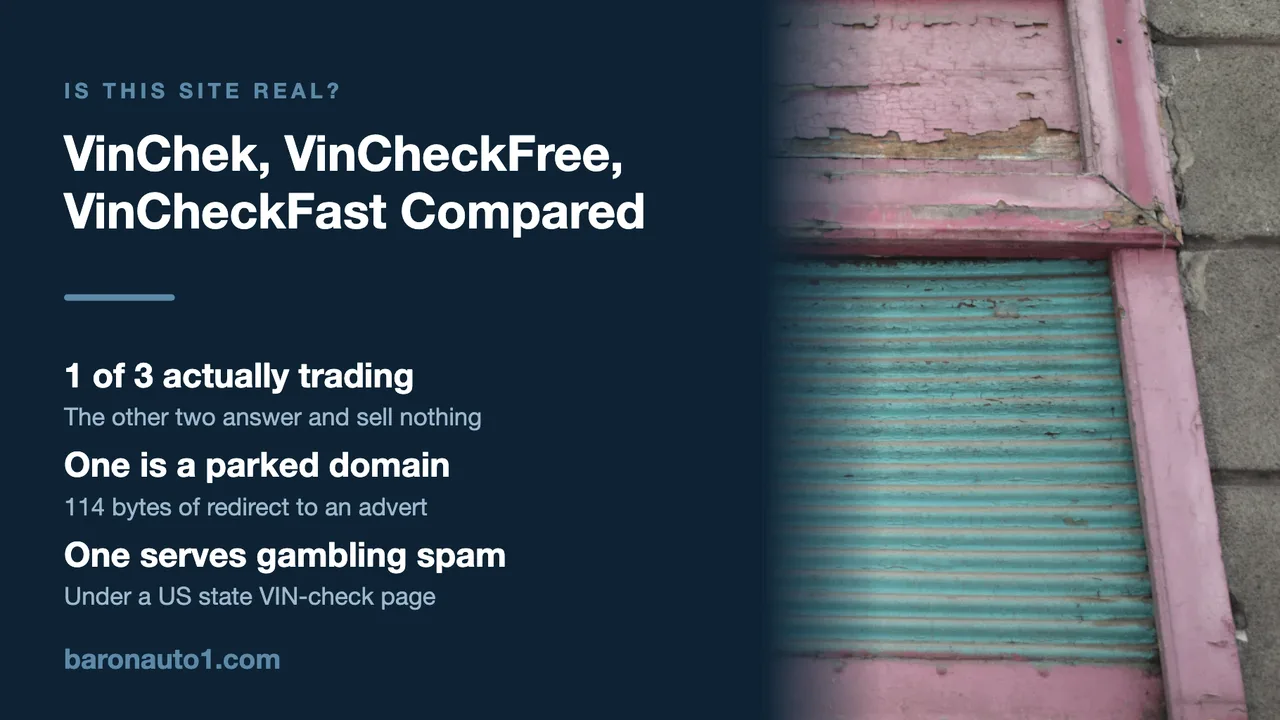
- Three similar names circulate as VIN-check services. On 1 September 2026, only one of them was a working business.
- VinChek is not a product. The .com serves 114 bytes of JavaScript that bounces you to a domain-parking page; the .net and .org do not resolve at all. It is a misspelling of “VIN check” with nothing behind it.
- VinCheckFree looks like a full site and is a frozen copy of one. Its pages carry the watermark of a Wayback Machine restoration service, and its code has not been rebuilt in roughly twenty months.
- Worse, pages presented as state VIN-check pages are not about vehicles. One returns 477,013 bytes of Indonesian online-gambling spam under a slot-machine title.
- VinCheckFast is genuinely live, with distinct working pages and a single report at $4.49. It describes itself as an official CARFAX data partner.
- That claim could not be corroborated, and the site’s own structured data asserts 847 customer reviews at 4.9 out of 5 — while the Trustpilot profile it points at carried 12 reviews and a score of 4.3.
An HTTP 200 response means only that a server answered. It does not mean a business exists, that anybody is running it, or that the page you are looking at is about cars.
That sounds obvious written down. It is not obvious in a search result, where a parked domain, an abandoned mirror and a working company all render as a blue link with a plausible title. This page takes three names that come up repeatedly in searches for cheap VIN reports and establishes which of them is real.
Everything below was fetched on 1 September 2026 and independently re-checked the same day. Where a figure is the site’s own claim rather than something confirmed, it says so.
VinChek: a parked domain
Start with the simplest case, because it sets the pattern.
vinchek.com responds. It returns HTTP 200, which is why it can appear in results and why link-checking tools will call it alive. The entire body is 114 bytes of JavaScript whose only job is to redirect the visitor to a lander path.
That lander is a GoDaddy domain-parking page. It loads parking assets from GoDaddy’s image host and declares itself a parking system in its own JavaScript. Its body is an empty container. There is no VIN tool, no pricing, no company and no content of any kind.
The registration is consistent with that: the domain was created in February 2025 and sits on GoDaddy’s parking nameservers. The other obvious spellings do not even get that far — vinchek.net and vinchek.org have no address records and do not resolve.
So “VinChek” is not a company anybody should be evaluating, and there is nothing here to form an opinion about. It is what happens when a common misspelling of a valuable search term gets registered and pointed at an advertising page: the traffic arrives by accident, and somebody earns a fraction of a cent for each visitor who leaves again. The keyword difficulty attached to the term is high not because a brand is defending it, but because established generic pages about VIN checks occupy the results.
VinCheckFree: a real brand, and a mirror of its own corpse
This one is more interesting, and considerably more misleading, because it passes every casual test.
vincheckfree.com returns a complete website: a proper title, a heading reading “Free VIN Check”, an FAQ, internal pages, and a sitemap. Click around and it behaves like a functioning service. The brand is genuinely old — the domain was created in February 2015 — so there is real history here.
The problem is that what is being served today is not a running site. It is a copy of one.
The live homepage carries a watermark injected after the closing footer tag, linking to a Wayback Machine downloader service. That watermark is what such tools add to their free tier. It does not appear in the site’s own archived capture from January 2025 — so the site was a genuine deployment then, and the watermark arrived afterwards, when somebody restored a copy of it.
Two further details confirm it. The JavaScript build fingerprints served today are byte-identical to those in that January 2025 archive, meaning the code has not been rebuilt in roughly twenty months. And the only external hosts the homepage references are the internet archive, the downloader service, and a font provider. There is no backend, no API, nothing a live report service would need.
A static mirror can still take your details. A form that posts nowhere looks exactly like a form that works, right up until nothing arrives. This page did not submit a VIN, so whether the search box does anything at all is unknown — but there is no server-side component visible for it to talk to.
The broken plumbing shows through in places. The licence-plate page redirects to itself indefinitely, producing a loop that never resolves — the kind of failure a live site would notice within a day.
And then the state pages, which are not about cars
The most striking finding on this page was nearly missed, because the page in question looks fine from the outside.
VinCheckFree presents per-state VIN-check pages, the sort of thing a legitimate service builds for search traffic. One of them — the New Hampshire page — returns HTTP 200 and 477,013 bytes, which is a substantial document.
Its title is not about New Hampshire, and it is not about vehicles. It advertises an Indonesian online slot-machine gambling site.
This is a well-known pattern: an abandoned or weakly-secured domain with residual search authority gets used to host spam that borrows the domain’s reputation. The vehicle pages that still look right are the shell; the traffic value is being spent on something else entirely.
An initial pass over this site read the page’s byte count and concluded the internal pages were “real and distinct”. The byte count was exactly right and the conclusion was exactly wrong, which is a useful warning about checking that a page loads rather than reading what it says.
VinCheckFast: live, and making a large claim
The third name is a real, operating website, and it deserves assessing on its merits rather than lumped in with the other two.
vincheckfast.com serves genuinely distinct pages — pricing, a sample report, an about page, terms and a VIN decoder — each with its own content and its own title. That is what a built site looks like, as opposed to a template or a mirror.
It advertises a single vehicle history report at $4.49, positioned against a claimed CARFAX price of $44.99. Its homepage title describes it as offering official CARFAX vehicle history data, and the site describes itself as an official data partner.
Those are significant claims, and they are the site’s own. No corroboration from CARFAX could be found, and the site carries no statement disclaiming affiliation — which some competitors in the same space do carry. That absence is worth noticing in both directions: it is not evidence of a relationship, and it is not evidence against one.
The reviews claim, checked
One assertion on the site can be tested directly, and testing it is instructive.
VinCheckFast ships structured data — the machine-readable block search engines read — on several of its pages. That block states the service is rated 4.9 out of 5 by 847 or more customers, and describes the company as a legitimate CARFAX reseller with that many verified reviews on Trustpilot.
The Trustpilot profile it names was read on 1 September 2026. It carried 12 reviews and a TrustScore of 4.3, on a profile claimed in January 2026.
Both figures are recorded here because the gap between them is the finding. A claim of 847 reviews at 4.9, published in the machine-readable layer that feeds search results, against a public profile showing 12 reviews at 4.3 on the very platform cited.
Structured data is not decorative. It is what search engines and AI assistants read to summarise a business, and a rating asserted there can propagate into results without anybody checking it against the platform it claims to quote. This is a check any reader can run: find the review claim, then open the review site named and count.
None of the three is on the federal register
One common test applies to all of them.
There is a public register of the companies cleared to hand out federal title data — the system the states, insurers and dismantlers report into, covering brands, odometer readings and salvage. Searching it for these three names returns nothing for any of them.
For the first two that hardly matters, since neither is trading. For the third it raises the obvious follow-up: any federal title records in its reports must be reaching it via some approved intermediary, and no page on the site names one.
Our guide to testing any provider’s claims sets out how to run that check in about two minutes, and it works on any site in this category.
How to tell a working service from a shell
Generalising from these three, because the specific names matter less than the method.
Look past HTTP 200. A response proves a server answered. Read the page: does it have pricing, terms, a company name and a contact route, or does it have a redirect and a slogan?
Check a second page. Parked domains and mirrors fall apart one click in. If the pricing page, the terms and an internal page each have their own distinct content, something was actually built.
Read an internal page’s title, not just its status. A page can be enormous, load perfectly and be about a different subject entirely. That is precisely how the gambling spam above went unnoticed on a first pass.
Test any review claim against the platform named. It takes one search and it is the single most revealing check in this category.
Search the federal register for the name. Free, public, and definitive on one narrow question: is this company approved to supply federal title data directly?
Look for a non-affiliation statement. Resellers that are straightforward about not being the brand they resell tend to say so plainly somewhere in their terms.
What to do instead
The reason people end up on sites like these is almost always price — a report from a well-known brand looks expensive, and $4.49 looks like a solution.
There is a cheaper and better-founded route that does not require trusting an unverifiable claim. The free federal recall lookup answers outstanding safety campaigns definitively, and our walkthrough of it shows where to run it. A free theft check covers stolen and unrecovered vehicles.
For the question that actually matters — written off, rebuilt, flooded, or none of those — pick somebody who states where the data comes from and can be held to it. Reading the title and brand record on a VIN is the route this site points at; its published single-report rate, noted on 29 August 2026, was $14.99. Several times $4.49, and the premium buys a counterparty with a name.
Why an old domain is worth buying
The VinCheckFree case is worth dwelling on, because the mechanism behind it explains a large share of the low-quality results in this whole category.
A domain that ran a real service for years accumulates things that cannot be bought directly: links from other sites, a history in search indexes, and a name people still type. When that business stops, those signals decay slowly. For a period — often years — the domain keeps ranking for terms it earned honestly, while nobody is home.
That gap is an asset, and there is an established trade in acquiring it. Sometimes the new owner rebuilds something genuine. Sometimes they restore an archived copy of the old site, so the domain keeps looking like what search engines already trust, and quietly attach something else to it. The archived copy is the costume; the spam pages are the point.
Recognising it is not hard once you know the shape. The design looks slightly dated, in the way a site does when nobody has touched it through two rounds of fashion. Copyright lines stop at a year in the past. Some links work and some loop or die, because a mirror preserves the pages but not the machinery behind them. And an internal page here and there is about something completely unrelated, because that is where the value is actually being extracted — the vehicle content is scenery, kept only because search engines already trust it.
None of which requires technical tools. Reading a footer date and opening two internal links catches most of it.
What “free VIN check” can honestly mean
All three names promise, or once promised, something free. It is worth being precise about what is genuinely available at no cost, because the honest answer is more than nothing and much less than a history report.
Free and real: VIN decoding, which turns the seventeen characters into year, make, model, engine, plant and body style. This is published federal reference data and any site can do it. A decode is not history — it describes what left the factory, not what happened afterwards — but it is genuinely free everywhere and no one needs to pay for it.
Free and real: the federal recall lookup, which is definitive about outstanding safety campaigns on a specific VIN.
Free and real: a theft check against insurance-industry records, subject to a modest daily search limit.
Not free anywhere, from anyone: title brands and salvage history. That data comes from a system whose access is charged for, at every level. A site offering it free is either not supplying it, supplying something else and calling it that, or funding it some other way that is worth understanding before you hand over details.
Our guide to what a VIN lookup can and cannot answer works through that boundary in detail, and it is the single most useful thing to understand before evaluating any site in this category. Once you know which side of the line a promise sits on, most of these judgements make themselves — and where the answer is on the paid side, the title record attached to that VIN is the thing being sold, by whoever is selling it.
What could not be established
Whether VinCheckFast has any relationship with CARFAX. No corroboration was found in either direction. Its claims are reported here as its claims.
Whether paying $4.49 delivers a genuine report. No purchase was made. Buying one would be the only way to know, and this page is not in a position to recommend that as a test.
Who operates VinCheckFast. Its registration is privacy-protected and the only contact detail found was a messaging number with an international dialling code.
Who now owns VinCheckFree, and whether the original operator has any connection to the mirror currently deployed on it.
Whether VinCheckFree’s search form does anything. No VIN was submitted. There is no visible backend for it to reach, but that is an inference from the page’s references, not a test.
Common questions
Is VinCheckFree safe to use?
What is being served is a static copy of a site that stopped being maintained around twenty months ago, on a domain where at least one page now hosts unrelated gambling spam. Entering personal details or a card into that is not something this page would recommend, regardless of what the original brand once was.
Is VinCheckFast legitimate?
It is a real, operating site with distinct pages and a published price, which distinguishes it from the other two names here. Its claim to be an official CARFAX partner could not be corroborated, and its published review count does not match the platform it cites. Weigh those together.
Why do these sites rank if they are not real?
Search ranking rewards signals a domain accumulates over time, and those signals outlive the business that earned them. An old domain with links pointing at it keeps some of that value after the company stops trading, which is exactly why expired domains get bought, restored and repurposed.
Is a $4.49 report too cheap to be real?
Not automatically. Bulk access genuinely does exist and resellers genuinely do pass some of it on. The question is not whether a low price is possible but whether the seller will tell you where the data comes from — and whether the brand it names has ever confirmed the relationship.
How do I check any VIN site myself?
Open a second page and see if it has its own content. Read an internal page’s title rather than just its status code. Search the federal approved-provider register for the company name. And if the site advertises a review score, open the review platform it names and count. Those four checks take a few minutes and settle most cases.
Does an HTTPS padlock mean a VIN site is trustworthy?
No. A certificate proves the connection is encrypted and that whoever set the site up controlled the domain at the time. It says nothing about whether a company exists, whether it will deliver anything, or whether the pages are about vehicles. Certificates are free and automatic; every site discussed here has one.
Should I report a site that turns out to be a shell?
If money changed hands and nothing arrived, your card issuer is the effective route — a dispute costs nothing and issuers can also block future charges from a merchant. Beyond that, the domain registrar and the search engine that surfaced it both accept reports, though neither is quick. If nothing was paid, the practical action is simply not to return.
Sources and further reading
- NMVTIS approved data providers
- NMVTIS (US Department of Justice)
- NHTSA recall lookup
- FTC used car buying guide
Recall, complaint and safety-rating figures on this page were retrieved from the federal databases above on August 19, 2026. Federal data changes — re-check any VIN before you rely on it.
Published September 1, 2026 · last updated September 1, 2026. Found something out of date or wrong? Tell us and we will correct it.