BMW Certified Pre-Owned: What the Plan Covers, and When It Actually Starts
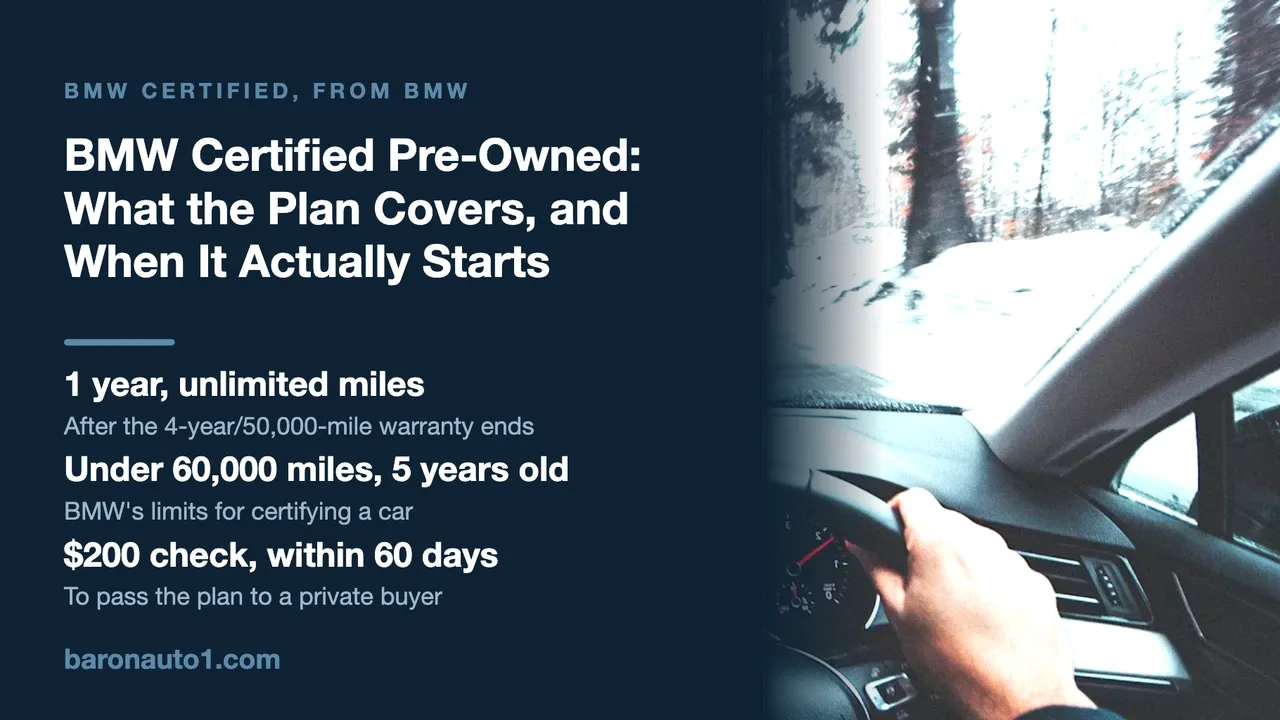
BMW certifies cars up to 5 years old and 60,000 miles, but its one-year plan runs after the new-car warranty expires, not from the day you buy. BMW's own pages also print three different roadside terms.
The short version
- BMW Certified Pre-Owned is one program with one plan. BMW says a car must be 5 years old or newer, with more than 300 but less than 60,000 miles. We found no “Elite” tier on any BMW page we read.
- The plan is one year with unlimited miles, and BMW’s program page says it starts “after the expiration of” the 4-year/50,000-mile new-car warranty. It doesn’t start on the day you buy. Read that way, the latest it can end is 5 years from the car’s original in-service date (our arithmetic).
- BMW’s all-electric page adds that you get the year “even if” the new-car coverage has already expired. The pages never print the end date for such a car. Get the plan’s start and end dates on your paperwork.
- BMW gives three different roadside terms for a certified car on its own pages: “an additional three years”, “up to six years” and “up to eight years”.
- The plan excludes suspension parts such as control arms, bushings and shock absorbers. It also excludes exhaust systems including catalytic converters, brakes, tires, and batteries replaced as a stand-alone repair.
- A private buyer can take over the remaining coverage for a $200 fee, paid by check, if they apply within 60 days of the sale. Dealer sales are excluded from this route.
BMW Certified Pre-Owned is BMW of North America’s certification program for used BMWs sold by BMW dealers in the United States. BMW says a certified car is 5 years old or newer with more than 300 but less than 60,000 miles, and has passed an inspection and road test. It comes with one year of coverage with unlimited miles that runs after the 4-year/50,000-mile new-car warranty ends. That timing is the part buyers miss. This page is built from BMW’s own documents, read on 30 September 2026: the program page, the inspection checklist, the exclusion sheet, the transfer form and the CPO Wrap brochure.
One program, one plan, two names for it
BMW markets the program as “BMW Certified”, and the warrantor is BMW of North America, LLC. The benefits list calls the coverage a “1 Year / Unlimited Miles Limited Warranty”, the FAQ calls it the Limited Protection Plan, and the transfer form calls it the BMW Certified Limited Warranty. All three mean the same coverage, which we call “the plan”.
People search for a BMW “Elite” tier. On the BMW pages we read on 30 September 2026 there isn’t one: the program, all-electric, plug-in hybrid and offers pages all describe a single program with a single plan. The only extra coverage BMW describes is an optional service contract, CPO Wrap, covered further down. If a dealer offers an “Elite” certified BMW, ask which document defines it.
The program page promotes “all 2021-2024 BMW Certified models”. That is a marketing line; the eligibility rule is the age and mileage test below.
Which BMWs qualify: age, miles and history
BMW’s FAQ answers “What does BMW Certified mean?” with an order of steps. The car must have more than 300 miles but less than 60,000 miles on the odometer. BMW reviews its CARFAX or AutoCheck report and checks for genuine BMW parts and an up-to-date maintenance history. Trained technicians then complete what BMW calls a 360° inspection, reconditioning and approvals, followed by a road test using BMW diagnostic equipment. After that, BMW says, the car is covered by the Limited Protection Plan. The checklist panel on the same page adds the age rule, “5 years old or newer”.
| BMW’s requirement | Where the inspection checklist covers it |
|---|---|
| 5 years old or newer | Section 1 records the original in-service date |
| Have less than 60,000 miles | Header records the mileage read from the key; Section 1 asks whether the instrument cluster was replaced and whether it shows the total and true mileage |
| Up to date CARFAX or AutoCheck report | Section 1 asks whether a report was run and whether it disqualifies the car |
| Genuine BMW Parts | Sections 2 and 4 say mismatched or non-approved parts are replaced with original BMW parts |
| Tire, wheel and brake inspection | Section 2: tread depth and pressure at each wheel, wheel condition and torque, pad thickness and rotor condition |
| Body condition, fit and finish | Section 3: panels, pillars, glass, interior, trunk, keys and door-pillar labels |
| Mechanical inspection | Section 4: lights, locks, airbags, seat belts, suspension, steering, fluid levels and leaks, 12-volt battery voltage, fault codes |
| Diagnostic and road test | Sections 5 and 7: every cabin control while parked, then engine, transmission, noise, handling and brakes on the road |
| Approved by a certified technician, a service manager and the certified manager | Section 8: three staff signatures, plus a line for the customer |
The checklist also names three things that rule a car out entirely. BMW lists them as:
- inconsistent or incomplete maintenance history
- non-BMW performance modifications
- a disqualifying CARFAX or AutoCheck report
BMW doesn’t say what makes a history report “disqualifying”, though the transfer form separately bars cars that have been totaled or stolen. Our explainer on what a salvage title means shows what those brands look like on a report.
One line on the program page qualifies the “Genuine BMW Parts” promise. BMW says the program “may permit the use of equivalent parts as substitutes under specific circumstances”. The checklist still tells technicians to replace mismatched or non-approved components with original BMW parts. If parts matter to you, as they might on an M car, ask the dealer which parts went on during reconditioning. The repair orders will show it.
What the inspection actually checks
BMW doesn’t publish an inspection point count. Its marketing says the inspection is “360°”, which describes coverage rather than counting anything. What BMW does publish is the form itself: a four-page Vehicle Inspection Checklist, form 23CPOCKLST 5-23, linked from the program page as “See the Full Checklist”. It is organised in eight sections:
- Vehicle background and maintenance
- Wheel assembly and tire inspection
- Body condition, fit and finish
- Mechanical
- Stationary review
- iBrand and plug-in hybrid vehicles
- Rolling review
- Approval
Most items are pass-or-service boxes, but a few carry hard numbers, and those are the ones you can check yourself on a test drive or at an independent shop:
- Tire tread: a minimum of 3 mm, measured from the top of the wear indicators, recorded at the inside, center and outside of each tire.
- Brake pads: a minimum of 5 mm of friction material at each wheel.
- 12-volt battery: BMW says the minimum voltage for delivering any pre-owned BMW to a customer is 12.5 volts.
- Road test: at least 20 uninterrupted minutes and at least 5 continuous miles. The dealer attaches the mileage from the key reader before and after.
- Electrified models: the high-voltage battery “must be 100% charged” for certification and at delivery, and the checklist has the technician test the charging socket, cables and AC charging.
- M models: the maintenance history section asks whether the 1,200-mile running-in check was done, with a box for “not to exceed the initial 2,400 miles”.
Section 1 holds the history questions: open campaigns or a stop-sale (usually an unfinished recall), non-BMW performance modifications, and body repair history with repair order numbers. It requires a BMW service history printout and a Condition Based Service printout. Section 3 records how many master keys come with the car (0, 1 or 2). Section 5 includes an item to delete all of the previous owner’s data from the infotainment system.

Section 8 is the approval. A technician, the service manager and the pre-owned manager each sign to certify that the car “has been carefully inspected and that apparent deficiencies have been corrected”. Straight after that, BMW’s form says no claim is made, implied or otherwise, that the car is in new condition. There is also a signature line for the customer, so you can ask to see the completed form before you sign anything else. The top of page two says that if the car is not enrolled as CPO, pending or active, the process stops, so the form should carry a CPO enrollment date.
The checklist was filled in by the people selling you the car. For an independent look, see our pre-purchase inspection guide.
The one-year plan, and when it actually starts
Here is BMW’s own sentence, as printed on the program page, the plug-in hybrid page and the all-electric page: the plan “provides coverage for one year with unlimited miles, after the expiration of the 4 year/50,000-mile BMW New Vehicle/SAV Limited Warranty.” (The plug-in hybrid page says SUV instead of SAV.)
The start point is the end of the new-car warranty, not the day you buy the car. The new-car warranty runs 4 years or 50,000 miles, whichever comes first, counted from when the car was first sold or put into service. So the plan’s end depends on the car’s history, not on your purchase date:
- A BMW that reaches its fourth birthday with fewer than 50,000 miles has its new-car warranty end at 4 years. The plan then runs one more year. On the program page’s wording it ends 5 years after the original in-service date. That sum is our arithmetic; BMW doesn’t print it.
- Take a BMW that passed 50,000 miles in its third year. Its new-car warranty ended then, by mileage. Read the same way, the plan’s year ran from that point and ended at about 4 years from in-service. That is our illustration, not a BMW example.
Two facts make this matter. First, BMW certifies cars up to 60,000 miles, so every certified car between 50,000 and 60,000 miles has already used up its new-car warranty by mileage. That band is 10,000 miles wide (our arithmetic). Second, BMW certifies cars up to 5 years old. Read literally, the latest the plan can end is also 5 years. So a car certified right at the age limit would have no plan year left (our arithmetic). BMW’s other pages point the other way, so the literal reading can’t be the whole story.
The all-electric page offers a different reading. It says that with a certified car “you automatically receive a one-year limited protection plan for unlimited miles, even if the extended protection plan for new BMW vehicles has already expired.” That sentence suggests a car past its new-car warranty still gets a year, but it doesn’t say when that year starts or ends. None of the BMW documents we read prints the plan’s end date for a car certified after its new-car warranty expired. The transfer form only adds that the plan must still be “within age & mileage limits” when it changes hands, which tells you the plan has limits but not what they are.
Get both dates in writing before you sign. Ask the dealer to print the car’s original in-service date and the exact start and end dates of the BMW Certified plan on the buyer’s order or the certification paperwork. On a car with more than 50,000 miles, or one near its fifth birthday, the plan’s end date matters more than anything else on the deal. If the dealer can’t or won’t give it, BMW’s transfer form says owners can ask BMW of North America Customer Relations for the remaining balance of the coverage.
One more line limits the plan in time. BMW says protection plan repairs “do not constitute an extension of the original Protection Plan period for the vehicle or a part thereof.” A part replaced under the plan in its final month isn’t covered for another year because of that repair. The plan ends on its date either way. None of the CPO documents we read mentions a deductible for the plan, either to set one or to rule one out. Ask whether the dealer’s copy of the terms states one.
What is left of the factory coverage
A certified BMW doesn’t start its coverage from zero. Whatever remains of the factory coverage stays with the car, and the certified plan sits after the 4-year/50,000-mile warranty. The table below sets out every clock BMW’s CPO documents mention and where each one is measured from.
| Coverage | Term as BMW prints it | Measured from |
|---|---|---|
| BMW Ultimate Care scheduled maintenance | 3 years or 36,000 miles | New-car start (“every new BMW begins with” it) |
| New Vehicle/SAV Limited Warranty | 4 years or 50,000 miles | New-car start |
| BMW Certified Limited Protection Plan | 1 year, unlimited miles | “After the expiration of” the new-car warranty |
| High-voltage battery defect warranty (plug-in hybrids and electric cars) | 8 years or 100,000 miles, whichever occurs first | Vehicle in-service date |
| Battery capacity (State of Health) protection | 96 months (8 years) or 100,000 miles, if capacity drops below 75% | Original in-service date; 2022 to 2025 model-year certified electric cars delivered on or after 1 March 2026 |
| CPO Wrap service contract (optional, extra cost) | Up to 7 years, unlimited mileage | Original in-service date, at zero miles |
| Genuine BMW parts fitted under the plan | 2 years, unlimited mileage | The repair |
On a plug-in hybrid or electric BMW, the battery rows matter most. The all-electric page says “the remaining years/miles of the initial battery warranty transfers to the new owner.” On a 3-year-old car that leaves at most 5 years of defect cover, less if the miles run out first (our arithmetic).
Certified electric BMWs also get battery capacity protection. BMW calls it the High-Voltage Battery Limited Capacity Loss/State of Health Protection Plan. It applies to 2022 to 2025 model-year certified all-electric BMWs with retail delivery on or after 1 March 2026. If the battery’s state of health, its current capacity compared with when new, drops below 75%, it is covered for 96 months or 100,000 miles from the original in-service date, whichever comes first. BMW contrasts its 75% threshold with what it calls an industry standard of 70%. That comparison is BMW’s, and we haven’t checked it. BMW also says every certified electric car gets a Battery Health Quick Report, and the page mentions “an up-to-date battery certificate”. Ask for the report’s state-of-health figure on paper.
Roadside, loaners, the oil change and the extras
Roadside assistance. BMW’s own pages disagree here. The program page says a certified owner gets “an additional three years of BMW Roadside Assistance”. The benefits list on the same page says “Covered by BMW Roadside Assistance up to six years”. BMW’s roadside page says roadside is available “for four years from the original in-service date of your new BMW, or up to eight years for Certified Pre-Owned BMWs”, with no mileage limit and no separate cost. Four years plus an additional three would be 7 (our arithmetic), which matches neither printed total. Another answer on the roadside page says most new BMWs get 24 to 36 months, typically up to 36,000 miles. Ask the dealer for the roadside end date for your VIN.
The program page prints these roadside details:
- Fuel delivery: up to 2 gallons at no cost, limited to 2 covered events a year. Oil and coolant cost extra.
- Lock-out: BMW prefers a remote unlock through BMW Assist or the app. If that fails, it may arrange transport to fetch a spare key, not to exceed 90 miles in total there and back.
- Trip interruption: meals, lodging and transport, up to $1,000 per event, within 5 business days. The breakdown must be more than 100 miles from home, a confirmed mechanical defect fixed by a warranty repair, and not repairable the same day. Accidents, flat tires and road hazards don’t qualify. BMW lists $2,500 per event for “GKL models” without defining the term.
Loaners. BMW says that whenever you service the car at a BMW dealership you get a complimentary loaner, subject to dealer availability, or are offered alternative transport, for which “charges may apply”, for the duration of the protection plan. Once the plan ends, so does this promise.
One oil change. The certified plan includes one complimentary oil and oil filter change, including labor. It “takes effect once the Ultimate Care standard maintenance has been exhausted”, and BMW says it applies to contracts sold on or after 1 October 2024. On a car bought before Ultimate Care runs out, the free change comes after the scheduled ones.
Extras. A vehicle history report at no cost and three months of SiriusXM satellite radio.
Financing offers. BMW posts certified financing offers on its special-offers page, and they change often; the ones we read on 30 September 2026 all ended that day. The same page still shows offers that ended in 2021, 2022 and 2024, so check the end date on any offer you’re shown, and compare the rate with a quote from your own bank or credit union before you sign.
What BMW CPO does not cover
BMW’s program page sends buyers to a one-page sheet titled “What Is Not Covered” for the plan’s exclusions. It says the plan “provides specific coverage against defects in materials and workmanship”. The list applies to enrolled cars retailed on or after 1 September 2017. It groups exclusions under six headings: vehicle maintenance, upkeep, suspension, body, interior, and accessories. Here are the items that most often lead to disputes.
| BMW’s heading | Items not covered (selected) | Exceptions BMW prints |
|---|---|---|
| Vehicle maintenance | Brake pads, rotors, shoes and drums; filters; spark plugs; scheduled maintenance; wiper blades | None |
| Upkeep | Exhaust systems, including gasoline catalytic converters and the diesel SCR converter and particulate filter; batteries as a stand-alone repair; engine drive belts; manual and SMG clutch assemblies; driveshaft flex disc; coolant and vacuum hoses; tires; alignment | Fluids are covered when needed for a covered repair |
| Suspension | Ball joints, bushings, control arms, tie rod ends, stabilizer links, shock absorbers and strut elements, sagging coil springs, trailing arms, thrust struts, wishbones | Leveling-system pneumatic or hydraulic springs |
| Body | Paint, body panels, rust or corrosion damage, water and air leaks, wind noise, squeaks and rattles, glass, bulbs including Xenon and LEDs, wheels | Electrical and electronic components of doors, glass, locks, mirrors and the convertible top; the front rain sensor |
| Interior | Carpet and mats, headliner, dashboards, consoles and trim, upholstery, interior squeaks and rattles | Cup holders; seat heating elements and the seat occupancy sensor mat; instrument cluster bulbs |
| Accessories | All non-original equipment parts, components and accessories | None |
The suspension row matters most. Control arms, bushings and shock absorbers are all excluded, so the plan’s value lies in the engine, transmission, electrics and electronics. The inspection checks those suspension parts before certification; after that, their repairs are yours to pay for.
Catalytic converters sit under “Upkeep”, though federal emissions warranties may still cover certain parts; our BMW extended warranty page sets out the factory terms we found. The high-voltage battery on an electrified BMW has its own warranty, covered above.
Selling a certified BMW: the transfer rules
BMW’s FAQ says the original owner of a certified BMW can transfer the plan to a private buyer. The one-page transfer application, dated 30 January 2023 in its file name, sets the conditions:
- The car must originally have been sold as BMW Certified on or after 1 January 2014.
- The plan must still be in effect when the car changes hands, “that is, the vehicle is within age & mileage limits”.
- The car must not have been totaled, stolen, exported from the US or imported from another country.
- Transfers run only from private owner to private owner. “Dealership participation is excluded.”
- The buyer requests the transfer and must submit the application within 60 days of the sale.
- The buyer encloses a bill of sale or copy of the title application showing the mileage, and a notarized seller statement affirming the car is BMW Certified.
- The fee is $200, by check payable to BMW of North America. Cash and credit cards are not accepted.
BMW can refuse a transfer for fraud, abuse or missing paperwork. Buying privately, the 60-day deadline is yours to meet. If the car reached you through a dealer, the form offers no transfer route.
CPO Wrap and BMW’s service contracts
BMW’s program page says CPO Wrap “kicks in after your original CPO protection plan expires”. The linked 2023 brochure from BMW Financial Services sells it as the BMW Ultimate Protection CPO Vehicle Service Contract, Platinum level. It is optional, costs extra and “is not insurance”.
The brochure prints the key term in a footnote. Wrap offers protection “for up to seven (7) years, and unlimited mileage”, and “coverage runs concurrently with the Manufacturer’s Original In-Service Date and at zero (0) miles on the odometer.” So the 7 years count from when the car was new, not from when you buy it or when the plan ends. The older the car, the less Wrap is left to buy:
| Car’s age at purchase | CPO Wrap years left, at most | Battery defect warranty years left, at most |
|---|---|---|
| 1 year | 6 | 7 |
| 2 years | 5 | 6 |
| 3 years | 4 | 5 |
| 4 years | 3 | 4 |
| 5 years | 2 | 3 |
Measured against the plan’s latest literal end at 5 years, Wrap adds at most 2 more years (our arithmetic). The brochure lists covered systems including the engine, turbochargers, fuel pump, cooling, the hybrid system and traction motor where fitted, the on-board charger, transmission, driveline, transfer case, suspension, brakes, heating and cooling, and infotainment. Suspension is on this list, unlike the certified plan. It excludes breakdowns covered by the factory warranty, damage from accident, collision, vandalism or weather, and pre-existing conditions or lack of maintenance. It also prints benefit caps:
- Trip interruption of $200 a day for up to 5 days, $1,000 in total, for breakdowns more than 100 miles from home. It isn’t available to New York residents.
- A rental car at $45 a day for up to 10 days, $450 in total.
- Several deductible options, “including the option for a zero-dollar deductible”.
The brochure prints no price. The obligor, the company that owes you the repairs, is BMW of North America in most states, BMW Extended Service Corporation in Oklahoma and National Product Care Company in Washington. Safe-Guard Products International administers claims. BMW’s protection program page describes its general service contracts as running up to 7 years or 100,000 miles, at Platinum and Powertrain levels. It says the price depends on model, age, mileage and coverage level. Whether a contract is worth its price is the question in our guide to whether an extended warranty is worth it. Our extended car warranty cost guide explains how the number gets set. For BMW’s factory terms and the complaint record behind its protection products, see our BMW extended warranty page.
How to check that a BMW is really certified
“Certified” on a dealer listing can mean BMW Certified, or it can mean a dealer’s own inspection with its own warranty. BMW’s checklist is headed with the BMW center’s name and number, and we found no public BMW tool for looking up a VIN’s CPO status in any document we read, so the proof is in the paperwork:
- The inspection checklist. Ask for the completed four-page form for this VIN. It should show a CPO enrollment date, measured tread and pad depths, road-test mileage before and after, and three staff signatures.
- The plan’s dates. Get the in-service date and the plan’s start and end dates in writing, as covered above.
- The exclusion sheet. BMW’s “What Is Not Covered” sheet should come with the car. A booklet with another company’s name on it is a dealer or third-party warranty, not BMW’s.
- The history report. BMW says certified cars come with one at no cost. Read it yourself for title brands, accidents and odometer entries.
- BMW itself. The transfer form says owners can contact BMW of North America to ask about the remaining balance of the certified coverage. Buyers can make the same call before signing, with the VIN in hand.
BMW CPO, a non-certified used BMW, or new
The certified plan’s value depends on when it ends. On a young, low-mileage BMW, certification adds a year after the new-car warranty, plus the inspection, extra roadside and loaners. On a car past 50,000 miles or close to 5 years old, the new-car warranty is gone, and what you get depends on the end date the dealer writes down.
A non-certified used BMW keeps whatever factory coverage is left, such as the new-car warranty and the high-voltage battery warranty, because those follow the car. It won’t have the certified plan, the inspection sign-off, the extra roadside or the loaners. A new BMW starts every clock at zero, including Ultimate Care maintenance and the full 4-year/50,000-mile warranty. BMW’s documents print no prices for any of these routes, so comparing them means comparing the actual quotes for the actual cars. For how certification works across carmakers, see our certified pre-owned guide.
- Confirm it is BMW Certified. Ask for the completed inspection checklist with a CPO enrollment date and three signatures, not just a “certified” sticker.
- Get the dates in writing. Original in-service date, plan start date and plan end date, on the buyer’s order or certification paperwork.
- Check the mileage band. Above 50,000 miles the new-car warranty is gone by mileage. The plan end date then does most of the work.
- Check the roadside end date. BMW’s pages print three different terms, so ask for the one that applies to this VIN.
- Read the exclusion sheet. Suspension, exhaust including catalytic converters, brakes, tires and batteries on their own are not covered.
- For electrified cars, get the battery report. Ask for the Battery Health Quick Report’s state-of-health figure and confirm whether the 75% capacity protection applies to this car.
- Price CPO Wrap against the calendar. Its 7 years count from the car’s in-service date, so subtract the car’s age before comparing quotes.
- Buying privately? The transfer application, notarized seller statement and $200 check must reach BMW within 60 days of the sale.
Common questions
Is BMW certified pre-owned worth it?
It depends on how much of the plan the car has left. On a young, low-mileage car it adds a year after the 4-year/50,000-mile warranty, plus the inspection, extra roadside and loaners. On a car past 50,000 miles or near 5 years old, the value rests on the plan end date the dealer puts in writing. Weigh that date and the exclusions against the price gap to a comparable non-certified car.
What does the BMW CPO warranty cover?
BMW describes it as coverage against defects in materials and workmanship for one year with unlimited miles. It lists what isn’t covered rather than what is. Excluded items include maintenance parts such as brake pads and filters, suspension parts including control arms, bushings and shocks, exhaust systems including catalytic converters, tires, paint and body panels, interior trim and non-original accessories. Electrical and electronic parts of several body items are exceptions to those exclusions.
How long is the BMW certified pre-owned warranty?
One year with unlimited miles, running after the 4-year/50,000-mile new-car warranty expires. If that warranty ended at 4 years, the plan ends 5 years from the original in-service date (our arithmetic). For a car already past its new-car warranty, no BMW page prints the end date, so ask the dealer to write it down.
What are the requirements for BMW certified pre-owned?
BMW says 5 years old or newer, more than 300 but less than 60,000 miles, an up-to-date CARFAX or AutoCheck report, genuine BMW parts and a complete maintenance history. The car must pass tire, wheel, brake, body and mechanical inspections and a road test, and be signed off by three dealership staff. Non-BMW performance modifications rule a car out.
Is there a BMW Certified Pre-Owned Elite program?
Not on the BMW pages we read on 30 September 2026. BMW describes one BMW Certified program with one Limited Protection Plan. The extra coverage it sells is CPO Wrap, an optional service contract of up to 7 years from the car’s original in-service date. If a seller uses the word “Elite”, ask for the document that defines it.
Can I transfer a BMW CPO warranty when I sell the car?
Yes, to a private buyer. The buyer applies within 60 days of the sale with proof of the sale and mileage, a notarized seller statement and a $200 check to BMW of North America. The car must have been sold as BMW Certified on or after 1 January 2014 and must still be within the plan’s limits. BMW’s form excludes transfers involving a dealership.
For sale near you
Dealer listings, checked liveFinding used BMW cars near you…
Sources and further reading
- FTC: a businessperson’s guide to federal warranty law
- 15 U.S.C. § 2301 (Magnuson-Moss definitions)
- FTC: auto service contracts and warranties
Recall, complaint and safety-rating figures on this page were retrieved from the federal databases above on August 19, 2026. Federal data changes — re-check any VIN before you rely on it.
Published September 30, 2026 · last updated September 30, 2026. Found something out of date or wrong? Tell us and we will correct it.