KINTO Review: Toyota’s Carshare Rules, Fees and Fine Print
KINTO, Toyota’s carshare in California and Texas, read from its own terms: who can rent, what booking, late returns, fuel and damage cost, what the car records, and whether a week in one works as a test drive.
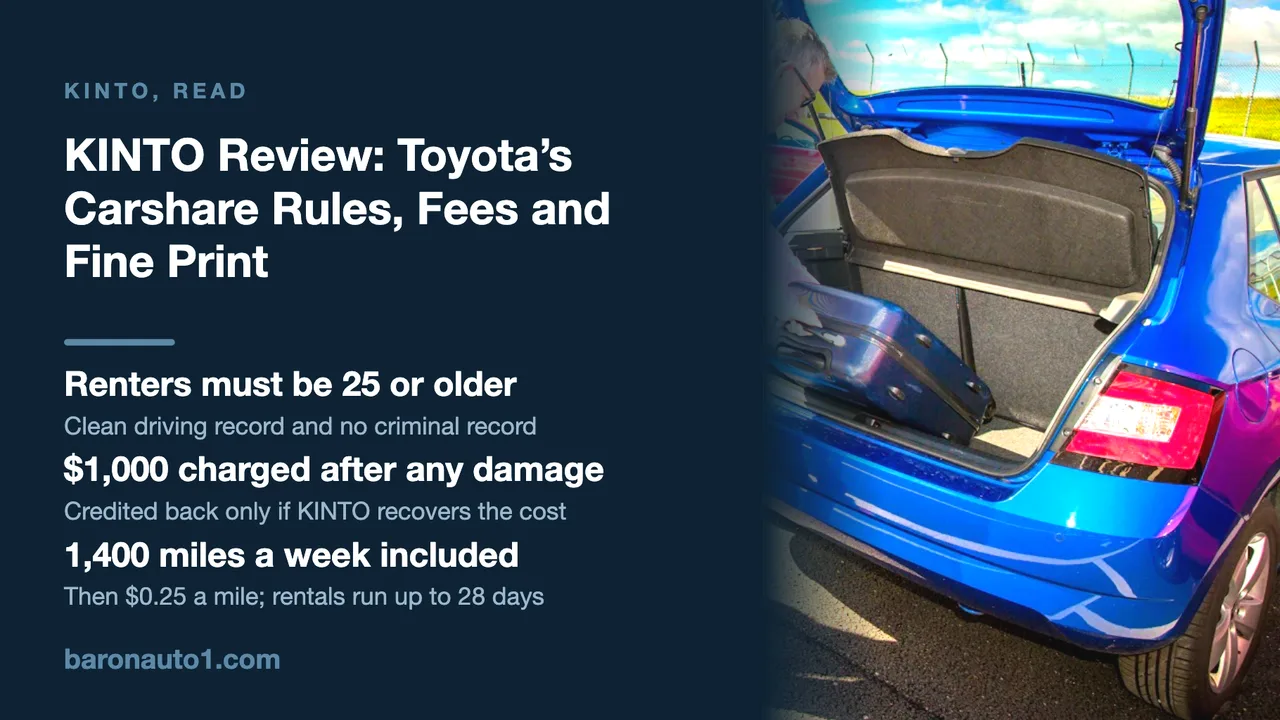
The short version
- KINTO in the US is a self-service carshare, not a dealer program or subscription. Its terms call it “a trademark of Toyota Motor Credit Corporation,” Toyota’s US finance company, and its footer says it is “currently serving California and Texas.”
- You must be 25, hold an in-state license, pass a driving-record check with “No criminal record,” and pay a $17 application fee that is kept even if you fail. KINTO says it runs no credit check.
- The full rental plus tax is charged when you book, and a hold of up to $200 stays on your card until 72 hours after a clean return. Cancel before the start time for a full refund; after it, or as a no-show, you get nothing back.
- The included insurance is liability only: $30,000 per person and $60,000 per accident for injuries, $25,000 for property. Any damage, even a hit-and-run, means a $1,000 charge at the start of KINTO’s investigation and a suspended account.
- Weekly rentals include 1,400 miles (1,750 for an EV), then $0.25 a mile, for up to 28 days. Two KINTO pages price the first late hour differently.
- KINTO’s home page lists “Test Drive” as a use. It works for living with a Toyota model for days, but KINTO does not sell the car you rent, and 20 of its 34 pick-up points are Toyota dealerships.
KINTO is Toyota’s carshare in the US: you apply in an app, pass a driving-record check, book a Toyota (or the one Mazda in the fleet) parked at a dealership, hotel or private lot in California or Texas, unlock it with your phone and keep it from a few hours to 28 days. Toyota Motor Credit Corporation runs it under the KINTO name, and most of its pages are written for Uber and delivery drivers, though personal and business rentals are allowed. On 17 and 18 October 2026 we read KINTO’s Terms of Service (effective June 1, 2026), its Privacy Policy (revised May 22, 2026), 12 other kinto-us.com pages, 48 of the 128 articles in its help center, Toyota’s global KINTO site and Toyota Motor Credit’s latest 10-K. We opened no account, started no application or reservation and searched no location. This site has no commercial relationship with KINTO, Toyota or any rental or car company.
What KINTO is in the US, and who runs it
KINTO’s help center calls it “a contactless carsharing service that offers hybrid, electric, and fuel-efficient Toyota vehicles,” used “when driving for Uber, approved delivery services, and for personal use.” There is no counter and no key: the app opens and starts the car over Bluetooth, and the cars sit “at various lots without an attendant available.”
The operator is Toyota’s finance company, not its sales arm or its dealers. The Terms describe “KINTO™, a trademark of Toyota Motor Credit Corporation,” and their e-signature section defines “we” as “Toyota Motor Credit Corporations d/b/a KINTO” (the stray “s” is KINTO’s). The Privacy Policy says “KINTO is a service operated by TMCC.” Toyota Motor Credit’s 10-K says it is wholly owned, through Toyota Financial Services International and Toyota Financial Services Corporation, by Toyota Motor Corporation. That 10-K, for the year to March 31, 2026, does not mention KINTO; it names its brands as Toyota Financial Services, Lexus Financial Services and Bass Pro Shops Financial Services. Our Toyota Financial Services review covers the company.
KINTO is a global Toyota brand, and the US runs one piece of it. Toyota’s global site, owned by Toyota Financial Services Corporation in Japan, says KINTO SHARE is “Available in over 20 countries” and lists, under The United States, only “KINTO SHARE” and “HUI (KINTO Partner),” linking the first to kinto-us.com. If you landed on kintomobility.com, it is not KINTO’s site: on 17 October 2026 that domain sat on a domain reseller’s name servers and redirected to a for-sale listing. KINTO’s terms say their current version “will be found at kinto-us.com/terms-of-service.”
The help center says KINTO runs “throughout Southern California, Napa California, and Dallas and Houston, Texas area,” and its location list holds 34 pick-up points, 18 in California and 16 in Texas.
| Type of location | Count | Where |
|---|---|---|
| Toyota dealership | 20 | 9 in California, 11 in Texas |
| Hotel or hotel garage | 4 | Bedford, Irving and Plano, Texas; Long Beach, California |
| Private lot | 4 | Chinatown, Hollywood, Santa Monica and Sylmar, California |
| Other: collision center, auto auction, mall, university lot, two Irving sites | 6 | Alhambra, Norwalk, Panorama City and Carson, California; Irving, Texas |
So the idea that KINTO rents “through participating Toyota and Lexus dealers” is half right: 20 of the 34 (58.8%, our arithmetic) are Toyota dealerships, 14 are not, and no Lexus store is listed. Each lot keeps its own hours, and “you cannot pick up or return the vehicle outside its operating hours.” All 16 Texas location pages add: “On Fridays, reservations will be unavailable from 2:00 PM to 11:59 PM.”
Who can rent: age, record and the $17 check
KINTO screens you before you can book. The Terms say “You must be at least 25 years of age to obtain an Account,” and the app asks for your license, a selfie holding it, contact details and a credit or debit card. KINTO then obtains a Motor Vehicle Report, and its help center refers applicants who fail “the Checkr application” to Checkr, Inc., which its e-signature terms also name.
| Rule | Limit |
|---|---|
| Age | At least 25 |
| License | “an active in-state license” for the state of use |
| Moving violations | No more than two in the past three years |
| Phone or distracted-driving violations | No more than two in the past three years |
| Accidents | No more than two in three years, or one moving violation and one accident |
| Major violations (suspended license, reckless driving) | None in the past three years |
| DUI or drug-related driving | None in the past seven years |
| All violations | No more than three in the past three years |
| Criminal history | “No criminal record” (help center: “No criminal convictions”) |
The record check costs $17, and the money is gone whatever the result: the Terms call application fees “non-refundable in all cases,” and the help center says it pays for the record check, “so unfortunately there are no refunds for the application fees.” Read the rules in the table before you pay. Approval “typically” takes about an hour, but can pass 10 business days if you have lived in a county without “an automated background check process” or in more than one county. KINTO may also review records “on an ongoing basis.”
“No credit check will be done,” the app page says. And only you may drive: no second driver can be added, and if someone else drives, “The renter’s KINTO insurance coverage will be revoked.” The one exception to the age rule is a campus program at California State University Dominguez Hills, whose own cars students and staff may rent from 21.
Booking, the charge at reservation and the $200 hold
You pay for the whole rental the moment you book. The Terms say KINTO “will authorize Your payment card by charging the full rental amount plus taxes at time of reservation.” Credit and debit cards are accepted, “Prepaid cards are not accepted,” and the card name must match your license and account. Uber or delivery earnings cannot be used, and any outstanding balance “must be paid prior to making a new reservation.”
On top of the rental there is a hold, the nearest thing to a deposit. Since September 1, 2025, the help center says, KINTO places an authorization hold, which the Terms cap at “not to to exceed $200” (KINTO’s doubled “to”). The money is unavailable “until 72 hours after your reservation is complete with no incident,” and your bank may take “7-10 business days” more. Fees found after you return are charged later to the same card.
KINTO’s website prints only starting prices; the app sets the rate. On 18 October 2026 the pricing page’s “Standard Pricing” read “Starting At $75 /day” and “Starting At $300 /week,” both “Plus tax,” and the rentals page gave hybrids “starting at $340 per week, $85 daily, and $11 hourly plus tax.” “Pricing may vary by location and vehicle type,” and KINTO may “amend rates, rate structures, terms and credits at any time.” The Terms say the price includes “maintenance, roadside assistance, and vehicle insurance.” A Vehicle License Recovery Fee is added as a daily line on every invoice; KINTO calls it “not a government tax” and prints no amount.
Weekly rentals “can be booked and extended on a weekly basis for up to 28 days,” though “extensions are not guaranteed.” Custom rentals run “as little as 4 hours and up to 28 days” on cars “model year 2021 and newer,” one help article says. You can book no more than seven days ahead, “on an as-available, first-come basis.” You choose one of 15 categories, from Compact to Electric Vehicle, not a model: KINTO “cannot accept vehicle preference requests, including specific models within each category, color, or trim level,” and electric cars need separate “access approval.”
Cancelling, changing and returning late
The start time is the line that matters. Cancel before it for “a full refund,” which takes “3-5 business days” to process. Cancel after it and “no refund will be issued”; a no-show is treated the same. A booking you never start is billed “for the full reservation unless the Driver cancels it,” and “No refunds will be issued for returning the vehicle early.”
Edits are free “more than 24 hours before your scheduled start time”; inside 24 hours “you can only extend your reservation.” You may start up to an hour early if the car is there, but pay in full if you start late. To keep the same car longer, KINTO says extend “within the first 48 hours,” “the only way we can guarantee you can keep your car.”
Late returns cost money after a 59-minute grace period, and KINTO prints the first hour two ways. The Terms’ late policy says that at 60 minutes late “You will be charged $10 for first hour of being late,” then $10 an hour, “with a maximum charge of $240.” The help center says “At 60 minutes late, you will be charged $20 (first hour, plus second hour),” then $10 an hour to the same cap. The Terms’ fee table says “$10/hour for any portion of an hour up to 24 hours” and mentions no grace period. The gap is $10 (our arithmetic).
Four hours late can end your account. The Terms say that if you are “over four (4) hours late” without contacting KINTO, “You will be permanently suspended,” and that a car not returned without a sufficient explanation will be considered “stolen.” If KINTO cannot reach you, “the vehicle may be reported to the police as missing” and “criminal charges could be sought.” Three returns an hour or more late within ninety days also suspend you automatically. If you will be late, extend in the app before the end time or contact KINTO’s support through the app.
The car goes back to the lot you took it from, inside that lot’s hours: a full tank or 150 miles of EV range, no trash or new damage, no odor, doors locked through the app, and photos of the outside when you end the rental. A car abandoned, towed or left at the wrong lot costs $250 when the tow stays in its home state, and an impounded car costs $500 plus the cost of recovery.
Fuel, charging and the weekly mileage limit
Bring it back full, whatever one sentence says. The Terms and the help center both say you return the car “at the level You started with,” while another Terms paragraph says “Please ensure that the gasoline tank is full” and that a fee applies below “half a tank.” The fee table decides it: less than full but more than 50% costs $75, and less than half costs $120. If the car is not full when you collect it, tell KINTO’s support at once.
Electric cars work the same way with range. KINTO aims to hand over an EV with “at least 150 miles or 80% charge” and expects the same back; 100 to 150 miles costs $75, under 100 miles $120. Running flat costs too: an emergency charge from KINTO’s mobile-charging partner “will be $100 and you will receive 7kwh/25 miles of range,” with a wait of up to 90 minutes; outside the partner’s hours or area, the car is towed back to its home lot. KINTO asks that DC fast charging be limited to two cycles a day.
Whether you get a charging cable depends on the page. The Terms say “Electric vehicles will come with a level one charging cable” and charge $850 if it goes missing; the Electrification page says “KINTO offers level 1 charging cable”; the help center says “Level 1 charger is not included in bZ4X rental.” Check the trunk before you leave and photograph it either way.
Since November 1, 2023, KINTO has limited non-electric rentals to 1,400 miles a week, and since April 1, 2024, electric ones to 1,750, with “an overage fee of $0.25 per additional mile.” That is about 200 miles a day, 5,600 miles over a full 28-day rental (7,000 for an EV), and 100 extra miles cost $25 (all our arithmetic). The cars stay on paved roads and in the US (“The vehicle may not be taken into Mexico or Canada”), may not tow a trailer, and the license to use one is “restricted to the state in which the vehicles are stationed.”
Insurance and the $1,000 damage fee
The insurance in the price protects other people, not the car you drive. KINTO’s Terms: “We provide liability insurance, which covers damages up to $30,000 in bodily injury per person, $60,000 bodily injury each accident, and $25,000 property damage each accident in the event of an at-fault accident.” It “does not cover the cost of Your own medical expenses.” Neither the Terms nor the help center articles we read describe collision cover for the KINTO car itself; damage to it runs through the damage fee.
That fee is charged first and settled later. “In the event of a collision or other incident where additional investigation is required, We will charge the Driver $1,000 at the start of the investigation process,” and your account is disabled until it ends. Triggers run from “dents, scratches, collisions, flat tires, windshield cracks, dead batteries” to “vandalism, theft, hit and run.” Not being at fault does not stop the charge: the help center says it is credited back once another driver’s insurer pays, and for a hit-and-run, “If KINTO is unable to recover the cost of damages to the vehicle while it was in your possession, you will be required to pay the $1,000.” If repairs cost less, the Terms say the balance is refunded. “There is no specific timeframe for how long an investigation will take.”
Sometimes $1,000 is only the start. Drive illegally, outside the Terms, deliberately or “negligently,” and you “bear the full cost of damage” to the car and to third parties beyond the policy. After theft or loss you “may be held responsible for the entire cost of recovery or replacement.” An unauthorized driver means “Revocation of insurance coverage, customer assumes full liability, and all damages incurred.” You also agree to indemnify KINTO, its parent and affiliates for losses “arising out of or relating to the vehicle, the Services, or Your use of the vehicle.” Normal wear and tear is not yours.
Protect yourself at both ends. Check the car inside and out and report damage before you leave, because “If You forget to notify us and the next driver reports the damage, We may hold You financially responsible.” Report any accident at once, with a police report. Roadside help is included for mechanical faults, flat tires, dead batteries and accidents, but “If you abandon the car while waiting for roadside assistance, you may be liable for additional incurred costs.” Before renting, ask your own insurer whether your policy covers a carshare car; KINTO’s terms do not say.
Cleaning, tolls, tickets and the fee schedule
KINTO prints its fees in a table near the end of its Terms. These are the amounts in the version effective June 1, 2026.
| What happened | Fee |
|---|---|
| Damage to the car, third parties or their property | Up to $1,000, charged at the start of the investigation |
| Returned below a full tank but above 50% | $75 |
| Returned below 50% of a tank | $120 |
| EV returned with 100 to 150 miles of range (or 50% to 80% charge) | $75 |
| EV returned below 100 miles of range (or below 50% charge) | $120 |
| Late return | Rental rate plus $10 an hour, up to 24 hours, $240 at most |
| Level 1, 2 or 3 cleaning | $25, $75 or $125 |
| Smoking or odor | $250 (professional detailing at market price) |
| Abandoned, towed or returned to the wrong location (in state) | $250 |
| Vehicle impounded | $500 plus the cost of recovery |
| Missing or damaged telematics unit | $550 |
| Missing or damaged level one charging cable | $850 |
| Missing or damaged toll tag, plate holder or parking pass | $50 |
| Failure to properly secure the car | $50 |
| Missing or damaged KINTO license plate | $5 |
| Miles over 1,400 a week (1,750 for an EV) | $0.25 a mile |
| Processing a ticket, toll or fine KINTO pays for you | $30 |
The help center adds two more. If a rideshare passenger makes a mess, KINTO “will charge your account a $150 cleaning fee, and it is your responsibility to collect reimbursement from Uber.” If the car is dirty at pick-up and KINTO cannot swap it, you may wash it and be “reimbursed for up to $12” with an itemized receipt. The smoking ban covers “marijuana or marijuana substitutes, e-cigarettes, or personal vaporizers,” and pets ride only in “locked pet carriers,” service animals excepted.
Tolls and tickets are yours, and they can arrive months later. Notices reach KINTO by mail, so “you may not receive the invoice for the fine and fee until up to 180 days after your reservation ends,” and KINTO adds the $30 fee when it pays one for you. Texas cars carry an NTTA TollTag, with tolls added to your invoice plus “a daily processing fee of $2.00” on days you use toll roads. California cars “do not come equipped with toll tags or transponders,” except for the 91 Express Lanes, so you pay the toll authority yourself or add the plate to your own account.
What the car and the app record
A KINTO car reports on how it is driven, and you cannot rent one without agreeing. The Privacy Policy lists “Vehicle Data” “such as dates, times and locations of use, mileage, driving performance, smoke detection, vehicle remote’s features, accidents and other information,” plus odometer readings, oil life and onboard diagnostics. Precise location, defined as “within a radius of 1,850 feet,” needs your consent in the app, but without it “you will not have access to the KINTO Vehicle Services.” Both the Terms and the policy say KINTO may use location “to track, locate, lock/unlock, or disable a KINTO Vehicle,” and the Terms ask you to “waive and release us from any and all liability” for its lawful use.
KINTO shares data with vendors including “motor vehicle agencies, payment processors, rideshare service providers, insurance companies, data analytics providers, marketing partners, social networks,” and with third parties after “a complaint, dispute or conflict, including an accident.” It collects information from sources that include “data brokers,” and keeps “inferences” drawn from motor vehicle reports. It says it does not “sell” data “as that term may be commonly interpreted,” yet its Texas notice says that for ads, “we sell personal information (i.e., information from cookies) to third-party advertisers and analytics companies.” It honors the Global Privacy Control signal but not “Do Not Track.”
If you applied in the past year, note this: the policy says that in the 12 months before May 22, 2026 “we also collected Social Security numbers,” and that it “no longer” does. Closing your account does not erase everything; data other than your login credentials “will continue to be stored in our backup systems.”
Disputes: arbitration, and how to opt out
Either side can force a dispute out of court: “either You or We may choose to resolve the Claim by binding arbitration,” and then “NEITHER PARTY WILL HAVE THE RIGHT TO LITIGATE SUCH CLAIM IN COURT OR TO HAVE A JURY TRIAL.” Arbitration is individual, with no class actions, under the Federal Arbitration Act and the American Arbitration Association’s rules, in “the county where the vehicle was located when the reservation began.” Small-claims court stays open, and the clause does not apply to service members and dependents covered by the Military Lending Act.
Some terms help the driver. KINTO will advance your arbitration costs if you cannot afford them and ask in writing in good faith. You must send a written Claim Notice at least 30 days before filing; if the arbitrator then awards you more than KINTO’s last written settlement offer, you get the award or $7,500, “whichever is greater.” Other terms help KINTO: you pay its collection costs, including attorneys’ fees, if you fall behind, and it excludes indirect and consequential damages and loss of personal property left in its cars.
You can reject arbitration, on paper only. The Terms give “thirty (30) days” from “the date You initially use the Services” to mail a signed request to the KINTO address in the Terms, with your name, address, phone number, account number and a set sentence. “No one else may sign the request for You,” and it must go on its own. Decide before your first rental.
Where KINTO’s own pages disagree
KINTO’s Terms, help center and marketing pages did not always agree when we read them. Where they differ, ask KINTO in writing which rule applies, and keep a screenshot of the page you rely on.
| Topic | One KINTO page says | Another says |
|---|---|---|
| First late hour | Terms: $10 at 60 minutes late | Help center: $20 at 60 minutes late; fee table: $10 for “any portion of an hour” |
| Fuel on return | Return it “at the level You started with” | Return it full; $75 for anything less |
| EV charging cable | Terms: EVs “will come with” one ($850 if lost) | Help center: “not included in bZ4X rental” |
| Allowed gig apps | Terms: nine, including HopSkipDrive and Via | Help center: “Uber is the only approved rideshare service”; delivery page lists a different nine |
| Criminal history | Terms: “No criminal record” | Help center: “No criminal convictions” |
| Social Security numbers | Help center: not stored; collected only for the background check | Privacy Policy: collected in the prior 12 months, “no longer” collected |
| How many locations | Home page: “57 Locations in Texas & California” | Locations page and help center: 34; About page: “four locations” |
| Booking types | Help center: “2 reservation types, weekly and custom” | Pricing page: daily, weekly and custom from “three base prices” |
| Custom rentals | Help center: “Available at participating locations in the DFW area” | Pricing and Uber pages: from 4 hours, no area named |
The location gap is 23 (our arithmetic). The “57” sits beside “1,400+ Rental Vehicles” and “11K+ Happy Drivers” on the home page, with no date or method. KINTO even calls itself “KINTO™” in its Terms and “KINTO®” in its footer.
KINTO as a long test drive before you buy
KINTO suggests this use itself. Its home page lists “Test Drive”: “Not sure if you’re ready for a hybrid or a larger vehicle test drive a KINTO car for a few hours or days to see how they fit your lifestyle.” Toyota’s global KINTO page lists “longer test drives” next to family weekends. A week in a RAV4 Hybrid, Sienna or bZ4X tells you about the commute, the car seats, charging and the fuel bill in a way a short dealer drive cannot.
It tells you nothing about the car you would buy. KINTO’s pages describe rentals only and offer no way to buy the car, and you book a category, not a model, so the rental may differ in year or trim from the car on a lot. Use KINTO to choose a model, then judge the actual car on its own record, starting with NHTSA’s recall lookup for its VIN: see our guides to test-driving a used car, pre-purchase inspections, buying a used hybrid and Toyota Certified cars, and our RAV4, Camry, Corolla, Highlander and Sienna model-year pages.
Some sellers of former rental cars let you drive the exact car before or after you pay. Their printed terms, copied from our reviews of each (we do not compare prices):
| Program | Time with the car | Is it the car you buy? |
|---|---|---|
| KINTO | Weekly up to 28 days; custom from 4 hours | No: rentals only |
| Hertz Rent2Buy | “3 full days” renting, before buying | Yes: the rental is waived if you buy it |
| Hertz Buy Back Guarantee | 7 days or 250 miles after buying | Yes: return it for a refund less a fee and any excess wear |
| Enterprise 7-Day Buyback | 7 days or 1,000 miles after buying | Yes: return it for the price paid less a restocking fee |
| Avis Money Back Return Policy | 3 days or 150 miles after buying | Yes: return it for your money back |
- Read the fee table and the late policy first. Note the $17 check you will not get back, the $200 hold and the refund cut-off at the start time.
- Ask your insurer about carshare cars. KINTO’s cover is liability only, and its terms describe no collision cover for the car.
- Photograph the car before you drive. Report damage, dirt or low fuel to KINTO first, or the next renter’s report may land on you.
- Plan around 1,400 miles a week. A long highway test can pass it, at $0.25 a mile.
- Check the lot’s hours and, in Texas, the Friday block. You cannot return outside the hours, and late fees start after 59 minutes.
- Return it full or with 150 miles of EV range, clean, locked through the app and photographed.
- Decide about arbitration before your first rental. The 30-day window to reject it starts when you first use the service.
Common questions
Is KINTO owned by Toyota?
Yes. In the US, KINTO’s Terms call it “a trademark of Toyota Motor Credit Corporation,” the Toyota finance company that operates it, which is owned through Toyota Financial Services by Toyota Motor Corporation. The global KINTO site is run by Toyota Financial Services Corporation in Japan.
What is KINTO Share?
The US name of KINTO’s carshare: Toyota hybrids, gas cars and EVs on unattended lots in California and Texas, unlocked with your phone, for Uber, approved delivery apps, personal trips or business, from 4 hours to 28 days.
How old do you have to be to rent from KINTO?
25, with an in-state license, a driving record inside KINTO’s limits (for example no DUI in seven years) and no criminal record. The only exception KINTO lists is its California State University Dominguez Hills program, open from 21 for that program’s cars.
Does KINTO include insurance?
Liability only: $30,000 per person and $60,000 per accident for injuries, and $25,000 for property, for at-fault accidents. It does not pay your own medical costs, and damage to the KINTO car runs through a $1,000 fee charged when an investigation starts.
Can you use a KINTO car for Lyft?
No. The help center says “Uber is the only approved rideshare service” and that KINTO cars do not support Lyft’s registration process. Approved delivery apps are allowed.
Can you buy the car you rent from KINTO?
KINTO’s pages describe no way to. To drive the exact car before or after buying, see the Hertz, Enterprise and Avis terms in the table above.
For sale near you
Dealer listings, checked liveFinding used cars near you…
Sources and further reading
Recall, complaint and safety-rating figures on this page were retrieved from the federal databases above on August 19, 2026. Federal data changes — re-check any VIN before you rely on it.
Published October 16, 2026 · last updated October 16, 2026. Found something out of date or wrong? Tell us and we will correct it.