Capital Auto Auction: Fees, Deadlines and Lights in Its Own Terms
Capital Auto Auction sells online only from four yards, and its buyer fee sits behind the login. What its Buyer Terms say about the deposit, the payment and pickup clocks, the light system, and the yard where cars are sold for dismantling only.
The short version
- Capital Auto Auction is a public vehicle auction that sells online only, in real-time internet sales with proxy bidding, from four pickup yards: Washington, DC; Temple Hills, Maryland; Philadelphia; and Manchester, New Hampshire. You need to be 18 with a valid U.S. driver’s license, not a dealer license.
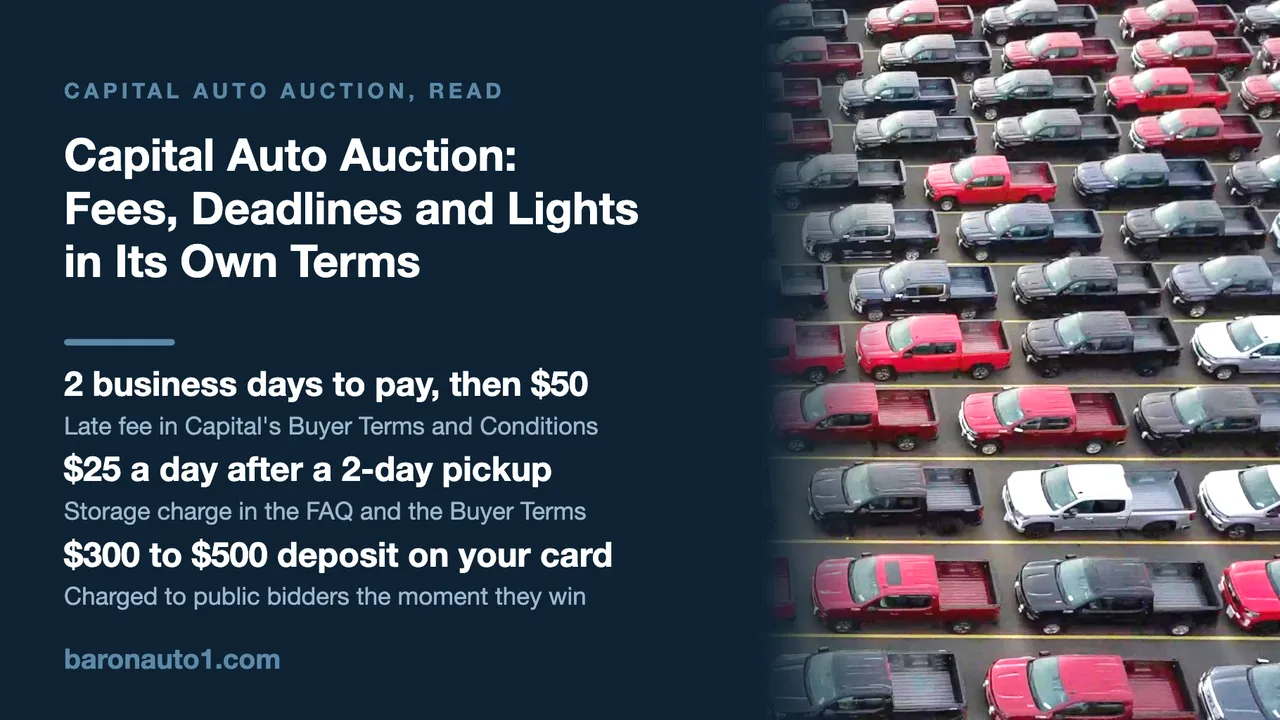
- The buyer fee is not public. The FAQ says fees run “on a sliding scale based on the selling price” and that “you can see them once you are logged in.” What is printed: a $300 to $500 deposit charged to your card when you win, a $50 late fee, a $300 to $500 relist fee, $25 a day storage and a 2.95% card fee.
- The clocks are short. Pay within 2 business days, not counting the sale date, or owe $50; at 3 business days come relist fees, forfeiture and suspension. Collect within 2 business days or storage starts; after 30 days a car is “deemed abandoned.”
- Every listing carries a light. Only a green light allows arbitration, within 48 hours, for one defect of $500 or more on a car sold above $1,000, and only before the car leaves. A red light means as-is, and Capital does not represent that the condition report is accurate or complete.
- Test drives and in-person viewing are not permitted. Temple Hills cars are sold “for dismantling or rebuilding purposes only,” Philadelphia cars as “un-roadworthy,” and Manchester cars un-inspected with an Unsafe Motor Vehicle form.
- Capital’s own pages disagree on the card fee (2.95% or 2.5%), the pickup window, what is forfeited and when it was founded: 17 disagreements in all.
Capital Auto Auction sells used cars, trucks, boats and other vehicles to the public in weekly online auctions, with pickup at four yards in the Washington, Philadelphia and Manchester areas. On 25 October 2026 we read its Buyer Terms and Conditions (the document you accept at registration), its three “Who and Where to Pay” payment pages, payment portal terms, Terms of Use, privacy policy, FAQs, carrier terms, yard, charity and tips pages, two blog posts and one listing’s field labels, plus the DC DMV’s Active Dealers list and the Pennsylvania vehicle board’s page. Capital’s Terms of Use bar linking to its site without written consent, so this page names its documents without linking them. We did not register, bid or request a quote. This site has no relationship with Capital Auto Auction or any seller on it.
Who runs Capital Auto Auction, and where its yards are
Capital’s About page says it “has been in business in Washington DC since 1988” and that it has served DC, Maryland and Virginia customers since 4 February 1989 from a 60,000 sq ft facility in Northeast Washington. It added Philadelphia on 11 December 1996, with three auctions a week, and Manchester, New Hampshire, on 18 November 1999. The Buyer Terms and payment pages add a fourth yard in Temple Hills, Maryland, and the Tips page sums it up: vehicles “can be picked up at four convenient locations in Maryland, Pennsylvania, New Hampshire and Washington DC.”
The sitemap lists 106 pages under Locations. Four are the yards; the other 102 are state and city pages, from Florida to Wisconsin, that name no yard. The Jacksonville page, for one, tells buyers to pick up “from one of our locations” or ship.
The Locations page gives the standing schedule: Manchester every Saturday at 9:00 a.m.; Philadelphia every Tuesday, Wednesday and Saturday at 4:00 p.m.; the D.C. area every Tuesday, Wednesday and Saturday at 10:00 a.m. The calendar we saw on 25 October 2026 matched it, with one extra event, a DC Area Mechanic’s Sale on 31 October at 9:00 a.m. No page we read explains what a Mechanic’s Sale is.
No document we read names an owner. The Terms of Use say “Capital Auto Auction” refers to “the owner of the website” and give a registered office in Washington, DC. The wire instructions for DC and Temple Hills purchases name the receiving account “Capital Auto & Truck Auction, Inc.”; the Philadelphia instructions name “Capital Auto Auction.” The privacy policy mentions “subsidiaries and affiliates” without naming them. We could not read the Maryland, Pennsylvania, New Hampshire or DC business registries, so we make no claim about corporate structure.
One naming point: Google’s results for the name on 25 October 2026 include a directory page for a “Capital Auto Auction” in Youngsville, North Carolina. We did not open it and do not know whether the two are connected; none of Capital’s terms names a North Carolina yard.
Who can bid, and how a sale works
Capital calls itself “a public car auction” where “everyone is welcome,” and the DC page says its sales “are open to everyone, not just dealers.” The Buyer Terms open bidding to “individuals 18 years of age and older who can form legally binding contracts,” subject to “seller specific requirements” and the law. The FAQ asks for “a valid U.S. issued driver license”; the Philadelphia page accepts “a valid U.S. driver’s license or government-issued ID” and adds that “no license (such as a dealer’s license) is required.”
Registration is free (“You only need money if you are going to bid”). The FAQ says sign-up asks you to “upload proper documents, credit card information and select the correct bidder type.” That card is where the deposit is charged when you win, and the bidder type matters because the payment pages treat dealers and public buyers differently.
Vehicles are posted “usually 1 week in advance,” and the FAQ says the only way to bid is online: the internet sales are “not a simulcast event.” Before the sale you leave a proxy bid, your maximum, and the system bids for you in increments from a start that is “generally” $100. When the car comes up in the real-time sale, the Buyer Terms say a countdown starts when bidding stops and resets on each new bid, and Capital may “extend or reset any countdown.” Note also: “The auction may bid on behalf of any minimum reserve price set by seller.”
Not every high bid is a sale. On an “If Sale,” where the reserve was not met, Capital passes your bid to the seller. The FAQ says an answer “may take 24 - 48 business hours”; the Buyer Terms say up to 2 business days after the sale day, with an e-mail when the seller approves. For “On Approval” sales the Time of Sale, which starts several clocks, is the moment the seller approves. Instant Buy cars are paid “100% of the total at that time.” And once a seller approves, “the last bidder is legally obligated to purchase the vehicle.”
The buyer fee, and the charges Capital does print
The FAQ answers “What are the fees?” this way: “The fees are on a sliding scale based on the selling price of the vehicle. We post our fees online, and you can see them once you are logged in.” It adds that, depending on where you live and which auction you bought from, “there may be additional fees for tax, tags, and other additional fees.” The Manchester page says the same in other words: buyer fees “based on the final sale price,” with “Full details are provided during checkout.”
So the number most buyers want is behind the login, and we did not create an account to see it; the listing we read logged out showed a starting bid and increment but no fee. Read the schedule before you bid and add it, the card fee and your taxes to your ceiling (our out-the-door price guide shows how). The charges Capital prints in public:
| Charge | What the document says | Document |
|---|---|---|
| Buyer fee | “on a sliding scale based on the selling price”; visible once logged in | FAQ |
| Deposit when you win | $300 to $500 “based on the price of the vehicle,” charged to the card on file and applied to the price; forfeited if the sale is not completed within 48 hours | Buyer Terms; FAQ; payment pages |
| Late payment | $50 if not paid in full within 2 business days, not counting the sale date | Buyer Terms; payment pages |
| Relist fee | $300 to $500 “based on the price of the vehicle” if you do not complete the sale | Buyer Terms; payment pages |
| Card payment | 2.95% of the amount charged (2.5% in the payment portal terms) | Buyer Terms; payment pages; portal terms |
| Storage | $25 a day after the pickup window | Buyer Terms; FAQ; payment pages |
| Maryland buyers, Temple Hills cars | Maryland state tax (6.5%) and title fee ($205.00) collected at purchase | Buyer Terms |
| Pennsylvania and New Jersey buyers, Philadelphia cars | Title transfer and sales tax at purchase; a tag service on site | Buyer Terms |
| Registration | Free | FAQ |
The Maryland figures are Capital’s; we could not reach the MVA’s site to compare. By our arithmetic, a $2,000 price means $130 of tax plus the $205 title fee, $335 in all, and $5,000 means $530. Capital does not say what the tax is charged on, so treat those as a floor.
The deposit and the payment clock
Winning starts the money moving at once. “Upon winning the bid on a vehicle, every public bidder is required to post a deposit between $300.00 and $500.00,” charged to the card you registered and counted toward the price. If you fail “to proceed with the sale within 48 hours of the sale, the deposit becomes non-refundable as liquidated damages not a penalty, and is forfeited.”
The payment deadline is written differently: pay in full “within two (2) business days, not including the date of the sale,” or pay a $50 late fee. Miss 3 business days and the Buyer Terms list “liability for relist fees, forfeiture of your deposit, and suspension of your account.” Another clause requires a $300 to $500 relist fee from anyone who fails to proceed, or “revocation of bidding privileges, up to and including legal proceedings.”
Forty-eight hours and two business days are not the same span. Taking business days as Monday to Friday (no document we read defines them), a car won at the 10:00 a.m. Tuesday DC sale hits 48 hours at 10:00 a.m. Thursday, the day the payment deadline ends. Won at the Saturday sale, it hits 48 hours at 10:00 a.m. Monday, while the payment deadline runs to Tuesday. That is our reading, holidays aside; paying inside 48 hours satisfies every version.
| When | What happens |
|---|---|
| You win | Public bidders post a $300 to $500 deposit by the card on file; an If Sale waits for seller approval |
| 48 hours after the sale | Deposit forfeited if you have not completed the sale (the Green Light arbitration window is also 48 hours, but with weekends and holidays excluded) |
| End of business day 2 (sale date not counted) | Payment in full due, or a $50 late fee; pickup is due within 2 business days of the Time of Sale, or storage runs at $25 a day |
| Business day 3 unpaid | Relist fees, forfeiture and account suspension |
| Check payments | Up to 7 business days to clear; the car is not released before |
| Over 30 days on the premises | “deemed abandoned and disposed of accordingly” |
The Buyer Terms accept “cash, cashier’s check, certified bank check, and wire transfer.” The yard sections and payment pages add cards at “a fee of 2.95% of the amount charged”; the payment portal terms say 2.5%. By our arithmetic the gap is $4.50 on a $1,000 charge ($29.50 against $25.00) and $22.50 on $5,000. Capital “may limit the amount that can be charged” to a card, and the portal warns that card payments can take “1-3 days” to show in its records. A check “may take up to 7 business days” to clear, and “Vehicles will NOT be released until the check clears,” while storage keeps running.

The light system, arbitration and the as-is rule
Every Capital listing has a “Lights” field, and the Buyer Terms make reading it your job: “Buyer is solely responsible for understanding the light system,” and “more than one light may apply to each vehicle.” There are four.
Green: “Arbitration Policy applies.” You have 48 hours from the Time of Sale, weekends and holidays excluded, to claim an undisclosed condition from a list of ten: the manual gearbox, engine knocks or a cracked block, transmission slippage, differential grind, misrepresented mileage, mismatched or reassigned VINs, frame or unibody damage, a blown head gasket, burnt or bent valves, and unlisted “Material differences (over $500 per item).” “One defect must total $500 and the sold price must be greater than $1,000.00,” unless the arbitrator declares the car unsafe. The decision binds both sides, a car “may be arbitrated once,” and removing it from Capital waives the right.
Yellow: “Announced condition.” The seller is disclosing a discrepancy, and it is “the Buyer’s responsibility to read and understand” it.
Blue: “Title delay.” No assignable title comes with the car; the seller has up to 10 days, weekends and holidays excluded, to deliver it. You are “strongly cautioned not to repair, sell, drive, or damage” the car until you have it, and if the seller cannot produce one and buys the car back, you answer for “excessive mileage or damage” and for returning it at your own cost.
Red: “As-is.” No representations or warranties; “RED LIGHT VEHICLES ARE NOT ARBITRATABLE FOR ANY REASON OF ANY KIND,” and “NEITHER CAPITAL NOR SELLER REPRESENT THAT THE CONDITION REPORT IS ACCURATE OR COMPLETE.” Some vehicles are as-is whatever their light: recreational vehicles, motorcycles, boats, trailers, buses, gray-market vehicles, former police cars and taxis, and anything with a flood or rebuilt brand. Our pages on salvage titles and rebuilt titles explain those brands.
Behind the lights sits a blunt general rule. “All vehicles are sold AS-IS, none of them have been inspected by a mechanic. If you are not familiar with vehicles and their mechanical systems, buyer beware. Test drives and in-person viewing are not permitted.” Cars are “not guaranteed to pass state inspections,” and once paid for, “all sales are final,” with arbitration the only exception. Capital’s Tips page agrees: buy at auction and “you do so at your own risk,” with “no getting your money back, and there’s no warranty.”
What you get instead is the listing: “Most vehicles have a condition report, images, and videos,” says the FAQ. The listing we read also carried two standing notes: the car was “SOLD AS-IS (FEDERAL BUYERS GUIDE),” with visible defects in the photos treated as part of the written report, and the buyer “AGREES TO CHECK FOR OUTSTANDING RECALLS.” A pre-purchase inspection is not possible before you bid; history checks are. Run the VIN through a title check, a flood check, an odometer check and an open-recall check before you set your maximum.
The arbitration right ends when the car moves. Capital’s Buyer Terms say removing a Green Light car waives arbitration, and removing any car waives “any objections to title information discrepancies.” Check the year, make, model and VIN against the title, and look the car over, at the gate, before it leaves the yard or goes on a truck. If you send a carrier, arrange for someone to make that check.
What changes by yard: dismantling-only cars, un-roadworthy sales and plates
The Buyer Terms end with a short section for each yard, and these change what you are buying more than anything else in them.
| Yard | How the car is sold | Tax, tags and pickup |
|---|---|---|
| Washington, DC | Internet vehicles sit at DC or Temple Hills; check the condition report for which | Payment received in DC; “You will need a tow truck to take a unit out of our locations”; public buyers collect the title and gate pass after paying; office closed Sundays |
| Temple Hills, MD | “sold for dismantling or rebuilding purposes only” | Maryland buyers pay 6.5% state tax and a $205.00 title fee at purchase |
| Philadelphia, PA | “sold as ‘un-roadworthy’ vehicles” | Title transfer and sales tax at purchase (Pennsylvania and New Jersey residents in the Buyer Terms; Pennsylvania and Maryland residents in the payment page); tag service on site; 30-day temporary tags for Maryland buyers; office closed Saturday and Sunday |
| Manchester, NH | “un-inspected with an Unsafe Motor Vehicle form” | “does not provide plates of any kind”; office closed Saturdays and Sundays |
The Temple Hills line deserves a second read. The Temple Hills page promises “clean, good used cars,” but the Buyer Terms say every vehicle there is sold for dismantling or rebuilding only. If you want a car to drive and register, check where the listing says it sits before you bid.
Registration is your problem too. Where state or local law requires it, you “may not remove vehicle from Capital premises without first obtaining registration tags and/or insurance,” and Capital warns that “vehicles bought at auction may not be eligible for registration outside of the state in which they reside.” Its recommendations are practical: pay in full before arriving, “Bring your own plates or arrange transportation,” and arrive early. Our guides to temporary tags and title transfers cover the motor-vehicle office side,, and our guide asks whether to buy a salvage title car.
Pickup, gate passes, titles and shipping
You leave with the car only after full payment. The Buyer Terms say your receipt “must be presented at the gate,” the FAQ calls it a Gate Pass, and the Philadelphia payment page says “Your GATE PASS must be presented at the gate.” Pickup is due “within two(2) business days of the Time of Sale” to avoid “storage fees of $25 per day.” By our arithmetic that is $175 for a week past the window, $350 for two weeks and $700 for four. A car left “in excess of 30 days” is deemed abandoned.
At the gate you are “solely responsible for verifying vehicle year, make, model, and serial number against the title prior to leaving Capital premises,” and leaving waives any objection. Blue Light titles follow once the seller delivers them. If a title never comes, our page on bonded titles explains that route.
Capital does not deliver: “Buyers need to arrange their own transportation.” Its delivery FAQ names ACERTUS as its “preferred shipping provider,” and each listing’s delivery quote “is for informational purposes only” until you pay and book from the member dashboard. The ACERTUS terms Capital hosts say pickup is not scheduled “until payment in full has been made,” a dry run costs $100, a cancellation after a carrier is en route can cost up to $100, an inoperable car can draw an extra fee or a refusal, and damage claims must reach ACERTUS within 48 hours of delivery, under Missouri law. ACERTUS ships only cars, trucks and SUVs, not motorcycles, ATVs or boats. Our car shipping guide covers what to check on a carrier’s bill of lading.
Where the cars come from, and the charity link
The FAQ names four sources: “Repossessions, Dealer Consignments, Government Vehicles, and Donated Vehicles.” The Philadelphia page lists the sellers as “government agencies, banks, dealerships, charities and private consignors,” and the Tips page says many cars are former fleet vehicles. Capital also takes consignments from the public: the title “must be free of liens and in your name,” and only “a limited number of consignments” are accepted each week. For what repossession sales involve, see our repossessed car auctions guide.
Donations are a large part of Capital’s own story. A 2023 blog post calls it “specializing in charity car donations,” and the salvage page says Capital accepts “donations of wrecked vehicles, with the proceeds donated to charity.” The Charity Links page has 20 entries. The first links to cardonationwizard.com and sits above a statement in another company’s voice: “Advanced Remarketing Services returns over 80% of every gross dollar raised back to our charity partners,” with “over $375,000,000” raised. The rest include the Salvation Army, Goodwill programs, Melwood, Wheels for Wishes and Volunteers of America, and two processors that describe themselves: Donation2Charity is “managed by Kars-R-Us,” “a Professional Fundraiser,” and CARS says it handles donations for over 2,600 charities.
None of these pages says how Capital is tied to Advanced Remarketing Services, Car Donation Wizard or any charity, and we found no document that does; we did not open the 20 linked sites. For a buyer, the point is narrower: a donated car comes through a charity program, and Capital sells it under the same lights and as-is terms as every other car.
What public records show
The District of Columbia DMV publishes an Active Dealers list, the latest “verified … as of 10/12/2026.” We read all 5 pages of it and the earlier edition of 9 February 2026. Neither contains a business or trade name with “auction” in it, Capital Auto Auction and Capital Auto & Truck Auction, Inc. included. One entry, M & G Motor Sales Inc, has the same street address as the registered office in Capital’s Terms of Use. No document we read says how, or whether, the two businesses are related, and the list covers dealers, not auctions; we found no DC list of licensed auctions.
Pennsylvania regulates auctions by name. The Department of State’s page for the State Board of Vehicle Manufacturers, Dealers, and Salespersons says the Board “also regulates wholesale vehicle auctions, vehicle branch lots, public or private vehicle auctions.” Its license lookup is a search form, which we did not run, so we make no claim about the Philadelphia yard’s license; you can run it yourself. The Maryland and New Hampshire records we tried were behind a captcha or blocked.
Searches on 25 October 2026 for attorney-general actions, settlements or lawsuits naming Capital Auto Auction found none about this company, and we read no docket or regulator release. If a dispute arises, the Buyer Terms send it to the courts of “the state and county in which Capital stored the vehicle at the time of the sale,” and you consent to service of a summons by certified or registered mail. Capital may also cancel a sale or withdraw a car without liability, and suspend any buyer “for any reason.”
Where Capital’s own documents disagree
Capital may amend its Buyer Terms and Payment Terms “at any time without any prior notice to you,” and its pages were not all updated together. On 25 October 2026 we found 17 disagreements. The ones that cost money or time:
- The card fee. 2.95% in the Buyer Terms and payment pages; 2.5% in the portal terms. The payment pages take Visa only; the FAQ and portal say Visa or Mastercard.
- What you forfeit at 3 business days. “Your deposit” (Buyer Terms) or “your convenience fee” (payment pages).
- Who owes the 48-hour payment and relist fee. “Every bidder” (Buyer Terms) or “Every dealer bidder” (payment pages).
- The clocks. Payment: 2 business days, 48 hours, or “within two days” (DC and Temple Hills pages). Pickup: 2 business days, “2 days” (payment pages), or “the next business day” (Temple Hills page). Seller approval: “24 - 48 business hours” (FAQ) or up to 2 business days (Buyer Terms).
- Inspection and condition. The Arbitration Policy says a Green Light buyer is “entitled to inspect your purchase,” yet in-person viewing is not permitted. The Locations page offers “only vehicles that are clean and in good condition” and the Jacksonville page says “What you see with us is exactly what you get,” against as-is terms and dismantling-only sales at Temple Hills.
- Taxes. A 2023 blog post says donated-car buyers “pay fewer fees, including taxes and registration”; the Buyer Terms collect tax at purchase in Maryland and Philadelphia, from Pennsylvania and New Jersey residents (Buyer Terms) or Pennsylvania and Maryland residents (payment page).
- Payments. The Philadelphia page adds money orders, which no payment terms page lists. The card processor is Authorize.net (portal terms) or Network Merchants, LLC (privacy policy, last modified 13 November 2025).
- Live or online, and history. The home page advertises “live vehicle auctions every week”; the FAQ says “not a simulcast event.” Capital was founded in 1988 or 1989 (Manchester page), and the Jacksonville page claims “over 40 years,” against 38 years since 1988 by our arithmetic.
- Copy errors. The DC page answers “who is eligible to bid?” with its vehicle-types answer, and the Temple Hills and Philadelphia pages invite you to an auction “in Manchester.”
The Buyer Terms are what you accept at registration, and they point to the “Where and Who to Pay” page for wires. Plan to the stricter version of each rule: pay within 48 hours, collect within the business-day window, budget for the 2.95% card fee.
Before you bid at Capital Auto Auction
The work comes before the bid. If you are weighing other sales, our guides to GovDeals, GSA Auctions, IAA, Copart fees, AutoBidMaster and CarMax Auctions each read that seller’s own terms.
- Log in and read the fee schedule. The buyer fee is a sliding scale shown only to members. Add it, the 2.95% card fee if you pay by card, and your taxes to your maximum bid.
- Read the light, and the yard. Green is the only light that allows arbitration. Temple Hills cars are sold for dismantling or rebuilding only, Philadelphia cars as un-roadworthy, Manchester cars un-inspected with an Unsafe Motor Vehicle form.
- Read the condition report, photos and video as the whole inspection. No test drives, no viewing, no mechanic. Then run the VIN through a history check and a recall check.
- Have the money ready before the sale. The deposit hits your card when you win, and the 48-hour clock is the shortest one in the terms. Checks can take 7 business days to clear.
- Book the tow or carrier before you win. You need a tow truck to take a car out, storage is $25 a day after 2 business days, and Manchester gives no plates.
- Check the title at the gate. Match the year, make, model and VIN before the car leaves; leaving waives title objections and any arbitration.
- Save a copy of the terms on the day you bid. Capital can change them without notice, and its pages already disagree.
Common questions
Is Capital Auto Auction open to the public?
Yes. Its pages say the auctions are “open to everyone, not just dealers,” and the Buyer Terms open bidding to anyone 18 or older who can form a binding contract, with a valid U.S. driver’s license and a registered card. No dealer license is needed, though Capital can deny bidding privileges at its discretion.
What are Capital Auto Auction’s buyer fees?
Capital does not publish them: the FAQ says they run “on a sliding scale based on the selling price” and show once you log in. Printed charges include a $300 to $500 deposit (applied to the price), a $50 late fee, a $300 to $500 relist fee, $25 a day storage and a 2.95% card fee (2.5% in the portal terms).
How long do I have to pay and pick up?
Two business days to pay, not counting the sale date, and 2 business days from the Time of Sale to collect before storage starts. The deposit is forfeited if the sale is not completed within 48 hours, which after a Saturday sale ends on Monday by our reading. A car left over 30 days is treated as abandoned.
Can I inspect or test drive a car at Capital Auto Auction?
No. “Test drives and in-person viewing are not permitted,” and no car has been inspected by a mechanic. You get the condition report, photos and usually video. Only Green Light cars can go to arbitration, within 48 hours and before removal, for a listed defect of $500 or more on a car sold above $1,000.
Can I return a car I bought from Capital Auto Auction?
Not in the ordinary sense. “Once the vehicle has been paid for, all sales are final,” with arbitration the only exception. A Blue Light sale can unwind if the seller cannot produce a title, but you then owe the seller for excess mileage or damage and must return the car at your own cost.
Where do Capital Auto Auction’s cars come from?
Repossessions, dealer consignments, government vehicles and donated vehicles, Capital says; its Philadelphia page lists government agencies, banks, dealerships, charities and private consignors as sellers. Its Charity Links page shows 20 donation programs and processors, but no page we read explains Capital’s business relationship with them.
For sale near you
Dealer listings, checked liveFinding used cars near you…
Sources and further reading
- FTC Used Car Rule
- NHTSA recall lookup
- NMVTIS (US Department of Justice)
- UCC § 2-314 (Implied warranty: merchantability)
Recall, complaint and safety-rating figures on this page were retrieved from the federal databases above on August 19, 2026. Federal data changes — re-check any VIN before you rely on it.
Published October 25, 2026 · last updated October 25, 2026. Found something out of date or wrong? Tell us and we will correct it.