Ford Certified Pre-Owned: Gold, EV and Blue Certified Compared
Ford's certified program has three tiers with very different warranties. Who qualifies for Gold, EV and Blue, why the powertrain clock started when the car was new, and the models Ford's own warranty leaves out.
The short version
- Ford’s certified used program is called Ford Blue Advantage and has three tiers: Gold Certified, EV Certified and Blue Certified. Ford says the main difference between them is age and mileage.
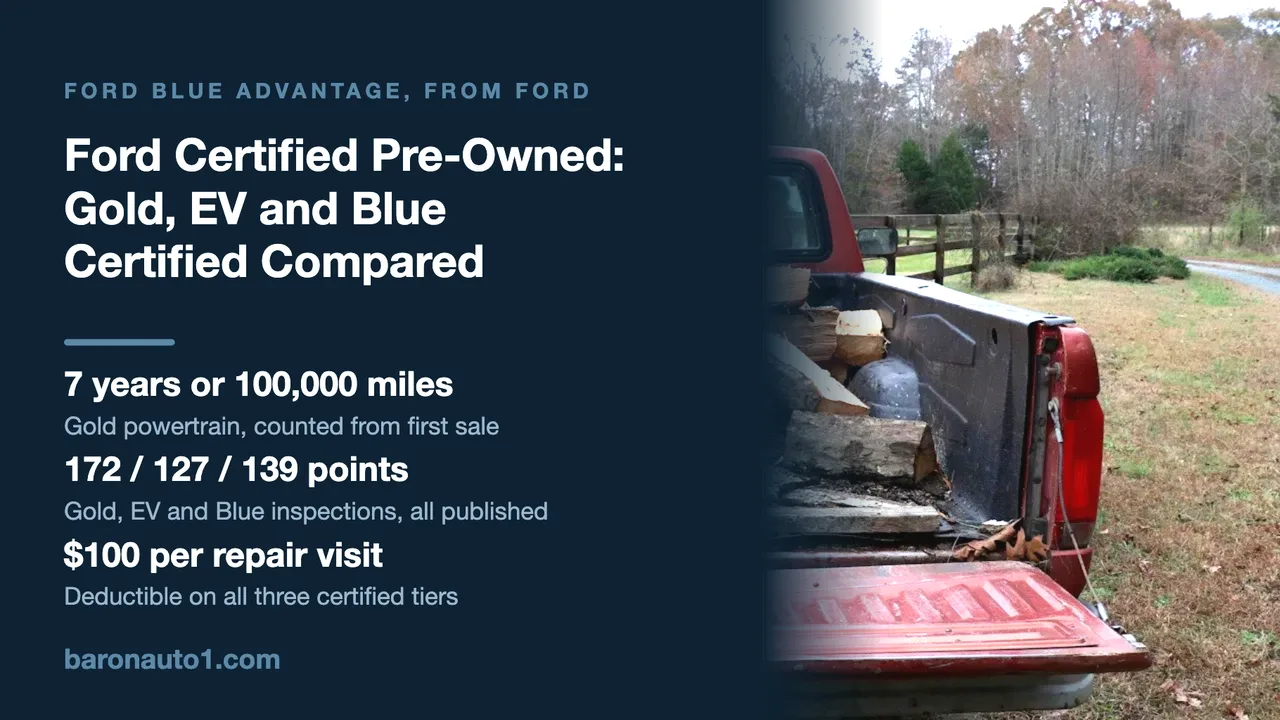
- Gold Certified takes Ford models no more than 6 years old with less than 80,000 miles. It gets 12 months or 12,000 miles of comprehensive cover and a powertrain warranty of 7 years or 100,000 miles, whichever comes first. The powertrain clock runs from the day the car was first sold new, not the day you buy it.
- Blue Certified takes any make up to 10 years old with less than 150,000 miles and gets 90 days (3 months in the signed warranty) or 4,000 miles of comprehensive cover. It has no separate powertrain term.
- Every certified repair carries a $100 deductible per visit, or $0 while the original new-car warranty still applies. Ford publishes the full inspection checklists: 172 points for Gold, 127 for EV and 139 for Blue.
- Read the exclusions before you sign. Ford’s signed Gold and Blue warranty statements list the Mustang, the GT and performance-modified Fords among vehicles “not covered”. And none of the three tiers’ certified warranties clearly covers the high-voltage battery.
- A car certified near the Gold limits may have as little as 1 year or 20,000 miles of powertrain cover left, by our arithmetic. The 14-day or 1,000-mile money-back guarantee is the only safety net that starts fresh on the day you buy.
A Ford certified pre-owned vehicle is a used car, truck or SUV that a Ford franchised dealer has inspected and sold under Ford Blue Advantage, the program Ford runs itself. Every certified car gets a limited warranty from Ford Motor Company, not a third-party contract. The tier decides almost everything else: which cars qualify, how long the warranty runs, and when its clock starts. This page is built from Ford’s three signed Limited Warranty statements (Gold, EV and Blue), the three program brochures, the published inspection checklists and twelve pages on ford.com/used, all read on 30 September 2026.
Gold, EV and Blue Certified: three tiers under one name
Ford Blue Advantage is the umbrella name, which causes the first confusion. “Blue Advantage” is the program; “Blue Certified” is its lowest tier. A listing that says only “Ford Blue Advantage” has told you nothing about the warranty. Ford’s comparison page puts it plainly: “The primary differences between Gold, EV, and Blue Certified used vehicles are age and mileage.” Coverage follows from that.
Gold Certified is what most shoppers mean by a Ford CPO. It is for Ford models only, and it is the only tier with a separate powertrain warranty. EV Certified is for fully electric Fords; Ford’s warranties page pictures a Mustang Mach-E with the EV Certified badge. It has the same eligibility limits as Gold, but carries an 8-year, 100,000-mile BaseCARE EV term in place of the powertrain term. Blue Certified is the wide net. It takes older, higher-mileage cars and, unlike the other two, cars of other makes. Its warranty is short.
| Term | Gold Certified | EV Certified | Blue Certified |
|---|---|---|---|
| Which vehicles | Ford models | Fully electric Ford models | Any make and model |
| Age limit | No more than 6 years old | No more than 6 years old | No more than 10 years old |
| Mileage limit | Less than 80,000 miles | Less than 80,000 miles | Less than 150,000 miles |
| Inspection | 172 points | 127 points | 139 points |
| Comprehensive cover | 12 months or 12,000 miles | 12 months or 12,000 miles | 90 days (web) or 3 months (signed statement), or 4,000 miles |
| Longer term | Powertrain, 7 years or 100,000 miles from the original warranty start date | BaseCARE EV, 8 years or 100,000 miles from the original warranty start date | None |
| Deductible | $100 per repair visit; $0 under any remaining new-car warranty | $100 per repair visit; $0 under any remaining new-car warranty | $100 per repair visit; $0 under any remaining new-car warranty |
| Roadside assistance (roadside page) | 7 years | 8 years | 90 days |
| Rental reimbursement (signed statement) | Up to $40 a day for up to 5 days | Up to $45 a day for up to 5 days | Up to $40 a day for up to 5 days |
| Ford Rewards points | 22,000 | 22,000 | 11,000 |
| Money-back guarantee | 14 days or 1,000 miles | 14 days or 1,000 miles | 14 days or 1,000 miles |
Read the deductible line closely. Each of Ford’s three signed statements says repairs under the certified warranty “have a $100 standard deductible per repair visit”.
Which vehicles qualify, and where Ford’s own documents disagree
Ford states the Gold and EV age limit four different ways. The comparison table says “up to 6 Years”. The certification pages say “no more than 6 years old”. The FAQ says “less than six years old”. The brochures say “current or five previous model-years”. They are not identical for a car near its sixth birthday. The mileage limit is consistent: less than 80,000 miles for Gold and EV, less than 150,000 for Blue.
Gold Certified must “Be a Ford model”. The Gold brochure narrows that to “Ford cars, SUVs, and trucks (up to F-350 Series)”. A heavier truck should not be sold to you as Gold without that being checked.
EV Certified must “Be a fully electric Ford model”, according to Ford’s EV certification page. The EV brochure says something wider: “All battery electric vehicles that are current or five previous model years and have fewer than 80,000 miles can qualify.” The EV warranty statement and its BaseCARE EV parts list are written around Ford components. If a dealer offers a non-Ford EV as EV Certified, ask to see the signed statement before you rely on it.
Blue Certified is for “Any make and model up to 10 years old with less than 150,000 miles”, according to Ford’s landing page. The Blue brochure uses “current or nine previous model-years” and adds “including many non-Ford vehicles”. Blue is the only tier open to other makes. The Blue statement then lists makes it will not cover. They include Porsche, Land Rover, Maserati, Tesla, Suzuki, Saab and Fisker, plus named performance models such as BMW M series, Mercedes-Benz AMG and the Nissan GT-R.
The vehicles the signed warranties leave out
Paragraph U of the Gold statement lists vehicles and uses that are “not covered by this Agreement”. The Ford models on it are the Foose F-150, the GT, the Mustang, Roush performance-modified vehicles other than Stage 1 and Stage 2, Shelby GT500KR, GTS, Supersnake and other Shelby performance-modified vehicles, the Tonka, Saleen-modified vehicles and the Transit Connect Electric. It also excludes all competitive makes, taxis, vehicles used for racing or off-road use, performance-modified vehicles, and police, fire, ambulance and tow vehicles. The Blue statement repeats the same Ford list.
Buying a certified Mustang? Get the exclusion question answered in writing. Ford’s signed Gold and Blue Limited Warranty statements (forms FBA-G-LWS-22 and FBA-B-LWS-22) both list “Mustang” among vehicles not covered. Yet Ford’s own warranties page illustrates Blue Certified with an image captioned “A Ford Mustang® coupe with the Blue Certified badge”. We can’t tell from Ford’s documents which one governs a given sale. Before paying for certification on a Mustang, ask the dealer to show you the signed statement for that VIN and to confirm in writing that the warranty applies.
When each warranty clock starts: the detail that decides what you get
Ford’s certified warranty has two clocks, and they start in different places. This is the part dealer pages most often blur.
The comprehensive clock (Gold and EV) runs “for 12 months or 12,000 miles (whichever comes first) from the expiration of the Ford New-Vehicle Limited Warranty or the date of your Ford Blue Advantage… purchase (whichever comes later)”. If the car’s new-car Bumper-to-Bumper cover of 3 years or 36,000 miles has already ended, the 12 months start the day you buy. If it is still running, the certified cover waits and starts when the new-car warranty ends. The statement adds that certified cover “is not as extensive as that provided under the New-Vehicle Limited Warranty”.
The powertrain clock (Gold) and the BaseCARE EV clock (EV) do not start at purchase at all. Both run “from the original Ford New-Vehicle Limited Warranty start date”, the day the car was first delivered new. A Gold car is sold with whatever is left of 7 years or 100,000 miles, not seven fresh years. By our arithmetic, the Gold powertrain term reaches 2 years and 40,000 miles past Ford’s new-car powertrain warranty of 5 years or 60,000 miles. Those are two end points, and a given car reaches only one of them first.
The Blue clock depends on the make. For a Ford, the Blue warranty begins “at the expiration of the New-Vehicle Limited Warranty or the signature date… (whichever comes later)”. For a non-Ford, it “begins at the signature date (and current miles) of your vehicle purchase”.
Worked through for hypothetical cars bought on 30 September 2026, the clocks look like this. These are illustrations of Ford’s published terms, not real listings.
| Car | Comprehensive cover ends | Longer term ends |
|---|---|---|
| Gold: first sold 1 June 2022, 52,000 miles at purchase (new-car warranty already over) | 30 September 2027 or 64,000 miles | Powertrain: 1 June 2029 or 100,000 miles |
| Gold: first sold 1 March 2025, 14,000 miles at purchase (new-car warranty still running until 1 March 2028 or 36,000 miles) | 12 months or 12,000 miles after the new-car warranty ends: 1 March 2029 if it ends on time, or 48,000 miles if it ends at 36,000 miles | Powertrain: 1 March 2032 or 100,000 miles |
| Gold at the edge: first sold 1 November 2020, 79,000 miles at purchase | 30 September 2027 or 91,000 miles | Powertrain: 1 November 2027 or 100,000 miles, so 21,000 miles left |
| EV: first sold 15 January 2022, 45,000 miles at purchase | 30 September 2027 or 57,000 miles | BaseCARE EV: 15 January 2030 or 100,000 miles |
| Blue, non-Ford: 110,000 miles at purchase | 30 December 2026 by the statement’s 3 months, or 29 December 2026 by the web’s 90 days; or 114,000 miles | None |
The edge row is the one to study. A Gold car bought just under 6 years old with nearly 80,000 miles gets two warranties that end within about a month of each other. After that the car has no Ford cover beyond whatever plan you buy. By our arithmetic, the least a car at the Gold limits can have left is 1 year or 20,000 miles of powertrain cover, and for an EV at the limits, 2 years or 20,000 miles of BaseCARE EV. The same Gold badge sits on a one-year-old F-150 with most of its warranty ahead and a nearly-six-year-old one with almost none.
For a car still inside its new-car warranty, the comprehensive term can run to at most 4 years from the original in-service date, by our arithmetic (3 years of new-car cover plus 12 months). That assumes the new-car warranty ends on time rather than at 36,000 miles.
The inspection: 172, 127 or 139 points, and Ford publishes the list
Ford publishes its inspection checklists, which not every carmaker does. The Gold certification page lists all 172 items by number, and the EV and Blue pages do the same for 127 and 139. Ford says the work is done by “Ford factory-trained dealer technicians”, and that “Any item(s) that does not meet Ford standards is repaired or replaced with a factory-authorized part(s).”
Counting the items section by section shows where each tier puts its effort. Each section’s count below is its last item number minus its first, plus one. The sums match Ford’s printed totals of 172, 127 and 139.
| Section | Gold | EV | Blue |
|---|---|---|---|
| Vehicle history | 5 | 4 | 2 |
| Road test | 17 | 9 | 11 |
| Exterior | 13 | 14 | 7 |
| Interior | 52 | 54 | 40 |
| Diagnostics | 1 | 1 | 1 |
| Underhood | 35 | 13 | 35 |
| Hybrid/electric | 15 | 6 | 15 |
| Underbody | 30 | 23 | 25 |
| Convenience | 4 | 3 | 3 |
| Total | 172 | 127 | 139 |
Most of the 33-point gap between Gold and Blue, by our subtraction, sits in the road test, the exterior and the interior. Blue keeps the full 35-item underhood check and the 15-item hybrid/electric block. The Blue vehicle-history section has only two items, service recalls and a VIN inspection. The Gold list adds “Vehicle History Report Obtained” and “Scheduled Maintenance Performed”. Ford’s FAQ and CARFAX page still say a CARFAX report is run on every Blue Certified vehicle, so ask for it.
The EV list has 13 underhood items against 35. Its frame check reads “Frame Damage/Severe Pack Damage”, its last item is “State of Charge” in place of a full fuel tank, and its underhood section has a single line reading “Battery”. The EV list has no item that names a high-voltage battery capacity test. One small error on Ford’s EV page: its Underhood heading reads “89-123”, copied from the Gold list, while the items under it are numbered 83 to 95.
Gold items worth knowing include item 23, “No Evidence of Flood, Fire, Major, or Hail Damage”, item 132, “Cell Variation Check”, and item 139, “Frame Damage”. The brochures also promise “A full tank of fuel, fresh oil and filter, and new wiper blades” (for EVs, “A fully charged vehicle and new wiper blades”).
The checklist tells you what was looked at, not what was found. It sets no measurement standard in public: no minimum tread depth, no minimum pad thickness. The Gold brochure says “Ask your dealer for a copy of the Vehicle Inspection Checklist”, and the Gold checklist form is printed as an original for the owner, one copy for the dealer and one for the service department. Ask for yours with the technician’s entries on it. Then consider an independent look anyway; our pre-purchase inspection guide covers what a second mechanic should check.
What the certified warranty covers
Comprehensive cover is written as an exclusion-based warranty. The Gold and EV statements say “All failures are covered except for those items excluded herein”, and Blue’s comprehensive section is built the same way. Ford’s web pages say the comprehensive warranty covers “more than 1,000 components”. They list the areas as engine, transmission, front- and rear-wheel drive, steering, brakes, front and rear suspension, electrical, air conditioning and heating, technology components, emissions components, the factory audio system and safety systems. The EV list swaps the engine for “Battery” and drops emissions. The brochures add what they call “a partial list” of covered parts. It runs from AC compressors and heater cores to Active Park Assist, BLIS (electrical only), adaptive cruise control, lane-keeping alert and SYNC (software upgrades excluded).
Gold powertrain cover lists four groups:
- Engine: the block and internal lubricated parts, cylinder heads, manifolds, factory-installed turbochargers and superchargers, the timing chain, gears or belt, flywheel, valve covers, oil pan, oil and water pumps, and the thermostat and housing. The statement adds: “Fuel-injection components are not covered.”
- Transmission: the case and all internal parts, the torque converter, the transfer case and the transmission control module.
- Front- and rear-wheel drive: the drive and axle housings with their internal parts, joints, axle shafts, driveshafts and four-wheel-drive locking hubs.
BaseCARE EV cover on EV Certified cars lists the drive motors (“Traction motor and all related internal parts”), front- and rear-wheel drive, odometer and speedometer, steering, front suspension, brakes (not drums, rotors, linings or pads), air conditioning and selected electrical parts. The battery question is covered in the next section.
The statements set a few limits on every claim. Repairs must be at your selling dealer or any other Ford franchised dealer. A non-Ford Blue car is the exception: there the Blue statement says “we recommend that you return to your selling dealer or other repair facility”. Ford’s liability “for any one (1) repair visit shall not exceed the current retail value of your vehicle immediately prior to the breakdown”. Repairs use “authorized new or remanufactured parts”. And coverage is “in addition to any remaining new-vehicle bumper-to-bumper limited warranty coverage”, so a young car uses up its new-car warranty first, at a $0 deductible.
What certified doesn’t cover, including the EV battery question
The Gold statement’s exclusions run from A to Y. The ones that matter most on a used car:
- Anything that was already wrong. “Repairs made to the vehicle that are required due to a condition that existed prior to the purchase or transfer” are excluded. The inspection is supposed to catch those; the warranty does not back it up if it didn’t.
- Wear items: “batteries of all types and cables”, brake drums, shoes, linings, rotors and pads, “exhaust system (includes catalytic converter)” and software upgrades. The web lists “Emissions components” as a covered area; the statement’s exhaust exclusion still applies to the catalytic converter.
- Body and trim: bumpers, glass, paint, rust, sheet metal, structural underbody framework, mirrors, weather strips, wheels, tires, alignment and balancing, upholstery, and “rattles/squeaks/wind noise/odors/water leaks”.
- Bulbs and HID and LED lamp assemblies.
- Chain reactions: “Repairs needed to a covered part caused by the failure of a non-covered part”.
- Maintenance lapses: repairs caused by missed required maintenance, and scheduled maintenance itself.
- Modifications: lift kits, oversized tires, aftermarket performance parts and non-factory PCM reprogramming.
- Recalls and other cover: repairs covered by a recall, insurance or another in-force warranty, “even if repair coverage has been denied”.
- Branded vehicles, or any car whose new-car warranty the manufacturer has voided. See what a salvage title means.
The high-voltage battery
Ford’s documents disagree here, and the stakes are high on an electric car. The warranties page says BaseCARE EV coverage is “covering the battery, transmission, and more”. The signed EV statement’s BaseCARE EV parts list does not name a battery, and its exclusions include “Batteries of all types and cables”. All three brochures list covered “Unique Hybrid/Electric Vehicle Components (Excluding High-Voltage Battery and Cables)”. On the signed paperwork, then, the certified warranty does not clearly cover the traction battery on any tier.
What does cover it on a young Ford is the original new-car warranty, which belongs to the car rather than to the certification. For hybrids, Ford’s 2025 Model Year warranty guide (a guide that excludes electric vehicles) lists hybrid and electric unique components at 8 years or 100,000 miles, and excludes gradual high-voltage battery capacity loss. Ford’s electric vehicles have their own new-car warranty guide, which we did not read. On a used EV or hybrid, ask the dealer to print the car’s remaining new-car battery coverage by VIN, and don’t accept “BaseCARE covers the battery” without seeing it in writing.
Roadside assistance, rental cars and the other extras
Ford’s roadside page gives complimentary 24/7 Ford Roadside Assistance “for 7 years with Gold Certified vehicles, 8 years with EV Certified vehicles, and 90 days with Blue Certified vehicles”. The brochures tie Gold and EV roadside to “the full duration” of the powertrain or BaseCARE EV term. Those terms count from the original in-service date, so what you get is the balance remaining. The services Ford lists:
- Towing assistance up to $100, for warranty and non-warranty problems, including accidents.
- Travel expense reimbursement up to $1,000 for up to five days of lodging, meals and rental vehicle when the breakdown is more than 100 miles from home.
- Destination expense assistance up to $75.
- Fuel delivery of up to two gallons, lockout assistance up to $50, flat-tire changes and jump starts.
- Service in the 50 United States and Canada.
Rental car reimbursement is where Ford’s numbers disagree. When the car is kept overnight for a covered repair, the Gold and Blue statements pay “up to $40 per day (including tax) for up to five days”. The EV statement says up to $45 per day, and so does the FAQ, for every tier. By our arithmetic that is a ceiling of $200 at $40 a day or $225 at $45 a day. Use the figure on your own signed statement.
The money-back guarantee is the most useful extra because it is the one benefit that starts fresh on the day you buy. Per the guarantee page, you can return the car to the dealer you bought it from within 14 days or 1,000 miles, whichever comes first, counted from the date and mileage on the bill of sale. If the car meets the guidelines, “you will be refunded the price you paid for the vehicle”. The conditions are strict:
- The car must be in the condition sold, apart from normal wear and tear.
- The dealer “cannot accept a return if the vehicle has been in an accident or has had a lien or other encumbrance put on the vehicle”, other than your dealer financing contract.
- You stay responsible for any negative equity from a trade-in rolled into the deal, and the trade-in itself is not returned.
- Only one return is allowed in any six-month period at any Ford dealership.
- The FAQ says the guarantee “is only available at participating Ford Dealers”. Confirm your dealer participates before you sign.
Ford Rewards points: 22,000 for Gold and EV, 11,000 for Blue. You must activate your Ford Rewards account and set a preferred dealer within 60 days of the sale. Trials: a 3-month SiriusXM All Access trial on factory-equipped cars, and 90-day Connected Services trials activated through the Ford app, for products Ford lists as including BlueCruise, the Security Package and Connected Navigation. Ford says these “vary by make and model”.
Financing: Ford’s FAQ says Ford Credit (whose payment, payoff and lease-end terms our Ford Credit review reads) will finance a certified car and that “sometimes special financing is available for Gold and EV Certified vehicles”. Ford posts certified finance rates on its offers page. They change often and are for qualified buyers, so check the current rate and its end date there rather than trusting a figure you saw elsewhere.
Transfers, where to get repairs, and keeping the cover valid
Transfer. The statements say “This Limited Warranty is transferable. Any remaining coverage will remain in effect with the new vehicle owner.” The FAQ adds that a transfer “won’t cost the buyer a penny”.
Where to go. Ford cars must be repaired at the selling dealer or “any other Ford franchised dealership in the United States”. The Blue statement extends that to Ford and Lincoln dealers in Canada and Mexico. Another shop may be used for an emergency repair only if all local Ford or Lincoln dealers within a 25-mile radius are closed. For a non-Ford Blue car, you pay the shop and claim reimbursement through the selling dealer, and “You have one year from the repair order open date or payment receipt date to request your reimbursement.” The Gold statement is “Valid only in the continental United States, Alaska, Hawaii, Canada and Mexico.”
Keep your records. To claim, you must “properly operate and maintain the vehicle” and provide proof of scheduled maintenance when a failure looks maintenance-related. Records must show mileage, date, VIN and the work done. If you do your own servicing, the statement requires a log of each service plus receipts for parts and fluids. Keep them from day one, including for the oil change done during certification.
How to confirm a Ford is really certified
A listing’s “certified” means little unless it names the tier and a Ford dealer sold it. Ford’s FAQ: “Only a Ford Motor Company-franchised Dealer can sell Ford Blue Advantage vehicles.” A car “certified” by an independent lot is certified by that lot, not by Ford.
The document that proves it is the signed Limited Warranty statement for your tier. The Gold form is headed “This Gold Certified Limited Warranty statement is valid for”, followed by fields for the VIN, make and model, purchase date, mileage at time of purchase, owner name and address, and both the dealer’s and owner’s signatures. Check that the VIN on it matches the car, that the tier matches the one you were sold, and that the form number is there (FBA-G-LWS-22 for Gold, FCPO-EVLWS-23 for EV, FBA-B-LWS-22 for Blue). Along with it, ask for:
- The completed inspection checklist for that VIN.
- The CARFAX report. Ford says it checks for flood, fire and frame damage, salvage and branded titles, odometer issues, accident history and title history, and that you can “ask your dealer for a copy at the dealership”.
- Confirmation of open recalls. Ford’s certification pages carry a notice that “Some vehicles offered for sale may be subject to unrepaired manufacturer safety recalls”. You can check the VIN yourself with our Ford recall lookup.
- For a Ford inside its original warranty, the in-service date by VIN. It sets when your powertrain or BaseCARE EV clock ends.
We did not find a Ford tool on the program pages that confirms a car’s certification by VIN. They point instead to the certified inventory search on fordblueadvantage.com, which we did not test as a verification tool. The signed statement is the proof.
Certified, ordinary used, new, or a service plan
Gold versus an ordinary used Ford. What certification adds is concrete: an inspection you can read, a 12-month or 12,000-mile comprehensive warranty, the balance of a 7-year or 100,000-mile powertrain term, roadside assistance and a 14-day exit. Ford prints no price for any certified vehicle, so whether that is worth the premium over a similar non-certified car depends on the gap on the lot. The value is highest on a younger car and lowest at the edge.
Blue versus an ordinary used car. Blue adds a 139-point inspection, the money-back guarantee and a few months of warranty with a $100 deductible. It is a short-term backstop, not long-term protection.
Certified versus new. A new Ford comes with 3 years or 36,000 miles of Bumper-to-Bumper cover and 5 years or 60,000 miles of powertrain cover, per the 2025 warranty guide, all at a $0 deductible. A young Gold car uses the rest of those terms at $0, then certified cover at $100 a visit.
Certified plus a service plan. Ford’s warranties page notes that “Ford Extended Service Plans, which offer additional coverage, are available from any Ford Dealer.” Those are Ford Protect plans, a separate paid product with its own terms. We cover them in detail on Ford extended warranty, and what plans cost in extended car warranty cost. If you’re buying Gold near the edge, or any Blue car, that is where the long-term cover question gets answered. Our guide to whether an extended warranty is worth it works through the decision, and our overview of certified pre-owned programs sets Ford beside how CPO works in general.
Before you sign: a Ford certified pre-owned checklist
- Name the tier. Gold, EV or Blue, written on the buyer’s order. “Blue Advantage” alone is not a tier.
- Get the in-service date. The Gold powertrain and EV BaseCARE clocks run from it, not from your purchase.
- Do the edge arithmetic. Subtract the car’s age and miles from 7 years and 100,000 miles (Gold) or 8 years and 100,000 miles (EV) to see what’s left.
- Check the exclusion list. Mustang, GT, Shelby, Roush, Saleen and other performance-modified Fords are named as not covered in the Gold and Blue statements. On Blue, check the excluded makes too.
- Ask about the battery. On an EV or hybrid, get the remaining new-car battery coverage by VIN in writing.
- Read the signed statement. VIN, tier, form number, purchase mileage, both signatures. Note your deductible ($100) and rental rate ($40 or $45).
- Take the checklist and CARFAX report. Ask for the completed checklist for that VIN and the history report, and look for open recalls.
- Confirm the money-back guarantee. Participating dealer? 14 days or 1,000 miles from the bill of sale. Don’t add accessories or liens that could block a return.
- Keep every service record. The warranty can be refused for maintenance-related failures without proof.
- Get an independent inspection anyway. Pre-existing conditions are excluded, so a problem the dealer’s inspection missed is yours.
Common questions
Is Ford certified pre-owned worth it?
It depends most on the tier and the car’s age. A young Gold Certified Ford gets 12 months or 12,000 miles of comprehensive cover plus a powertrain term that runs to 7 years or 100,000 miles from its original sale, and that can be several years of real cover. A Gold car near 6 years and 80,000 miles may have about a year left, by our arithmetic. Blue Certified adds an inspection and a 90-day or 4,000-mile warranty. Compare the premium on the lot against the cover remaining on that VIN.
What does the Ford CPO warranty cover?
Gold and EV comprehensive cover is exclusion-based: “All failures are covered except for those items excluded herein”, for 12 months or 12,000 miles. Ford says that spans more than 1,000 components. Gold adds powertrain cover for the engine, transmission and drive systems to 7 years or 100,000 miles from the original in-service date. Wear items, body and glass, pre-existing conditions and the exhaust system are excluded, and each repair visit carries a $100 deductible.
What is the difference between Ford Gold Certified and Blue Certified?
Gold is for Ford models up to 6 years old with less than 80,000 miles, uses a 172-point inspection and adds a 7-year, 100,000-mile powertrain warranty. Blue takes any make up to 10 years old with less than 150,000 miles, uses a 139-point inspection and gets 90 days or 4,000 miles of cover, with no powertrain term.
When does the Ford certified powertrain warranty start?
From “the original Ford New-Vehicle Limited Warranty start date”, the day the car was first delivered new, not the day you buy it. The 12-month comprehensive cover starts at purchase or when the new-car warranty ends, whichever is later.
Can I return a Ford certified used car?
Within 14 days or 1,000 miles, whichever comes first, at participating dealers, if the car comes back to the selling dealer in the condition sold, with no accident and no new lien. You get back the price you paid, but not your trade-in or any negative equity rolled in.
For sale near you
Dealer listings, checked liveFinding used Ford cars near you…
Sources and further reading
- FTC: a businessperson’s guide to federal warranty law
- 15 U.S.C. § 2301 (Magnuson-Moss definitions)
- FTC: auto service contracts and warranties
Recall, complaint and safety-rating figures on this page were retrieved from the federal databases above on August 19, 2026. Federal data changes — re-check any VIN before you rely on it.
Published September 30, 2026 · last updated September 30, 2026. Found something out of date or wrong? Tell us and we will correct it.