Genesis Certified Pre-Owned: Warranty Clock, Inspection and Transfer
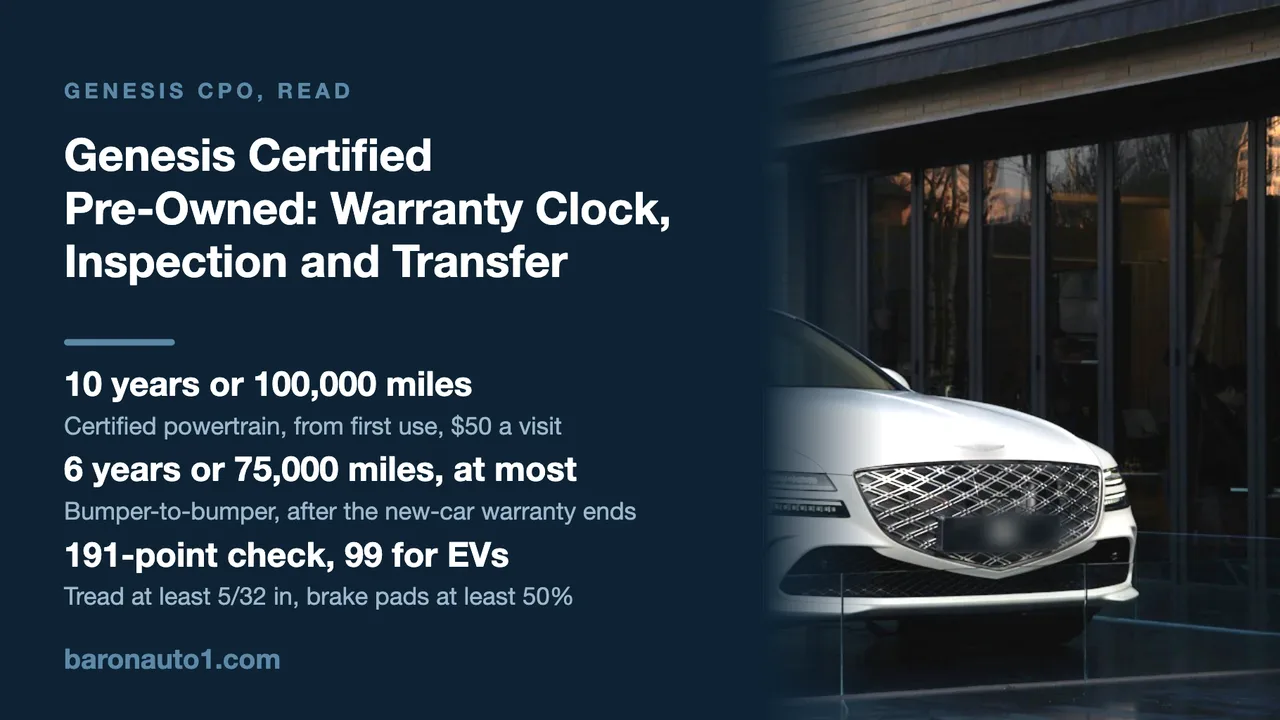
A later owner of an uncertified Genesis keeps engine and transmission cover only to 5 years or 60,000 miles. Certification brings a separate 10-year, 100,000-mile powertrain warranty counted from the car's first day, a 191-point check with printed tread and brake minimums, and a 6-year bumper-to-bumper extension with a mileage catch.
The short version
- Genesis Certified Pre-Owned takes Genesis cars “5 model years or newer” with fewer than 60,000 miles and a clean CARFAX report. Genesis says gas models must pass a 191-point retailer inspection and EVs a 99-point one.
- For a later owner, certification is the only way back to a Genesis warranty on the powertrain to 10 years or 100,000 miles. Every Genesis owner’s handbook we read says the original owner’s powertrain warranty “is not transferable”; an uncertified later owner has powertrain parts covered only to 5 years or 60,000 miles.
- The certified powertrain warranty is a separate contract that counts from the car’s original in-service date and mile 0, not from your purchase, with a $50 deductible per repair visit. A car certified near the limits has at most about 5 years or 40,000 miles of it left, by our arithmetic.
- The bumper-to-bumper part continues the new-car warranty after it ends, “an additional 1 year or 15,000 miles” in the contract’s words, never past 6 years or 75,000 miles from the first day. It has no deductible.
- While the new-car warranty is still running, it pays: the certified contract excludes “Repairs covered by the Genesis New Vehicle Limited Warranty”, and no Genesis handbook we read prints a deductible.
- The certified warranty can pass to a private buyer if Genesis is told about the sale. A trade-in or sale to any dealer ends the certification.
Genesis Certified Pre-Owned is Genesis Motor America’s certified used-car program, sold through participating Genesis retailers and marketed as Genesis Certified. A certified Genesis is 5 model years old or newer, has fewer than 60,000 miles and has passed the retailer’s inspection. It comes with a powertrain warranty to 10 years or 100,000 miles and new-car cover stretched to at most 6 years or 75,000 miles, both counted from the car’s first day in service. This page is built from the certified warranty provisions (form GMACPO0005, dated 06/26), Genesis’s certified page on genesis.com, its 191-item inspection check sheet, its 2021 certified brochure and its owner’s handbooks, all read on 5 October 2026.
One program, backed by Genesis Motor America
Genesis runs one certified program, with no tiers. The contract calls it the “Genesis Certified Pre-Owned (‘CPO’) Vehicle Limited Warranty”, and its warrantor is Genesis Motor America. The certified page says the cars are sold only through participating Genesis retailers. The 2021 brochure says certified cars “are backed by Hyundai Motor America”, but its own small print and the provisions name Genesis Motor America as warrantor, and the certified page says Genesis Motor America offers the warranties. Go by the contract.
The terms have been steady. The inspection check sheet is dated 2018 (revised 12/18), the brochure 10/21, and an earlier edition of the provisions, form GMACPO005 dated 12/23 and still hosted on genesis.com, prints the same coverage, deductible, rental, travel, roadside and transfer terms as the current 06/26 edition. The newer edition mainly adds a section on California’s written-notice rules.
Which Genesis cars qualify
The certified page sets three gates: “5 Model Years or Newer”, “Fewer Than 60,000 Miles” and a clean CARFAX vehicle history report. It adds that certified vehicles “must have less than 60,000 miles to qualify for the limited warranty”, and the 2021 brochure agrees, so a car showing exactly 60,000 miles doesn’t qualify.
Genesis doesn’t say how it counts the five model years, and that matters now. When we read genesis.com it listed new 2027 and 2026 models side by side. If 2027 is the newest of the five, the oldest certifiable model year is 2023; if 2026 is, it is 2022 (our arithmetic). On a 2022 Genesis sold as certified, ask to see the provisions with the car’s VIN on page one before you rely on it.
What “clean” means. The certified page’s footnote defines it as “No reports of total loss, structure damage, airbag deployment, odometer rollback, manufacturer recall, or branded title.” Past damage doesn’t automatically rule a car out: the provisions say vehicles “that have had prior repairs for damage that did not impact the vehicle’s frame may still be eligible for certification”, and that certified status “does not guaranty that the pre-owned vehicle has never been involved in any prior accidents.” Our page on salvage and branded titles explains what the brands mean.
Cars the warranty won’t accept. The provisions also exclude vehicles “manufactured or distributed for sale outside of the 50 United States or Washington, D.C.”, vehicles “not certified by an authorized Genesis Retailer”, and vehicles used for a “Prohibited Commercial Purpose”, which includes daily rentals, delivery work, carrying passengers for hire and company pool use. A car titled to a company but driven by one person, or used by one driver for sales calls or light contracting, is allowed.
Who gets 10 years or 100,000 miles of powertrain cover
Genesis advertises 10 years or 100,000 miles of powertrain cover on new cars, so it is easy to assume any young used Genesis still has it. Genesis’s documents give three answers, each a different warranty.
The original owner
Each handbook we read, for model years 2021, 2022, 2023, 2024 and 2026, says: “For original owners only, this Powertrain Limited Warranty will begin upon expiration of the 5 year/60,000 mile New Vehicle Limited Warranty”, covering the listed engine and transmission parts “up to 10 years from the date of original delivery or the date of first use, or 100,000 miles, whichever occurs first.” The original owner is “the first retail purchaser of the vehicle who took delivery of the vehicle on its date of first use”. Three cases stretch that:
- Lease buyouts. If the lessee bought the car at the end of the lease, the 10-year warranty “remains in effect”.
- Demonstrators and loaners. For a former Genesis manager demonstrator or service loan car, the first retail buyer counts as the original owner.
- Spouses. The 2024 and 2026 handbooks say the warranty “may remain in effect when an original owner transfers the vehicle to a spouse”. The 2021, 2022 and 2023 handbooks have no such clause.
A later owner who buys uncertified
Every one of those handbooks says “The 10-year/100,000 mile Powertrain Limited Warranty is not transferable and applies only to the original owner”, and adds: “For subsequent owners, powertrain components are covered under the New Vehicle Limited Warranty for 5 years/60,000 miles, whichever occurs first.” The 2021 to 2024 summary charts print it as “Original Owner 10 Years/100,000 Miles, Second and subsequent Owner(s) 5 Years/60,000 Miles”.
The New Vehicle Limited Warranty itself does transfer, so a later owner keeps whatever is left of 5 years or 60,000 miles from first use, engine and transmission included, and nothing after it. By our arithmetic, that is up to 5 years or 40,000 miles less powertrain end point than the original owner had; whichever limit a car reaches first decides how much a given buyer loses.
A certified buyer
Certification doesn’t hand you the original owner’s warranty. It gives you a new one: “This Limited Warranty is distinct and separate from any original owner’s manufacturer’s warranty applicable to the CPO Vehicle.” Its powertrain section covers the listed parts “for a total of 10 years or 100,000 miles, whichever occurs first, from the Original In-Service Date and zero (0) miles.”
The certified page says Genesis “offers the remainder of the 10-Year/100,000-Mile Powertrain Limited Warranty”. The end point is the same either way, but the terms are the contract’s, and they add something the original owner’s warranty doesn’t have: “For each repair visit covered under the 10 Year/100,000 Mile Powertrain Limited Warranty, a fifty dollar (US $50.00) deductible shall apply.” It is waived if a part already repaired under that warranty fails again.
| Cover | Original owner | Later owner, bought uncertified | Certified buyer |
|---|---|---|---|
| New Vehicle Limited Warranty | 5 years or 60,000 miles | Whatever is left of 5 years or 60,000 miles | Whatever is left, then “an additional 1 year or 15,000 miles”, never past 6 years or 75,000 miles |
| Engine and transmission parts | 10 years or 100,000 miles | Only inside 5 years or 60,000 miles | 10 years or 100,000 miles under the certified warranty |
| Deductible | None printed in any handbook | None printed in any handbook | $50 per visit under the certified powertrain warranty |
| Passes on when sold | Powertrain warranty doesn’t (spouse exception in the 2024 and 2026 handbooks) | New-car warranty does | To a private buyer, if Genesis is notified |
When the certified clocks start, with worked examples
Both certified warranties count from the “Original In-Service Date”: “the date the CPO Vehicle’s manufacturer’s warranty began as determined by the manufacturer’s records”, or failing that “the original record of sale/original DMV registration date” on the history report used to certify the car. It is written on page one of your provisions, next to the VIN, the “Vehicle Delivery Date” and the “Mileage at time of delivery”.
Because the clocks start on the car’s first day, every year and mile it has already done comes off your cover. A Genesis certified at the limits, about 5 model years old with just under 60,000 miles, has at most about 5 years or 40,000 miles of certified powertrain cover left, and at most about 1 year or 15,000 miles of the bumper-to-bumper extension, whichever comes first in each case (our arithmetic). The table works two made-up cars bought on 5 October 2026. Neither is a real listing.
| Car | Younger car, low miles | Car near the mileage limit |
|---|---|---|
| Model year and first in service | 2023 model, 15 April 2023 | 2023 model, 1 November 2022 |
| Odometer when you buy | 31,000 miles | 57,500 miles |
| New Vehicle Limited Warranty | To 15 April 2028 or 60,000 miles: up to 29,000 more miles | To 1 November 2027 or 60,000 miles: 2,500 more miles at most |
| Powertrain cover if bought uncertified | The same: to 15 April 2028 or 60,000 miles | The same: 2,500 miles at most |
| Certified bumper-to-bumper extension | Starts when the new-car warranty ends; never past 15 April 2029 or 75,000 miles | A year after the car passes 60,000 miles, or at 75,000 miles; never past 1 November 2028 |
| Certified powertrain warranty | To 15 April 2033 or 100,000 miles: up to 69,000 more miles | To 1 November 2032 or 100,000 miles: up to 42,500 more miles |
| Certified roadside assistance | To 15 April 2033 | To 1 November 2032 |
For the second car, certification is almost all of its powertrain cover: 2,500 miles uncertified against up to 42,500 certified. For the younger car, it adds the stretch from 15 April 2028 to 15 April 2033, or from 60,000 to 100,000 miles, whichever comes first.
Read page one before you talk price. Find the Original In-Service Date and the mileage at delivery. Count 10 years from that date and take the odometer reading away from 100,000 miles; whichever runs out first is the certified powertrain cover you are buying. Do the same with 6 years and 75,000 miles for the bumper-to-bumper part, then read the next section.
The 6-year, 75,000-mile warranty, and the two ways to read it
Section IV of the provisions sets out the bumper-to-bumper part in one sentence: “Upon the expiration of Your Genesis New Vehicle Limited Warranty (at the earlier of 5 years from the Original In-Service Date or 60,000 miles), the coverage provided by the Genesis New Vehicle Limited Warranty which would have expired at that time will continue an additional 1 year or 15,000 miles, for a total of up to 6 years or 75,000 miles, whichever occurs first, measured from the Original In-Service Date and zero (0) miles.” It covers the same parts, with the same exclusions, as the new-car warranty, and “There is no deductible associated with the 6 Year/75,000 Mile Limited Warranty.”
Read it by its end points. If the new-car warranty ends at 60,000 miles, the extension runs to 75,000 miles or for one more year, whichever comes first. If it ends at 5 years with fewer miles on the clock, the sentence can be read two ways:
- “An additional 1 year or 15,000 miles”. A car at 40,000 miles on its fifth anniversary would be covered to 6 years or 55,000 miles (our arithmetic).
- “A total of up to 6 years or 75,000 miles”. The same car would be covered to 6 years or 75,000 miles, 20,000 miles more.
The certified page prints only “6-Year/75,000-Mile”. For a car driven fewer than 15,000 miles a year the difference never arises, because the sixth anniversary comes first either way; for a high-mileage driver it can. Ask the retailer to write the end date and end mileage on your paperwork.
Who pays while the new-car warranty runs. The provisions’ general exclusions begin with “Repairs covered by the Genesis New Vehicle Limited Warranty or any other warranty applicable to the CPO Vehicle”. Read that way, on a young certified car a covered engine or transmission failure is a new-car warranty repair, and the certified warranty, with its $50 deductible, takes over its listed parts when that cover ends. None of the 2021 to 2024 handbooks contains the word “deductible”, and the 2026 handbook doesn’t either. If a retailer charges you $50 inside 5 years and 60,000 miles, ask which warranty the repair was billed under.
The 191-point check sheet, section by section
The certified page says “EV models must pass an extensive 99-point inspection, while gas models must pass a 191-point inspection”, and that any component that falls short is “reconditioned or repaired, and any component that cannot be repaired is replaced.” It links no checklist, but the 191-item Vehicle Inspection Checklist is still hosted on genesis.com as form GECPO0601, revised 12/18. It prints no counts per section; ours below match the brochure’s counts for all five sections it counts.
| Section | Items | Count | Brochure | Examples as printed |
|---|---|---|---|---|
| Vehicle history report | 1 | 1 | None | Run and print CARFAX Vehicle History Report |
| Road test | 2 to 31 | 30 | 30 | Cold and warm idle; shift smoothness; steering alignment; ABS |
| Exterior | 32 to 73 | 42 | 42 | Frame: no visible damage / clamp marks; emergency braking warning light; glass chips |
| Interior | 74 to 140 | 67 | 67 | Keys and remotes; free of odor or scents to mask odor; stored personal data deleted |
| Mechanical | 141 to 176 | 36 | 36 | Service recalls performed; trouble codes; oil sludge; battery load test |
| Maintenance | 177 to 183 | 7 | 7 | Fluids replaced if within 3 months or 3,000 miles of service with no record |
| Tires and wheels | 184 to 191 | 8 | None | Tread depth; matching tires; brake pad wear; rotor thickness |
The brochure’s five counts add up to 182, leaving 9 of the 191 items uncounted in its graphic (our arithmetic). The sheet prints pass marks you can check yourself:
- Item 184, tread. “Remaining tread depth (minimum 5/32” across tread width)”, recorded for each wheel.
- Item 189, brake pads. “Brake Pad minimum remaining wear (50% or greater)”, in millimetres for each wheel. Item 190 records rotor thickness the same way.
- Items 185 and 187, tires and wheels. OEM size, speed and load rating, “matching brand and type (all four)”, on matching wheels.
- Item 169, battery. A load test, with volts and CCA written on the sheet.
- Water and recalls. Items 64, 148 and 175 look for water damage. Item 141 is “Perform service recalls / updates/campaigns on vehicle”, and item 146 checks for “evidence of oil gel (sludge)”.
- Item 74, keys. “Two (2) master keys, one (1) valet and two (2) remotes”, where the car came with them.
The sheet was written for a whole model range. By our count, 20 items say “if applicable”, “as applicable” or “if dipstick is present”, and “Rear seat power adjustments (if applicable)” is printed twice, as items 128 and 133. It also sets its own rules: it must be “Completed with all items checked” and signed by a Genesis-trained technician, the service manager and the CPO manager, and “Failure to comply with these requirements shall VOID the vehicle’s certification.” The customer signs for a copy of the sheet, the history report and the provisions, and the yellow copy is marked for the customer. Ask for yours, filled in.
Electric models. We found no Genesis document that prints the 99-point EV list. The 191-item sheet dates from 2018 and includes engine and exhaust items an electric Genesis doesn’t have, so ask which list your car was checked against.
Who does the checking. The provisions say “GMA does not perform this inspection and neither Us nor our affiliates can attest to the accuracy or completeness of the inspection for your vehicle.” It is the selling retailer checking its own stock, so an independent check is still worth booking; our pre-purchase inspection guide covers what to ask for.

What the certified powertrain warranty covers
Section V covers parts “originally manufactured or installed by Genesis Motor Company or Genesis Motor America that are found to be defective in material or workmanship under normal use and maintenance”:
- Engine: “Cylinder block/head and all internal parts, manifolds, timing gears, timing chain, timing cover, gaskets and seals, oil pump, water pump, flywheel, oil pan assembly, rocker cover and engine mounts, and turbocharger.”
- Transmission/transaxle and drivetrain: “Case and all internal parts; axle shafts (front/rear); constant velocity joints; front/rear hub bearings; propeller shafts; seals and gaskets; torque converter and converter housing; transfer case for AWD models; and rear differential.”
“All items not specifically listed as Covered Components above are excluded”. The 2021 brochure says the cover includes “certain hybrid/electric components”, but the current contract names none. On an electric Genesis, the battery and drive motor fall under the factory’s Electric Vehicle Direct Energy Components Warranty, which the 2024 and 2026 handbooks put at 10 years or 100,000 miles from first use, keeping no less than 70% of original capacity on a covered repair. The handbooks’ transfer paragraph names only the 10-year powertrain warranty as not transferable. On a certified EV, get in writing which warranty covers the battery and motor, and until when.
Repairs and your duties. A Genesis retailer “should perform authorized repairs covered under this Warranty without charge to You”, using new or Genesis-authorized remanufactured parts. If a covered part fails when retailers are closed and the car is “inoperable or unsafe to drive”, any shop may repair it, but Genesis must get your paperwork “no later than thirty (30) days after the Mechanical Breakdown”. You must service the car to the owner’s manual schedule, “keep original copies of all repair orders, invoices and receipts”, and after a breakdown “stop the CPO Vehicle immediately”. Failing these “may result in the denial of Your claim.”
Roadside assistance, rental, travel and Connected Services
- Roadside assistance. The certified page offers “10-Year/Unlimited Mileage” roadside assistance “From original in-service date and zero (0) miles.” A new Genesis gets 60 months from the same date, so certification stretches it by 5 years (our arithmetic). The provisions print no length of time but do set a limit: “up to six (6) free Roadside Events during each 12-months period of coverage”, after which you pay up front. Towing to the nearest Genesis retailer, jump starts, flat tire changes, lockouts and up to three gallons of fuel are included, with fuel delivery “limited to two (2) services per 12-month period”. The contract adds “Roadside Assistance is NOT A WARRANTY.”
- Rental car. “Up to $50 per day for a maximum of ten (10) days” during a covered repair: $500 per breakdown at most, by our arithmetic. Nothing is paid “for parts delay, shop scheduling, or for work not covered by the Limited Warranty”, and the certified page says you “must receive prior authorization for rental and/or travel expenses.”
- Travel breakdown. If a covered part fails when you are “in excess of 150 miles from home”, Genesis repays hotel and restaurant costs “commencing the day after the claim is reported”, up to $100 a day and $500 per occurrence, a cap reached on day 5 (our arithmetic). The certified page words the distance as “within 150 miles or more from your residence”; the contract’s wording governs. The new-car roadside program pays up to $200 a day for up to 5 days, $1,000 an incident by our arithmetic.
- Connected Services. “Every Genesis Certified vehicle includes 3 years of complimentary Connected Services”, footnoted “Available on select model years.” No Genesis page we read says which, so ask.
- History report. A complimentary CARFAX report. The 2021 brochure also promised a three-month SiriusXM trial; the current certified page doesn’t mention one.
What a certified buyer doesn’t get. Genesis’s ownership page, as read on 1 October 2026, says Complimentary Scheduled Maintenance “is available to original owners of new 2017 and newer model year Genesis vehicles”, for 3 years or 36,000 miles, and that Genesis Service Valet is “available for original purchaser of the vehicle”. Neither comes with certification. The certified page printed no certified financing rate when we read it; if a retailer quotes one, check its end date.
Selling or buying a certified Genesis privately
Section X(e) is short: “The remainder of this Limited Warranty is solely transferable upon the sale of the CPO Vehicle by you to a private party owner. The GMA Customer Connect Center ... must be notified of any change in ownership or any applicable warranty will be voided. Upon trade-in or sale of the CPO Vehicle to a Genesis Retailer or any entity in the business of selling or leasing motor vehicles, CPO certification and Limited Warranty coverage ends.” If you finance or lease through the brand, our Genesis Finance review reads its payment, payoff and lease-end pages.
- Private sales only. A certified Genesis that was traded in or sold to any dealer is no longer certified, whatever a later listing says.
- Tell Genesis. The clause names no form, fee or deadline, only notice, but missing it can void “any applicable warranty”. Get the notice confirmed in writing.
- The clock doesn’t restart. The buyer gets “the remainder”, so page one’s in-service date still sets both end points.
- Once, or more? The certified page says the warranty “can be transferred from the original owner to the next privately sold owner”. Neither says whether that owner can pass it on again.
Here Genesis and its sister brand differ. Hyundai’s certified contract, as transcribed for our Hyundai certified pre-owned guide, requires a transfer request form and documents by a deadline and limits transfers to cars certified after a set date. Genesis’s provisions ask only for notice. Either way, “This Limited Warranty is non-cancellable.”
What Genesis Certified doesn’t cover
Section VII’s general exclusions run long. The ones most likely to matter:
- Wear and maintenance. Spark plugs, brake pads and linings, clutch linings, filters, wiper blades, bulbs, fuses and “other wear and consumable items”, plus routine maintenance. Tires are left to the tire maker’s warranty.
- Manual gearboxes and add-ons. “Standard transmission clutch assemblies and all component parts”, and engine or transmission damage caused by “an aftermarket-installed turbocharger/ supercharger”.
- Damage and misuse. Accidents, theft, flooding, fire, racing, road hazards, rodents, modifications, the wrong fuel or fluids, non-Genesis parts, and chipped paint or glass.
- Knock-on failures. “Repairs needed to a Covered Component caused by the failure of a non-Covered Component.”
- Odometer, title and location. A car whose actual mileage “cannot be determined” because the odometer was altered, broken or replaced, or which “has been totaled, salvaged, or branded after purchase”, and repairs done outside the 50 states and Washington, D.C.
Extra cover costs extra. The 2021 brochure offers “a Genesis Protection Plan CPO Wrap Vehicle Service Contract with coverage up to 10 years or 120,000 miles”. Genesis Finance says the CPO Wrap “enhances the factory limited warranty and CPO warranty program” with “No deductible”, but prints no term, and no Genesis page we read prints a price. Our Genesis extended warranty guide reads the Protection Plan contract, including how its term counts on a certified car; our guides to extended warranty costs and whether one is worth it show how to judge a quote.
California and other states. For a car bought in California, most disputes go to binding arbitration at either side’s choice, apart from personal injury and Magnuson-Moss Warranty Act claims. Genesis pays the fees except “the initial filing fee of $200 for AAA”, and you can opt out by email within 30 days of purchase. A rule effective 1 July 2025 requires written notice to Genesis at least 30 days before suing for civil penalties. The provisions also carry amendments for 10 states, including New York and Massachusetts, that add short dealer warranties on some used cars.
How to confirm a Genesis is really certified
- Get the provisions with page one filled in. Genesis links a certified inventory search, but we found no Genesis tool that confirms one VIN’s certified status, so the signed page one is your proof. Match its VIN to the car and its Original In-Service Date to the history report.
- Ask for the completed check sheet, with all items checked, three signatures, and the tread, pad, rotor and battery readings. For an EV, ask which list was used.
- Read the CARFAX report yourself for title brands, structural damage, airbag deployment, rental or fleet use and the first registration date.
- Check that recalls were done. Item 141 calls for it; our guide to checking a car for open recalls shows how to confirm none is open.
- Make sure it wasn’t traded in after certification, and get every promise written in: the provisions say “NO ORAL REPRESENTATION OR STATEMENT SHOULD BE RELIED UPON BY YOU”.
- Book an independent inspection, since Genesis says it can’t vouch for the retailer’s.
Certified, ordinary used, or new
Against the same car uncertified. Both keep what is left of the new-car warranty. Certification adds the bumper-to-bumper extension, powertrain cover to 10 years or 100,000 miles from the first day (less $50 per repair visit), roadside assistance to 10 years and the rental and travel benefits. Weigh the retailer’s certified premium against that stretch for the car in front of you.
Against new. A new Genesis’s first owner gets 5 years or 60,000 miles of new-car cover and 10 years or 100,000 miles of powertrain cover from the first day, with no deductible printed, 60 months of roadside assistance and, Genesis says, complimentary scheduled maintenance for 3 years or 36,000 miles. A certified car shares the powertrain end points but has used part of them, carries the $50 deductible and gives up the free maintenance, in return for longer roadside cover and the bumper-to-bumper extension. Our certified pre-owned guide compares programs in general, and our powertrain vs bumper-to-bumper guide shows where the line between the two covers falls.
Before you sign:
- Check age and miles. Fewer than 60,000 miles, and a model year the retailer confirms is within Genesis’s five.
- Read page one. VIN, Original In-Service Date, mileage at delivery, retailer’s signature.
- Work out the real cover. 10 years from the in-service date or 100,000 miles minus the odometer, whichever runs out first; then 6 years or 75,000 miles for the bumper-to-bumper part.
- Get the 6-year end in writing. End date and end mileage, on the paperwork.
- Ask which warranty pays now. If the new-car warranty is still running, it covers repairs first.
- Take your copy of the check sheet. Tread at least 5/32 inch, pads at least 50%, three signatures.
- For an EV, ask for the 99-point list and which warranty covers the battery.
- Keep every service receipt. The contract requires originals.
- Buying privately? Confirm it was never traded in, and that Genesis is notified of the sale.
Common questions
Is Genesis certified pre-owned worth it?
It is worth most on a Genesis nearing 5 years or 60,000 miles, because for any owner after the first, certification is the only way to keep a Genesis warranty on the engine and transmission past that point. A car admitted at the limits has at most about 5 years or 40,000 miles of certified powertrain cover left, by our arithmetic. Compare the certified premium with what that car has left, and allow $50 per powertrain repair visit.
What does the Genesis CPO warranty cover?
The new-car warranty’s coverage continues after it ends, by “an additional 1 year or 15,000 miles”, never past 6 years or 75,000 miles from the in-service date, with no deductible. A separate powertrain warranty covers the listed engine, transmission and drivetrain parts to 10 years or 100,000 miles from that date, at $50 per repair visit.
Does the Genesis 10-year warranty transfer to a second owner?
The original one doesn’t. Genesis’s handbooks say it “is not transferable and applies only to the original owner”, with lease buyouts and, from the 2024 handbook on, spouses as exceptions. A second owner has powertrain parts covered only within 5 years or 60,000 miles, unless they buy the car certified.
Is the Genesis certified warranty transferable?
Yes, to a private buyer, provided Genesis’s customer center is notified, or “any applicable warranty will be voided”. A trade-in or sale to any dealer ends both the certification and the warranty.
How many miles can a Genesis have to be certified?
Fewer than 60,000. Genesis says the car “must have less than 60,000 miles to qualify for the limited warranty”, and it must be 5 model years or newer with a clean CARFAX report.
Is there a deductible on Genesis certified pre-owned repairs?
Only on the certified powertrain warranty: $50 per repair visit, waived if the same part fails again. The 6-year, 75,000-mile part has none, and while the new-car warranty runs it covers repairs first, with no deductible printed in any Genesis handbook we read.
For sale near you
Dealer listings, checked liveFinding used Genesis cars near you…
Sources and further reading
- FTC: a businessperson’s guide to federal warranty law
- 15 U.S.C. § 2301 (Magnuson-Moss definitions)
- FTC: auto service contracts and warranties
Recall, complaint and safety-rating figures on this page were retrieved from the federal databases above on August 19, 2026. Federal data changes — re-check any VIN before you rely on it.
Published October 5, 2026 · last updated October 5, 2026. Found something out of date or wrong? Tell us and we will correct it.