Avis Car Sales Review: Its Return Policy, Warranty and Ex-Rental Cars
Avis Car Sales’ own pages read against Avis Budget Group’s 10-K: a 3-day/150-mile money-back policy, a 12-month/12,000-mile powertrain warranty, 13 to 15 stores, and where the rest of a 684,000-car fleet goes.
The short version
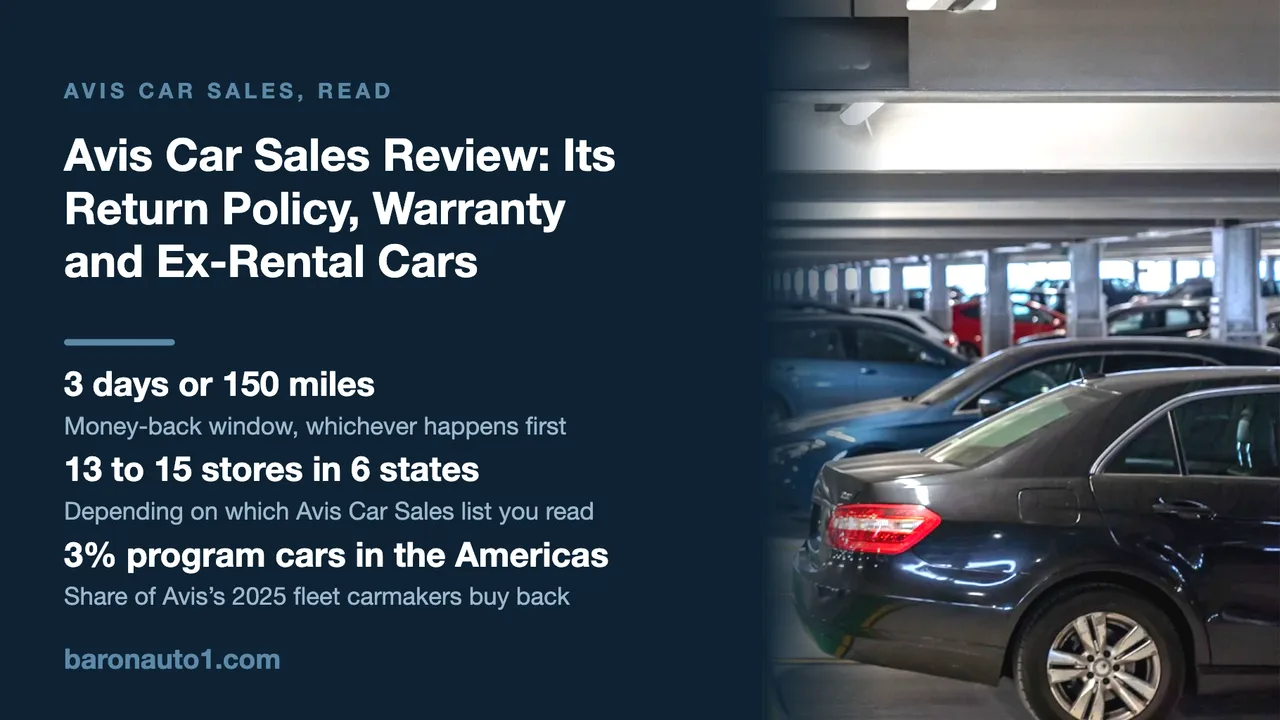
- Avis does sell its own used rental cars, through Avis Car Sales: between 13 and 15 stores in 6 states, depending on which list on its site you read, plus delivery it says reaches all 50 states. On 6 October 2026 it listed 1,769 cars.
- That is a small door onto a large fleet. Avis Budget Group’s 10-K reports an average rental fleet of about 684,000 vehicles in 2025, sold through online auctions, dealer sales and traditional auctions as well as its own lots, with no split by channel.
- In the Americas only 3% of that 2025 fleet were “program” cars that carmakers buy back. Nearly every ex-Avis or Budget rental in the US is sold by Avis itself, to you, a dealer or an auction.
- Avis Car Sales offers a 3-day/150-mile Money Back Return Policy (whichever comes first) and a 12-month/12,000-mile limited powertrain warranty from purchase. Its returns page adds “certain conditions and requirements” that it does not publish.
- Its own pages disagree on the inspection (“170-point”, “120-point” and “multi-point”, with 63 items listed) and on whether every car had one owner.
- On an ex-rental, the factory warranty clock usually started when the car went into rental service, not when you buy it. Kia’s 10-year powertrain cover excludes rental cars altogether.
Yes, you can buy a car from Avis, but probably not where you expect. Avis Budget Group runs a retail arm, Avis Car Sales, with a handful of stores in six states, and its annual report says the rest of the fleet leaves through online auctions, sales to dealers and traditional auctions, so an ex-Avis car may well turn up on another dealer’s lot. On 6 October 2026 we read Avis Budget Group’s Form 10-K for 2025 (filed 19 February 2026), its 10-K for 2024 and its 10-Q for the second quarter of 2026 (filed 29 July 2026) on SEC EDGAR, 18 pages of aviscarsales.com, avis.com’s Avis Car Sales FAQ and the federal rules on rental-car recalls and used-car warranties. We entered no VIN and started no credit application, and this site has no commercial relationship with Avis or any dealer or lender.
Does Avis sell its rental cars to the public?
It does, on a smaller scale than the name suggests. Avis Car Sales calls itself “a division of Avis Budget Group” and, on its delivery page, “a national used car dealership.” The stores behind that are few, and the site lists them five different ways. The menu on every page we read names 13 stores; the address directory at the foot of the returns page names 13, but not the same 13; the contact form’s drop-down offers 15; the financing page lists 14; and the sitemap holds 15 store pages. Across all five lists there are 16 names, and 12 appear in every one: Colton, Glendale and Vista in California; Orlando and Tampa in Florida; Morrow, Georgia; Boston; Knoxville, Tennessee; and Houston, Irving, Katy and San Antonio in Texas. Jacksonville, McKinney, Pompano Beach and West Palm Beach appear on some lists and not others. Call before you travel.
Avis’s rental site tells a different story again. The Avis Car Sales FAQ on avis.com says “Cars are available in Arizona, California, Colorado, Florida, Nevada, New Jersey and Texas,” offers “a no-risk, hassle free test drive for 2 hours FREE or for up to 3 Days at a reduced rate,” and names “AutoNation Direct” as the source of expert advice. Only 3 of those 7 states have a store on aviscarsales.com, and no aviscarsales.com page we read mentions AutoNation or a paid test drive. Treat that FAQ as stale. BBB also keeps Avis Car Sales profiles for Phoenix and Seattle, two cities on no current store list, which fits a store network that has changed.
Two older names now point to the same place: budgetcarsales.com redirects to a “Budget Car Sales” page on aviscarsales.com, and rubycar.com to a page saying “RubyCar has officially transitioned to Avis Car Sales.” The 2024 10-K had named “RubyCar, our online retail sales platform”; the 2025 10-K drops the name, and neither mentions “Avis Car Sales” at all. Beyond the stores, the delivery page says “Customers from all 50 states are eligible for delivery” at rates that “vary by your location”; no price is printed. Our guide to buying a car online covers the checks.
Where ex-Avis cars actually go: the 10-K’s answer
The 10-K splits Avis’s fleet in two. “Program” vehicles are bought under agreements requiring carmakers “to repurchase vehicles at a specified price during a specified time period or guarantee our rate of depreciation.” Everything else is a “risk” vehicle, so called “because we retain the risk associated with such vehicles’ residual values at the time of their disposition.” Program cars go back under those agreements. Risk cars, Avis says, are sold “largely through alternative disposition channels, including direct-to-consumer, online auctions, and direct-to-dealer sales, as well as through more traditional automobile auctions.”
| Item | 2025 (10-K) | 2024, or as noted |
|---|---|---|
| Average rental fleet | About 684,000 vehicles; quarterly averages from about 631,000 to 746,000 | Q2 2026 (10-Q): about 665,000 |
| Program vehicles, share of average fleet | About 16% (84% risk vehicles) | About 10% |
| Program share, Americas segment | 3% | Less than 1% |
| Program share, International segment | 52% | 46% |
| Program vehicles, share of cars disposed of | About 24% (76% other cars, our arithmetic) | About 30% (70% other cars, our arithmetic) |
| Cash from vehicle disposals | $10,406 million | $7,394 million ($8,403 million in 2023) |
| Channels for risk vehicles | Traditional auctions, online auctions, direct-to-dealer sales and “directly to consumers through either retail lots or online.” No split by channel and no count of cars. | |
For a US buyer the Americas line matters most. With 3% of the Americas fleet on program terms in 2025, almost every former Avis or Budget rental in the US is a car Avis sells itself, through the four channels the filing names. It does not give the mix. The cash line shows the scale: $10,406 million from disposals in 2025, about 41% more than in 2024, and $6,153 million in the first six months of 2026 against $4,986 million a year earlier, about 23% more (our arithmetic). Those are dollars from every country and every channel, not cars.
Set the retail listing beside the fleet and the proportion is plain. The 1,769 cars on aviscarsales.com on 6 October 2026 equal about 0.27% of the 665,000-vehicle average fleet in the second quarter (our arithmetic). That compares one day’s stock with an average fleet, so it is an order of magnitude, not a share of sales; but most people who end up driving an ex-Avis car buy it from someone else. Avis’s reason for selling direct, per the 10-K: alternative channels can “increase speed to sale and vehicle sales prices.”
The filings disagree with themselves about the trend. The 2025 10-K’s business section says “Recently, program vehicles have comprised an increasing proportion of our fleet”; its risk factors say the share “is reduced as has been the trend over the last several years.” The numbers back the first reading: 10% to 16% of the average fleet, up 6 points (our arithmetic). In the Americas program cars remain a sliver, and what carmakers do with the ones Avis returns is not in any document we read.
How old, how far driven, and why Budget and Payless matter
The 10-K says Avis’s fleet “consists primarily of vehicles from the current and immediately preceding model year,” and that the cost of its risk vehicles turns on “the market for one- to two-year old used vehicles.” In the fourth quarter of 2024 it moved “to accelerate certain fleet rotations in order to decrease the age of our fleet,” and a year later it “shortened the useful life” of “certain United States EV rental car vehicles.”
The listings bear that out. Of the 1,769 cars listed on 6 October 2026, 1,752 sat under the site’s “Under 30,000 miles” filter, about 99% (our arithmetic); 1,695 were gasoline cars; 1,663 were on a lot and 106 “In Transit.” The hybrid and EV page listed 49.
Three lines in the 10-K explain what else a former Avis car may have been. “We maintain a single fleet of vehicles for Avis and Budget in countries where we operate both brands,” so Budget and Avis rentals are one pool. “A substantial majority of Zipcar’s fleet is dedicated to use by Zipcar,” so a minority is not. And Payless lets Avis “cascade” cars “that exceed certain Avis and Budget age or mileage thresholds”: an older ex-Avis car may have rented under a second name before it was sold.
The In-Transit program sells cars that are “currently active in the AVIS rental fleet”; “their mileage might increase slightly before they arrive,” and “we may require a customer deposit.” If you reserve one, ask the deposit, whether it is refundable and the mileage ceiling at delivery.
The 3-day/150-mile Money Back Return Policy
Avis Car Sales’ money-back page is short: “We offer a 3-day/150-mile Money Back Return Policy, which grants you greater peace of mind on the roads. This policy grants protection for three days or 150 miles, whichever happens first. In that time, if you decide you don’t want to keep your vehicle, let us know, and you can return your vehicle, and we’ll return your money.”
Read it by its end points: three days or 150 miles, whichever comes first. At more than 50 miles a day on average, the mileage limit arrives before the third day (our arithmetic). The page does not say whether the count starts at signing or at delivery, so ask, and photograph the odometer when you take the keys.
The page says nothing about a fee, conditions or what “your money” includes. The returns and warranty page gives “a designated window” but no length, says “Eligibility for our return program depends on meeting certain conditions and requirements,” adds that “certain exclusions and limitations may apply,” and says the team “at our Parsippany location” will help with a return. Parsippany, New Jersey, the town the site’s Terms give for Avis Car Sales, LLC, appears on no store list. The site’s Terms of Use add that “Avis reserves the right to change product pricing and specifications, as well as the terms of our guarantees and warranties without notice.”
“We’ll return your money” has conditions that are not published. Before you sign, ask for the return policy in writing and check five things: the exact end date and odometer limit, whether taxes, registration, the documentation fee and delivery are refunded, what condition or use voids a return, how a financed purchase is unwound, and which store accepts the car. Then book an independent inspection inside the 3 days.
For comparison, Enterprise Car Sales’ buyback, read the same day for our Enterprise Car Sales review, runs 7 days or 1,000 miles and keeps a $200 restocking fee; Avis’s window is shorter on both counts and mentions no fee either way. The useful question is whether the window is long enough to reach a mechanic you choose. Avis’s FAQ allows one before you buy: “we allow customers to have a third-party mechanic inspect a vehicle before the purchase is completed.” See our guide to a used-car pre-purchase inspection.
The 12-month/12,000-mile warranty, and the factory clock that started in the fleet
Avis Car Sales’ warranties page says “Every vehicle we offer includes a 12-month / 12,000-mile limited powertrain warranty from the time of purchase. Plus, any remaining factory warranties are passed along to you.” The same page lists benefits that come with it:
| Benefit | What Avis prints | Limit |
|---|---|---|
| Limited powertrain warranty | 12 months or 12,000 miles “from the time of purchase” | Contract not posted; covered parts and any deductible unknown |
| Rental car coverage | Up to $35 a day, “for a maximum of ten (10) days” | $350 per covered breakdown or warranty repair (our arithmetic) |
| Towing | Up to $75 “per mechanical breakdown” | Per mechanical breakdown |
| Travel breakdown | $100 a day for food and lodging if you break down more than 100 miles from home | “per occurrence” and “per covered mechanical breakdown” |
| Roadside assistance | 24-hour, “for one year from the date of purchase” | Up to $50 for services such as a flat tire, fuel, lockouts and jump-starts |
| Optional plans | “Premium Assured Protection Plans” | No terms or prices published |
The written warranty is not on the site; the FAQ says only that “Specific coverage details vary.” The FTC’s Used Car Rule, 16 CFR 455.2, makes the window Buyers Guide name “Which of the specific systems are covered,” with no “power train” shorthand, and 16 CFR 702.3 lets you see the text “upon request prior to sale.” Ask for it.
The bigger question on an ex-rental is the factory warranty, because its clock did not start when you bought the car. Carmakers count from first use, and rental use counts:
- Kia’s 2026 Warranty and Consumer Information Manual (this site read it on 30 September 2026) defines the “Date of First Service” as the first date the car “is delivered to the first retail purchaser, is leased or is placed into service as a company vehicle use (e.g., as a demonstrator, rental or fleet vehicle), whichever is earliest.” It adds that the 10-year/100,000-mile powertrain warranty “excludes all coverage for any Kia Vehicle that has been placed into any form of commercial service, including but not limited to taxi, route delivery, livery service, or rental.”
- Mazda’s 2023 Warranty Information booklet uses the same definition, naming “rental or fleet vehicle.”
- Chevrolet’s 2025 warranty booklet says coverage “begins on the date the vehicle is first delivered or put in use”; Nissan’s 2026 booklet, “delivered to the first retail buyer or put into use, whichever is earlier.”
Kia, Mazda and Chevrolet are all among the 10 brands the 10-K says Avis “primarily purchased from” in 2025. Take an ex-rental Kia with 30,000 miles. Kia’s basic cover runs 60 months or 60,000 miles from the Date of First Service, so at most 30,000 miles are left, and 48 months if the car spent 12 months in rental service, 36 if it spent 24 (our arithmetic). Avis’s 12,000-mile powertrain warranty would end at 42,000 miles, inside that remaining factory cover. On a young car Avis’s warranty mostly overlaps the factory’s; it adds most where factory cover is nearly gone. See our Kia extended warranty page.
“Certified” needs the same care. The FAQ says Avis Car Sales “sells only certified pre-owned vehicles,” while the online-buying page says “Certified pre-owned vehicles are also available,” which reads as a subset. Either way it is Avis’s label, not a carmaker’s program, and some carmakers shut rentals out: Volkswagen’s CPO warranty manual excludes “rental cars,” and Mercedes-Benz lists “Commercial Rental” vehicles as not eligible. See what certified pre-owned means.

170-point, 120-point or multi-point: the inspection, read three ways
Avis Car Sales describes its inspection three ways. The FAQ says, twice, that every car passed “a 170-point inspection.” The In-Transit page says a reserved car “undergoes a comprehensive 120-point inspection.” The home and warranty pages and another FAQ answer say “multi-point,” and the certification page, the only one that publishes a list, has 63 items under 5 headings by our count. Avis prints no count for that list itself.
| Heading | Items | Examples, in Avis’s words |
|---|---|---|
| Test Drive / Steering | 11 | “Car starts as normal, drives and shifts as built”; “Collision Avoidance Systems functional” |
| Brakes | 4 | “Check brake pads, must have > 25% remaining”; master cylinder and brake booster “no leaks” |
| Mechanical | 19 | “Check for trouble codes”; “If sludge, not eligible for retail lot”; matching tires on cars “under 60k miles” |
| Fluids & Filters | 6 | “change oil if within 2,500 miles of PM”; filters “replaced, if dirty” |
| Interior | 23 | Air conditioning, seat belts, power windows and locks, headlights; “Stains/Cuts/Burns removed/resolved” |
It is a pass-or-fix list in which almost every item is “operates” or “no visible leaks,” with three numbers: brake pads above 25%, an oil change if the car is within 2,500 miles of its next service, and stricter tire matching below 60,000 miles. It names no frame or structural check and no tread depth as a number, and the “list below” promised after the brake-pad line does not follow. Ask for the completed checklist for your car; an outside mechanic is still the stronger protection.
The certification page also promises that “Each car has been in Avis’ rental fleet since day one” and “Received all factory-recommended routine scheduled maintenance,” and the FAQ that “all of our vehicles are accident-free.” The next two sections show how to check.
Recalls on a former Avis car: what Avis says and what the law requires
Avis Car Sales is direct here: “We won’t sell a vehicle with an open safety campaign,” says the certification page, and the RubyCar page says “No car on our lot has safety-related recalls.” The 10-K describes the process: recalls “often require us to retrieve vehicles from customers and/or hold vehicles from rental or sale until we can arrange for the repairs described in the recalls to be completed,” and Avis has “implemented policies and procedures to promptly address manufacturer recalls.”
Federal law requires much of this for rental fleets. The Raechel and Jacqueline Houck Safe Rental Car Act of 2015 (Pub. L. 114–94, enacted 4 December 2015) added 49 U.S.C. 30120(i). Where a carmaker has notified a rental company about “a covered rental vehicle in the company’s possession at the time of notification,” the company may sell it only once the defect is remedied before delivery. A rental company must comply “not later than 24 hours after the earliest receipt of the notice to owner,” or 48 hours for a notice covering “more than 5,000 motor vehicles in its fleet.” If the fix is not yet available but an interim step removes the risk, the company “may rent (but may not sell or lease)” the car. A covered rental vehicle has a gross vehicle weight rating of 10,000 pounds or less, is rented for an initial term under 4 months and belongs to a fleet of 35 or more. The rules took effect 180 days after enactment, on 1 June 2016 by our arithmetic.
The statute has edges. It binds the rental company while it holds the car; the chapter’s matching rule for dealers covers new vehicles, so it does not follow a used car to a dealer who bought it at auction, and nothing reaches a recall announced after you buy. That is our reading, not legal advice. The repair itself is free: 30120(a) says the carmaker “shall remedy the defect or noncompliance without charge when the vehicle or equipment is presented for remedy.” Whoever sells it, run the VIN through NHTSA’s lookup the day you sign; our guide on how to check a car for open recalls walks through it.
How to tell whether a used car was an Avis or Budget rental
Most ex-Avis cars are sold by someone other than Avis, so the more useful skill is spotting one on any lot. Four checks do most of the work, and then ask the seller for the auction or purchase record:
| Check | What it can show | Its limit |
|---|---|---|
| Vehicle history report | Carfax says its data sources include “fleet management and rental agencies”; GoodCar advertises “personal/rental/lease usage” records | Shows only what was reported; read the usage and owner lines, not just the accident line |
| Factory warranty start date | Ask a franchised dealer or the carmaker when the warranty began; a start date well before the first retail sale means the car was in service first | Shows that the car was in some kind of service, not which company ran it |
| Title and registration history | A company owner in the chain; Avis’s 10-K says its subsidiary AESOP Leasing LP must use loan proceeds “to acquire or finance the acquisition of vehicles used in our rental car operations” | A company name on a title is consistent with fleet use, but does not prove rental use by itself |
| Odometer against model year | Avis’s fleet is “primarily” current and prior model year; 99% of its 6 October listings were under its 30,000-mile filter (our arithmetic) | Many private cars match too; this only raises the question |
Our guide to checking a used car’s history covers the title and odometer checks in detail, and Carfax versus AutoCheck explains why two reports on the same car can differ.
One federal source is weaker than people assume on ex-rentals. NMVTIS, the federal title database, gets total-loss reports from insurers, and 28 CFR 25.52 defines an insurance carrier as “an individual or entity engaged in the business of underwriting automobile insurance.” On that text, a rental company repairing or selling its own damaged car is not acting as an insurer, so the insurer reporting duty is not triggered; a state title brand or a salvage-yard filing would still appear. That is our reading; our NMVTIS report guide sets out the same gap. So “all of our vehicles are accident-free” is a claim to test with a mechanic, not one a clean federal record proves.
Ownership needs the same scepticism. The FAQ says vehicles are “owned solely by Avis” and the Budget page that its cars “only had one owner,” but the online-buying page says “Many of our cars are one-owner vehicles.” “Many” is not “all,” so read the owner count on the report for the car in front of you, and remember that one owner on paper can mean hundreds of drivers. The In-Transit page promises “complete rental and maintenance records”; ask for them.
On smoking, a 2009 release on avis.com’s Car Sales FAQ says Avis and Budget rentals in the US and Canada became smoke-free on 1 October 2009, with a cleaning fee for cars returned with “tobacco odor or residue.” A policy is not a guarantee, so smell the car.
Prices, fees and financing at Avis Car Sales
Prices are fixed. The FAQ says “All Avis Car Sales vehicles have been specially priced with a no-haggle price tag,” and each listing sets a “Kelley Blue Book® Typical Listing Price” beside the “Avis Price.” All 21 listings on the first page of the inventory on 6 October 2026 showed the Avis Price below the KBB figure, by $31 to $4,251. The Budget page goes further, “Our vehicles are priced below Kelley Blue Book (KBB) value,” yet one of the first three listings on the hybrid and EV page showed an Avis Price with no KBB comparison. The asterisk on “Avis Price*” opens a disclaimer on a path the site’s robots.txt closes to automated readers, so we did not read it; read it before you rely on the number.
The sticker is not the total. The Buy Your Way page says “The price you see is the price you pay,” the Budget page promises no “extra fees being tacked on,” and the EV page says “no hidden fees.” The FAQ is more candid: “There may be additional fees or charges involved in the purchase of your vehicle. These fees can include documentation fees, sales tax, registration fees and any applicable state or local fees.” No amount is printed. Ask for the out-the-door price in writing; our page on dealer fees explains the documentation fee. Payment can be by certified check or electronic transfer: “We do not accept cash payments.” Only one trade-in is accepted per purchase.
Avis Car Sales does not lend. Its financing page says approval comes from one of the lenders it works with, “with approved credit,” mentions “many local Credit Unions,” and the FAQ says common terms “range from 36 months (3 years) to 72 months (6 years).” The pre-qualification tool promises “no impact to your credit score”; a full lender application is a different step. Listings show estimated payments that change, so we do not quote them. Arrive with a car loan preapproval to compare, and see our credit union used-car loan rates.
Complaints and the public record
The record is thin. Avis Car Sales does not lend, and the CFPB’s complaint database had no Avis, Avis Budget or Avis Car Sales company in its index when we checked on 6 October 2026, so a financing complaint would name the lender. We found no Trustpilot profile for aviscarsales.com. BBB keeps separate profiles store by store (we read five: Alcoa, Tennessee; McKinney, Texas; Morrow, Georgia; Seattle; and Phoenix), and none says the business is BBB-accredited. Because each file covers one store and they differ in scope, we have not added up their complaints or ratings. A web search on 6 October 2026 found no FTC or state attorney-general action naming Avis Car Sales; that is a search result, not a clearance.
Complaints are unverified consumer reports whose number grows with a company’s size; Avis’s own documents, read against each other, are stronger evidence. We read Enterprise’s and Hertz’s sales arms the same way in our Enterprise Car Sales review and Hertz Car Sales review, and listing sites in our CarGurus review.
Before you buy a former Avis or Budget car
- Confirm the store exists and has the car. Avis’s own lists disagree, and avis.com’s FAQ names states with no store.
- Get the return policy in writing: 3 days or 150 miles, whichever first, plus the conditions, what is refunded and how a loan is unwound. Note the odometer at delivery.
- Book an independent inspection inside the 3 days, or before you sign; Avis’s FAQ allows a third-party mechanic.
- Ask for the factory warranty start date from a franchised dealer, and work out what is left from that date, not from today.
- Ask for the text of the 12-month/12,000-mile powertrain warranty and read the Buyers Guide on the window.
- Run the VIN through NHTSA’s recall lookup yourself, whether you buy from Avis or from a dealer that bought the car at auction.
- Read the history report’s usage and owner lines, and ask for Avis’s rental and maintenance records and the completed inspection checklist.
- Get the out-the-door total in writing: price, documentation fee, tax, registration, state or local fees and any delivery charge.
- Bring a loan preapproval and decline unpriced protection plans.
Common questions
Does Avis sell its rental cars?
Yes. Avis Budget Group sells most of its own cars rather than returning them to carmakers: 76% of its 2025 disposals were not program cars (our arithmetic), and in the Americas only 3% of the average fleet were cars carmakers buy back. Its 10-K names four channels for the rest: its own retail lots and website (Avis Car Sales), online auctions, sales direct to dealers and traditional auctions. It does not say how many go each way.
Is it a good idea to buy a used car from Avis?
It can be, if the specific car checks out. You get a fixed price, a 3-day/150-mile money-back window, a 12-month/12,000-mile powertrain warranty, a year of roadside assistance and a published checklist. Against that: unpublished return conditions, a factory warranty that started in the fleet, conflicting inspection and ownership claims, and few stores.
Can you return a car to Avis Car Sales?
Avis says yes, within 3 days or 150 miles, whichever happens first: “you can return your vehicle, and we’ll return your money.” Its returns page adds that eligibility “depends on meeting certain conditions and requirements,” which are not published, so get them in writing before you sign.
Can you negotiate at Avis Car Sales?
Not on the price; Avis says every car has “a no-haggle price tag.” Fees, your trade-in, the loan and any protection plan are still open. See our guide to negotiating a used-car price covers those.
Does Avis Car Sales give a warranty?
Every car comes with a 12-month/12,000-mile limited powertrain warranty from purchase, and Avis says any remaining factory warranty passes to you. That factory cover usually started when the car entered rental service, and Kia excludes rentals from its 10-year powertrain cover.
How do I know if a used car was a rental?
Read the history report’s usage and owner entries, ask a franchised dealer for the factory warranty start date, look for a company owner in the title history, and compare the odometer with the model year. Then ask the seller where the car came from.
For sale near you
Dealer listings, checked liveFinding used cars near you…
Sources and further reading
- SEC EDGAR filings: Avis Budget Group, Inc.
- NHTSA recall lookup
- NMVTIS (US Department of Justice)
- 16 CFR § 455.2 (Consumer sales — window form)
- 16 CFR Part 702 (Pre-Sale Availability of Written Warranty Terms)
Recall, complaint and safety-rating figures on this page were retrieved from the federal databases above on August 19, 2026. Federal data changes — re-check any VIN before you rely on it.
Published October 6, 2026 · last updated October 6, 2026. Found something out of date or wrong? Tell us and we will correct it.