Sherpa Auto Transport Review: What FMCSA’s Records Show
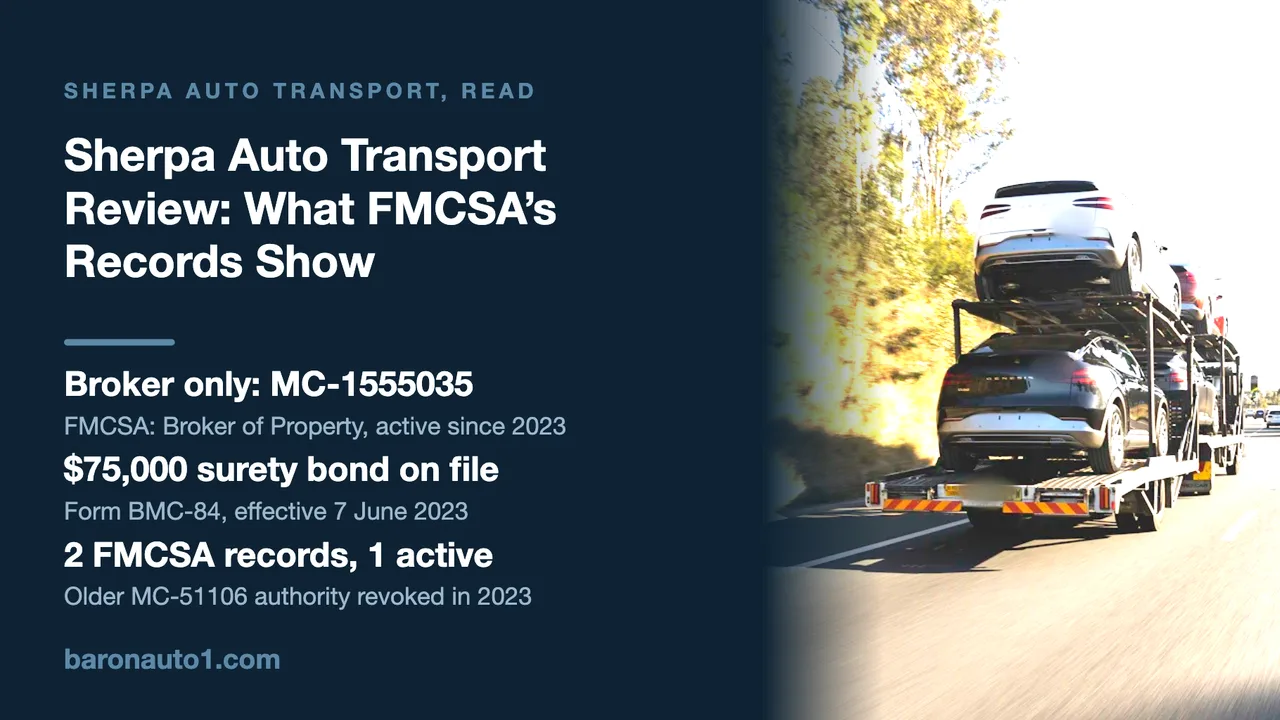
Sherpa Auto Transport holds active federal broker authority (MC-1555035) and the $75,000 bond every broker files, but FMCSA also lists an older registration under the same name, revoked in 2023. Its site bars our crawler, so this review reads the federal record and says what to check in its terms.
The short version
- Sherpa Auto Transport is a licensed broker, not a trucking company. FMCSA lists Sherpa Auto Transport LLC (USDOT 4085166, MC-1555035, Tucker, Georgia) as authorized only as a “Broker of Property (Except Household Goods),” active since 23 June 2023, with 0 power units. An independent carrier hauls your car.
- It has the $75,000 surety bond every broker must file (Form BMC-84, effective 7 June 2023). The bond pays if a broker fails to carry out its contracts. It is not insurance on your car, and the broker has no cargo insurance on file.
- FMCSA holds a second, older registration under the same legal name: USDOT 3053476, MC-51106, in Charlotte, North Carolina, granted in 2017 and revoked on 27 September 2023. If your paperwork shows those numbers, ask why before you pay.
- We did not read Sherpa’s own terms. Its robots.txt bars ClaudeBot, Anthropic’s crawler, from the whole site, and we follow that rule, so this review says nothing about Sherpa’s price promise, deposits, cancellation fees, claims process or arbitration clause. We list what to look for instead.
- Under federal law, damage in transit is the carrier’s liability, and a carrier may not give you less than 9 months to file a claim or less than 2 years to sue.
- BBB’s profile page blocked us, and searches found no regulator action or lawsuit naming the company. That is a search result, not a clearance.
Sherpa Auto Transport is a federally registered car-shipping broker with active authority and the bond the law requires, and FMCSA’s records hold something every customer should check: two registrations under the same name, one active and one revoked. On 9 October 2026 we read FMCSA’s SAFER company snapshots (data as of 7 October 2026), the Motus account page and FMCSA’s licensing, insurance and census datasets for both registrations, along with the federal rules for brokers and carriers. We did not read Sherpa’s website: its robots.txt closes every page to ClaudeBot, and this site follows the rules a website sets for that crawler, so the contract that governs a Sherpa booking is not quoted here. We requested no quote, entered no details, and have no commercial relationship with Sherpa or any other shipper.
Why this review does not quote Sherpa’s own pages
A review of a car shipper should start with the shipper’s own contract, and for most companies we do exactly that. Sherpa is the exception. The file at sherpaautotransport.com/robots.txt, which we read first on 9 October 2026, carries a block headed “Block AI Training Crawlers.” It names five crawlers, ClaudeBot among them, and gives each the rule “Disallow: /”, which covers every page on the site. The server dates that version of the file to 24 July 2026. The same file says some search crawlers are “intentionally NOT blocked,” so the rule is aimed at the crawlers the file lists under AI training, not at search engines.
Our research follows the rules a site writes for ClaudeBot, and a rule covering “/” leaves nothing to read. We did not get around it through a proxy, a reader service or a browser, and we did not use other websites that repeat Sherpa’s wording, because that would be the same text at one remove. The only file we requested from Sherpa’s server is robots.txt itself, the one file a crawler is expected to read, and our data script re-reads it on each run in case the rule changes.
That leaves out what a shipper most wants to know from the company itself:
- how Sherpa describes itself, and which USDOT and MC numbers it prints;
- any price promise, how long it lasts and what voids it;
- when your card is charged, how much up front and how the driver is paid;
- what cancelling costs, and when;
- how damage claims work and whether Sherpa adds a deadline of its own;
- what its pickup and delivery wording promises, and what “guaranteed” covers;
- arbitration, class-action waivers and any cap on its liability.
What remains is the part of the story a company cannot write for itself: its federal registration, its bond, its history with the regulator, and the rules that apply to every broker whatever its terms say. Those are below, followed by a guide to reading Sherpa’s terms yourself.
Is Sherpa a broker or a carrier?
A broker. FMCSA’s SAFER snapshot for USDOT 4085166 gives the entity type as BROKER and the operating authority as “AUTHORIZED FOR: Broker of Property (Except Household Goods).” FMCSA’s licensing dataset shows no common or contract carrier authority on the same registration, the snapshot lists 0 power units and 0 non-CMV units, and the cargo box ticked is “Motor Vehicles.” SAFER’s own legend explains that the authority line lists “the specific operating authorities the carrier (or broker) is allowed to operate.” For Sherpa that is brokering, and nothing else. Our AmeriFreight review reads another broker’s record and terms.
Federal rules define the job. Under 49 CFR 371.2, a broker “arranges, or offers to arrange, the transportation of property by an authorized motor carrier,” and brokerage includes “the arranging of transportation or the physical movement of a motor vehicle.” 49 CFR 371.7 adds that a broker “shall not, directly or indirectly, represent its operations to be that of a carrier,” that “any advertising shall show the broker status of the operation,” and that it may not offer brokerage “in any name other than that in which its registration is issued.” We could not check how Sherpa’s pages describe the service, so check that your order or contract calls Sherpa a broker and names the registration you are dealing with.
In practice, booking with a broker means dealing with two companies:
- Sherpa takes the order and finds a trucking company to move the car.
- The carrier collects, hauls and delivers it. The driver who arrives works for the carrier, under the carrier’s own USDOT number, insurance and bill of lading.
- Federal law makes the carrier liable for damage in transit (see damage below). Anything Sherpa adds to that is a matter for its terms.
Our guide to car shipping companies explains how brokers, carriers and lead sites differ across the industry.
Two FMCSA registrations carry the Sherpa name
Search FMCSA’s datasets for the legal name and two registrations come back, both “SHERPA AUTO TRANSPORT LLC.” Only one is active. Which one you are dealing with matters, because a broker’s authority and bond belong to a registration, not to a brand name.
| Field | USDOT 4085166, MC-1555035 | USDOT 3053476, MC-51106 |
|---|---|---|
| Location in the record | Tucker, Georgia | Charlotte, North Carolina (trade name “Sherpa Auto Transport”) |
| USDOT number added | 2 June 2023 | 28 September 2017 |
| Broker authority | Granted 23 June 2023; active | Granted 30 October 2017; revoked 27 September 2023 |
| Security on file | BMC-84 surety bond, $75,000, effective 7 June 2023 | Surety bonds from 19 October 2017; the last cancelled 19 October 2023 |
| SAFER today | USDOT status ACTIVE, data as of 7 October 2026 | “Record Inactive” |
| Last registration update (MCS-150) | 20 February 2026 | 26 September 2023 |
| Contact e-mail in FMCSA’s files | On the sherpaautotransport.com domain | On a different domain |
The dates overlap. The Georgia registration got its broker authority on 23 June 2023; the North Carolina one was revoked on 27 September 2023, 96 days later by our arithmetic. FMCSA’s records do not explain the change or say whether the two registrations belong to the same business, and we do not guess. What they do show is which registration is tied to the website’s domain: FMCSA’s census file and the Motus account page list a business e-mail on the sherpaautotransport.com domain for USDOT 4085166, and the older record’s e-mail is on another domain. We made that match from FMCSA’s files, not from Sherpa’s site.
Check the numbers on your contract. A broker may not offer its services “in any name other than that in which its registration is issued” (49 CFR 371.7), and the bond on file belongs to the registration. If an order, invoice, payment page or review gives you USDOT 3053476 or MC-51106, it points to a registration FMCSA shows as inactive and revoked. Ask Sherpa to confirm in writing that your order is with MC-1555035 before you pay anything.
The same check protects against a wider problem. Our guide to looking a shipper up covers FMCSA’s warning about copied and hijacked registration numbers: the name and location on the federal record should match the company on your contract and the one taking your money.
Is Sherpa Auto Transport legit? The active registration
Yes, in the sense the federal record can answer. On 9 October 2026 the registration for USDOT 4085166 showed every sign of a broker in good standing:
- Active status. SAFER gives the USDOT status as ACTIVE and the out-of-service date as “None”; the Motus account page reads “Active” for both the USDOT number and MC1555035.
- Authority since 2023. FMCSA’s authority history records the property-broker authority as granted on 23 June 2023, with no later action. Neither the Motus revocation table nor the older revocation dataset has a row for it.
- Bond on file. A BMC-84 surety bond from Great American Insurance Company, effective 7 June 2023 and posted the next day, for $75,000 in FMCSA’s Motus insurance table. It took effect 16 days before the authority was granted, by our arithmetic, which fits the rule that FMCSA will not register a broker until its security is in place.
- Current registration data. The MCS-150, the form a registrant uses to update its details, was last filed on 20 February 2026.
The snapshot also shows 0 inspections and 0 crashes in the 24 months to 7 October 2026, in the United States and Canada, and no safety rating. For a broker that owns no trucks that is expected rather than reassuring: the inspections and crashes that bear on your car are the carrier’s. FMCSA’s own note on crash counts applies when you read the carrier’s snapshot: they record involvement in reportable crashes “without any determination as to responsibility.”
You can check all of this yourself on FMCSA’s SAFER company snapshot for USDOT 4085166. A registration in good standing is a floor, not a verdict on service: how your shipment goes depends heavily on the carrier Sherpa assigns.
The older registration: MC-51106, revoked in 2023
The North Carolina registration has a longer history, and FMCSA’s datasets record it in some detail. In date order:
- 28 September 2017: USDOT 3053476 added to FMCSA’s census, with “Sherpa Auto Transport” as the trade name.
- 19 October 2017: the first broker surety bond takes effect, from Philadelphia Indemnity Insurance Company, 11 days before the authority is granted.
- 30 October 2017: property-broker authority granted under MC-51106.
- 23 September 2019: FMCSA serves an “INVOLUNTARY REVOCATION” action; it is marked “DISCONTINUED REVOCATION” on 25 September 2019, 2 days later. The dataset gives no reason.
- 2018 to 2023: the bond passes from Philadelphia Indemnity to Hudson Insurance Company (from 19 October 2018) and then to SureTec Insurance Company (from 19 October 2021). The 5 bond rows show no gap between one bond and the next.
- 22 September 2023: an order recorded as a “VOLUNTARY REVOCATION” is served.
- 26 September 2023: the last MCS-150 update on the registration.
- 27 September 2023: the broker authority is recorded as “REVOKED,” 5 days after the order.
- 19 October 2023: the last bond, SureTec’s, is cancelled on Form BMC-36, 22 days after the revocation.
Read plainly, the registration held broker authority for nearly six years (5.9 by our arithmetic), kept a bond in force throughout, survived one revocation action that was discontinued within days, and closed with a revocation the record labels voluntary. FMCSA’s SAFER system now answers a search for USDOT 3053476 with “Record Inactive.” None of that history attaches to the Georgia registration in FMCSA’s files, and none of it tells you how either handled customers.
What the $75,000 bond covers, and what it does not
Every property broker must carry the same security. 49 CFR 387.307 (effective 16 January 2026) says “a broker must have a surety bond or trust fund of $75,000 in effect,” filed on Form BMC-84 for a bond or BMC-85 for a trust fund, and that “the broker registration shall remain in effect only as long as a surety bond or trust fund remains in effect.” Sherpa’s active registration uses the bond route, with Great American Insurance Company as surety. FMCSA’s Motus insurance table prints the amount as $75,000; the older licensing table leaves that field at 0 for the same bond, so we rely on the Motus figure.
The rule says what the money is for: it “shall ensure the financial responsibility of the broker by providing for payments to shippers or motor carriers if the broker fails to carry out its contracts, agreements, or arrangements for the supplying of transportation by authorized motor carriers.” In plain terms, it protects you against a broker that takes your order and does not deliver on the arrangement. It is not cargo insurance, and $75,000 is the total security for all of a broker’s customers and carriers, not a sum per car.
Two more parts of the rule matter to a shipper:
- A bond cannot vanish overnight. It “may be cancelled only upon 30 days’ written notice to FMCSA, on prescribed Form BMC-36.” The older Sherpa registration’s bond cancellations are recorded on that form.
- If a broker fails financially, FMCSA posts the cancellation in the FMCSA Register on its website, and the surety “must accept claims” against the bond for 60 calendar days after that notice.
The broker has no cargo insurance on file, and FMCSA does not require it: FMCSA’s data for MC-1555035 reads “N” for cargo insurance required and on file, and 0 for liability insurance. Cover for your car in transit comes from the carrier. Our guide’s section on the broker bond and the 2023 rule explains how the security changed and how claims against it are paid.
If your car is damaged: who answers under federal law
The Carmack Amendment, 49 U.S.C. 14706, puts loss and damage in interstate transport on the carrier. A carrier “shall issue a receipt or bill of lading for property it receives,” and the receiving carrier, the delivering carrier and any carrier in between are liable “for the actual loss or injury to the property.” If no bill of lading is issued, that “does not affect the liability of a carrier.” A carrier also “may not provide by rule, contract, or otherwise, a period of less than 9 months for filing a claim” or less than 2 years for bringing a lawsuit.
Sherpa, as a broker, is not the carrier in that statute. Whether its terms take on any responsibility for damage, offer cover of their own, or require you to tell Sherpa about damage within a set time is something only its terms can answer, and we did not read them. Montway’s terms, for comparison, name the carrier as the liable party and require notice to Montway within 48 hours of delivery; look for any clause like that in Sherpa’s before you book, because, as Montway’s shows, a broker’s deadline can be far shorter than the carrier’s.
What protects you most is paperwork done at the curb:
- Before pickup, get the carrier’s name and USDOT number from Sherpa, look the carrier up on SAFER, and ask for its certificate of insurance.
- At pickup, walk round the car with the driver, mark every existing scratch on the bill of lading, photograph every side, the roof, the wheels and the odometer, and keep your copy.
- At delivery, repeat the walk before you sign, and write any new damage on the delivery receipt. If it is dark or raining, say so on the document.
- Then file a written claim with the carrier that states an amount, with the bill of lading, photos and a repair estimate. A note on the delivery receipt alone is not a claim.
Our car shipping guide covers the bill of lading and condition report and the claim deadlines step by step, including the carrier’s duty to answer.
Six things to find in Sherpa’s terms before you book
Sherpa’s Terms of Service will be the contract for your shipment, and they are a click away for you even though they are closed to us. Read them before you pay anything, and save a copy (a PDF or screenshots) on the day you book so you can show later what you agreed to. These are the six points that decide how a shipment goes when something goes wrong. The right-hand column shows how one other broker’s printed terms answered each point when we read them for our Montway review; it is there to show what such clauses look like, not to rank either company.
| Point | What to look for in Sherpa’s terms | How Montway’s terms answered it |
|---|---|---|
| Price promise | How long a quoted or booked price holds, which cars qualify, and what voids it | Booked price locked for 30 calendar days, for operable, factory-standard cars; void if you work or post with another broker |
| Deposit and when you are charged | When the card is first charged, how much, and how the driver must be paid | Charged at dispatch to a carrier (Terms); a partial payment of $199 or less on cash-price orders (help center) |
| Cancelling and refunds | The point after which cancelling costs money, and how much | Free until a carrier accepts the order; after that, a minimum of $249 |
| Damage claims | Who you claim against, and any notice deadline the broker adds | The carrier is liable, not Montway; tell Montway within 48 hours of delivery |
| Pickup and delivery dates | Whether any date is guaranteed, and what the guarantee covers | Montway “cannot and does not guarantee delivery dates or times” |
| Disputes | Arbitration, class-action waiver, any opt-out, and any cap on the broker’s liability | Binding individual arbitration, small-claims court excepted; liability capped at the fees paid to Montway |
A few things to watch for as you read Sherpa’s version:
- Quote versus booked price. Montway’s terms say plainly that a quote is not a confirmed booking; check whether Sherpa’s draw the same line. If Sherpa promises a fixed or locked price, find the conditions: how many days it lasts, whether it covers only running, unmodified cars, and what happens if the pickup date moves.
- The moment the money changes hands. Money taken at booking, at dispatch or at delivery carries different risks if the job falls through. Find out how much goes to Sherpa and how much is paid to the driver, and in what form the driver must be paid.
- The cancellation trigger. Montway’s terms tie the fee to the moment a carrier accepts the job. Find the trigger in Sherpa’s terms, know when it happens, and how Sherpa tells you it has happened.
- “Guaranteed” wording. A guaranteed pickup date is not a guaranteed delivery date. Check which one any paid upgrade covers, and what you get back if it is missed.
- Precedence. If the terms say they override the carrier’s bill of lading, or that the carrier’s own terms also apply, you may be bound by both documents. Ask for the carrier’s terms too.
- Where disputes go. An arbitration clause decides where and how you can pursue a claim against the broker; it does not change the carrier’s duties under 49 U.S.C. 14706.
Your right to see the broker’s record of your shipment
One federal rule gives every customer of a broker a tool worth knowing about. Under 49 CFR 371.3, a broker “shall keep a record of each transaction” showing, among other things:
- the name, address and registration number of the carrier that took the shipment;
- the bill of lading or freight bill number;
- “the amount of compensation received by the broker for the brokerage service performed and the name of the payer”;
- “the amount of any freight charges collected by the broker and the date of payment to the carrier.”
Brokers must keep these records “for a period of three years,” and “each party to a brokered transaction has the right to review the record of the transaction.” You are a party. If your car arrives damaged and you need the carrier’s details, or if you want to know how much of what you paid went to the trucker and how much the broker kept, ask Sherpa in writing to let you review the record for your order under 49 CFR 371.3, and keep a copy of your request.
Sherpa Auto Transport reviews: what we could and could not check
People searching for Sherpa Auto Transport reviews mostly want to know whether other customers’ cars arrived on time and undamaged. We could verify less than we would like, and we would rather say so than repeat ratings we have not seen.
BBB. The Better Business Bureau’s robots.txt lets Anthropic’s crawlers read business profiles, but when we opened Sherpa’s profile on 9 October 2026 the site showed its “You have been blocked” security page. We did not try to get around it, so this page carries no BBB grade, accreditation date or complaint count. Read the profile yourself, and look at recent complaints and the company’s answers rather than the letter grade.
Trustpilot and Reddit. Left out of this review as a matter of policy.
Ratings on Sherpa’s own site. Not read, for the robots.txt reason above. Any testimonials a company chooses to show are a selection, not a sample.
Regulators and courts. Web searches on 9 October 2026 for the company’s name with attorney general, lawsuit, consent order, settlement and court case found no regulator action or lawsuit naming Sherpa Auto Transport LLC. That is a search result, not a clearance, and we read no complaint or docket. FMCSA’s own tables are firmer ground: no revocation or suspension on the active registration, and the older registration’s history as set out above.
The carrier. No rating of a broker tells you how the carrier it assigns to your car will perform. That carrier’s SAFER snapshot, with its inspections, out-of-service rate, crashes and insurance on file, is the record closest to your shipment.
Before you book with Sherpa
- Look up the right registration. Check USDOT 4085166 or MC-1555035 on FMCSA’s SAFER system and confirm that the name on your order is Sherpa Auto Transport LLC with those numbers. If anything you are sent shows USDOT 3053476 or MC-51106, ask why before paying.
- Read the Terms of Service yourself and save a copy. Find the six points above: price promise, deposit and charge timing, cancellation, damage claims, delivery wording and disputes.
- Get the payment terms in writing. How much up front, when the card is charged, how much the driver collects and in what form.
- Ask which carrier is assigned, then look that carrier up on SAFER: its authority to carry property, insurance on file, inspections and crashes.
- Ask for the carrier’s certificate of insurance before pickup, and ask whether Sherpa adds any cover or claim deadline of its own.
- Describe the car exactly. Running or not, modified, lifted or lowered, oversized wheels. Montway’s terms, for one, let the carrier charge more or refuse a car that is modified, oversized or not running; check what Sherpa’s say.
- Inspect and photograph at both ends. Every existing mark on the bill of lading at pickup, every new one on the delivery receipt before you sign, and the odometer reading.
- Know your deadlines. At least 9 months to file a written claim with the carrier and at least 2 years to sue after a written denial, plus any notice period Sherpa’s terms set.
- Use the broker record if there is a dispute. Ask in writing to review the record of your shipment under 49 CFR 371.3.
If you are shipping a car you have just bought, the shipment is a separate contract from the sale. Our guides to buying a car out of state and taking delivery of a car bought online cover the tax, title and handover steps, the pre-purchase inspection guide covers checking the car before it is loaded, and auction buyers should add Copart fees to the shipping bill. For the dealer side of the purchase, the FTC’s used-car buying guide applies.
Common questions
Is Sherpa Auto Transport legit?
It is a registered broker in good standing on the federal record. FMCSA lists Sherpa Auto Transport LLC under USDOT 4085166 and MC-1555035 with active broker authority since 23 June 2023, a $75,000 surety bond on file and no revocation or suspension. Registration does not guarantee a good shipment: the carrier Sherpa assigns does the physical work, so look that carrier up too.
Is Sherpa Auto Transport a broker or a carrier?
A broker. FMCSA authorizes the registration only as a “Broker of Property (Except Household Goods),” with no carrier authority and 0 power units. An independent trucking company with its own USDOT number collects, hauls and delivers the car.
What is Sherpa Auto Transport’s MC number?
The active one is MC-1555035, under USDOT 4085166, in Tucker, Georgia. An older registration under the same legal name, MC-51106 and USDOT 3053476 in Charlotte, North Carolina, was revoked on 27 September 2023 and shows as inactive on SAFER.
Why are there two USDOT numbers under the Sherpa Auto Transport name?
FMCSA’s records show the older North Carolina registration from 2017 and the Georgia registration from 2023, with the new authority granted 96 days before the old one was revoked. The records do not explain the change or say whether the two belong to the same business. Only the newer record’s contact e-mail is on the sherpaautotransport.com domain.
Who pays if my car is damaged shipping with Sherpa?
Under 49 U.S.C. 14706 the carrier that hauled the car is liable for actual loss or damage, and it may not give you less than 9 months to file a claim. Whether Sherpa’s own terms add cover or a notice deadline is something we could not check; read them before booking, note any damage on the bill of lading at delivery, and file a written claim with the carrier.
Does Sherpa Auto Transport have a price lock?
We cannot say what Sherpa promises on price, because its website bars the crawler our research follows and we did not read its terms. If Sherpa quotes you a locked or guaranteed price, find the written conditions before you pay: how long it holds, which cars qualify, what voids it, and when your card is charged.
Sources and further reading
Recall, complaint and safety-rating figures on this page were retrieved from the federal databases above on August 19, 2026. Federal data changes — re-check any VIN before you rely on it.
Published October 9, 2026 · last updated October 9, 2026. Found something out of date or wrong? Tell us and we will correct it.