Buying a Car Out of State: What Comes Home With It, and What Does Not
Every guide gives you the same four-item checklist. None of them tells you that your state’s used-car lemon law almost certainly requires the sale to have happened in it.

The short version
- The car crosses the state line. The law it was sold under does not. That single sentence explains almost every unpleasant surprise in an out-of-state purchase.
- Federal protections are keyed to the vehicle, so they travel with it: the odometer disclosure under 49 CFR Part 580, title brands reported to NMVTIS, open safety recalls held by NHTSA, and the Buyers Guide the dealer had to display under 16 CFR Part 455.
- State protections are keyed to the sale, so they stay behind. New York’s Used Car Lemon Law, to take one published example, requires that you bought the car from a New York dealer. Moving to New York afterwards does not qualify you.
- The Used Car Rule itself admits this. It tells dealers that if their state limits or prohibits “as is” sales, that state law overrides the federal rule — so the window form is a readout of which regime you are standing in.
- Sales or use tax is generally due where you will register and use the car, not where you bought it. A “no sales tax” state is usually not a saving; it is a deferral until you get home.
- Emissions and safety inspection are your home state’s tests, not the seller’s. A car that passed where it was sold can fail where it will live, and you will own it by then.
Every guide to buying a car out of state gives you the same four-item checklist: sales tax, emissions, temporary tags, inspection. All four are real. None of them is the reason people get hurt. The reason people get hurt is structural, it is written into federal regulation in plain language, and almost nobody puts it in front of buyers before they wire the deposit.
Here it is. Buying a car is two separate things happening at once — you acquire a vehicle, and you enter into a sale. The vehicle is yours to take home. The sale happened somewhere, and it stays there. Every protection you have divides cleanly along that seam, and knowing which side each one falls on tells you exactly what you are giving up by driving eight hours to save money.
What crosses the line, and what stays behind
The division is not a matter of opinion or of how sympathetic your local regulator is. It follows from what each rule attaches itself to.
Federal vehicle law attaches to the vehicle. It is keyed to the VIN, recorded in national systems, and enforced by federal agencies whose jurisdiction does not stop at a border. Those records are on the car when it arrives in your driveway, and they are on it when you sell it on.
State consumer law attaches to the transaction. It is written by a legislature with authority over sellers doing business inside its own borders, administered by a regulator who licenses those sellers, and enforced through a court sitting in that state. None of that follows a car down the interstate.
Read that diagram once and the rest of this article is detail. The four rows on the right are yours no matter where you bought. The four rows on the left belonged to somebody who bought at home.
The four things that come with the car
The odometer disclosure. Federal regulation at 49 CFR Part 580 requires the transferor of a vehicle to disclose the mileage in writing on the title at the point of transfer, and to certify it as actual, as exceeding mechanical limits, or as not actual. That disclosure becomes part of the title record. It does not matter which state issued the title — the requirement is federal, the record is permanent, and a later inconsistency is visible to anyone who pulls the mileage history. Federal law also gives a private right of action to a buyer defrauded by a false disclosure.
Title brands. When a state brands a title salvage, flood, rebuilt or lemon, it reports that brand to the National Motor Vehicle Title Information System, which exists precisely so that a brand applied in one state is visible to titling agencies in every other. The whole point of a federal clearinghouse is to defeat the practice of moving a car to a jurisdiction with looser vocabulary and re-titling it clean. Brands are not perfect and they are not instantaneous, but they are the one part of a used car’s reputation that was deliberately designed to cross state lines.
Open safety recalls. A recall is issued by the manufacturer under NHTSA supervision against a range of VINs. It is not a state programme, it has no residency requirement, and any franchised dealer of that make must perform the remedy without charge regardless of where the car was bought or where you live. This is one of the very few things that genuinely does not care about the border.
The Buyers Guide. A dealer selling a used vehicle must display the Buyers Guide required by 16 CFR Part 455, and once it is filled in it is a written representation about that car. The Rule requires the completed form to be given to the buyer at consummation, and its terms override contrary provisions in the sales contract. Take it with you. It is federal paperwork, it describes the car, and it is admissible a long way from the lot where you collected it.
These four are the reason a long-distance purchase is a defensible idea at all. The whole federal record layer is available to you before you travel, keyed to a number the seller will give you over the phone. Running the VIN and reading a vehicle history report from your own kitchen table is the closest thing there is to inspecting a car in another state without being in it, and it is the step that decides whether the trip is worth making.
The four things that stay behind
Used-car lemon law coverage. Not every state has one, the ones that exist differ sharply, and — the part that matters here — they are written around sales made in-state. More on this below, because it is the single most expensive misunderstanding in the subject.
Whether the car could be sold “as is” at all. Some states permit it. Some restrict it. Some prohibit it outright for certain vehicles. Which regime applied to your purchase was decided by the seller’s state at the moment you signed, and it does not update when you register the car at home.
Implied warranties. The Used Car Rule defines an implied warranty as one arising under state law. Whose state law is not a question with a comfortable answer when the buyer and seller are in different ones, and it is settled by the terms of the deal and the law governing it rather than by where the car ends up parked.
The dealer’s licence and bond. Most states license motor vehicle dealers and require a surety bond that an aggrieved buyer can claim against. That machinery belongs to the state that issued the licence. Your own state’s dealer board has no authority over a business it did not license, and complaining to it produces sympathy rather than leverage.
The clause in the middle of the eligibility list
New York publishes its Used Car Lemon Law eligibility conditions as a plain list, and it is worth reading in full because the decisive line is the third one and nothing draws attention to it.
The car is not covered if you bought or received it after it already had 18,000 miles on it. It must be less than two years old. It must have cost at least $1,500. It must have been driven less than 100,000 miles when you bought it. It must be used mostly for personal purposes. And: you must have bought or leased the car from a New York dealer.
That last condition is doing more work than any of the mileage figures. It means a New York resident who drives to a neighbouring state, buys a two-year-old car with low mileage from a licensed dealer there, and brings it home has bought a car that satisfies every condition on the list except the one about where the dealer is — and is therefore not covered. The car qualifies. The sale does not.
New York is not unusual in this. It is simply unusually clear about it, which is why it is the example here. The structural point generalises: a state lemon law is an obligation imposed on sellers subject to that state’s jurisdiction, and a seller in another state is not subject to it. Before you cross a line to save money, find your own state’s used-car lemon law, read its eligibility conditions, and look specifically for the words describing where the sale must have taken place. If they are there, you are trading that protection for the discount.
Two clarifications, because this is easy to overstate. First, a new-car manufacturer warranty is a different animal entirely — it is issued by the manufacturer, honoured across its franchised network, and unaffected by which state you bought in. Second, the seller’s state may have its own lemon law that covers you as the buyer in that transaction. That is a real remedy. It is also one you would have to pursue in a court or agency several hundred miles from home, which is a materially different proposition from filing at your county courthouse.
The window form tells you which regime you are in
The most useful thing about the Buyers Guide is not the boxes most buyers look at. It is the fact that the federal rule instructs dealers to change the form depending on the state they are standing in.
The Used Car Rule tells dealers, in terms, that if their state law limits or prohibits “as is” sales of vehicles, that state law overrides the federal rule and the rule does not give them the right to sell “as is”. In those states the heading “As Is — No Dealer Warranty” must be deleted from the form and a different heading and paragraph substituted in its place.
That is a remarkable admission for a federal regulation to make on its own face, and it converts the window sticker into a diagnostic. If the guide in the window offers an “as is” option, you are in a state that permits it. If that heading has been replaced with implied-warranty language, you are in a state that does not. You can read the legal climate of the sale off a form printed for a completely different purpose, before you have spoken to anyone.
The Rule goes further still. It provides a mechanism for the Commission to exempt a state from the federal rule entirely where that state imposes a requirement affording protection as great as, or greater than, the federal one. The existence of that mechanism is the clearest possible statement that used-car protection was designed as a patchwork with a federal floor, not as a uniform national standard.
So: photograph the Buyers Guide, both sides, before you agree anything. It records which regime governed your purchase, and it is the document you will want if the car turns out to be something other than advertised. Our guide to reading a branded title covers what the disclosure boxes on it interact with.
Where the tax is actually due
The most common reason people shop across a state line is price, and the most common miscalculation is tax. The Illinois Department of Revenue states the general principle about as plainly as any agency does: when purchasing a vehicle from another state, sales or use tax is generally due where the vehicle will be registered and used, not necessarily where it was purchased.
That is the destination principle, and it is why the “drive to a state with no sales tax” plan usually fails. You do not escape tax by buying somewhere that does not charge it. You defer it until the moment you present the title at your own registry, at which point your state assesses its own use tax on the purchase. The saving evaporates and the fuel is still spent.
The word “generally” in that sentence is load-bearing, and this article is not going to pretend otherwise. States operate reciprocity agreements, credits for tax lawfully paid elsewhere, and different treatment for dealer sales versus private sales. Some out-of-state dealers are registered to collect your state’s tax and will do it at the desk; others will not, and you will pay at your own counter. A handful of arrangements do genuinely reduce the total. None of them is knowable from a blog post, including this one.
What is knowable is the question to ask, and there are only three. Will the selling dealer collect my home state’s tax, or will I pay it at registration? Does my state credit tax I pay in the seller’s state? What is the taxable base — is it the sale price, and does a trade-in reduce it? Put those to your own state’s revenue department, not to the salesperson, and get the answer before you agree a number. If you want the fuller treatment of how the tax interacts with everything else in the deal, our guide to the out-the-door price sets out how to make a seller quote a single total.
Fees do not travel either, and neither does your familiarity with them
Dealer fees are regulated at state level, and the ceilings, the disclosure requirements and the naming conventions all vary. A charge that is capped by statute in your state may be uncapped in the seller’s. A charge that must be disclosed in the advertised price at home may lawfully appear only at the desk there.
The practical consequence is that your instinct for what is normal is calibrated to the wrong state. A figure that would make you walk out at home may be routine three hundred miles away, and vice versa. The defence is not to memorise another state’s fee rules; it is to stop negotiating on the sale price at all and negotiate on the total you will pay to drive away, which is a number that does not care what anything is called. Our guide to dealer fees explains which charges are genuinely unavoidable and which are simply printed in a font that suggests they are.
Inspection and emissions are your state’s tests, not theirs
This is the item that catches out the largest number of otherwise careful buyers, because it fails after the money has moved.
Safety inspection and emissions testing are state programmes. Requirements range from nothing at all, through annual safety checks, to emissions regimes that vary by county. A car sold with a current inspection certificate in the seller’s state has satisfied the seller’s state. It has told you nothing about whether it will satisfy yours.
Two specific traps are worth naming. The first is emissions equipment: some states require configurations that others do not, and a car built and sold for one market may need work before it can pass in another. The second is modification. A car with aftermarket exhaust, suspension, lighting or tint that is unremarkable where it was sold may be non-compliant where you are taking it, and you will discover that at your own inspection station, as the owner, with no recourse to anybody.
The fix is unglamorous and it works: read your own state’s inspection and emissions requirements before you travel, then check the specific car against them. If you are having a pre-purchase inspection done — and at this distance you should, because you cannot come back for a second look — tell the inspector which state the car is going to and ask directly whether it will pass there. An hour of a mechanic’s time is the cheapest insurance in this entire article.
Title, registration and getting it home legally
The mechanics vary by state, but the shape of the problem does not, and it comes down to three documents and one gap.
The title. You need the actual title, properly signed over, with the odometer disclosure completed. If there is a lien on the car, the lienholder holds the title and it will be released to you or to your registry only after the loan is settled — a process that takes time you may not have if you are standing in a car park a long way from home. Check for a lien before you travel, not on the day. Our guide to checking for a lien covers how.
Temporary registration. The gap is between buying the car and being able to register it at home, and it is bridged by a temporary tag or transit permit. Who issues it varies: some states have the selling dealer issue a temporary registration valid for the drive, some require you to obtain a permit from your own state before you travel, and private sales are handled differently again. Establish which applies to your combination of states before you commit, because the answer determines whether you can legally drive the car away at all.
Insurance. Cover must be in place from the moment you take possession, which is in another state, on a vehicle you did not own when you left home. Call your insurer with the VIN in advance and have the policy bound before you sign. This is a five-minute phone call that is very easy to postpone until it is a problem.
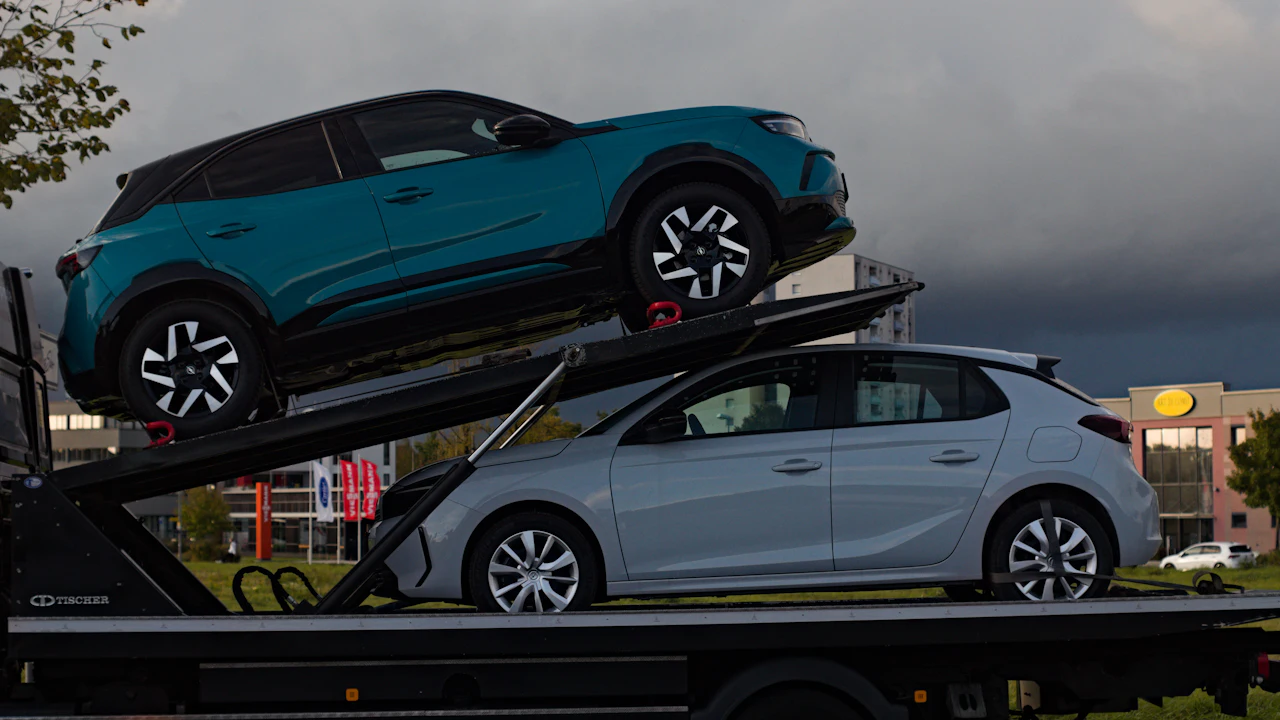
The gap between purchase and home registration is also where the practical case for shipping the car appears. A transporter costs money and takes days, but it removes the drive, the temporary tag, the fuel and the risk of discovering a fault a long way from anyone who owes you anything. On an expensive car, or a very long distance, it is frequently the cheaper option once everything is counted.
Buying privately across a state line
Everything above gets sharper when the seller is not a dealer, because two of the four federal protections thin out.
The Buyers Guide requirement applies to dealers, so a private sale has no window form and no federal disclosure document. There is no dealer licence and no surety bond, which means the state-law column of the diagram is not merely distant but empty. And the odometer disclosure, while still required, is now being made by a private individual with no compliance department behind it.
What remains is the VIN and everything keyed to it, which is exactly why remote private purchases live or die on the record check. Title brands, mileage history, reported accidents, lien status and open recalls are all knowable before you spend a day driving. Our guide to buying from a private seller covers the sequence in full; the only modification for a long-distance deal is that every step of it has to happen before you travel rather than while you are standing in the driveway.
One more thing specific to distance: never send a deposit to hold a car you have not verified, to a person you have not confirmed exists, in a state where you have no practical recourse. The combination of urgency, distance and a deposit is the shape of most vehicle sale fraud, and it is the shape precisely because it works.
The sequence that makes a long-distance purchase safe
Ordered so that everything cheap happens before anything expensive.
- Get the VIN and check it before anything else. Decode it, confirm the year, engine and trim match the advertisement, pull open recalls from NHTSA, and run a full history. A mismatch here ends the conversation for the price of nothing.
- Read your own state’s lemon law eligibility conditions. Find out in advance whether the purchase you are contemplating is inside or outside them. You may still decide the discount is worth it. Decide it knowingly.
- Call your own state’s revenue department about the tax. Three questions, listed above. Get the answer from the agency that will be collecting it.
- Read your own state’s inspection and emissions rules against this specific car. Especially if it is modified.
- Establish how the car will be legally driven or shipped home. Temporary tag, transit permit, or transporter — decided before you agree a price, not after.
- Commission an independent inspection near the seller. You are not coming back. This is the step that most often turns up the thing the advertisement omitted.
- Photograph the Buyers Guide and every document at the desk. Both sides of the form. It is the record of which state’s regime governed your purchase.
- Bind insurance before you take possession.
Steps one, two, three and four all happen at home, cost nothing but time, and eliminate most of the ways this goes wrong. A VIN history check and half an hour on two government websites is the whole of the preparation that distinguishes a good out-of-state purchase from an expensive story.
When crossing the line is genuinely worth it
None of this argues against buying out of state. It argues for pricing it correctly.
There are excellent reasons to travel. Regional supply differs, and a body style or specification that is scarce and dear in one market can be common and cheap in another. Climate matters enormously for a used car: the same model that is structurally sound after a decade in a dry state may be compromised by underbody corrosion after the same decade on salted roads, and that difference is worth crossing several state lines for. Enthusiast and low-volume cars are geographically concentrated in ways that make a local search meaningless.
What has to be counted honestly is the full cost. Fuel and time, or a transporter. The independent inspection, which is not optional at distance. Any work needed to pass your own state’s test. The tax you will pay at home regardless. And the value of the state-law protections you are giving up, which is not zero even though it does not appear on any invoice.
Add all of that to the sale price and compare it to the local car. Sometimes the out-of-state car is still comfortably ahead, and then the answer is obvious. Sometimes it is a few hundred dollars ahead, and a few hundred dollars is not enough to compensate for buying outside your own state’s consumer protections from a business your regulator cannot touch.
The saving has to be large enough to be worth the whole of what you are trading, and now you know what that is.
Frequently asked questions
Can I buy a car in another state?
Yes. There is no restriction on buying a vehicle in a state you do not live in, and dealers sell to out-of-state buyers routinely. What changes is not your right to buy but the set of protections attached to the purchase: federal, VIN-keyed protections come home with the car, while state consumer protections generally belong to the state where the sale took place.
Do I pay sales tax in the state I buy the car or the state I live in?
Generally in the state where you will register and use the vehicle. The Illinois Department of Revenue puts it directly: when purchasing a vehicle from another state, sales or use tax is generally due where the vehicle will be registered and used, not necessarily where it was purchased. Some dealers collect your home state’s tax at the desk and some do not, and reciprocity and credit rules vary, so confirm the specifics with your own state’s revenue department before you agree a price.
Does my state’s lemon law cover a car I bought out of state?
Often not. Used-car lemon laws are typically written around sales made by dealers licensed in that state. New York’s eligibility conditions, for example, require that you bought or leased the car from a New York dealer — so an otherwise qualifying car bought elsewhere and brought home is not covered. Read your own state’s conditions and look for the clause describing where the sale must have happened.
How do I get an out-of-state car home legally?
Either on a temporary registration or transit permit, or on a transporter. Which permit applies depends on both states and on whether the seller is a dealer or a private individual, so establish the answer before you travel rather than at the point of sale. Insurance must be bound before you take possession, whichever route you choose.
Will a car that passed inspection in another state pass in mine?
Not necessarily, and you will own it by the time you find out. Safety and emissions requirements are set state by state and in some places county by county. Modified cars are the most common failure: exhaust, suspension, lighting and window tint that are legal where the car was sold may not be legal where you are registering it. Check your own state’s rules against the specific car, and tell your pre-purchase inspector which state it is going to.
Do recalls and title brands follow a car across state lines?
Yes to both. Recalls are issued against VIN ranges under NHTSA supervision and are remedied free by any franchised dealer of that make regardless of where you bought or live. Title brands are reported to NMVTIS, a federal system built specifically so that a brand applied in one state is visible to titling agencies in the others. These are among the few things in a used car purchase that genuinely do not care about the border.
Is it safer to buy from a dealer or a private seller out of state?
A dealer, in the narrow sense that a dealer sale carries a Buyers Guide, a state licence and usually a surety bond, none of which exists in a private sale. But the licence and the bond belong to the seller’s state regulator, not yours, so the advantage is smaller at distance than it is at home. Either way the protection you can actually rely on is the one you arrange yourself: the record check before you travel and the independent inspection before you pay.
This article describes federal regulations and state agency guidance read from the issuing bodies’ own publications on 26 August 2026. Tax, titling, inspection and lemon-law rules are set by each state, differ substantially between them and are revised regularly, which is why no rate table or state-by-state chart appears here — the New York and Illinois material is quoted as a documented illustration of how these rules are structured, not as guidance for readers elsewhere. Confirm the current position with your own state’s revenue department and motor vehicle agency before you buy. This is general information, not legal or tax advice.
For sale near you
Dealer listings, checked liveFinding used cars near you…
Sources and further reading
- 16 CFR Part 455 (Used Car Rule)
- FTC Used Car Rule
- FTC used car buying guide
- 49 CFR Part 580 (odometer disclosure requirements)
- 49 U.S.C. §32710 (odometer fraud: civil actions by private persons)
- NMVTIS (US Department of Justice)
- NHTSA recall lookup
- NY Attorney General: Used Car Lemon Law
- Illinois Department of Revenue: buying a car out of state
- Texas Comptroller: motor vehicle sales and use tax
- NHTSA flood-damaged vehicles
Recall, complaint and safety-rating figures on this page were retrieved from the federal databases above on August 19, 2026. Federal data changes — re-check any VIN before you rely on it.
Published August 26, 2026 · last updated August 26, 2026. Found something out of date or wrong? Tell us and we will correct it.