Brake Fluid Change: The Only Service Measured in Years
Water lowers the temperature at which the fluid boils, and vapour compresses where liquid does not. That is the pedal going soft at the bottom of a hill.
The short version
- Brake fluid is the one item on this site’s published service timeline expressed in years and nothing else. Oil, filters, plugs, transmission fluid and the timing belt are all quoted in miles. Coolant is quoted in years and miles. Brake fluid gets two to three years on its own, and the unit is the whole story.
- The reason is chemistry, not wear. Brake fluid draws water out of the atmosphere continuously and deliberately — through the vent in the reservoir cap, through the walls of the flexible hoses, through every seal in the circuit — and it does that whether the car is being driven or standing still with a cover over it.
- Water lowers the temperature at which the fluid boils. Boiled fluid becomes vapour, vapour squashes where liquid will not, and the pedal stops moving the pistons. It happens on long descents and in repeated hard stops, which is to say at the only moments when it matters.
- For a buyer that inverts the usual reading of an odometer. A garage-kept car with a very low reading and no service folder has fluid that has been taking on water for its entire life, unopposed. A higher-mileage car with receipts has fluid that was replaced on a clock.
- A higher DOT number is not a better product. They are separate specifications with separate chemistry, and the silicone one is not interchangeable with the glycol ethers at all. Putting the wrong one in is a rebuild, not a fluid change.
- NHTSA’s complaint archive holds 387 records under service brakes, hydraulic, at a median reported odometer reading of 60,000 miles. It is the largest single component category in that file by a wide margin — the engine, next on the list, carries 200. Those are complaints about the hydraulic system specifically, which is the system this page is about.
Look at any service schedule long enough and it starts to read as one continuous list of mileages. Oil at a few thousand. Filters somewhere in the tens of thousands. Plugs and belts out past sixty. The odometer is the clock the whole document is written against, and that makes intuitive sense, because almost everything on a car is consumed by being used. Then there is one line written in a different unit entirely, and most people read straight past it.
Brake fluid is quoted in years. Not in years or miles, whichever comes first, which is how coolant is normally written and how a cautious manufacturer hedges. Just years. That is neither a rounding convenience nor an omission. It is a statement about what actually degrades the fluid, and once you understand it, a great deal of received wisdom about used cars turns out to be pointing the wrong way.
The line on the schedule written in a different unit
Our own used-car service timeline lists eight routine items. Seven of them are anchored to distance. Engine oil and tyre rotation sit at 5,000 to 7,500 miles. Cabin and engine air filters run 15,000 to 30,000. Transmission fluid is 30,000 to 60,000. Spark plugs and, where a car has one, the timing belt sit further out again, both of them quoted from 60,000 upwards. Coolant is the only entry on the whole list that mentions a calendar at all, and even there the figure is hedged: five years or 100,000 miles, whichever the car reaches first.
Brake fluid is alone. Two to three years, with the note attached that it is time-based rather than mileage-based, and no distance offered as an alternative. Go through the list a second time and check: there is no other row you could read without knowing how far the car has travelled.
That distinction is doing real work, and it is worth stating plainly rather than letting it sit in a table. Every other consumable on a car is spent by motion. Oil shears and oxidises because the engine is turning. Pads and discs are eaten by kinetic energy being converted into heat, which is why nobody can honestly quote a pad life in miles either — but at least pads are being consumed by something the odometer is a rough proxy for. Brake fluid is not being consumed at all. It is being contaminated, slowly and continuously, by something in the air.
Park the car for a year and the oil barely ages. The pads do not wear. The plugs are exactly as they were. The brake fluid, meanwhile, has spent a year doing precisely what it does, which is absorbing water. A stored car is not a paused car as far as its brake hydraulics are concerned.
What the fluid is actually for
Before the chemistry, the mechanics, because the two only make sense together.
Your foot presses a pedal. Some distance away, four pistons have to clamp friction material against four discs, hard, at exactly the same instant, with a force that scales smoothly with how hard you pushed. Between the foot and the pistons there is a narrow steel and rubber plumbing system that snakes around the engine, over the subframe and out to the corners of the car, through a bulkhead, past suspension that moves several inches, and into calipers that steer.
Cable would not do it. Rods would not do it. A liquid will, because a confined liquid transmits pressure equally in every direction and does not lose any of it along the way. Push the master cylinder piston in a small distance with a large-ish force, and every square millimetre of every caliper piston in the circuit feels the same pressure. Make the caliper pistons collectively larger in area than the master cylinder piston and the force multiplies, which is why a modest shove on a pedal generates enough clamping load to lock a wheel.
The property that whole arrangement rests on is that the liquid does not change volume when you squeeze it. Push on a sealed column of liquid and the far end moves immediately, because there is nowhere for the push to go except onwards. That is the entire premise. It is not a design detail; it is the reason the system exists in that form.
Now put a bubble of gas in the column. Gas is compressible — that is what makes it gas. Press the pedal and the first part of the travel goes into shrinking the bubble rather than into moving the pistons. The pedal drops further than it should before anything happens, the response feels soft and vague, and the force you get at the wheel for a given effort at the foot collapses. A brake system with gas in it has not lost some braking. It has lost the mechanism by which the pedal was ever connected to the wheels.
Air gets in through a leak or through a careless repair, and everyone knows that. The subject of this page is the other way of getting gas into a brake system: making it, out of the fluid that is already there.
Hygroscopic, and why that is a design choice rather than a defect
Ordinary brake fluid — the glycol ether family, which is what almost every car on the road is filled with — is hygroscopic. It has a chemical affinity for water and will pull water molecules out of the surrounding atmosphere until it reaches an equilibrium with them.
The first thing to say about that is that it is intentional. It looks like a flaw and it is actually the least bad option available. Water is going to get into a brake system over a period of years; the question was never whether, only what happens to it once it is there. A fluid that repels water leaves that water as free liquid, sitting in whatever low or cold pocket of the circuit it finds — the bottom of a caliper bore, the underside of a wheel cylinder — where it can freeze in winter, flash into steam under braking heat, and corrode the metal it is in contact with, all in one concentrated spot. A fluid that takes water into solution disperses it through the whole volume instead. The harm is spread thin rather than pooled, and it happens gradually rather than as a local event.
So the specification accepts the water and manages it. What it cannot do is refuse it, and the routes in are more numerous than people expect.
- The reservoir. The fluid level falls as the pads wear, because the caliper pistons move further out and the fluid follows them. The reservoir therefore has to breathe, through a vent or a permeable diaphragm in the cap, or it would pull a vacuum on itself. Every breath brings humid air onto the surface of the fluid.
- The flexible hoses. This is the route almost nobody knows about, and it is the significant one. The short rubber sections between the body and each caliper are not perfectly impermeable. Water vapour migrates through the hose wall from the outside in, slowly, continuously, for the life of the hose — and as a hose ages and its rubber hardens, that migration gets easier rather than harder.
- Seals and joints. Every piston seal, every union, every bleed nipple is a boundary between a wet atmosphere and a fluid that wants what the atmosphere has.
- The container. An opened bottle of brake fluid starts absorbing immediately from the air trapped above it. Half a bottle left on a shelf since the last job is not fresh fluid, whatever the label says.
None of those routes cares whether the wheels are turning. That is the crux of the whole subject. A car doing thirty thousand miles a year and a car doing three hundred take on water at broadly the same rate, because the mechanism is diffusion and equilibrium, not friction and heat. If anything the car that is used regularly does slightly better, because a system that gets hot occasionally drives some moisture back out and a car that never moves does not.
The uncomfortable consequence
There is no symptom. Water content produces no noise, no warning lamp, no fault code, no change in how the car drives on an ordinary journey, and no visible change in the fluid for a long time. The reservoir light monitors level, and level is a leak detector, not a condition monitor. A car with badly degraded fluid and a full reservoir will show you a dashboard with nothing on it right up until the day you ask the brakes for sustained work and discover what you have. Everything on this page that looks like scaremongering is really a consequence of that one fact: the failure mode has no run-up.
Dry boiling point, wet boiling point, and why both get printed
Pick up a bottle of brake fluid and you will find two boiling points on it. This confuses people, because nothing else in the car is sold with two of anything. The explanation is that they are the same measurement taken at the two ends of the fluid’s working life, and printing only one of them would be a lie by omission.
The dry boiling point is the figure for the fluid as it comes out of a sealed container: the day it is poured in, and only that day. The wet boiling point is the figure for the same fluid once it has taken on the amount of water the standard defines as a realistic saturated condition — which is to say, a fluid that has been in a car for a few years, breathing.
The gap between the two is not a rounding error. The wet figure is specified far below the dry one, by a margin large enough that the fluid at the end of its service life is a materially different product from the fluid at the start. And crucially, the decline is not linear across the interval. Water content climbs fastest early, when the concentration gradient between a dry fluid and a wet atmosphere is steepest, and the boiling point falls steeply with the first water absorbed and more gently thereafter. Most of the damage is done in the first part of the period, which is a large part of why the recommended interval is as short as it is.
This page will not print either number, and that is deliberate rather than coy. The figures differ by specification, they differ between manufacturers within a specification, and they are exactly the sort of thing that gets quoted from memory on a forum and repeated as fact. The structural point is what a buyer needs and it survives without any digits: the boiling point of the fluid in a used car is a function of its age, it falls a long way over the recommended interval, and the manufacturer prints the lower figure because that is the one you will be relying on for most of the fluid’s life. If you want a number for a specific product, it is on the bottle, and the bottle is the only place it should be read from.
What boiled fluid feels like from the driver’s seat
Brakes get hot. That is the mechanism — a friction brake works by turning motion into heat and shedding it — and the heat has to go somewhere. Most of it leaves through the disc and into the air. Some of it conducts back through the pad, into the caliper body, and into the fluid standing in the piston bore.
On an ordinary journey that is fine, because the brakes are applied briefly and get long periods to cool. The situations that are not fine share one feature: sustained or repeated work with no recovery time in between. A long mountain descent where the brakes are dragging continuously. Towing down a gradient. A sequence of hard stops from speed. A dragging caliper cooking one corner while the driver notices nothing.
If the fluid in the caliper reaches its boiling point, it boils, and the vapour that forms is a compressible gas sitting in a circuit that only works because its contents were not compressible. The pedal goes long. Not spongy in the way air in the lines feels at any temperature — long, and progressively longer with each application, because each application makes more heat and more vapour. Drivers describe pressing the pedal to a position it has never reached before and finding almost nothing there. The car keeps rolling.
Two things make this particularly nasty. The first is that it appears at the exact moment of maximum demand and never at any other time, so nothing in the previous months of driving warned anybody. The second is that it recovers. Let the brakes cool and the vapour condenses back into liquid, the pedal returns to normal, and the car passes every subsequent test anyone thinks to give it. A driver who has had one episode and then finds the brakes working perfectly the next morning will very reasonably conclude they imagined it.
It is worth separating this from the other thing people call brake fade, which is the friction material itself losing its coefficient at high temperature. Pad fade feels like a firm pedal that is not slowing the car. Vapour lock feels like a pedal with nothing under it. Two different faults with two different fixes, and the fluid is responsible for exactly one.
DOT grades, and why a bigger number is not an upgrade
Brake fluids in the United States are classified under a federal motor vehicle safety standard that sets minimum boiling points, viscosity limits and compatibility requirements for each grade. The grades are numbered, the numbers get larger, and the natural assumption is that a larger number is a better fluid. That assumption is wrong in a way that can wreck a car.
| Grade | Chemistry | Takes on water? | Mixes with |
|---|---|---|---|
| DOT three | Glycol ether | Yes — hygroscopic | DOT four and DOT five point one. The common baseline on older vehicles. |
| DOT four | Glycol ether with borate esters | Yes — hygroscopic | DOT three and DOT five point one. Higher minimum boiling points than DOT three. |
| DOT five point one | Glycol ether, low viscosity | Yes — hygroscopic | DOT three and DOT four. Named for its performance class, not as a variant of DOT five. |
| DOT five | Silicone | No — and that is the problem | Nothing else on this table. Never mix it with a glycol ether fluid. |
Read the table by chemistry rather than by number and the structure becomes obvious. Three of the four are glycol ethers with different additive packages and different performance floors, and those three are mutually compatible — topping a DOT three system up with DOT four is a normal thing to do, and many manufacturers now specify DOT four from the factory for systems that were historically filled with DOT three. The odd one out is DOT five, which is silicone, and which sits in the middle of that number sequence purely as an accident of the order in which the specifications were written.
DOT five is not a step up from DOT four
Silicone fluid does not absorb water. That sounds like an unambiguous improvement and it is not, because water still enters the system — it simply has nowhere to dissolve. It stays as free liquid, collects at the lowest and coldest points in the circuit, and does there exactly what the glycol ethers were formulated to prevent: freezes, corrodes locally, and flashes to steam under braking heat at a temperature far below anything the fluid itself would boil at. Silicone is also more compressible than glycol ether and holds entrained air more stubbornly, which makes bleeding harder and pedal feel softer, and it is generally not specified for use with antilock systems. Beyond all that, it is not miscible with what is already in the car. Pour it into a glycol ether system and you get a two-phase mess, seals that were selected for one chemistry sitting in another, and a job that now means flushing and rebuilding the hydraulics rather than changing the fluid. It exists for specific applications — certain military and stored-vehicle uses where paint protection and long dormancy matter more than pedal feel. It is not an upgrade for a road car.
Two further points that matter more on modern cars than they used to. First, viscosity is now part of the specification and not an afterthought: stability control and antilock systems have to pump fluid through narrow passages quickly, including on a cold morning, and manufacturers increasingly call for a low-viscosity DOT four variant for exactly that reason. Fitting an ordinary fluid where a low-viscosity one is specified is a subtler error than the silicone one but it is still an error. Second, and simply: the answer to which fluid a car takes is printed on the reservoir cap and repeated in the manual. It is not a matter of opinion, it is not a place to economise, and it takes ten seconds to check.
How the fluid is actually assessed, and why looking at it barely counts
Everybody’s instinct is to open the reservoir and look. Fresh fluid is clear to pale straw; old fluid goes amber, then brown, then genuinely dark. So dark fluid means old fluid, and that much is true.
The trouble is the reverse inference, which is the one people actually make. Clear fluid does not mean the fluid is in good condition, for three separate reasons, and each of them is worth understanding because they also explain what a proper test is doing.
Colour tracks contamination, not water. What darkens brake fluid is the additive package depleting and, more visibly, fine particulate picked up from seals, hose linings and corrosion products in the bores. Water is colourless and stays colourless in solution. A fluid can be at the end of its useful boiling point and still look perfectly acceptable through the neck of a reservoir, particularly in poor light against a translucent white plastic tank.
The reservoir holds the least representative fluid in the car. Water is denser than brake fluid and the circuit is not stirred. The moisture concentrates at the low points and the far ends — the calipers, the wheel cylinders — which are also, conveniently for the fault and inconveniently for you, the hottest parts of the system. Sampling at the reservoir tests the one place with the least water in it.
The reservoir can be refreshed on its own. This is the point with the sharpest edge for a buyer. Drawing the old fluid out of the reservoir with a syringe and refilling it takes a couple of minutes, requires no tools worth the name, and produces a tank of clear fluid on a car whose calipers are still full of what was in them before. It is sometimes done in good faith as a partial measure. It is also, on a car being prepared for sale, the cheapest possible way to make a neglected system look maintained. Either way, the fluid you can see is not the fluid that decides whether the pedal holds up on a descent.
What a real test looks like
Two instruments do the job properly, and both are inexpensive enough that any competent workshop has one.
Test strips are chemical indicators dipped into the fluid, reading the depletion of the corrosion inhibitors rather than water directly. They are quick and they are a reasonable screen. Their limitation is that inhibitor depletion and water content are correlated but not identical, so a strip is an indication rather than a measurement.
An electronic boiling-point tester is the honest answer. A probe goes into the fluid, a small heating element boils a tiny sample in situ, and the instrument reports the temperature at which it boiled. That is not a proxy for anything. It is the actual property the fluid is in the car to provide, measured on the fluid that is actually in the car. It is the only test that answers the question directly, and it is quick enough that there is no good reason for it not to be on an inspection sheet.
There are also refractometers and conductivity meters sold for this, which infer water content from optical or electrical properties. They work, with caveats about which base fluid they were calibrated for. If you are asking a workshop to check a car for you, the request to make is for a boiling-point reading taken at a caliper bleed nipple rather than at the reservoir, and it belongs on the list you hand to whoever does your pre-purchase inspection.
Why it is bled rather than drained
Oil has a drain plug. Coolant has a drain tap or at least a bottom hose you can pull off. Brake fluid has neither, and the reason is structural: there is no point in the circuit where you could empty it that would not also fill it with air.
The hydraulic system is a closed loop that is meant to be completely full at all times. Every void in it is a void that will compress. So the fluid is not removed and replaced; it is displaced. Fresh fluid goes into the reservoir at the top, and at each wheel in turn a bleed nipple is opened so that the old fluid ahead of it is pushed out and thrown away, with new fluid following behind it the whole way. Done properly the circuit is never less than full at any moment.
Several details in that process are what separate a job done well from one done badly, and they matter to a buyer because they determine what a receipt is actually worth.
- The order is not arbitrary. The conventional approach works from the wheel furthest from the master cylinder to the nearest, so that the longest run of old fluid is cleared first. Some manufacturers publish a different sequence for their own systems, and on a split circuit that sequence is part of the specification rather than a preference.
- The reservoir must not run dry. If it empties mid-job, air is drawn into the master cylinder and the whole thing has to be started again from a worse position. It is the most common way a driveway attempt turns into a recovery truck.
- Old fluid is not reused, ever. It has been out of the sealed circuit and in contact with the air. Nor is fluid from a bottle that has been standing open in a workshop.
- The antilock unit needs to be told to participate. On a car with ABS — which is to say any modern car — the modulator contains chambers and passages that ordinary bleeding at the calipers does not flush, because the valves that would open the path are closed at rest. Getting the old fluid out of them requires a diagnostic tool that commands the pump and valves to cycle during the bleed. A shop with the right tool does this as a matter of course. A shop without one changes the fluid in the pipes and leaves the fluid in the module, and nothing about the finished job looks any different.
That last point is the reason the phrase “brake fluid change” hides a range of outcomes rather than describing one procedure, and it is worth one question when you are handed a service record: was it done with a scan tool, and does the invoice say so? On a car that has gone a long time between changes, the fluid sitting in the ABS unit is precisely the fluid you would most want gone.
The module, the calipers, and why neglect stops being cheap
Water in a brake system does two things. The boiling point is the dramatic one and it is the one this page opened with. The slow one is corrosion, and it is where the money goes.
Dissolved water, plus the acidic products the fluid forms as its inhibitor package depletes, attacks the inside of the system continuously. Caliper bores pit; the piston then does not retract cleanly and the pad drags, which cooks that corner, destroys a set of pads early and produces the uneven wear that is one of the most useful things a buyer can spot at a viewing. Bleed nipples corrode into their threads and shear off, which turns a routine job into a caliper replacement. Rigid lines corrode from the outside too, which becomes a serious matter wherever roads get salted every winter.
The expensive one is the antilock hydraulic control unit. It is a compact block containing a pump, an electric motor and a set of solenoid valves with very small clearances, and it lives in the same fluid as everything else. Corrosion products and debris circulating in old fluid are exactly the wrong thing to introduce to a valve with tight tolerances. A module that sticks or seizes takes the antilock function offline at best, and on some designs interferes with normal braking as well. Replacing one is not in the same category of expense as changing the fluid that would have protected it, and there is no realistic repair.
The recall record makes the point from a different direction. In our archived pull of NHTSA campaigns, service brakes, hydraulic accounts for 12 campaigns across 6 manufacturers. Heading the parts list inside those campaigns is a vacuum power assist unit, at 4, followed by a disc caliper at 3. Two further parts appear once apiece: the brake hoses and rigid lines, and an antilock control unit.
Two of those entries deserve a second look in the context of this page. The hoses-and-lines campaign concerns the components that are simultaneously the main route by which moisture enters the fluid and the components most likely to fail once the fluid has been left long enough to corrode them from within. The antilock control unit campaign concerns the single most expensive item the fluid is responsible for protecting. Neither of those campaigns is about fluid maintenance — a recall is a manufacturing or design defect the maker has conceded, not a service failure — but they identify, from an entirely independent direction, which parts of a brake hydraulic system are the ones that get you.
Where a car does turn out to have an outstanding campaign against its braking system, that is a repair somebody else pays for, and it does not matter how many owners the car has had since. It is worth taking the two minutes to check the VIN for open safety campaigns before you pay anybody to investigate a brake complaint. A conceded defect and a neglected service are two very different bills.
Where brake hydraulics sit in the complaint record
One archive on this site touches the subject sideways, and it has to be framed carefully, because the same file is quoted on other pages to support a different argument entirely.
NHTSA splits brake reports into more than one category, and the split is the useful part. Service brakes holds 64 records at a median reported odometer reading of 30,000 miles. Service brakes, hydraulic holds 387 records at a median of 60,000. The second of those is the largest single component category in the entire file — the engine, the next biggest, carries 200, and the electrical system 145.
The distinction between the two brake categories is the reason this matters here. The general service brakes category collects complaints about braking as a function. The hydraulic category is specifically about the pressurised circuit: master cylinders, calipers, hoses, lines, the antilock unit, and the fluid moving through all of them. It is the system this article is about, and it is the most-reported system anywhere in the archive by a factor of nearly two over its nearest rival.
What that figure is not
60,000 miles is not a brake fluid interval, and nothing in this dataset measures fluid condition. What sits behind each line is one owner writing to a federal regulator about something they judged dangerous. Fluid quietly losing its boiling point is invisible, produces no symptom, and has never caused anybody to file anything. These records are generated by the downstream event instead — a pedal that went long, a caliper that seized, an antilock fault, a car that did not stop where the driver expected. Treat 60,000 as a service figure and you have swapped one subject for another without noticing. The real interval comes from chemistry and the manufacturer’s own schedule, and it is measured in years, which is the entire argument of this page.
What the number does support is a claim about weight. Whatever else is true, the pressurised half of the braking system generates more owner-reported safety complaints than any other system on these cars, and it does so at a mileage landing precisely on the middle of the whole file. Which is another way of saying: right in the range where ordinary cars change hands. It is not evidence about fluid specifically. It is evidence that the part of the car the fluid lives in is the part owners most often find themselves complaining about, at exactly the point in a car’s life when it is most likely to be changing hands.
Where two to three years comes from, and what to do when the manual disagrees
The interval is not a marketing figure and it is not folklore. It is derived from the rate at which a glycol ether fluid takes up water under ordinary conditions, set against the margin between the dry and wet boiling points of the specification. In plain terms: it is roughly how long it takes for a fresh fill to approach the saturated condition the wet figure describes, with some margin built in for hot climates, humid ones, and cars that are worked harder than average.
Manufacturers publish their own intervals and they are not all identical. Some say two years flat. Some say three. Some quote a mileage alongside the years, in which case the years are the part that will almost always arrive first. And some vehicles, particularly in the American market, have owner’s manuals that either bury the recommendation in an appendix or omit brake fluid from the maintenance schedule altogether.
That last case is worth being blunt about. An absent recommendation is not evidence that the fluid does not need changing; the chemistry is not different in cars whose manuals are quiet about it. The service exists in every manufacturer’s workshop literature even where it is soft-pedalled in the customer-facing schedule. If a car’s book says nothing, the sensible default is the interval the rest of the industry uses.
Two practical notes. Fluid changed as part of another job — a caliper replacement, a hose replacement, a master cylinder — does not necessarily reset the clock, because that work may have replaced the fluid in one circuit and not the other. And a car that has had a full fluid change is one of the few maintenance items where the benefit is immediate and measurable rather than notional: the boiling point of what is in the system goes back to the dry figure the day it is done.
The low-mileage car that has been sitting
This is where the whole argument lands for somebody buying a used car, and it inverts the reading almost everybody applies to an odometer.
Consider two cars of the same age. One has covered a great many miles, has a folder of receipts, and has been through several services in which the fluid was changed because the calendar said so. The other has covered a fraction of the distance, has spent most of its life under a cover in a garage, is presented as barely used, and comes with no history worth the name.
On pads and discs the second car is genuinely ahead, though even there the picture is less flattering than it looks, because lightly used discs corrode on their swept faces and pads that never scrub them clean leave pitting behind. On tyres it is behind, because tyres age out. And on brake fluid it is not merely behind, it is in a materially worse position than the car that has been driven — because the fluid in it has been absorbing water for the entire period, with no service to interrupt it and no heat cycling to drive any of it back out.
Say that plainly, because it is the sentence this page exists for: mileage does not protect brake fluid, and low mileage combined with no service history is the specific combination in which fluid is guaranteed to be original. A car with a very low reading and a very high age is not a car that has been spared. It is a car that has been running the fluid clock at full speed while its owner watched an odometer that was not measuring the thing that was degrading.
The general form of that argument — distance and time destroy different parts of a car, and a small number on the dash buys no relief from the age — gets the long treatment in our piece on what a high odometer reading actually means. Brake fluid is the cleanest illustration of the principle anywhere on a vehicle, because it is the one item whose mileage column is empty by design.
The question to ask, and what the answers mean. Put it as a date rather than as a yes or no: what year was the fluid last done, and is it written down anywhere? “Here it is, done last year” settles it. “It was done with the service” needs the invoice checked, because a basic service does not include it and many people assume it does. “It has never needed doing” is a category error worth gently correcting: it never announces that it needs doing. “The car has hardly been used” is not an answer to the question that was asked, and on this particular item it is close to the opposite of a reassurance.
At a viewing: what you can establish in five minutes
Almost everything above is chemistry, and chemistry is not inspectable in a car park. What is inspectable is a set of secondary indicators, and between them they get you a long way — not to a verdict on the fluid, but to a decision about whether to price the job in and what else to look at.
The reservoir
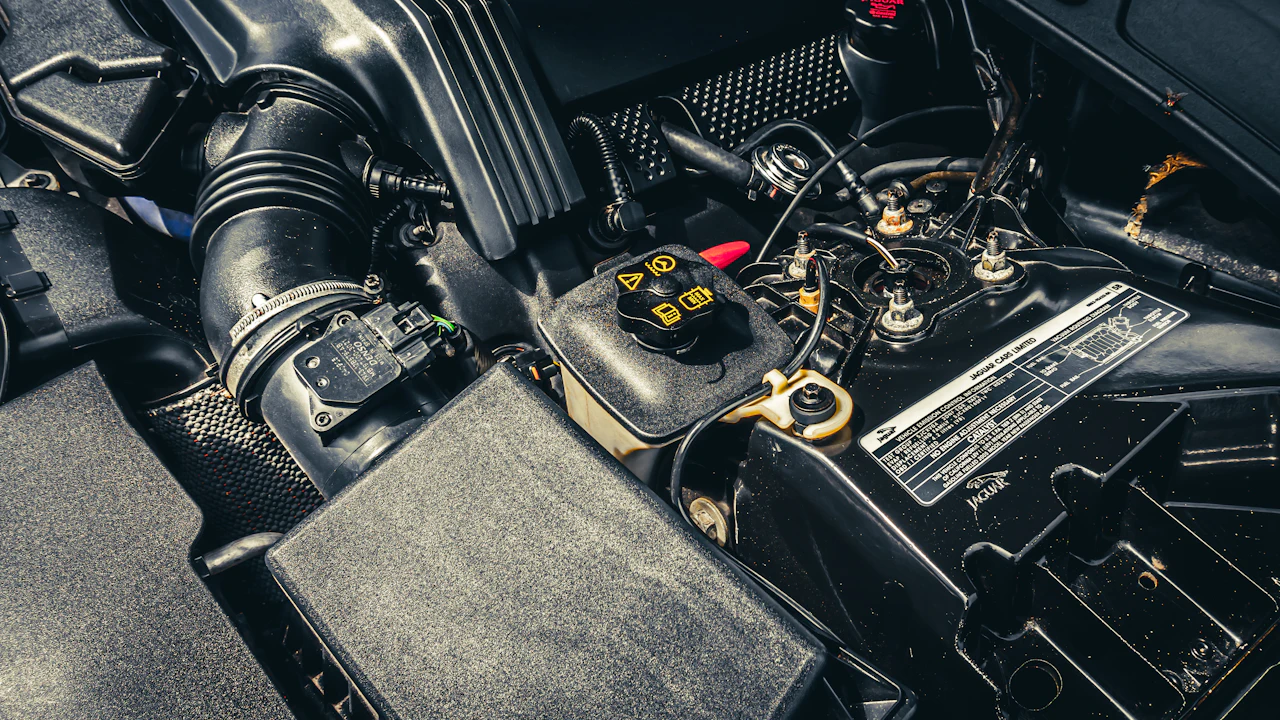
Find it under the bonnet, usually high on the bulkhead on the driver’s side, a small translucent tank with maximum and minimum marks moulded into it and a cap carrying a fluid specification. Look, but read the result correctly.
- Dark fluid is a finding. Genuinely brown or black fluid in the reservoir means old fluid, and since the reservoir is the least contaminated part of the circuit, it means the rest is worse. This one is reliable in the direction it points.
- Clear fluid is not a finding. It is consistent with a recent change and equally consistent with a reservoir that was emptied and refilled with a syringe last weekend. Treat it as neutral and go and look for the receipt.
- The level tells you about the pads. A level sitting near the minimum on a car with no leak usually means the pads are well worn, because the fluid has followed the pistons outward. That is a brake-wear signal rather than a fluid signal, and it is among the more valuable things anybody gets for free under a bonnet.
- The level having been topped up is a question. Somebody topping a reservoir back to maximum on a car with worn pads means the next person to fit pads has to deal with the overflow, and it means somebody has been managing a symptom.
- Read the cap. It carries the specification the car requires. Then look at whether anything about the car suggests somebody has been guessing.
- Look for a stain. Lifted, dulled or crazed paint on the inner wing below the master cylinder is brake fluid that escaped and was cleaned up. Our guide to identifying a fluid leak covers the ways that presents.
The pedal
Before you start the engine, press the pedal several times to exhaust the vacuum in the servo, then hold firm pressure on it. What you want is a pedal that stops at a consistent height and stays there. A pedal that continues to creep downwards under steady pressure, with nothing on the ground and no light on the dash, is a master cylinder leaking internally past its own seals, and it is a fault that produces no visible evidence anywhere on the car.
Start the engine, and the pedal should drop slightly as the servo takes over and then hold. On the drive, brake deliberately somewhere safe and note where the pedal sits and how firm it is. A soft or vague pedal at ordinary temperature is air or moisture in the circuit rather than a fluid-age question specifically, but it is the same conversation and it is one you want to have before money changes hands rather than after. Note too that a shudder felt only under braking is a disc problem rather than a hydraulic one, and reading a vibration by when it appears is the fastest way to keep the two apart.
The paperwork, which is the actual test
The honest position is that a viewing cannot tell you the condition of the fluid, and any page that suggests otherwise is selling confidence. What a viewing can establish is whether anyone has been treating the fluid as a scheduled item, and that is nearly as good, because the interval is short enough that a car with no record of it in the last few years can safely be assumed to need it.
So: look for the line item on the invoices, note the date rather than the mileage, and treat its absence as a finding rather than as missing information. Then ask for a boiling-point reading as part of the inspection, taken at a wheel rather than at the reservoir. On a car whose paperwork is thin generally, it is also worth a couple of minutes to pull the recall and title record attached to the VIN, because the things that reach a federal record are exactly the things a folder of receipts never mentions.
- Open the reservoir cap area and read the specification printed on it. Do not assume DOT three.
- Judge the colour in daylight against a white background, and remember that dark is informative while clear is not.
- Note the level against the marks, and read a low level as a pad-wear signal.
- Hold firm pressure on the pedal for a slow count and watch for creep.
- Look for lifted paint below the master cylinder and wet streaks on the inside faces of all four wheels.
- Ask for the date of the last fluid change and ask to see it written down.
- Put a boiling-point test at a caliper on the inspection list, and ask whether the last change was done with a scan tool on a car with ABS.
- On a low-mileage car with no history, assume the fluid is original and price the work in.
None of this should send you away from a car. A fluid change is a short job of known scope, and discovering that one is due is discovering something entirely ordinary. What it is worth is the inference it supports: a car whose brake fluid has been left is a car whose owner has been servicing to the odometer, and the odometer does not cover the parts of the schedule that run on a calendar. Where the fluid has been skipped, look hard at the coolant and at the timing belt, because they are skipped by the same reasoning.
Common questions
How often should brake fluid be changed?
Every two to three years for the great majority of cars, and the figure is in years rather than miles because the fluid degrades by absorbing water from the air rather than by being used. Check the specific interval in the owner’s manual, and where a manufacturer quotes both a time and a distance, expect the time to arrive first on nearly every car. Where a manual omits brake fluid from the schedule entirely, which happens more often than it should, the absence is not a reason to skip it — the chemistry is the same in every car.
What does it mean that brake fluid is hygroscopic?
It means the fluid has a chemical affinity for water and will draw it out of the surrounding air until it reaches equilibrium. Water enters through the vent in the reservoir cap, through the walls of the flexible hoses, and through the seals, and it does so continuously whether or not the car is driven. It is a deliberate property rather than a flaw: a fluid that took water into solution spreads the contamination thinly through the whole system, where a fluid that repelled it would leave free water pooling at the coldest, lowest points of the circuit to freeze and corrode in one place.
Why do brake fluids have two boiling points?
Because the same fluid performs differently at the start and end of its service life, and quoting only the first figure would misrepresent the product. The dry boiling point describes the fluid as poured from a sealed container. The wet boiling point describes it once it has absorbed the amount of water the standard treats as a realistic saturated condition after a few years in service. The wet figure is specified far below the dry one, and the decline is steepest early in the interval, which is a large part of why the recommended service period is as short as it is.
Is DOT 5 better than DOT 4?
No, and they are not alternatives. DOT three, DOT four and DOT five point one are all glycol ether fluids with different additive packages and different minimum boiling points, and they are mutually compatible. DOT five is silicone, it is not compatible with any of them, and it must never be mixed into a system designed for glycol ether. It does not absorb water, which sounds like an advantage and is not: water still gets in and simply pools instead of dispersing. Use what is printed on the reservoir cap.
Can I tell whether brake fluid needs changing by looking at it?
Only in one direction. Dark brown or black fluid is definitely old and, since the reservoir holds the least contaminated fluid in the system, it means the rest is worse. Clear fluid proves very little, for three reasons: water is colourless and does not darken the fluid, the moisture concentrates at the calipers rather than at the reservoir, and a reservoir can be emptied and refilled by hand in two minutes without touching the fluid in the rest of the circuit. A boiling-point test taken at a wheel is the only assessment that answers the question directly.
Does a car that barely gets driven still need its brake fluid changed?
Yes, and arguably more urgently than one that is used. The mechanism that degrades brake fluid is absorption of atmospheric moisture, which runs on a calendar and takes no notice of whether the wheels are turning. A car doing very few miles gets no benefit and one small disadvantage: a system that is worked occasionally will drive some moisture back out through heat, and a car that never moves does not even get that. A low odometer reading with no service history is the specific combination in which the fluid can be assumed to be original and saturated.
Will a brake fluid problem show up as a warning light?
No. The reservoir sensor monitors level, not condition, so it functions as a leak detector and nothing more. There is no dashboard indication for water content, no fault code for it, and no change in how the car feels during ordinary driving. The first symptom is usually the last one: a pedal that goes long under sustained braking, on a descent or during repeated hard stops, and which then recovers completely once the brakes cool and gives no sign of itself afterwards.
Sources and further reading
- NHTSA Office of Defects Investigation complaint database
- NHTSA recall lookup
- FTC used car buying guide
Recall, complaint and safety-rating figures on this page were retrieved from the federal databases above on August 19, 2026. Federal data changes — re-check any VIN before you rely on it.
Published August 28, 2026 · last updated August 28, 2026. Found something out of date or wrong? Tell us and we will correct it.