How to Protect Your Car From Rust

The short version
- Rust is an electrochemical reaction that needs iron, oxygen and an electrolyte. Road salt supplies the electrolyte, which is why treated winter roads destroy cars and dry climates preserve them.
- Six of the eight places corrosion begins are invisible unless the car is on a lift. The two you can see are usually the last to show it.
- Washing the underside — not the paint — is the single most effective thing you can do between November and April.
- Blocked drain holes in doors, sills, sunroofs and the boot well turn a waterproof car into a container. Clearing them takes minutes.
- Corrosion in odd places, silt in the spare wheel well and unexplained electrical faults together point at flood history, which is a title problem rather than a bodywork one.
Steel and oxygen want to be iron oxide. That is the whole of it. A car body is a temporary arrangement holding those two apart with paint, primer, zinc coating and sealant, and every one of those layers is a consumable. Rust does not attack a car; it simply resumes once the barriers fail.
What changes the timetable is salt. Pure water is a poor conductor and corrodes steel slowly. Salt water is an excellent conductor, and it turns the surface of a panel into a working battery where one patch of metal gives up electrons to another. That is why a fifteen-year-old car from Arizona has a clean underside and a six-year-old car from Long Island can have a subframe you would not want to jack against. If you drive through winters where roads are treated, you are not preventing rust so much as slowing it down — and the difference between slowing it a lot and not at all is a routine that takes minutes.
Where rust actually starts
Almost nobody finds rust first on a door skin or a wing. They find it there last, once it has pushed through from behind. Corrosion begins where water collects and cannot leave, where two panels are joined and moisture wicks into the seam, and where stone chips have already stripped the protective coating.
Working through those eight zones in the order they cause trouble:
Rear wheel arches
The worst offender on almost every car. The rear arch traps a mixture of salt, grit and moisture behind the wheel where nothing dries it, and on many designs there is a lip where the outer skin folds back on the inner arch — a seam that holds water by capillary action. Once the paint blisters along that lip, the metal behind it is already gone.
Rocker panels and jacking points
The sills run the length of the car below the doors, which means every wheel throws water at them for the entire life of the vehicle. They are usually boxed sections with drain holes at the bottom. When those holes clog with road grime the section stops draining and starts holding. The jacking points are the visible symptom: they crumble first because the seam and the reinforcement plate there trap the most moisture.
Door bottoms and drain holes
A car door is designed to let water in. Rain runs past the window seal, down the inside of the glass, and out through slots in the bottom of the door. Those slots block with leaves and grit. The door then holds an inch of water permanently, and rots from the inside out.
Subframes, suspension mounts and lines
Structural corrosion is the category that turns a repairable car into a scrapped one. Subframes, suspension mounting points, and the steel brake and fuel lines that run the length of the underbody are all directly exposed to spray and are all expensive or impossible to repair properly. A brake line that has corroded through fails without warning, and it fails at the moment you need it.
Boot floor and spare wheel well
The lowest point in the rear of the car, and therefore where any leak collects. Boot seals perish, tail-light gaskets harden, and the well fills quietly under the boot board where nobody looks. Lift the boot floor on any used car you are considering. It takes five seconds and it is one of the most informative five seconds of the whole inspection.
Roof rails, sunroof drains and window seams
A sunroof is not sealed — it is drained, through four small tubes that run down the pillars and exit near the wheels. When those tubes block, water backs up into the headlining and then into the door cards and the floor. Owners usually diagnose this as a leaking sunroof and replace a seal that was never the problem.
Structure is a category federal regulators track too
Body and structural faults are serious enough that NHTSA maintains “Structure” as its own complaint and recall component category. The 2016 Mercedes-Benz C300 carries 32 structure complaints and two structure recall campaigns, including campaign 21V197000 covering body roof and pillars, received in March 2021. The 2018 Ford F-250 SD carries 14 structure complaints and two structure recalls, one of which — campaign 19V880000, received in December 2019 — also concerns roof and pillars. The 2015 Mercedes-Benz E350 has seven structure complaints and campaign 15V088000 against the bonnet. These are manufacturing and design faults rather than corrosion, but they show that “the body” is a system with its own failure modes, not just a shell around the interesting parts.
The washing routine that actually prevents rust
Washing the paint is cosmetic. Washing the underside is structural, and almost nobody does it.
Between the first salting of the roads and the last, aim to run the car through an underbody wash roughly every two weeks, and always after driving on freshly treated roads. Most touchless washes offer an undercarriage rinse as a cheap add-on; it is the only part of the package that matters for longevity. If you wash at home, a hose with a wand angled up behind each wheel and along the sills does the same job.
Three refinements make a real difference:
- Wash when it is above freezing. Rinsing a car at -5°C leaves water sitting in every seam where it freezes, expands and forces coatings apart. A mild day after a cold snap is the right moment.
- Do not park a wet, salted car in a heated garage. A warm, damp, enclosed car corrodes faster than a cold one outside. If the car is going into a warm space, rinse it first.
- Rinse before you dry, not after. Wiping salt across a panel with a cloth grinds it into the clearcoat and creates the micro-scratches that become chips.
Clear the drains twice a year
This is a ten-minute job that prevents the single most common cause of interior corrosion. Open each door and look along the bottom edge for slots; poke them clear with a soft trimmer line or a length of weed-strimmer cord, never a metal probe that will strip the internal coating. Do the same for the sill drains, the boot drains and — if the car has one — the four sunroof drains, which usually terminate in the front footwells and behind the rear wheels. Pour a little water into each sunroof corner channel and confirm it appears underneath the car.
Fix chips while they are chips
A stone chip through the clearcoat and primer exposes bare steel to salt spray. Left alone, corrosion spreads laterally under the surrounding paint, which is why a chip the size of a pinhead becomes a bubble the size of a coin. A bottle of touch-up paint from the dealer, matched to the colour code on the door jamb sticker, is the cheapest preventive maintenance on a car. Clean the chip, let it dry completely, and build the paint up in thin layers rather than filling it in one blob.
Treatments: what is worth paying for
The market for rustproofing runs from genuinely useful to outright snake oil, and the difference is what the product does rather than what it is called.
| Treatment | What it does | Worth it? |
|---|---|---|
| Annual oil or wax-based underbody spray | Creeps into seams and box sections and displaces moisture; stays soft so it self-heals when stones hit it | Yes, in a salt-belt climate, applied to a clean and dry underside |
| Cavity wax injected into sills and doors | Coats the inside of closed sections that no external spray can reach | Yes, and the only way to protect the places rust actually starts |
| Hard undercoating (rubberised) | Forms a rigid shell | Only on a genuinely clean underside. Applied over existing corrosion it seals moisture in and hides the damage |
| Electronic rust modules | Claim to protect the body by applying a small current | No. Cathodic protection works on submerged structures like ship hulls and pipelines, which have a continuous electrolyte. A car body in air does not |
| Dealer paint sealant packages | Protect the clearcoat | Cosmetic only. Irrelevant to structural corrosion, and usually the highest-margin item on the finance form |
If you buy an aftermarket treatment, the timing matters as much as the product. Applying anything to an underside caked in old salt traps that salt against the metal. Get the car steam-cleaned underneath first, let it dry properly, then treat it — ideally in early autumn, before the first salting.
Inspecting a used car for rust
Sellers wash cars. Rain hides things. Dealer lots are gravel and shadow. So carry a routine rather than trusting a walk-around, and do it in daylight.
- Get underneath, or get it on a lift. Everything that decides whether a car is worth buying corrosion-wise is underneath it. A torch and a phone camera held under the sills will tell you more than an hour spent looking at the paint.
- Press, do not just look. Sound metal is hard. Push firmly along the sills, the arch lips and the floor edges with your thumb. If anything gives, flexes or crunches, the panel is scale rather than steel.
- Use a magnet, gently. A weak magnet in a soft cloth sticks to steel and does not stick to filler. A sill or arch that has been repaired with body filler over rust is being sold to you as a body, not a repair.
- Lift the boot floor. Every time. Look for standing water, silt, a tide line, or a spare well that has been freshly painted for no reason.
- Look at the seams, not the middle of panels. Bubbling along a seam, an arch lip or a door bottom is rust coming through from behind. Bubbling in the middle of a flat panel is usually a stone chip that was ignored.
- Check the brake and fuel lines. They run the length of the car. Flaking, scaling or a furry surface on a hard line is an immediate safety issue and a real repair bill.
- Open and close everything. Doors, bonnet, boot, fuel flap. A hinge that binds or a door that has dropped can mean corroded mounting points.
Fresh undercoating on a used car is a question, not a feature
A thick, uniform black coating on the underside of a car being sold is worth asking about. Sometimes it is a conscientious owner who had the car treated. Sometimes it is a seller covering scale so the car photographs well and passes a cursory look. The difference is whether the coating is smooth and even everywhere or thick and lumpy over the arches and sills specifically. Prod it. Sound coating over sound metal does not flake off in your hand.
Rust that is not weather: flood damage
Corrosion in the wrong places is one of the reliable tells for a flood car. A vehicle that sat in water — river flooding, a storm surge, a submerged car park — comes out with silt and salt in places rain never reaches, and the corrosion pattern follows the water line rather than the road spray.
Signs worth taking seriously together, rather than individually:
- Rust on seat rails, seat frames, or the bolt heads under the carpet — high, dry areas that never see road spray.
- Silt or a fine dried mud line inside the spare wheel well, under the carpet edges, or in the seatbelt reel housing. Pull a belt all the way out and look at the last few inches.
- A musty smell, or the opposite — an aggressively fresh air-freshener smell in a car with no other reason for it.
- Fogging or a water line inside a headlight or tail-light lens.
- Mismatched or unusually new carpet in an otherwise average interior.
- Electrical faults that come and go, especially several unrelated ones at once. Water corrodes connector pins slowly, so a flood car’s electronics often fail months or years later.
Flood damage is not primarily a bodywork problem. It is a title problem, and it follows the car across state lines through the National Motor Vehicle Title Information System. NHTSA maintains public guidance on flood-damaged vehicles that is worth reading before you shop after any major storm season. The title-brand side of this — what “flood”, “salvage” and “rebuilt” actually mean and how they travel — is covered in our guide to checking a used car’s history before buying.
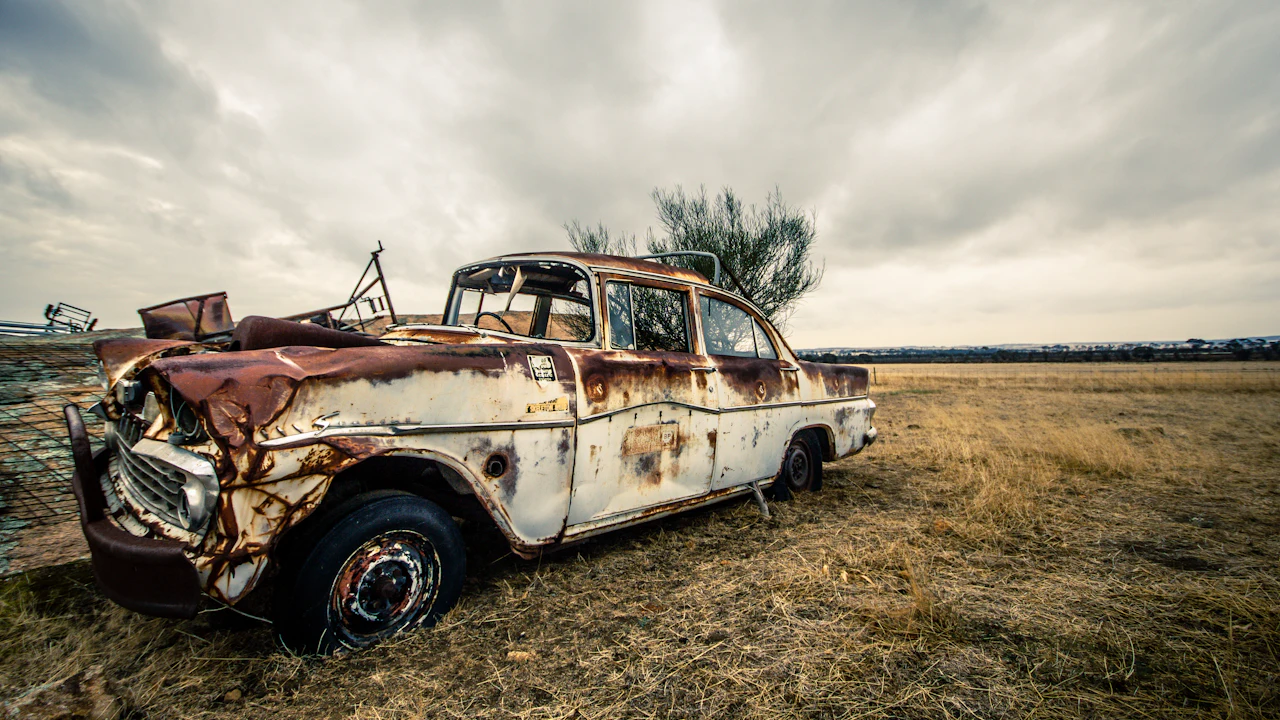
Repair, or walk away?
Not all corrosion is disqualifying. The decision comes down to whether the rust is cosmetic, structural, or safety-critical.
| What you found | Grade | What to do |
|---|---|---|
| Surface bloom on a subframe or an exhaust heat shield | Cosmetic | Normal on any car that has seen winters. Wire brush and treat; not a negotiating point |
| Bubbling paint along an arch lip or door bottom | Cosmetic becoming structural | Repairable, but properly means cutting out and welding in new metal, not filler. Price the real repair and negotiate |
| Flaking scale on brake or fuel lines | Safety-critical | Must be replaced before the car is driven. Factor a full line replacement into any offer |
| Perforation in a sill, floor pan or boot floor | Structural | The sill is a crash structure. This is a professional welded repair and often exceeds what the car is worth |
| Corroded suspension or subframe mounting points | Structural | Walk away. There is no economic repair on an ordinary used car |
| Rust on seat rails plus silt in the spare well | Flood indicator | Stop the inspection and check the title history before going further |
The rule of thumb that holds up: rust you can see on a hanging component is a maintenance item, rust in anything the car’s crash structure depends on is a reason to buy a different car. Sills, floor pans, subframes and suspension mounts are all in the second category.
Where the car lived matters more than how old it is
A used car’s geography is one of the more useful facts on its history report and one of the least discussed. Two identical cars of the same year and mileage, one from a salted northern state and one from a dry southwestern one, are not the same purchase. The southwestern car will have a clean underside and probably worse paint, dashboard cracking and perished rubber from ultraviolet exposure. The northern car will look better on top and be the one that eventually fails an inspection from beneath.
Coastal cars are their own case. Salt air corrodes without any road treatment at all, and it works on aluminium and electrical connectors as well as steel. A car that has spent its life within a mile of the ocean deserves the same underside inspection as one from a snow belt.
None of this appears in a listing. It appears in the registration history on a paid history report, and it is one of the more concrete reasons to buy one before committing to a car you have not seen in person.
Rust prevention is part of ordinary servicing
The most practical way to make any of this happen is to attach it to something you already do. Tyres get rotated every 5,000 to 7,500 miles, which means the car is on a lift with all four wheels off several times a year. That is the moment to ask the technician to look at the sills, the arch lips, the subframe and the brake lines, and to tell you if anything has changed since last time.
Do it twice and you have a baseline. Do it for three years and you will know exactly how fast your particular car is going and whether treatment is worth the money on it. The rest of the routine servicing schedule — which intervals matter after the warranty ends and which dealer add-ons are padding — is covered in our guide to used car maintenance that actually matters.
Frequently asked questions
Does undercoating prevent rust or hide it?
Both, depending on what was underneath when it was applied. A soft oil or wax-based coating applied to a clean, dry underside genuinely protects, because it creeps into seams and self-heals when stones chip it. A hard rubberised coating sprayed over existing corrosion seals moisture against the metal and conceals the damage from anyone inspecting the car. Ask when it was done and whether the underside was cleaned first.
How often should I wash the underside of my car in winter?
Roughly every two weeks while roads are being salted, and always after driving on freshly treated roads. Choose a day above freezing so water is not trapped as ice in the seams, and give the car a chance to drain before parking it in a heated garage.
Is surface rust on the underside a reason not to buy a car?
Usually not. Light surface bloom on subframes, exhaust heat shields and suspension components is normal on any car that has seen a few winters. What matters is whether the metal is still sound: press it firmly, and if it flexes, crunches or flakes into layers, it has gone beyond surface rust. Perforation anywhere in the sills, floor pan or suspension mounting points is a different conversation entirely.
Can rust be repaired properly, or does it always come back?
It can be repaired properly, but “properly” means cutting out every trace of affected metal, welding in new steel, sealing the seam and treating the inside of the section. Filler over rust always comes back, usually within two winters, because the corrosion continues behind it. Ask any seller whether a repair was welded or filled, and look at the inside of the panel where the work was done.
Do modern cars still rust?
Far less than cars from the 1970s and 1980s, thanks to galvanised steel, better sealants and cavity waxing at the factory. But the protection is finite and it degrades. Stone chips, kerbed sills, minor accident repairs and blocked drains all breach it, and once breached, a modern car corrodes on the same chemistry as an old one.
Where should I look for rust that sellers do not clean?
Under the boot floor in the spare wheel well, inside the door bottoms, behind the plastic wheel arch liners, along the jacking points, and at the seam where the rear arch lip folds under. Those areas are awkward to reach, rarely photographed, and are exactly where corrosion starts.
Does a car from a dry state avoid all of this?
It avoids salt corrosion, which is the expensive kind. It has its own problems: sun-degraded paint and clearcoat, cracked dashboards, perished window and door seals, and hardened rubber bushings. Neither climate produces a perfect used car — they just produce different inspection priorities.
Sources and further reading
- NHTSA flood-damaged vehicles
- NHTSA Office of Defects Investigation complaint database
- NHTSA recall lookup
- NY DMV inspection requirements
- FTC used car buying guide
Recall, complaint and safety-rating figures on this page were retrieved from the federal databases above on August 19, 2026. Federal data changes — re-check any VIN before you rely on it.
Published August 6, 2026 · last updated August 19, 2026. Found something out of date or wrong? Tell us and we will correct it.