How to Check a Used Car’s History Before Buying (2026 Guide)

The short version
- Six steps, in order. Five of them are free. The sixth — an independent inspection — is the one that saves the most money.
- Start by matching the VIN in three places on the car. If the windscreen, door jamb and title do not agree, the viewing is over.
- The federal decoder is free and exact. Given a sample VIN it returned a 2016 BMW 328i built in Rosslyn, South Africa, with a 241-horsepower 2.0-litre four — before anyone described the car to us.
- Title brands are permanent and follow the car across state lines. Salvage, flood, lemon and junk each mean something different, and only one of them is negotiable.
- A paid history report is a fourth opinion, not a verdict. It reports what was reported. Cash repairs, unreported accidents and pre-brand flood damage leave no trace in it.
Every used car arrives with a story attached, and most of the story comes from the person trying to sell it. The point of a history check is to replace that account with records — federal databases, state title files, reported odometer readings, and finally a mechanic who has the car on a lift and no reason to flatter it.
Done properly this takes an evening of work and one paid inspection, and it is the difference between buying a car and buying somebody else’s problem. Here is the sequence, in the order it should be run, with what each step catches and — just as importantly — what each step misses.
Step 1: match the VIN in three places before anything else
The Vehicle Identification Number is the car’s only permanent identifier. Every vehicle built for the US market since the 1981 model year carries a 17-character VIN, and the format never varies: characters 1 to 3 are the World Manufacturer Identifier, 4 to 8 are the Vehicle Descriptor Section describing the model, body, engine and restraint system, character 9 is a check digit, character 10 encodes the model year, character 11 identifies the assembly plant, and 12 to 17 are the sequential serial number.
Find it in three places and confirm they are identical:
- The base of the windscreen on the driver’s side, visible from outside the car.
- The driver’s door jamb sticker, which usually also carries the build date and tyre pressures.
- The title and registration documents the seller shows you.
There are more copies than three — under the bonnet, stamped into the structure, etched into the glass — and our guide covers where the VIN is on a car and what each location tells you.
Any mismatch ends the viewing. So does a VIN plate that looks disturbed, has rivets that do not match the others, or shows adhesive residue around the edges. There is no innocent reason for a VIN to have been touched.
Two quick format checks. The letters I, O and Q never appear in a VIN — they were excluded to avoid confusion with 1 and 0. And a VIN with fewer or more than 17 characters on a car of 1981 or later is not a VIN. Either of these means you are reading something wrong, or something is wrong.
Step 2: decode the VIN free, and hold the advert up against it
NHTSA’s vPIC decoder is a free public service that returns the manufacturer’s own build specification for a VIN. No account, no payment, no limit. It is the fastest way to find out whether the car in front of you is the car in the advert.
We ran four sample VINs through it. What comes back is not vague:
| VIN | What NHTSA returned |
|---|---|
| WBA8E9G59GNT84880 | 2016 BMW 328i SA, sedan body, 2.0 L, 4 cylinders, 241 hp, assembled at Rosslyn, South Africa |
| 4T1B11HK4JU123456 | 2018 Toyota Camry L/LE/SE/XLE, sedan body, 2.5 L, 4 cylinders, 203 hp, 4x2, automatic, assembled at Georgetown, USA |
| 1FTFW1ET5DFA12345 | 2013 Ford F-150, pickup body, 3.5 L, 6 cylinders, 365 hp, 4WD, assembled at Dearborn, USA |
| SALGS2VF4FA123456 | 2015 Land Rover Range Rover HSE, SUV/MPV body, 3.0 L, 6 cylinders, 340 hp, automatic, assembled at Solihull, England |
Look at what that gives you for free. On the BMW: the model year is 2016, the engine is the 2.0-litre four rated at 241 horsepower, and the car was built in South Africa rather than Germany. On the Ford: 2013, the 3.5-litre six with 365 horsepower, four-wheel drive, Dearborn-built. Every one of those facts is checkable against the listing before you drive anywhere.
Take the BMW VIN apart by position and you can see the structure working: WMI “WBA”, VDS “8E9G5”, check digit “9”, year code “G” for 2016, plant code “N”, serial “T84880”. The Range Rover: WMI “SAL”, VDS “GS2VF”, check digit “4”, year code “F” for 2015, plant “A”, serial “123456”.
One detail worth carrying into the real thing: alongside every one of those results the decoder also returned an error, because the check digit in position 9 of each sample does not calculate. The specifications are still correct — they are read from positions that do not depend on the check digit — but the error line is the decoder telling you it cannot confirm the VIN is genuine. Most consumer tools display the specifications and discard the error. Our guide to the VIN year chart and the 10th digit works through how to run that check yourself in under a minute.
What a decode mismatch actually means
Most mismatches are seller error rather than fraud — people genuinely do not know which engine or trim they own, and second-hand adverts get copied from each other. But a mismatch is still a fact you now hold and the seller does not, and it is the cheapest leverage in the entire process. A car advertised as all-wheel drive that decodes as 4x2 is either the wrong advert or the wrong car, and you should find out which before you discuss price.
Step 3: pull open safety recalls
Enter the same VIN at nhtsa.gov/recalls. It returns unrepaired safety recalls reported by the manufacturer for that specific vehicle, covering the last 15 calendar years. Free, about two minutes.
Open recalls are common and are usually not a reason to walk away, because the remedy is free for the life of the car at any franchised dealer regardless of how many owners it has had. What matters is what the campaign is for. In our federal pull across 26 vehicles, the range was enormous: the 2018 Ford F-150 carried 19 campaigns, the 2016 Mercedes-Benz C300 carried 13, the 2016 Range Rover Sport 11, while the 2018 Hyundai Sonata and 2016 Range Rover Evoque carried one each.
And those two single campaigns are nothing alike. The Sonata’s, 21V619000 filed 6 August 2021, is a trunk lid latch — someone inside the boot could be trapped. The Evoque’s, 16V889000 filed 9 December 2016, is a front lower control arm fastener that, in NHTSA’s own words, could allow the knuckle to separate and affect vehicle handling. Same count, different universe.
Read the consequence line, note the campaign numbers, and ask a franchised dealer whether the parts are actually in stock. The full method, including what the Park It flag means and why campaigns stay open for years, is in our guide to checking a used car for open recalls.
Step 4: read the title, and understand what the brands mean
The title is the legal record of ownership, and any brand on it is permanent. Brands are recorded by the issuing state and carry across state lines when the vehicle is retitled, which is exactly why “title washing” — moving a car through states to shed a brand — is a known fraud pattern and why you check the brand rather than trusting a clean-looking document.
The brands, and what each one should do to your decision
- Clean — no reported brand in the issuing state. It is the baseline, not a guarantee: it means nothing was reported.
- Rebuilt / reconstructed — the car was salvage, was repaired, passed a state re-inspection and returned to the road. Legal to drive. Worth materially less, harder to insure and finance, and the quality of the repair is unknowable from the paperwork alone.
- Salvage — an insurer declared it a total loss. Not road legal in that condition. Do not buy one to drive unless you know precisely what you are doing.
- Flood / water damage — the brand with the longest tail. Corrosion and electrical faults surface for years afterwards, and they surface in places ordinary rust never appears.
- Lemon / manufacturer buyback — the manufacturer repurchased the car because it could not fix a defect. What the state tests actually require, and when a buyback is worth buying, is covered in the guide to lemon titles. New York publishes its own Used Car Lemon Law guidance covering the rights that attach to used vehicles bought from dealers in the state.
- Junk / certificate of destruction — parts only. It must never be retitled for road use. If you are being offered one as a running car, leave.
That list is a summary rather than the whole set — the full taxonomy, including the brands with no damage behind them at all, is in our guide to what a branded title is and what each brand costs you.
If the car in front of you carries one of the salvage-family brands, the decision needs more than a line in a list. Our guide to what a salvage title means for a buyer works through the insurer’s arithmetic and the consequences that only surface after you own the car. If it has already been repaired and re-titled, read what a rebuilt title actually certifies instead — the answer is a great deal less than the word implies.
Also confirm the seller’s name matches the title, and check whether a lienholder is listed. A car with an outstanding lien cannot be transferred cleanly until the loan is settled, and that is a problem you inherit if you pay first and ask later. New York’s requirements for registering and titling a vehicle spell out what has to be in order at transfer.
Spotting flood damage the paperwork missed
Not every flooded car gets branded — many are repaired and resold before an insurer is ever involved. NHTSA maintains public guidance on flood-damaged vehicles, and the physical tells are consistent: silt in the spare wheel well and under the carpet edges, corrosion on seat rails and bolt heads inside the cabin, a musty smell or an aggressively fresh one, water lines inside the headlight housings, and electrical faults that come and go. We go through the inspection in detail in our guide to rust and flood damage.
Step 5: verify the mileage against reported readings
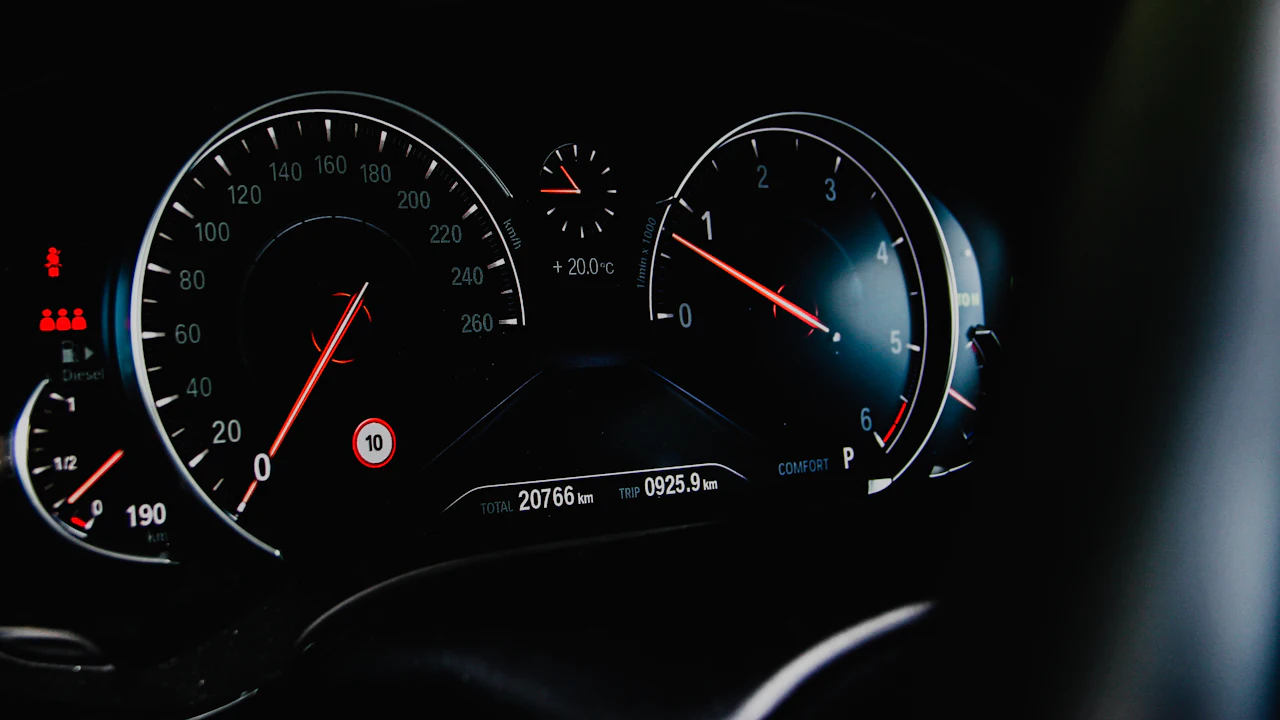
Odometer fraud is a federal offence and remains common because it is profitable — rolling back a digital odometer is a software job now, not a mechanical one. NHTSA maintains guidance on odometer fraud and what to do if you suspect it.
The defence is a sequence of reported readings over time. Every title transfer records a mileage disclosure; state inspections and many service visits record one too. Plotted in order, genuine readings climb steadily. Fraud shows up as a reading that is lower than an earlier one, or a suspicious flat spot where a car covered almost no distance for two years and then resumed.
Then check the car against its own claimed mileage. A steering wheel worn smooth, a shiny brake pedal rubber, a driver’s seat bolster collapsed on one side and a driver’s door check strap that clunks are all consistent with high mileage regardless of what the display says. Wear does not lie as easily as software.
Step 6: run a full history report — and know its limits
The free federal tools tell you what the car is and what campaigns are open. They do not tell you how many owners it has had, where it was registered, what accidents were reported, or what the odometer said at each transfer. That is what a paid report adds.
A good report should give you ownership count and duration, registration geography, reported accident and damage records, title brand history across states, reported odometer readings with dates, and any recorded service or inspection events. Running a vehicle history report by VIN before you travel to a viewing is the efficient order to work in — you arrive already knowing which questions matter, rather than discovering the answers in the driveway.
Registration geography is the most underrated field
Where a car spent its life tells you what to inspect. A car registered in the northeast has driven on salted roads every winter, and its underside deserves a proper look for the reasons set out in our rust guide. A car registered on the Gulf coast during a major storm season needs a flood inspection whether or not a brand appears. A car that moved states three times in two years is worth asking about.
What no report can see
This is the part sellers rely on. A history report reports what was reported, and a great deal is never reported at all:
- Accidents settled in cash between two drivers, with no insurance claim and therefore no record.
- Repairs done at independent shops that do not feed data to reporting networks.
- Damage repaired before any brand was applied, including flood cars cleaned up and moved on quickly.
- Deferred maintenance — the transmission fluid never changed, the timing belt overdue, the brakes at the wear indicator. None of it appears anywhere.
- Current mechanical condition, which is the thing you are actually buying.
Treat a clean report as an absence of red flags, not as evidence of a good car. Two reports on the same car from different providers can differ, because they draw on different data feeds — we go through why in Carfax vs AutoCheck, and through how far any single report can be trusted in how accurate Carfax actually is. And no report substitutes for the next step.
Step 7: the paid inspection that pays for itself
An independent pre-purchase inspection by a mechanic you choose is the only step in this list that examines the car rather than its paperwork, and it is the step buyers skip most often. It costs roughly one modest repair bill and routinely finds several.
What it should cover:
- The car on a lift — subframe, sills, floor pan, suspension mounts, brake and fuel lines, exhaust, and evidence of impact or crude repair underneath.
- A full diagnostic scan of every module, including stored and intermittent codes rather than just current ones.
- Compression or leak-down testing where the engine’s history warrants it.
- Fluid condition — oil, coolant, brake fluid, transmission fluid. Burnt transmission fluid on a car with no service record is a costed problem, not a detail.
- Paint depth readings across panels, which reveal repaired bodywork that no report recorded.
- A cold start, arranged in advance. Sellers warm cars up for a reason.
- Every electrical feature exercised — windows, seats, sunroof, climate, cameras, sensors.
Never accept the seller’s mechanic, and never accept an inspection at the selling dealer’s own workshop. Independence is the entire value of the exercise.
What the federal data says about reading a specific car
Once you know what the car is, model-level federal data tells you what to look at hardest. It is not a verdict on the individual vehicle — it is a list of where to point the torch.
Complaint volume alone is misleading, because popular cars generate more complaints. The 2018 Honda Accord has 1,838 owner complaints across 33 categories, the highest in our pull; the 2018 Toyota Camry has 731 across 34. Both are five-star cars in every NHTSA crash category. What is useful is the concentration: engine leads the Accord file at 527 reports, while the Camry’s top category is power train at 190 followed by service brakes at 166. Those point at different pre-purchase checks on two cars with similar reputations.
The same reading applies at the luxury end. The 2016 Mercedes-Benz C300 has 315 complaints across 23 categories with engine leading at 99. The 2015 BMW 328i has 124 across 20 categories, led by electrical system at 56 — which tells you to insist on a full module scan rather than a compression test. The 2016 Range Rover Sport’s 75 complaints are led by steering at 23 with suspension at 11 close behind, which tells you to check the air suspension overnight. The 2016 Audi Q5’s 77 complaints lead with engine at 26. We work through that segment in detail in our guide to buying a used luxury car, and through the mainstream class in our midsize sedan comparison.
When data is missing, that is not a zero. Our recall fetch for the 2016 Audi A4 returned nothing at all. That means we have no recall figure for it — not that it has no recalls. Treat a blank in any database the same way: as a question you still have to answer, not as a clean result.
Buying in New York: the extra boxes
State rules sit on top of everything above, and New York’s are specific.
- Inspection. New York requires periodic safety and emissions inspection. Ask when the current sticker expires and what was noted at the last one — the state’s inspection requirements set out what is covered.
- Used Car Lemon Law. New York’s law provides a statutory warranty on qualifying used vehicles bought from dealers, scaled by mileage. It applies to dealer sales, not private ones, and it is worth reading before you sign rather than afterwards.
- Title transfer. Confirm the paperwork the DMV will require at transfer, particularly if there is a lien or the seller’s name does not match the title. Checking for a lien is its own step and no history report does it for you.
- Salt exposure. Any car that has spent northeast winters on treated roads needs its underside inspected properly, on a lift, every time.
On the finance side, if you are borrowing to buy, the Consumer Financial Protection Bureau publishes independent auto loan guidance covering how dealer-arranged financing works and what to compare. Arrange your own approval before you shop so the price conversation and the finance conversation stay separate.
Dealer or private seller: what changes
The checks are identical. The protections are not.
Buying from a dealer, the Federal Trade Commission’s Used Car Rule requires a Buyers Guide displayed on the vehicle, stating whether it is sold with a warranty or as-is and, if there is a warranty, what it covers and for how long. That document becomes part of the sale contract, and if the salesperson tells you something the Buyers Guide contradicts, the Buyers Guide is what you can enforce. Dealers may also offer certified pre-owned programmes with manufacturer backing.
Buying privately, you usually get a lower price and almost no recourse. There is no Buyers Guide, no statutory used-car warranty in most cases, and no obligation on the seller to disclose an open recall. Everything you know about the car is what you verified yourself — which is precisely why the sequence above matters more, not less, in a private sale. Our guide to buying a car from a private seller works through the verification that has to replace those missing protections, in the order it needs to happen.
Red flags that should end a viewing
- VIN mismatch between windscreen, door jamb and title, or any sign the plate has been disturbed.
- The seller’s name is not on the title, and the explanation involves a friend, a relative or a business that is not present.
- Pressure to skip the inspection — a deadline, another buyer arriving, a discount that expires today.
- A price well below the market with no explanation the paperwork supports.
- Refusal to allow a cold start, or an engine that is already warm when you arrive after being told it had not been driven.
- Silt, corrosion inside the cabin, or intermittent electrical faults — flood indicators regardless of the title.
- Fresh undercoating on an older car. Sometimes maintenance, sometimes concealment, always worth getting on a lift.
- No service records at all on a car whose owner claims meticulous maintenance.
After you buy
The check does not end at purchase. Register the vehicle in your name with the manufacturer so recall notices reach you rather than a previous owner’s address — as we found, a 2015 BMW acquired two air bag campaigns in 2024, nine years after it was built. Re-run the free recall lookup annually. Keep every invoice, because a documented service history is worth real money at trade-in time, as we cover in our guide to what moves a trade-in number. And get ahead of the intervals rather than behind them, using our used car maintenance guide.
One more thing worth doing on day one: run a full VIN report on the car you now own and file it. It is your baseline. When you come to sell, being able to hand a buyer a documented history — recalls closed, mileage consistent, brands clean — is what separates a car that sells quickly at your price from one that sits.
If you want the boundary of what the decode itself can answer before you start, our guide to what a VIN lookup returns lists the fields NHTSA publishes and the six common questions that have no federal record behind them at all.
Frequently asked questions
How do I check a used car’s history before buying?
Work in order: match the VIN on the windscreen, door jamb and title; decode it free with NHTSA’s vPIC tool to confirm the specification; run the free federal recall lookup; read the title for brands such as salvage, flood or lemon; verify the odometer against reported readings over time; run a paid history report for ownership, accident and mileage records; then pay an independent mechanic for a pre-purchase inspection. Five of those seven steps cost nothing.
Is a free VIN check enough?
It is enough to confirm what the car is and whether it has unrepaired safety recalls, and those are genuinely valuable. It will not tell you how many owners it has had, whether it was in a reported accident, what the odometer read at each transfer, or where it was registered. For that you need a paid report — and for the car’s actual condition you need a mechanic, because no database has ever driven the vehicle.
What does a branded title mean?
It means a state recorded a permanent status on the vehicle. Salvage means an insurer declared it a total loss and it is not road legal as-is. Rebuilt means a salvage vehicle was repaired and passed re-inspection. Flood means water damage, with electrical and corrosion problems that surface for years. Lemon or manufacturer buyback means the maker repurchased it over a defect it could not fix. Junk means parts only. Brands follow the vehicle across state lines.
Can a VIN check detect odometer rollback?
Indirectly, and only where readings were reported. Title transfers, state inspections and some service visits record mileage with a date. Plotted in sequence, a reading lower than an earlier one, or a long implausible flat spot, indicates tampering. If a car’s readings were never reported, there is nothing to compare — which is why physical wear on the steering wheel, pedals, seat bolster and door strap still matters.
What can NHTSA’s free VIN decoder tell me?
The manufacturer’s build specification. Running four real VINs returned, among other things, a 2016 BMW 328i with a 2.0-litre four-cylinder rated at 241 horsepower built in Rosslyn, South Africa; a 2018 Toyota Camry with a 2.5-litre four at 203 horsepower built in Georgetown, USA; a 2013 Ford F-150 with a 3.5-litre six at 365 horsepower built in Dearborn; and a 2015 Land Rover Range Rover HSE with a 3.0-litre six at 340 horsepower built in Solihull, England. All free, in seconds.
Does a clean history report mean the car is fine?
No. It means nothing adverse was reported. Accidents settled privately in cash, repairs at shops outside reporting networks, damage fixed before any brand was applied, and every item of deferred maintenance leave no record at all. A clean report removes known red flags; only an independent inspection tells you the condition of the car you are about to buy.
Should I check recalls on a car I already own?
Yes, once a year. Campaigns are filed when defects surface in the field, which is frequently years after the car was built — the 2015 BMW 328i in our data picked up two separate air bag campaigns in 2024. Register the vehicle in your name with the manufacturer so notification letters reach you, and remember the remedy is free at any franchised dealer for the life of the car.
Do I need all of this for a cheap car?
The free steps take under half an hour combined and are worth doing at any price. The paid inspection is the judgement call — but the cheaper the car, the less margin you have for a surprise transmission, and the more likely the seller is relying on you not looking. Run the free checks on everything and pay for an inspection on anything you are seriously considering.
Sources and further reading
- NHTSA VIN decoder
- NHTSA recall lookup
- NHTSA odometer fraud
- NHTSA flood-damaged vehicles
- NHTSA Office of Defects Investigation complaint database
- FTC used car buying guide
- FTC Used Car Rule
- NY DMV register and title a vehicle
- NY Attorney General: Used Car Lemon Law
- NY DMV inspection requirements
- CFPB auto loan resources
Recall, complaint and safety-rating figures on this page were retrieved from the federal databases above on August 19, 2026. Federal data changes — re-check any VIN before you rely on it.
Published August 18, 2026 · last updated August 19, 2026. Found something out of date or wrong? Tell us and we will correct it.