Progressive Roadside Assistance: What It Covers, Limits, Claims
Progressive sells roadside help only as a coverage on its policies, and Agero sends the truck. What the roadside page promises, what the policy form posted by Maine’s regulator actually allows (three calls per car in six months, the nearest shop, an hour of labor), why each use is a claim, and where Progressive’s own documents disagree.
The short version
- Progressive roadside assistance is not a membership. It is an optional coverage added to a Progressive auto, motorcycle, RV or boat policy, and Progressive says the service is provided by Agero.
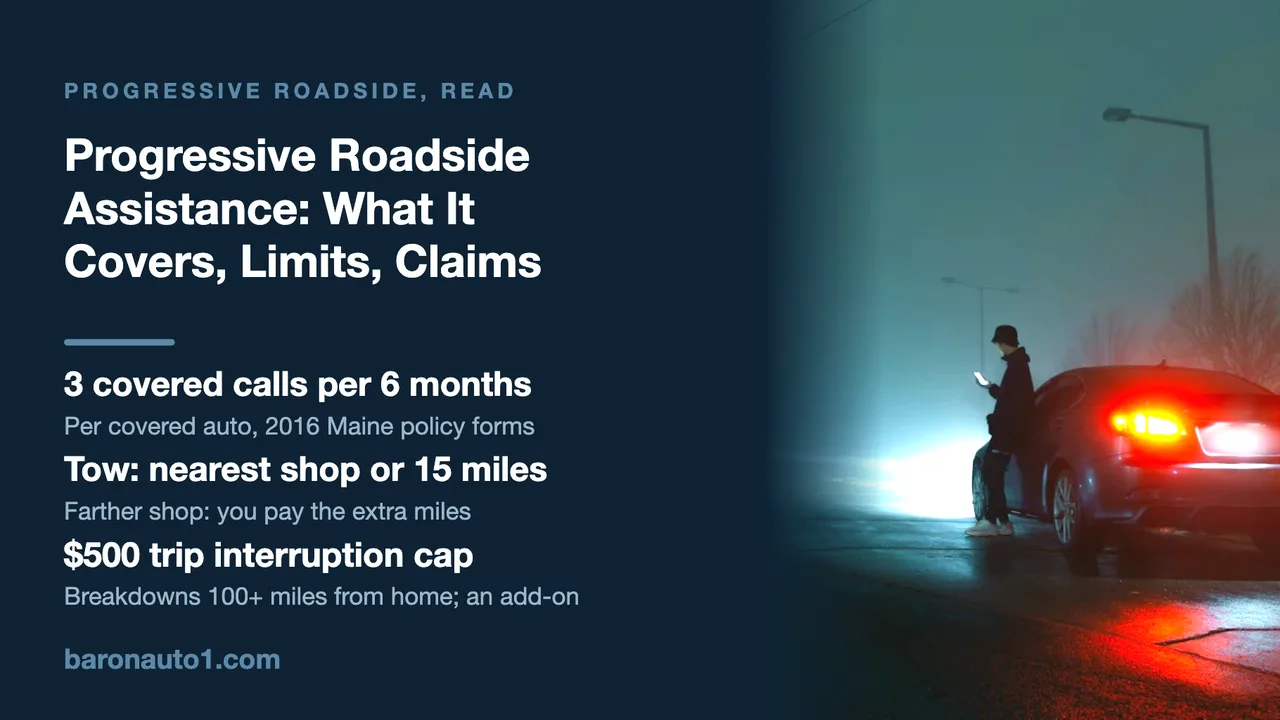
- Progressive’s roadside page promises a tow “anywhere within a 15-mile radius.” Its policy forms promise a tow to the nearest qualified repair facility, and any farther shop means paying the extra miles.
- The Progressive auto policy forms posted by Maine’s insurance regulator (dated September 2016) exclude “more than three covered emergencies for any single covered auto in a six-month period,” labor past 60 minutes, and the cost of fuel, parts and replacement keys.
- Using it is a claim: “you’ll file a claim to use your coverage,” Progressive says. No Progressive page we read says whether a roadside claim changes your premium.
- Trip interruption is a separate add-on where sold: up to $500 when you break down more than 100 miles from home, with daily limits of $100 for lodging and $50 each for transport and food.
- Progressive prints no price for auto roadside coverage, and coverage you add “may not be effective the same day.” Add it before a trip, not from the shoulder.
Progressive roadside assistance is a line on an insurance policy. You pay for it in your premium, it attaches to the cars on your policy, and when you use it you file a claim that Agero, an outside roadside company, carries out. The marketing page describes the services; the policy form decides what is covered. On 26 October 2026 we read Progressive’s roadside assistance page, its Answers article on towing, its coverage, rideshare, boat, app and claims pages, its commercial roadside pages and two newsroom releases, then Part V of the Progressive auto policies posted by the Maine Bureau of Insurance and the Oklahoma Insurance Department, and The Progressive Corporation’s SEC filings. This site has no commercial relationship with Progressive, Agero or any roadside or insurance company. We print no phone numbers.
What Progressive roadside assistance is: a coverage, not a membership
Progressive’s roadside page puts it in one line: “Progressive’s 24/7 Roadside Assistance is an extra coverage you can add to your policy.” There is no card sold on its own and no pay-per-use option on the pages we read. You need a Progressive policy, and not every one qualifies: “The majority of Progressive auto policyholders are eligible for roadside assistance coverage,” the Answers article says, adding that “coverage is always optional.” The same name covers several products.
| Product | What it is | Who provides the service |
|---|---|---|
| Roadside Assistance on an auto policy | An optional coverage on the policy; using it is a claim | Agero, per Progressive’s roadside page |
| Roadside on a motorcycle, RV/trailer or boat policy | The same coverage; it also covers the vehicle or trailer that tows or hauls the insured one | Agero (Progressive’s boat page says the same) |
| Trip interruption | An add-on to roadside, where sold, for breakdowns more than 100 miles from home | Reimbursement under the policy |
| Sign & Glide | A separate boat coverage for help on the water, printed at $30 a year ($50 in Florida) | Progressive’s dispatch center; no provider named |
| Commercial Roadside Assistance | An optional coverage for cars, pickups and vans on a commercial auto policy | Agero, per Progressive Commercial |
| Heavy Truck Roadside Assistance | A commercial coverage with dollar limits and a $250 deductible | TTN Fleet Solutions, per a 2023 release |
Accident Response is easy to confuse with roadside help. It is a feature in the Progressive app, launched nationwide in November 2024, that uses phone sensors “to detect when a customer may have been in a major accident” and can send emergency services or a tow. What the tow costs is “subject to the coverage purchased under a customer’s personal auto policy,” and once a tow is requested, “Progressive will automatically submit a claim.” It is not available in California.
Progressive does not report roadside as a business of its own: its 10-K for 2025 and its 10-Q for the quarter to June 30, 2026 never use the word. The 10-Q counts 11,211 thousand agency and 16,721 thousand direct auto policies in force, about 27.9 million personal auto policies by our arithmetic. How many carry roadside is not published.
Who sends the truck: Agero, by Progressive’s own pages
Progressive names its provider: “Services are provided by Agero, which is trusted by over 80 million drivers nationwide.” A 2017 roadside one-pager from its press kit says the services “are provided by Agero and its affiliate companies,” and the Progressive Commercial page says Agero “services claims for smaller commercial vehicles.” Heavy trucks are the exception: Progressive’s May 22, 2023 release routes them to TTN Fleet Solutions, “which will dispatch a qualified service provider to the site of disablement.”
So the coverage and the claim are Progressive’s (its 10-K says “Our employees handle nearly all of our Personal Lines vehicle and Commercial Lines claims”), but the dispatch, texts and tow truck come through Agero. Our page on Agero explains how a request flows through it. The policy form never names Agero; it promises “our authorized service representative,” so the provider could change without the policy changing.
Progressive’s figure for Agero’s size is not consistent: “over 80 million drivers” on the personal page, “over 115 million drivers” on the commercial page. Agero’s own pages, as this site read them on 17 October 2026, say “150 Million drivers served each year.” None of this changes what your policy covers.
What Progressive roadside assistance covers, service by service
The roadside page offers help “Whether you’re in your own driveway or on the road” when a vehicle “has stopped running due to non-accident-related events.” Part V of the policy form says it in contract language: Progressive pays its “authorized service representative” for towing and on-scene labor after a “covered emergency,” a disablement from one of six causes: mechanical or electrical breakdown, battery failure, running short of fuel, oil, water or other fluid, a flat tire, “accidental lock-out,” or being stuck in snow, mud, water or sand within 100 feet of a road or highway.
| Service | Progressive’s roadside page | Policy form, Part V | What you still pay |
|---|---|---|---|
| Towing | Within a 15-mile radius, or to the nearest qualified shop if none is within 15 miles | To the nearest qualified repair facility; anywhere else, you pay the additional charges | Parts, repairs, extra miles |
| Winching | Stuck in mud, snow, water or sand within 100 feet of a road or highway | The same 100-foot rule; unmaintained roads, sand beaches and open fields excluded | Anything outside the rule |
| Jump-start | At the scene | Battery failure is covered; the cost of parts is not | A new battery |
| Fuel delivery | Delivery and service free | Fuel and fluid cost excluded | The fuel |
| Electric car out of charge | Tow within 15 miles, or to the nearest qualified charging facility | Not mentioned in the 2016 form | The charge |
| Locksmith | Keys lost, stolen or locked inside | “Accidental lock-out”; replacement keys and the labor to make them excluded | Replacement keys |
| Flat tire | Your spare put on “as long as you can provide a spare” | Tire repair, snow tires and chains excluded | Repairing or replacing the tire |
| On-scene labor | Up to one hour | Labor “in excess of 60 minutes per disablement” excluded | Labor past the hour |
The pattern: roadside coverage pays for the visit, not for anything the visit uses up. Fuel delivery is free, but “You only pay for the cost of the fuel.” A jump-start is covered; a battery that will not hold a charge is yours, since the form excludes “the cost of purchasing parts.” If the battery is young, its own warranty may help: see our battery warranty guide and signs of a bad battery. The truck fits your spare but the form excludes “tire repair,” so a car with no spare (see run-flat tires) gets a tow, not a repair.
Keys have a wording gap. The website covers keys “lost, stolen, or accidentally locked inside your vehicle”; the 2016 form’s covered emergency is “accidental lock-out.” Both agree you pay for new keys, and Progressive’s Answers article adds that if a locksmith cannot copy a key, roadside “can pay to tow your car to a dealer or other service shop qualified to make a new key.” Our guide to replacement keys covers that step.
Roadside never pays for the repair itself. “Car insurance generally doesn’t cover a mechanical breakdown unless related to a covered peril,” Progressive’s Answers article says; that is the job of a warranty or mechanical breakdown insurance, which Progressive’s own MBI page says does not cover towing. And “Your auto insurance company won’t cover impound or lot fees.”
How far Progressive tows your car
This is where Progressive’s documents disagree most. The roadside page, the Answers article and the 2017 one-pager all describe a radius: a tow “anywhere within a 15-mile radius,” or to the nearest qualified shop if none is within 15 miles. The policy forms describe a destination. Part V of the Maine and Oklahoma forms promises “towing of a covered disabled auto to the nearest qualified repair facility,” and the Maine forms add: “If a covered disabled auto is towed to any place other than the nearest qualified repair facility, you will be responsible for any additional charges incurred.”
The roadside page carries the same warning beside its 15-mile promise: “If you choose to have your vehicle towed to a shop that isn’t the closest one, you need to pay for the extra mileage.” So “anywhere within” 15 miles is not free choice of shop. The safe reading is the policy’s: the covered tow ends at the nearest qualified facility, and any other destination costs you the difference. If you want your own mechanic or a dealer, ask the dispatcher for the extra charge before the truck hooks up. Electric cars get the same treatment, with a charger in place of a shop.
How many calls, and the 16 exclusions in the policy form
Progressive’s roadside page prints no number of calls: “There may be a limit to the number of roadside events your policy covers. Additionally, in some states, such as North Carolina and Virginia, Roadside Assistance coverage is subject to limits stated on your policy.” The number is in the policy. Maine’s regulator posts two Progressive forms, Form 9611A ME (09/16) for three Progressive companies and Form 9611D ME (09/16) for a fourth, whose Part V is word for word the same (our comparison). Its first exclusion is the limit: no coverage for “more than three covered emergencies for any single covered auto in a six-month period.”
The count is per car, not per policy, and a fourth call in the period is simply not covered. Progressive’s 2017 one-pager calls the window “any rolling six-month period,” so it may not reset on a set date. Progressive Commercial prints the same rule for business vehicles: “You can use this coverage three times per insured vehicle every six months. We can send assistance a fourth time, but it will be at your expense.”
Older forms worked differently. Progressive Direct’s Oklahoma form, Form 9610D OK (07/06), has no numeric cap. It excludes “a second service call or tow for a single disablement” and “repeated service calls for a covered disabled auto in need of routine maintenance or repair,” and also “towing from a service station, garage, or repair shop.” The posted forms are 10 and 20 years old by our arithmetic, and both regulators say they are not the whole policy: Maine warns that “other forms and endorsements not listed here may impact coverage,” and Oklahoma that optional endorsements “are not listed here.” Your own declarations page and policy booklet decide.
| Document | How many calls | On-scene labor | Tow destination |
|---|---|---|---|
| Maine Form 9611A/9611D ME (09/16) | Not more than three covered emergencies per covered auto in a six-month period | 60 minutes per disablement | Nearest qualified repair facility |
| Oklahoma Form 9610D OK (07/06) | No number; no second call or tow for one disablement | 60 minutes per disablement | Nearest qualified repair facility |
| Progressive roadside page | “There may be a limit” | Up to one hour | Within 15 miles, or the nearest qualified shop |
| 2017 roadside one-pager | Your “policy limit” in “any rolling six-month period” | Up to one hour | Within 15 miles, or the nearest qualified facility |
| Progressive Commercial (light vehicles) | Three per insured vehicle every six months; a fourth at your expense | Up to one hour | Nearest qualified repair shop |
Three calls go fast in a bad winter. A dead battery, then a lockout, then a car stuck in snow at the roadside is three covered emergencies under the 2016 Maine forms. A fourth in the same six months is excluded outright. If a car keeps needing jump-starts, fix the cause rather than spending your calls.
The full list in the 2016 Maine forms has 16 exclusions. Besides the call and labor limits, coverage does not apply to: parts, fluid, lubricants, fuel or replacement keys, or the labor to make keys; work not related to the disablement; towing or storage tied to impoundment, abandonment or illegal parking, and storage charges; help with jacks, levelers, airbags or awnings; labor or repairs at a service station, garage or repair shop; disablement “on roads not regularly maintained, sand beaches, open fields, or areas designated as not passable due to construction, weather, or earth movement”; snow tires, chains and tire repair; disablement from an intentional act by you, a relative or the driver; a car used for ride-sharing activity or in a personal vehicle sharing program; and a trailer.
The road rules matter more than they look. Winching is promised only “within 100 feet of a road or highway,” and unmaintained roads, beaches and open fields are excluded outright, so a car stuck at a trailhead or in a snowed-in field may be outside the coverage even though it is plainly stuck.
Trip interruption: the add-on for breakdowns far from home
Trip interruption is sold on top of roadside coverage, “in states where available.” Progressive’s roadside page says it applies when your car, motorcycle or RV/trailer “breaks down more than 100 miles from home,” and “covers up to $500 of your covered breakdown costs like alternative transportation, a hotel, and food,” with “The daily limit is $100 for lodging, $50 for transportation, and $50 for food.”
Those limits stack to $200 a day, so at the daily maximums the $500 cap is used up in 2.5 days (our arithmetic). Progressive pitches it for the weekend breakdown, when “the local repair shops don’t open until Monday,” and that is about the stay it pays for. The coverages page adds that “Trip interruption isn’t available for off-road vehicles.” We did not find the endorsement itself, so we cannot quote how a claim is documented; keep every receipt and the repair order.
Does using Progressive roadside assistance count as a claim?
Yes, by Progressive’s own account. Its Answers article asks “Is roadside assistance considered a claim?” and answers: “Yes, if you have roadside assistance coverage and your car experiences a breakdown not related to an accident, you’ll file a claim to use your coverage.” Roadside claims may go through “a designated phone number that will dispatch a service person quickly rather than having you follow the standard car insurance claims process.” The roadside page itself sits in the Claims section of Progressive’s site.
Whether a roadside claim moves your premium is not answered on any Progressive page we read. What Progressive says about claims in general: “Your claim will not impact your current rate. But when you renew your policy, your rate may increase,” and “There are some claims that typically won’t raise your rate, like a claim that we didn’t make a payment on or one with a payment of less than $500.” Its article on multiple claims adds that “Depending on your state, insurer, and type of claim, your auto policy’s rate may increase because of multiple claims.” “Typically” is not a promise; if it matters to you, ask Progressive and note the answer.
Accidents are different. Roadside covers non-accident events. After a crash, the cost of a tow “may be covered under the at-fault driver’s liability coverage” if someone else caused it, and “if you’re found to be at fault for the accident, you may be responsible for towing expenses, depending on your coverage.”
How to request help, and what happens if you call your own tow truck
Progressive’s roadside page gives three ways to ask: “You can download and use the Progressive app, get support online, or call us.” The app page lists a roadside feature (“Get roadside help, exactly when you need it most”) and uses your location “to make it easier to file a claim, request roadside assistance, or find a local agent.” The “get support online” link points to a separate domain (app.my-roadside.com), which we did not open. The phone number is on Progressive’s roadside page and your policy documents.
Because Agero provides the service, texts during the event may come from Agero’s systems. Agero’s terms, as this site recorded them on 17 October 2026, say customers “may receive text messages that directly relate to the requested roadside assistance and/or towing service event,” and its provider FAQ says an en-route driver triggers “a text message with a live tracking link.” Fake messages imitate them; our guide to real and fake Agero messages covers what to check. A text about a tow you did not request is not from your coverage.
You can use another tow company, but it costs you. The policy form’s “UNAUTHORIZED SERVICE PROVIDER” clause says that then “we will pay only reasonable charges, as determined by us,” for the tow to the nearest qualified repair facility and the on-scene labor, and that payment is “excess over any other collectible insurance or towing protection coverage.” That is how reimbursement works under the 2016 forms: you pay the tow company, claim, and Progressive decides what was reasonable. Keep the itemized receipt, the distance and the destination.
Motorcycles, RVs, boats, rideshare and commercial vehicles
Progressive’s roadside page says the coverage “covers the same events whether you drive a car, motorcycle, boat, or RV.” One rule is unique to the non-car policies: roadside on a motorcycle, boat or RV/trailer policy “extends to any vehicle or trailer that tows or hauls it, even if that vehicle or trailer is not insured by us.” If the truck pulling your insured camper breaks down, the camper’s policy can send help.
Motorcycles and RVs. The motorcycle page says roadside “will tow your bike to the nearest repair shop for free” if it is “disabled within 100 feet of a public road”; the RV page uses the same 100-foot condition for a motorhome or travel trailer, and says the coverage “can cover fuel delivery, mechanical breakdowns, flat tires, and dead battery replacement.” We did not read an RV policy form, so confirm whether a new battery is really paid for. Progressive’s 10-K says its special lines products (motorcycles, RVs, watercraft) “are not written in the District of Columbia.”
Boats. Roadside “does not apply on the water.” On land, “Boat roadside assistance is automatically covered if you have a trailer listed on your policy.” On the water, Progressive sells Sign & Glide at “$30/year in all states except Florida ($50/year),” with “unlimited tows and no deductible” through its dispatch center, or reimbursement “with limits of $250/per hour or $3,000/per disablement” if you arrange your own.
Rideshare and delivery driving. The 2016 Maine form excludes a car “used in connection with ride-sharing activity,” which it defines as running from the time a driver logs on to a ride-hailing or delivery app until they log off, “whether or not the user has accepted any passenger(s) or delivery assignment.” Progressive’s rideshare page says it “requires you to add rideshare insurance coverage to your personal auto policy if you’re driving for a rideshare company,” and its table shows roadside and trip interruption provided by Progressive both while waiting for a rider and during a trip, if “you carry them on your personal auto policy.” We did not read the rideshare endorsement. Without it, assume a breakdown while logged in is not covered.
Commercial vehicles. Progressive Commercial sells the same kind of coverage for business cars, pickups and vans, “available in all states,” with three uses per vehicle every six months. Heavy trucks get dollar limits instead: “up to $500 in labor and $5,000 in towing to the nearest qualified repair facility for your truck and attached trailer,” with “a $250 deductible at the time of service.” Progressive’s shareholder letters trace that rollout from seven states in the first quarter of 2022 to “46 states that collectively account for approximately 92% of eligible vehicles” by the third quarter of 2023.
Where Progressive’s own documents disagree
Progressive’s Answers articles end with a caution that fits every page quoted here: “This information is not an insurance policy ... and does not modify any provisions, limitations, or exclusions expressly stated in any insurance policy.” When the page and the policy differ, the policy wins. The differences we found:
- Tow distance. “Anywhere within a 15-mile radius” on the web pages; the nearest qualified repair facility in the policy forms.
- Number of calls. “There may be a limit” on the roadside page; three per covered auto in six months in the 2016 Maine forms; no number, but no second call for the same disablement, in the 2006 Oklahoma form.
- Keys. Keys “lost, stolen, or accidentally locked inside” on the roadside page; “accidental lock-out” in the 2016 form.
- Agero’s size. “Over 80 million drivers” on the personal page; “over 115 million drivers” on the commercial page.
- Batteries. A jump-start on the auto pages, with parts excluded in the form; “dead battery replacement” on the RV page.
- The 100-foot rule. It limits winching on the auto pages, and the tow itself on the motorcycle and RV pages.
- Rideshare. Excluded in the base form; shown as covered while logged in on the rideshare page, for drivers who buy that add-on.
Before you add it: eligibility, timing, price, and roadside you may already have
Timing and other coverages. Current customers add roadside by logging in or by phone, and the roadside page warns: “Coverage may not be effective the same day.” Some help also depends on other coverages: “Some services described below are only available to customers who purchased coverages such as Comprehensive, Collision, Rental Reimbursement, Medical Payments, etc., before their loss.”
Price. Progressive prints no price for auto roadside coverage on any page we read. It is a line in your premium, visible only in your own quote or declarations page; we did not start a quote.
Which car it follows. Under the 2016 form, roadside attaches to the car, not the driver. A “covered disabled auto” is “a covered auto for which this coverage has been purchased,” and a covered auto is a car or trailer shown on the declarations page, an additional or replacement auto, or a trailer you own. A friend’s car or a rental is not in that definition, and on a two-car policy each car needs the coverage listed. The policy territory is the United States, its territories and possessions, and Canada.
Roadside you may already have. Progressive’s payment to an outside tow company is “excess over any other collectible insurance or towing protection coverage,” and many cars and tires already come with roadside help. These are terms this site recorded from each company’s own documents, with the date read; we compare terms, not prices, and the order carries no meaning.
| Plan | What its document says | Our page |
|---|---|---|
| Carvana 100-Day Limited Warranty and CarvanaCare | Roadside assistance including “towing (up to $200), jump start, flat tire assistance, locksmith assistance” [30 September 2026] | Carvana warranty |
| Volvo Roadside Assistance | “complimentary towing, regardless of age or mileage,” for 25 miles to an authorized Volvo dealer or collision center [30 September 2026] | Volvo extended warranty |
| Lincoln Protect service contract | Your own roadside help reimbursed “up to $100 per disablement,” with a written request within twenty (20) days [1 October 2026] | Lincoln extended warranty |
| Michelin replacement tires | Roadside “for 3 years after you purchase your Michelin replacement tires”; towing up to 150 miles if no inflated spare is available [7 October 2026] | Tire maker warranties |
| Sam’s Club tire installation package | Emergency roadside assistance “For four years from the date of purchase,” including towing, fuel delivery, lockout and winching [7 October 2026] | Sam’s Club tires |
| Tire Discounters | With any annual $25 purchase, reimbursement “up to $75 nationwide” for towing, jump starts, lock-outs and flat changes [9 October 2026] | Tire Discounters |
Other insurers sell roadside under their own rules; this site covers Allstate’s roadside products and State Farm’s separately, and states none of their terms here.
- Find it on your declarations page. Roadside is listed per car; a car without it is not covered.
- Read Part V of your own policy booklet. Check the call limit, the labor limit and the exclusions; the 2016 Maine forms are a guide, not your contract.
- Add it before a trip. New coverage may not take effect the same day.
- Know the tow rule. The nearest qualified shop is covered; anywhere else, ask the extra cost first.
- Carry a working spare. The truck fits your spare; it does not repair tires.
- Count your calls. Three covered emergencies per car in six months under the 2016 forms.
- Check rideshare cover if you drive for an app; the base form excludes it.
- Keep receipts if you use your own tow company; Progressive pays what it decides is reasonable.
Common questions
Does Progressive have roadside assistance, and how do I know if I have it?
Yes, as optional coverage on auto, motorcycle, RV, boat and commercial auto policies. You have it only if you added it: check the coverages listed for each car on your declarations page or in the Progressive app. Progressive says most auto policyholders are eligible and that “coverage is always optional.”
What does Progressive roadside assistance cover?
Towing, winching within 100 feet of a road, jump-starts, fuel delivery, a tow to a charger for an electric car, a locksmith, a spare-tire change and up to one hour of on-scene labor, for breakdowns not caused by an accident. You pay for fuel, charge, parts, replacement keys and tire repair, and for any tow beyond the nearest qualified repair facility.
How many times can I use Progressive roadside assistance?
The website says only that there may be a limit. The Progressive policy forms posted by Maine’s regulator, dated September 2016, exclude “more than three covered emergencies for any single covered auto in a six-month period.” Forms differ by state and date, so check your own policy.
How much is Progressive roadside assistance, and is it free?
It is a paid coverage priced inside your premium; Progressive prints no standalone price. Some services are described as free once you have it (fuel delivery: “The delivery and service is free”), but you pay for the fuel, and each use is a claim.
Will Progressive reimburse me if I call my own tow truck?
Under the 2016 forms, only “reasonable charges, as determined by us,” for a tow to the nearest qualified repair facility and on-scene labor, and only as excess over any other insurance or towing protection you have. Keep the itemized receipt.
How do I contact Progressive roadside assistance, and is it 24/7?
Progressive calls it “24/7 Roadside Assistance.” Requests go through the Progressive app, the “get support online” link on its roadside page, or the roadside number on that page and your policy documents; we print no phone numbers. Texts and tracking links during a call may come from Agero, which Progressive says provides the service.
Sources and further reading
Recall, complaint and safety-rating figures on this page were retrieved from the federal databases above on August 19, 2026. Federal data changes — re-check any VIN before you rely on it.
Published October 26, 2026 · last updated October 26, 2026. Found something out of date or wrong? Tell us and we will correct it.