Tire Agent Review: Shipping, Installers, Returns and Payment Plans
Tire Agent sells tires online and ships them free to you or one of its partner shops. What its return and one-hour cancellation rules, Allstate road hazard plan, PayPair lease-to-own partners, Terms of Use and Form D filings say, and the 13 places its own pages disagree.
The short version
- Tire Agent is an online-only tire store run by Tire Agent Corp., a Delaware company its About page says was founded by Jared Kugel. Its Form D notices on SEC EDGAR report $5,472,515 of shares sold in 2018 and 2020, by our arithmetic.
- Shipping is free to your address, to one of “over 2,000” partner installers or to a FedEx Print & Ship Center, in the 48 contiguous states only. Installation is extra, and its customer pages never say whom you pay for it.
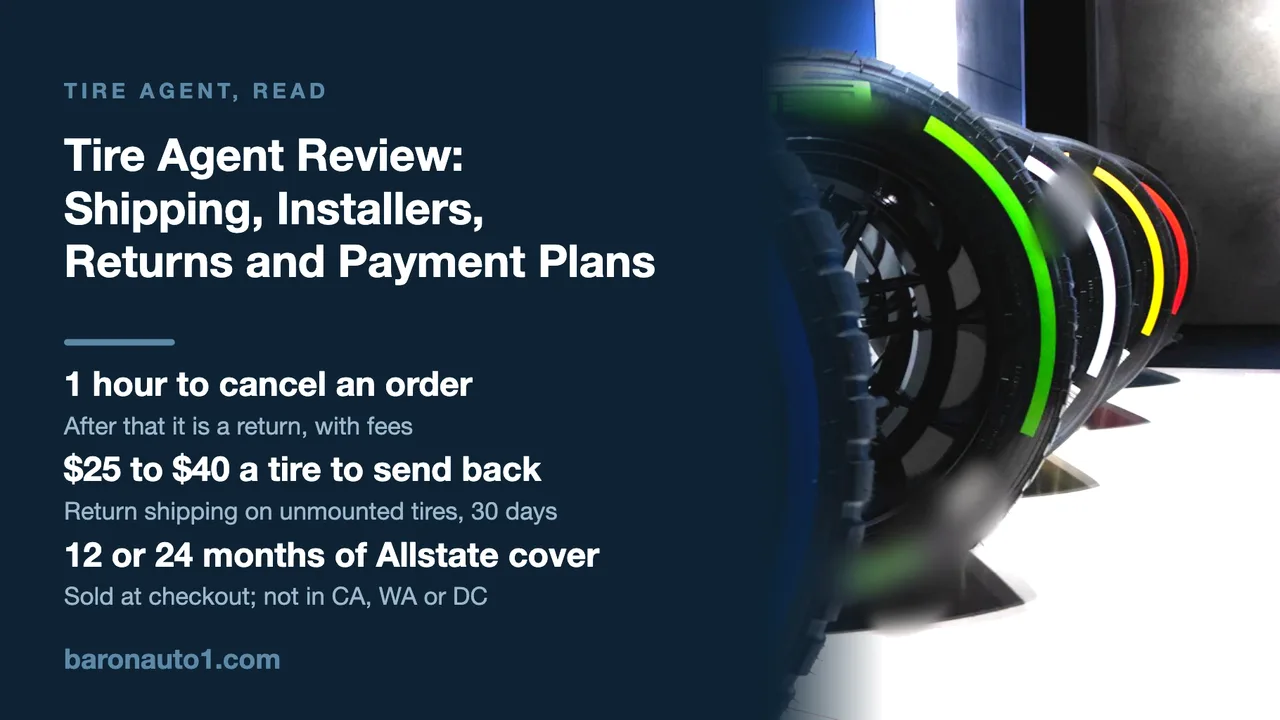
- Unmounted tires can go back within 30 days, but you pay return shipping of $25 to $40 a tire, and the FAQ adds restocking fees it never prices. Mounted tires cannot go back.
- Cancel within 1 hour of ordering. After that the FAQ treats a cancellation as a return, with fees.
- Road hazard cover comes from Allstate, sold at checkout for 12 or 24 months, not in CA, WA or DC, with no contract printed anywhere else. Most tire makers’ booklets exclude road hazards.
- Its PayPair payment plans are mostly lease-to-own deals, which the partners’ own disclosures say cost more than the cash price.
Tire Agent (tireagent.com) is an online tire store: you order on its site, it ships the tires free, and a partner shop, a mobile installer or you fit them. On 17 October 2026 we read its Terms of Use (last updated 3 March 2025), FAQ, return policy, warranty page, delivery and installation page, installer sign-up page, PayPair payment-plan page, About page, Privacy Policy, homepage and reviews page, plus Tire Agent Corp.’s three Form D notices on SEC EDGAR. Its Terms bar “unauthorized framing of or linking to the Site,” so we name its documents rather than link them. This site has no commercial relationship with Tire Agent or any tire seller.
How buying from Tire Agent works, and who owns it
The Terms of Use are an agreement with “Tireagent Corp.,” which says “We are registered in Delaware, United States” and gives a registered office in New York City. The footer on every page we read says “Tire Agent Corp.,” the spelling on SEC EDGAR, where the company is CIK 0001728706. The About page says Tire Agent “was founded by Jared Kugel, a tire industry veteran for more than a decade.”
EDGAR lists three Form D notices, the short filing a private company makes when it sells shares under an exemption from registration. They describe a Delaware corporation incorporated in 2017. The first, signed 19 January 2018, reports $500,000 of equity sold to 15 investors; an amendment on 31 January 2018 changes only the industry group, from “Manufacturing” to “Other.” The last, signed 18 May 2020 under “Retailing,” reports $4,972,515 sold to 41 investors: $5,472,515 in all, by our arithmetic. Kugel signed each as chief executive. No filing names a parent company and none has been made since 2020. A Form D is a notice, not an audited account, so who holds the shares today is not public.
You shop “By vehicle, by tire size, or by tire brand,” choose “Free delivery to a shipping address you provide, or free shipping to a Tire Agent tire installation partner,” then “Select a payment plan or pay in full.” An account is required. Tire Agent takes Visa, Mastercard, Amex and Discover, but “Prepaid cards are NOT accepted.” It says it carries “over 70 brands” and “over 1,000,000 tires,” all “brand new.” If an item is out of stock after you order, it offers “the choice of a full refund to the original method of payment or tires that are equal (or better) in quality”; check a substitute’s size, load and speed rating before you accept it.
Free shipping, delivery times and the 48-state limit
The delivery page promises “Tires and Wheels Delivered to You, Anywhere*, Fast and FREE,” and the FAQ says “We offer free shipping nationwide for every order on our website.” The asterisk leads to the limit: “Tire Agent delivers tires and wheels for free to continental United States addresses only.” Alaska and Hawaii get a plain “No, we currently only offer service to the continental 48 states.” No shipping charge is printed for any order, so inside those states free shipping is what it says.
The FAQ says “most orders will be shipped within one business day,” and “Most orders are typically delivered in 2 to 4 business days via Fedex Ground or one of our trusted carriers. About 40% of our orders are delivered within 1-2 business days.” Each tire has its own tracking number, you cannot pick a delivery hour, and Tire Agent says it is “not liable for carrier delays that are out of Tire Agent’s control.” Three rules are easy to miss:
- No warehouse pick-up, though you can collect from a FedEx Print & Ship Center.
- Wheels and tires ship separately and unmounted, so a wheel and tire set still needs mounting and balancing.
- Lease-to-own orders have fewer destinations. Paid by card or financing, an order can go to “any valid address in the lower 48 states.” On a lease-to-own plan Tire Agent “can only deliver to your billing address, preferred installer on our website or Fedex Print & Ship Center.”
Tire Agent installation: partner shops, mobile installers and who pays
Tire Agent does not fit tires itself. Its delivery page gives “3 options”: ship to you to install yourself, with a warning that “Some manufacturer warranties require tires and wheels to be installed by qualified automobile mechanics or tire/wheel installers”; ship to you and “schedule a mobile installer to come to you (where available)”; or ship “to a local installer with your name and details on the invoice.” The network “includes over 2,000 tire mounting places,” chosen at checkout. A shop is notified and, once the tires arrive, “you can call the store directly to schedule your installation.” For a mobile installer the tires come to your home, and after the full order arrives you fill in an appointment form that goes to the installer.
Who you pay is not stated. The FAQ says “Installation is not included in the tire price at this time,” and no customer page says whether you pay the shop or Tire Agent. The page that recruits shops is clearer: its steps end “Customer comes to you for installation” and “5. Tire Agent pays you.” Our reading is that an installation price picked at checkout is collected by Tire Agent and passed on, but checkout is a robots-disallowed area we did not open. Confirm it there, and if you paid for fitting at checkout, take the order confirmation to the shop so you are not charged twice.
What the shops sign up to. Joining is “100% free,” “Only 4 installers are shown per order,” and shops must “Uphold promised pricing” and “Provide Tire Agent customer care.” Tire Agent says it requires “a predetermined pricing program for installation” to “eliminate any surprise charges.” The same page tells shops to “Upsell your other services to grow your revenue,” so ask the price of any extra work, such as an alignment or valve stems, before you agree to it.
Who answers for the work is not stated either. No page says Tire Agent stands behind a partner’s workmanship, and its Terms say “WE DO NOT WARRANT, ENDORSE, GUARANTEE, OR ASSUME RESPONSIBILITY FOR ANY PRODUCT OR SERVICE ADVERTISED OR OFFERED BY A THIRD PARTY THROUGH THE SITE.” Treat a fitting problem as one between you and the shop. Keep the shop’s invoice: it is also your proof of professional installation, which Tire Agent’s warranty page lists for tread life claims. Using your own shop is allowed; the delivery page says to “Call first and ask how much carry-in tire mounting costs.”
How old the tires are, registration and TPMS sensors
Tire age. The FAQ says “Most of our tires are within 1-2 years old” and “We do not sell tires that exceed 4 years old from production date,” but also “We are not able to check each tire for the date of production,” so you cannot ask for a particular year; “If you receive a tire that is older please let us know.” Read every date code before anything is mounted. Under 49 CFR 574.5 it is the final group of the tire number, “consisting of four numerical symbols,” week first, then “the last two digits of the year of manufacture.” Our guide to the tire date code explains why age matters on unused tires too.
Registration. No Tire Agent page says it registers your tires with their maker. Its warranty page puts the job on you: for maker roadside programs, “Customer must register their tire(s) with the tire manufacturer after you purchase them from us.” Among the options 49 CFR 574.8 gives an independent dealer are handing the buyer a registration form already filled in with the tire numbers and the dealer’s name and address, or sending the details to the maker electronically “at no charge to the tire purchaser and within 30 days of the date of sale” and saying so on the invoice. We do not know which Tire Agent does. Look for a form in the box or a note on the invoice; if there is neither, register the tire numbers on the maker’s site yourself, because registration is how a recall letter finds you.
TPMS sensors. Sensors bought from Tire Agent “will be shipped to your home, even if you selected a tire shop for installation.” They come “pre-programmed for your specific vehicle” only if you entered your vehicle details “(including trim)” at checkout; otherwise they “will require programming before installation.” Our page on the TPMS light after new tires covers a failed relearn.

Tire Agent return policy, cancellations and restocking
The return policy says: “All returns are accepted within 30 days of delivery. Only unused tires and/or wheels that have not been mounted on a rim and/or vehicle will be eligible for return.” Tires must come back “in their original condition including manufacturer stickers when possible,” and unless Tire Agent made the mistake, “Customers will be responsible for the cost of shipping.” The return process page prices it: “Return shipping cost ranges from $25 - $40 per tire depending on the size of the tire,” or $100 to $160 for a set of four by our arithmetic. A logistics representative answers your request “within 2 business days,” you drop the tires at a FedEx location Tire Agent assigns, and “Refunds are processed within 5-7 business days once the tires have arrived at the warehouse.”
The FAQ differs in three places. It starts the 30 days at purchase: “you are eligible for a return within 30 days of purchase.” Its condition reads “if your item is unused/mounted,” an apparent typo. And it adds fees the return policy never mentions: “Return and restocking fees apply,” and refusing a delivery brings “an additional fee on top of return and restocking fees.” No page we read prints a restocking fee. Count the 30 days from the order date, and ask in writing what will be deducted before you ship anything back.
| Situation | How | What Tire Agent prints about the cost |
|---|---|---|
| Cancel within 1 hour of ordering | Its cancel form | No Tire Agent fee printed; a financing company may charge “up to $49” |
| Cancel after the first hour | Treated as a return | “Return and restocking fees apply”; no amount printed |
| Unmounted tires you no longer want, within 30 days | Return request, FedEx drop-off | Return shipping $25 to $40 a tire, plus the FAQ’s restocking fees |
| Refusing the delivery | Avoid it | “an additional fee on top of return and restocking fees” |
| Damaged or wrong tires | Shipment issues form | “A full refund will be issued or exchanged tires shipped at no additional cost” |
| Tires mounted on a rim or a car | None | Not eligible for return |
| Lease-to-own purchase, past 30 days | The leasing company | “Please contact your leasing or lease to own payment plan company” |
The cancel window is one hour. “All cancellation requests MUST be made within 1 hour from the time an order was placed,” the FAQ says, because “The warehouses begin pulling and loading orders shortly after orders are placed.” After that a change of mind is a return: you pay to ship the tires back, restocking fees may apply, and refusing the delivery adds another fee. A financed or leased purchase may also bring “a cancellation fee of up to $49 from your financing company (not Tire Agent).” Check the size and vehicle before you order.
Damaged or wrong deliveries. Use the shipment issues form and “keep the tires in its original condition and packaging with the original label.” Photograph the boxes and labels before opening.
Mounted means final. Because only tires not “mounted on a rim and/or vehicle” can go back, the check that matters comes before fitting: the size on each sidewall against the door-jamb placard, which our guide to finding your tire size treats as the authority, plus the date codes and the count.
Manufacturer warranty claims: what Tire Agent handles and what the maker decides
Tire Agent offers no tire warranty of its own. Its return policy says merchandise “is sold with the warranty by the manufacturer extended to the purchaser” and that “Other than applicable manufacturer’s warranties, there are no warranties, expressed or implied, including any warranty of merchantability or fitness for a particular purpose.” The FAQ promises “the same manufacturer warranties as buying from your local tire shop” and says “The date of warranty begins when you purchase the tire.” A claim runs through Tire Agent:
- Fill in its warranty form; “a Tire Agent representative will reach out to you within 2 business days.”
- Ship the tire back at your cost: “Customers will be responsible for shipping tires in the original order back to our warehouse.” Tire Agent sends it “to the manufacturer for a final determination.”
- Wait: “Once the manufacturer gives us a verdict (4 - 6 weeks), we will give credit back based on the approval of the manufacturer.”
- Buy again: “For road hazard and tread life warranty, a new tire must be purchased in order to receive credit back.”
“Not all tire claims are guaranteed a refund,” the policy adds. Keep your invoice and the shop’s receipt. Tire Agent’s warranty page also describes makers’ terms in its own words, and in places they differ from the booklets this site read for its tire manufacturer warranty guide. Your tire’s own booklet is what a claim is decided under.
| Term | Tire Agent’s warranty page and FAQ | The makers’ booklets (12 read) |
|---|---|---|
| Rotation for a tread life claim | “every 3,000 - 5,000 miles,” with documentation | 5,000 to 8,000 miles, apart from Toyo’s 3,500-mile figure for V-rated tires |
| Road hazard damage | “Manufacturers will cover the cost of a new tire” if it cannot be repaired; “Usually only covers 1 year” | Michelin, Goodyear, Cooper, Bridgestone, Yokohama and Toyo list road hazards as not covered; Continental (as goodwill) and General replace in the first 12 months or 2/32 inch; Hankook for listed lines in the first year; Pirelli for Run Flat tires |
| How long defect cover lasts | “This varies depending on the manufacturer” | 72 months from purchase for 8 makers, 60 months for 4 |
| Trial or satisfaction returns | Not mentioned | Bridgestone’s go back “to the location where they were originally purchased within 90 days of purchase” |
Tire Agent’s rotation advice is a safe habit, but its road hazard line overstates what makers give: for nails and potholes most will not pay, which is the gap the Allstate plan below is sold to fill. If you mean to use a maker’s trial offer, ask Tire Agent first how it handles one; its pages are silent and its return policy refuses mounted tires.
Two federal rules frame this. Under 16 CFR 702.3(c), a seller taking orders that “do not require a personal visit” must show the warranty text, or where to get it, near the product description for products costing more than $15.00. We did not open product pages, so we cannot say how Tire Agent does this; get the booklet before you pay. Under 15 U.S.C. 2308, “No supplier may disclaim or modify” an implied warranty if it gives a written warranty or enters into a service contract with the buyer “at the time of sale, or within 90 days thereafter.” Whether that reaches a Tire Agent sale with an Allstate plan is a question for a lawyer or your state attorney general.
Allstate road hazard and Extend wheel plans sold at checkout
Allstate Tire Road Hazard Protection. The FAQ says Tire Agent’s “road hazard tire protection is backed by Allstate® and covers your tires from any road hazard event for 12 or 24 months from the date of purchase based on the protection plan you purchased.” The warranty page lists “Flat Repair (any local licensed repair facility),” “Tire Replacement & Installation” and “No Deductible.” The homepage adds “Mount & Balance Included with Replacement,” “Roadside Assistance,” “Car Rental Reimbursement” and “Uber Ride Reimbursement,” with a footnote: “*Coverage not available in CA, WA, HI, AK, DC.” Claims start with Tire Agent’s warranty form.
That is all Tire Agent prints about the plan outside checkout. No page we read gives its price, a per-tire cap, a repair limit, the exclusions, how far a tow goes, who the obligor is, or whether it can be cancelled for a refund. “Any road hazard event” is Tire Agent’s summary; the contract decides. Ask for the full terms before you pay and keep a copy; the FTC’s advice on service contracts lists the questions worth asking.
Extend plans for wheels and accessories. For wheels, the FAQ points to “Extend Road Hazard Protection.” The warranty page lists cover for “TPMS” sensors and an inflater, for “1 year,” “2 years” or “3 years,” with “Road Hazard Coverage,” “Zero Deductible” and “Electrical & Mechanical Malfunctions.” Extend claims go to Extend’s own portal, not Tire Agent. We did not read Extend’s contract.
Tire Agent financing: PayPair and its lease-to-own partners
The homepage introduces “PayPair, by Tire Agent,” one application matched to several plans. The Terms set out the relationship: “Tire Agent is not a financing provider and does not approve or manage payment plans,” it charges you nothing to use them, “but we may receive compensation from them based on various factors,” and “Any fees you pay associated with a payment plan are paid to and determined by the provider.” Payments go to the partner, and questions go to “the partner whom you signed your agreement with.” The page shows nine partners, and its footnotes and logo captions describe nearly all of them as leases rather than loans:
| Partner | What the page calls it | Standing terms it prints |
|---|---|---|
| Uown | “a lease-to-own product” | “Up to 13 Months to Ownership,” 90-day early buyout |
| American First Finance | “The transaction advertised is a lease” | Early buyout option; “AFF retains ownership until you pay” |
| Own.Lease | “Rent to own” | “Pay Over 13 or 18 Months,” 101-day early purchase |
| PayTomorrow | Not stated | “Pay Up to 24 Months,” 90-day early buyout |
| Koalafi | “a lease-to-own product” | 90-day early buyout; “does not imply no credit check” |
| Snap Finance | “a lease-to-own agreement provided by Snap RTO LLC” | Approvals from $300 to $5,000; lease plans up to 18 months; not in Minnesota, New Jersey or Wisconsin |
| Katapult | “lease-purchase” | 90-day early purchase option; “No Late Fees, Ever” |
| Progressive Leasing | “rental/lease agreement” | “Standard agreement offers 12 months to ownership”; not in MN, NJ, VT, WI or WY |
| Acima | “Not a credit transaction” | Lease approvals up to $6,000 |
Outside PayPair the page lists Affirm, which makes loans; its disclosure gives rates from 0 to 36% APR, “subject to an eligibility check.” PayPal, Google Pay, Apple Pay, AfterPay and Cash App are shown as other ways to pay.
The lease footnotes are blunt about cost. American First Finance’s says “the total amount you pay for leasing an item is more than the retail cost”; Progressive’s and Acima’s say ownership through their leases costs more than the cash price. The cheaper exit is the early buyout, which “Most partners offer” at “between 90 and 101 days.” Katapult’s footnote shows its price: in nine named states, the cash price plus 5% of it plus $45, less lease payments made, plus sales tax; in most other states the same without the $45, and California’s formula differs again. Before signing, get the total cost to own and the buyout price in dollars, and set them beside the cash price.
Two more cautions. The FAQ’s “No Money Down, 0% interest, and terms as long as 24 months” describes different partners, not one plan, and the homepage says “Approval does not guarantee a no money down payment option.” And while the first step says applying “won’t affect your credit score,” the same page says “credit may be checked by certain partners,” asks for your “SSN” and “Income information,” and quotes Snap: “your score with those agencies may be affected.” Assume a credit check is possible.
Is Tire Agent legit? Reviews, ratings and public records
On the record, Tire Agent is a real business: a Delaware corporation incorporated in 2017 that has filed with the SEC under its own name, sold shares in 2018 and 2020, and publishes terms, a return policy and a privacy policy. How an order goes is another question, and the evidence on that is mostly Tire Agent’s own:
- Its rating. The homepage says “Yes, Tire Agent is legit and safe. In fact, we’re pretty close to perfect,” beside “4.8/5 Based on 19,237 reviews.” The reviews page says “95% of customers that buy from this merchant give them a 4 or 5-Star rating.” The widget is loaded from Shopper Approved, a review-collection service, and Tire Agent’s Terms say “We may accept, reject, or remove reviews at our sole discretion.”
- Outside ratings. The Better Business Bureau’s site refused our request and we did not try to get around it, so we cite no BBB rating. Trustpilot and Reddit are left out by our policy.
- Regulators and courts. We searched for FTC, state attorney general, class action and court records naming Tire Agent and found none to read. That is not proof none exist.
Whether an order goes well depends on carriers whose delays Tire Agent disclaims and on the return and claim rules above, which are stricter than its homepage suggests.
The fine print, and where Tire Agent’s pages disagree
The Terms print “Last updated: March 3, 2025,” and Tire Agent may change them by updating that date: “you waive any right to receive specific notice of each such change.” None of their 28 section headings covers prices, shipping, returns or warranties; those sit in the FAQ and policy pages, which the Terms fold in as “any policies or operating rules posted by us on the Site.”
- Law and court. New York law applies, and any legal action “shall be commenced or prosecuted in the state and federal courts located in Harris County, New York.” There is no arbitration clause and no class-action waiver. If a dispute arises, ask Tire Agent in writing which court it means.
- Liability cap. Liability is “LIMITED TO THE AMOUNT PAID, IF ANY, BY YOU TO US DURING THE THREE (3) MONTH PERIOD PRIOR TO ANY CAUSE OF ACTION ARISING,” though “CERTAIN US STATE LAWS” may give you more.
- Pricing errors. Tire Agent may correct errors in “pricing” and other information “without prior notice.”
- Order in your own name. The Terms bar using “a buying agent or purchasing agent to make purchases on the Site.”
- Privacy. The Privacy Policy lists 15 categories of third parties it shares data with and prints no revised date. Installers are not one of them, though the delivery page says the installer “will be notified about your order.”
Read side by side, Tire Agent’s own pages disagree in 13 places:
- Return clock: 30 days “of delivery” in the return policy; “of purchase” in the FAQ.
- Mounted tires: not returnable once mounted; “unused/mounted” in the FAQ.
- Return costs: shipping only on the return page; restocking and refusal fees in the FAQ.
- Free shipping: “Anywhere*” and “nationwide”; “continental United States addresses only.”
- Road hazard plan: “for purchase on all tires or wheels”; not in CA, WA, HI, AK or DC, and wheels go to Extend.
- Credit checks: “won’t affect your credit score”; several partners say they check.
- Progressive’s states: “MN, NJ, WI” in a payment-plan panel built into Tire Agent’s page template; MN, NJ, VT, WI and WY on the payment-plan page.
- Katapult’s buyout: “the cash price, plus the lease-to-own cost for the first 90-days” in the panel; a formula with 5% and $45 on the payment-plan page.
- Partners: payments go to “(Uown, FlexShopper, etc.)”; FlexShopper is not among the nine shown.
- Payment methods: four named on the homepage; six on the payment-plan page.
- Who installs: “let us come to you to change your tires” (About page); three options, none by Tire Agent (delivery page).
- Who pays the installer: unstated to customers; “Tire Agent pays you” to shops.
- The name: “Tireagent Corp.” in the Terms; “Tire Agent Corp.” in the footers and on EDGAR.
Where they conflict, plan on the stricter reading, and get Tire Agent’s answer by email.
Before you order from Tire Agent, and when the tires arrive
The model suits a buyer who knows the exact size and has a shop lined up. Our reviews of Tire Rack, SimpleTire and Priority Tire read three other online sellers’ documents if you want to compare the fine print yourself.
- Confirm the size against the door-jamb placard, and order only when sure: the cancel window is 1 hour.
- At checkout, see whether installation is priced and paid there, so you do not pay the shop twice.
- Ask the shop for prices on anything beyond mounting and balancing before work starts.
- Before buying the Allstate plan, read the contract: price, per-tire limit, exclusions, cancellation.
- On a payment plan, find out whether it is a lease, and note the total cost to own and the buyout date.
- On delivery, count the tires, read each size and date code, photograph the boxes and keep the packaging.
- Register the tires with the maker unless the invoice says Tire Agent did.
- Keep three papers: the Tire Agent invoice, the shop’s invoice and your rotation records.
Common questions
Is Tire Agent legit?
Tire Agent Corp. is a real Delaware company, incorporated in 2017, with three Form D notices on SEC EDGAR, the last in 2020. Its “legit and safe” claim and 4.8 rating are its own; we found no BBB rating we could read and no regulator or court record naming it.
What do Tire Agent reviews say?
Its homepage shows 4.8 out of 5 from 19,237 reviews, and its reviews page says 95% give 4 or 5 stars. The reviews come through Shopper Approved, and its Terms let it “accept, reject, or remove reviews.”
What is Tire Agent’s return policy?
Unused, unmounted tires within 30 days (of delivery, says the return policy; of purchase, says the FAQ). You pay return shipping of $25 to $40 a tire unless Tire Agent erred, the FAQ adds restocking fees, and refunds take 5 to 7 business days after the tires reach its warehouse. Mounted tires cannot go back.
Does Tire Agent install tires?
Not itself. It ships to one of “over 2,000” partner shops, to you for a mobile installer “where available,” or to you to fit. Installation is not in the tire price, you book the shop after the tires arrive, and no page says who answers for the shop’s work.
Does Tire Agent offer financing?
Through PayPair, which matches you with partners, most of them lease-to-own or rent-to-own plans that their own disclosures say cost more than the cash price; Affirm offers loans. Tire Agent says it is “not a financing provider” and may be paid by the partners.
Does Tire Agent have road hazard protection?
It sells an Allstate plan at checkout lasting 12 or 24 months from purchase, plus Extend plans for wheels. The Allstate plan is not available in CA, WA, HI, AK or DC, and its contract is not printed outside checkout, so read it before paying.
Sources and further reading
- 49 CFR Part 574 — Tire Identification and Recordkeeping
- 16 CFR Part 702 (Pre-Sale Availability of Written Warranty Terms)
- 15 U.S.C. § 2308 (Implied warranties)
- FTC: auto service contracts and warranties
Recall, complaint and safety-rating figures on this page were retrieved from the federal databases above on August 19, 2026. Federal data changes — re-check any VIN before you rely on it.
Published October 16, 2026 · last updated October 16, 2026. Found something out of date or wrong? Tell us and we will correct it.