Wheel Alignment Cost, and When It Is the Wrong Purchase
Tyres keep their own record and cannot be reset. Which is also why a car wearing four new ones has had that record erased.
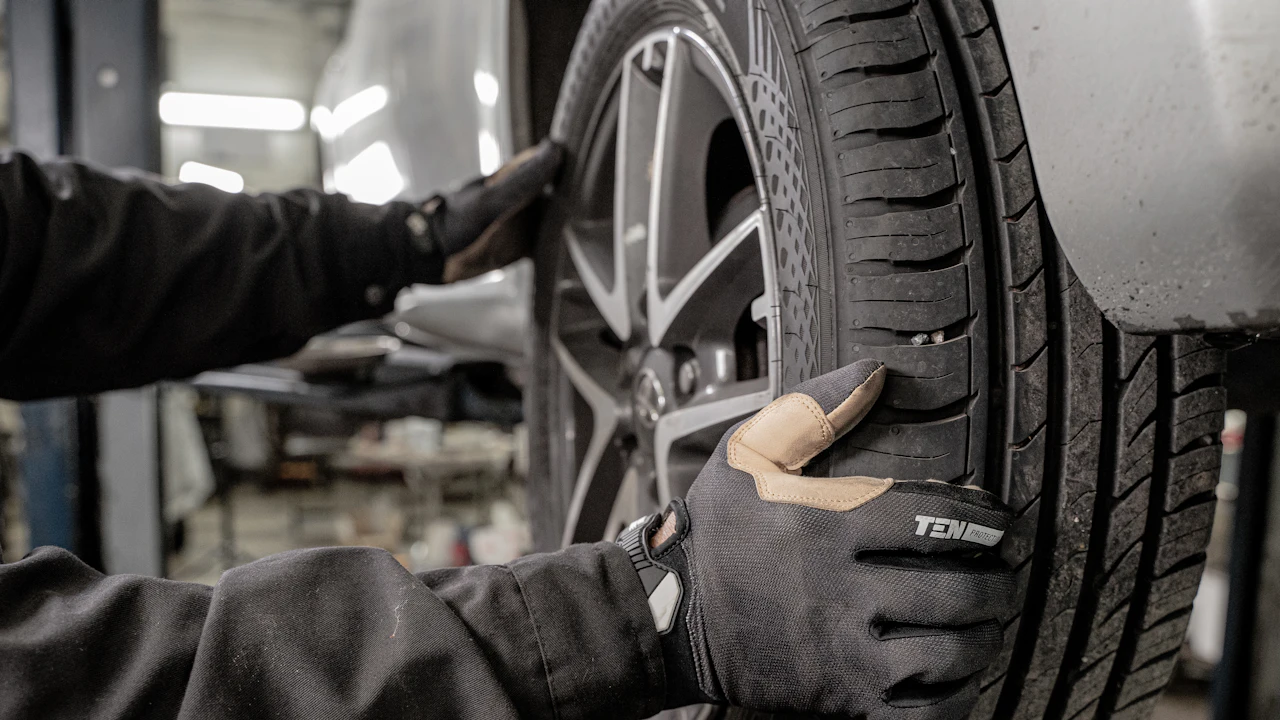
The short version
- An alignment sets angles. It cannot hold them if the parts carrying the wheel have play in them, which is why the useful question is never what an alignment costs. It is whether an alignment is the thing this particular car needs.
- Three angles do nearly all the work. Toe is whether the wheels point at each other or away from each other, and it is the one that destroys tyres fastest, because a wheel aimed slightly across the direction of travel is scrubbed sideways for every mile the car covers. Camber is the lean of the wheel. Caster is the tilt of the steering axis, and it is why the wheel returns to centre on its own.
- The difference between a front alignment and a four-wheel alignment is not really how many wheels get adjusted. It is how many get measured. Setting the front wheels straight without establishing which way the rear axle is actually pointing is a guess dressed up as a measurement.
- Pulling is the most over-diagnosed symptom in the subject. It can be the crown of the road, a tyre, a dragging brake or a pressure difference. A steering wheel that sits crooked while the car travels straight is the symptom that genuinely belongs to alignment and to almost nothing else.
- Tyres are the only component on a car that keeps a written record of its own geometry. A wear pattern takes thousands of miles to form, so it describes where the car has been rather than where it is now — and a car wearing four new tyres has had that record thrown in a skip, innocently or otherwise.
- In the archived NHTSA complaint pull this site keeps, the suspension category has its middle odometer reading at 53,000 miles. Only twenty-seven readings sit behind that, which is few enough that the figure is worth citing for the order it implies and for nothing more exact.
An alignment is one of the cheapest things a workshop sells. It takes a bay, a rack and a technician a short time, it produces a printout in which a column of red figures has turned green, and the customer drives away holding physical evidence that something was fixed. Very few car repairs end that tidily. That is precisely the problem with it.
Because what the printout records is the car at rest. Four wheels, standing still on a level surface, under nothing but their own weight, rolled gently back and forth so the machine can see where they sit. Every angle on that sheet is a static angle. Out on the road none of them are static: the body rolls, the suspension travels through its arc, rubber bushes deflect under cornering load, and the geometry that the tyre actually experiences is the geometry those parts allow it to have. If a ball joint has slack or a bush has gone soft, the sheet can read perfect and the car can still be eating a tyre from the inside edge outwards. The measurement was honest. It just was not a measurement of the thing that matters.
That figure explains why this page spends more of its length on tyres than on alignment racks. Every pattern in it is a piece of evidence that formed slowly, under load, in real corners, over thousands of miles — which makes a worn tyre a better instrument for the question a buyer is asking than any static reading could be. A rack tells you where the angles were on Tuesday afternoon. A tyre tells you where they have actually been for the last three years. Read the figure as a set of signatures rather than a lookup table, because the mechanism behind each one is what lets you tell a cheap finding from an expensive one, and the mechanisms are the subject of the second half of this page.
Why there is no figure printed here
This site does not publish prices, and the standing reason is that they perish without ever looking perished. A reader who arrives two years after publication meets the same confident number as a reader who arrived the week it went up, with nothing on the page to signal that regional labour rates moved, that the vehicle in question was never the one the figure was written for, or that half the job now involves recalibrating a camera.
There is a second reason here, and it cuts harder. An alignment is cheap. Nobody is deterred by the price of one. Which means the price is not the decision, and publishing it would answer a question that was never actually blocking anybody. The decision is whether to buy an alignment at all, or whether to spend the same money establishing what is worn first — and a page that leads with a figure quietly implies the first thing is the right thing. Often it is not. An alignment sold to a car with a tired lower arm bush is a service that was performed correctly and delivered nothing, and the customer has no way of knowing, because the printout came out green.
So what follows is the anatomy of the bill rather than the bill: what the job consists of, what the inputs are, which of those inputs you can establish on a specific car before any money moves, and the much larger question of what the tyres on that car are telling you about whether an alignment is the right purchase in the first place.
What an alignment actually sets
An alignment adjusts the angles at which the wheels sit relative to the car and to the road. Three of them have names most drivers half-recognise. A fourth idea hardly anybody has heard of decides whether a front alignment was worth paying for at all.
One thing this page will not do is print the angles in degrees. Specification is per vehicle, often per trim and per suspension option, and the tolerances are narrow enough that a figure lifted from a general article and applied to a specific car is worse than no figure at all. The correct source is the manufacturer’s specification, which is what the alignment machine is looking up while you wait. What is worth carrying around is not the numbers but what each angle does, because that is what turns a wear pattern into a diagnosis.
Toe: the tyre killer
Stand behind the car and look down at the two front wheels from above. Toe describes whether their leading edges are closer together than their trailing edges, or further apart. Pigeon-toed is toe-in; splayed is toe-out. On most cars a small amount is designed in deliberately, to take up the slack in the steering and suspension the moment the car starts moving and loads everything up, so that the wheels end up parallel when it counts.
Toe is the angle that eats rubber, and the mechanism is worth understanding because it explains the whole economics of the subject. A wheel that is not pointing exactly where the car is travelling is being dragged sideways the entire time the car is moving. Not occasionally, not in corners — continuously, in a straight line, at every speed. The tyre resolves that conflict the only way it can, by giving up rubber. The scrubbing distance accumulates in direct proportion to the miles driven, which is why a toe fault that would be invisible to a driver can convert an expensive set of tyres into a cheap one in a small fraction of their expected life.
It is also the angle most likely to be adjustable, at the front of essentially every car and at the rear of many. Toe is set by threaded rods on the steering linkage: turn the rod, the wheel points differently, tighten the locknut. That is the whole of what a great many alignments consist of, and it is why the job is quick.
Camber: the lean
Now look at the car from directly in front. Camber is the angle the wheel leans away from vertical. Lean the top of the wheel in towards the car and camber is negative; lean it out and camber is positive.
Negative camber exists because a car rolls when it corners. The body leans, the outside wheel is pushed towards positive camber by that roll, and a wheel that started slightly leaned-in ends up standing closer to upright at the moment it is carrying the most load. That is the whole argument for it: the contact patch stays flat when the tyre is working hardest.
Camber wear looks entirely different from toe wear, and the difference is diagnostic. The tyre is not being dragged across the road, so nothing is being torn; it is simply carrying the car on a narrower strip than it was designed to use. The result is a smooth, evenly textured band of faster wear along one shoulder, with no roughness to it. Toe wear is violent and you can feel it. Camber wear is polite and you have to look.
Camber is where the price of an alignment stops being predictable. On a great many cars — particularly front ends built around a strut, which is most of them — the factory provided no camber adjustment at all. The angle is whatever the shape of the parts makes it. Which means that a car with a camber reading outside specification is not a car that needs adjusting. It is a car telling you that something has changed shape: a bent arm, a collapsed bush, a knuckle that took an impact, or a ride height that has dropped because the springs have settled. Aligning it is not the repair. Finding out why is.
Caster: the one that is not about tyres
Caster is the hardest of the three to picture and the least talked about, because it leaves almost no mark on a tyre. View the car from the side and imagine the line the wheel steers around, running from the lower ball joint up through the top of the strut. Caster is how far that line is tilted from vertical.
Tilt it backwards at the top and the point where the steering axis would meet the road ends up ahead of the tyre’s actual contact patch, so the wheel trails behind its own steering point in the same way a supermarket trolley wheel trails behind its pivot. That is the entire source of a car’s tendency to straighten itself out after a corner and to track steadily down a motorway without constant attention. More of it means heavier steering and better stability; less of it means light steering and a car that wanders.
Two practical consequences follow. First, because caster does not point the tyre anywhere different in a straight line, it is not a tyre-wear angle, and a car with terrible caster can wear its tyres perfectly evenly while feeling vague and tiring to drive. Second, a difference in caster between the left and right sides of the car makes it pull towards the side with less of it, which puts caster on the short list of things that cause a pull without leaving evidence on the rubber. Like camber, it is frequently not adjustable from the factory, so a caster split is usually a report of damage rather than of drift.
Thrust angle: where the car is actually going
Here is the concept that decides whether a front-only alignment was money well spent, and hardly anybody outside the trade has heard of it.
The rear wheels of a car are supposed to point straight down its centreline. If they do not — if the rear axle is very slightly crabbed, or one rear wheel has picked up a toe error — then the direction the car actually travels is not the direction its bodywork is facing. That travel direction is the thrust angle, and it is the line the front wheels have to be set against if the steering wheel is going to end up straight.
Now think about what happens when a shop aligns the front of that car without measuring the rear. It sets the front wheels straight relative to the body, because the body is the only reference it has. The car still travels along the thrust line, so the driver has to hold a small steering input in to keep it going where the road goes, and the steering wheel sits permanently off-centre. The alignment was performed to specification and the customer got a worse car out of it. A second visit to correct the crooked wheel by adjusting the front toe again produces a straight wheel and a front axle that is now genuinely out of specification — the fault has been papered over rather than found.
This is why the honest version of the two-wheel question is not about adjustment at all. It is about measurement.
Two wheels, four wheels, and which one your car needs
The names are unhelpful, so it is worth translating them.
A front-end or two-wheel alignment, in its cheapest form, measures and adjusts the front wheels only, referenced to the vehicle’s centreline. It is appropriate on a vehicle with a solid rear axle whose geometry is fixed by the axle housing and cannot be adjusted — a pickup, an older body-on-frame vehicle, a van. On that kind of car there is nothing at the back to turn.
A thrust-angle alignment is the version worth asking for on that same vehicle. It still adjusts only the front, but it measures all four wheels first, works out the thrust line, and sets the front toe to that rather than to the bodywork. It costs a little more than the basic version and it is the difference between a straight steering wheel and a crooked one. If a shop offering a cheap front alignment cannot tell you whether it is referencing the thrust line, that is a useful thing to have learned about the shop.
A four-wheel alignment measures all four and adjusts whatever is adjustable at both ends. On any car with independent rear suspension — which covers most cars of any recent vintage, and effectively all of them at the more expensive end — this is the only version that makes sense, because the rear wheels on those cars have their own toe and camber and are perfectly capable of being wrong.
The thing to hold on to is that rear geometry is the most neglected part of the whole subject. Rear tyres wear more slowly, they sit where nobody looks, and they are behind the driver rather than in front of them. A rear toe error will quietly destroy a pair of tyres over years without ever producing a symptom at the steering wheel, and it is entirely routine to find a car whose rear alignment has never been measured in its life because every alignment it has had was sold as a front-end job.
One question, asked before anybody touches the car
Do you measure all four wheels, and do you set the front toe to the thrust line? That single question separates a shop that will hand you back a straight steering wheel from one that will hand you back a printout. It costs nothing to ask, the answer arrives in a few seconds, and a hesitation is as informative as a yes.
Where the money actually goes
Six inputs account for nearly all the spread between a quick alignment and an awkward one. Most of them are visible on a specific car, which means a buyer can work out roughly where a particular vehicle sits before anybody quotes for anything.
| Input | Why it moves the number | Establish it in advance? |
|---|---|---|
| How many wheels are measured | A basic front-end setting, a thrust-angle setting and a full four-wheel measurement are three different products sold under one word | Yes — the rear suspension design decides which of them is appropriate |
| Whether the rear is adjustable | Adjustable rear toe and camber mean more to set and more time on the rack; a fixed beam axle means there is nothing to turn back there | Yes — look under the back of the car for a beam between the wheels or a cluster of separate arms |
| Seized adjusters | Cam bolts and tie rod threads live outdoors. On a car that has spent winters on salted roads, freeing them is heat, penetrating oil, patience and occasionally a replacement part | Partly — the condition of the underside is a fair proxy, and where the car has lived is a fair question |
| Parts needed before adjustment is possible | Nothing can be set on a joint that has play in it, so a worn tie rod end or a split bush turns an alignment into a repair with an alignment on the end of it | Yes — this is what the inspection is for, and the tyres usually flag it first |
| Adjustment the factory did not provide | Where camber is out on a car with no camber adjustment, correcting it means eccentric bolts, offset bushes or slotted plates — parts and labour, with the alignment as the smallest line on the invoice | Partly — the wear pattern tells you whether camber is a live question |
| Recalibration afterwards | Stability control needs its steering angle sensor re-zeroed; a car with lane-keeping has a forward camera aimed relative to the thrust line and may require a documented recalibration | Yes — the equipment list tells you, and so does the presence of a camera behind the mirror |
Notice what is not in that table. The shop’s hourly rate is in there somewhere, and it is the smallest lever of the six. When two quotes for the same car differ substantially, the usual explanation is that the two shops have priced different jobs — one assumed a straightforward front toe adjustment, the other looked at where the car had lived and budgeted for a fight with the cam bolts. Asking each of them what is included, and what happens if an adjuster will not move, gets you a much better comparison than asking each of them for a number.
Lifetime alignment plans
Several chains sell an alignment plan covering the car for as long as you own it. The arithmetic on these is simple and slightly uncomfortable.
The plan pays for itself if the car needs aligning often. A car that needs aligning often has something wrong with it: a worn joint that keeps letting the setting drift, a bent component that will not hold, or a driving environment that keeps knocking it out. So the plan delivers value precisely in the circumstances where you would rather be spending the money on the underlying fault, and it can quietly fund years of resetting an angle that has a mechanical cause nobody has gone looking for.
The honest case for one is narrower than the advertising suggests but it does exist. If you keep cars for a long time, drive on genuinely poor surfaces, and would actually go and use the plan a couple of times a year rather than forgetting you own it, it can be reasonable. Three caveats belong with it. It covers the setting, not the parts, so the visit where the car turns out to need a tie rod end is a visit where you pay. It ties you to one operator and to their opening hours. And it is a contract between that chain and you, not a feature of the car, so it is worth nothing to whoever buys the vehicle next — which also means it is worth nothing to you when a seller mentions it.
When an alignment is the wrong thing to buy
The rest of the page hangs on this, and it repays a slow reading.
An alignment machine measures where the wheels are sitting. It has no way to test whether they will stay there. Those are completely different questions, and only the first one has a printout.
Consider what actually holds a front wheel in position. A lower arm bolted to the subframe through rubber bushes at its inner end and to the steering knuckle through a ball joint at its outer. On many designs an upper arm doing the same job at the top, or a strut whose top mount carries a bearing. A tie rod running from the steering rack to a joint on the knuckle. A wheel bearing inside the hub. Every one of those is a wear part, and every one of them defines the angles the alignment is trying to set. The geometry is not a property of the car in any absolute sense. It is a property of those components, in their current condition, under whatever load they happen to be carrying.
Now put a car with a worn outer ball joint on the rack. The wheel is resting on the ground, the joint is loaded in the direction gravity puts it, and the play in it takes up in one consistent direction. The machine reads a stable, repeatable angle, and it is a perfectly real reading of a car standing still. Turn into a roundabout and the load on that joint reverses. The play takes up the other way. The angle the tyre sees for the duration of the corner is not the angle on the sheet, and no amount of adjustment at the tie rod can make it be.
Rubber bushes do the same thing more subtly and more commonly. A bush is meant to deflect — that is its function, isolating noise and allowing the arm to move through its arc. As it ages it softens, cracks and eventually separates from its inner sleeve, and the amount it deflects under a given load grows. A car with tired lower arm bushes can align to specification and still change its toe by a meaningful amount every time you brake hard, because braking loads those bushes in a direction they no longer resist properly.
What a green printout does and does not prove
It proves that the angles were within specification with the car sitting still on a level rack. That is all it proves. It says nothing about joint play, nothing about bush condition, nothing about whether a component is bent, and nothing about what the geometry does under load — which is the only version of the geometry that ever touches a road. A shop that aligns a car without first checking every joint and bush for play has sold a measurement rather than a repair, and the customer will be back, usually with the same tyre wearing in the same place, wondering why the alignment did not hold.
The sequence that follows from this is unglamorous and it is the whole of the practical advice. Play first, geometry second. Get the car in the air, have somebody rock each wheel top-to-bottom and side-to-side and lever against each arm, and replace whatever moves that should not. Then align it. Reverse those two steps and you pay for the alignment twice over, because a second one stops being optional the moment a joint is changed.
What the federal archives say about the parts underneath
Two archived pulls on this site touch this subject, and neither of them measures alignment, because alignment is not a defect and no regulator collects it. What they can do is say something about the components that decide whether an alignment will hold.
Owner complaints
Two of the categories in that file bear on this page. Suspension has its middle odometer reading at 53,000 miles; steering sits at 64,000 miles; pooling every category together gives 60,000 miles. Taken at face value, suspension trouble reaches a reportable stage earlier than most of what owners write in about.
The caveat belonging to this page is a large one, and it sits on the smaller of those two figures. Behind the suspension median are twenty-seven records. At that size a few filings landing elsewhere would visibly shift where the middle sits, and the categories being compared against it rest on far more evidence — steering has eighty-four. So the suspension number is a weak signal that happens to point the same way as sturdier ones, rather than a finding in its own right. Better to say that plainly than let a small sample borrow authority from the size of the archive around it.
There is a structural limitation on top of the sample size, and it matters more. An owner writes to a safety regulator when something alarms them. A ball joint that has developed play does not alarm anybody; it produces a knock over bumps that gets ignored for a year, and a tyre that wears out early and gets blamed on the tyre. What reaches the archive from these categories is the dramatic end of the distribution — things that broke, separated or seized. The slow loss of tightness that makes an alignment worthless is, almost by construction, absent.
Recalls
Four suspension campaigns sit in that archive, filed by three manufacturers with nothing else in common. Steering accounts for nine campaigns from four. What makes the suspension entry worth pulling apart is not the count, which is small, but the component paths NHTSA attached to each one.
Three of the four are named precisely: an upper ball joint on a front control arm, a front lower arm, and the front wheel bearing. Only the remaining campaign is vague, filed against the rear of the vehicle without naming a component. That is not a random handful of suspension hardware. Two of those named parts are among the components that carry a front wheel and define where it points, and the third is the assembly the wheel spins on. Put that list beside the argument in the previous section and the point makes itself. Every one of them is a part whose condition decides whether an alignment means anything, and not one of them is a part an alignment can do anything about. A car with any of them worn will align perfectly and hold nothing.
Both archives are useful for ranking rather than for magnitude, and both are silent on the thing a buyer actually wants to know, which is the condition of the specific car in front of them. That has to be established by looking at it — and the most informative surface to look at is the one the car has been writing on for years.
The symptoms that mean alignment, and the ones that do not
Half the alignments sold are sold against a symptom that has another cause. It is worth separating the two groups carefully, because the wrong diagnosis here is unusually cheap to make and unusually annoying to discover.
The crooked steering wheel
This is the strongest single symptom in the subject and it is the one people are most likely to tolerate. Find a straight, level, empty stretch of road, let the car settle at a steady speed, and look at where the steering wheel sits while the car is travelling straight. If the spokes are not level, or the badge is rotated, the front wheels have been set straight to something other than the direction the car is actually going.
Almost nothing else produces that. It is not a tyre, it is not a brake, it is not the road. It is geometry, and on a car whose steering wheel was straight when the owner bought it, it is geometry that changed. Which brings up the question of what changed it: a kerb, a pothole, a repair, or a rear axle that was never measured. All four of those are worth asking about.
There is a second version of it that is worth knowing about, because it is a fault rather than a setting. On a car where somebody has adjusted only one of the two front tie rods to straighten a crooked wheel, the total toe can be correct while each wheel individually points wrongly relative to the centreline. The car tracks straight, the wheel looks right, and the two front tyres wear at different rates for reasons nobody can account for.
Pulling, which is usually something else
A car that drifts towards one side of the lane if you relax your grip is the classic reason people book an alignment, and it is right often enough to keep the belief alive. It is also wrong a great deal of the time, for four reasons that cost nothing to eliminate.
- The road. Every road is built with a crown so water runs off it, which means every car drifts gently downhill towards the kerb. Test on a genuinely flat surface, or drive the same stretch in both directions. A pull that reverses when you turn round is the road, not the car.
- Pressures. A meaningful difference between the two front tyres changes their rolling radius and their cornering behaviour, and produces a pull that a shop will happily align away and then have to align back. Set them equal and cold before you conclude anything.
- The tyres themselves. A tyre can be built with a very slight cone shape in its belt package, and a cone rolls in a circle rather than a straight line. The result is a tyre that steers the car on its own, and no adjustment will cure it. There is a free test almost nobody performs: swap the two front tyres side to side and drive the same road again. If the pull swaps direction with them, the alignment was never the problem. If it stays put, it is the car.
- A brake dragging. A caliper that is not releasing cleanly pulls the car to that side and gets worse the longer you drive. The tell is heat — after a run, hold a hand near each front wheel, without touching, and compare. One that is markedly hotter than its opposite number has been working when it should not have been.
Only once those four are out of the way does a pull start to point at geometry, and specifically at a difference between the two sides of the car: a caster split or a camber split, usually caused by something that got bent rather than something that drifted.
Symptoms that belong to other pages entirely
A shake or a shimmy is not an alignment symptom. Alignment is about where wheels point; balance is about how weight is distributed around a wheel spinning at speed. They are separate faults with separate remedies, and the reason they get conflated is that both get diagnosed at the same tyre shop. Where the car shakes rather than pulls, an entirely different diagnostic sequence applies, and our page on what a vibration is telling you works through it.
Noise is not an alignment symptom either. Geometry is silent. A clonk over bumps, a click on full lock, a groan when the steering is turned at parking speed — all of those are parts, and specifically they are the parts listed a few sections above, which means they are worth taking more seriously than the alignment they are being mistaken for.
Nor is a floating, wallowing ride. That is damping, it decays so gradually that the person driving the car every day stops registering it, and it leaves a different signature on the tyres from the ones discussed further down.
After new tyres, and after suspension work
Two moments genuinely call for an alignment, and they call for it for different reasons and with different force.
New tyres: sensible
Fitting tyres does not change a car’s alignment. Nothing that happens at a tyre machine touches the geometry. So the case for aligning at the same time is not mechanical, and the usual explanation given at the counter is not quite the real one.
The real case is twofold. The first half is insurance on a purchase you have just made: four tyres are a significant amount of money, and putting them onto a car whose geometry is out is a reliable way to spend that money twice. If a toe error destroyed the last set, it is still there, and it does not care that the rubber is new.
The second half is about evidence, and it is the half that matters to a used-car buyer. The tyres you are fitting are the record for the next several years. Starting that record on a car whose geometry is known-good means that any pattern which appears later is unambiguous — it developed on your watch, and you know approximately when. Fitting new tyres without aligning means the next pattern you find could have started at any point, including before you owned the car.
Suspension work: not optional
Anything that disturbs a link between the body and the wheel changes the angles. Replacing a lower arm, a tie rod end, a strut, a spring, a subframe bolt, a bush — all of them move the geometry, and some of them move it a long way. So does anything that changes ride height, because camber and toe both vary with suspension travel on most designs; a car that has been lowered, or one whose springs have settled with age, has different geometry from the one that left the factory even with nothing worn.
The practical test for a buyer is documentary rather than mechanical. If a seller tells you the front suspension was rebuilt, ask to see the invoice and look for an alignment on it. Its absence does not prove the work was bad, but it does tell you the job was finished at the point where a corner was reassembled rather than at the point where the car was set up, and the tyres fitted since then have been recording the consequences.
Strut work is the clearest case of the lot, because on a strut the damper is a structural member locating the wheel, so taking one out moves the geometry by definition. Why that is true of a strut and not of a plain shock is worked through in our page on replacing shocks and struts. An invoice for strut work with no alignment on it is an incomplete job rather than a bargain.
Ask for the sheet, and read the left-hand column
An alignment printout has a before column and an after column, and everybody looks at the after column because that is the one that turned green. The before column is the useful one. It is a free measurement of what the car was doing, and it is the only diagnostic information the whole procedure generates.
A before column that is mildly out on both sides of an axle is ordinary drift — the car has been driven, things have settled, the setting needed refreshing. A before column that is wildly out on one corner only is a different message: one corner of this car is not the same shape as the other. That is an impact, or a part that has failed, and it deserves an explanation before anybody adjusts anything. A before column showing a camber value that could not be brought into specification at all is the loudest message of the three.
Keep the sheet. On a car you own it is the baseline against which the next one is read, and on a car you are selling it is a document that answers a question buyers cannot otherwise answer. On a car you are buying, ask whether one exists.
Reading the tyres as a record
Everything above is background for this. Wear patterns are the most reliable free evidence available on a used car, and the reason they are so good is not that they reveal the alignment. It is that they reveal the alignment’s history.
A tyre integrates. Every mile the car covers deposits a tiny increment of wear, in a distribution determined by the geometry and the load at that instant. The pattern you can see took thousands of miles to accumulate, which means it is a summary of a long period rather than a snapshot — and unlike an alignment rack, it recorded the car in motion, under load, in corners, at speed, with the bushes deflecting exactly as much as they actually deflect. That is a better instrument for the buyer’s question than any static reading, and it is already fitted to the car.
Why toe wear feels rough and camber wear does not
The two most common alignment signatures are easy to tell apart once you know what is happening in the contact patch.
Toe wear is produced by sideways scrubbing, which acts on individual tread blocks. Each block enters the contact patch, is deflected sideways as it grips, drags, and then releases as it leaves. That repeated deflect-and-release wears one edge of each block away and leaves the other standing proud, so the tread takes on a saw-tooth profile across its width. A hand finds it far more readily than an eye does.
The direction the saw teeth face carries information too. Sharp edges point towards the side the tyre is being dragged from, so feathering with the sharp edges turned in towards the car is a different setting error from feathering the other way about. You do not have to know which is which to use it. What matters is that the two front tyres should be feathered as mirror images of each other, and that a car where only one of them is feathered has a fault on one side rather than a setting that has drifted.
Camber wear is produced by load distribution, not by scrubbing, so nothing is being torn and there is no roughness at all. The result is a smooth band of accelerated wear along one shoulder while the rest of the tread looks ordinary. Run a hand over it and it feels like tyre; look at it and the depth difference is obvious. The critical follow-up question is whether the same shoulder is worn on both tyres of that axle. Both, evenly, is an axle setting — the cheapest kind of finding. One tyre only is a single corner, which means a bent part, a failed bush or an impact, and the alignment is the last thing to buy.
The two frequently appear together, because the wear that gets a car noticed is usually a shoulder that is both worn down and rough to the touch. That combination is a car whose toe went out and whose camber followed it, which is what happens when a tie rod end or an arm bush lets go.
The rear tyres, which nobody looks at
On a car with independent rear suspension the rear wheels have their own toe and their own camber, and they are the least examined surfaces on the entire vehicle. Rear wear develops slowly enough to pass for ordinary consumption, and it sends nothing up to the steering wheel to prompt anybody into checking.
What you are looking for at the back is a shoulder taper that does not match on the two sides, or a diagonal, patchy wear that walks across the tread. Both are geometry. Neither will ever be corrected by an alignment that only measured the front, and on a fair number of cars nobody has ever measured the rear at all.
Cupping: damping or geometry
Scalloped patches spaced around a tyre’s circumference are the least diagnostic pattern on this page, because at least three unrelated things produce them and the pattern looks similar in each case.
The version everybody names first is damping. A wheel the damper has stopped controlling bounces, and a bouncing tyre alternates between pressing hard into the road and barely touching it, so the rubber comes off in scallops. That mechanism, the handling symptoms that go with it, and the reason the car’s owner will sincerely tell you the ride is fine, all belong to our page on worn dampers and are not repeated here.
The version relevant to this page is that geometry can produce scalloping too, and that it does so in a distinguishable way. A tyre being dragged sideways by a toe error does not wear smoothly; the scrubbing is periodic around the tyre, and on a tyre that is also under-inflated or carrying a camber error, the result can be a scalloped shoulder rather than a scalloped tread. So the useful discriminator is not the scallops themselves but what accompanies them. Cupping across the full tread width, on both tyres of an axle, on a car that floats over crests, is damping. Cupping confined to one shoulder, on a car that tracks and settles normally, is geometry doing it. Cupping on one tyre of an axle and not the other is a single corner, and that is the finding worth the most money.
And a third possibility that is nobody’s fault: chronic under-inflation produces its own shoulder wear and makes every other pattern worse, which is why a car whose pressures have been neglected is harder to read than one whose have not. Whether the car has been warning its owner about that is its own question with its own answer, and it is worked through in our page on the tyre pressure light.
Dating the fault
This is the part that turns a pattern into a negotiating position, and it depends on one fact people rarely join up: tyres on a used car are frequently not all the same age.
Every tyre has the week it was built stamped permanently into its sidewall, and reading that code is a short, free operation set out in our guide to how long tyres last. What that page does not do, because it is about the tyre rather than the geometry, is use the dates as timestamps on the wear.
Do that and the evidence acquires a clock. A shoulder worn nearly to the belts on a tyre with a recent date is a fast, active fault — something is wrong with that corner now. The same amount of wear on a tyre several years old could be a mild error that has been grinding away slowly, or a serious one that was corrected two years ago and left its mark behind. And the most useful configuration of all: a car with two recent tyres on one axle showing a developing pattern, and two older tyres on the other axle showing none. That is a fault with a start date, and the start date is roughly when the newer pair went on. Something changed on that car within a knowable window, and the seller was there for it.
At the viewing
Four minutes at the wheels, before the test drive, at the point in a visit where nobody is yet hurrying you. Bring a torch and expect to kneel. Most of the evidence lives on the inner shoulders, and the inner shoulders are invisible from standing height.
What you are looking for is not whether the car needs an alignment. An alignment is cheap and nobody walks away from a car over one. You are looking for what the pattern implies about the parts underneath, because that is where the money is, and for whether the car has hit something hard enough to change its shape.
Three findings, in ascending order of what they should cost the seller:
- Even wear on all four tyres. This is a good result about the whole car and not just about the rubber. It says the geometry has been right, the pressures have been roughly right, and the joints and bushes at all four corners have been holding position for the life of the tyres. Very few free observations tell you that much.
- A matching pattern on both tyres of an axle. An axle setting has drifted or was never set. This is the cheap finding: an alignment, possibly a set of tyres if the wear has gone far, and a question about when it was last done. Ordinary, and priceable.
- A pattern on one tyre only. One corner of this car is different from the other three. That is a worn part, a bent part, or an impact, and the alignment is the last thing on the list rather than the first. Look at that wheel for kerb damage, look along the tyre’s sidewall, and treat it as the thing the inspection is about.
That third case is also the one where the paperwork matters more than the rubber. A bent arm and a kerbed wheel are a modest repair; a subframe that moved in a collision and was never brought back true is a car that will destroy tyres and pull for the rest of its life, and the two look identical from a crouch beside the wheel. It costs very little to find out whether an impact was ever recorded against this car, and an event severe enough to reach the suspension is exactly the sort that leaves a trace in a record even when it left nothing visible on the paintwork.
Four new tyres, and what has gone with them
A seller pointing out that the tyres are new expects you to receive it as good news, and in most cases it is offered in complete good faith. It is also the single most effective thing anybody can do to a used car to remove the evidence discussed on this page, and almost nobody — seller or buyer — thinks of it that way, because nobody thinks of tyres as data.
New tyres are not a red flag. They are a gap in the record, and gaps have to be filled by other means. What that means in practice is that the free evidence has been withdrawn and you now have to buy the equivalent information:
- Ask why they were replaced. “They were worn out” and “they were going on the inside edges” describe two completely different cars, and the second answer is offered in perfect good faith all the time by people nobody ever told what it signified.
- Ask whether the geometry was checked when the tyres went on, and whether a printout came out of it. If one did, the before column is worth more to you than the after column, for the reasons above.
- Look at the wheels rather than the tyres. Kerb damage on a rim, one wheel refinished when the others are original, or a single wheel that does not match the set, all survive a tyre change and all point at the same corner the tyres would have pointed at.
- Lift the boot floor. Spares almost never get replaced alongside the road wheels, so on a car carrying a full-size spare that has done time on an axle, that is the last piece of old rubber left on the vehicle.
- Put the geometry explicitly on the inspection list. With the tyres reset, a lift and a pair of hands on every joint is the only way to recover what the tread would have told you for nothing.
What to ask, and what the answers are worth
- When was it last aligned, and is there a printout? A seller who has one and produces it has said something about the standard of care the car has had, quite apart from what the sheet reads.
- Has it been kerbed, or hit a pothole hard enough to remember? Ask it plainly rather than as an accusation. It is the question most likely to produce a useful answer, because most people will tell you.
- What suspension or steering work has been done, and did an alignment follow it? Look for the alignment on the invoice rather than in the answer.
- Why were the tyres replaced, and what did the old ones look like? Whatever was worn into those tyres is precisely the evidence you no longer have.
- Has the rear ever been aligned? On a car with independent rear suspension this is a fair question and the answer is very often no.
The habit worth forming out of all this is separating the mechanical picture from the documentary one, because they answer different questions and a car can pass one while failing the other. A set of tyres tells you how the geometry has behaved. It says nothing about the state of the title, nothing about what the recorded mileage has done over the years, and nothing about a large repair that somebody once declared to an insurer. Kneeling next to a wheel will never surface any of it. Spending a couple of minutes to read the reported history before you make an offer covers the half of the assessment the tyres cannot reach.
Then hand the specifics to somebody with a lift. An inspector told “check the suspension” will do a general once-over; an inspector told “the front left inner shoulder is worn and feathered and the others are clean” is being asked a question with an answer, and will check that corner’s ball joint, bushes and tie rod end deliberately. What else belongs on that list, and what a competent inspection actually reaches, is laid out in our page on inspecting a car before you buy it.
Once the car is yours
Alignment is a condition item rather than a scheduled one. There is no interval to keep, and a car that is tracking straight, sitting with a level steering wheel and wearing its tyres evenly does not need a preventative appointment.
What it does need is attention at four specific moments: after an impact you remember, after suspension or steering work of any kind, when new tyres go on, and the moment a wear pattern starts to appear. That last one is the cheapest of the four to act on and the easiest to miss, which is why running a hand across the front tyres every few weeks is a habit worth more than its cost. Pressures matter alongside it, because incorrect inflation produces its own shoulder wear and confuses everything else you are trying to read. Both sit on the short list of jobs that repay attention out of all proportion to what they cost, which is the argument running through the maintenance habits worth keeping on a used car.
Keep the printouts, too. A folder with three alignment sheets in it is a record of whether the car holds its settings, and a car that does not hold its settings is telling you something an individual sheet never can.
Common questions
What does a wheel alignment actually do?
It adjusts the angles at which the wheels sit relative to the car and the road, principally toe — whether the wheels point at each other or away from each other — and, where the design allows it, camber and caster. Toe is adjustable on essentially every car and is the angle that destroys tyres fastest, because a wheel aimed slightly across the direction of travel is scrubbed sideways continuously. Camber and caster are frequently not adjustable from the factory, which means a reading outside specification on either is usually a report that something has changed shape rather than something that needs turning.
How do I know if my car needs an alignment?
The most reliable indicator is a steering wheel that sits crooked while the car travels straight on a level road; almost nothing else produces that. The second is uneven wear across the width of a tyre, especially the same pattern on both tyres of an axle. A pull to one side is a much weaker signal than its reputation suggests, because the crown of the road, a pressure difference, a tyre with a slight cone shape in its construction and a dragging brake all produce one, and all four are cheaper to eliminate than an alignment is to buy.
Do I need a four-wheel alignment or will a front-end one do?
It depends on what is at the back. A vehicle with a solid rear axle has no rear geometry to adjust, so a front alignment is appropriate — but it should still measure the rear, so the front wheels can be set to the direction the car actually travels rather than to the bodywork. On a car with independent rear suspension the rear wheels have their own toe and camber, they are perfectly capable of being out, and a front-only alignment cannot address it. The question worth asking a shop is not how many wheels they will adjust but how many they will measure.
Should I get an alignment when I buy new tyres?
It is sensible, though not for the reason usually given: fitting tyres does not change a car’s geometry. The real arguments are that a geometry fault which destroyed the last set is still there and will start on the new one immediately, and that new tyres are the record you will be reading for the next several years, so it is worth knowing they started clean. If the old tyres wore evenly and the steering wheel is straight, the case is weaker and it is a reasonable thing to decline.
Will an alignment fix uneven tyre wear?
It stops it getting worse. It does not undo it — rubber that has been scrubbed away does not come back, and a tyre worn badly on one shoulder stays worn on that shoulder for the rest of its life, wearing evenly from that point on. There is a further catch worth knowing: a tyre that has been running at an angle for a long time develops an irregular shape of its own, so it can continue to wear oddly and feel rough even after the geometry has been corrected. If the wear has gone far enough to feel through the car, the tyre and the alignment are both on the bill.
Is a lifetime alignment plan worth buying?
Only in narrow circumstances, and the arithmetic is a little uncomfortable. The plan repays itself when the car needs aligning often, and a car that needs aligning often has something mechanically wrong with it — so the plan pays out precisely when the money would be better spent finding the cause. It covers the setting rather than the parts, it ties you to one operator, and it is a contract between that operator and you rather than a feature of the vehicle, so it is worth nothing to the next owner and worth nothing to you when a seller mentions it.
Why does this page refuse to print a price?
Partly because printed prices go stale without ever looking stale, which is this site’s standing position. Mostly because on this subject the price is not the decision. An alignment is one of the cheapest things a workshop sells, so nobody is deciding on the basis of it, and leading with a number would quietly suggest that buying one is the right move. Often it is not: an alignment performed on a car with a worn joint or a tired bush is a service that was carried out correctly and achieved nothing, and the printout will look exactly the same as one that did.
Sources and further reading
- NHTSA Office of Defects Investigation complaint database
- NHTSA recall lookup
- NHTSA TireWise
- FTC used car buying guide
Recall, complaint and safety-rating figures on this page were retrieved from the federal databases above on August 19, 2026. Federal data changes — re-check any VIN before you rely on it.
Published August 28, 2026 · last updated August 28, 2026. Found something out of date or wrong? Tell us and we will correct it.