Exeter Finance Review: Rates, Login, Fees and Its Public Record
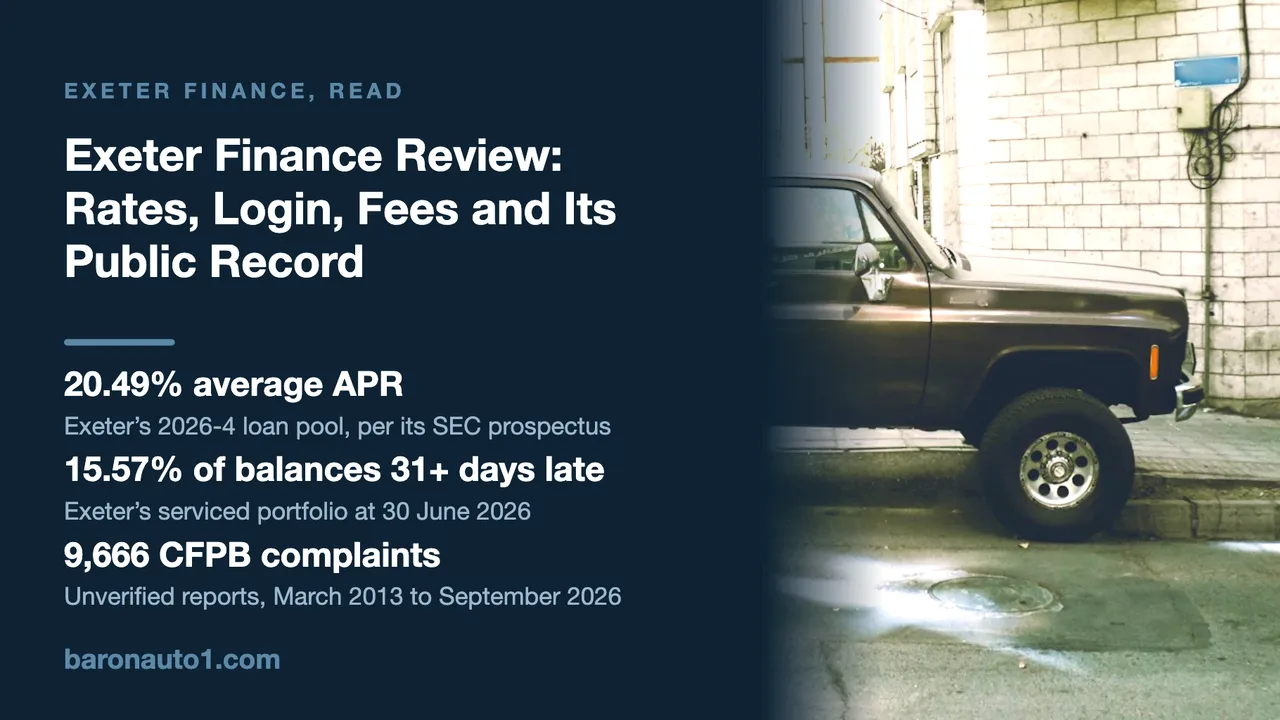
Exeter Finance buys subprime car loans from dealers and posts no rates, but its 2026 SEC prospectuses do: a 20.49% average APR over 75 months. How to log in and pay without fees, what extensions cost, the 2019 Massachusetts and Delaware settlements, and 9,666 CFPB complaints.
The short version
- Exeter Finance is a privately held subprime auto lender in Irving, Texas. You do not apply to it directly: a dealer writes your contract and sells it to Exeter, which then collects the payments. To pay or log in, use MyAccount (you need your 7-digit account number) or call (800) 321-9637.
- Exeter’s website shows no rates, but its SEC prospectuses print pool averages. Its August 2026 subprime loan pool carried a weighted average APR of 20.49% over a 75-month original term, and 52.47% of the balance was at 20% or more, by our arithmetic.
- AutoPay and one-time bank payments in MyAccount are free. Debit card, phone, MoneyGram and Western Union payments can carry third-party fees that Exeter does not print.
- Payment extensions exist but cost money: interest keeps accruing, GAP coverage is not extended, and Exeter’s prospectus says you must first have made six payments.
- In April 2019 Exeter settled with the Massachusetts and Delaware attorneys general over subprime loans that, the states alleged, it knew or should have known were unlawful: $5.5 million in Massachusetts and $0.6 million in Delaware, with no admission. Its prospectus also discloses a multistate investigation open since May 2015.
- The CFPB database holds 9,666 complaints naming Exeter Finance, LLC., half of them about credit reporting. BBB shows 742 complaints in 3 years and a 1.08 review average; Trustpilot shows 4.5 from 16,574 reviews that Exeter invites customers to write.
Exeter Finance is a real, licensed lender (NMLS 967404) that buys car loans from dealers, mostly for borrowers with damaged or thin credit, and charges rates to match. On 6 October 2026 we read its customer pages, FAQs, terms, privacy notice and state rate filings; the prospectus for Exeter Automobile Receivables Trust 2026-4 and the prospectus for Exeter Select Automobile Receivables Trust 2026-2, which describe the loans Exeter sold to investors; its withdrawn 2019 IPO filing; the Massachusetts and Delaware settlement records; and its CFPB, BBB and Trustpilot counts. We entered no login, payment or application, and this site has no commercial relationship with Exeter or any lender.
How Exeter Finance works: a dealer writes the loan, Exeter buys it
Exeter is an indirect lender. Its prospectus says it “purchases automobile loan contracts that are secured by new and used vehicles purchased by consumers from predominantly franchised automobile dealerships, generally without recourse to the dealers.” The dealer sends your application to several lenders; if Exeter buys the contract, you pay Exeter for the rest of the loan.
Exeter is direct about who it serves. “Exeter primarily offers financing to consumers who are unable to obtain financing from traditional financing sources such as banks, credit unions and captive automobile finance companies,” the prospectus says, and because of that “the sponsor generally charges higher interest rates than those charged by such sources.” At 30 June 2026 it serviced about 760,000 contracts with about $14.8 billion outstanding, had about 1,900 employees and worked with “over 12,500 automobile dealerships.”
Software makes the decision. Since October 2014 “all of the sponsor’s credit underwriting decisions are made through this automated credit underwriting system,” and staff cannot “override the decisions.” A proprietary score sets “the approval or decline decision as well as the pricing,” and since September 2022 the bureau input has been VantageScore rather than FICO. Before buying a contract Exeter makes a “welcome call” to confirm the terms; answer it and compare what you hear with what you signed.
The dealer is paid for placing the loan. Exeter’s dealer page advertises an Elite Program that lets dealers “Earn up to 75% more per deal” once they send 6 loans in 3 months, and when it launched its near-prime ExeterPlus program on 30 November 2021 it promised dealers “flats, an extended max term and increased back-end.” That is common in indirect lending, but the person arranging your loan has an interest in which lender gets it. Our reviews of Credit Acceptance and Westlake Financial read those lenders’ dealer terms the same way, and our page on buy here pay here lots covers dealers that keep the loan. Exeter also buys loans through CarMax (its prospectus mentions a “CarMax channel”); our page on CarMax Auto Finance explains how CarMax passes applications to outside lenders.
Exeter Finance login and payments: MyAccount, QuickPay and what costs money
Exeter’s customer portal is MyAccount (myaccount.exeterfinance.com). To register, its login page says to have “your 7-digit Exeter account number handy, along with the last four digits of your (or the primary account holder’s) Social Security number and the ZIP code associated with the mailing address on the account,” then click “Register” and create a user ID and password. The account number is in the “ABOUT YOUR ACCOUNT” box on your statement. If registration rejects your details, Exeter’s FAQ gives one fix worth knowing: “Delete ‘1001’ at the end of the account number.”
Exeter says it offers “seven easy ways to pay.” Only the bank-account methods are free; the others go through outside processors, and Exeter prints no fee amounts for them. Its FAQ says the processing fee “is charged by our third-party payment providers. Exeter does not retain any portion of this fee.”
| Method | Fee, per Exeter | Timing and notes |
|---|---|---|
| AutoPay (recurring ACH from checking or savings, set up in MyAccount) | None (“no fees”) | Exeter recommends it to avoid late fees and processing fees |
| One-time ACH payment in MyAccount | None (“no fees”) | Cutoff 7 p.m. Central for same-day credit |
| Debit or ATM card (MyAccount or QuickPay, run by ACI) | “Third-party payment processing fees may apply”; amount not printed | QuickPay needs no login; cutoff 7 p.m. Central |
| Phone (automated line or a representative) | “Restrictions and third-party payment processing fees may apply” | Automated line answers around the clock |
| MoneyGram or Western Union (cash) | “Fees may apply”; amount not printed | Cutoff 8 p.m. Central |
| None stated | Exeter says to use the address on your statement’s payment coupon |
A payment “could take up to 48 hours to reflect on account/statement,” Exeter says, and the gap can trigger a collection call; keep the confirmation number MyAccount shows. Payments go first to interest accrued since your last payment, then to principal, “then any outstanding fees.” Statements went paperless by default in June 2026, and a due-date change is available “after first payment” with “Some restrictions.”
For a payoff quote, call or use MyAccount. Exeter’s payoff, overnight and regular payment addresses differ, so use the one on your quote or statement rather than one copied from the web. Customer service is at (800) 321-9637, Monday to Friday 8 a.m. to 7 p.m. and Saturday 8 a.m. to 5 p.m. Central; MyAccount messages get a reply within 48 hours, Exeter says, and complaints have their own line, (855) 717-1250.
Who Exeter lends to, in its own prospectus
“The sponsor’s typical borrower has experienced prior credit difficulties or has a limited credit history,” Exeter’s prospectus says. Exeter sells its loans to investors through two programs. Exeter Automobile Receivables Trust (EART) pools are subprime; the 2026-4 pool left out borrowers who had both a bureau score of 640 or more and a high internal score. Exeter Select (ESART), started in 2025, takes only bureau scores of 640 or more. Both use “the same origination procedures and systems,” Exeter says, so the pools show each end of its range.
In the EART 2026-4 pool (cutoff 9 August 2026; 45,996 contracts), the weighted average FICO score was 566. By our arithmetic, 70.22% of the balance went to borrowers scoring below 600, and another 5.17% had no FICO score at all. Exeter used VantageScore for 95.63% of the pool; on that measure the average was 585. Used cars made up 82.45% of the balance, and Texas, California, Florida and Georgia were the largest states. In the ESART 2026-2 pool the average FICO score was 646 and the average bureau score 671.
Exeter’s dealer sign-up page calls it “the 4th largest non-prime auto finance company in the U.S.,” citing J.D. Power data we did not see. What the filings show is that a score below 600 does not stop an Exeter approval; our guide to the credit score you need to buy a car explains why lenders rarely publish a minimum.
What Exeter charges: APRs, terms and loan-to-value in its 2026 pools
Exeter publishes no rate for car buyers; its system prices each application, and the dealer writes the APR into the contract. The nearest thing to a rate sheet is the prospectus for each pool Exeter sells. Its figures are averages across thousands of loans, not offers.
| Measure | EART 2026-4 (subprime) | ESART 2026-2 (bureau score 640 or more) |
|---|---|---|
| Cutoff date | 9 August 2026 | 31 August 2026 |
| Contracts | 45,996 | 17,589 |
| Weighted average APR | 20.49% | 16.69% |
| APR on used cars / new cars | 20.96% / 18.28% | 17.02% / 15.19% |
| APR range | 6.00% to 29.99% | 6.00% to 29.99% |
| Weighted average original term | 75 months | 77 months |
| Weighted average FICO score | 566 | 646 |
| Weighted average loan-to-value | 117.75% | 125.84% |
| Used cars, share of balance | 82.45% | 82.15% |
The APR table in the EART prospectus is spread across 24 bands. By our arithmetic, 52.47% of the balance carried an APR of 20% or more, 46.31% was between 12% and 20%, and only 1.22% was below 12%. The single largest band was 18.000% to 18.999% (10.44% of the balance), and the top band, 29.000% to 29.999%, held 7.15% of the balance across 3,669 contracts. The ceiling matches Exeter’s South Carolina Maximum Rate Schedule, issued 27 January 2026 and valid to 31 January 2027, which caps secured loans of $5,000 to $60,000 at 29.99%.
Terms are long. In the EART 2026-4 pool, 72.48% of the balance had an original term of 73 months or more, and 92.5% ran 67 months or longer, by our arithmetic; the longest remaining term was 84 months. In 2019, when Exeter filed to go public, it told investors its contracts “provide for payments over periods typically ranging from 24 to 72 months,” at rates “ranging from 5% to 29%.” Our page on how term length affects the rate explains the trade-off.
Most of these loans start underwater. The prospectus measures loan-to-value from “the total amount financed, which may include taxes, title fees and ancillary products,” over the car’s value. The EART pool averaged 117.75%, with 77.4% of the balance at 105% or more and 24.61% in the top band. The higher-credit ESART pool averaged 125.84%. Above 100%, you owe more than the car is worth from the first day; see our guide to negative equity.
What does 20.49% mean in dollars? By our arithmetic, a hypothetical $20,000 amount financed at the EART pool’s averages (20.49% over 75 months) costs $474.89 a month and $15,617 in interest. The same $20,000 at the ESART averages (16.69% over 77 months) costs $424.83 a month and $12,712 in interest, $2,905 less. These are illustrations of the pool averages, not Exeter offers. The rate on your contract is the one that counts, so bring a pre-approval from a bank or credit union to compare.
Simple interest, late payments and payment extensions
Exeter’s loans are simple-interest contracts: “Interest accrues daily on the unpaid balance of the contract.” Its own PDF shows what that means. On “a $20,000 loan at 20% interest,” interest runs at $10.96 a day, so being “ten days late on your payment” costs “$109.60 in additional interest,” and more of the next payment goes to interest. At the EART pool’s 20.49%, the same $20,000 accrues $11.23 a day, by our arithmetic. Paying early works the other way, and Exeter’s simple-interest article promises “No prepayment penalties.” One point to check in your contract: the prospectus lists “late fees, prepayment fees and liquidation fees” among fees the servicer may collect.
Exeter’s website prints no late fee; your contract and state law set it. The only fee schedules it posts are state disclosures. Its Montana statement (dated 11/3/2023) says Exeter may charge “the greater of $15 or 5% of the amount past due, not to exceed $50,” up to $25 for a dishonored payment, and that it “does not charge deferral or extension fees.” Exeter’s article on missed payments says a late payment “may incur a late fee,” while a missed one “can stay on your credit report for up to 7 years.”
If you are struggling, Exeter’s FAQ says you may ask for a payment extension. Read the rest of the answer first. Interest “will continue to accrue daily and may result in a larger final payment.” The form “expires in ten (10) days from the Date of the Notice.” On “a 60-month term” with “a two-month extension, your term will now expire at the end of the 62nd month.” Exeter says the option “should be reserved for significant financial challenges or emergencies.”
An extension does not extend your GAP coverage. Exeter’s FAQ says “the extension of your payments does not include the extension of insurance and/or GAP coverage,” so on a GAP product covering 60 months, “anything after the 60-month term is not covered.” If the car is totaled in those extra months, any gap between the insurance payout and your balance is yours. The prospectus also limits extensions: you “must have made six payments since the loan was originated, or six payments since the last extension,” all extensions on one loan may not exceed eight months in total, and a due date can be moved only once, by no more than 14 days.
The prospectus allows exceptions approved “at the appropriate level of authority,” so ask, but get any agreement in writing: Exeter’s Terms of Use say that where a representative’s words conflict with the written terms, the written terms “will control.” Our pages on how GAP works and alternatives to refinancing cover the options around a hardship.

Collections, repossession and charge-offs
Statements go out “approximately fifteen days prior to the monthly due date,” the prospectus says, and “the collection process generally begins as early as an account becoming 5 days past due.” A contract is delinquent when “more than 10% of a contractual payment remains unpaid by the due date.”
Exeter says it “uses repossession as a last resort,” decided on “the customer’s delinquency status, capacity to bring the account up to date, whether or not the asset is in jeopardy, and the customer’s willingness to continue to maintain contact with collections staff.” If you do not redeem or reinstate the car, it goes to auction, and the proceeds, net of auction, reconditioning and other costs, go to your account. Exeter charges an account off after 120 days with more than 10% of a payment unpaid, or once a repossessed car is sold or held more than 60 days. A charge-off does not end the debt: a Form 1099-C “simply reflects that Exeter has discontinued any further collection activity,” its FAQ says. Our guides to getting a repossessed car back and what you owe after the sale explain the rules.
Insurance is the trap people miss. Exeter requires “comprehensive and collision coverage with a maximum deductible of $1,000 each,” and the prospectus says “it is the sponsor’s policy not to force-place such coverage.” If your policy lapses, nobody buys cover for you. Service members get more: Exeter’s SCRA page lists “An interest rate of 6%,” “Protection from repossession of collateral” and “No late fee assessments.”
The portfolio tables show how often Exeter’s borrowers fall behind, across every loan it services.
| Period | Balances 31+ days delinquent | Repossessed assets | Net charge-offs (share of average balance) |
|---|---|---|---|
| 2021 | 15.23% | 0.75% | 4.64% |
| 2022 | 19.68% | 0.92% | 8.28% |
| 2023 | 18.94% | 1.08% | 10.28% |
| 2024 | 17.92% | 0.84% | 10.22% |
| 2025 | 16.87% | 0.75% | 9.79% |
| First half of 2026 (annualized) | 15.57% | 0.95% | 9.79% |
Delinquency is measured at period end. At 30 June 2026, about $2.28 billion of a $14.6 billion portfolio was 31 days or more past due, by our arithmetic. After 56 months, cumulative net losses on Exeter’s four 2021 EART pools ranged from 14.21% to 23.14% of their original balances. Those losses are what the rates pay for.
Exeter’s refinance program, and why current customers cannot use it
Exeter’s FAQ says: “Refinancing with Exeter Finance is not available at this time.” Its refinance page invites people to “Lower your monthly payment in minutes,” then says “Currently, refinancing is not available to existing Exeter customers.” Read together, Exeter refinances other lenders’ borrowers, not its own.
Nor does Exeter write those loans. The prospectus says Exeter has bought, since December 2020, “auto loans originated by the direct lenders, in connection with the refinancing of existing auto loans,” and Exeter’s Montana disclosure says it “purchases note and security agreements from its strategic refinance partners.” That disclosure (dated 11/3/2023) gives a minimum example of 12.95% on $6,000 over 36 months ($202.02 a month) and a maximum of 29% on $38,000 over 78 months ($1,087.13 a month, $46,796.42 in total interest). Its first page says “Exeter does not purchase contracts that exceed 28%,” so the document contradicts itself.
The refinance page says “Customers save an average of $181 per month on their car payment,” footnoted to loans funded “Oct. 2025 through Feb. 2026,” and adds “There is no guarantee of savings.” The first payment is due “45 days from the date on the contract.” A lower payment from a longer term can cost more in total, so compare the total of payments.
If Exeter holds your loan and you want a lower rate, you need another lender. Our guide to refinancing and loan-to-value explains why an underwater loan is hard to move, and our reviews of Caribou, RateGenius and AUTOPAY read the refinance marketplaces’ terms. First Investors’ About page still describes mailed refinance offers, but its FAQ says it “does not refinance loans”; see our First Investors review.
The 2019 Massachusetts and Delaware settlements, and the open investigations
On 8 April 2019 the Massachusetts Attorney General announced that Exeter would pay “more than $5.5 million for its role in allegedly financing unfair, subprime auto loans.” The assurance of discontinuance, filed in Suffolk Superior Court, included $4.675 million for borrowers and $825,000 to the state. The Attorney General alleged that Exeter “facilitated the origination of Massachusetts auto loans that the company knew or should have known were unfair,” noting that lending is unlawful under the statute “if lenders do not have a basis for believing that borrowers will be able to repay,” and that Exeter “allegedly mishandled servicing and collecting activities.” Exeter also agreed to waive deficiencies on certain loans and to ask the credit bureaus to remove the trade lines. We did not find the assurance itself on mass.gov, so its terms come from the release and Exeter’s prospectus.
The same day the Delaware Attorney General announced a parallel settlement. The Cease and Desist by Agreement, signed 5 April 2019, required $550,000 for a relief fund and $50,000 to the state, covered “certain subprime contracts that were acquired by Exeter between 2011 and 2015 that charged off or are at elevated risk of charging off,” and required Exeter to waive deficiency balances on charged-off contracts on the borrower list. It states that Exeter “neither admits nor denies” the allegations and that the agreement “is made without any trial or adjudication of any issue of fact or law.”
| Date | What happened | Source |
|---|---|---|
| September 2014 onward | Civil subpoenas and civil investigative demands from the Justice Department (under FIRREA), the SEC and several state attorneys general | Exeter prospectus |
| May 2015 | Maryland Attorney General notifies Exeter of a multistate investigation into origination, servicing and collection | Exeter prospectus |
| November 2015 onward | CFPB civil investigative demands, “related primarily to Exeter’s servicing activities” | Exeter prospectus |
| 5 to 8 April 2019 | Massachusetts ($4.675 million to borrowers, $825,000 to the state) and Delaware ($550,000 and $50,000) settlements; allegations, no admission | State releases; Delaware agreement |
| 6 October 2026 | The CFPB’s enforcement index shows no action under the title “exeter” | CFPB enforcement page |
The multistate investigation is still open, according to Exeter. Its August 2026 prospectus names the executive committee (the attorneys general of Arkansas, California, Illinois, Maryland, Massachusetts, New Jersey and Washington), says Exeter received subpoenas or demands “through 2017,” and says it “recently received a request for additional information.” No allegation or finding from it is public, and none should be assumed. The prospectus also lists the usual consumer claims, such as “wrongful repossession” and “credit bureau reporting,” without naming cases; we read no court docket and describe none.
Who owns Exeter, what it files, and the fine print
Exeter was incorporated in Texas on 24 April 2006 and became a Delaware company in 2017. Its own timeline says it was acquired by the Blackstone Group in 2011. In January 2019 a newly formed corporation, Exeter Finance Corporation, filed to go public; the S-1 said Blackstone affiliates would still control a majority of the vote. On 22 November 2019 Exeter withdrew it, writing that it “decided not to pursue the offering due to market conditions.” On 28 June 2021 Exeter announced a sale to an investor group led by Warburg Pincus, which closed on 8 November 2021, per the prospectus; Exeter’s press release said “Terms of the private transaction were not disclosed.”
So Exeter files no 10-K. Under its own SEC number, Exeter Finance LLC files only Form ABS-15G, a report on loan repurchase requests. The useful filings come from its securitization depositor, EFCAR, LLC: a prospectus for each pool, then monthly 10-D reports from each trust. EART 2026-4 was the 56th subprime EART deal since Exeter began securitizing in March 2012, and in 2023 Exeter agreed to sell up to $200 million of “residual certificates per annum” to the Canada Pension Plan Investment Board. For a borrower this changes little: your loan may sit in a trust owned by bondholders, but Exeter keeps servicing it for a fee (3% a year of the balance in the 2026-4 deal), so you keep paying Exeter.
Two parts of the fine print matter. Exeter’s privacy notice (updated July 2025) says the companies it shares with “can include financial service providers, motor vehicle dealers, insurance companies, aftermarket product providers, and direct marketing companies,” starting “30 days from the date we sent this notice” for new customers; outside California you can limit the marketing sharing. Its Terms of Use (updated 25 February 2025) say that giving a mobile number is consent to “auto-dialed, artificial voice, and pre-recorded message calls,” which you can withdraw. In Texas, Exeter is licensed and examined by the Office of Consumer Credit Commissioner.
CFPB complaints, BBB and Trustpilot: what 9,666 reports and two review scores show
The CFPB’s public database held 9,666 complaints naming Exeter Finance, LLC. received from 29 March 2013 to 22 September 2026, pulled on 6 October 2026. They are unverified reports that consumers submit and the company answers, and their number grows with the size of a lender’s book, so they show what people complain about, not how likely a problem is. The CFPB stopped publishing complaint narratives on 30 September 2026; only counts are used here.
Half are about credit reports: 4,911 (50.8%) fall under the three credit-reporting labels the CFPB has used, and the two largest issues overall are “Improper use of your report” (2,223) and “Incorrect information on your report” (2,107). Another 2,641 (27.3%) concern the car loan itself and 1,790 (18.5%) debt collection. Within the car-loan complaints, the largest issues are managing the loan (830, led by billing problems at 376), repossession (508, or 19.2%), getting the loan (402, including 101 tagged as a fraudulent loan), struggling to pay (286, with 157 about a denied request to lower payments) and the end of the loan (235, including 95 about not receiving the title). Of all 9,666, Exeter closed 9,663 “with explanation” and 3 were in progress; the database records none closed with monetary or non-monetary relief.
| Year | All complaints | Vehicle loan or lease |
|---|---|---|
| 2020 | 335 | 120 |
| 2021 | 543 | 131 |
| 2022 | 696 | 220 |
| 2023 | 896 | 282 |
| 2024 | 1,352 | 355 |
| 2025 | 2,671 | 728 |
| 2026 to 22 September | 2,208 | 621 |
Complaints in 2025 were 1.98 times the 2024 count and 4.92 times the 2021 count, by our arithmetic, while the portfolio Exeter services grew 1.75 times from the end of 2021 to the end of 2025. So the rise is not only a bigger book.
The two review sites point in opposite directions. BBB rates Exeter A+ but lists it as not accredited, with 742 complaints in the last 3 years (198 closed in the last 12 months), 542 of them, or 73%, typed as billing issues; its 126 customer reviews average 1.08 out of 5. Trustpilot shows a TrustScore of 4.5 from 16,574 reviews, 77.5% of them five stars and 9.4% one star. Trustpilot labels Exeter as a company that “invites their customers to review, whether positive or negative,” with a paid subscription, and says it replied to 100% of negative reviews. Invited reviews come from people Exeter prompts; BBB reviews come from people who went looking. We read each profile once on 6 October 2026.
Before you sign a contract that will go to Exeter
- Get a second quote first. A bank or credit union pre-approval gives you an APR to compare, because Exeter publishes none and its 2026 subprime pool averaged 20.49%.
- Read the APR, term and total of payments. Most of the balance in Exeter’s 2026-4 pool ran past 72 months; a longer term lowers the payment and raises the total.
- Compare the amount financed with the car’s value. Counting taxes, fees and add-ons, one pool’s average loan-to-value was 117.75%; ask for the out-the-door price in writing.
- Ask for the payment with and without each add-on. GAP and service contracts are financed at your APR, and an extension will not stretch GAP coverage.
- Answer the welcome call. Exeter uses it to confirm your terms; if anything differs from your contract, say so then.
- Set up AutoPay or pay by bank in MyAccount. Both are free; card, phone and cash-network payments can carry third-party fees.
- Keep full insurance in force. Exeter requires comprehensive and collision with deductibles no higher than $1,000 and does not force-place coverage.
- Get any promise in writing. Exeter’s terms say its written terms control over what a representative says. Have the car checked with a pre-purchase inspection too.
Common questions
How do I log in to my Exeter Finance account?
Go to MyAccount at myaccount.exeterfinance.com and click “Register” the first time. You need the 7-digit account number from your statement, the last four digits of the primary holder’s Social Security number and the ZIP code on the account. If the number is rejected, Exeter says to delete “1001” from the end. QuickPay takes payments without a login.
What is Exeter Finance’s phone number?
Customer service is (800) 321-9637, Monday to Friday 8 a.m. to 7 p.m. and Saturday 8 a.m. to 5 p.m. Central; the automated payment line runs around the clock. Complaints go to (855) 717-1250.
What credit score do you need for Exeter Finance?
Exeter publishes no minimum, and software makes the decision. In its August 2026 subprime pool the average FICO score was 566, 70.22% of the balance went to borrowers below 600 by our arithmetic, and 5.17% had no FICO score. Its Exeter Select pool took only bureau scores of 640 or more.
Why did I get a letter from Exeter Finance when I don’t have an account?
Usually because a dealer or refinance site sent your application to Exeter. Its FAQ says that in that case “Exeter Finance was included as an option” and it is “obligated to send you the letter.” Our guide to the notices lenders must send explains why.
Can I refinance my Exeter Finance loan?
Not with Exeter: its refinance page says the program is “not available to existing Exeter customers.” Another lender may refinance the loan if the car is worth enough and your credit has improved; see our guides to refinancing and why negative equity gets in the way.
Has Exeter Finance been sued or fined?
In April 2019 Exeter settled with the Massachusetts and Delaware attorneys general over allegations that it financed loans it knew or should have known were unlawful, paying $5.5 million and $0.6 million in total and admitting nothing. Its 2026 prospectus discloses an open multistate investigation and past CFPB demands. The CFPB’s enforcement index listed no action against Exeter on 6 October 2026.
Sources and further reading
- CFPB auto loan resources
- CFPB consumer complaint database
- CFPB: how does a lender decide what interest rate to offer me on an auto loan?
- CFPB, Negative Equity in Auto Lending (June 2024)
- FTC vehicle repossession
- CFPB: what is Guaranteed Asset Protection (GAP)?
Recall, complaint and safety-rating figures on this page were retrieved from the federal databases above on August 19, 2026. Federal data changes — re-check any VIN before you rely on it.
Published October 6, 2026 · last updated October 6, 2026. Found something out of date or wrong? Tell us and we will correct it.