Volkswagen Certified Pre-Owned: Warranty, Timing and the 2026 Change
Volkswagen certifies model year 2020 and newer cars with a 2-year, 24,000-mile warranty that waits for the new-car warranty to end. What the April 2026 manual changed for electric cars, and what it leaves out.
The short version
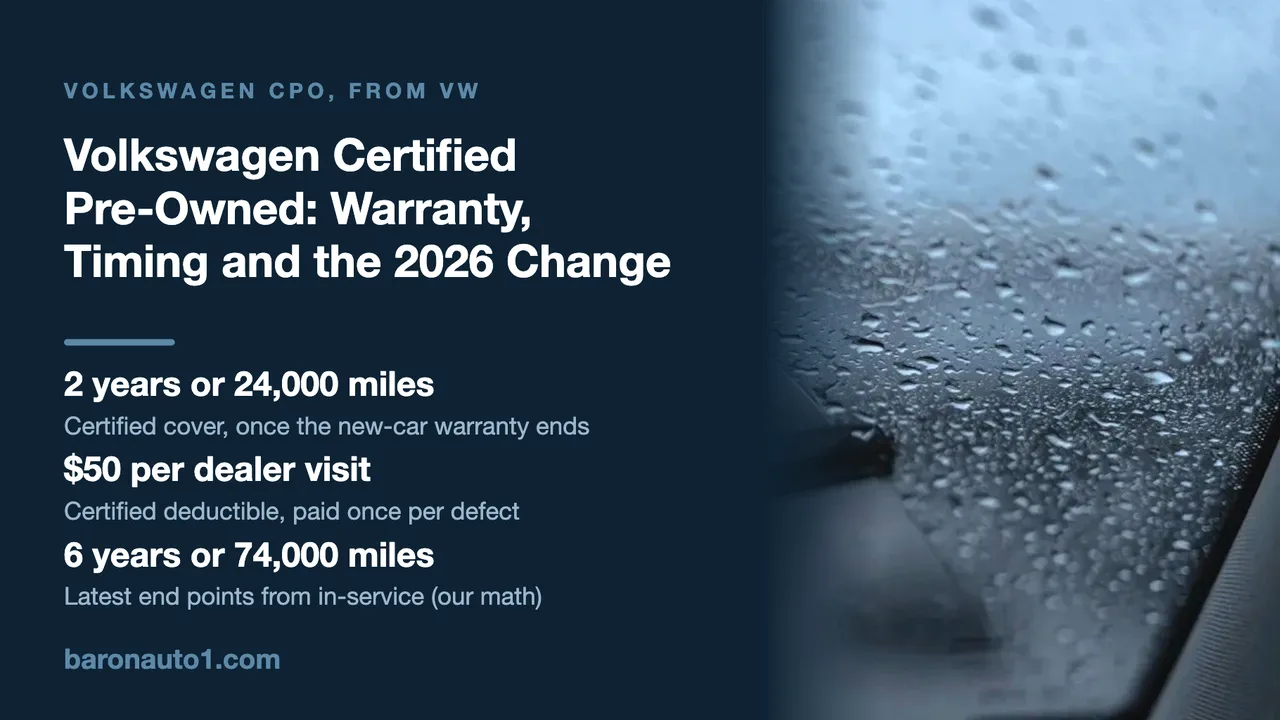
- A Volkswagen bought certified today gets 2 years or 24,000 miles of warranty, whichever comes first, with a $50 deductible per dealer visit. The April 2026 manual applies that one term to every model year 2020 and newer car sold certified from 1 April 2026.
- The certified clock waits for the new-car warranty: it starts when the 4-year, 50,000-mile New Vehicle Limited Warranty expires or on the sale date, whichever is later. On a car bought inside that warranty, by our arithmetic, it ends no later than 6 years from the original in-service date and at no more than 74,000 miles.
- Certified electric cars now get less. Volkswagen lists its 3-year, 36,000-mile EV term only for purchases before 1 April 2026. The high-voltage battery keeps its own 8-year, 100,000-mile warranty, counted from the original in-service date.
- Volkswagen publishes no inspection checklist and no age or mileage limit. Ask for the signed inspection and condition report; on an electric car it includes a Battery Health Status.
- Batteries (the 12-volt included), brake pads and rotors, exhaust systems, tires and paint are excluded. So is any car once sold for commercial use, even after it passes to a private owner.
- Roadside assistance runs 2 more years, but Volkswagen’s documents disagree on when they start. On model year 2020 and newer cars the warranty passes free to a private buyer who applies.
A Volkswagen certified pre-owned car is a used Volkswagen that a dealer has inspected and sold with a Certified Pre-Owned Limited Warranty issued by Volkswagen of America. For a car bought today that warranty runs 2 years or 24,000 miles, whichever comes first, and it doesn’t begin until any new-car warranty left on the car has run out. This guide is built from Volkswagen’s four certified warranty manuals (revised January 2021, January 2024, January 2026 and April 2026), its CPO, benefits, roadside and maintenance pages on vw.com, two new-car warranty booklets and sixteen VW Help Center articles, all read on 30 September 2026.
One program, one warranty, and what changed on 1 April 2026
Volkswagen sells one certified program in the United States, with no tiers. Its Certified Pre-Owned page leads with the VW CPO Limited Warranty, 2 years of 24-hour roadside assistance and a “100+ Point Dealer Inspection”, then adds a CARFAX Vehicle History Report and, on cars with SiriusXM, three months of Platinum programming.
Until this spring there were two terms. The January 2026 manual describes a VW CPO Limited Warranty Program for model year 2020 and newer gasoline cars, at 2 years or 24,000 miles, and a VW EVCPO Limited Warranty Program for model year 2021 and newer electric cars, at 3 years or 36,000 miles. The April 2026 manual keeps only the first, for all model year 2020 and newer cars, with no separate electric term.
The older terms are still on vw.com. The Certified Pre-Owned Benefits page splits its warranty section at 1 April 2026 and says the terms can differ with the model, the model year and when you buy. If you already own a certified Volkswagen, the manual you were given at the sale governs it.
| Bought certified | Which cars | Certified term | Where Volkswagen prints it |
|---|---|---|---|
| On or after 1 April 2026 | All model year 2020 and newer | 2 years or 24,000 miles, from the end of the 4-year, 50,000-mile new-car warranty, or from the sale if that has already expired | April 2026 manual; CPO and benefits pages |
| From 3 January 2026 | Model year 2021 and newer electric (EVCPO) | 3 years or 36,000 miles | January 2026 manual |
| 3 January 2024 to 31 March 2026 | Electric, model year 2018 and newer | 3 years or 36,000 miles | Benefits page; January 2024 manual |
| 5 January 2021 to 31 March 2026 | Model year 2020 and newer gasoline | 2 years or 24,000 miles | Benefits page; January 2021, 2024 and 2026 manuals |
| Before 1 April 2026 | Model years 2018 and 2019 (the benefits page lists model year 2019 gasoline) | 1 year or 12,000 miles; cannot be transferred | January 2021 and January 2024 manuals; benefits page |
| From 5 January 2021 | Model year 2017 and older | 2 years or 24,000 miles | January 2021 manual |
Volkswagen prints no certified term for a model year 2019 or older car bought on or after 1 April 2026, so a car certified today should be model year 2020 or newer. And a certified electric car bought today gets a shorter warranty than one bought in March.
Which Volkswagens can be certified
The model year is the only entry floor Volkswagen prints. We found no age or mileage limit on the CPO page, the benefits page, the four manuals or the Help Center. Dealer pages often quote limits; we haven’t repeated them, because a limit you can’t trace to the carmaker is not one you can hold anyone to. The Help Center does narrow the field:
- No totaled or stolen cars. They can’t be certified, and once a car is identified as a total loss its warranties are invalid except the emissions warranty. Our guide to what a salvage title means explains how that status reaches the paperwork.
- Matching tires. Every tire the dealer fits at certification must be the same brand and meet the specification on the A or B pillar sticker.
- Two keys. A certified car should come with 2 keys.
- Recalls done first. Volkswagen’s policy is that new and certified cars sold by its dealers have open recalls completed before delivery, a policy it says doesn’t cover cars they sell as ordinary used cars.
- Imported by Volkswagen of America. The warranty doesn’t apply to Volkswagens it didn’t import or distribute.
A car that was ever in commercial service is outside the certified warranty. The April 2026 manual excludes vehicles sold for commercial use, naming taxi, courier or delivery service and limousine, and extends that to cars originally used commercially and “later sold to a non-commercial owner”. The 2021 and 2024 manuals also named rental cars, driver education and ride-sharing. If the history report shows fleet, rental or commercial registration, get the dealer to confirm in writing that the certified warranty applies to that VIN before you pay for certification.
When the certified warranty starts, and why the end date barely moves
This is the rule that decides what a certified Volkswagen is worth, and the CPO page’s headline leaves it to a footnote. The April 2026 manual says the certified period begins when the New Vehicle Limited Warranty expires or on the sale date, “whichever occurs later”. The term is an additional 2 years or 24,000 miles, whichever comes first, counted from the end of the 4-year, 50,000-mile new-car warranty, or from the sale if that warranty has expired. So there are two kinds of certified Volkswagen:
- Past its new-car warranty (more than 4 years from its original in-service date, or past 50,000 miles). The certified term ends 2 years after you buy or 24,000 miles past the odometer reading at the sale, whichever comes first.
- Still inside its new-car warranty. You get the rest of that warranty first. The certified term starts when it ends and runs 2 more years or 24,000 more miles, whichever comes first.
The original in-service date is the day the car was delivered to its first buyer or lessee, or first put into service as a demonstrator or company car, according to Volkswagen’s 2024 warranty booklet. For a car bought inside its new-car warranty, the certified term ends no later than 6 years after that date, by our arithmetic (4 years plus 2), and at no more than 74,000 miles (50,000 plus 24,000), which it reaches only if the new-car warranty ran out on mileage. Those are two end points; a car reaches one of them first.
| Age at purchase | New-car warranty left, at most | Certified term starts | Volkswagen warranty ahead, at most | Certified term ends by |
|---|---|---|---|---|
| 1 year | 3 years | When the new-car warranty ends | 5 years | 6 years from in-service |
| 2 years | 2 years | When the new-car warranty ends | 4 years | 6 years from in-service |
| 3 years | 1 year | When the new-car warranty ends | 3 years | 6 years from in-service |
| 4 years | None | At purchase | 2 years | 6 years from in-service |
| 5 years | None | At purchase | 2 years | 7 years from in-service |
| 6 years | None | At purchase | 2 years | 8 years from in-service |
Every certified Volkswagen bought in its first 4 years loses its certified cover by the same anniversary, 6 years from in-service, at the latest. Buying younger doesn’t lengthen the certified term; it buys more new-car warranty in front of it, and new-car repairs are free where certified ones cost $50 a visit.
Four hypothetical cars, not real listings, show how the clocks run.
| Car | New-car warranty | Certified warranty |
|---|---|---|
| Gasoline, in service 1 July 2024, 16,000 miles at purchase | Runs to 1 July 2028 or 50,000 miles | 2 years or 24,000 miles after that: no later than 1 July 2030 and no higher than 74,000 miles |
| Gasoline, in service 1 March 2023, 44,000 miles at purchase | Ends at 50,000 miles or on 1 March 2027, whichever comes first: 6,000 miles left | If it ends on time: 1 March 2029, or 24,000 miles past that day’s odometer. If it ends at 50,000 miles: 74,000 miles, or 2 years after the day it got there |
| Gasoline, in service 1 June 2021, 58,000 miles at purchase | Expired by 1 June 2025 | 30 September 2028 or 82,000 miles |
| Electric, in service 15 September 2021, 47,000 miles at purchase | Expired 15 September 2025 | 30 September 2028 or 71,000 miles. Battery warranty: 15 September 2029 or 100,000 miles |
The second row is the one buyers lose track of. If that car passes 50,000 miles before 1 March 2027, its certified 2 years start the day it does. The manual’s certificate records the Original In-Service Date and the CPO Delivery Odometer, but not the day the new-car warranty ran out on mileage, so note that date yourself and keep a service record from around it.
The 100+ point inspection, and the report you should leave with
The CPO page calls the inspection a “100+ Point Dealer Inspection”, says every certified Volkswagen goes through it to make sure it meets VW standards, and says a car that doesn’t pass is rejected. It names five areas: engine performance for starting issues; transmission performance for malfunction and noise; brakes for proper function and stopping distance; steering for noise, effort, vibration and pulling; and maintenance brought up to date as recommended or required.
That is the whole public description: no checklist, no point count more exact than “100+” and no pass standards, such as a minimum tread depth. A 2019 checklist form circulates online, but it sits on a dealer-software vendor’s server rather than vw.com, so we haven’t relied on it.
The document that matters is the one the Help Center says you should be handed at the sale: a signed copy of the 100+ Point Inspection and Condition Report, which for electric cars includes the Battery Health Status. Ask to see it before you sign; it is your record of what was checked on your car.
Every certified car also comes with a CARFAX Vehicle History Report, the Help Center says, though Volkswagen adds that it doesn’t warrant the report’s accuracy. Have an independent mechanic look at the car anyway; our pre-purchase inspection guide sets out what to check. The certified warranty excludes damage from accidents, collision-repaired parts and salvage parts, and a history report and a second inspection are how you find those before you buy.
What the certified warranty covers, and what the new-car warranty adds
The certified warranty is written the broad way round. The manual says it covers any repair to correct a defect in the manufacturer’s material or workmanship, then lists what it excludes. There is no parts list to check a failure against; you check it against the exclusions in the next section.
The deductible is $50 per dealer visit in all four manuals. One detail works in the owner’s favor: when the same defect needs more than one repair attempt, the deductible for that repair is paid once. A fault that takes three visits to fix costs one deductible.
Where to go. Any authorized Volkswagen dealer or Volkswagen Service Center in the United States can do the work. Abroad the warranty doesn’t apply, except that a Volkswagen dealer in Canada can submit a claim for a traveling owner with proof of United States residence. In an emergency, when reaching a Volkswagen dealer is impossible or unreasonable, Volkswagen says it will reimburse the reasonable cost of warranty repairs done elsewhere, against the paid receipts, repair orders and a statement of what happened.
A car while yours is in the shop. The 2021 and 2024 manuals said the warranty “does not include loaner allowance”. The 2026 manuals say covered repairs “may be eligible for alternative transportation assistance” and send you to the dealer. All four exclude out-of-pocket costs for substitute transportation, so ask before you drop the car off. A dealer may also ask you to approve a diagnosis fee up front; the Help Center says it isn’t charged if the repair is covered.
The new-car warranty a young certified car still carries
The April 2026 manual says the only express warranties Volkswagen makes on a certified car are the certified warranty plus whatever remains of the New Vehicle Limited Warranty, the Limited Warranty Against Corrosion Perforation and the emissions warranties. The new-car warranty isn’t something certification adds: Volkswagen’s 2024 gasoline booklet says it transfers automatically, at no cost. But it covers things the certified warranty doesn’t, and its repairs are free of charge.
| Item | Certified warranty | New-car warranties |
|---|---|---|
| Defects in material or workmanship | 2 years or 24,000 miles once the new-car warranty ends; $50 per dealer visit | New Vehicle Limited Warranty: 4 years or 50,000 miles, free of charge |
| 12-volt battery | Excluded (batteries are wear items) | 3 years or 36,000 miles |
| Paint | Excluded | 3 years or 36,000 miles |
| Brake pads and wiper blades | Excluded as wear items | 1 year or 12,000 miles |
| Tires | Excluded; may carry the tire maker’s warranty | Excluded |
| Corrosion perforation | The manual points to what remains of the new-car corrosion warranty | 7 years or 100,000 miles |
| Catalytic converter, engine and transmission control modules | See the exclusions; exhaust systems are listed as wear items | Federal emissions warranty for listed parts: 8 years or 80,000 miles |
| Scheduled maintenance | Excluded; any Carefree Maintenance left may cover some services | Carefree Maintenance on model year 2020 and newer: the 10,000- and 20,000-mile services, or two years |
So on a car inside its first 3 years or 36,000 miles, a failed 12-volt battery or a paint defect falls to the new-car warranty, at least on the 2024 gasoline models the booklet covers. After that, neither warranty pays.
What the certified warranty doesn’t cover
The April 2026 manual’s section on what is not covered runs to fifteen headings. The ones most likely to matter on a used car:
- Wear-and-tear items, in a list that isn’t exhaustive: clutch linings, brake pads, linings, rotors and drums, timing belts, spark plugs, filters, ignition wires, struts, shocks, batteries, exhaust systems, wiper blades, fuses, worn seat covers, trim, and belts, hoses and clamps worn by normal use.
- Tires, paint and glass. Painted surfaces are excluded outright; glass breakage is covered only if a defect caused it.
- Maintenance and adjustments: scheduled servicing, filters, oil and fluids unless replaced as part of a covered repair, wheel alignment and balancing, and brake and clutch adjustments.
- Warning lights ignored. Damage from driving on after a warning light or gauge reading shows a mechanical problem is excluded, as is damage from missed maintenance or improper repairs.
- Modifications and non-Volkswagen parts: engine-management changes, lowering kits, aftermarket parts that change performance specifications, used, salvage and collision-repaired parts, and accessories such as alarms and remote starters.
- Accident, vandalism, fire, bad fuel and competition use, plus environmental damage from stones, floodwater, acid rain, bird droppings and tree sap.
- Noise, vibration and cosmetic conditions, unless a defect caused them.
- Networks switched off. Failures of connected services, Car-Net included, caused by the retirement of networks such as 3G and 4G.
- Tampered odometers, and your other losses: lost value, lost earnings and substitute transport or lodging.
Batteries catch buyers out twice. They are on the wear-item list, so the certified warranty never pays for a 12-volt battery, and an electric car’s high-voltage battery sits outside it because it has a warranty of its own.
Certified ID.4 and ID. Buzz: the battery, and a shorter term since April
Volkswagen’s maintenance-coverage page describes its high-voltage battery warranty as covering the ID.4 and ID. Buzz. A certified electric Volkswagen carries two warranties with different clocks.
The certified term. The January 2024 and January 2026 manuals gave certified EVs 3 years or 36,000 miles, and the benefits page still shows that term, but only for purchases before 1 April 2026. The April 2026 manual names no electric term, so a certified EV bought now gets the same 2 years or 24,000 miles as a gasoline Volkswagen: by our arithmetic, 1 year and 12,000 miles less at each end point. For the hypothetical 2021 electric car above, certified cover ends on 30 September 2028 or at 71,000 miles; under the old term it would have run to 30 September 2029 or 83,000 miles.
The battery warranty. The certified warranty excludes the high-voltage components covered by the High-Voltage Battery Limited Warranty. For model year 2021 and newer electric Volkswagens sold certified, the April 2026 manual gives that warranty as 8 years or 100,000 miles, starting at the original in-service date: what is left of the new-car battery warranty, not a fresh 8 years. Volkswagen says it covers defects and a net capacity of at least 70%, and that a repair may not restore the battery to as-new, 100% capacity. The model year 2021 all-electric booklet adds that gradual capacity loss is not a defect while the reduction stays within 30%, and that its wider High-Voltage System Limited Warranty, covering the motor, power electronics and charger, ran 4 years or 50,000 miles from in-service.
Buying a certified EV? Check the manual’s date and the battery report before you sign. A certified electric Volkswagen bought on or after 1 April 2026 should come with the April 2026 manual and its 2 years or 24,000 miles; the 3-year, 36,000-mile term still shown on vw.com applies only to earlier purchases. Volkswagen’s documents also disagree on which electric model years the battery line covers: the January 2024 manual says model year 2018 and newer on one page and 2021 and newer on another. Get the Battery Health Status, and the battery warranty’s end date for that VIN, in writing.
The Help Center says the Electrify America Charging Plan comes only with a new, unused Volkswagen EV, so a certified buyer doesn’t get it. For electric cars the manual’s roadside list has a flatbed tow to the nearest VW e-mobility dealership and an out-of-charge service, and no jump start or fuel delivery.
Roadside assistance, trip interruption and the other extras
Roadside assistance is provided by a third party, and Volkswagen notes some services may cost extra. For gasoline cars the manual lists towing to the nearest authorized VW dealership or service facility, collision towing, jump starts, flat-tire and lock-out service, fuel delivery and trip interruption benefits. When the 2 years start depends on which Volkswagen document you read. Every certified manual says two years from the date of purchase. The roadside page, a benefits-page footnote and two Help Center articles say two years from when the original cover (3 years or 36,000 miles from new) expires or from the sale, whichever is later; one adds “regardless of mileage”. A third article says 2 years or 24,000 miles from the certified car’s in-service date.
Under the roadside page’s wording, a car bought while its original cover still ran keeps roadside until as late as 5 years from in-service, by our arithmetic. For the hypothetical car in service from 1 July 2024 and bought on 30 September 2026, that is 1 July 2029; under the manual’s wording, 30 September 2028. Get your end date in writing.
Trip interruption. If the car breaks down more than 100 miles from home and can’t be made safe to drive the same day, you may be reimbursed for lodging, meals and alternate transportation, each capped at $100 a day and $500 per incident in total, but only when the repair is covered by the new-car or certified warranty. Call Volkswagen 24-Hour Roadside Assistance within 24 hours of the breakdown for a reference number; reimbursement takes 4 to 6 weeks. If no service truck can be sent to you, Volkswagen will authorize a provider of your choice and reimburse up to $150, with receipts due within 30 days. Roadside won’t cover replacement keys, impound charges or anything outside the 50 states and Puerto Rico.
SiriusXM and connected services. A certified car with SiriusXM gets three months of premium programming at no charge; the footnote says the trial begins upon the vehicle in-service date, so confirm when yours will run. Model year 2020 and newer certified cars can use any time left on the included Remote Access and Safe & Secure plans, which began when the car was first delivered new. Safe & Secure excludes any car ever classed as totaled, salvaged or rebuilt.
Financing. Volkswagen’s CPO page carries certified finance offers through Wells Fargo for well-qualified customers. Offers like these change often; check the current terms and end date with the dealer.
Proving it’s certified, and passing the warranty on
We found no Volkswagen tool that confirms a car’s certified status by VIN, so the proof is the paperwork. The Help Center lists what you should receive, including the buyer’s order, the signed FTC Buyer’s Guide, the CARFAX report, the Certified Pre-Owned Limited Warranty Manual and the signed 100+ Point Inspection and Condition Report (with the Battery Health Status on an electric car). If anything is missing, it says to contact the sales manager at the selling dealer.
Read the manual’s cover and certificate. The current manual is titled for vehicles purchased on or after April 1, 2026, and marked Revised April 2026. Its certificate carries the VIN, the CPO Delivery Date, the CPO Delivery Odometer, the Original In-Service Date, the dealer code and both signatures. Check that the VIN matches the car and that the in-service date matches the history report, because that date sets when the certified term begins. Confirm the model year from the VIN with our Volkswagen VIN decoder guide, and run an open-recall check. Volkswagen says its myVW app keeps owners informed of active factory coverages; we haven’t tested whether it shows the certified warranty.
Selling it on. On model year 2020 and newer cars, the April 2026 manual lets the rest of the certified warranty pass to the next owner in a private sale at no charge. The new owner starts the transfer by letter to Volkswagen of America with their name, address and phone number, the seller’s name and the complete VIN. One Help Center article asks instead for both parties’ names and addresses and the current mileage, says the transfer can take 4 to 6 weeks, and limits it to private sellers, “not dealerships or other shops”. Model year 2018 and 2019 certified warranties can’t be transferred. The new-car warranty stays with the car without paperwork.
If a claim goes wrong, Volkswagen asks you to raise it with Volkswagen first, then points to BBB AUTO LINE, a dispute program it says is free, though with vehicle age and mileage limits. One sign of how the manual was assembled: its BBB paragraph, in both 2026 editions, refers to a problem under “any Audi written warranty”.
Certified, ordinary used, new, or a service plan
Certified versus an ordinary used Volkswagen. An uncertified used Volkswagen keeps whatever new-car warranty it has, because that warranty transfers automatically. Certification adds 2 years or 24,000 miles of cover after it, the inspection report, the CARFAX report, 2 years of roadside assistance and Volkswagen’s recall-completion policy, which it says doesn’t apply to cars its dealers sell as used. Volkswagen prints no price for any of this, so compare the premium on the lot with the cover it buys on that VIN.
Certified versus new. A new model year 2020 or newer Volkswagen comes with the 4-year, 50,000-mile New Vehicle Limited Warranty, 3 years or 36,000 miles of roadside assistance and Carefree Maintenance (the 10,000- and 20,000-mile services, or two years). A new electric Volkswagen also brings the Electrify America Charging Plan. A young certified car takes over whatever is left of the first three, then adds the certified 2 years.
Certified plus a service plan. Volkswagen’s service contracts are sold as Volkswagen Drive Easy. The benefits page says Volkswagen vehicle service protection can extend coverage up to 10 years or 150,000 miles and protect over 1,500 parts. The Help Center says Drive Easy is optional and isn’t insurance, and names its obligor, the company that owes the claim, as VWFS Protection Services, Inc. A 2018 Drive Easy brochure for certified cars, still on vw.com, made the same timing point as the certified warranty: a plan bought while the factory warranty runs is measured from the original in-service date and zero miles. Terms may have changed since, so read the current customer agreement. What plans cost is in our guide to extended car warranty cost, and whether one pays off in is an extended warranty worth it. Our Volkswagen extended warranty guide reads the current Drive Easy pages in full. For how certification works across carmakers, see our overview of certified pre-owned programs.
Before you sign: a Volkswagen certified pre-owned checklist
- Check the model year and in-service date. The current term covers model year 2020 and newer, and the in-service date sets when your certified 2 years begin.
- Do the end-point arithmetic. Bought inside the new-car warranty, certified cover ends by 6 years from in-service, at 74,000 miles at most. Bought after it, 2 years or 24,000 miles from purchase, whichever comes first.
- Look for commercial history. Taxi, courier, delivery or limousine use puts the car outside the certified warranty, even after it passes to a private owner.
- Take the inspection and condition report. Signed, for your VIN, with the Battery Health Status on an electric car.
- Check the manual you’re given. For a purchase on or after 1 April 2026 it should be the April 2026 edition, with your VIN, delivery odometer and in-service date on the certificate.
- Count the keys and the tires. Two keys; tires of one brand that match the door-pillar specification.
- Get the roadside end date in writing. Volkswagen’s documents disagree on when certified roadside starts.
- Keep every service record. Missed maintenance and driving on a warning light are both grounds for refusing a claim.
Common questions
Is Volkswagen certified pre-owned worth it?
It is worth most on a young car, which gets the rest of the free 4-year, 50,000-mile new-car coverage and then 2 years or 24,000 miles of certified cover: up to 5 years of Volkswagen warranty ahead on a 1-year-old car, by our arithmetic. A car past 4 years or 50,000 miles gets 2 years or 24,000 miles from purchase. Weigh the premium on the lot against the coverage left on that VIN.
What does the Volkswagen CPO warranty cover?
Volkswagen says it covers any repair to correct a defect in the manufacturer’s material or workmanship, at $50 per dealer visit. It excludes wear items (all batteries, brake pads and rotors, exhaust systems and more), tires, paint, glass breakage, maintenance, damage from accidents or modifications, and cars sold for commercial use.
How long is the VW certified pre-owned warranty, and when does it start?
For cars bought on or after 1 April 2026, 2 years or 24,000 miles, whichever comes first, starting when the 4-year, 50,000-mile new-car warranty expires or on the day you buy, whichever is later. Earlier purchases carry the term in their own manual, such as 1 year or 12,000 miles for model years 2018 and 2019.
Is there a deductible on the Volkswagen CPO warranty?
Yes: $50 per dealer visit, paid once if the same defect needs more than one repair attempt. Repairs under any remaining new-car warranty are free of charge.
Does the VW CPO warranty cover the ID.4 battery?
No. The high-voltage battery has its own warranty of 8 years or 100,000 miles, whichever comes first, from the original in-service date, for defects and a net capacity of at least 70%. Ask for the Battery Health Status in the inspection report.
Can I transfer a Volkswagen CPO warranty?
On model year 2020 and newer cars, yes, to a private buyer at no charge; the new owner applies to Volkswagen of America in writing, and the Help Center allows 4 to 6 weeks. Model year 2018 and 2019 certified warranties can’t be transferred.
For sale near you
Dealer listings, checked liveFinding used Volkswagen cars near you…
Sources and further reading
- FTC: a businessperson’s guide to federal warranty law
- 15 U.S.C. § 2301 (Magnuson-Moss definitions)
- FTC: auto service contracts and warranties
Recall, complaint and safety-rating figures on this page were retrieved from the federal databases above on August 19, 2026. Federal data changes — re-check any VIN before you rely on it.
Published September 30, 2026 · last updated September 30, 2026. Found something out of date or wrong? Tell us and we will correct it.