Cadillac VIN Decoder: The Codes Belong to the Parent Group
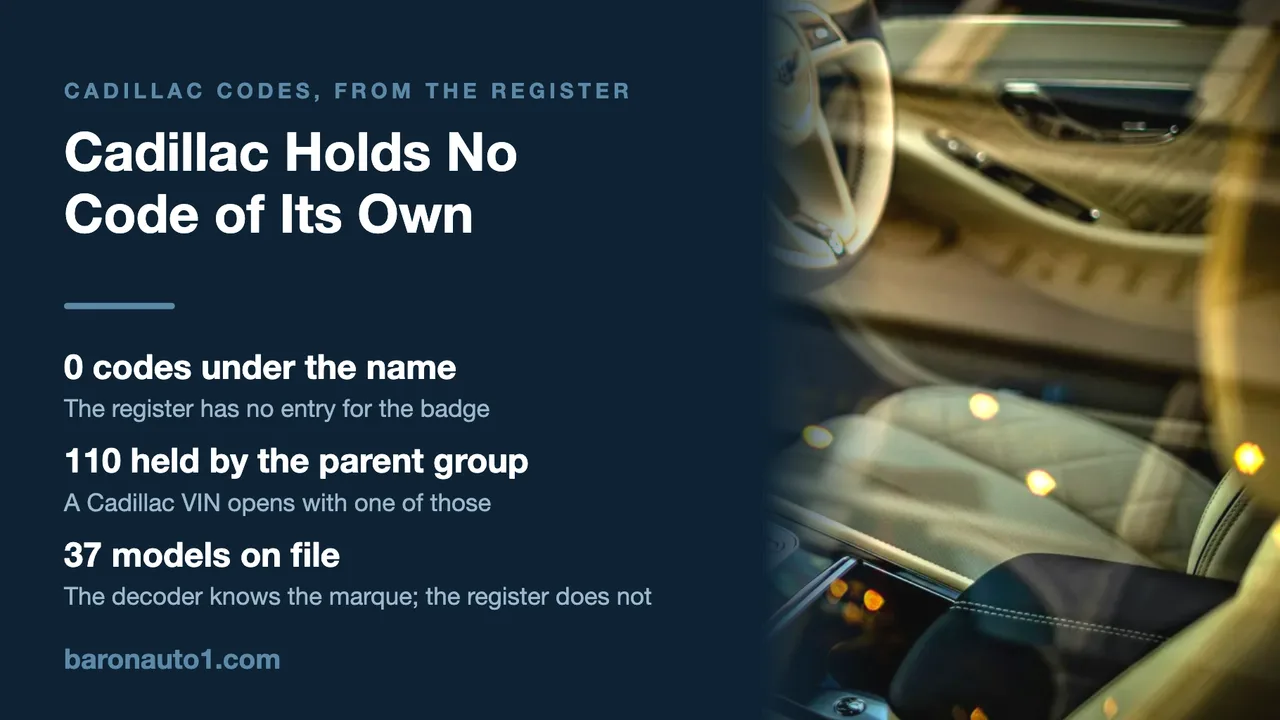
The register has no entry under Cadillac. The 110 codes a Cadillac VIN opens with are filed under the parent group.
The short version
- Cadillac holds 0 world manufacturer identifiers in the federal register under its own name. The entry is not short. It is empty.
- The three characters a Cadillac VIN opens with are registered to the parent group recorded against the make, General Motors, whose entry holds 110 of them.
- A name query on the badge returns zero unrelated matches as well, so the result is a clean nothing on both sides: no genuine codes to report and no coincidences to filter out.
- Those 110 parent codes are filed under five vehicle classes — 38 Passenger Car, 37 Multipurpose Passenger Vehicle, 16 Truck, 13 Incomplete Vehicle and 6 Bus — and under two registered company names.
- Seven countries appear across the parent entry, led by 75 rows against the United States, and four rows carry no country at all. That field records where the registering entity filed.
- None of this stops a Cadillac VIN decoding. The federal decoder holds 37 models for the make and records four vehicle types against the name, so the badge is visible to the system — only the manufacturer codes are filed elsewhere.
- What no decode carries, on this make or any other: service history, present condition, and whether a recall that was issued was ever actually carried out.
Search the federal manufacturer register for Cadillac and it returns nothing. No codes, no companies, no near misses, no partial results to sift. An empty set, twice over. That is the finding this page is built around, because until it is explained it looks exactly like a broken lookup.
It is not a fault in the register, in the decoder, or in the vehicle. It is what happens when a filing system organised around registered companies is asked a question phrased in badges. The register files a manufacturer code against the legal entity that certifies vehicles and issues numbers under it, and no entity on this register is filed under a name containing the word Cadillac. Once the name the codes are actually filed under is on the table, everything that looked broken resolves in a sentence.
This page works from one archived read of that register. It sets out what the federal data holds under this badge, what it holds under the parent entry the codes belong to, and — the part that matters most before money changes hands — the questions no decode of any make can answer at all.
The entry under this badge is empty on both sides
The first three characters of any seventeen-character VIN are the world manufacturer identifier. They are assigned centrally rather than chosen by the company, they are published openly, and the register behind them can be queried by manufacturer name. That query is the engine underneath every by-make decoder listing, including the ones on this site.
Run it for Cadillac and the count of genuine three-character codes is 0. The archived entry carries an empty list of codes, an empty list of countries, an empty vehicle-type breakdown for codes, and an empty list of registered divisions. There is no small number to report here. There is no number at all.
A register query of this kind has two sides to it, and it is worth separating them because they fail in different ways. One side is the set of codes genuinely held by an entity whose registered name matches. The other is the set of companies whose registered names merely contain the same run of letters — unrelated builders that a text match drags in. On this make both come back at zero. There are no codes and there are no stray matches.
Zero unrelated matches is the ordinary outcome rather than a distinction. Counting across all 57 make entries in our file, 43 of them return no unrelated name match at all. Stating the figure and moving on is the honest treatment: it means only that no company on the register happens to carry this string in its registered name, so nothing has to be filtered by hand and nothing here can be mistaken for a manufacturer by a careless reading.
The empty code count is less common but far from unique. Counted across the same 57 entries, 12 hold no world manufacturer identifier under their own name and sit beneath a parent entry instead. This make is one of the twelve. That is frequent enough to deserve an explanation rather than an eyebrow.
What the empty entry does not mean deserves saying with equal force. It does not mean a vehicle is unregistered, that a number is invalid, that a decoder is out of date, or that a seller has misdescribed something. It means the register files codes under companies, and the company is not called Cadillac.
What the first three characters of a Cadillac VIN actually are
The parent recorded against this make in our read is General Motors, and that parent entry holds 110 world manufacturer identifiers. A Cadillac number opens with one of those. That single sentence is the whole of the answer to the question the empty entry raises.
To put 110 in proportion, we counted every entry in the file rather than guessing. The largest entry any make holds under its own name is Ford’s, at 60 codes. The largest parent entry in the file is this one, at 110. So the group of codes standing behind this badge is close to twice the size of the biggest single-name entry anywhere in our data. That is what a corporation which registers centrally, rather than badge by badge, looks like from the outside.
Now the limit that disappoints people, and it needs to be stated before anything else on this page can be read properly. The register attributes each code to a company. It does not divide those codes by marque, and nothing in the federal data we hold says which of the 110 carries which badge. There is no code that means Cadillac. That is not an omission in our read; it is the shape of the register itself, and it is precisely why a search on the word could never have returned one.
The practical consequence for a decode is straightforward and slightly deflating. Put a genuine number in, and the manufacturer field comes back with a registered company name drawn from the parent entry. It will not contain the badge. That is not a mismatch to worry about and not evidence that the car is something other than what it is. It is the register reporting the registrant, which is the only job that field has ever had.
One federal system reads every VIN, and there is no Cadillac-only decoder
The VIN is a federal standard and its layout does not change with the badge on the bonnet. Positions one to three are the world manufacturer identifier. Positions four to eight are a descriptor block each manufacturer designs for itself. Position nine is a check digit, computed arithmetically from the other sixteen characters. Position ten carries the model year. Position eleven identifies the assembling plant. The final six characters are the serial.
Because that structure is identical across everything certified for sale in this market, one federal system reads every VIN, and a general decoder handles a Cadillac exactly as readily as it handles a delivery van.Our guide to reading a VIN position by position works through the full layout, and the by-make index collects what the register holds for each manufacturer we have read.
Where a genuinely make-specific decoder would earn its keep is the middle block, and this is the point at which admitting a gap is more useful than filling it. Positions four to eight are the manufacturer’s own descriptor scheme, and the federal register does not publish the key to it. The register records who holds a prefix, which vehicle class the prefix is filed under, which country the entity filed in, and the date a code was opened. It does not record that a particular character in position six means one body style on one line and something different on another.
So this page prints no position-by-position breakdown and no plant-code list, because we hold neither from a source we would defend. Decoding an actual number returns the descriptor fields as the federal system resolves them for that specific vehicle, which is a different and far more dependable thing than a printed key. Position ten, the model year character, is the one part of the middle of the number standardised across manufacturers, and our VIN year chart converts it.
Why the brand-name query comes back empty, and what to search instead
The mechanism is simple once it is spelled out. A world manufacturer identifier is registered by the legal entity that certifies the vehicle, and a legal entity is not a marketing brand. Large groups tend to register once for the corporation, or once for each corporate subsidiary, rather than once for each nameplate. The badge is a commercial fact and it does not appear in the filing.
The name lookup compounds this by matching registered company names as text rather than resolving brands to owners. Ask it for a word and it hands back every firm whose registered name happens to contain that run of characters, whatever they build. On this make the text match finds nothing to catch on: the register records no company at all filed under a name containing the string, so the result is neither a filtered list nor a padded one. It is genuinely empty.
The rule to carry away is short. If you want the manufacturer codes behind a Cadillac, search the parent rather than the badge. Our page on decoding a General Motors number reads the same entry from the parent side, and the by-make index explains why one federal system serves every manufacturer while the entries beneath it vary so widely in size and shape.
The same pattern sits under the other marques that share this parent, and the register does not treat them identically. Our GMC register page covers a badge that also returns zero codes and zero name matches, while the Chevrolet page takes apart the single unrelated row that a name query on that word does return. Same parent entry, same 110 codes, and two different results at the badge level. The query is answering a question about names rather than about vehicles, and the outcomes differ for that reason alone.
The five classes the parent’s codes are filed under
Every code in the register is filed under a vehicle class, and the parent entry’s 110 divide five ways: 38 Passenger Car, 37 Multipurpose Passenger Vehicle, 16 Truck, 13 Incomplete Vehicle and 6 Bus.
Read those as regulatory categories rather than as showroom descriptions, because that is what they are. The federal safety standards define a passenger car as a motor vehicle with motive power, excluding the other defined categories. A multipurpose passenger vehicle is also designed for ten or fewer, but is constructed either on a truck chassis or with special features for occasional off-road operation — which is why so much of what the market calls an SUV or a crossover is filed under that heading. Incomplete Vehicle is the class used where a chassis is certified before a body has been fitted to it. None of those words is a body style, and none of them is a verdict on what something “really” is.
Two cautions follow from the split. The first is that a class describes how vehicles issued numbers under that code are certified, not what the specific vehicle in front of you is. The second is that these are the parent’s figures. The register does not apportion them by badge, so nothing in the five-way split says how many of the 38, or of the 37, sit behind any one nameplate.
What the split does show honestly is the breadth of the filing the codes come from. A single group registration spanning passenger cars, multipurpose vehicles, trucks, bare chassis and buses is a wide entry, and a decode returning a company name out of it is naming the registrant of a very large filing rather than describing your car.
Four vehicle types under the name, five across the codes
There is a second, quieter figure in this entry that is easy to miss, and it is one of the two fields where the federal data says something about this badge specifically rather than about its parent.
Alongside the code register, the decoder records the vehicle types it holds against a make name. For Cadillac it records four: Passenger Car, Truck, Multipurpose Passenger Vehicle and Incomplete Vehicle. The parent’s codes, as the previous section set out, span five classes. The type the make name does not carry is Bus.
That gap is worth pausing on, because it demonstrates something the rest of this page has been circling. These are two separate lookups against two separate keys. One is keyed to a registered company and returns codes. The other is keyed to a make name and returns classes. The badge is invisible to the first and perfectly visible to the second, which is why a reader can be told in the same breath that the register holds nothing under this name and that the federal system knows the name perfectly well.
We counted the same field across the marques sharing this parent entry, since a lone figure means little. Chevrolet and GMC each carry five vehicle types against the name; this make carries four; Buick carries three. One shared set of 110 manufacturer codes, and three distinct type lists across the four marques. The differences sit in the decoder’s make-level records, not in the codes, and no code moved to produce them.
The useful takeaway is narrow. If a decode on a specific vehicle returns a class you would not have chosen yourself, that is the federal category the number resolves to, not an error and not a comment on the car. And if you are trying to work out what a badge covers from the register alone, the type list is the field that answers, while the code count is the field that will keep telling you nothing.
Where the parent’s codes were filed, and what that field means
The register records a country against most codes. Across the parent entry of 110: 75 against the United States, 15 against Canada, 10 against Mexico, 2 against Australia, 2 against China, 1 against South Korea and 1 against South Africa. Four rows carry no country at all.
Seven named countries, then, and four blanks. A blank is not an error and not a concealment.
Now the caution that matters more than any of the figures. The country field records where the registering entity filed. It is a fact about a filing, and it says that and nothing stronger. It is not a statement about where a vehicle was assembled, and a decode that looks careful can still be read too far in exactly that direction. This page will not tell you that a code “means” a vehicle was built anywhere, because the data does not support the claim.
A related question falls to the same caution. Position eleven of an individual number is the plant character, and it is the field that would genuinely identify an assembly location — but the register does not publish the key that turns that character into a plant name, so no plant table appears here. The leading character of a code and the country recorded beside it both describe filings. Neither substitutes for the plant field, and the plant field is not something this data resolves.
Two registered names hold the whole parent entry
Our read records the registered divisions behind the parent entry, and there are two of them: GENERAL MOTORS LLC and SHANGHAI GENERAL MOTORS CORP LTD. All 110 codes sit beneath that pair of names.
Two names across 110 codes is a concentrated arrangement, and the file offers a contrast worth stating: the parent entry behind Acura carries ten distinct company names across 45 codes, and the one behind Lexus carries fourteen across 34. A group can spread its registrations across a long list of separately named subsidiaries or hold a very large entry under a very short list. This one does the latter, which is why the manufacturer field on a decode here has so few possible answers.
What the register supplies about those two names is exactly this: a name, and sometimes a country, against each code. It does not record how the entities relate to one another, which one certifies what, or why a second name exists at all. This site does not supply that kind of detail from memory, so the paragraph stops where the data does.
The effect on a decode follows. Whatever Cadillac number goes in, the manufacturer name that comes back is drawn from a set of two, and neither of them contains the badge. This is also the answer to whether a decode can confirm a badge for you. It cannot, and on this make it is structurally incapable of doing so. The company name identifies a filer. Confirming that a vehicle is what an advert claims is a job for the model and the model year the decode returns, read against the listing, and then for your own eyes on the vehicle itself.
A capped sample, and the things it must not be used for
Our archived read does not carry all 110 parent rows. It carries a capped sample of twelve of them, and the cap is more important than the contents.
A capped sample cannot be counted and it cannot be totalled. Twelve rows out of an entry of 110 will not tell you how many codes exist, how they divide, or how they are spread. Any figure derived by adding up a sample of this kind is a statement about our extract rather than about the register, and the two are not the same thing.
The sample is unrepresentative in a way that is easy to check from the figures already on this page. Every one of the twelve rows is filed under a single vehicle class, while the full parent entry spans five. Read the sample as evidence about the shape of the entry and you would conclude the group registers only one kind of vehicle, which the 110-code breakdown flatly contradicts.
The sample also cannot answer the question a reader most wants put to it. It does not say which code carries which badge, because the register does not record that against any of the 110 rows, sampled or not. So there is no prefix table on this page and no list of “Cadillac codes”. A code you are holding that does not appear in a twelve-row sample is not thereby suspicious, and one that does appear is not thereby a Cadillac code.
Thirty-seven models, and why none of them is named here
Separately from the manufacturer codes, the federal decoder holds a roster of model names for each make. For Cadillac it holds 37. That is the vocabulary a decode can draw on when it resolves a specific number — the model names the system knows for the badge, across all the years it covers rather than any current line-up.
The archived read behind this page carries that count and not the roster of names, so no model list is printed. Every make page on this site works from one archived read, and the rule is that we publish what the read contains. Reciting a list of names from memory would look, to a reader, exactly like reporting the data, and that similarity is the whole problem with doing it. Where we hold the roster, we print it. Here we hold the count, so the count is what you get.
The count is not the useful part in any case. What a buyer needs is the model returned for one specific vehicle, and that comes from decoding that vehicle’s number rather than from any published roster. A list would tell you what the system knows about the make in general; a decode tells you what it holds about the thing you are being asked to pay for.
It is worth noticing what this count sits beside. The same parent entry of 110 codes stands behind four marques in our file, and the decoder holds 124 models for Chevrolet, 87 for GMC, 37 for this make and 27 for Buick. One shared set of manufacturer codes, and four differently sized model rosters. That is the sharpest illustration on this page of how thoroughly the register separates the question “which company registered this number” from the question “what is this vehicle”.
The figure below sets the four counts from this entry side by side — codes filed under the badge, codes filed under the parent, models the decoder holds, and unrelated name matches. It is a summary of counts rather than a list of companies, because under this name the register has no rows to list.
And a model name, however it arrives, is not a trim. The system knows the model line. It does not know which engine option, which drive configuration, which axle, which interior or which options package a particular vehicle left the factory with, and those are the distinctions that move money on a used sale. Our pages on trim level by VIN and build sheets set out how far that can be pushed and where it stops.
What the federal decode does not carry
Everything above concerns what the register holds. This section concerns what it does not, and for anyone about to hand over money it is the more important half of the page.
A decode does not carry service history. It will not tell you when a car was last looked at, what was done to it, whether the work was done by someone competent, or whether anything was skipped.
A decode does not carry condition. It resolves what a vehicle was specified as when its number was assigned. It says nothing about what has happened since — wear, damage, repairs, replacements, or anything fitted, removed or swapped after the vehicle left the factory. A VIN is a fixed record of an origin, not a live description of an object.
A decode does not tell you that a recall was carried out. A recall lookup and a VIN decode run against the same number and feel like one operation, but they query different systems and answer different questions. A recall check against a specific number shows whether a campaign is recorded as open or as remedied against that vehicle, which is free, quick and always worth running — our guide to checking a car for open recalls covers how to do it. What it cannot show is whether a previous owner ever presented the vehicle, or any work done outside the campaign system. Read the campaign text rather than only the status flag.
And a decode does not carry title status, mileage history, or the record of what has been reported against a vehicle over its life. Those live in different systems and have to be asked separately. A free VIN check is a reasonable first pass, and a title check by VIN covers the branding questions a decode is structurally incapable of answering.
One further limit specific to this entry. Because the codes are filed under a parent, a decode here cannot confirm the badge either. The manufacturer field returns a registered company. The badge is confirmed by the model the decode resolves, by the paperwork, and by the vehicle in front of you.
Reading the number off the vehicle
Before any of this is worth doing, the number has to be right, and that is a physical check rather than a digital one.
The VIN appears in more than one place: on the dashboard at the base of the windscreen, on the certification label in the driver’s door opening, and on the title, registration and insurance paperwork. Compare them character by character, in every position, on every document. Confusing an S with a 5, or a B with an 8, produces a decode that either fails outright or, worse, resolves to something plausible that is not the vehicle you are standing next to.
The certification label is worth a proper look while you are there. It is the manufacturer’s own statement that the vehicle conformed to the applicable federal standards, and it carries the date of manufacture and the class the vehicle was certified under. That class is the same regulatory vocabulary the register uses, which means the label and a decode should agree. A missing, damaged, painted-over or obviously replaced label is a reason to slow down and ask questions rather than to keep typing numbers into websites.
If characters disagree between the vehicle and the documents, stop there. No decoder resolves that, and there is nothing on this page or any other that makes a mismatched number safe to ignore.
A sensible sequence on a specific car
Put together, the order of operations on an individual vehicle is short and does not take long.
Start with the character-by-character comparison above.
Then decode the number and read the result for what it is. The manufacturer prefix will resolve to one of the parent entry’s codes and return a registered company name and a federal vehicle class. Expect the company name to be a registered entity rather than the badge. Expect the class to be a regulatory word, possibly one you would never use in conversation. Neither is a fault, and on this make both are the expected outcome rather than a surprise.
Then check the model year character against the advert, run the recall lookup, and run the title check. Those three take a few minutes between them and they address the questions that actually decide whether a car is worth pursuing.
Finally, treat everything the decode cannot reach as a documentation problem rather than a data problem. Service records, evidence that recall work was actually done, and an inspection by somebody competent are what fill that gap.
If you are the one selling
The same material is useful from the other side of a transaction. A buyer who runs a decode on a car like this and gets back a company name that is not the badge may arrive with a question that sounds like an accusation.
The answer is the one this page has been making throughout: the register records a registrant and a federal classification, and neither is a description of the car. The codes are filed under the parent entry, the badge does not appear in the filing, and a decode returning a corporate name is the system working exactly as designed. Being able to say that plainly, and to point at where it comes from, tends to close the question rather than open it.
Common questions
Is there an official Cadillac VIN decoder?
Not a separate one, and none is needed. Every vehicle certified for this market carries the same seventeen-character number, and one federal system resolves the manufacturer prefix on the same terms for every make. A general decoder handles this badge exactly as it handles any other.
How many manufacturer codes does Cadillac have?
None under its own name. The register holds 0 world manufacturer identifiers filed under the badge. The parent entry recorded against the make, General Motors, holds 110, and a Cadillac number opens with one of those.
Why does a register search for Cadillac return nothing?
Because the register files codes against registered companies rather than marketing brands, and no company on it is filed under a name containing the word. The lookup has not failed; there is simply no row matching that string. Search the parent group instead.
Which three characters mean Cadillac?
The federal data does not answer that. It attributes each of the parent’s 110 codes to a company, not to a badge, so nothing in it identifies a code as belonging to one marque rather than another.
Why does my decode return a company name that is not Cadillac?
Because that field reports the registered entity that issued the number. The whole parent entry sits under two registered names, GENERAL MOTORS LLC and SHANGHAI GENERAL MOTORS CORP LTD, so the manufacturer field has a very small set of possible answers and neither of them contains the badge. It is not a mismatch.
Does the empty entry mean something is wrong with my car?
No. It is a fact about how the group organises its registrations, not about any vehicle. Counted across the 57 make entries in our file, 12 hold no code under their own name and sit beneath a parent instead. Nothing about that affects whether an individual number decodes.
Does a name query return any stray results for this badge?
None. The count of unrelated name matches is zero, which is the ordinary outcome: 43 of the 57 entries we have read return no such match. It means there is nothing to filter out by hand and nothing here that a loose reading could mistake for a manufacturer.
What do the vehicle classes in a decode mean?
They are categories from the federal safety standards rather than descriptions. Passenger Car and Multipurpose Passenger Vehicle both cover vehicles, with the multipurpose category additionally requiring construction on a truck chassis or features for occasional off-road use. Incomplete Vehicle covers a chassis certified before a body is fitted. The parent’s 110 codes span five such classes; the decoder records four vehicle types against this make name.
Does the country against a code tell me where the car was built?
No. It records where the registering entity filed, and that is all it records. Across the parent entry, 75 codes sit against the United States, 15 against Canada, 10 against Mexico, 2 each against Australia and China, and 1 each against South Korea and South Africa, with four rows carrying no country at all. If assembly location matters to you, that belongs to the certification label on the vehicle and the documentation, not to this field.
What does the registration date on a code mean?
Where the register carries a date against a code, it is the date the registration was recorded. It is not a build date, not a model year, and not the date anything was sold. A code must exist before numbers can be issued under it, so a filing date sets an outer boundary and nothing finer.
How many models does the decoder hold for the make?
Thirty-seven, across all years rather than as a current line-up. The archived read behind this page carries the count and not the list of names, so no roster is printed here. Decoding a specific number returns the model for that vehicle, which is the answer a buyer actually needs.
Will a decode tell me the trim, engine or options?
No. It resolves what the federal system holds for the number — manufacturer, class, model year and the model line as filed. Options, fitted equipment and anything changed after the vehicle was built sit outside every historical decode, on this make and on all others.
Can a VIN check prove a recall was completed?
It can show whether a campaign is recorded as open or remedied against that specific number, which is free and always worth running. It cannot prove a previous owner ever presented the vehicle, and it does not capture work done outside the campaign system. Read the campaign text, not only the status flag.
For sale near you
Dealer listings, checked liveFinding used Cadillac cars near you…
Sources and further reading
- NHTSA VIN decoder
- NHTSA recall lookup
- NMVTIS (US Department of Justice)
- 49 CFR Part 567 — Certification
Recall, complaint and safety-rating figures on this page were retrieved from the federal databases above on August 19, 2026. Federal data changes — re-check any VIN before you rely on it.
Published September 6, 2026 · last updated September 6, 2026. Found something out of date or wrong? Tell us and we will correct it.