Free Carfax Reports: What Works, What Is a Myth, and What It Costs
The most upvoted free-Carfax tip on the internet is a myth, and it is a myth about a different company. Every route checked against a source you can open.
The short version
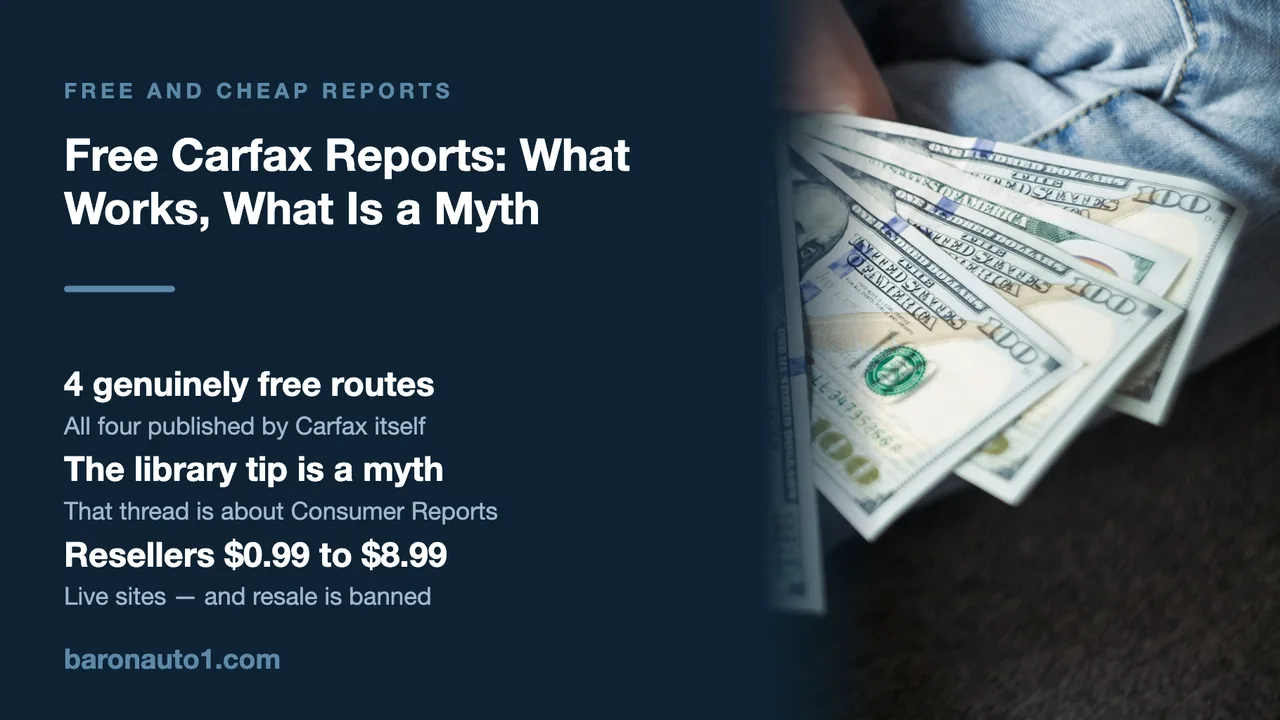
- Carfax itself publishes four ways to get a report at no charge, and they are the only free routes on this page that are both legitimate and reliable: a report attached to a Carfax listing, one linked from a dealer’s own site, one you ask the seller for, and a free Car Care account.
- The most upvoted free-Carfax tip on the internet — use your library card — appears to be a myth. The library thread everyone cites is about Consumer Reports, not Carfax, and no library licensing Carfax could be found.
- Carfax’s terms ban resale and redistribution outright. Sharing is permitted only through Carfax’s own share feature. That single clause is what separates a dealer emailing you a live link from a stranger selling you a PDF.
- The discount resellers are real and live. Verified prices on 1 September 2026 run from $4.99 to $8.99 for a single report, with bulk packs at $15 for three and $87 for twenty-five.
- They are also selling something they did not originate, which is the thing Carfax’s terms prohibit. What that means for the buyer is set out below rather than waved at.
- One well-known “cheap Carfax” domain is not a service at all — it is a 114-byte stub that bounces you to a parking page.
“Free Carfax” is one of the most searched phrases in used-car buying, and almost everything written about it is either wrong, out of date, or quietly selling something.
This page takes the advice that circulates and tests it. Not by reporting what people say — that is how the bad advice spreads in the first place — but by going to the primary sources: Carfax’s own terms and help pages, the federal provider register, and the resale sites themselves.
One limit stated up front, because it shapes what this page can claim. Carfax’s own domains — the main site, the checkout and the help centre — all return HTTP 403 to this network, verified on 1 September 2026. Where Carfax’s own wording is quoted below it comes from archived captures, dated in the text. No current Carfax price is printed here, because none could be read from the source.
The four routes Carfax publishes itself
Start with the least exciting answer, which is also the correct one. Carfax operates a help page listing ways to get a report without paying, and it heads four of them.
The first is that every Carfax used-car listing comes with a free report attached. The second is that dealer websites frequently link one for the cars they are advertising. The third is simply to ask the seller. The fourth is a free Car Care account.
None of those is a loophole. They exist because Carfax’s actual customers are dealers, who buy reports in volume and attach them to listings precisely so buyers do not have to. When a report is free to you, a dealer has usually already paid for it. That is the business model working as designed, not a gap in it.
The practical consequence is that for a car being sold by a dealer, asking is very often the whole technique. It costs a message, it works most of the time, and a seller who refuses has told you something useful for free.
The library card, which is where this gets interesting
Ask anywhere online how to get a Carfax report free and one answer rises above the rest: use your public library card.
It appears to be wrong, and the way it is wrong is instructive.
The thread that circulates as the source is real, and it is about libraries giving free access to a subscription database. But the database is Consumer Reports, not Carfax. Nobody in it mentions Carfax at all. Somewhere in the retelling, “your library card gets you a car-related paid service” lost its specifics, and the advice mutated into a claim nobody checked.
Checking it is not hard. The A-to-Z database lists of two large public library systems were searched for Carfax and neither carries it.
Stated precisely, because the difference matters: no library licensing Carfax could be found. That is not the same as proving none exists anywhere. If your library does carry it, the catalogue will say so and it costs nothing to look. But do not go in expecting it, and do not repeat the tip as though it were established.
The Consumer Reports half of the advice, incidentally, is genuine and worth having. It is just a different product answering a different question — reliability across a model, rather than the history of one car.
The clause that governs everything else
Before the paid shortcuts, the rule they run into.
Carfax’s consumer terms — the document is headed October 2017 and carries no other date — contain a block titled “Restrictions on Access and Use.” It does three things at once. It bans reselling reports. It bans letting other people access a report. And it bans copying or redistributing them without written permission.
Against that sits one narrow carve-out: you may share a report through Carfax’s own share feature, as a link posted to a social account or sent to email recipients.
That carve-out explains a great deal. A dealer emailing you a live Carfax link is doing the permitted thing. A stranger sending you a PDF for six dollars is doing the prohibited thing. Both arrive in your inbox looking similar; they are not similar at all.
A note on citations, since this page is arguing about sourcing. Several write-ups attribute these rules to “Section 5” of the Carfax terms. There is no Section 5 — the document has no numbered sections anywhere. It is a small thing, but a citation that specific and that wrong is a reliable sign nobody opened the document.
The discount resellers, priced
A cluster of sites sells Carfax and AutoCheck reports far below list. They are not hypothetical and they are not all scams. Each of the following was live on 1 September 2026 and re-checked independently.
vinfax.com advertises reports at $4.99, with an introductory offer at $0.99; its page title claims 90 per cent off official reports. carfaxdeals.com sells a single report at $7.99, describing it as the same data in the same format, directly from Carfax. dealsoncarfax.com sells at $8.99 and, to its credit, states plainly in its own FAQ that it is an independent service and not affiliated with Carfax.
cheapcarfax.net sells in bulk: $15 for three reports and $87 for twenty-five. It is unusually candid about the mechanism, saying it partners with providers offering discounted bulk access and passes the saving on.
That candour is the useful part, because it describes exactly what all of these are: somebody with volume access reselling individual pulls. Which is the practice the terms quoted above prohibit.
What buying from a reseller actually risks
Being straight about this rather than alarmist: the realistic downside is not legal trouble for you.
Carfax’s terms bind the account holder who pulls the report. The person exposed to account termination and chargebacks is the reseller, not the buyer. Nobody is coming after a used-car shopper who spent $7.99.
The real risks are duller and more likely. You may receive a report that is genuine but stale, pulled weeks earlier and cached. You may receive a document that looks like a Carfax report and is not one. You may pay a site that takes the money and disappears, with no chargeback path that is worth the hour it takes. And you have no recourse to Carfax itself, because Carfax has no relationship with you.
Set against saving twenty or thirty dollars on a purchase costing thousands, that is a poor trade at the exact moment when being wrong is most expensive.
The domain that is not a business
One name that comes up in these lists deserves separating out, because it illustrates how thin some of this territory is.
cheapcarfax.com — the .com, not the .net discussed above — is not a vehicle-history service. It returns 114 bytes: a stub whose only content is a JavaScript redirect bouncing the visitor to a parking page. There is no product, no pricing and no company.
It is worth knowing because the two domains differ by three letters, one is a functioning business and the other is parked, and a search result will not tell you which you are about to click.
What is genuinely free, and actually federal
Rather than ending on what does not work, here is what does — none of it costing anything and none of it depending on a seller’s goodwill.
The NHTSA recall lookup takes a VIN and returns outstanding safety recalls for that specific vehicle, definitively and free. Our walkthrough of the recall check covers where to run it.
The NICB VINCheck tool reports whether a vehicle has been recorded as stolen and unrecovered, or as a salvage total loss by a participating insurer. It is free, and it is rate-limited to five searches in any 24-hour period per IP address — which is generous for a buyer and deliberately useless for a scraper.
Those two answer different questions from a history report, and neither substitutes for one. But they are free, they are authoritative, and a striking number of people pay for a report before running either.
Checking any provider in about two minutes
One national system holds the title, brand and odometer records the states report in, and the companies permitted to resell from it are named on a public page. The list is not long.
It is the fastest test available for any site promising cheap reports. If a provider claims federal title data and is not on that list, it is obtaining that data through somebody who is, or it is not supplying it. Neither answer is automatically damning, but the question is worth asking before paying.
One detail on that register catches people out: Carfax appears on it as dealer-only. The register states in terms that consumers cannot receive NMVTIS reports from Carfax. A Carfax report and an NMVTIS report are different documents from different systems, and a site selling you one while naming the other is worth a second look. Our guide to choosing between report providers works through how to test those claims.

Two tricks that circulate, and what is wrong with each
Beyond the library myth, two technical workarounds get passed around often enough to deserve an answer.
The first is to add the car to a free Carfax Car Care account as though you owned it, and read the history that appears. The problem is not that it fails — it is that Carfax’s terms require account holders to warrant that they own the vehicles they add. Doing it knowingly means making a false statement to get a product you would otherwise pay for. Car Care is genuinely free and genuinely useful for a car you actually own; used this way it is simply a small fraud.
The second is to find a dealer page that loads a live report and swap the VIN in the URL for the one you care about. Whether that still works is not something this page can tell you honestly — testing it would mean doing it, and the sources describing it are anonymous comments rather than anything checkable. What can be said is that it depends on a dealer’s site passing an unvalidated parameter, which is the kind of thing that gets fixed quietly and without announcement. Advice of this shape is stale far more often than the people repeating it realise.
Both share a structure worth recognising: they work, if at all, by using somebody else’s paid access. That is the same structure as the resellers, minus the payment.
The alternative nobody mentions in these threads
Almost all of this discussion treats Carfax as the only document that exists, which is how the question ends up being “how do I get this one specific product cheaply” rather than “what do I actually need to know”.
The federal title system is a separate database with its own approved providers, sold to consumers directly and generally for a few dollars rather than a few tens of dollars. It covers title brands, odometer readings, and salvage and junk records reported by the states, insurers and dismantlers. It does not carry the service history or the dealer-reported events that make a Carfax report feel comprehensive.
Which of those you need depends entirely on what you are afraid of. If the fear is a written-off car resold as clean, the federal record addresses it directly and cheaply. If the fear is a neglected car with a gap in its servicing, the commercial compilation has material the federal record will never hold. Our comparison of the two best-known commercial reports and our piece on what the federal record actually contains set out the split in more detail.
The practical upshot is that “cheap Carfax” is often the wrong search. A buyer who works out which question they are asking usually finds it answered by something that was never expensive in the first place — and a title and brand check on the VIN costs a fraction of the figure that sends people hunting for discounts.
Why so much of this advice is out of date
A last observation, because it explains the whole landscape.
Advice about getting things free has an unusually short shelf life and an unusually long circulation. A route that worked in 2019 gets posted, upvoted, quoted in an article, and then repeated for years after the company closed it — because nobody who repeats it is testing it, and the original post never gets edited.
That is how a thread about Consumer Reports becomes a claim about Carfax. It is how a URL trick from over a decade ago is still being offered as current. And it is why this page tries to distinguish, in every section, between what a primary source says today and what people say about it.
The test worth applying to anything you read on this subject, here included: does it name a source you could open yourself, and does it say when it was checked? Most of what circulates fails both.
The order that actually makes sense
Putting it together into something you can follow on a Saturday morning.
Ask the seller first. For a dealer car it is free, it is instant, and it is the route Carfax itself recommends. Run the NHTSA recall check and the NICB theft check while you wait for the answer; both are free and take a minute each.
If the seller produces nothing and the car still interests you, buy a report from a provider that states its data source and stands behind it, rather than from a reseller who cannot. A title and brand check against the VIN is where we send readers, and the disclosure below explains our interest in saying so.
Then have the car inspected. Every route on this page, ours included, describes paperwork. None of them has seen the vehicle.
Common questions
Is there any way to get a real Carfax report completely free?
Yes, and Carfax publishes them: a report attached to a Carfax listing, one linked from a dealer’s site, one the seller gives you on request, and a free Car Care account. For a car being sold by a dealer, asking is usually enough.
Can I get a Carfax report with a library card?
No library licensing Carfax could be found, and the widely shared library tip traces back to a thread about Consumer Reports rather than Carfax. Your own library catalogue will settle it in a minute, but do not count on it.
Are the cheap Carfax reseller sites legal to buy from?
The terms they run into bind the account holder pulling the report, not you as a buyer. The practical risks are a stale report, a document that is not what it claims, or a site that takes your money and vanishes — not legal exposure for the shopper.
Why is a Carfax report expensive when the data comes from public records?
Much of it does not. Title and brand data originates with the states, but the service history, the dealer-reported events and the accident records are compiled from commercial relationships Carfax pays to maintain. The federal title system is separate, and Carfax is listed on its register as dealer-only.
What is the difference between a Carfax report and an NMVTIS report?
Different systems. NMVTIS is the federal title, brand and odometer database fed by the states, junkyards and insurers, and consumers buy it through approved providers. A Carfax report is a commercial compilation that includes title data alongside service and accident records from private sources. Neither contains the other.
Does a free report tell me if the car was in a crash?
Only if a crash was reported to a source that feeds it. No report of any price captures collisions settled privately or repairs paid in cash, which is why an inspection remains the check that reads the car rather than the paperwork.
A dealer sent me a Carfax link. Is that the real thing?
Almost certainly, and it is the route Carfax explicitly permits. Its own share feature exists to let a report be sent as a link, which is why a dealer emailing one is behaving normally rather than doing you a special favour. A live link you open on Carfax's own site is a very different object from a PDF forwarded by a stranger.
How can I tell a real report from a convincing imitation?
Open it at the source rather than as an attachment. A genuine shared report resolves on the provider's own domain and renders live; a static PDF or an image proves nothing about where it came from or when it was pulled. If the only artefact you are offered is a file, treat the date on it as unverified and the contents as a claim rather than a record.
Sources and further reading
- NMVTIS approved data providers
- NMVTIS (US Department of Justice)
- NICB VINCheck
- NHTSA recall lookup
- FTC used car buying guide
Recall, complaint and safety-rating figures on this page were retrieved from the federal databases above on August 19, 2026. Federal data changes — re-check any VIN before you rely on it.
Published September 1, 2026 · last updated September 1, 2026. Found something out of date or wrong? Tell us and we will correct it.